
Embryo Incubator Market Size and Share
Market Overview
| Study Period | 2020 - 2031 |
|---|---|
| Market Size (2026) | USD 110.20 Million |
| Market Size (2031) | USD 140.60 Million |
| Growth Rate (2026 - 2031) | 4.98 % |
| Fastest Growing Market | Asia-Pacific |
| Largest Market | North America |
| Market Concentration | Medium |
Major Players *Disclaimer: Major Players sorted in no particular order Image © Mordor Intelligence. Reuse requires attribution under CC BY 4.0. | |
Embryo Incubator Market Analysis by Mordor Intelligence
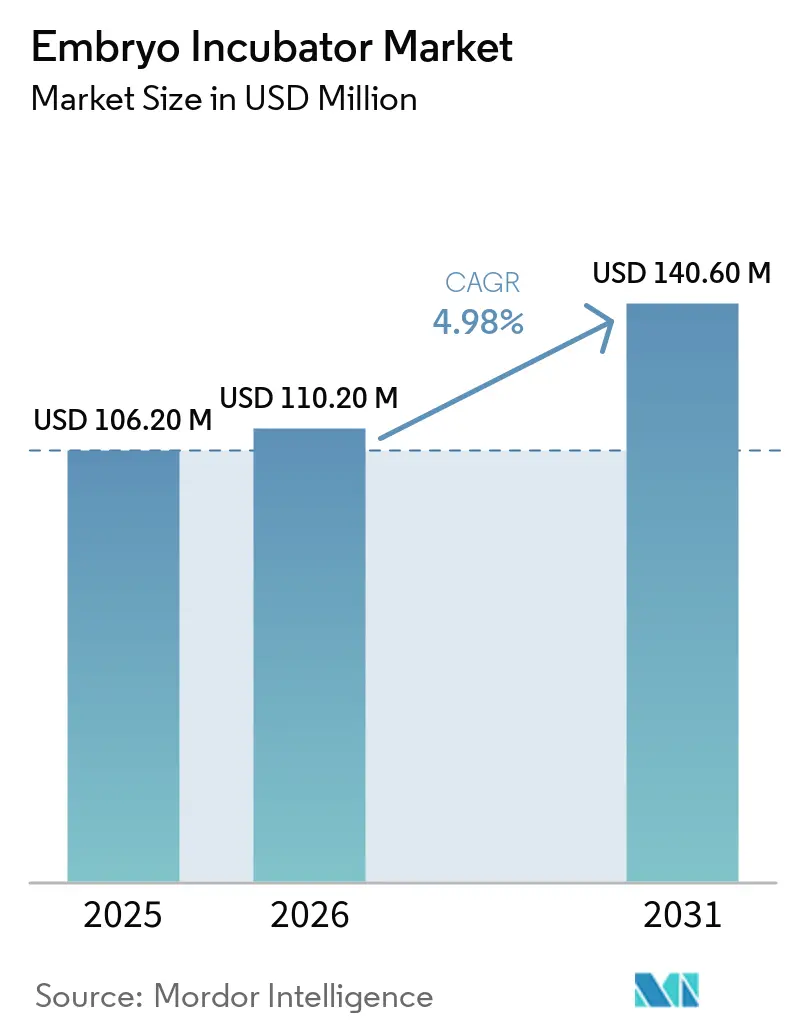
The Embryo Incubator Market size is expected to increase from USD 106.20 million in 2025 to USD 110.20 million in 2026 and reach USD 140.60 million by 2031, growing at a CAGR of 4.98% over 2026-2031.
Demand is supported by the continuing need for assisted reproduction services and by clinic investment in controlled embryo culture. Purchasing decisions often focus on documented culture performance, gas recovery, and workflow reliability rather than equipment price alone. This makes the embryo incubator market less exposed to short-term price competition than many general laboratory equipment categories. Time-lapse monitoring and AI-supported assessment are changing replacement decisions because clinics need compatible imaging systems to use these tools. Capacity additions in Asia-Pacific and consolidation among fertility service providers are also shifting purchasing toward standardized systems and service contracts.
Key Report Takeaways
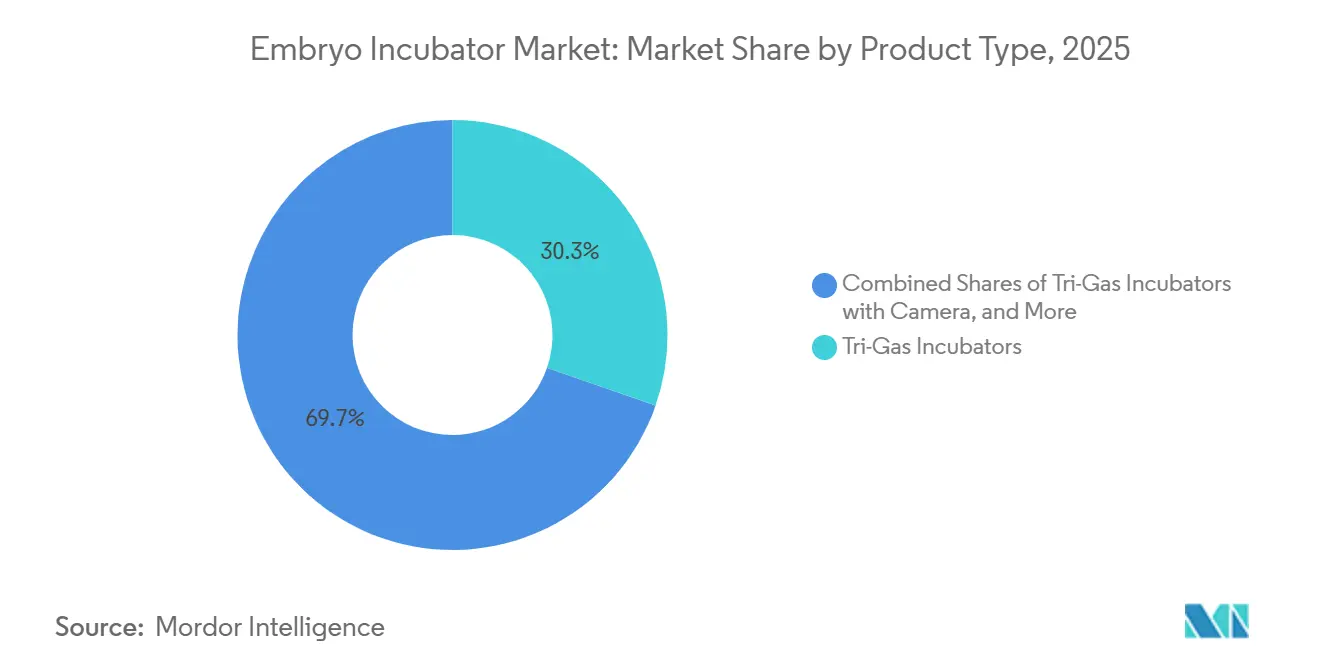
- By product type, tri-gas incubators led with 30.32% of the embryo incubator market share in 2025, while tri-gas incubators with camera recording are expected to grow at 8.36% CAGR through 2031.
- By technology, time-lapse imaging held 35.46% of the embryo incubator market share in 2025, while AI-enabled embryo assessment is projected to grow at an 8.79% CAGR through 2031.
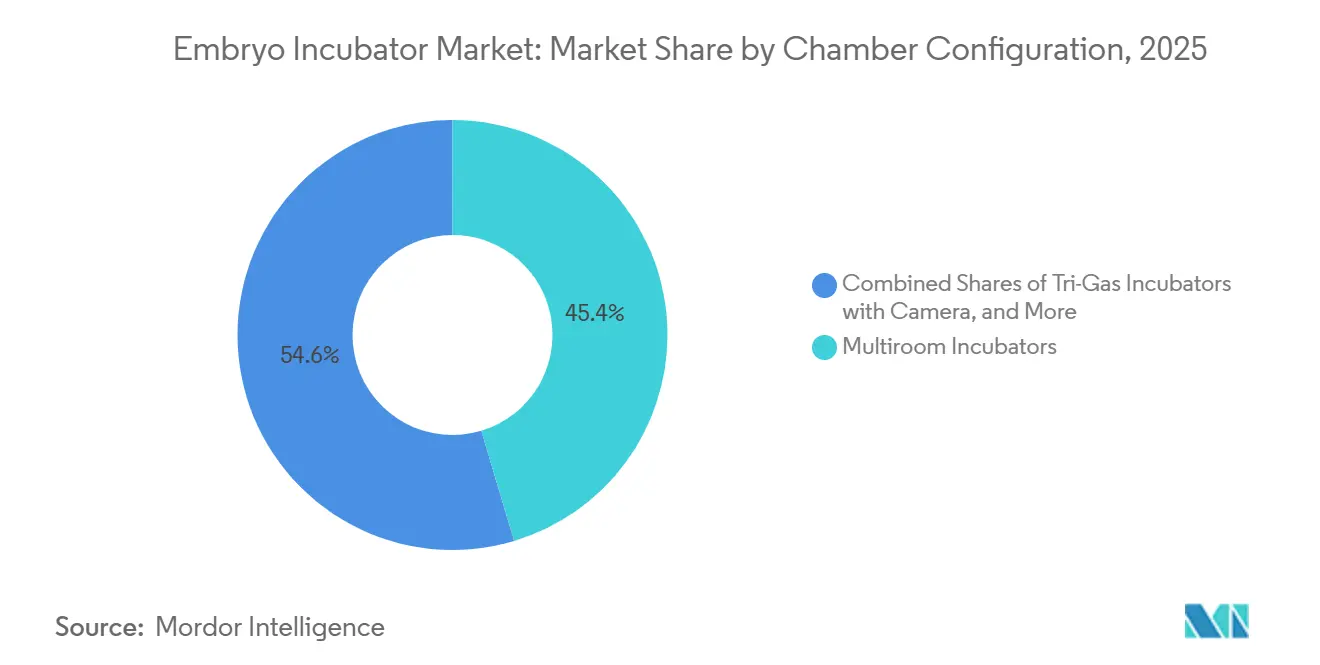
- By chamber configuration, multiroom incubators accounted for 45.36% of the embryo incubator market share in 2025, while individual embryo chambers are forecast to expand at a 7.45% CAGR through 2031.
- By capacity, multi-embryo incubators held 55.13% of the embryo incubator market share in 2025, while single-embryo incubators are forecast to grow at an 8.12% CAGR through 2031.
- By application, IVF accounted for 58.65% of the embryo incubator market share in 2025, while ICSI is projected to expand at a 7.94% CAGR through 2031.
- By end user, fertility clinics held 65.34% of the embryo incubator market share in 2025, while private embryology laboratories are forecast to grow at an 8.23% CAGR through 2031.
- By geography, North America accounted for 43.21% of global demand in 2025, while Asia-Pacific is projected to advance at an 8.76% CAGR through 2031.
Note: Market size and forecast figures in this report are generated using Mordor Intelligence’s proprietary estimation framework, updated with the latest available data and insights as of January 2026.
Market Trends and Insights
Drivers Impact Analysis of Embryo Incubator Market*
| Driver | (~) % Impact on CAGR Forecast | Geographic Relevance | Impact Timeline |
|---|---|---|---|
| Rising Infertility and Delayed Parenthood | +1.5% | Global | Long term (≥ 4 years) |
| Expansion of IVF and Intracytoplasmic Sperm Injection Workloads | +1.2% | Global, most acute in APAC and North America | Medium term (2–4 years) |
| Migration From Disturbing Spot Checks to Undisturbed Time-Lapse Culture | +0.8% | North America & Europe core, spill-over to APAC | Medium term (2–4 years) |
| Fertility Clinic Capacity Expansion in Asia-Pacific and the Middle East | +0.7% | APAC core, spill-over to MEA | Short term (≤ 2 years) |
| AI-Enabled Morphokinetic Decision Support | +0.6% | North America & EU, expanding to APAC | Medium term (2–4 years) |
| Lower Gas Consumption and Modular Multiroom Designs | +0.4% | Global | Long term (≥ 4 years) |
| Source: Mordor Intelligence | |||
Rising Infertility and Delayed Parenthood
Delayed parenthood increases the need for careful embryo culture and monitoring during IVF treatment. Patients beginning treatment at older ages may require closer clinical assessment and more stable culture conditions. This supports demand for systems that manage temperature, carbon dioxide, oxygen, and humidity consistently. Public support programs in several Asian markets are bringing new patients into fertility care rather than serving only returning patients. New patient cohorts can lead to new clinic openings and complete laboratory installations, not only replacement purchases. The resulting combination of patient demand, new laboratory capacity, and higher equipment requirements provides a stable basis for the embryo incubator market over the forecast period.
Expansion of IVF and ICSI Workloads
IVF and ICSI workloads are increasing as fertility clinic networks add capacity in developing and established care markets. India had 2,616 registered IVF centers in December 2025[1], showing the scale of clinic infrastructure that now requires standardized laboratory equipment. ICSI requires precise post-injection culture conditions because embryos are sensitive to temperature, pH, and gas variation. Tri-gas and multiroom formats can support faster gas recovery and separate culture environments during busy laboratory schedules. Clinics that combine IVF and ICSI protocols therefore have a stronger reason to invest in systems with independent chambers and reliable environmental control. This relationship helps explain why ICSI is growing faster than the overall embryo incubator market even though IVF remains the larger application.
Undisturbed Time-Lapse Culture
Time-lapse culture allows embryologists to observe embryo development without routinely removing dishes from the incubator. This can preserve the controlled temperature and gas environment that manual microscopy may interrupt. A study in European Journal of Medical Research[2] reported a 56.77% clinical pregnancy rate with lumen-blending tri-gas incubation, compared with 45.90% for a preblending approach in cleavage-stage transfers. The study linked the difference to more stable carbon dioxide conditions and pH control. These results support purchasing interest in systems that combine culture stability with continuous imaging. In high-volume clinics, the technology can also reduce the routine observation burden placed on embryologists.
AI-Enabled Morphokinetic Decision Support
AI-supported embryo assessment is increasing the demand for incubators that can capture suitable time-lapse images. A 2025 Nature Communications [3] study described a foundation model trained on 18 million time-lapse embryo images and reported an area under the receiver operating characteristic curve above 0.75 for ploidy prediction from image data. A 2026 Scientific Reports[4] study also evaluated time-lapse and maternal-age models for predicting embryo characteristics associated with implantation potential and euploidy. These tools make software capability more relevant to hardware selection. Clinics adopting AI workflows need imaging infrastructure that produces consistent datasets and fits their validation requirements. The embryo incubator market therefore, increasingly connects equipment replacement cycles with software adoption decisions.
Restraints Impact Analysis of Embryo Incubator Market*
| Restraint | (~) % Impact on CAGR Forecast | Geographic Relevance | Impact Timeline |
|---|---|---|---|
| High Capital Cost and Limited Reimbursement | -1.2% | Global, most acute in LMIC and mid-tier clinics | Short term (≤ 2 years) |
| Shortage of Skilled Embryologists and Service Engineers | -0.8% | Global, most acute in North America and Western Europe | Medium term (2–4 years) |
| Validation Burden for Imaging and Embryo-Assessment Software | -0.5% | North America & EU | Medium term (2–4 years) |
| Gas, Sensor, and Replacement-Part Supply Concentration | -0.3% | Global | Short term (≤ 2 years) |
| Source: Mordor Intelligence | |||
High Capital Cost and Limited Reimbursement
Time-lapse and tri-gas systems require a larger initial investment than conventional carbon dioxide incubators. Their cost may be difficult to justify in clinics with low cycle volumes or limited financing. Reimbursement for time-lapse monitoring remains uneven, so some clinics must recover the cost through patient fees. Quality management, validation, and regulatory documentation can add further operating expenses for smaller providers. This produces a two-tier purchasing pattern in which large fertility chains can spread investment across many cycles while independent clinics retain conventional systems. The embryo incubator market consequently has stronger premium-system penetration in urban, high-volume, and better-funded care settings.
Shortage of Skilled Embryologists and Service Engineers
A shortage of trained embryologists can limit laboratory throughput even when a clinic has adequate equipment. It also makes technologies that simplify observation and help standardize assessment more valuable. However, staff shortages can slow implementation because time-lapse data and AI tools need trained users and defined laboratory procedures. The same constraint affects service support for systems requiring calibration, sensor replacement, or validation. Longer service downtime can raise the effective cost of complex equipment for clinics outside major metropolitan areas. Vendors that provide training, field service, and clear workflow support can therefore have an advantage in the embryo incubator market.
*Our forecasts treat driver/restraint impacts as directional, not additive. The impact forecasts reflect baseline growth, mix effects, and variable interactions.
Embryo Incubator Market Segment Analysis
By Product Type:
Tri-Gas Systems Lead Demand While Camera-Integrated Models Grow FasterTri-gas incubators held 30.32% of embryo incubator market share in 2025, supported by their controlled oxygen, carbon dioxide, and nitrogen environment. Their clinical appeal rests on the ability to maintain lower oxygen conditions that more closely match the reproductive tract. The 2026 study of tri-gas blending methods reported higher clinical pregnancy outcomes for the lumen-blending configuration.
Tri-gas incubators with camera are the fastest-growing product category, with the embryo incubator market size for this segment projected to grow at an 8.36% CAGR through 2031. The format combines controlled gas conditions with continuous image capture. It reduces the tradeoff between stable culture and access to developmental observations.

By Technology:
Time-Lapse Imaging Holds the Lead While AI Assessment ExpandsTime-lapse imaging accounted for 35.46% of embryo incubator market share in 2025. It has become a leading monitoring option in clinics that can support the capital cost and data review process. The technology records embryo development inside the incubator and reduces routine dish removal for microscopy. This supports consistent observation while maintaining controlled culture conditions. Standard incubation remains widely used in lower-volume facilities and research-oriented laboratories.
AI-enabled embryo assessment is projected to grow at an 8.79% CAGR through 2031. The segment uses image data to support embryo selection and reduce reliance on manual morphokinetic review. Research published in 2025 and 2026 has shown the potential of deep-learning models to analyze time-lapse images for embryo characteristics.
By Chamber Configuration:
Multiroom Incubators Are Established While Individual Chambers Gain GroundMultiroom incubators represented 45.36% of embryo incubator market share in 2025. Their separate compartments help laboratories organize patient cohorts and reduce disruption when one chamber is opened. This design can preserve environmental stability for embryos in other chambers. It also enables capacity additions without replacing an entire laboratory platform.
Individual embryo chambers are forecast to expand at a 7.45% CAGR through 2031. The format supports separate environmental control for each embryo or culture position. It aligns with the growing use of elective single-embryo transfer protocols. The Geri incubator system provides modular chambers with individual temperature control and time-lapse imaging.
By Capacity:
Multi-Embryo Systems Retain Scale Advantages While Single-Embryo Systems ExpandMulti-embryo incubators held 55.13% of embryo incubator market share in 2025. High-volume laboratories use these systems to manage multiple embryos while controlling equipment costs per cycle. The format fits established batch culture workflows and supports clinics with several hundred or more annual cycles. High-capacity floor-standing models serve hospital departments and large fertility chains. These buyers usually prioritize total capacity, reliability, and service coverage. Single-embryo systems are less dominant by installed capacity but meet a more specialized clinical requirement. Both formats will remain necessary because laboratory volume and clinical protocols differ widely.
Single-embryo incubators are forecast to grow at an 8.12% CAGR through 2031. Growth reflects the use of elective single-embryo transfer and the increasing role of data-supported embryo selection. The approach seeks to reduce the risk of multiple pregnancies by selecting one embryo for transfer. Individual culture can also give laboratories more targeted control of the embryo environment.
By Application:
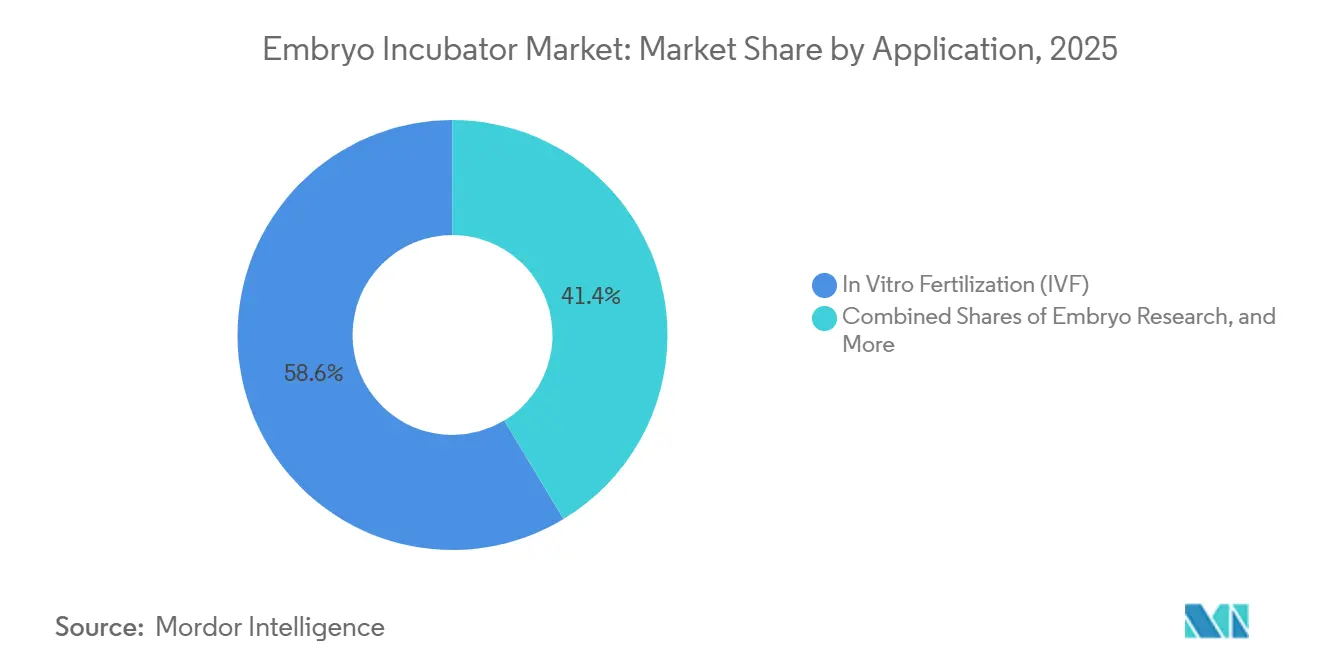
IVF Remains the Main Use While ICSI Grows FasterIVF held 58.65% of embryo incubator market share in 2025 and remained the central application for incubation systems. It creates demand across tri-gas, carbon dioxide, time-lapse, and multiroom formats. Embryo research is a stable secondary use in academic medical centers and laboratories conducting reproductive science studies. Embryo storage support and preimplantation genetic testing support are smaller uses within the broader IVF workflow.
ICSI is forecast to grow at a 7.94% CAGR through 2031. It requires careful culture after sperm injection because the early embryo may be less tolerant of changes in gas and temperature. This gives clinics a clinical reason to consider incubators with rapid carbon dioxide recovery and stable tri-gas control. A 2025 study evaluated machine-learning prediction using time-lapse information and clinical features in ICSI cycles.
By End User:
Fertility Clinics Lead Purchasing While Private Laboratories Grow FasterFertility clinics held 65.34% of embryo incubator market share in 2025. They are the main location for IVF cycles and for full laboratory equipment installations. Clinics need systems that can support daily culture, observation, documentation, and patient workflow. Hospitals and research laboratories form another important customer base. Hospital-based units often require institutional service arrangements and equipment that fits broader laboratory standards.
Private embryology laboratories are projected to grow at an 8.23% CAGR through 2031. Fertility groups are separating laboratory operations from patient consultation sites to improve the use of expensive clinical space. Centralized laboratories can concentrate trained embryologists, standardized equipment, and quality procedures in one location. Gaudium IVF reported a standardized Signature Labs model within its expansion approach in India.
Geography Analysis
North America Embryo Incubator Market
North America held 43.21% of global embryo incubator market share in 2025. The region has a dense network of commercial fertility clinics and a strong base of premium laboratory equipment users. United States clinics often adopt time-lapse imaging and AI-supported tools early when regulatory and clinical requirements are met. The concentration of specialized clinics also supports vendor training, maintenance, and distribution networks. Insurance coverage changes in some states can expand the number of patients seeking multiple IVF cycles. This strengthens the case for clinic capacity and equipment investment. Workforce shortages in embryology also create interest in systems that can improve observation consistency and workflow efficiency.
Europe Embryo Incubator Market
Europe was the second-largest regional market in 2025. Scandinavia has an established culture of time-lapse use, while Germany, Spain, and the United Kingdom have large fertility clinic networks. The European Medical Device Regulation affects procurement because software and hardware vendors must meet defined regulatory requirements.
APAC Embryo Incubator Market
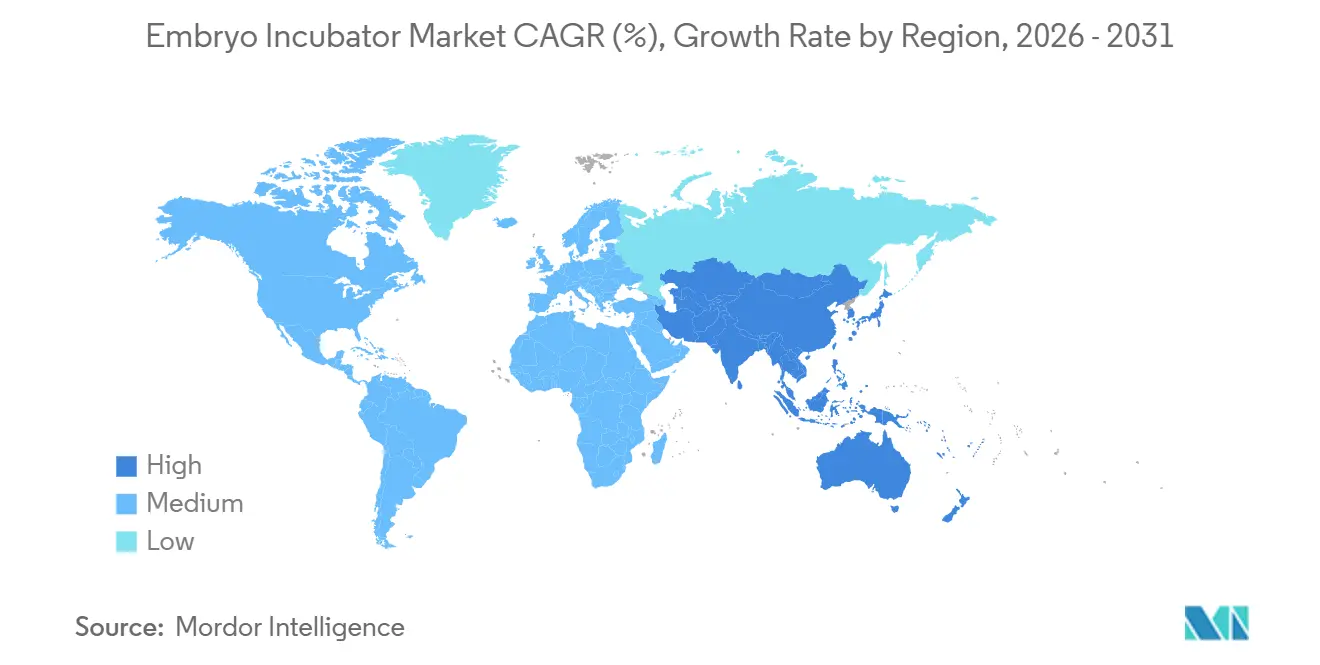
Asia-Pacific is the fastest-growing geography, with the embryo incubator market size in the region projected to grow at an 8.76% CAGR through 2031. Clinic expansion, public support measures, and a large group of underserved patients support this growth. Japan recorded 3,630 assisted reproduction cycles per million inhabitants, compared with 30 cycles per million in Indonesia, indicating substantial differences in access across the region.
Competitive Landscape
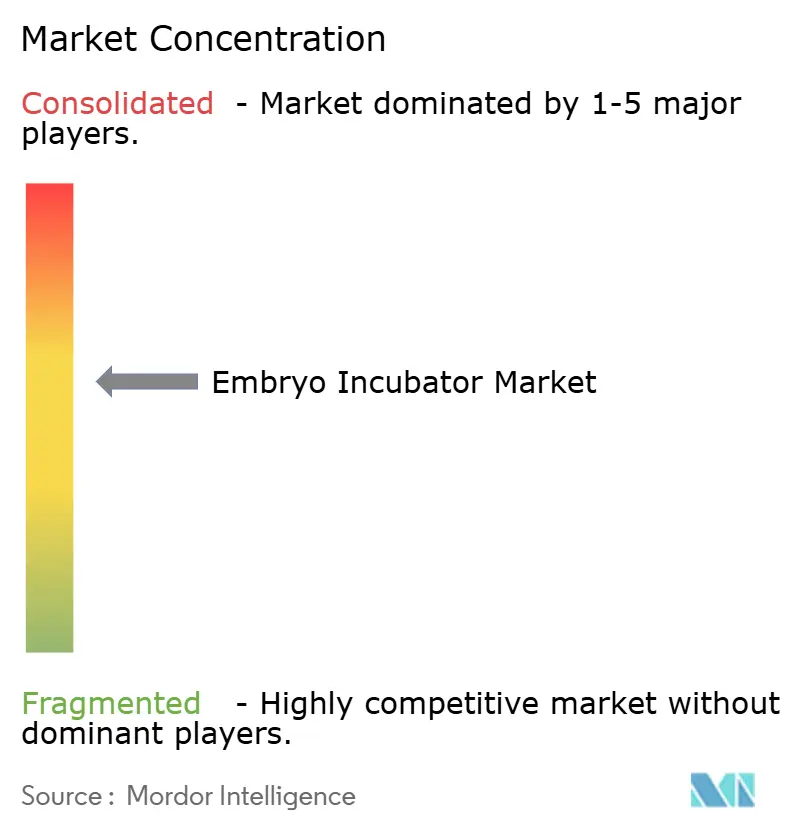
The embryo incubator market is moderately concentrated, with Vitrolife, Esco Medical, and Hamilton Thorne among the recognized suppliers. Vitrolife has a strong position in time-lapse incubation through the EmbryoScope family. Esco Medical is established in multi-room formats through the MIRI line. CooperSurgical participates in benchtop tri-gas incubation with the G210 InviCell platform. These companies compete through clinical performance, integrated imaging, software compatibility, service support, and laboratory workflow design. The purchasing process can favor suppliers that offer equipment, analytics, training, and maintenance as a coordinated package. This gives larger suppliers an advantage where fertility groups are standardizing their laboratories.
Vitrolife launched EmbryoViewer Pro in 2026 to add analytical capabilities to its existing platform. Esco Medical launched MIRI M in December 2025 and positioned it as a movable embryo incubator validated for stable culture conditions. Hamilton Thorne became part of Nexpring Health in March 2025, alongside Cook Reproductive Health, Planer, IVFtech, and other assisted reproduction brands. This combination increased the importance of distribution scale and coordinated service capability. Hamilton Thorne had also partnered with Alife Health and MIM Fertility to add AI assessment options to existing hardware platforms. These actions show that suppliers are responding to the stronger link between laboratory equipment and data-supported embryo assessment.
Embryo Incubator Industry Leaders
-
Esco Lifesciences Group
-
Vitrolife AB
-
Hamilton Thorne Ltd.
-
Genea Biomedx Pty Ltd
-
ASTEC Co., Ltd.
- *Disclaimer: Major Players sorted in no particular order
Embryo Incubator Market Companies Covered in this Report
- ASTEC Co., Ltd.
- Binder
- Cook Group
- The Cooper Companies
- Eppendorf
- Esco Lifesciences
- Fullei Medical
- Genea Biomedx Pty Ltd.
- Hamilton Thorne Ltd.
- Heal Force Bio-Meditech Holdings Ltd.
- Kivex Biotec Ltd.
- LABOTECT GmbH
- Merck
- PHC Holdings
- Planer PLC
- Thermo Fisher Scientific
- Vitrolife
- Weigao Group
Recent Industry Developments in Embryo Incubator Market
- February 2026: Esco Medical partnered with Cercle, an AI technology company focused on transforming healthcare data into actionable insights. This collaboration introduced an AI-driven scoring system within the MIRI TL Incubator, which automatically analyzes embryo development sequences, empowering embryologists, supporting clinical decision-making, and improving workflow efficiency.
- December 2025: Esco Medical launched the MIRI M, described as the world's first movable embryo incubator, and reported independent validation by Embryotools under Good Laboratory Practice standards.
Global Embryo Incubator Market Report Scope
As per the scope of the market, embryo incubators are specialized laboratory devices used in assisted reproductive technology (ART) procedures to provide a controlled environment for the culture and development of embryos outside the human body. These systems maintain optimal temperature, humidity, oxygen, and carbon dioxide levels, enabling embryologists to monitor and support embryo growth during in vitro fertilization (IVF) and related fertility treatments.
The embryo incubator market report segments the market by product type, including tri-gas incubators, tri-gas incubators with camera, conventional CO₂ incubators, portable and compact incubators, benchtop embryo incubators, and floor-standing embryo incubators. It also categorizes the market by technology, covering time-lapse imaging, standard incubation, microprocessor-controlled incubation, AI-enabled embryo assessment, and others (automated environmental monitoring, remote monitoring, and data management). The market is further segmented by chamber configuration, including single-chamber incubators, multiroom incubators, and individual embryo chambers. By capacity, the market is segmented into single-embryo incubators, multi-embryo incubators, and high-capacity floor-standing incubators. Based on application, the market covers in vitro fertilization (IVF), intracytoplasmic sperm injection (ICSI), embryo research, embryo storage support, and others (preimplantation genetic testing (PGT) support and fertility preservation procedures). The end-user segmentation includes fertility clinics, hospitals and research laboratories, private embryology laboratories, cryobanks, and academic and research institutes.
Geographically, the market is segmented into North America, Europe, Asia-Pacific, the Middle East & Africa, and South America. The market report also covers the estimated market sizes and trends for 17 countries across major regions globally. For each segment, the market size and forecast are provided in terms of value (USD).
Segmentation Overview
| Tri-Gas Incubators |
| Tri-Gas Incubators with Camera |
| Conventional CO2 Incubators |
| Portable and Compact Incubators |
| Benchtop Embryo Incubators |
| Floor-Standing Embryo Incubators |
| Time-Lapse Imaging |
| Standard Incubation |
| Microprocessor-Controlled Incubation |
| AI-Enabled Embryo Assessment |
| Others (Automated Environmental Monitoring, Remote Monitoring and Data Management) |
| Single-Chamber Incubators |
| Multiroom Incubators |
| Individual Embryo Chambers |
| Single-Embryo Incubators |
| Multi-Embryo Incubators |
| High-Capacity Floor-Standing Incubators |
| In Vitro Fertilization (IVF) |
| Intracytoplasmic Sperm Injection (ICSI) |
| Embryo Research |
| Embryo Storage Support |
| Others (Preimplantation Genetic Testing (PGT) Support, Fertility Preservation Procedures) |
| Fertility Clinics |
| Hospitals and Research Laboratories |
| Private Embryology Laboratories |
| Cryobanks |
| Other End Users |
| North America | United States |
| Canada | |
| Mexico | |
| Europe | Germany |
| United Kingdom | |
| France | |
| Italy | |
| Spain | |
| Rest of Europe | |
| Asia-Pacific | China |
| India | |
| Japan | |
| Australia | |
| South Korea | |
| Rest of Asia-Pacific | |
| Middle East and Africa | GCC |
| South Africa | |
| Rest of Middle East and Africa | |
| South America | Brazil |
| Argentina | |
| Rest of South America |
| By Product Type | Tri-Gas Incubators | |
| Tri-Gas Incubators with Camera | ||
| Conventional CO2 Incubators | ||
| Portable and Compact Incubators | ||
| Benchtop Embryo Incubators | ||
| Floor-Standing Embryo Incubators | ||
| By Technology | Time-Lapse Imaging | |
| Standard Incubation | ||
| Microprocessor-Controlled Incubation | ||
| AI-Enabled Embryo Assessment | ||
| Others (Automated Environmental Monitoring, Remote Monitoring and Data Management) | ||
| By Chamber Configuration | Single-Chamber Incubators | |
| Multiroom Incubators | ||
| Individual Embryo Chambers | ||
| By Capacity | Single-Embryo Incubators | |
| Multi-Embryo Incubators | ||
| High-Capacity Floor-Standing Incubators | ||
| By Application | In Vitro Fertilization (IVF) | |
| Intracytoplasmic Sperm Injection (ICSI) | ||
| Embryo Research | ||
| Embryo Storage Support | ||
| Others (Preimplantation Genetic Testing (PGT) Support, Fertility Preservation Procedures) | ||
| By End User | Fertility Clinics | |
| Hospitals and Research Laboratories | ||
| Private Embryology Laboratories | ||
| Cryobanks | ||
| Other End Users | ||
| By Geography | North America | United States |
| Canada | ||
| Mexico | ||
| Europe | Germany | |
| United Kingdom | ||
| France | ||
| Italy | ||
| Spain | ||
| Rest of Europe | ||
| Asia-Pacific | China | |
| India | ||
| Japan | ||
| Australia | ||
| South Korea | ||
| Rest of Asia-Pacific | ||
| Middle East and Africa | GCC | |
| South Africa | ||
| Rest of Middle East and Africa | ||
| South America | Brazil | |
| Argentina | ||
| Rest of South America | ||
Key Questions Answered in the Report
What is the expected growth of the embryo incubator market?
The embryo incubator market is projected to grow from USD 110.2 million in 2026 to USD 140.6 million by 2031 at a 4.98% CAGR.
Which embryo incubator product category held the largest share?
Tri-gas incubators held the largest product share at 30.32% in 2025.
Which technology is growing fastest in embryo incubation?
AI-enabled embryo assessment is projected to grow at an 8.79% CAGR through 2031.
Why do fertility clinics use time-lapse incubators?
Time-lapse systems allow embryo observation without routine dish removal, helping maintain controlled culture conditions.
Which region is growing fastest for embryo incubator demand?
Asia-Pacific is projected to grow at an 8.76% CAGR through 2031, supported by clinic expansion and wider treatment access.
Who are the principal suppliers of embryo incubators?
Vitrolife, Esco Medical, CooperSurgical, and Hamilton Thorne are among the established suppliers discussed in the research.