
Electronic-Grade Nitric Acid Market Size and Share
Market Overview
| Study Period | 2021 - 2031 |
|---|---|
| Market Size (2026) | USD 96.08 Million |
| Market Size (2031) | USD 124.68 Million |
| Growth Rate (2026 - 2031) | 5.35 % |
| Fastest Growing Market | North America |
| Largest Market | Asia-Pacific |
| Market Concentration | Medium |
Major Players *Disclaimer: Major Players sorted in no particular order Image © Mordor Intelligence. Reuse requires attribution under CC BY 4.0. | |
Electronic-Grade Nitric Acid Market Analysis by Mordor Intelligence
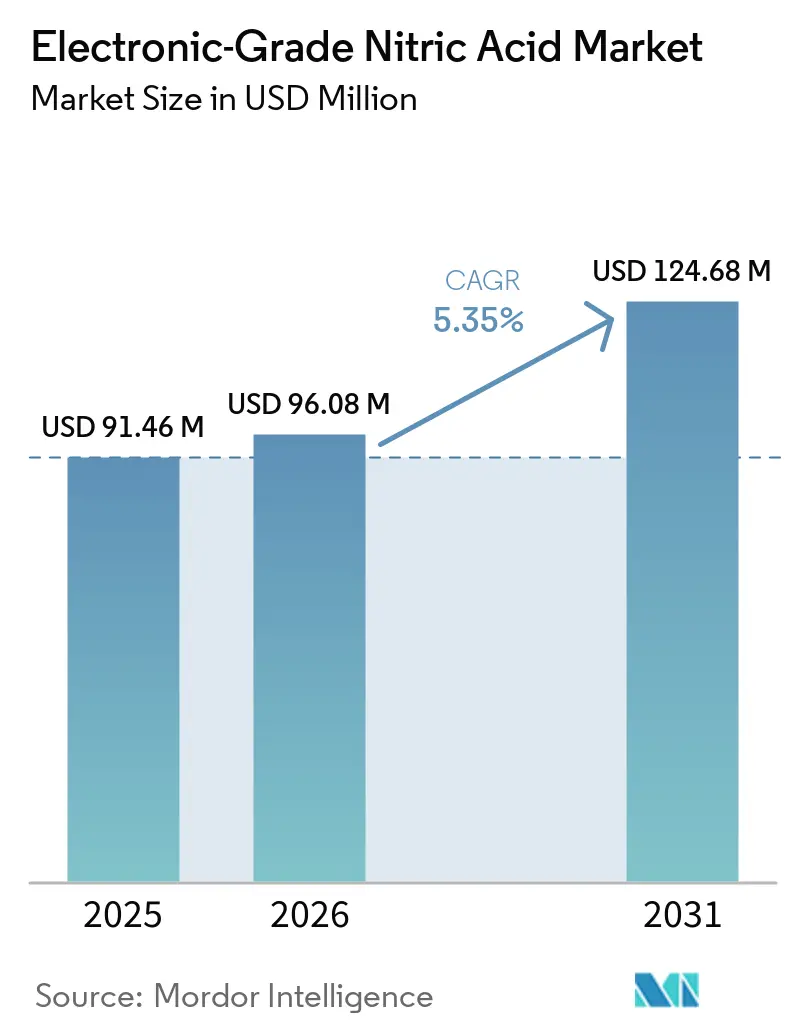
The electronic-grade nitric acid market size is estimated at USD 91.46 million in 2025 and is estimated to grow from USD 96.08 million in 2026 to USD 124.68 million by 2031, at a CAGR of 5.35% during the forecast period (2026-2031). The electronic-grade nitric acid market is supported by the expansion of wafer fabrication capacity and by more wet-cleaning and etching steps at advanced process nodes. Demand is becoming less tied to a simple commodity purchase, as fabs must control chemical quality throughout the filling, transport, and delivery processes. This gives qualified suppliers an advantage when they can provide reliable documentation, clean packaging, and technical support near customer sites. Semiconductor localization programs are establishing new purchasing centers in North America and Europe, while Asia-Pacific remains the primary region for production and consumption. The market remains exposed to semiconductor demand cycles, higher environmental compliance costs, and the lengthy qualification periods required before a supplier can serve an advanced fab.
Key Report Takeaways
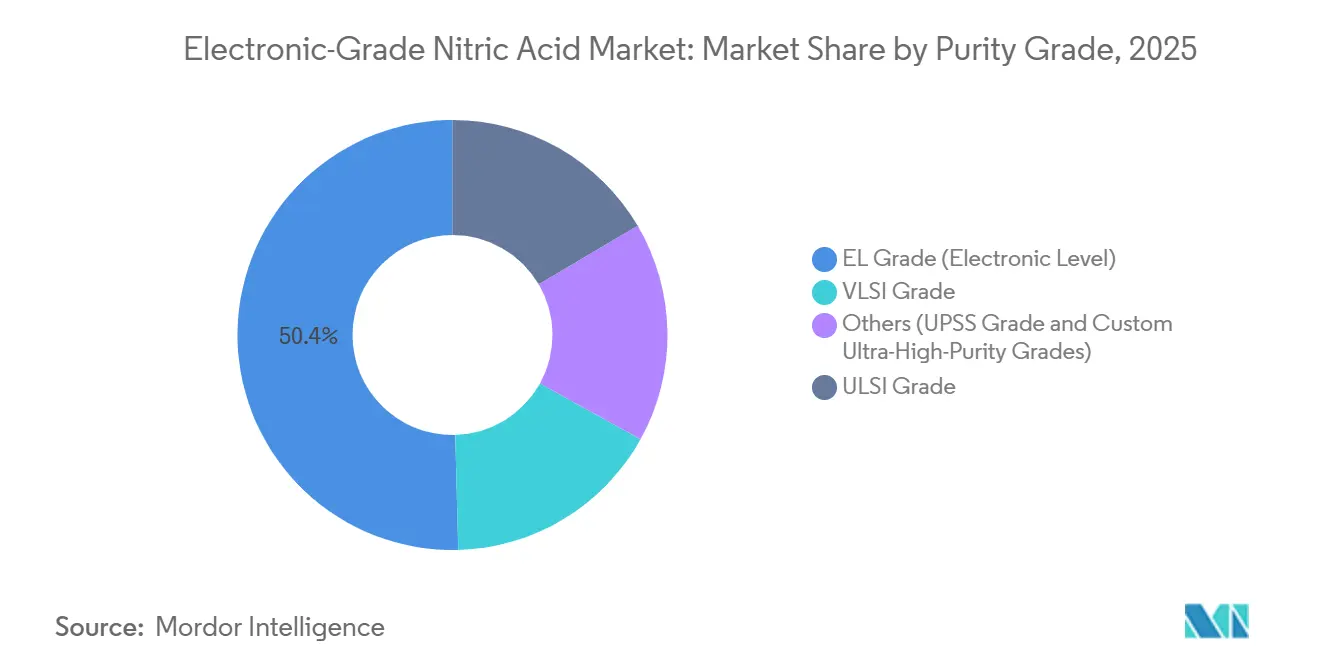
- By purity grade, EL Grade held 50.42% of revenue in 2025, while VLSI Grade is projected to expand at a 5.90% CAGR through 2031.
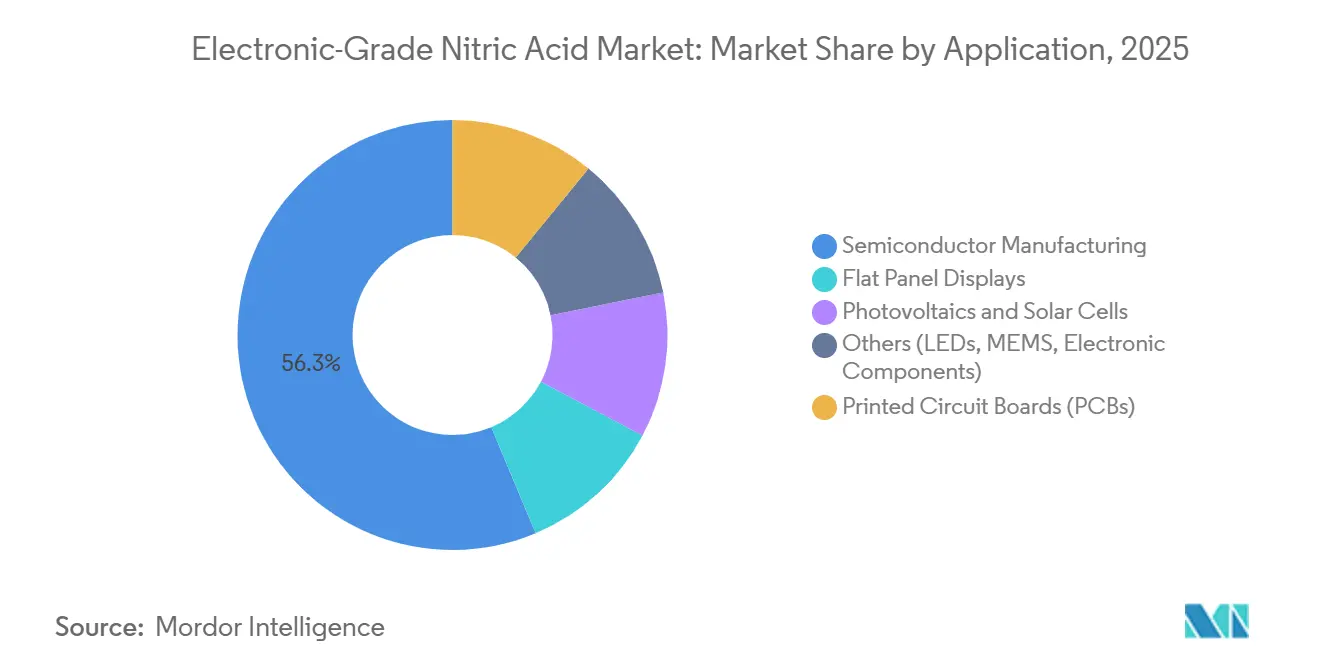
- By application, semiconductor manufacturing accounted for 56.33% of revenue in 2025, while photovoltaics and solar cells are forecast to grow at a 5.90% CAGR through 2031.
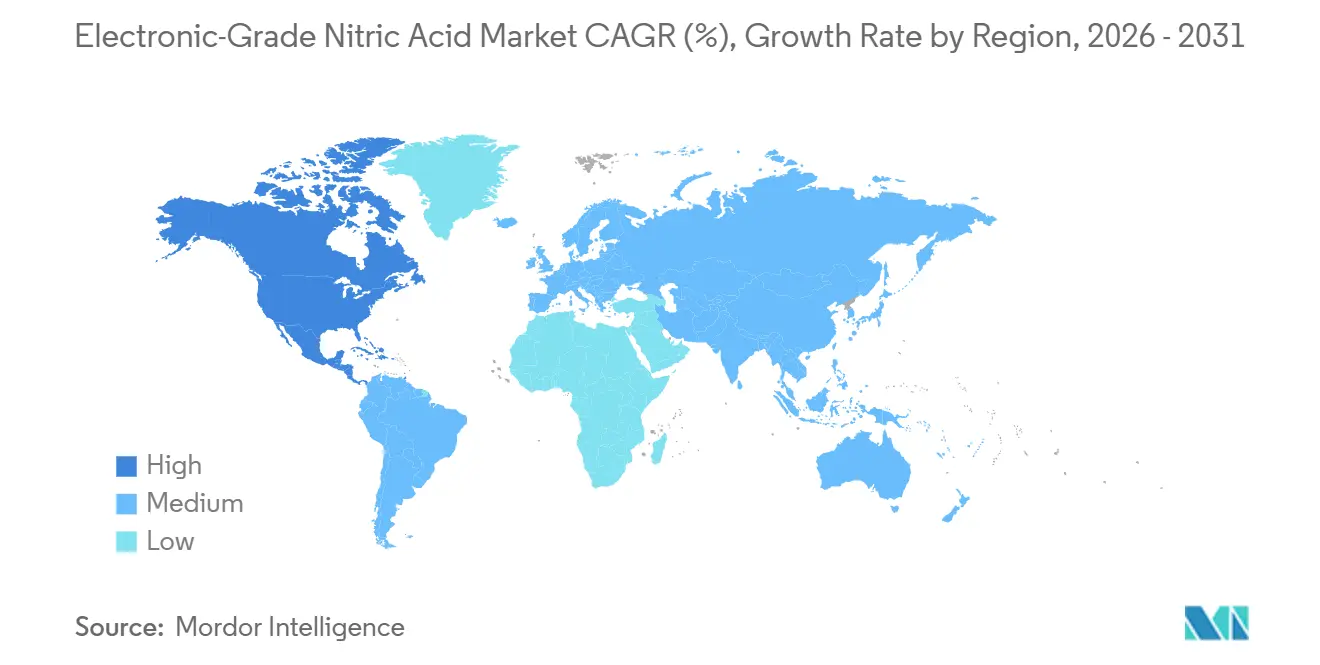
- By geography, Asia-Pacific held 40.17% of revenue in 2025, while North America is forecast to grow at a 6.80% CAGR through 2031.
Note: Market size and forecast figures in this report are generated using Mordor Intelligence’s proprietary estimation framework, updated with the latest available data and insights as of January 2026.
Market Trends and Insights
Drivers Impact Analysis of Electronic-Grade Nitric Acid Market*
| Drivers | (~) % Impact on CAGR Forecast | Geographic Relevance | Impact Timeline |
|---|---|---|---|
| Semiconductor Fab Capacity Expansion and Wafer-Start Growth | +1.4% | Global | Medium term (2-4 years) |
| Advanced-Node Miniaturization and Higher Wet-Chemical Intensity | +1.2% | APAC core, spillover to North America & EU | Long term (≥ 4 years) |
| AI, High-Performance Computing, 5G, and Automotive Semiconductor Demand | +0.9% | Global | Medium term (2-4 years) |
| Government-Led Semiconductor Localization Programs | +0.7% | North America, EU, APAC | Medium term (2-4 years) |
| Node-Specific Chemical Qualification and Joint Process Development | +0.4% | APAC, North America | Long term (≥ 4 years) |
| Fab-Cluster Localization of Purification, Packaging, and Inventory | +0.3% | North America, EU | Long term (≥ 4 years) |
| Source: Mordor Intelligence | |||
Semiconductor Fab Capacity Expansion and Localized Supply
Each greenfield fab that enters pilot production can become a long-term wet-chemical customer. The electronic-grade nitric acid market benefits when new fabs require recurring quantities for Radio Corporation of America (RCA) cleaning, piranha etching, and oxide-strip processes. TSMC in Arizona, Samsung in Texas, Intel in Ohio, and TSMC in Dresden represent major fab projects that are increasing demand for qualified materials suppliers. A supplier that secures an initial qualification can build a durable position, as replacing a chemical source requires significant process validation. Local purification, packaging, and inventory close to fab clusters can therefore be as important as upstream acid production. In November 2024, UBE Corporation announced a further 30% capacity expansion for high-purity nitric acid, following a 1.5-fold capacity increase in spring 2024, linking its investment to demand from AI processors and quantum computing applications[1].
Advanced Nodes and Higher Wet-Chemical Use
Advanced-node manufacturing raises both purity requirements and chemical use per wafer. Smaller geometries require more cleaning and etching steps, so demand can increase faster than wafer-start counts alone would suggest. As a result, the electronic-grade nitric acid market is moving toward tighter control of particle and metal content, filling conditions, and container quality. Fabs also require closer cooperation with suppliers when process changes alter the required chemical profile. In December 2025, Merck inaugurated its semiconductor solutions megasite in Kaohsiung, with production beginning in 2026, bringing manufacturing and research closer to semiconductor customers in Taiwan. This type of local presence can shorten feedback loops between material development, qualification work, and fab operations.
AI, High-Performance Computing, 5G, and Automotive Demand
AI accelerators and high-bandwidth memory are increasing demand for leading-edge logic and memory devices. These devices require chemically intensive process flows that consume high-purity wet chemicals. The electronic-grade nitric acid market also has a broader demand base in automotive semiconductors, where mature-node power and mixed-signal chips use Electronics (EL)-grade material in consistent quantities. 5G infrastructure adds demand for RF front-end and millimeter-wave components produced across a range of process nodes. The Semiconductor Industry Association reported global semiconductor sales of USD 298.5 billion in the first quarter of 2026, reflecting continued demand despite wider economic uncertainty. The combination of leading-edge computing and mature-node applications reduces dependence on a single end-use segment.
Government Semiconductor Localization Programs
Public semiconductor programs are shifting where fabs and their materials supply chains are built. The electronic-grade nitric acid market can benefit from new domestic procurement requirements in regions that previously depended mainly on imports. The US CHIPS and Science Act allocated USD 52.7 billion, while the European Chips Act provided a EUR 43 billion (USD 49.62 billion) framework for semiconductor investment. In July 2026, the US Department of Commerce announced letters of intent for USD 874 million in incentives for 7 companies developing compute supply chain technologies. In April 2025, BASF announced a semiconductor-grade sulfuric acid plant in Ludwigshafen, followed by an electronic-grade ammonium hydroxide plant at the same location in October 2025, with both planned for operations in 2027. These investments illustrate how regional chemical capacity is being developed alongside new fab construction.
Restraints Impact Analysis of Electronic-Grade Nitric Acid Market*
| Restraints | (~) % Impact on CAGR Forecast | Geographic Relevance | Impact Timeline |
|---|---|---|---|
| Hazardous Material Regulations and Environmental Compliance Costs | -0.5% | Global | Short term (≤ 2 years) |
| High Purification, Qualification, and Contamination-Control Costs | -0.8% | Global | Long term (≥ 4 years) |
| Long Supplier Qualification Cycles and Limited Second-Source Flexibility | -0.3% | North America & EU | Medium term (2-4 years) |
| Recontamination Risk Across Containers, Transport, and Fab Delivery Systems | -0.2% | Global | Medium term (2-4 years) |
| Source: Mordor Intelligence | |||
Hazardous Material Regulation and Environmental Compliance Costs
Nitric acid handling requires specialized packaging, transport controls, documentation, and trained personnel, making its logistics more costly than those of many other industrial chemicals. Environmental regulations add testing, labeling, and operating obligations at production and storage sites. High-purity suppliers in the electronic-grade nitric acid market must maintain compliance while preserving material quality across every transfer point. Semiconductor producers in new locations may face procurement delays while local permits and approvals for controlled chemicals are still being established. These obligations can delay capacity additions and reduce the financial returns from expansion projects.
High Purification, Qualification, and Contamination-Control Costs
Electronic-grade nitric acid requires dedicated equipment, validated clean filling systems, and extensive quality records. Entry barriers in the electronic-grade nitric acid market are high, as advanced fabs must evaluate chemical compatibility, particle content, wafer defects, containers, and delivery practices before approving a supplier. Requalification may be required when a producer changes batch size, container material, or logistics provider. Transport and delivery systems can introduce trace contamination even when the producer's original material meets specifications. Smaller companies may find it difficult to finance these controls and support multiple customer qualifications simultaneously. This structure favors suppliers with established fab relationships, but limits rapid supply responses during periods of strong demand.
*Our forecasts treat driver/restraint impacts as directional, not additive. The impact forecasts reflect baseline growth, mix effects, and variable interactions.
Electronic-Grade Nitric Acid Market Segment Analysis
By Purity Grade:
VLSI Grade Momentum Signals the Advanced-Node TransitionEL Grade accounted for 50.42% of the electronic-grade nitric acid market share in 2025. Its broad use across legacy and mid-node fabs provides a stable demand base for automotive, industrial, and Internet of Things devices. These fabs commonly operate across node ranges where purity requirements fall below the most demanding levels. EL Grade remains relevant because a large portion of global wafer capacity serves applications that do not require the most specialized grade. ULSI Grade sits above EL Grade and serves fabs moving toward more stringent process conditions. Demand for this grade continues as manufacturers transition from mature processes toward smaller geometries.
VLSI Grade is the fastest-growing purity tier, with a forecast CAGR of 5.90% through 2031. The electronic-grade nitric acid market size for VLSI Grade is supported by the shift of leading-edge production from 7 nm toward 3 nm and below. Each node transition can add wet-cleaning and etching steps rather than simply tightening existing chemical specifications. UPSS Grade and other custom ultra-high-purity grades serve specialized applications such as Micro-Electro-Mechanical Systems (MEMS), advanced packaging, and compound semiconductors. These applications can require chemical development agreements tailored to a customer's process conditions. Japanese suppliers, including UBE Corporation, Tokuyama Corporation, and Sumitomo Chemical, have long supported high-purity production for domestic semiconductor customers. Their established quality practices continue to influence supply expectations for VLSI and ULSI materials.

By Application:
Solar's Rising Chemical Intensity Reshapes the Demand MixSemiconductor manufacturing accounted for 56.33% of the electronic-grade nitric acid market share in 2025. This application uses nitric acid in cleaning, etching, surface preparation, and advanced packaging processes. Its significance reflects both high consumption and the strict service requirements placed on suppliers. Semiconductor contracts can require lot records, container tracking, analytical documentation, and on-site technical assistance. Printed circuit boards represent another important application, as denser board designs can increase chemical consumption during etching operations. Flat-panel display production also uses electronic-grade nitric acid in glass-substrate etching and metal thin-film patterning.
Photovoltaics and solar cells are forecast to grow at a CAGR of 5.90% through 2031. The electronic-grade nitric acid market size in this application is supported by the transition from PERC solar cells to TOPCon and heterojunction designs. These cell architectures require additional selective-etch operations to protect functional layers during manufacturing. The Council on Energy, Environment, and Water identified nitric acid as an input for surface-damage etching and texturing in solar-cell production. Solar manufacturing expansion in India and China can, therefore, add a demand stream that is independent of the semiconductor cycle. LEDs, MEMS, and discrete components drive additional demand, though grade requirements for these applications are often less stringent than those at advanced wafer fabs.
Geography Analysis
APAC Electronic-Grade Nitric Acid Market
Asia-Pacific accounted for 40.17% of revenue in 2025. The region has a dense base of wafer fabs, solar-cell lines, PCB factories, and display plants across China, South Korea, Japan, Taiwan, and Southeast Asia. Japan remains an important quality center, as its chemical producers have built extensive experience in higher-purity materials for domestic semiconductor operations. South Korea adds demand from memory and logic manufacturing, particularly as high-bandwidth memory and advanced DRAM processes require more chemically intensive steps. China is a major regional consumer of mid-node integrated circuits, photovoltaics, and displays.
North America and Europe Electronic-Grade Nitric Acid Market
North America is projected to record a 6.80% CAGR through 2031, the fastest regional growth rate in the electronic-grade nitric acid market. New US fabs are changing regional purchasing patterns for electronic materials and wet chemicals. In the near term, imported material may be warehoused, repackaged, and distributed while local production capacity is developed. This sequence can create early demand before domestic chemical plants are fully operational. Samsung's Taylor, Texas, fab illustrates this transition, with ENF Technology having begun commercial shipments of semiconductor chemicals from Kyle, Texas, in 2026, and Samsung's trial production expected by the end of 2026. Europe is developing its own regional materials base alongside semiconductor investment related to the CHIPS Act. BASF's planned Ludwigshafen plants demonstrate how chemical producers are positioning themselves to meet local semiconductor material demand[2].
MEA and South America Electronic-Grade Nitric Acid Market
South America, the Middle-East, and Africa represent smaller demand areas in the electronic-grade nitric acid market. Current use in these regions centers on PCB fabrication, semiconductor assembly, solar cell manufacturing, LEDs, and consumer electronics production. Brazil and Argentina are the primary South American locations due to their electronics assembly and renewable energy manufacturing activities. Saudi Arabia is developing advanced manufacturing under Vision 2030, which may gradually increase demand for controlled electronic chemicals. South Africa has a smaller electronics base, resulting in limited demand for PCB and LED applications. These regions currently contribute modestly to overall revenue, but supplier and customer diversification could increase their importance later in the forecast period.
Competitive Landscape
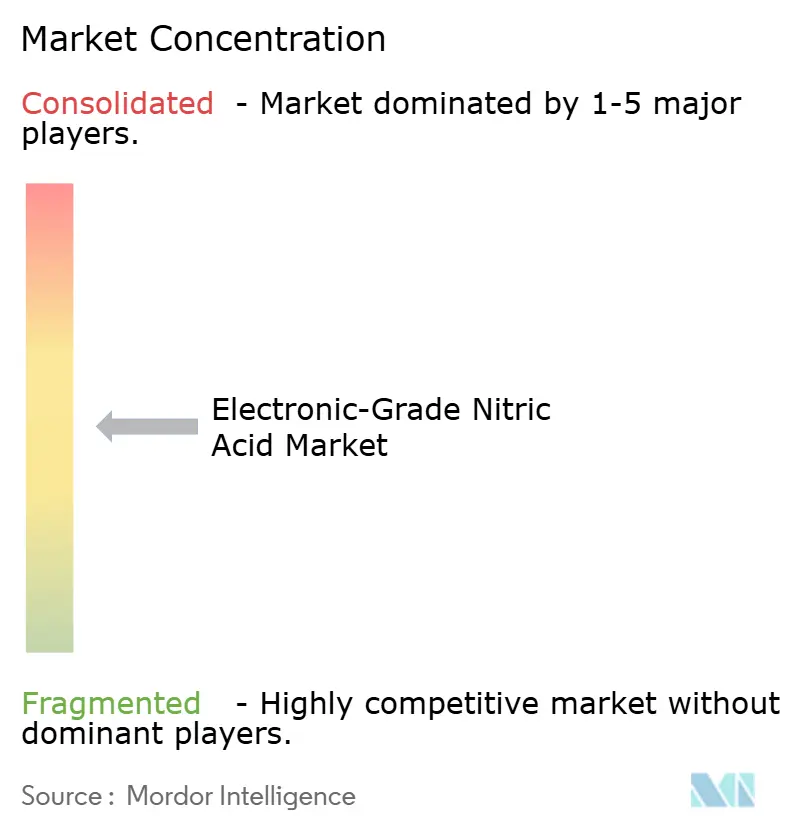
The electronic-grade nitric acid market is moderately fragmented, as only a limited number of qualified suppliers can meet the demanding purity, documentation, delivery, and customer support requirements. Japanese chemical companies hold established positions at many Asia-Pacific fabs, supported by long qualification histories. Western materials companies compete through integrated chemical operations, research capabilities, local supply, and support for advanced manufacturing customers. Chinese producers have expanded their presence in the domestic mid-node and photovoltaic supply segments, where EL grade is widely used. Zhongjuxin stated that it held more than 60% of China's domestic electronic-grade nitric acid supply and was expanding capacity for higher-purity applications. Competition is therefore based on certification history, proximity to customer fabs, container integrity, and joint process development rather than on price alone.
BASF has adopted a regional supply chain approach, as reflected in its announced investments in semiconductor-grade sulfuric acid and electronic-grade ammonium hydroxide at Ludwigshafen. These projects are not nitric acid facilities, but they reflect a broader strategy to meet semiconductor wet-chemical needs near European fabs. Merck opened its Kaohsiung semiconductor solutions megasite in December 2025 and began production in 2026, bringing materials manufacturing and research closer to customers in Taiwan. UBE expanded high-purity nitric acid capacity after identifying demand from advanced computing applications. Within the electronic-grade nitric acid market, these actions reflect the importance of local capacity, technical support, and product development near active fab clusters.
The electronic-grade nitric acid market also presents opportunities in on-site purification, controlled packaging, and inventory systems located near fabs. Such systems can reduce transport exposure and support traceability from production through the point of use. Suppliers that can serve compound-semiconductor, silicon carbide, gallium nitride, and advanced-packaging fabs may benefit from new facilities that have not yet established strong supplier relationships. SEMI compliance remains an important requirement for participating in leading-edge chemical procurement. Smaller regional suppliers can compete by providing fast logistics and direct support to fab engineers, but must still demonstrate that their materials, containers, transport processes, and documentation meet customer qualification requirements.
Electronic-Grade Nitric Acid Industry Leaders
-
Avantor, Inc.
-
KANTO KAGAKU
-
BASF
-
UBE Corporation
-
Entegris
- *Disclaimer: Major Players sorted in no particular order
Electronic-Grade Nitric Acid Market Companies Covered in this Report
- ASIA UNION ELECTRONIC CHEMICAL CORP.
- Avantor, Inc.
- BASF
- Columbus Chemicals
- Entegris
- FUJIFILM Wako Pure Chemical Corporation
- Jiangyin Jianghua Microelectronic Materials Co., Ltd.
- KANTO KAGAKU
- Merck KGaA
- Moses Lake Industries, Inc.
- Solstice Advanced Materials US, Inc.
- Sumitomo Chemical Co., Ltd.
- TNC Chemicals Philippines Inc.
- Tokuyama Corporation
- UBE Corporation
Recent Industry Developments in Electronic-Grade Nitric Acid Market
- July 2026: The US Department of Commerce announced letters of intent with 7 companies to provide USD 874 million in federal incentives for semiconductor research and development, covering integrated photonics, compute architectures, advanced packaging, substrates, materials, and next-generation memory.
- April 2026: Air Products was selected by Samsung Electronics to supply industrial gases (nitrogen, oxygen, argon, and hydrogen) for Samsung's new advanced semiconductor fab in Pyeongtaek, South Korea. Multiple production facilities are scheduled to come onstream between 2028 and 2030, reflecting sustained demand for process materials at one of the world's most chemically intensive fab clusters.
Global Electronic-Grade Nitric Acid Market Report Scope
Electronic-grade nitric acid is an ultra-high purity formulation of nitric acid (HNO₃) refined specifically for the microelectronics and semiconductor industries. It contains minimal trace metallic impurities and particles, often restricted to parts-per-billion (ppb) levels, to prevent defects or short circuits in microchips and photovoltaic cells.
The electronic-grade nitric acid market is segmented by purity grade, application, and geography. By purity grade, the market is segmented into EL grade (electronic level), ULSI grade, VLSI grade, and others (UPSS grade and custom ultra-high-purity grades). By application, the market is segmented into semiconductor manufacturing, printed circuit boards (PCBs), flat panel displays, photovoltaics and solar cells, and others (LEDs, MEMS, electronic components). The report also covers market size and forecasts for electronic-grade nitric acid across 16 countries in major regions. The market sizes and forecasts are provided in terms of value (USD).
Segmentation Overview
| EL Grade (Electronic Level) |
| ULSI Grade |
| VLSI Grade |
| Others (UPSS Grade and Custom Ultra-High-Purity Grades) |
| Semiconductor Manufacturing |
| Printed Circuit Boards (PCBs) |
| Flat Panel Displays |
| Photovoltaics and Solar Cells |
| Others (LEDs, MEMS, Electronic Components) |
| Asia-Pacific | China |
| India | |
| Japan | |
| South Korea | |
| ASEAN Countries | |
| Rest of Asia-Pacific | |
| North America | United States |
| Canada | |
| Mexico | |
| Europe | Germany |
| United Kingdom | |
| France | |
| Italy | |
| NORDIC Countries | |
| Russia | |
| Rest of Europe | |
| South America | Brazil |
| Argentina | |
| Rest of South America | |
| Middle-East and Africa | Saudi Arabia |
| South Africa | |
| Rest of Middle-East and Africa |
| By Purity Grade | EL Grade (Electronic Level) | |
| ULSI Grade | ||
| VLSI Grade | ||
| Others (UPSS Grade and Custom Ultra-High-Purity Grades) | ||
| By Application | Semiconductor Manufacturing | |
| Printed Circuit Boards (PCBs) | ||
| Flat Panel Displays | ||
| Photovoltaics and Solar Cells | ||
| Others (LEDs, MEMS, Electronic Components) | ||
| By Geography | Asia-Pacific | China |
| India | ||
| Japan | ||
| South Korea | ||
| ASEAN Countries | ||
| Rest of Asia-Pacific | ||
| North America | United States | |
| Canada | ||
| Mexico | ||
| Europe | Germany | |
| United Kingdom | ||
| France | ||
| Italy | ||
| NORDIC Countries | ||
| Russia | ||
| Rest of Europe | ||
| South America | Brazil | |
| Argentina | ||
| Rest of South America | ||
| Middle-East and Africa | Saudi Arabia | |
| South Africa | ||
| Rest of Middle-East and Africa | ||
Key Questions Answered in the Report
What is current market size of Electronic-Grade Nitric Acid Market?
The electronic-grade nitric acid market size is estimated at USD 91.46 million in 2025 and is estimated to grow from USD 96.08 million in 2026 to USD 124.68 million by 2031, at a CAGR of 5.35% during the forecast period (2026-2031).
Which purity grade leads electronic-grade nitric acid sales?
EL Grade led with 50.42% revenue share in 2025, while VLSI Grade is the fastest-growing purity tier at a 5.90% CAGR.
Which application uses the most electronic-grade nitric acid?
Semiconductor manufacturing led applications, with a 56.33% revenue share in 2025, due to its role in wafer cleaning, etching, and surface preparation.
Which region is growing fastest for electronic-grade nitric acid?
North America is forecast to grow at a 6.80% CAGR through 2031, supported by new U.S. fab construction and localized materials supply.