
Electrochemical Instruments Market Size and Share
Market Overview
| Study Period | 2020 - 2031 |
|---|---|
| Market Size (2026) | USD 3.22 Billion |
| Market Size (2031) | USD 4.26 Billion |
| Growth Rate (2026 - 2031) | 5.71 % |
| Fastest Growing Market | Asia-Pacific |
| Largest Market | North America |
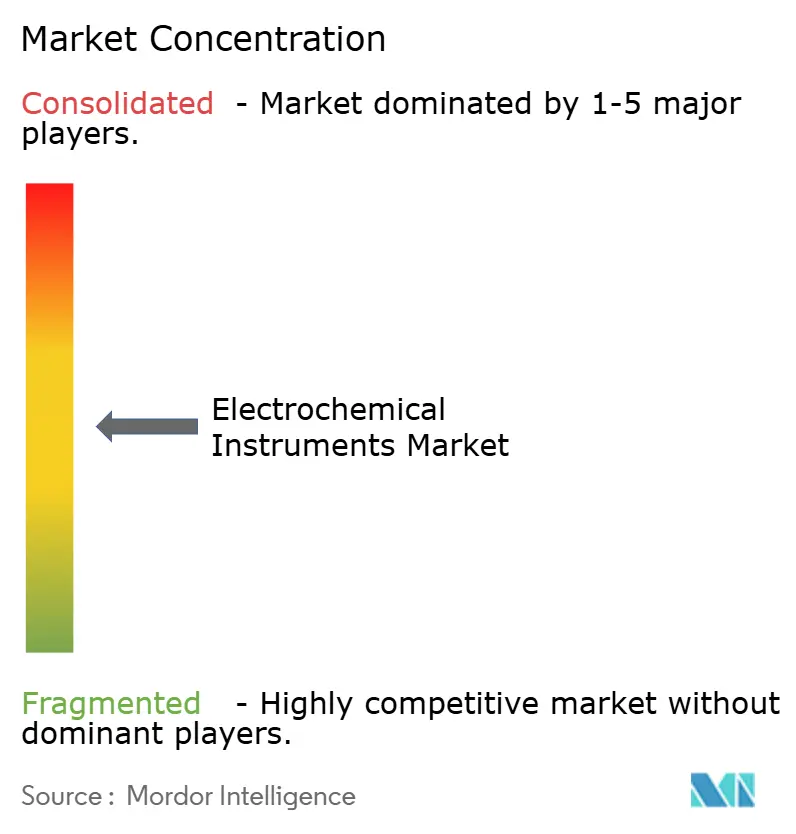
| Market Concentration | Medium |
Major Players *Disclaimer: Major Players sorted in no particular order Image © Mordor Intelligence. Reuse requires attribution under CC BY 4.0. | |
Electrochemical Instruments Market Analysis by Mordor Intelligence
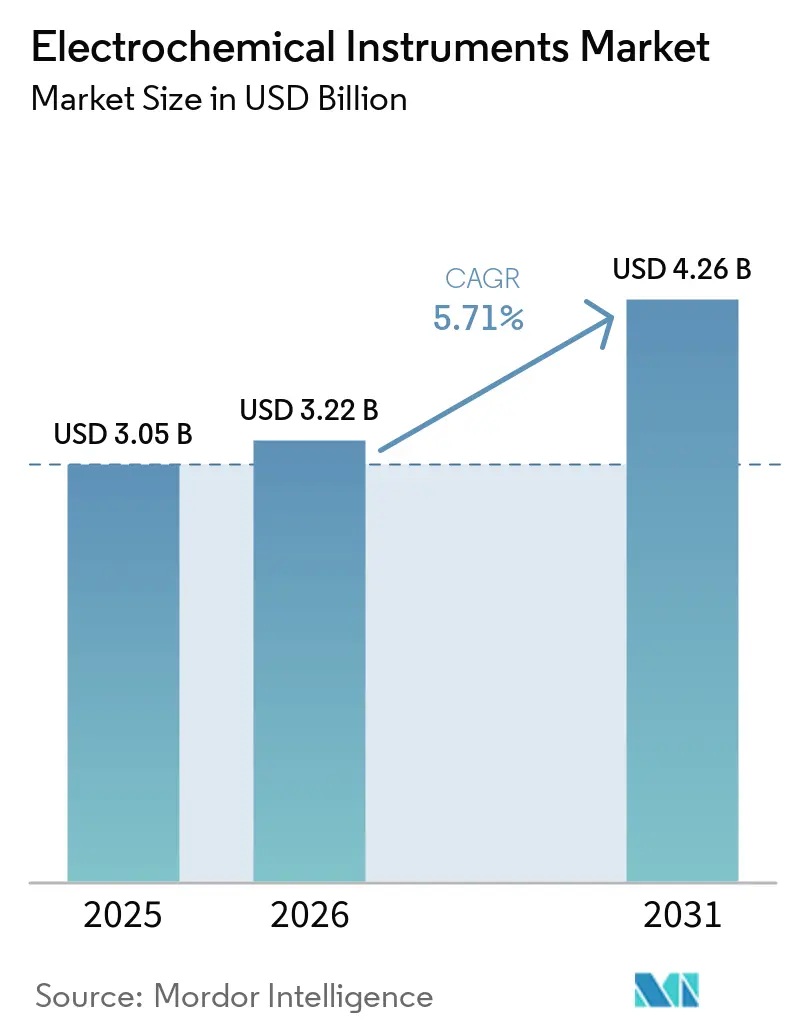
The Electrochemical Instruments Market size is expected to increase from USD 3.05 billion in 2025 to USD 3.22 billion in 2026 and reach USD 4.26 billion by 2031, growing at a CAGR of 5.71% over 2026-2031.
The electrochemical instruments market is supported by rising battery, hydrogen, environmental, and pharmaceutical testing requirements. Energy storage accounted for 40% of global energy patenting in 2023, and the continuing research pipeline requires validation for new battery chemistries. Environmental rules are shifting measurement toward continuous monitoring and more frequent reporting. Pharmaceutical quality requirements are also increasing the need for documented and validated analytical workflows. Suppliers are responding with laboratory workstations, inline systems, and portable devices that provide better data connectivity.
Key Report Takeaways
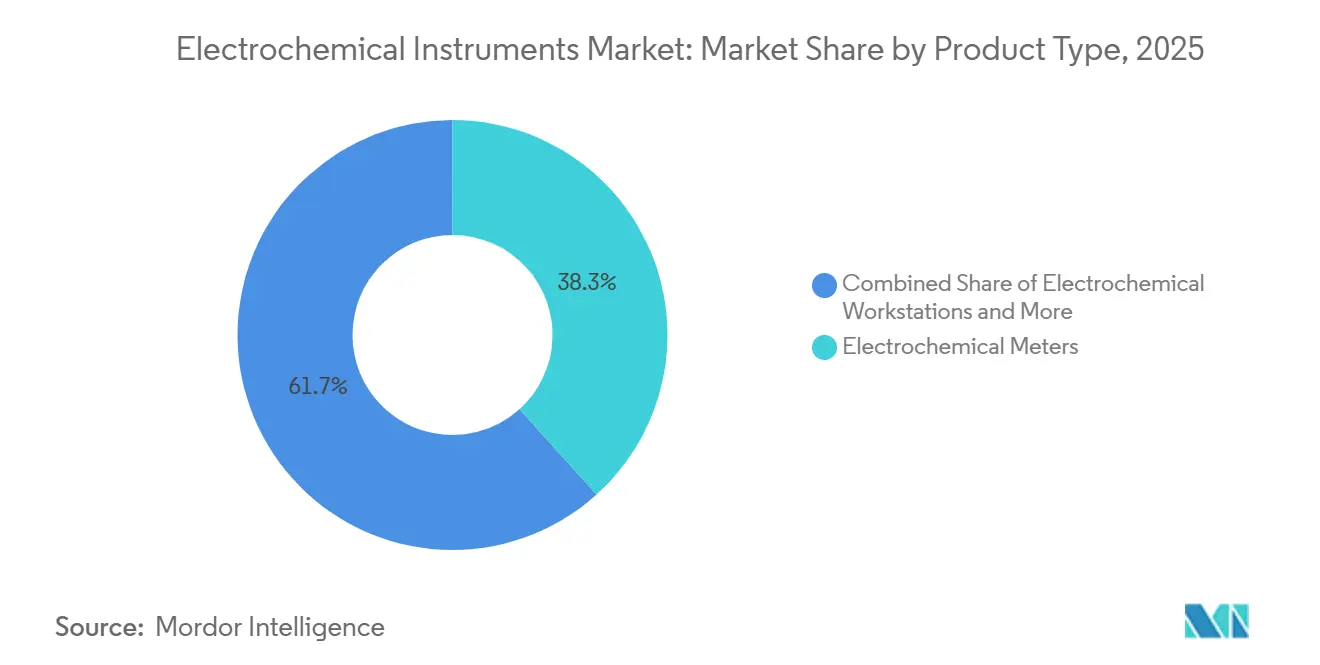
- By product type, electrochemical meters held 38.31% revenue share in 2025, while electrochemical workstations are forecast to grow at a 7.58% CAGR through 2031.
- By form factor, benchtop and rack-mounted instruments held 54.24% revenue share in 2025, while portable and handheld instruments are forecast to grow at an 8.22% CAGR through 2031.
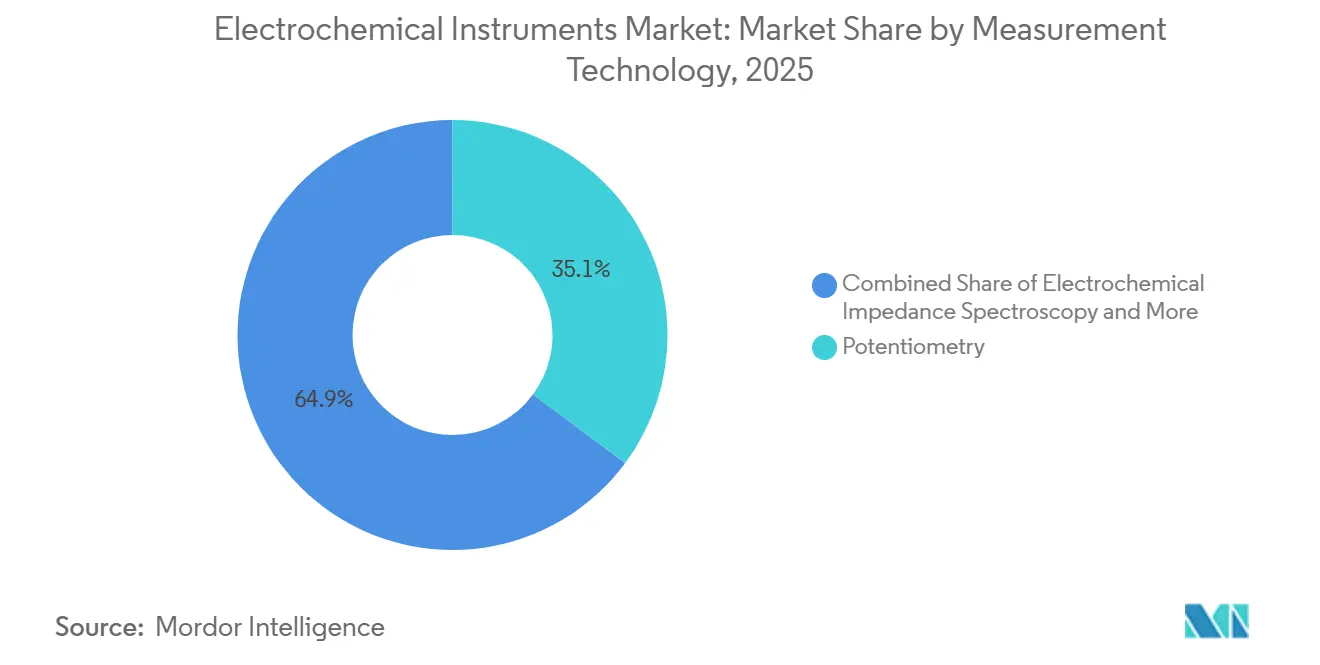
- By measurement technology, potentiometry held 35.14% revenue share in 2025, while electrochemical impedance spectroscopy is forecast to grow at an 8.82% CAGR through 2031.
- By end user, pharmaceutical and biotechnology companies held 48.65% revenue share in 2025, while environmental testing agencies are forecast to grow at an 8.25% CAGR through 2031.
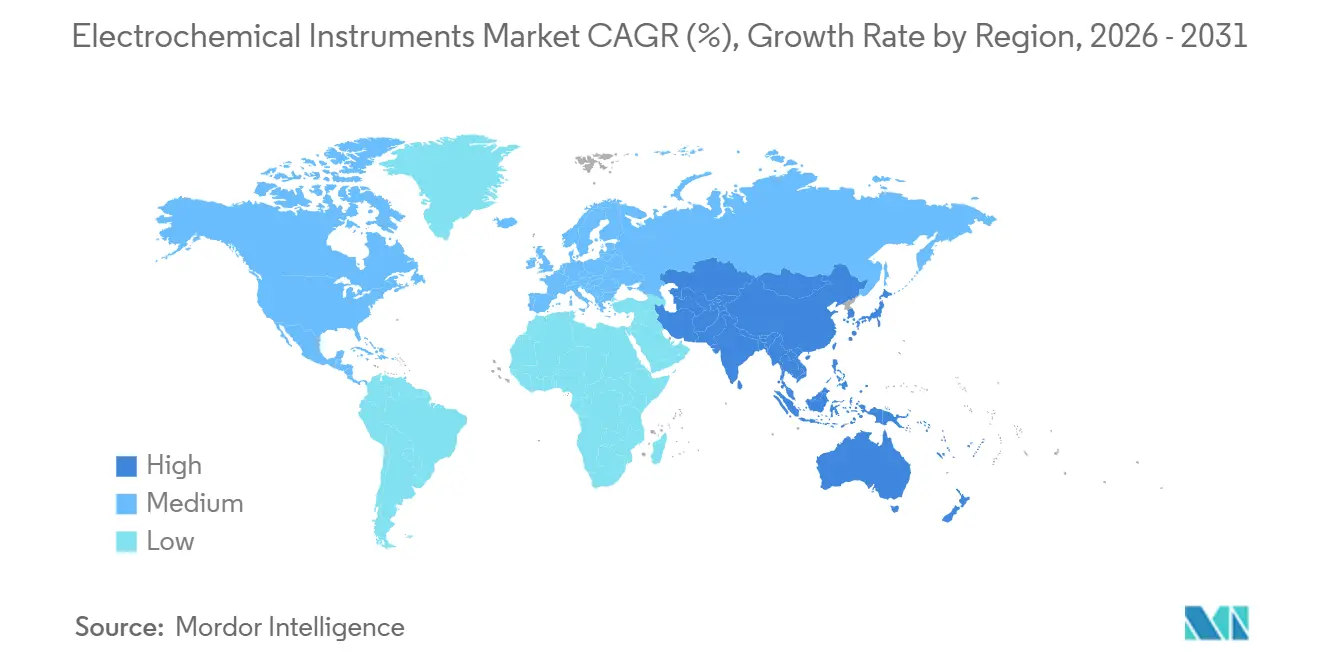
- By geography, North America held 36.61% revenue share in 2025, while Asia-Pacific is forecast to grow at an 8.75% CAGR through 2031.
Note: Market size and forecast figures in this report are generated using Mordor Intelligence’s proprietary estimation framework, updated with the latest available data and insights as of January 2026.
Market Trends and Insights
Drivers Impact Analysis of Electrochemical Instruments Market*
| Driver | (~) % Impact on CAGR Forecast | Geographic Relevance | Impact Timeline |
|---|---|---|---|
| Battery and Hydrogen-Energy R&D Expansion | +1.2% | Global, APAC core, with spillover to Europe and North America | Long term (≥ 4 years) |
| Water-Quality and Industrial-Emissions Monitoring | +0.9% | Global, with early gains in Europe and North America | Medium term (2-4 years) |
| Pharmaceutical and Biotechnology Testing Expansion | +1.1% | North America and Europe, with spillover to India and APAC | Long term (≥ 4 years) |
| Portable, Multiparameter, and Connected Instruments | +0.8% | Global | Short term (≤ 2 years) |
| Distributed Testing for High-Throughput Workflows | +0.5% | North America and Europe are growing in APAC | Medium term (2-4 years) |
| Embedded Measurement in Process-Control Systems | +0.4% | Global, with early gains in Germany, Japan, and South Korea | Long term (≥ 4 years) |
| Source: Mordor Intelligence | |||
Expansion of Battery and Hydrogen-Energy R&D
The electrochemical instruments market benefits from lithium-ion, solid-state, and hydrogen-energy programs that require precise characterization. Every new battery chemistry requires a separate cycle of performance testing, safety validation, and reference measurement. This requirement extends demand beyond routine laboratory use and into research facilities, pilot lines, and development laboratories. Global corporate energy research and development reached USD 160 billion in 2024. Energy storage accounted for 40% of global energy patenting in 2023, with preliminary data showing continued momentum during 2024 and 2025[1]. Hioki launched the ALDAS-E EIS measurement system in March 2026 for megawatt-class electrolyzers and large fuel-cell stacks. The system handles stack voltages up to 1,000 V and electrolysis currents up to 10,000 A, while reducing a measurement cycle from over 30 minutes to 7.6 minutes. Germany’s EUR 3.56 million Inno-Batt platform extends through October 2028 and adds EIS and electrochemical characterization infrastructure. The resulting equipment needs span routine materials analysis, specialized EIS testing, and larger-scale diagnostic systems.
Tightening Water-Quality and Industrial-Emissions Monitoring
The electrochemical instruments market gains from the move from periodic checks to continuous online measurement. Continuous systems can replace isolated capital purchases with recurring upgrades for equipment, software, calibration, and service. The shift also increases the importance of reliable reporting and validated measurements for industrial operators. The Industrial Emissions Portal Regulation, adopted in April 2024, expanded pollutant-reporting requirements for industrial operators. Directive (EU) 2024/1785 requires assessment of monitoring results at least annually against best-available-technique emission limit values[2]. The U.S. EPA proposed Method 1633A in January 2025 to add 40 PFAS compounds to the approved Clean Water Act analytical framework. Higher sensitivity requirements can make lower-specification portable meters unsuitable for regulated applications. Commission Implementing Decision (EU) 2025/439 also created a Union-wide watch list that broadens the substances considered in water monitoring. The resulting demand is concentrated in applications where analytical performance and reporting compliance are both material.
Pharmaceutical and Biotechnology Analytical-Testing Expansion
Pharmaceutical and biotechnology companies accounted for 48.65% of 2025 revenue in the electrochemical instruments market. Mandatory critical-quality-attribute testing and biotherapeutic release assays help explain the segment’s concentration. Laboratories, therefore, value dependable workflows, traceable records, and suppliers that can support regulated operating environments. The FDA Quality Management System Regulation became effective on February 2, 2026, and aligns U.S. device quality requirements with ISO 13485:2016. The regulation increases documentation and equipment-validation needs in laboratories supporting medical-device manufacturing. Roche Diagnostics received 510(k) clearance in February 2026 for its Gen.2 ion-selective electrode panel for potassium, sodium, and chloride measurement. Biotherapeutic quality control is also increasing the demand for multicapillary electrophoretic platforms that can process 8 samples in one run. Audit-trail requirements under FDA 21 CFR Part 11 favor suppliers that combine instruments with integrated data-management systems. Suppliers with these capabilities can become more deeply embedded in laboratory processes and data-management practices.
Demand for Portable, Multiparameter, and Connected Instruments
Portable equipment is moving beyond a limited field-testing role as connectivity improves data transfer and record management. The electrochemical instruments market is increasingly served by hybrid fleets that combine fixed laboratory systems with portable equipment. These devices allow organizations to collect results closer to the sample source while retaining a clearer path to central records. Portable systems increasingly combine compact hardware with Bluetooth or cloud-enabled data transfer. This reduces the administrative burden that previously limited the use of field results within laboratory records. Portable and handheld instruments are expected to expand at an 8.22% CAGR through 2031. Their smaller footprint supports interchangeable electrode cartridges for food safety, environmental monitoring, and field diagnostics. The two remaining drivers, distributed testing and embedded measurement, reinforce demand for higher-throughput workflows and process-control integration across the electrochemical instruments market. These requirements favor instruments that can operate across laboratory, process, and field settings without creating disconnected data records.
Restraints Impact Analysis of Electrochemical Instruments Market*
| Restraint | (~) % Impact on CAGR Forecast | Geographic Relevance | Impact Timeline |
|---|---|---|---|
| Acquisition, Calibration, and Lifecycle Costs | -0.7% | Global, most acute in the Middle East, Africa, and South America | Long term (≥ 4 years) |
| Commoditization and Average-Selling-Price Pressure | -0.5% | Global, most pronounced in APAC entry-level segments | Medium term (2-4 years) |
| Cross-Disciplinary Electrochemistry and Data Skills Shortage | -0.4% | Global, most acute in the Middle East, Africa, and South America | Medium term (2-4 years) |
| Interoperability and Method-Transfer Friction | -0.3% | Global, most acute in pharmaceutical multi-site environments | Long term (≥ 4 years) |
| Source: Mordor Intelligence | |||
High Acquisition, Calibration, and Lifecycle Costs
High total ownership costs can delay purchases where budgets are constrained. The electrochemical instruments market faces this limitation most strongly in settings where users cannot spread service costs across a large instrument base. Suppliers with service contracts have a better ability to smooth demand when capital budgets are delayed. Precision potentiostats and EIS workstations can cost from tens of thousands to several hundred thousand U.S. dollars. Calibration, electrode replacement, and software maintenance can add 10% to 20% of capital cost each year in intensive-use settings. Smaller testing agencies and academic institutions can postpone upgrades or select lower-specification alternatives. Pharmaceutical replacement cycles commonly run for 5 to 7 years, concentrating purchasing decisions into narrow windows. Contract research and development organizations can pool utilization, although this also strengthens the purchasing power of price-sensitive buyers. This makes service offerings and broader account relationships important for sustaining supplier revenue between equipment purchases.
Instrument Commoditization and Average-Selling-Price Pressure
Standard pH meters, conductivity probes, and entry-level potentiostats face price competition from Asian manufacturers. This creates a clear split between standardized equipment and premium systems with specialized measurement, connectivity, or service capabilities. The electrochemical instruments market must therefore shift more value toward software and consumables, where product differentiation is stronger. The pricing pressure is most visible in entry-level APAC products, where standard multiparameter meters have become commodity offerings. Lower pricing narrows gross-margin differences between local and Western-branded alternatives. Established suppliers are investing in software, connectivity, and premium instruments to protect margins. This response requires continuing research and development spending while mature product lines produce less cash. Skills shortages and interoperability challenges add further friction when customers must analyze results or transfer validated methods across platforms. Suppliers also need to make it easier for trained users to apply methods consistently across sites and instrument families.
*Our forecasts treat driver/restraint impacts as directional, not additive. The impact forecasts reflect baseline growth, mix effects, and variable interactions.
Electrochemical Instruments Market Segment Analysis
By Product Type:
Electrochemical Meters Anchor Share as Workstations Drive GrowthElectrochemical meters held 38.31% of the 2025 product-type revenue in the electrochemical instruments market. Their position reflects routine measurement needs that occur across many industries rather than a reliance on a single research application. This breadth supports a recurring replacement cycle when older instruments no longer meet operational or documentation expectations. Water testing, industrial process monitoring, and routine pharmaceutical quality control provide a broad installed base for these instruments. Environmental and food-safety requirements support replacement demand across routine applications. This demand is less dependent on individual high-value research projects than workstation demand. Potentiostats and galvanostats serve a narrower research market with higher unit values. Their demand is tied closely to battery materials work and pharmaceutical biosensor development.
Electrochemical workstations are forecast to expand at a 7.58% CAGR through 2031. Their higher specification suits applications where researchers need complex test protocols, repeatable results, and detailed interpretation of electrochemical behavior. This makes workstations important in materials development, even where the volume of instruments is lower than for routine meters. The electrochemical instruments market continues to need these systems for high-value work that demands detailed, repeatable characterization. Battery engineers and materials scientists need multichannel and high-frequency impedance capability that standard meters do not provide. On-chip EIS adoption in automotive battery-management systems increases the need to validate new architectures against laboratory reference systems. Titrators and ion chromatographs retain stable demand in pharmaceutical and chemical quality assurance. ISO 17025 accreditation supports instrument qualification and validation in commercial testing laboratories. Specialized electrochemical sensors also form an emerging revenue pool in wearable diagnostics and food-safety detection. Across these categories, the electrochemical instruments market balances broad routine demand with more specialized research-led procurement.

By Form Factor:
Benchtop Instruments Still Dominant, Portables Challenge the ParadigmBenchtop and rack-mounted instruments accounted for 54.24% of 2025 form-factor revenue. Their revenue lead reflects the need for stable operating conditions and documentation in regulated laboratory environments. They also remain suited to workflows that require repeated testing with defined methods and controlled calibration practices. Their precision, compliance documentation, and fit with automated workflows support this leading position. Pharmaceutical and industrial laboratories require audit trails, calibration records, and method-validation documentation. These needs preserve the role of fixed instruments in high-throughput environments. Inline and process instruments serve continuous monitoring requirements within manufacturing lines. They can reduce sampling delays and contamination risks in sterile pharmaceutical and high-purity semiconductor production.
Portable and handheld instruments are forecast to grow at an 8.22% CAGR through 2031. The form factor broadens the possible locations for testing, including operational sites where rapid measurement is useful. The electrochemical instruments market can therefore serve users who need decisions closer to the source of a sample. It does not remove the need for benchtop systems, because regulated or complex work still depends on higher precision and formal documentation. Deployment in food safety, environmental monitoring, and field diagnostics supports the electrochemical instruments market size for portable systems. Miniaturized potentiostats can function as universal readers for application-specific electrode cartridges. This model supports a wider range of deployable biosensor platforms. Wearable, smartphone-enabled, and OEM module formats remain a smaller but strategically relevant revenue line. Consumer health monitoring and precision-agriculture sensing extend electrochemical measurement into broader use cases.
By Measurement Technology:
Potentiometry Leads, EIS Redefines the Growth CeilingPotentiometry held 35.14% of the 2025 measurement-technology revenue. The method is deeply established because it supports common measurement tasks and can be applied across water, food, industrial, and pharmaceutical settings. Its broad applicability makes it a stable foundation for the electrochemical instruments market. Its use in pH, ion-selective electrode, and redox sensing supports this leadership across liquid-handling sectors. Industrial and regulatory applications widely specify potentiometric methods. Voltammetry and amperometry serve trace-metal and dissolved-gas sensing needs. Amperometry is particularly relevant for dissolved-oxygen monitoring in bioprocessing and environmental applications. Coulometry and conductometry remain established for water-content determination and ionic-strength measurement in chemical quality assurance.
Electrochemical impedance spectroscopy is forecast to grow at an 8.82% CAGR through 2031. The technology is important where users need to assess an interface or material condition without damaging the sample. Battery diagnostics and materials characterization provide central applications for this demand. It can characterize battery interfaces, corrosion layers, and biosensor surfaces without destructive sampling. China’s GB 38031-2025 is mandatory for new vehicle type approvals from July 1, 2026. The standard establishes a 2-hour observation window after thermal runaway and sets temperature-monitoring requirements. Embedded automotive EIS increases validation activity for instrument suppliers as well as chip providers. The electrochemical instruments industry, therefore, retains a role in reference testing even as EIS functions move into vehicle electronics.
By End User:
Pharma Consolidates Share While Environmental Agencies Outpace the FieldPharmaceutical and biotechnology companies accounted for 48.65% of 2025 revenue. Their purchase decisions are shaped by quality-control requirements and the need to demonstrate that systems remain suitable for their stated analytical use. These conditions make technical support and validated documentation central elements of supplier selection. This leading position reflects quality testing, biotherapeutic release assays, and critical-quality-attribute measurement. The FDA QMSR now reinforces equipment-validation and documentation obligations. Revalidation needs can lengthen supplier relationships because instrument switching costs are high. Contract research and contract development organizations are growing buyers within this group. Their multi-platform needs favor suppliers with broad portfolios and high-utilization workstation options.
Environmental testing agencies are projected to grow at an 8.25% CAGR through 2031. More tests and a broader set of analytes can raise demand even when agency staffing levels are unchanged. Instruments that automate routine measurement can help these users manage higher workloads with fewer manual steps. Tighter water-quality and emission rules increase analyte coverage and measurement frequency. Agencies need automated multiparameter instruments when staff levels do not rise in line with testing demand. Academic institutes also purchase workstations and modular platforms through battery and hydrogen research programs. Industrial laboratories retain a large installed base, although near-term growth is moderated by cost optimization. Sustainability reporting can still create retrofit demand for higher-specification inline sensors linked to environmental management systems. The electrochemical instruments market depends on a range of buyers whose requirements differ in throughput, compliance, and measurement scope.
Geography Analysis
North America Electrochemical Instruments Market
North America held 36.61% of 2025 revenue in the electrochemical instruments market. The region’s demand is anchored in an installed base that covers pharmaceutical laboratories, environmental testing facilities, and research institutions. Established field-service networks further strengthen the position of suppliers that can support these users locally. The United States combines pharmaceutical manufacturing, environmental enforcement, and university and national laboratory research capacity. The January 2025 EPA proposal for Method 1633A covers 40 PFAS compounds and supports new validation needs in municipal and industrial laboratories. The FDA QMSR now extends compliance-driven validation cycles for laboratories serving medical-device manufacturing. Canada adds demand through mining water monitoring and university research. Mexico provides an emerging source of demand through pharmaceutical manufacturing and electronics assembly. This mix of regulated users and research organizations supports demand for both routine meters and advanced workstation systems.
Europe Electrochemical Instruments Market
An active regulatory framework for emissions and process monitoring supports Europe. The electrochemical instruments market is affected by requirements that favor continuous process analysis and documented emissions measurement. These rules can create replacement demand when existing instruments cannot achieve sensitivity or uptime expectations. Member States must transpose Directive (EU) 2024/1785 by July 1, 2026. The directive supports the purchase of higher-specification inline analyzers that can meet sensitivity and uptime requirements. Germany has chemical and automotive demand bases that support equipment purchasing. The EUR 3.56 million Inno-Batt program in Münster adds battery characterization infrastructure through October 2028. The EU Battery Regulation will require state-of-health documentation in battery passports from February 2027, adding a compliance requirement for European battery supply chains. Other European markets contribute to pharmaceutical and industrial testing demand, while renewable-energy expansion adds hydrogen research activity.
APAC, MEA and South America Electrochemical Instruments Market
Asia-Pacific is forecast to grow at an 8.75% CAGR through 2031. The Asia-Pacific electrochemical instruments market share growth reflects battery scale, environmental requirements, and public research investment. China’s mandatory GB 38031-2025 standard supports demand for EIS and potentiostat testing in cell development and automotive quality assurance. Japan’s USD 75 billion Green Transformation fund supports battery and hydrogen research infrastructure. India’s pharmaceutical sector has over 3,000 WHO-GMP-certified manufacturing sites, and increases demand for potentiometric and conductometric testing. The Middle East, Africa, and South America remain earlier-stage areas where water infrastructure, mining, agri-food activity, and environmental standards create new demand. These regions can adopt portable and process-oriented equipment as testing standards and develop local technical capacity.
Competitive Landscape
The electrochemical instruments market has moderate concentration among broad-line instrumentation companies. Large suppliers benefit from broad product ranges and established customer relationships, while specialists compete where detailed electrochemical performance is decisive. This combination produces a market with strong leading groups but continued room for technically focused suppliers. Danaher Corporation, AMETEK, Mettler-Toledo International, Thermo Fisher Scientific, and Metrohm AG have extensive distribution, regulatory support, and multi-platform portfolios. Their scale helps them address laboratory, process, and field requirements through related product lines. The electrochemical instruments market also includes specialist suppliers such as BioLogic, Gamry, Ivium Technologies, Zahner-elektrik, and PalmSens. These companies compete through technical depth in potentiostat and EIS instrumentation. The structure below the largest suppliers remains fragmented because specialized applications require differentiated performance.
AMETEK announced an agreement in May 2026 to acquire Indicor instrumentation businesses for USD 5.0 billion[3]. The acquired businesses add USD 1.1 billion in annual sales to AMETEK’s Electronic Instruments Group. The transaction demonstrates the preference for complementary technologies and recurring revenue streams. Metrohm has expanded its analytical method range across potentiostats, ion chromatography, and Raman spectroscopy since 2024. This approach can deepen existing customer relationships and reduce the cost of winning new accounts. Large-format EIS systems for gigawatt-scale electrolyzers remain an area with limited overlap between traditional benchtop suppliers and purpose-built equipment providers. The electrochemical instruments industry also faces a need to preserve instrument value as embedded electronics become more capable.
Cloud-connected inline analyzers can support industrial environmental management requirements under IED 2.0. Portable platforms that accept third-party sensors also create a lower-cost route into field applications. Semiconductor suppliers are integrating EIS capability into automotive battery-management electronics. This can reduce some end-of-line testing work historically served by conventional instruments. It can also preserve laboratory demand where new automotive architectures require comparison with reference systems.
Electrochemical Instruments Industry Leaders
-
Thermo Fisher Scientific Inc.
-
Danaher Corporation
-
Metrohm AG
-
Mettler-Toledo International Inc.
-
Xylem Inc.
- *Disclaimer: Major Players sorted in no particular order
Electrochemical Instruments Market Companies Covered in this Report
- ALS Co., Ltd.
- AMETEK, Inc.
- BioLogic Science Instruments
- CH Instruments, Inc.
- Danaher
- DKK-TOA Corporation
- DropSens S.L.
- Endress+Hauser Group
- Gamry Instruments
- Hach Company
- Hanna Instruments, Inc.
- Hiranuma Sangyo Co., Ltd.
- HORIBA
- INESA Scientific Instrument Co., Ltd.
- Ivium Technologies BV
- KEM Corporation
- Metrohm
- Mettler Toledo
- PalmSens BV
- Pine Research Instrumentation
- Thermo Fisher Scientific
- Xylem Inc.
- Yokogawa Electric
- Zahner-elektrik GmbH & Co. KG
Recent Industry Developments in Electrochemical Instruments Market
- February 2026: FDA's QMSR became effective, incorporating ISO 13485:2016 and raising equipment-validation and documentation obligations across analytical laboratories serving pharmaceutical and medical-device manufacturing. This will drive instrument revalidation cycles affecting the broad electrochemical equipment installed base.
- February 2026: Roche Diagnostics received 510(k) clearance (K253491) for its Gen.2 ion-selective electrode panel covering potassium, sodium, and chloride measurement in clinical chemistry, demonstrating continued absorption of potentiometric technology into high-volume diagnostic platforms.
Global Electrochemical Instruments Market Report Scope
As per the scope of the report, electrochemical instruments are devices used to measure and analyze the electrical properties of chemical substances and reactions. The electrochemical instruments market is segmented by product type into electrochemical meters, potentiostats and galvanostats, electrochemical workstations, titrators, ion chromatographs, and other product types. By form factor, the market is segmented into benchtop and rack-mounted instruments, portable and handheld instruments, inline and process instruments, and wearable, smartphone-enabled, and OEM modules.
By measurement technology, the market is segmented into potentiometry, voltammetry, coulometry, amperometry, conductometry, and electrochemical impedance spectroscopy. By end user, the market is segmented into pharmaceutical and biotechnology companies, contract research and contract development organizations, industrial laboratories, environmental testing agencies, academic research institutes, and other end users. By geography, the market is segmented into North America, Europe, Asia-Pacific, the Middle East and Africa, and South America. The market report also covers the estimated market sizes and trends for 17 countries across major regions globally. For each segment, the market size and forecast are provided in terms of value (USD).
Segmentation Overview
| Electrochemical Meters |
| Potentiostats and Galvanostats |
| Electrochemical Workstations |
| Titrators |
| Ion Chromatographs |
| Other Product Types |
| Benchtop and Rack-Mounted Instruments |
| Portable and Handheld Instruments |
| Inline and Process Instruments |
| Wearable, Smartphone-Enabled, and OEM Modules |
| Potentiometry |
| Voltammetry |
| Coulometry |
| Amperometry |
| Conductometry |
| Electrochemical Impedance Spectroscopy |
| Pharmaceutical and Biotechnology Companies |
| Contract Research and Contract Development Organizations |
| Industrial Laboratories |
| Environmental Testing Agencies |
| Academic Research Institutes |
| Other End Users |
| North America | United States |
| Canada | |
| Mexico | |
| Europe | Germany |
| United Kingdom | |
| France | |
| Italy | |
| Spain | |
| Rest of Europe | |
| Asia-Pacific | China |
| Japan | |
| India | |
| Australia | |
| South Korea | |
| Rest of Asia-Pacific | |
| Middle East and Africa | GCC |
| South Africa | |
| Rest of Middle East and Africa | |
| South America | Brazil |
| Argentina | |
| Rest of South America |
| By Product Type | Electrochemical Meters | |
| Potentiostats and Galvanostats | ||
| Electrochemical Workstations | ||
| Titrators | ||
| Ion Chromatographs | ||
| Other Product Types | ||
| By Form Factor | Benchtop and Rack-Mounted Instruments | |
| Portable and Handheld Instruments | ||
| Inline and Process Instruments | ||
| Wearable, Smartphone-Enabled, and OEM Modules | ||
| By Measurement Technology | Potentiometry | |
| Voltammetry | ||
| Coulometry | ||
| Amperometry | ||
| Conductometry | ||
| Electrochemical Impedance Spectroscopy | ||
| By End User | Pharmaceutical and Biotechnology Companies | |
| Contract Research and Contract Development Organizations | ||
| Industrial Laboratories | ||
| Environmental Testing Agencies | ||
| Academic Research Institutes | ||
| Other End Users | ||
| By Geography | North America | United States |
| Canada | ||
| Mexico | ||
| Europe | Germany | |
| United Kingdom | ||
| France | ||
| Italy | ||
| Spain | ||
| Rest of Europe | ||
| Asia-Pacific | China | |
| Japan | ||
| India | ||
| Australia | ||
| South Korea | ||
| Rest of Asia-Pacific | ||
| Middle East and Africa | GCC | |
| South Africa | ||
| Rest of Middle East and Africa | ||
| South America | Brazil | |
| Argentina | ||
| Rest of South America | ||
Key Questions Answered in the Report
What is the projected value of the electrochemical instruments market by 2031?
The electrochemical instruments market is projected to reach USD 4.26 billion by 2031, from USD 3.22 billion in 2026, at a 5.71% CAGR.
Which product type held the largest revenue share in 2025?
Electrochemical meters led product revenue with a 38.31% share in 2025.
Which electrochemical measurement technology is growing fastest?
Electrochemical impedance spectroscopy is forecast to grow at an 8.82% CAGR through 2031, supported by battery, corrosion, and biosensor applications.
Which end-user group was the largest in 2025?
Pharmaceutical and biotechnology companies held 48.65% of revenue in 2025, supported by quality testing and validation needs.
Which region is forecast to grow fastest through 2031?
Asia-Pacific is forecast to grow at an 8.75% CAGR through 2031, supported by battery production, environmental requirements, and research investment.
What is constraining the adoption of electrochemical instruments?
High acquisition, calibration, and lifecycle costs can delay purchases, particularly where laboratory budgets are limited.