
Electric Vehicle Insulation Market Size and Share
Market Overview
| Study Period | 2021 - 2031 |
|---|---|
| Market Size (2026) | USD 2.84 Billion |
| Market Size (2031) | USD 5.63 Billion |
| Growth Rate (2026 - 2031) | 14.67 % |
| Fastest Growing Market | Asia-Pacific |
| Largest Market | Asia-Pacific |
| Market Concentration | Medium |
Major Players *Disclaimer: Major Players sorted in no particular order Image © Mordor Intelligence. Reuse requires attribution under CC BY 4.0. | |
Electric Vehicle Insulation Market Analysis by Mordor Intelligence
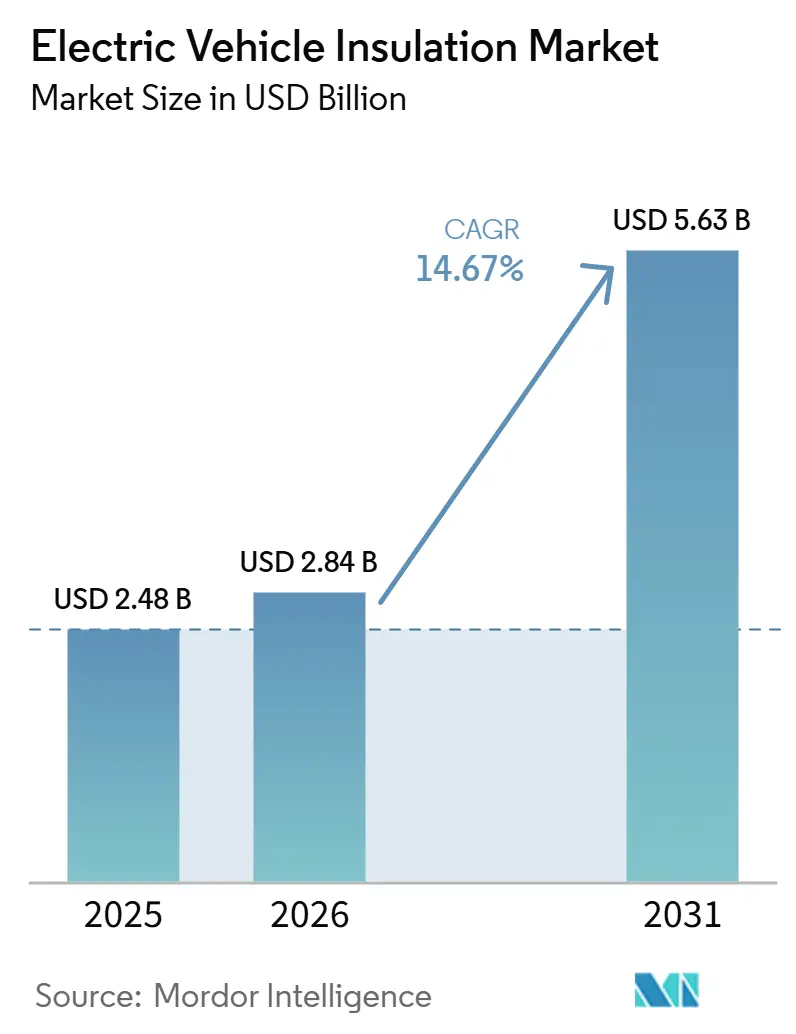
The Electric Vehicle Insulation Market was valued at USD 2.48 billion in 2025 and is estimated to grow from USD 2.84 billion in 2026 to reach USD 5.63 billion by 2031, at a CAGR of 14.67% during the forecast period (2026–2031). Tighter battery-safety rules in China have increased the need for materials that limit heat transfer and isolate high-voltage components. The shift toward 800 V vehicle platforms is also raising insulation requirements in battery packs, wiring, power electronics, and charging interfaces. Material suppliers are responding by combining thermal, electrical, mechanical, and sealing functions within fewer components. This favors companies with documented test data and the ability to support qualification across major vehicle-producing regions. The electric vehicle insulation market, therefore, depends on both vehicle production volumes and the growing material content required for safer battery designs
Key Report Takeaways
- By material type, polyurethane foam held 22.73% of the electric vehicle insulation market share in 2025, while aerogel is projected to grow at an 18.83% CAGR through 2031.
- By vehicle propulsion, Battery Electric Vehicles (BEVs) held 66.71% of the electric vehicle insulation market share in 2025 and are forecast to expand at a 16.71% CAGR through 2031.
- By vehicle type, passenger vehicles accounted for 63.52% of the electric vehicle insulation market share in 2025, while heavy-duty vehicles are forecast to grow at an 18.35% CAGR through 2031.
- By application, battery pack and battery housing held 39.68% of the electric vehicle insulation market share in 2025, while battery cell and module insulation are forecast to expand at a 15.22% CAGR through 2031.
- By geography, Asia-Pacific held 51.83% of the electric vehicle insulation market share in 2025 and is forecast to expand at a 15.69% CAGR through 2031.
Note: Market size and forecast figures in this report are generated using Mordor Intelligence’s proprietary estimation framework, updated with the latest available data and insights as of January 2026.
Market Trends and Insights
Drivers Impact Analysis of Electric Vehicle Insulation Market*
| Driver | (~) % Impact on CAGR Forecast | Geographic Relevance | Impact Timeline |
|---|---|---|---|
| Increasing Battery Energy Density and Demand for Fast-Charging Capabilities | +3.5% | Global; intensity concentrated in China, South Korea, and Germany | Short term (≤ 2 years) |
| Stringent Thermal Runaway Protection and High-Voltage Safety Regulations | +3.2% | Global; regulatory influence strongest in China, EU, and North America | Short term (≤ 2 years) |
| Growing Electrification of Commercial Vehicles, Buses, and Heavy-Duty Trucks | +2.8% | APAC core, spill-over to Europe and North America | Medium term (2-4 years) |
| Rising Demand for Lightweight Insulation Materials to Improve Vehicle Range | +2.4% | Global; early gains in China, Germany, and Japan | Medium term (2-4 years) |
| Increasing Adoption of Cell-to-Pack and Structural Battery Architectures | +2.0% | Global; accelerating in China, with early deployment in Europe and North America | Medium term (2-4 years) |
| Source: Mordor Intelligence | |||
Increasing Battery Energy Density and Demand for Fast-Charging Capabilities
Higher energy density in modern Nickel Manganese Cobalt (NMC) and Lithium Iron Phosphate (LFP) cells increases the severity of thermal events within battery packs. Society of Automotive Engineers (SAE) research published in 2026 stated that thicker and more energetic cells require 50%–60% more insulation resistance per pack with equivalent energy capacity[1]“Thermal Insulation Materials Used in Battery Pack Assembly: A Review of Materials, Test Methods, and Key Considerations,” SAE Technical Paper, saemobilus.sae.org. This makes insulation performance more closely tied to the energy rating of the cell. The spread of 800 V charging systems adds further demands across busbars, connectors, pack enclosures, battery disconnect units, and high-voltage interlock loops. IEC 62196-1:2025 sets performance requirements for charging plugs and connectors at up to 1,500 V DC and 800 A. The Electric Vehicle Insulation Market is consequently moving toward multi-layer materials with thermal and dielectric properties that remain stable during high-rate charging and discharge cycles.
Stringent Thermal Runaway Protection and High-Voltage Safety Regulations
China’s GB 38031-2025 took effect on July 1, 2026, and requires battery systems to prevent fire and explosion for at least 120 minutes after thermal runaway in a single cell. The rule also prohibits smoke from entering the vehicle cabin. This extended containment requirement has increased the need for purpose-designed barriers between cells and around the pack. Europe uses UNECE R100.3 requirements for fireproof housing and system separation, while North American testing includes UL 9540A evaluation from cell to full installation level. Suppliers with test records across multiple regulatory systems are better positioned to support global vehicle programs. The electric vehicle insulation market is therefore placing greater weight on certified performance rather than low initial material cost.
Growing Electrification of Commercial Vehicles, Buses, and Heavy-Duty Trucks
Commercial electric vehicles need insulation that can operate across wider temperature ranges and heavier-duty cycles than many passenger vehicles. Large truck battery packs can operate in ambient temperatures as low as -30 °C, where battery capacity declines and internal resistance increases. Their 400–600 kWh battery systems also contain more thermal mass than passenger vehicle packs. SAE research presented in 2026 found that additional cabin insulation lowered energy demand by 20% at 0 °C and nearly 30% at -10 °C in an electric city bus. These operating conditions increase demand for durable materials that provide thermal protection, vibration resistance, and electrical isolation. The electric vehicle insulation market is gaining support from fleet applications where reliable range and daily operating availability are essential.
Rising Demand for Lightweight Insulation Materials to Improve Vehicle Range
Vehicle designers are seeking insulation materials that reduce mass without reducing resistance to heat or electrical stress. Aerogel pads can be 0.5–3 mm thick and can help limit thermal runaway propagation while supporting battery performance in low-temperature environments. This combination supports their use where pack space is limited. Materials such as polymer composite foams and polyimide films also address the tradeoff between vehicle mass and protection level. UL 2596 testing requires materials to withstand a 1,200 °C flame and alumina particle blasts, raising the qualification threshold for battery protection applications. The electric vehicle insulation market is consequently rewarding materials that combine lightweight construction with documented fire, thermal, and dielectric performance.
Restraints Impact Analysis of Electric Vehicle Insulation Market*
| Restraint | (~) % Impact on CAGR Forecast | Geographic Relevance | Impact Timeline |
|---|---|---|---|
| High Cost of Advanced Insulation Materials such as Aerogels, Ceramics, and Polyimides | -0.8% | Global; disproportionately impacts cost-sensitive markets in South and Southeast Asia | Short term (≤ 2 years) |
| Lack of Standardization in High-Voltage Insulation and Charging Systems | -0.5% | Global; fragmentation most acute between North America, EU, and China | Medium term (2-4 years) |
| Recycling and End-of-Life Challenges for Multi-Layer Insulation Materials | -0.3% | Global; compliance factors most stringent in the EU under Battery Regulation 2023/1542 | Long term (≥ 4 years) |
| Source: Mordor Intelligence | |||
High Cost of Advanced Insulation Materials such as Aerogels, Ceramics, and Polyimides
Aerogels, ceramic fiber, and polyimide films offer strong thermal and dielectric performance, but they have higher costs than conventional foam materials. Their processing methods require specialized production capacity and can limit supply expansion. The cancellation of Aspen Aerogels’ planned Georgia facility in February 2025 showed the difficulty of scaling aerogel capacity through large, fixed investments. China’s new battery safety rules are expected to increase power battery system costs by 15%–20% per vehicle pack. Original Equipment Manufacturers (OEMs) in cost-sensitive vehicle categories may be slower to adopt premium insulation solutions. The electric vehicle insulation market still has room for materials that combine thermal and electrical functions, because they can reduce the number of components used in a battery system.
Lack of Standardization in High-Voltage Insulation and Charging Systems
Insulation suppliers must work across China’s GB 38031-2025, Europe’s UNECE R100.3, North American UL 9540A and UL 9540B requirements, and IEC 62619. These systems use different test procedures for thermal propagation, flammability, and insulation resistance. IEC 62196-3:2026 and IEC TS 63379:2026 set additional insulation and dielectric requirements for high-power charging connectors. A material that qualifies in one region can require redesign or retesting before it is used elsewhere. The reported 12–24 month qualification cycle can raise development costs for smaller suppliers. The electric vehicle insulation market gives larger suppliers an advantage when they can maintain certification programs across several regions.
*Our forecasts treat driver/restraint impacts as directional, not additive. The impact forecasts reflect baseline growth, mix effects, and variable interactions.
Electric Vehicle Insulation Market Segment Analysis
By Material Type:
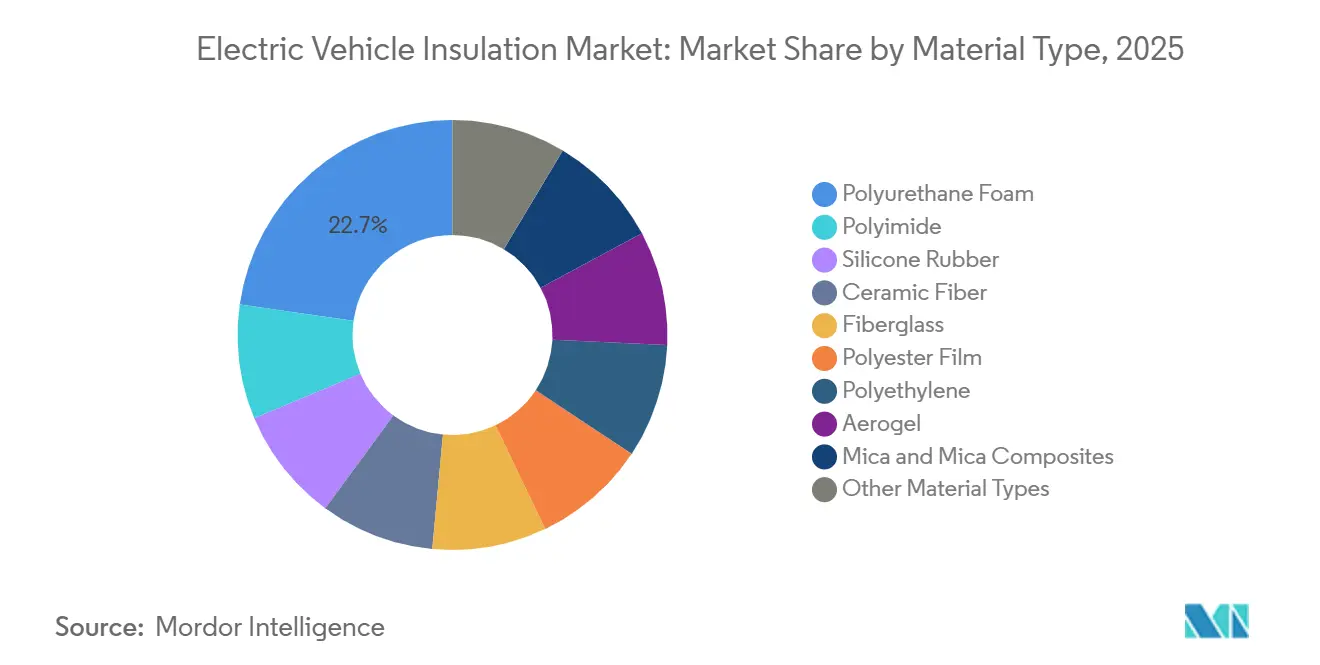
Aerogel Gains Ground in Thermal Barrier ApplicationsPolyurethane foam held the largest share at 22.73% in 2025, supported by its established supply base and its use in thermal insulation and vibration damping. Its thermal conductivity was reported at 0.020–0.030 W/m·K in battery pack assemblies. Silicone rubber remains useful for flexible sealing under thermal cycling. Polyimide films support high dielectric strength in cell-to-cell barriers, while mica composites are used where flame resistance is critical. Ceramic fiber, fiberglass, polyester film, and polyethylene continue to serve defined thermal or liner applications. Aerogel adoption can grow where one certified composite replaces several single-function materials in pack designs.
Aerogel is projected to grow at an 18.83% CAGR through 2031. It contains heat transfer at thicknesses of 0.5–3 mm, which helps preserve battery pack space. A 2025 study reported that a 2 mm aerogel sheet created a 200–400°C temperature drop during cell combustion events that peaked at 600–800°C. Such performance supports the 120-minute thermal-runaway containment requirement under China’s battery standard. The electric vehicle insulation market size for advanced thermal barriers is supported by battery designs that need direct protection between closely packed cells.



By Vehicle Propulsion:
Battery Electric Vehicles (BEVs) Remain the Primary Source of DemandBattery Electric Vehicles (BEVs) held 66.71% of the electric vehicle insulation demand in 2025 and are forecast to grow at a 16.71% CAGR through 2031. Their battery systems require insulation across cells, modules, packs, high-voltage wiring, and charging connections. Larger and more energy-dense packs increase the amount of thermal and dielectric material used per vehicle. The move to 800 V BEV platforms requires greater creepage distances and higher insulation resistance across key electrical interfaces. The electric vehicle insulation market has a direct connection to the growing complexity of BEV batteries and power systems.
Hybrid Electric Vehicles (HEVs) use insulation mainly around motors and power electronics because their battery packs are smaller. Plug-in Hybrid Electric Vehicles need intermediate-level solutions for their 20–40 kWh battery packs. These vehicles still require materials that manage heat, resist voltage stress, and isolate components inside a limited package space. Fuel-cell electric vehicles have different insulation needs because they combine high-voltage fuel-cell stacks, hydrogen storage systems, and power electronics. South Korea and Japan remain important locations for fuel-cell vehicle activity through Hyundai and Toyota programs. The electric vehicle insulation market benefits from this varied propulsion mix, although BEVs remain the leading source of material demand.
By Vehicle Type:
Heavy-Duty Vehicles Raise Material RequirementsPassenger vehicles held 63.52% of demand in 2025 because they represented the largest share of electric vehicle production. Their 80–120 kWh battery packs, larger vehicle platforms, and expanding use of 800 V systems increase insulation content. Passenger vehicle manufacturers need materials that can meet safety targets without adding unnecessary pack mass. The electric vehicle insulation market size for passenger applications remains substantial because battery safety rules apply across high-volume vehicle platforms. Two-wheelers add demand through their large fleet volumes in India and Southeast Asia.
Heavy-duty vehicles are forecast to grow at an 18.35% CAGR through 2031. Long-haul trucks and construction vehicles require battery packs that can operate between -30 °C and +55 °C. Their materials must handle thermal cycling, vibration, shock, and compressive loads. MAN tested its Lion’s Coach E in 2026 in northern Sweden and Turkey at temperatures as low as -30 °C, showing the importance of thermal insulation and battery preconditioning for electric coach operations. Electric buses also need materials that withstand repeated charging cycles and daily temperature changes. The electric vehicle insulation industry is therefore seeing stronger demand for ceramic fiber and mica composite options in severe operating conditions.
By Application:
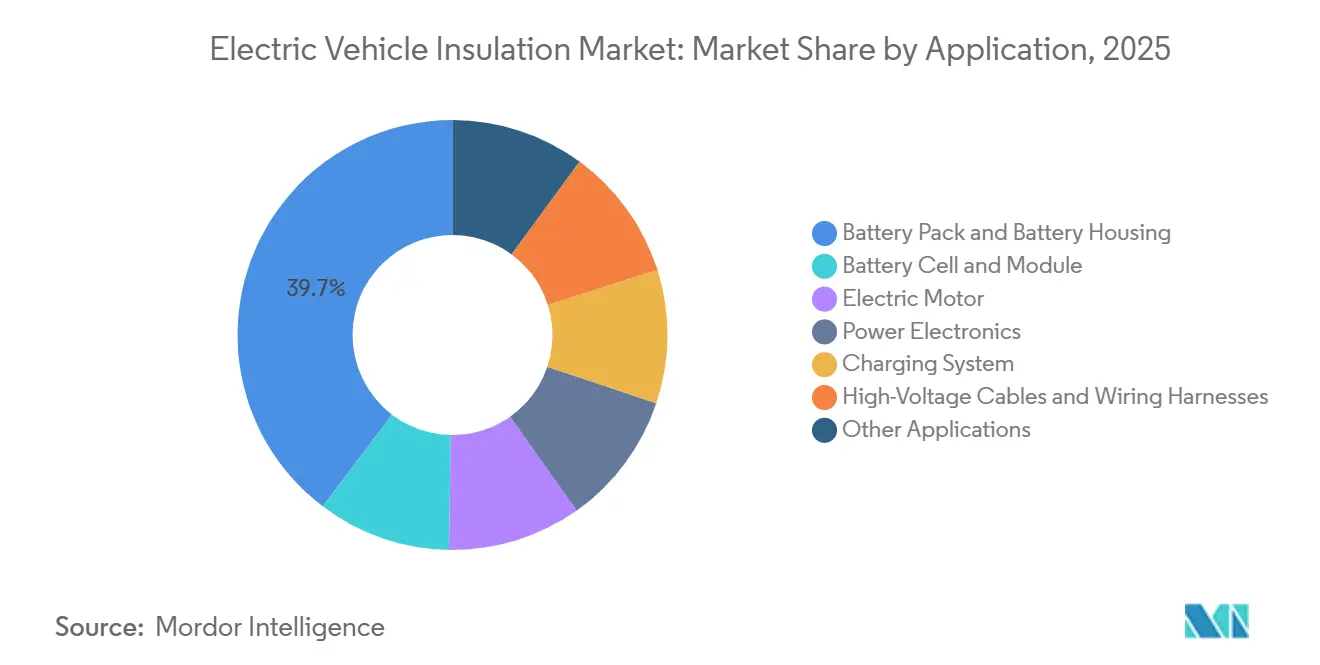
Battery Cell and Module Supports Faster GrowthThe battery pack and battery housing held 39.68% of the market demand in 2025. These applications prevent heat transfer between the battery system and the passenger cabin while protecting structural members from external thermal events. Electric motor insulation uses polyimide slot liners and Class H winding materials for high-temperature operation. Power electronics need dielectric compounds that can support high breakdown voltages on 800 V DC buses. Charging-system insulation and high-voltage cable insulation are also affected by the updated requirements for vehicle couplers and cables. The electric vehicle insulation market favors application solutions that combine thermal, electrical, and mechanical protection in fewer parts.
Battery cell and module insulation is forecast to grow at a 15.22% CAGR through 2031. Cell-to-pack designs remove intermediate module housings and require continuous thermal barriers across the cell array. Cell-to-body designs place the battery within the vehicle’s load-bearing structure and need insulation directly between cells. These designs also require venting paths that direct hot gases away from adjacent components. Henkel AG & Co. KGaA launched Loctite TLB 9270APS in May 2026, a polyurethane-based adhesive with 2 W/m·K thermal conductivity and integrated electrical insulation for cell-to-pack architectures.
Geography Analysis
APAC Electric Vehicle Insulation Market
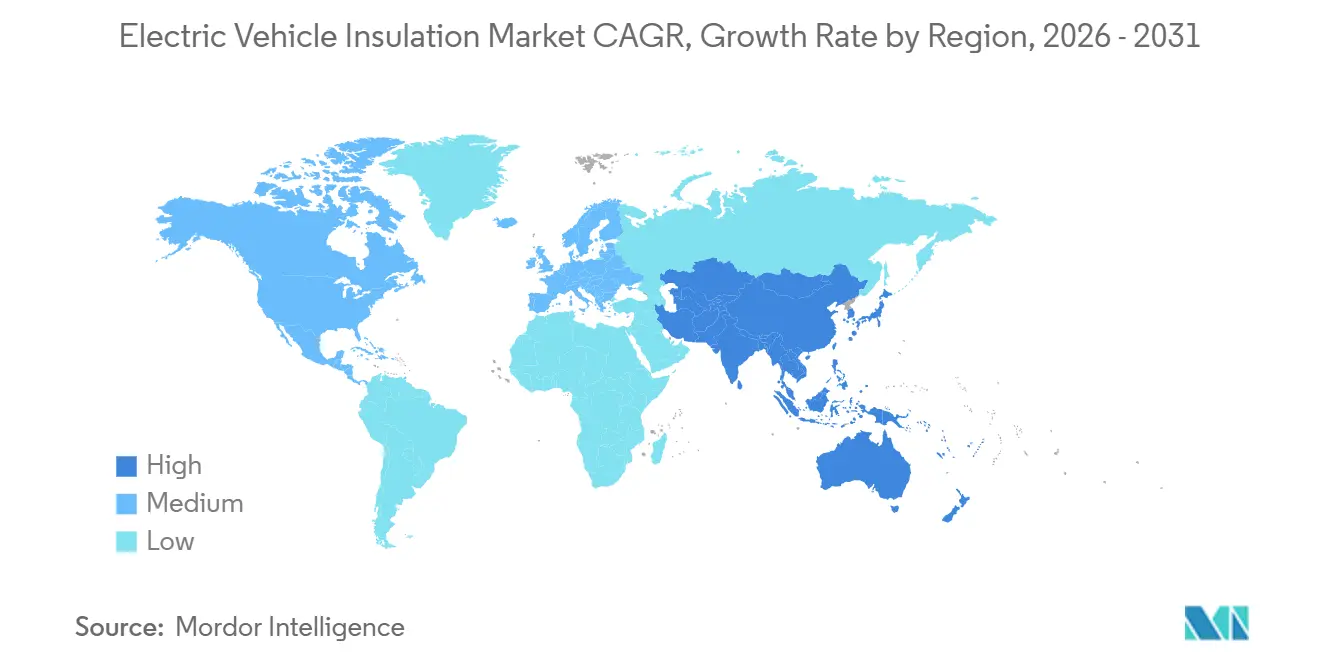
Asia-Pacific held 51.83% of global demand in 2025 and is forecast to grow at a 15.69% CAGR through 2031. China, South Korea, Japan, and India provide the region’s core electric vehicle production and battery manufacturing base. China’s GB 38031-2025 standard is increasing insulation requirements for battery systems sold in the country. China’s vehicle suppliers are incorporating non-thermal-propagation designs and high-temperature-resistant diaphragms. India recorded 2.55 million electric vehicle sales in FY2025-26, according to the India Energy Storage Alliance. The region’s electric vehicle insulation market share reflects both high production volumes and stronger safety specifications for battery packs.
India and Northeast Asia Electric Vehicle Insulation Market
India’s electric vehicle penetration reached 11.43% in the first half of 2026, compared with 8% in the first half of 2025. Sales reached 1.54 million units in the first half of 2026, supporting demand in two-wheelers, three-wheelers, and passenger vehicles. Japan and South Korea remain important premium-specification markets. Their vehicle programs place significant importance on battery protection, durability, and high-voltage performance. China’s battery standard also influences supply chains beyond its domestic vehicle market because Chinese producers export complete vehicles and battery systems. The electric vehicle insulation market is becoming more connected to Chinese battery-safety requirements as these systems move into other regions.
EMEA and the Americas Electric Vehicle Insulation Market
Europe and North America remain important demand centers with different regulatory conditions. Europe’s requirements for fireproof battery housing under UNECE R100.3 are increasing insulation content in new vehicle programs. In North America, domestic battery plants and OEM programs maintain baseline demand for insulation materials. The expected adoption of 800 V systems supports high-dielectric materials in the region. South America, and Middle-East, and Africa represent emerging demand centers. Chinese vehicle exports bring China-specified battery packs and associated insulation requirements into these developing markets. The electric vehicle insulation market is expected to develop in these regions through fleet programs, electric bus procurement, and broader charging infrastructure.

Competitive Landscape
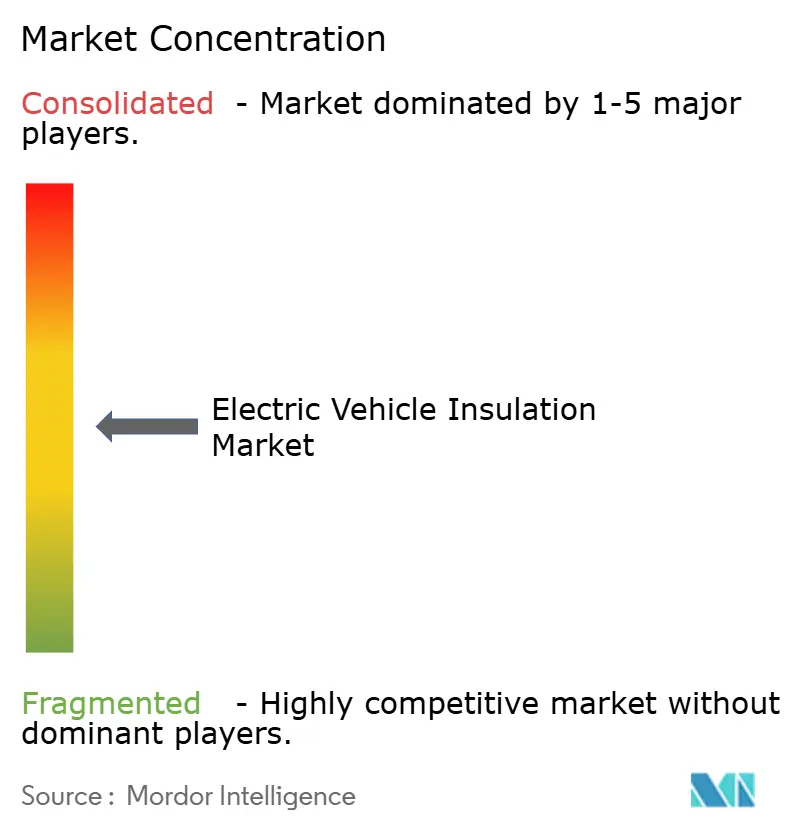
The electric vehicle insulation market is moderately concentrated, with the top five players including DuPont, 3M, Saint-Gobain, BASF, and Morgan Advanced Materials plc. Aerogel suppliers, mica and ceramic specialists, and engineered foam producers compete in more focused safety applications. Large suppliers are integrating several insulation functions into composite systems that can reduce part counts, simplify application steps, and support consistent assembly. Smaller specialists focus on inter-cell barriers and arc-flash protection, where long qualification cycles can raise switching costs and make validated material records important. This structure supports competition on material certifications as well as on product breadth.
Aspen Aerogels represents the specialized thermal-barrier segment and reported PyroThin sales of more than USD 300 million in 2024, primarily to a single OEM. The company confirmed in February 2026 that it received a fourth-quarter 2025 customer award related to Volvo Cars, with European programs expected to contribute USD 10–15 million in 2026 revenue. Henkel AG & Co. KGaA introduced a next-generation thermal gap filler in July 2026 with 6.5 W/m·K conductivity for electric vehicle electronic components[2]Henkel AG & Co. KGaA AG, “Henkel AG & Co. KGaA Launches Next-Generation Thermal Gap Filler with 6.5W/m∙K Conductivity,” Henkel AG & Co. KGaA, Henkel AG & Co. KGaA.com. These moves show how materials suppliers are combining thermal management with electrical isolation in one product system.
Asian aerogel producers supply vehicle programs in China and South Korea and compete through production cost and local qualification capability. Their development increases competitive pressure in thermal-barrier applications that can be served with standard material formats. Large material groups retain an advantage where vehicle manufacturers need support across several countries, battery designs, and regulatory systems. Suppliers must increasingly demonstrate compliance with UL 9540A, GB 38031-2025, and IEC 62619 requirements. Certification depth, repeatable production, and the ability to document performance through the full battery system are becoming decisive factors in sourcing decisions. The electric vehicle insulation market remains open to specialized suppliers, while global programs favor companies that can complete qualifications quickly, document material performance consistently, and provide support from early design through production. The electric vehicle insulation market also rewards suppliers that can maintain validated material performance across product generations.
Electric Vehicle Insulation Industry Leaders
DuPont
3M
Saint-Gobain
BASF
Morgan Advanced Materials plc
- *Disclaimer: Major Players sorted in no particular order
Electric Vehicle Insulation Market Companies Covered in this Report
- 3M
- Adler Pelzer Holding GmbH
- Aspen Aerogels, Inc.
- Autoneum
- BASF
- DuPont
- Elmelin Ltd.
- Freudenberg Group
- Henkel AG & Co. KGaA
- Isovolta AG
- Morgan Advanced Materials plc
- Rogers Corporation
- Saint-Gobain
- Shin-Etsu Chemical Co., Ltd
- Tecman Holdings Ltd,

Recent Industry Developments in Electric Vehicle Insulation Market
- July 2026: Henkel AG & Co. KGaA launched Bergquist Gap Filler TGF 6500LVO with 6.5 W/m·K thermal conductivity for Advanced Driver Assistance Systems (ADAS), Electronic Control Units (ECUs), and EV power conversion components. The launch expands Henkel AG & Co. KGaA's EV thermal management portfolio, supporting efficient heat dissipation and enhancing the performance and reliability of electric vehicle electronic systems, which are key requirements for advanced EV insulation solutions.
- July 2026: China enforced GB 38031-2025 and GB 18384-2025, introducing the world's first mandatory "no fire, no explosion" safety requirement for electric vehicle batteries. The regulations significantly increase thermal runaway containment requirements, driving demand for advanced insulation materials such as mica, ceramic fibers, aerogels, and high-performance polymer insulators to enhance battery safety and comply with the new standards.


Global Electric Vehicle Insulation Market Report Scope
Electric vehicle insulation materials are designed to provide thermal management, electrical insulation, fire resistance, and noise reduction in electric vehicles. They help improve battery safety, enhance vehicle performance, extend component life, and ensure reliable operation of high-voltage systems under demanding operating conditions.
The Electric Vehicle Insulation Market is segmented by material type, vehicle propulsion, vehicle type, application, and geography. By material type, the market is segmented into polyurethane foam, polyimide, silicone rubber, ceramic fiber, fiberglass, polyester film, polyethylene, aerogel, mica and mica composites, and other material types. By vehicle propulsion, the market is segmented into battery electric vehicles (BEVs), hybrid electric vehicles (HEVs), plug-in hybrid electric vehicles (PHEVs), and fuel cell electric vehicles (FCEVs). By vehicle type, the market is segmented into passenger vehicles, commercial vehicles, two-wheelers, heavy-duty vehicles, electric buses, and other vehicle types. By application, the market is segmented into battery pack and battery housing, battery cell and module, electric motor, power electronics, charging system, high-voltage cables and wiring harnesses, and other applications. The report also covers the market size and forecasts for electric vehicle insulation in 16 countries across major regions. For each segment, the market sizing and forecasts have been done on the basis of value (USD).
| Polyurethane Foam |
| Polyimide |
| Silicone Rubber |
| Ceramic Fiber |
| Fiberglass |
| Polyester Film |
| Polyethylene |
| Aerogel |
| Mica and Mica Composites |
| Other Material Types |
| Battery Electric Vehicles (BEVs) |
| Hybrid Electric Vehicles (HEVs) |
| Plug-in Hybrid Electric Vehicles (PHEVs) |
| Fuel Cell Electric Vehicles (FCEVs) |
| Passenger Vehicles |
| Commercial Vehicles |
| Two-Wheelers |
| Heavy-Duty Vehicles |
| Electric Buses |
| Other Vehicle Types |
| Battery Pack and Battery Housing |
| Battery Cell and Module |
| Electric Motor |
| Power Electronics |
| Charging System |
| High-Voltage Cables and Wiring Harnesses |
| Other Applications |
| Asia-Pacific | China |
| India | |
| Japan | |
| South Korea | |
| Rest of Asia-Pacific | |
| North America | United States |
| Canada | |
| Mexico | |
| Europe | Germany |
| United Kingdom | |
| France | |
| Italy | |
| Russia | |
| Rest of Europe | |
| South America | Brazil |
| Argentina | |
| Rest of South America | |
| Middle-East and Africa | Saudi Arabia |
| South Africa | |
| Rest of Middle-East and Africa |
| By Material Type | Polyurethane Foam | |
| Polyimide | ||
| Silicone Rubber | ||
| Ceramic Fiber | ||
| Fiberglass | ||
| Polyester Film | ||
| Polyethylene | ||
| Aerogel | ||
| Mica and Mica Composites | ||
| Other Material Types | ||
| By Vehicle Propulsion | Battery Electric Vehicles (BEVs) | |
| Hybrid Electric Vehicles (HEVs) | ||
| Plug-in Hybrid Electric Vehicles (PHEVs) | ||
| Fuel Cell Electric Vehicles (FCEVs) | ||
| By Vehicle Type | Passenger Vehicles | |
| Commercial Vehicles | ||
| Two-Wheelers | ||
| Heavy-Duty Vehicles | ||
| Electric Buses | ||
| Other Vehicle Types | ||
| By Application | Battery Pack and Battery Housing | |
| Battery Cell and Module | ||
| Electric Motor | ||
| Power Electronics | ||
| Charging System | ||
| High-Voltage Cables and Wiring Harnesses | ||
| Other Applications | ||
| By Geography | Asia-Pacific | China |
| India | ||
| Japan | ||
| South Korea | ||
| Rest of Asia-Pacific | ||
| North America | United States | |
| Canada | ||
| Mexico | ||
| Europe | Germany | |
| United Kingdom | ||
| France | ||
| Italy | ||
| Russia | ||
| Rest of Europe | ||
| South America | Brazil | |
| Argentina | ||
| Rest of South America | ||
| Middle-East and Africa | Saudi Arabia | |
| South Africa | ||
| Rest of Middle-East and Africa | ||


Key Questions Answered in the Report
What is the size of the electric vehicle insulation market?
The electric vehicle insulation market stands at USD 2.84 billion in 2026 and is projected to reach USD 5.63 billion by 2031.
Which material category is expected to grow fastest through 2031?
Aerogel is forecast to grow at a forecast CAGR of 18.83% through 2031. Its thin 0.5–3 mm format supports inter-cell thermal barriers where battery pack space is limited.
Which vehicle propulsion led the demand in 2025?
Battery electric vehicles (BEVs) held 66.71% of demand in 2025. The electric vehicle insulation market benefits from the demand for BEVs across battery cells, packs, power electronics, high-voltage cables, and charging components.
Why are battery-safety rules important for insulation suppliers?
China’s GB 38031-2025 requires 120 minutes of fire and explosion prevention after single-cell thermal runaway, increasing demand for tested thermal barriers. The rule also prohibits smoke from entering the vehicle cabin, which raises the performance requirement for pack-level materials.
Page last updated on:





