
Electric Hair Clipper and Trimmer Market Size and Share
Market Overview
| Study Period | 2022 - 2032 |
|---|---|
| Market Size (2027) | USD 6.57 Billion |
| Market Size (2032) | USD 8.44 Billion |
| Growth Rate (2027 - 2032) | 5.15 % |
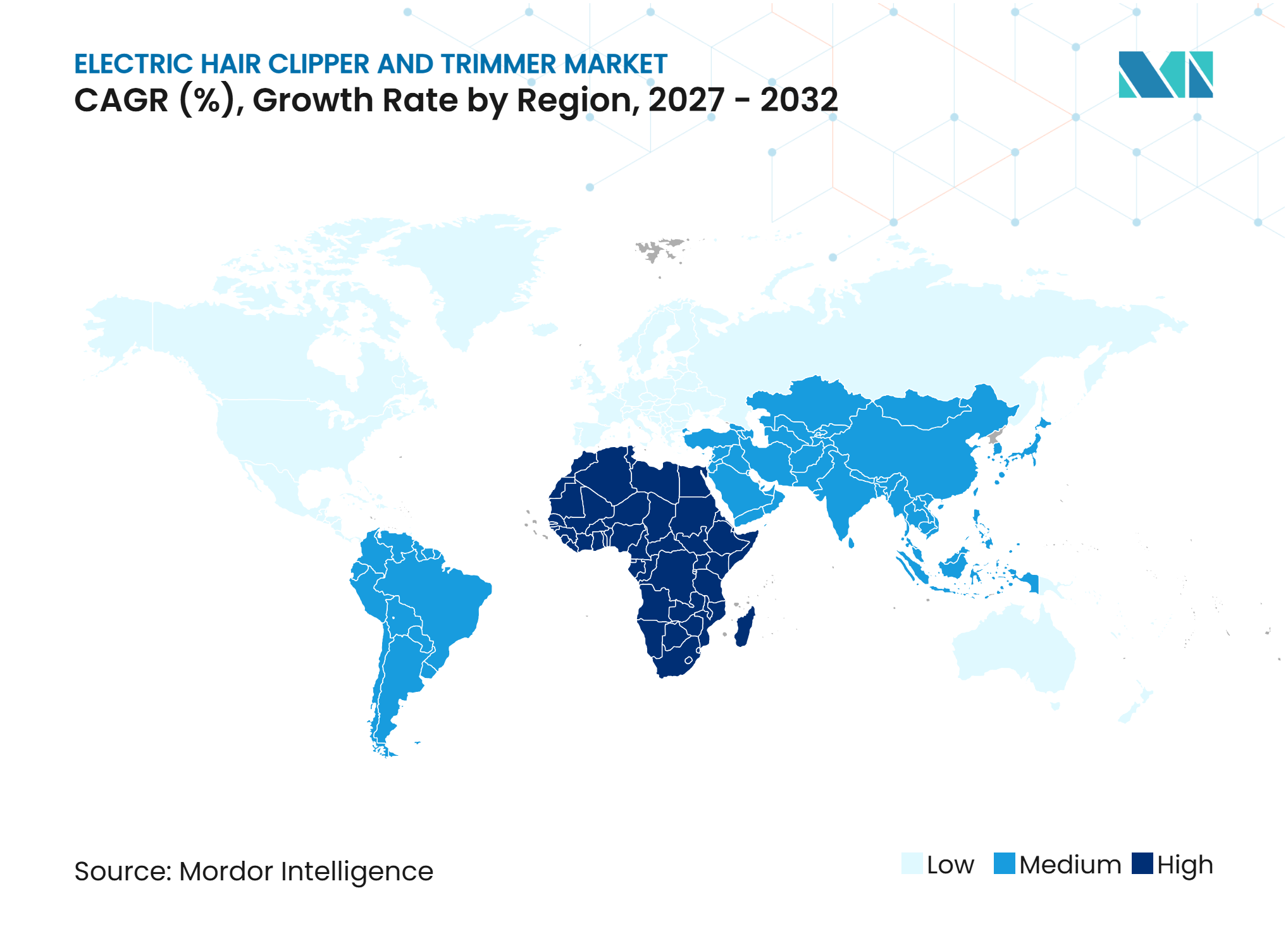
| Fastest Growing Market | Middle East and Africa |
| Largest Market | Asia-Pacific |
| Market Concentration | Medium |
Major Players *Disclaimer: Major Players sorted in no particular order Image © Mordor Intelligence. Reuse requires attribution under CC BY 4.0. | |
Electric Hair Clipper and Trimmer Market Analysis by Mordor Intelligence
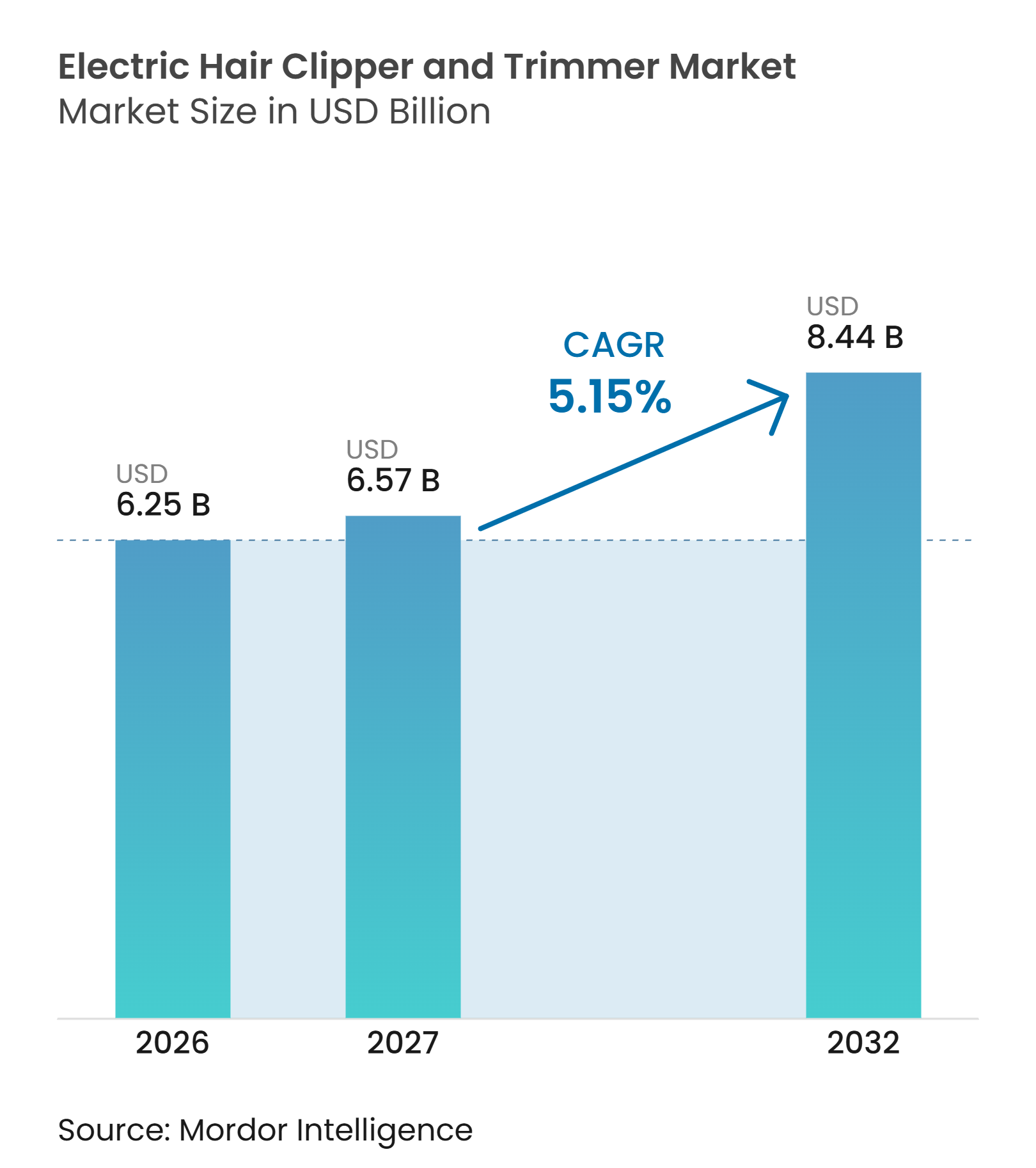
The electric hair clipper and trimmer market size is expected to grow from USD 6.25 billion in 2026 to USD 6.57 billion in 2027 and is forecast to reach USD 8.44 billion by 2032 at a 5.15% CAGR over 2027-2032. The electric hair clipper and trimmer market is expanding as consumers increasingly adopt at-home grooming across genders, age groups, and income levels. Organized retail and online channels are strengthening product accessibility and brand visibility. Advancements in cordless technology, charging efficiency, and wet-dry functionality are enhancing product convenience and performance. Manufacturers are expanding product offerings across different price points to cater to diverse consumer preferences. Growing emphasis on product reliability, ease of use, and grooming convenience is further supporting market development.
Key Report Takeaways
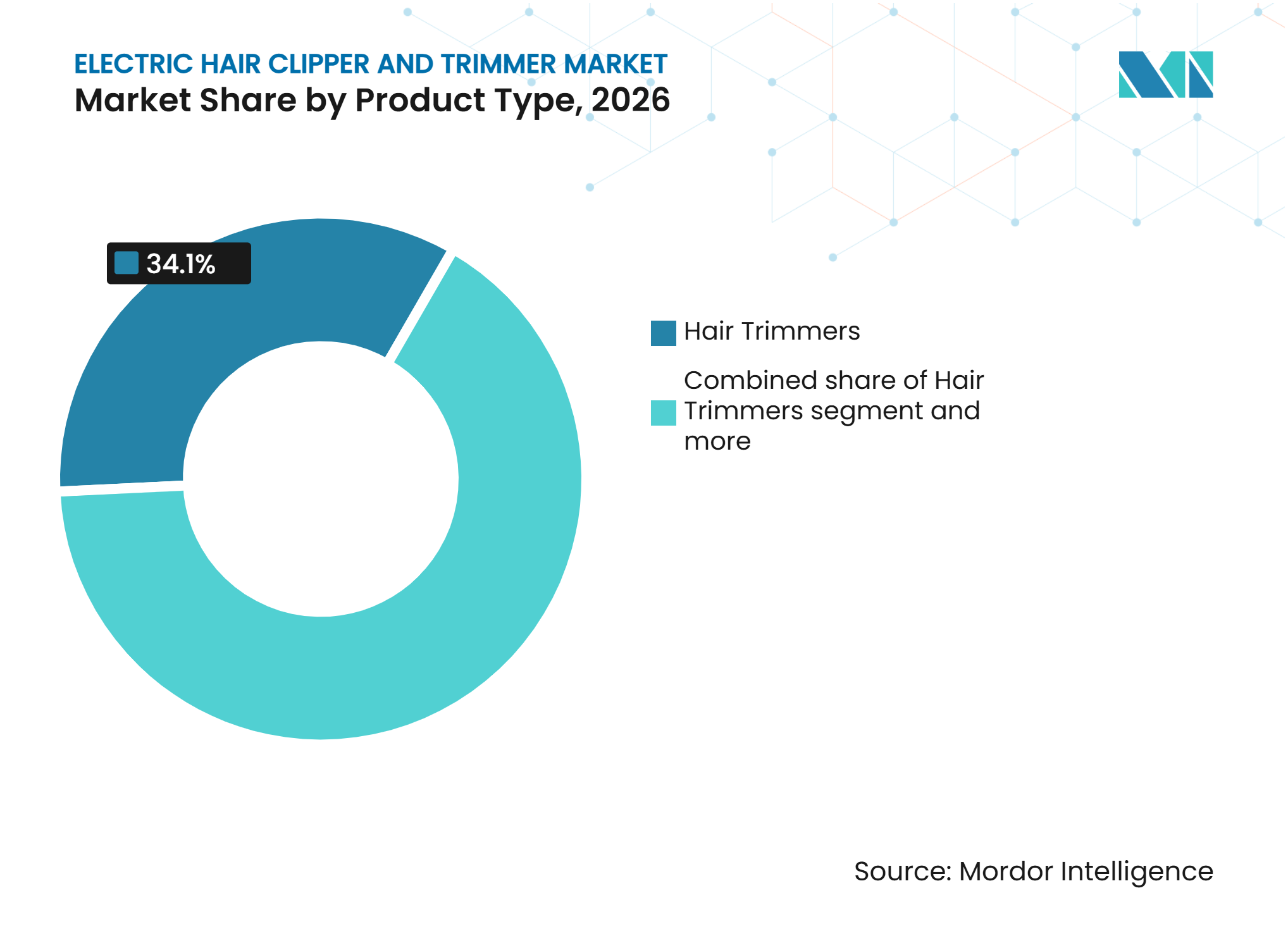
• By product type, hair trimmers held 34.12% of the electric hair clipper and trimmer market size in 2026 and are forecast to expand at a CAGR of 6.71% through 2032.
• By power source, cordless held 67.15% of the electric hair clipper and trimmer market share in 2026 and is forecast to expand at a CAGR of 6.42% through 2032.
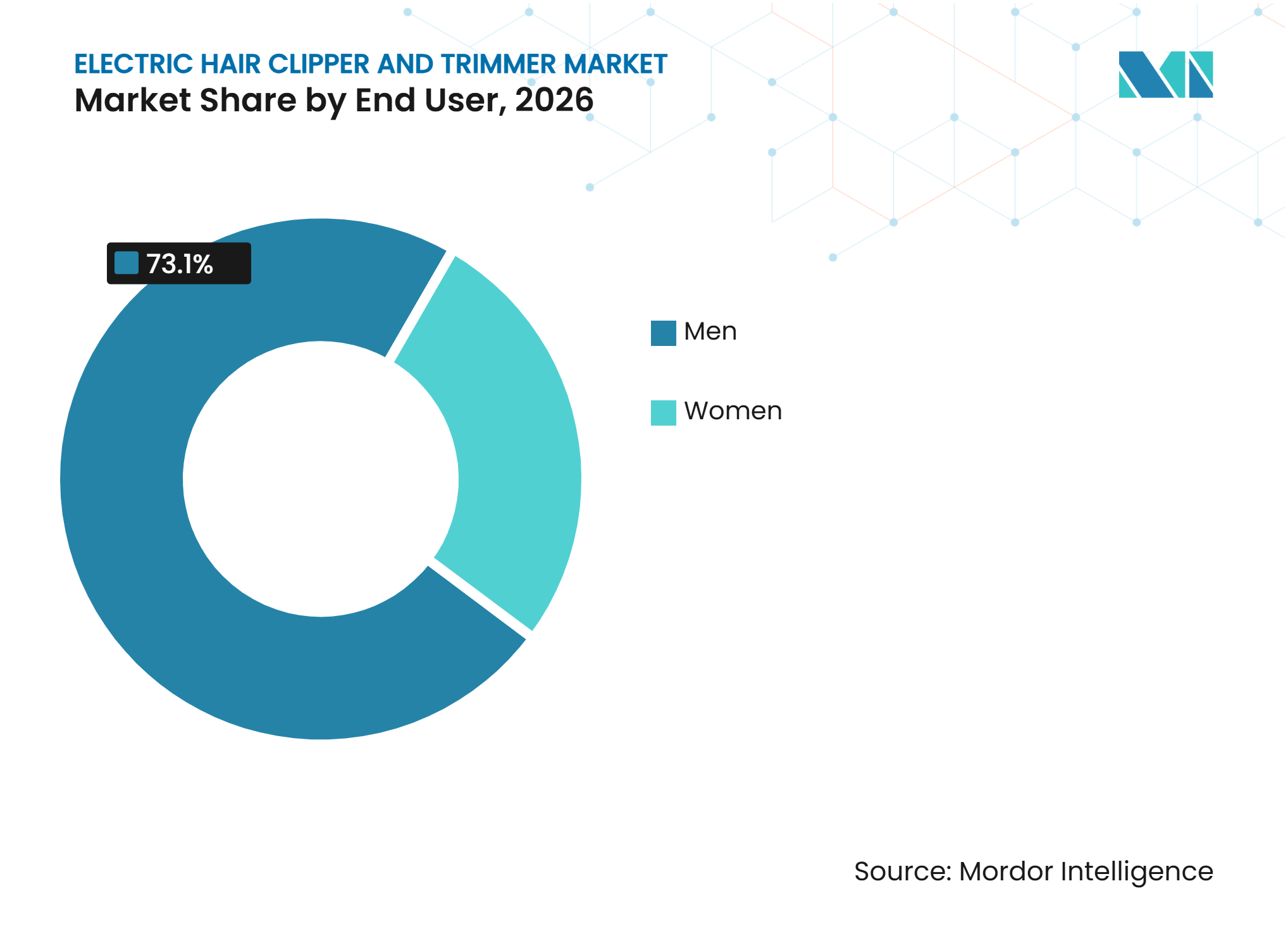
• By end user, men held 73.12% of the electric hair clipper and trimmer market share in 2026, while women are forecast to expand at a CAGR of 7.21% through 2032.
• By distribution channel, supermarkets and hypermarkets held 41.12% of the electric hair clipper and trimmer market share in 2026, while online retail stores are forecast to expand at a CAGR of 7.41% through 2032.
• By geography, Asia-Pacific held 51.11% of the electric hair clipper and trimmer market share in 2026, while the Middle East and Africa are forecast to expand at a CAGR of 7.21% through 2032.
Note: Market numbers in this report are based on Mordor Intelligence's proprietary estimation framework, which combines nine months of actuals with Q4 projections for base year 2026.
Market Trends and Insights
Drivers Impact Analysis of Electric Hair Clipper and Trimmer Market*
| Driver | (~) % Impact on CAGR Forecast | Geographic Relevance | Impact Timeline |
|---|---|---|---|
| Expansion of organized retail infrastructure across emerging and developing markets | +0.8% | Global, led by Asia-Pacific and Middle East and Africa | Medium term (2–4 years) |
| Growing consumer preference for online purchasing of personal grooming appliances | +1.2% | Global, particularly Asia-Pacific and North America | Short term (≤ 2 years) |
| Increasing product visibility through in-store demonstrations and promotional displays | +0.6% | Global, particularly North America and Europe | Short term (≤ 2 years) |
| Growing availability of electric hair clippers and trimmers through omnichannel retail platforms | +0.9% | Global, particularly Asia-Pacific and Europe | Medium term (2–4 years) |
| Expansion of retail partnerships between grooming appliance brands and multi-brand electronics retailers | +0.7% | Global, particularly Asia-Pacific and North America | Medium term (2–4 years) |
| Increasing availability of flexible payment options and buy-now-pay-later services across retail channels | +0.5% | Global, particularly Asia-Pacific and Middle East and Africa | Medium term (2–4 years) |
| Source: Mordor Intelligence | |||
Expansion of Organized Retail Infrastructure Across Emerging and Developing Markets
The expansion of organized retail infrastructure across emerging and developing markets is improving the accessibility and availability of electric hair clippers and trimmers. Growing investments in modern retail formats are strengthening the distribution networks of personal grooming appliance manufacturers. The increasing presence of supermarkets, hypermarkets, multi-brand electronics stores, and specialty grooming retailers is improving product visibility and expanding consumer access to branded appliances. Wider retail penetration across metropolitan, tier-two, and smaller urban markets is enabling manufacturers to reach a broader consumer base. The development of integrated retail networks is also strengthening product availability across physical and digital purchasing channels.
Growing Consumer Preference for Online Purchasing of Personal Grooming Appliances
The growing adoption of online shopping is enhancing access to electric hair clippers and trimmers through digital retail channels. For instance, in March 2025, according to the Consumer Council for Northern Ireland, 94% of consumers purchased products online. Furthermore, 80% of online shoppers made at least one purchase per month, indicating the growing role of e-commerce in consumer purchasing behavior [1]. Supporting this, in May 2026, Wahl introduced its TrimNinja hybrid electric razor and beard trimmer, with online purchasing available through its digital sales channels. The availability of specialized grooming appliances through online platforms is expanding consumer access to product information, specifications, and purchasing options.
Increasing Product Visibility through In-Store Demonstrations and Promotional Displays
The increasing use of in-store demonstrations and promotional displays is improving product visibility and consumer engagement in the electric hair clipper and trimmer market. For instance, in September 2026, according to the Out of Home Advertising Association of America, 80% of consumers are more likely to consider a product after experiencing it in person, while 89% are willing to attend live marketing events or promotional experiences. Furthermore, 40% of consumers who attended such events reported making a purchase, highlighting the influence of direct product engagement on purchasing decisions [2]. Supporting this, Stove Kraft's May 2025 investor presentation documented the introduction of Pigeon's men's grooming products and promotional activities for its grooming range.
Growing Availability of Electric Hair Clippers and Trimmers through Omnichannel Retail Platforms
The growing availability of electric hair clippers and trimmers through omnichannel retail platforms is improving consumer access across online and offline purchasing channels. For instance, in March 2026, Alvarez & Marsal and the Confederation of Indian Industry found that 64% of Indian consumers shop across multiple channels, underscoring the growing importance of integrated retail experiences [3]. The report also identified research-driven purchasing and instant-delivery expectations as important shifts in consumer behavior. Supporting this, in June 2026, boAt launched its Slazer grooming series, comprising the S100, K100+, and K100 Pro trimmers, available through its official online channels and partner retail outlets across India.
Restraints Impact Analysis of Electric Hair Clipper and Trimmer Market*
| Restraint | (~) % Impact on CAGR Forecast | Geographic Relevance | Impact Timeline |
|---|---|---|---|
| High initial costs of premium grooming devices | -0.7% | South and Southeast Asia, Sub-Saharan Africa, South America | Long term (≥ 4 years) |
| Limited battery life in cordless devices | -0.4% | Global, strongest in professional and high-frequency use | Medium term (2-4 years) |
| Availability of low-cost counterfeit grooming products | -0.5% | Southeast Asia, Sub-Saharan Africa, South Asia online channels | Medium term (2-4 years) |
| Intense competition from traditional shaving alternatives | -0.4% | Middle East and Africa, South Asia, parts of South America | Long term (≥ 4 years) |
| Source: Mordor Intelligence | |||
High Initial Costs of Premium Grooming Devices
High initial costs of premium grooming devices can limit their affordability among price-sensitive consumers, particularly in emerging markets. Advanced electric hair clippers and trimmers often incorporate specialised blades, powerful motors, rechargeable batteries, and additional grooming features, increasing their manufacturing and retail costs. These higher prices may discourage consumers from upgrading existing devices or purchasing premium models. Price sensitivity can also shift demand toward basic grooming appliances and lower-priced alternatives. This limits the adoption of premium electric hair clippers and trimmers and may restrict market penetration across lower-income consumer segments.
Limited Battery Life in Cordless Devices
Limited battery life in cordless electric hair clippers and trimmers can affect product convenience and overall user experience. Frequent charging requirements may interrupt grooming activities and reduce device reliability during extended use. Battery performance may also deteriorate over time, resulting in shorter operating periods and increased maintenance requirements. These limitations can discourage consumers who prefer uninterrupted operation and dependable performance. Consequently, concerns regarding battery capacity, charging frequency, and long-term battery durability may restrict the adoption of cordless grooming appliances.
*Our forecasts treat driver/restraint impacts as directional, not additive. The impact forecasts reflect baseline growth, mix effects, and variable interactions.
Electric Hair Clipper and Trimmer Market Segment Analysis
By Product Type:
Trimmers Lead Precision-Focused DemandHair trimmers accounted for 34.12% of the electric hair clipper and trimmer market share in 2026 and are projected to expand at a CAGR of 6.71% through 2032. Hair trimmers represent both the largest and fastest-growing product category in the electric hair clipper and trimmer market due to their versatility across different grooming applications. Their usage extends beyond hair cutting to beard maintenance, body grooming, and precision styling, supporting broader consumer demand. The convenience of compact designs and ease of handling make trimmers suitable for both home grooming and professional use. Growing consumer interest in personalized grooming routines is further strengthening demand for multifunctional trimming devices. Manufacturers are also focusing on precision blades, adjustable settings, ergonomic designs, and improved cutting performance to enhance product functionality and consumer appeal.
Hair clippers continue to serve professional barbershops and salons, where consistent cutting performance, powerful motors, and reliable operation are important for regular grooming services. Demand is supported by their suitability for bulk hair removal, fade blending, and maintaining uniform hair lengths. Manufacturers are focusing on improved motor performance, precision blades, and ergonomic designs to enhance cutting efficiency and professional usability. Other product categories, including nose and ear trimmers and multifunctional body grooming devices, address specialized personal grooming requirements. The market is therefore expanding beyond conventional haircutting towards a broader range of personal grooming applications.



By Power Source:
Cordless Devices Define Flexible UseCordless accounted for 67.15% of the electric hair clipper and trimmer market share in 2026 and is forecast to expand at a CAGR of 6.42% through 2032. Cordless devices lead the power-source category due to their portability, convenience, and flexibility in both home and professional grooming environments. Their ability to operate without continuous access to electrical outlets makes them suitable for personal use, salon services, and mobile grooming activities. Advancements in rechargeable battery technology are improving operating efficiency, charging convenience, and overall device performance. Manufacturers are also focusing on longer battery life, faster charging, and ergonomic designs to enhance the user experience. Growing preference for flexible grooming solutions is further strengthening demand for cordless electric hair clippers and trimmers over conventional corded devices.
Corded devices continue to attract consumers and professional users who value consistent power delivery and uninterrupted operation during extended grooming sessions. Their direct connection to electrical outlets supports steady motor performance and eliminates the need for regular battery charging. Affordable pricing also makes these devices accessible to price-conscious consumers and professional grooming establishments. Their dependable operation and straightforward maintenance support their continued use across home and salon environments. Manufacturers are further focusing on improving motor efficiency, ergonomic designs, and product durability to strengthen the appeal of corded electric hair clippers and trimmers.
By End User:
Women Create the Fastest-Growing Demand BaseMen accounted for 73.12% of the electric hair clipper and trimmer market share in 2026. The men's segment continues to hold a strong position, supported by established grooming habits, long-standing product development, and extensive retail availability. At the same time, growing interest in personal grooming among women is creating new opportunities for market expansion. Manufacturers are introducing products designed for body grooming, facial hair removal, and precision styling to address women's diverse grooming requirements. Dedicated product designs, specialized features, and targeted product communication are helping brands strengthen their presence in this consumer segment. This growing focus on women's grooming is broadening product offerings and supporting the expansion of the electric hair clipper and trimmer market.
Women are forecast to expand at a CAGR of 7.21% through 2032. Growing interest in women's personal grooming is encouraging manufacturers to expand beyond traditionally male-focused product ranges. Companies are increasingly developing grooming appliances that address women's requirements for body grooming, facial hair removal, and precision styling. This shift is supporting more specialized product designs, features, and targeted product offerings. Greater attention to women's grooming needs is also creating opportunities to broaden consumer reach and strengthen product portfolios. The electric hair clipper and trimmer market is therefore benefiting from expanding product diversity and growing participation across consumer segments.

By Distribution Channel:
Online Retail Broadens Product ChoiceSupermarkets and hypermarkets accounted for 41.12% of the electric hair clipper and trimmer market share in 2026, supported by foot traffic and impulse purchases. Supermarkets and hypermarkets remain important distribution channels due to their wide product availability, strong consumer footfall, and convenient shopping experiences. Their physical retail environments allow consumers to compare different grooming appliances, assess product features, and make informed purchasing decisions. Product displays, promotional offers, and in-store visibility also encourage consumer engagement and impulse purchases. The availability of multiple brands and product options within one location further strengthens their appeal. These factors support the continued importance of supermarkets and hypermarkets in the distribution of electric hair clippers and trimmers.
Online retail stores are forecast to expand at a CAGR of 7.41% through 2032. Online stores are emerging as the fastest-growing distribution channel, driven by growing consumer preference for convenient shopping and broader product accessibility. Digital platforms allow consumers to explore different brands, compare product features, and evaluate prices before making purchasing decisions. Direct brand websites and online marketplaces also offer access to specialized grooming appliances and a broader range of products. Meanwhile, supermarkets, hypermarkets, and specialty stores continue to support product discovery through physical displays and in-store assistance. The expansion of online retail is therefore complementing established physical channels and strengthening consumer access to electric hair clippers and trimmers.
Geography Analysis
Asia-Pacific
Asia-Pacific accounted for 51.11% of the electric hair clipper and trimmer market share in 2026. Asia-Pacific continues to support demand for electric hair clippers and trimmers through its large consumer base, urbanization, and growing interest in personal grooming. Established grooming practices and professional barbering services in several countries sustain demand for reliable grooming equipment. The expansion of e-commerce is also improving product accessibility, particularly across smaller cities and emerging urban markets. Meanwhile, rising awareness of personal grooming, mobile-first shopping habits, and younger consumer populations are creating opportunities for manufacturers to expand their presence across developing markets. Professional training initiatives are further supporting product familiarity and awareness of grooming equipment. These factors strengthen Asia-Pacific's position as a key regional market for electric hair clippers and trimmers.
Middle East and Africa
The Middle East and Africa is forecast to expand at a CAGR of 7.21% through 2032. The Middle East and Africa electric hair clipper and trimmer market is supported by growing urban populations, rising disposable incomes, and increasing interest in personal grooming. Demand for premium grooming appliances is gaining traction in markets with established barbershop cultures and a growing consumer base seeking advanced grooming solutions. The development of organized retail and trusted online distribution channels is also improving product accessibility and strengthening consumer confidence. Manufacturers are further supporting market development through professional training initiatives and partnerships that improve product familiarity and access to grooming equipment. These factors are creating opportunities for brands to expand their presence across the region and address the needs of both professional and individual users.
North America, Europe, and South America
North America and Europe remain established markets for electric hair clippers and trimmers, with demand supported by professional grooming practices, product innovation, and consumer preference for reliable appliances. In North America, professional barbershop culture and direct-to-consumer brands are strengthening product visibility and expanding grooming applications. European markets place greater emphasis on product safety, durability, engineering quality, and ease of maintenance, supporting demand for premium grooming devices. Meanwhile, South America offers growth opportunities through organized retail, established barbershop cultures, and increasing consumer interest in personal grooming. Manufacturers can further expand their presence by improving product accessibility and strengthening distribution networks across emerging markets
Competitive Landscape
Market Concentration
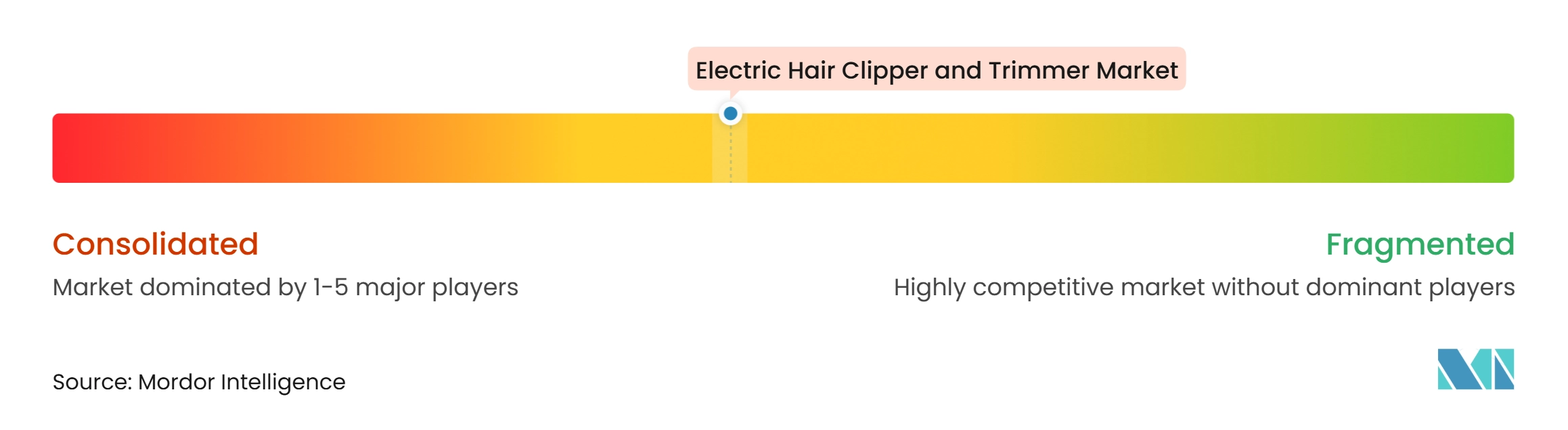
The electric hair clipper and trimmer market is moderately concentrated, with established manufacturers maintaining strong positions in professional and premium consumer segments. These companies benefit from engineering capabilities, professional barber relationships, and extensive distribution networks. Their focus on product performance, durability, and reliability supports their competitive positions. Strong brand recognition and established customer relationships further strengthen their market presence.
Competition remains strong in value and mid-market segments, where manufacturers compete through affordable pricing, product features, and manufacturing efficiency. Cost-effective production capabilities allow companies to serve price-sensitive consumers with a wide range of grooming appliances. Direct-to-consumer channels and targeted marketing strategies also help brands reach specialized consumer groups. This creates opportunities for manufacturers to differentiate their offerings across different price categories.
Established manufacturers are increasingly focusing on product personalization, advanced engineering, and differentiated designs to strengthen their market positions. Growing interest in women's grooming and multifunctional appliances is encouraging companies to diversify their product portfolios. Improvements in blade technology, motor performance, battery efficiency, and ergonomic designs are also supporting product differentiation. These developments create opportunities for innovation while sustaining competition across professional, premium, and value-oriented segments.
Electric Hair Clipper and Trimmer Industry Leaders
-
Koninklijke Philips N.V.
-
Wahl Clipper Corporation
-
Spectrum Brands Holdings, Inc. (Remington Products)
-
Panasonic Holdings Corporation
-
Conair LLC (BaBylissPRO)
- *Disclaimer: Major Players sorted in no particular order
Electric Hair Clipper and Trimmer Market Companies Covered in this Report
- Koninklijke Philips N.V.
- Wahl Clipper Corporation
- Spectrum Brands Holdings, Inc. (Remington Products)
- Panasonic Holdings Corporation
- Conair LLC (BaBylissPRO)
- Andis Company
- Newell Brands, Inc. (Oster Professional)
- Vega Beauty Products
- Flyco Electrical Appliance Co., Ltd.
- Yiwu Kemei Electric Appliances Co., Ltd.
- Xiaomi Corporation
- Beurer GmbH
- JRL USA Inc.
- StyleCraft
- Ningbo VGR Electric Appliance Co., Ltd.
- Hatteker
- Brio Product Group
- The Procter & Gamble Company (Braun)
- MANSCAPED, Inc.
- Nova Consumer Electronics
Recent Industry Developments in Electric Hair Clipper and Trimmer Market
- July 2026: Panasonic launched the BARIKAN ER-XT70 T-Shaped Trimmer and expanded the professional trimmer's availability into Malaysia, featuring Japanese-engineered blades and a high-torque motor.
- March 2026: KooFex introduced the KF-6801 Professional Hair Clipper, a professional clipper featuring an outer-rotor brushless motor, intelligent power management, and an integrated performance display.
- September 2025: Kemei introduced four professional grooming models featuring upgraded blade structures, improved body designs, and enhanced cutting performance for professional barbering applications.
Global Electric Hair Clipper and Trimmer Market Report Scope
The electric hair clipper and trimmer market includes electrically powered appliances used to cut, trim, and style hair for personal and professional grooming. The market is segmented by Product Type, Power Source, End User, Distribution Channel, and Geography. Based on Product Type, it includes Hair Clippers, Hair Trimmers, and Other Product Types. Based on Power Source, it includes Corded and Cordless devices. Based on End User, it includes Men and Women. Based on Distribution Channel, the categories include Supermarkets/Hypermarkets, Specialty Stores, Online Retail Stores, and Other Distribution Channels. By geography, it covers North America, Europe, Asia-Pacific, South America, the Middle East, and Africa, with country-level analysis. Market forecasts are provided in terms of value (USD).
Segmentation Overview
| Hair Clippers |
| Hair Trimmers |
| Other Product Types |
| Corded |
| Cordless |
| Men |
| Women |
| Supermarkets/Hypermarkets |
| Specialty Stores |
| Online Retail Stores |
| Other Distribution Channels |
| North America | United States |
| Canada | |
| Mexico | |
| Rest of North America | |
| Europe | Germany |
| United Kingdom | |
| Italy | |
| France | |
| Spain | |
| Netherlands | |
| Poland | |
| Belgium | |
| Sweden | |
| Rest of Europe | |
| Asia-Pacific | China |
| India | |
| Japan | |
| Australia | |
| Indonesia | |
| South Korea | |
| Thailand | |
| Singapore | |
| Rest of Asia-Pacific | |
| South America | Brazil |
| Argentina | |
| Colombia | |
| Chile | |
| Peru | |
| Rest of South America | |
| Middle East and Africa | South Africa |
| Saudi Arabia | |
| United Arab Emirates | |
| Nigeria | |
| Egypt | |
| Morocco | |
| Turkey | |
| Rest of Middle East and Africa |
| By Product Type | Hair Clippers | |
| Hair Trimmers | ||
| Other Product Types | ||
| By Power Source | Corded | |
| Cordless | ||
| By End User | Men | |
| Women | ||
| By Distribution Channel | Supermarkets/Hypermarkets | |
| Specialty Stores | ||
| Online Retail Stores | ||
| Other Distribution Channels | ||
| By Geography | North America | United States |
| Canada | ||
| Mexico | ||
| Rest of North America | ||
| Europe | Germany | |
| United Kingdom | ||
| Italy | ||
| France | ||
| Spain | ||
| Netherlands | ||
| Poland | ||
| Belgium | ||
| Sweden | ||
| Rest of Europe | ||
| Asia-Pacific | China | |
| India | ||
| Japan | ||
| Australia | ||
| Indonesia | ||
| South Korea | ||
| Thailand | ||
| Singapore | ||
| Rest of Asia-Pacific | ||
| South America | Brazil | |
| Argentina | ||
| Colombia | ||
| Chile | ||
| Peru | ||
| Rest of South America | ||
| Middle East and Africa | South Africa | |
| Saudi Arabia | ||
| United Arab Emirates | ||
| Nigeria | ||
| Egypt | ||
| Morocco | ||
| Turkey | ||
| Rest of Middle East and Africa | ||
Key Questions Answered in the Report
What is the market size of electric hair clipper and trimmer market?
The electric hair clipper and trimmer market is estimated to reach USD 6.25 billion in 2026 and USD 6.57 billion in 2027. The market is projected to grow to USD 8.44 billion by 2032, registering a CAGR of 5.15% during 2027–2032.
Which product category is expanding the fastest?
Hair trimmers are forecast to expand at a CAGR of 6.71% through 2032.
Why are cordless products leading demand?
Cordless devices held 67.15% of 2026 revenue as portability, lithium-ion performance, and flexible use appeal to home and professional users.
Which region is forecast to grow fastest?
The Middle East and Africa are projected to expand at a CAGR of 7.21% through 2032, supported by young populations, urban income growth, and stronger grooming demand.