
Edge AI Medical Software Market Size and Share
Market Overview
| Study Period | 2020 - 2031 |
|---|---|
| Market Size (2026) | USD 0.77 Billion |
| Market Size (2031) | USD 1.81 Billion |
| Growth Rate (2026 - 2031) | 18.45 % |
| Fastest Growing Market | Asia-Pacific |
| Largest Market | North America |
| Market Concentration | Medium |
Major Players *Disclaimer: Major Players sorted in no particular order Image © Mordor Intelligence. Reuse requires attribution under CC BY 4.0. | |
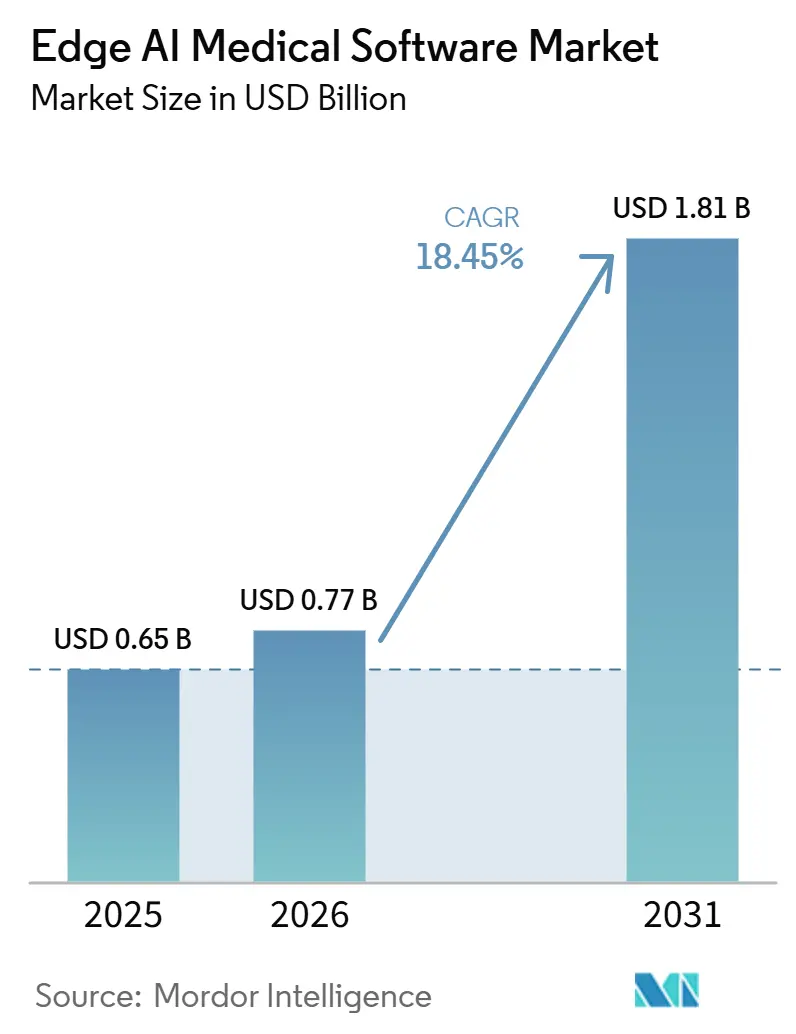
Edge AI Medical Software Market Analysis by Mordor Intelligence
The Edge AI medical software market size was valued at USD 0.65 billion in 2025 and is estimated to grow from USD 0.77 billion in 2026 to reach USD 1.81 billion by 2031, at a CAGR of 18.45% during the forecast period (2026-2031).
The edge AI medical software market is expanding as hospitals move selected AI workloads closer to the patient, where software can support fast clinical decisions without relying on a constant cloud connection. This approach can reduce delay in bedside care, ambulances, remote clinics, and home-based care while helping providers retain control of sensitive health data. The addressable opportunity is widening as clinical teams seek software that works across imaging, monitoring, documentation, and device-based workflows. Vendors are responding by combining clinical algorithms with deployment, governance, and monitoring capabilities rather than offering isolated tools. The edge AI medical software market also faces practical limits, since validation, integration, model monitoring, and payment pathways can slow adoption outside well-funded health systems.
Key Report Takeaways
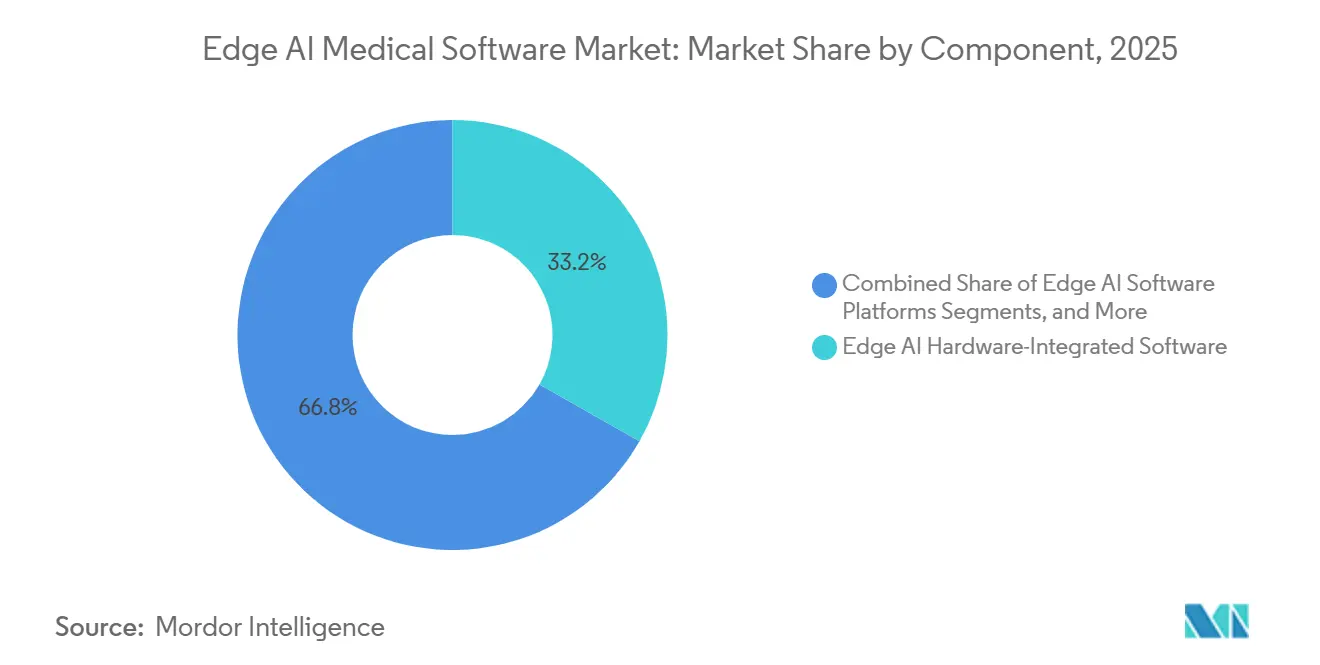
- By component, edge AI hardware-integrated software held 33.22% of revenue in 2025, while edge AI professional and managed services recorded the highest projected CAGR at 20.93% through 2031.
- By software type, medical imaging analysis software held 36.23% of revenue in 2025, while patient monitoring and remote care software recorded the highest projected CAGR at 19.67% through 2031.
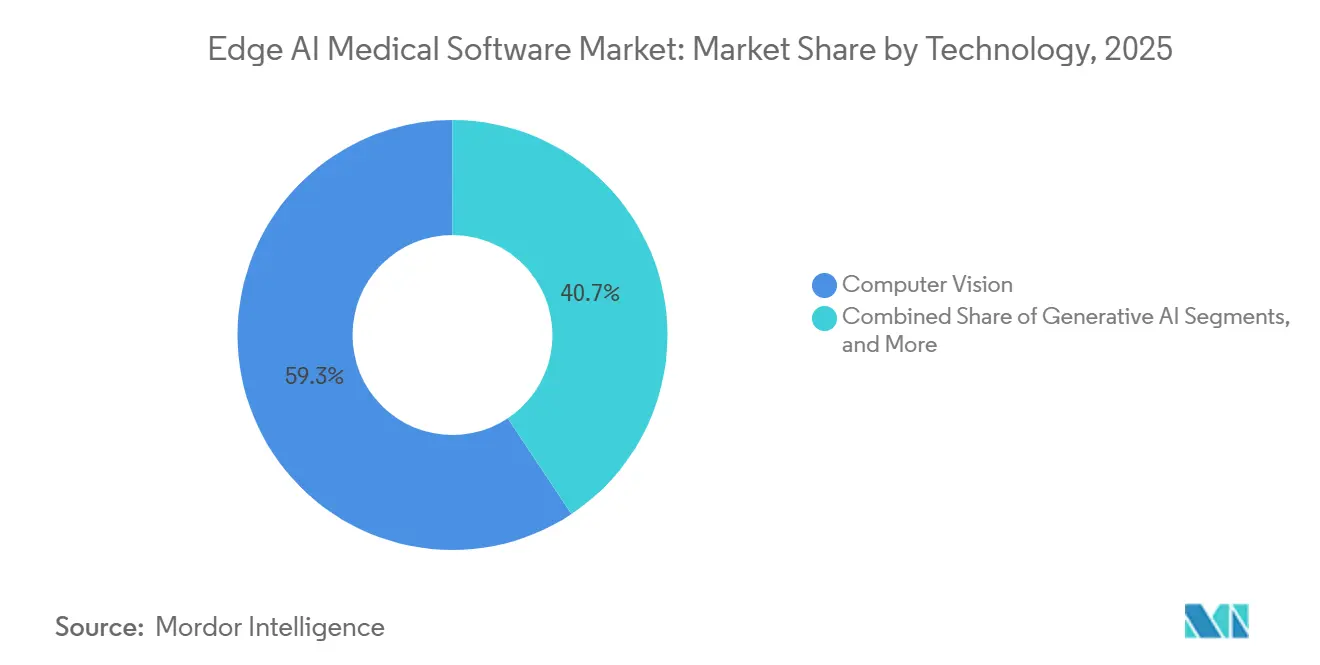
- By technology, computer vision held 59.34% of revenue in 2025, while generative AI recorded the highest projected CAGR at 18.35% through 2031.
- By clinical application, radiology and medical imaging held 32.88% of revenue in 2025, while neurology and stroke care recorded the highest projected CAGR at 19.78% through 2031.
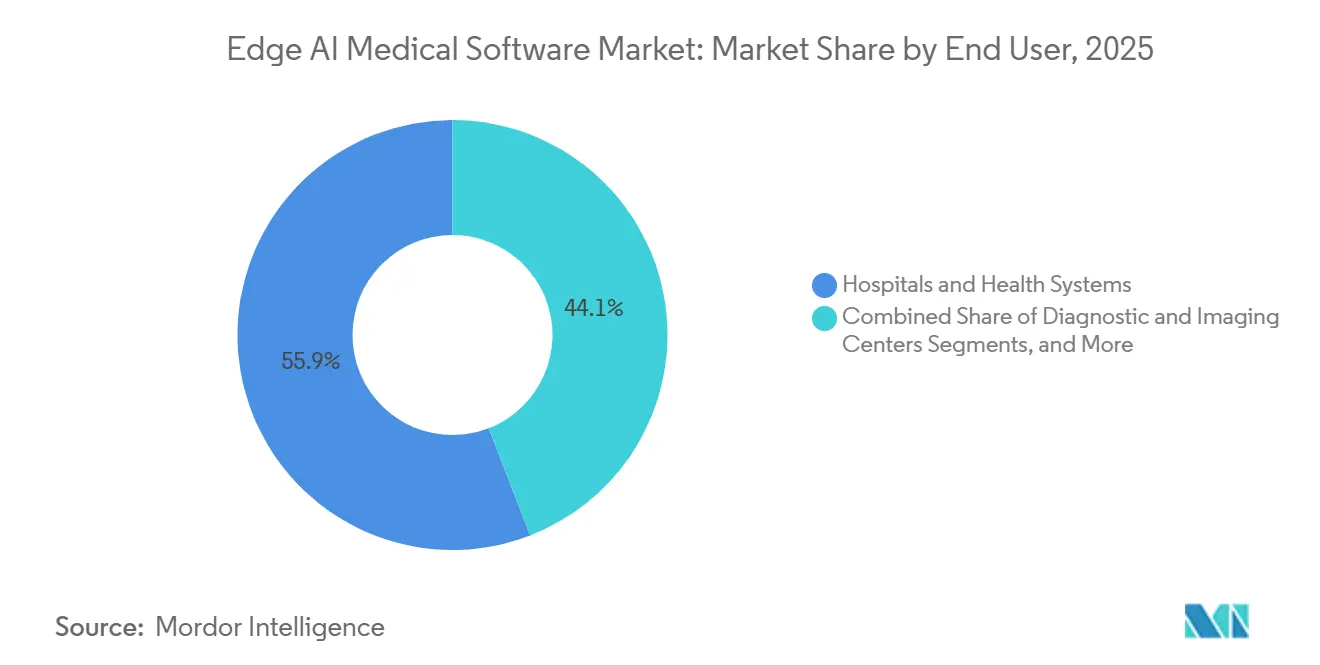
- By end user, hospitals and health systems held 55.89% of revenue in 2025, while diagnostic and imaging centers recorded the highest projected CAGR at 20.45% through 2031.
- By deployment, on-device deployment held 52.45% of revenue in 2025, while on-premises edge server deployment recorded the highest projected CAGR at 22.45% through 2031.
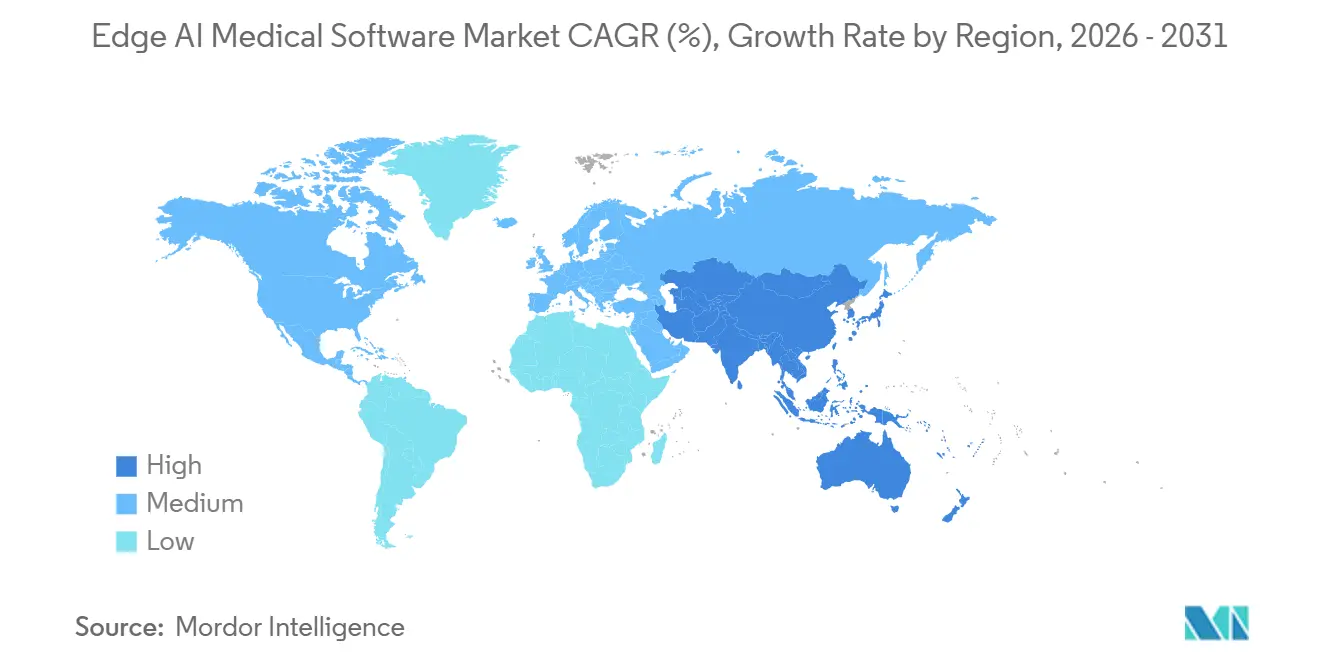
- By geography, North America held 42.76% share in 2025, while Asia-Pacific is forecast to grow at a 19.56% CAGR through 2031.
Note: Market size and forecast figures in this report are generated using Mordor Intelligence’s proprietary estimation framework, updated with the latest available data and insights as of January 2026.
Market Trends and Insights
Drivers Impact Analysis of Edge AI Medical Software Market*
| DRIVER | (~) % IMPACT ON CAGR FORECAST | GEOGRAPHIC RELEVANCE | IMPACT TIMELINE |
|---|---|---|---|
| Real-time clinical decision-making and low-latency inference | +2.8% | Global, concentrated in North America and Europe | Short term (≤ 2 years) |
| Expansion of AI-enabled medical devices and imaging workflows | +2.5% | Global, with Asia-Pacific accelerating | Medium term (2-4 years) |
| Growth of remote patient monitoring and hospital-at-home care | +2.2% | North America and Europe, with spillover to Asia-Pacific | Medium term (2-4 years) |
| Data residency, privacy, and cybersecurity requirements | +1.8% | European Union core, with spillover to North America and Asia-Pacific | Medium term (2-4 years) |
| Federated learning for multi-institutional clinical intelligence | +1.4% | North America and European Union leading, with global adoption | Long term (≥ 4 years) |
| TinlyML and ultra-low-power inference in wearable medical devices | +1.0% | Asia-Pacific core, with spillover to North America | Long term (≥ 4 years) |
| Source: Mordor Intelligence | |||
Real-Time Clinical Decision-Making and Low-Latency Inference
The edge AI medical software market benefits from processing clinical data close to the point of collection, especially in emergency medicine, ambulatory surgery, and other time-sensitive care settings. A 2026 Scientific Reports study reported median inference latency of 118 ms in an edge setup, compared with 246 ms for a cloud-only baseline, with accuracy of 94.7% versus 83.1%. The same study found that INT8 quantization reduced model size by up to 74% while limiting accuracy loss to 0.4 percentage points.[1]P. Karpagam, M. Karthikeyan, G. Kalpana et al., “Edge-AI Enabled Secure IoT Framework for Real-Time Patient Monitoring and Anomaly Detection in Smart Healthcare Systems,” Scientific Reports, nature.com. These results made local inference more viable for community hospitals with limited budgets for large GPU-server installations and helped vendors serve clinical sites that had not adopted enterprise PACS-integrated AI.
Expansion of AI-Enabled Medical Devices and Imaging Workflows
The growing range of AI-enabled medical devices increased the need for software that can operate safely within local clinical workflows. Imaging systems, point-of-care devices, and procedural platforms require model management and inference environments aligned with hardware and regulatory requirements. In April 2026, Abbott received FDA clearance and CE Mark for Ultreon 3.0, an AI-powered coronary imaging platform that combines real-time planning guidance with automated blood-flow assessment. Such product development expanded the need for edge software across imaging data, device controls, and workflow integration, supporting market growth across cardiology, neurology, oncology, and other clinical areas.
Growth of Remote Patient Monitoring and Hospital-at-Home Care
Hospital-at-home programs created demand for software that can evaluate patient data beyond traditional hospital campuses. These programs combine acute care, monitoring devices, telehealth, and clinical coordination, making dependable data handling essential. A 2026 Journal of Medical Internet Research article described how new technology supported acute care delivery in patients’ homes. Local processing helped monitoring systems respond to vital-sign changes without repeated data transfers to a central cloud environment, although providers still needed clear workflows and clinical oversight to scale these services.[2]J. Congdon, “Hospital-at-Home: New Technology Brings Acute Care to Patients’ Homes,” Journal of Medical Internet Research, jmir.org.
Data Residency, Privacy, and Cybersecurity Requirements
Health systems placed greater emphasis on architectures that keep protected health information within their own environments. This requirement became important as providers aligned clinical AI operations with privacy rules, cybersecurity controls, and internal governance practices. A 2026 IEEE conference paper reported that a 6-bit quantized medical language model operated locally and achieved 81.20% accuracy on Italian medical specialization examinations.[3]J. Zhao et al., “Quantized Medical LLMs for Edge Deployment: A Privacy-Preserving RAG System,” IEEE Conference on Artificial Intelligence, ieee.org. This finding supported procurement decisions favoring on-premises or device-based deployments and made compliance a core product requirement in the edge AI medical software market.
Restraints Impact Analysis of Edge AI Medical Software Market*
| RESTRAINT | (~) % IMPACT ON CAGR FORECAST | GEOGRAPHIC RELEVANCE | IMPACT TIMELINE |
|---|---|---|---|
| High deployment, validation, and lifecycle-management costs | -1.5% | Global, most acute in smaller and community hospitals | Medium term (2-4 years) |
| Limited reimbursement alignment for medical AI software | -1.2% | North American, European Union, and Asia-Pacific payers | Medium term (2-4 years) |
| Model drift across patient populations and clinical workflows | -0.9% | Global | Long term (≥ 4 years) |
| Heterogeneous edge hardware, connectivity, and legacy-system integration | -0.8% | Asia-Pacific, Middle East and Africa, and South America | Long term (≥ 4 years) |
| Source: Mordor Intelligence | |||
High Deployment, Validation, and Lifecycle-Management Costs
Institutional deployment requires more than purchasing an algorithm or an edge device. Health systems must validate clinical performance, integrate software with existing systems, train staff, and maintain models after go-live. These requirements can make implementation difficult for community hospitals, even when local processing supports their care settings. Ongoing workflow changes and safety and performance reviews can add costs, favoring vendors that offer managed services, monitoring, and regulatory support, while early adoption may remain concentrated in larger tertiary centers with established clinical informatics resources.
Limited Reimbursement Alignment for Medical AI Software
Reimbursement remains uneven across medical AI use cases, particularly in outpatient and home-based settings. The gap between regulatory authorization and payment clarity can make it difficult for providers to justify new deployments. While defined billing mechanisms can support adoption, many edge-based software applications do not receive comparable payment treatment. Providers may delay adoption despite clinical value, slowing growth in the edge AI medical software market where organizations must absorb costs until reimbursement rules become clearer.
*Our forecasts treat driver/restraint impacts as directional, not additive. The impact forecasts reflect baseline growth, mix effects, and variable interactions.
Edge AI Medical Software Market Segment Analysis
By Component:
Hardware Integration Anchors Revenue, Services Drive GrowthEdge AI hardware-integrated software held 33.22% of revenue in 2025, making it the largest component group in the edge AI medical software market. This category includes software embedded in imaging systems, surgical platforms, and point-of-care medical devices. Its leadership reflects the value of running inference close to the device where clinical data originates. Once an original equipment manufacturer integrates a software layer into a scanner or ultrasound system, switching costs can rise as updates, validation, and retraining remain tied to that ecosystem.
Edge AI software platforms connect individual models with broader clinical workflows. They support model orchestration, workflow integration, and management across devices from different suppliers. Their role is becoming more important as hospitals run several algorithms without creating separate processes for each one. Edge AI professional and managed services is forecast to grow at a CAGR of 20.93% through 2031, driven by demand from health systems that lack dedicated teams for governance, monitoring, validation, and audit processes.



By Software Type:
Imaging Dominates Revenue, Patient Monitoring AcceleratesMedical imaging analysis software accounted for 36.23% of the edge AI medical software market share in 2025. The category benefits from high imaging volumes and the need to prioritize studies when radiology resources are constrained. It is expanding beyond detection into report generation, strengthening its role in imaging workflows. Lunit announced in December 2025 that its multimodal foundation models would support chest X-ray report generation across SimonMed Imaging’s more than 175 locations.
Patient monitoring and remote care software is forecast to grow at a CAGR of 19.67% through 2031, the highest rate among software types. Hospital-at-home programs and monitoring devices that generate continuous patient data streams support this growth. Local software can process these streams faster when network availability or data governance limits a cloud-first approach. Medical data management, interoperability software, clinical documentation, and ambient intelligence tools are also gaining traction across electronic health record and clinical workflow environments.
By Technology:
Computer Vision Leads, Generative AI Reshapes the StackComputer vision held 59.34% of technology revenue in 2025, reflecting the central role of imaging in clinical AI. It supports image analysis in radiology, pathology, endoscopy, and surgical guidance. The technology can run through lightweight bedside models or accelerated local servers at high-throughput imaging centers. Its broad applicability supports multiple types of visual clinical data and high-volume scan prioritization.
Generative AI is forecast to grow at a CAGR of 18.35% through 2031, the fastest rate among the technologies assessed. Its use cases include draft reports, clinical note summaries, and multimodal diagnostic content. Aidoc received FDA Breakthrough Device Designation in June 2026 for First Read, a feature designed to analyze chest radiographs and generate preliminary radiology reports across more than 100 findings. This development moved generative functions closer to regulated diagnostic workflows.
By Clinical Application:
Radiology Anchors the Market, Neurology Pushes Speed LimitsRadiology and medical imaging represented 32.88% of 2025 clinical application revenue in the edge AI medical software market. This position reflects the high data volume in imaging workflows and the need for triage and prioritization. Local processing can help analyze images quickly near the scanner or within a hospital network. The category also supports report generation and structured review functions that extend AI beyond single-task detection.
Neurology and stroke care is forecast to grow at a CAGR of 19.78% through 2031, making it the fastest-growing clinical application. Stroke triage requires rapid and consistent review because treatment options depend on timing. A study discussed by RapidAI and published in the American Journal of Neuroradiology in May 2026 covered 1,589 consecutive code strokes and reported 98% sensitivity for a leading platform, compared with 73.5% for a competing platform, in large-vessel-occlusion detection. The result highlights why performance evidence is becoming more relevant in purchasing decisions.
By End User:
Hospitals Lead, Diagnostic Centers AccelerateHospitals and health systems accounted for 55.89% of 2025 end-user revenue, the largest share in the edge AI medical software market. Large networks operate across many sites, devices, and patient workflows, creating a need for centralized oversight of models and integrations. They also have the scale to support validation, training, and ongoing performance management. Aidoc reported that Asklepios completed a radiology AI rollout across 28 hospitals in Germany by the end of 2025.
Diagnostic and imaging centers are forecast to grow at a CAGR of 20.45% through 2031, the fastest end-user rate. Independent imaging networks are investing in AI to improve turnaround times and compete with hospital-affiliated radiology departments. Their operating model can favor local inference infrastructure that processes studies quickly while retaining data control. These centers also need workflow-ready tools that do not require large internal informatics teams, making managed deployment and maintenance services relevant.
By Deployment:
On-Device Leads, On-Premises Edge Server Grows FastestOn-device deployment held 52.45% of revenue in 2025, making it the leading deployment model in the edge AI medical software market. It places inference directly inside a scanner, wearable, ultrasound probe, handheld device, or another clinical tool. This model can reduce reliance on external network access and support use in remote clinics, ambulances, and home settings. It also helps providers keep data near its original point of collection.
On-premises edge server deployment is forecast to grow at a CAGR of 22.45% through 2031, the highest rate among deployment models. Imaging centers, hospital radiology departments, and genomics laboratories use this approach when they need immediate processing of large data files within their facilities. It provides a middle path between device-based inference and fully centralized cloud processing. Private edge cloud, public cloud, and edge-cloud hybrid models remain relevant for systems that want centralized management without configuring each device separately.
Geography Analysis
North America Edge AI Medical Software Market
North America held 42.76% of the edge AI medical software market share in 2025, supported by established health IT investments, large hospital networks, and a strong base of clinical AI platforms. The United States remained central to regional growth, as its regulatory and payment environment shaped product development and provider purchasing decisions. Abbott’s April 2026 clearance for Ultreon 3.0 highlighted continued AI product activity in coronary imaging. Canada’s virtual ward programs and Mexico’s digital health activity added opportunities for local data processing in community settings, while regional vendors combined clinical software with infrastructure and deployment support.
Europe Edge AI Medical Software Market
Europe is the second-largest regional revenue contributor in the edge AI medical software market. Germany supported clinical AI infrastructure through the Hospital Future Act, and the Asklepios rollout across 28 hospitals showed how funding and implementation readiness supported larger deployments. The United Kingdom also used AI-supported remote monitoring in virtual ward care. European providers prioritized data handling, governance, and systems aligned with existing clinical processes, supporting edge architectures that retained patient information within the provider environment. France, Italy, and Spain also developed digital health frameworks linked to the European Health Data Space, making compliance and integration key purchasing factors.
APAC, MEA and South America Edge AI Medical Software Market
Asia-Pacific is forecast to grow at a CAGR of 19.56% through 2031, the fastest regional growth rate. Large patient populations, expanding hospital networks, and policy interest in digital health supported demand for locally deployable clinical AI. NVIDIA, Foxconn, and Taiwan medical centers announced a June 2026 collaboration to deploy agentic and physical AI in hospital workflows, including breast cancer screening, ECG analysis, fundus imaging, and coronary artery analysis. India also remained relevant for point-of-care applications in settings with constrained connectivity. The Middle East and Africa and South America remained at earlier stages of adoption, with Gulf Cooperation Council countries and Brazil contributing to broader digital health activity.

Competitive Landscape
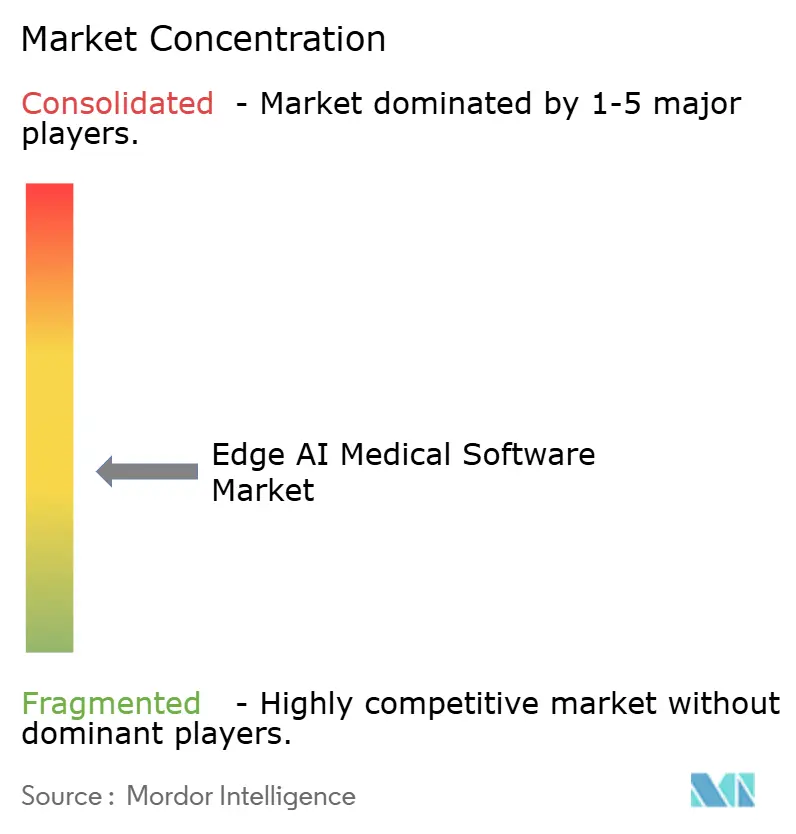
The edge AI medical software market is moderately fragmented, with pure-play clinical AI providers, medtech companies, and infrastructure suppliers addressing different parts of the value chain. Pure-play vendors compete on clinical performance, workflow integration, and clinical evidence, while medtech suppliers embed AI into proprietary device ecosystems to strengthen hardware-software integration. Infrastructure providers support local computing, model development, and deployment. Healthcare providers increasingly prefer unified tools that can govern, monitor, and update multiple applications, allowing smaller specialty vendors to compete through focused clinical value and platform integration.
Aidoc pursued a platform strategy through regulatory activity and investment. The company received FDA Breakthrough Device Designation in June 2026 for First Read, a chest radiograph feature that drafts preliminary reports across more than 100 findings. This expanded Aidoc’s focus from prioritization to a broader role in radiology reporting, where deployment must align with providers’ review and sign-off procedures. Aidoc also raised USD 150 million in Series E funding in April 2026, bringing its total funding to more than USD 500 million to support CARE foundation model development and global deployment. Lunit’s deployment of multimodal foundation models across SimonMed Imaging’s more than 175 locations also showed how vendors are moving from narrow imaging functions toward scaled reporting workflows.
NVIDIA strengthened the infrastructure layer through platforms that support real-time medical edge computing. Its IGX Thor platform gave original equipment manufacturers an option for safety-oriented hardware and a supported software lifecycle. Advantech’s March 2026 USM-500 launch showed how this infrastructure can support CT analysis, surgical visualization, and diagnostic support. Providers are likely to favor vendors that can enable multiple applications across existing device, data, and governance environments, supporting partnerships among algorithm developers, medical device suppliers, and computing providers.
Edge AI Medical Software Industry Leaders
GE Medical Systems, LLC
Medtronic Navigation, Inc.
Siemens Medical Solutions USA, Inc.
Tempus AI, Inc.
Aidoc Medical Ltd.
- *Disclaimer: Major Players sorted in no particular order
Edge AI Medical Software Market Companies Covered in this Report
- Aidoc Medical Ltd.
- Amazon Web Services, Inc.
- Butterfly Network, Inc.
- Canon
- Clarius Mobile Health Corp.
- Digital Diagnostics
- GE Medical Systems, LLC
- Google LLC
- Heartflow
- IBM
- Lunit, Inc.
- Medtronic Navigation, Inc.
- Microsoft
- NVIDIA
- Philips Medical Systems Nederland B.V.
- Qure.ai Technologies Pvt. Ltd.
- RapidAI, Inc.
- Siemens Medical Solutions USA, Inc.
- Tempus AI, Inc.
- Viz.ai, Inc.

Recent Industry Developments in Edge AI Medical Software Market
- July 2026: Viz.ai supported the MINUTE Trial, a prospective, multicenter, randomized study evaluating the SCUBA technique for ultra-early intracerebral hemorrhage evacuation using the Viz Neuro Suite.
- July 2026: Barts Health NHS Trust deployed Ovia’s AI-powered telephone monitoring service to remotely manage heart and lung patients through virtual wards, with early results indicating lower winter 2024/25 healthcare utilization.
- June 2026: Aidoc received FDA Breakthrough Device Designation for First Read, an AI feature that analyzed chest radiographs and generated preliminary radiology reports across more than 100 clinical findings.
- June 2026: NVIDIA, Foxconn, and medical centers in Taiwan collaborated to deploy agentic and physical AI in hospitals, including CoDoClaw for breast cancer screening, ECG analysis, fundus imaging, and coronary artery analysis.
- April 2026: Abbott received FDA clearance and CE Mark approval for Ultreon 3.0, an AI-powered coronary imaging platform using optical coherence tomography with real-time planning guidance and automated blood-flow assessment.


Global Edge AI Medical Software Market Report Scope
As per the scope of the report, Edge AI medical software is specialized artificial intelligence programs that run locally on hardware devices (such as smart monitors, portable scanners, or wearables) rather than on distant cloud servers. It enables real-time data processing, offline clinical use, and high data privacy.
The edge AI medical software market is segmented by component, software type, technology, clinical application, end user, deployment, and geography. By component, the market includes edge AI hardware-integrated software, edge AI software platforms, and edge AI professional and managed services. By software type, the market is segmented into clinical decision support software, medical imaging analysis software, patient monitoring and remote care software, surgical and procedural guidance software, medical data management and interoperability software, and clinical documentation and ambient intelligence software. By technology, the market is segmented into machine learning and deep learning, computer vision, natural language processing, and generative AI. By clinical application, the market is categorized into radiology and medical imaging, cardiology, neurology and stroke care, oncology and digital pathology, ophthalmology, gastroenterology, obstetrics and women’s health, critical care and emergency medicine, remote patient monitoring and chronic disease management, and others. By end user, the market is segmented into hospitals and health systems, diagnostic and imaging centers, ambulatory surgical centers, long-term and home-care providers, physician offices and primary-care clinics, emergency medical services, pharmaceutical and biotechnology companies, and academic and research institutions. By deployment, the market is segmented into on-device, on-premises edge server, private edge cloud, and public cloud and edge-cloud hybrid. By geography, the market is analyzed across North America, Europe, Asia-Pacific, the Middle East and Africa, and South America. The report also covers the estimated market sizes and trends for 17 countries across major regions globally. The report offers the market sizes and forecasts in terms of value (USD) for the above segments.
| Edge AI Hardware-Integrated Software |
| Edge AI Software Platforms |
| Edge AI Professional and Managed Services |
| Clinical Decision Support Software |
| Medical Imaging Analysis Software |
| Patient Monitoring and Remote Care Software |
| Surgical and Procedural Guidance Software |
| Medical Data Management and Interoperability Software |
| Clinical Documentation and Ambient Intelligence Software |
| Machine Learning and Deep Learning |
| Computer Vision |
| Natural Language Processing |
| Generative AI |
| Radiology and Medical Imaging |
| Cardiology |
| Neurology and Stroke Care |
| Oncology and Digital Pathology |
| Ophthalmology |
| Gastroenterology |
| Obstetrics and Women's Health |
| Critical Care and Emergency Medicine |
| Remote Patient Monitoring and Chronic Disease Management |
| Others |
| Hospitals and Health Systems |
| Diagnostic and Imaging Centers |
| Ambulatory Surgical Centers |
| Long-Term and Home-Care Providers |
| Physician Offices and Primary-Care Clinics |
| Emergency Medical Services |
| Pharmaceutical and Biotechnology Companies |
| Academic and Research Institutions |
| On-Device |
| On-Premises Edge Server |
| Private Edge Cloud |
| Public Cloud and Edge-Cloud Hybrid |
| North America | United States |
| Canada | |
| Mexico | |
| Europe | Germany |
| United Kingdom | |
| France | |
| Italy | |
| Spain | |
| Rest of Europe | |
| Asia-Pacific | China |
| India | |
| Japan | |
| Australia | |
| South Korea | |
| Rest of Asia-Pacific | |
| Middle East and Africa | GCC |
| South Africa | |
| Rest of Middle East and Africa | |
| South America | Brazil |
| Argentina | |
| Rest of South America |
| By Component | Edge AI Hardware-Integrated Software | |
| Edge AI Software Platforms | ||
| Edge AI Professional and Managed Services | ||
| By Software Type | Clinical Decision Support Software | |
| Medical Imaging Analysis Software | ||
| Patient Monitoring and Remote Care Software | ||
| Surgical and Procedural Guidance Software | ||
| Medical Data Management and Interoperability Software | ||
| Clinical Documentation and Ambient Intelligence Software | ||
| By Technology | Machine Learning and Deep Learning | |
| Computer Vision | ||
| Natural Language Processing | ||
| Generative AI | ||
| By Clinical Application | Radiology and Medical Imaging | |
| Cardiology | ||
| Neurology and Stroke Care | ||
| Oncology and Digital Pathology | ||
| Ophthalmology | ||
| Gastroenterology | ||
| Obstetrics and Women's Health | ||
| Critical Care and Emergency Medicine | ||
| Remote Patient Monitoring and Chronic Disease Management | ||
| Others | ||
| By End User | Hospitals and Health Systems | |
| Diagnostic and Imaging Centers | ||
| Ambulatory Surgical Centers | ||
| Long-Term and Home-Care Providers | ||
| Physician Offices and Primary-Care Clinics | ||
| Emergency Medical Services | ||
| Pharmaceutical and Biotechnology Companies | ||
| Academic and Research Institutions | ||
| By Deployment | On-Device | |
| On-Premises Edge Server | ||
| Private Edge Cloud | ||
| Public Cloud and Edge-Cloud Hybrid | ||
| By Geography | North America | United States |
| Canada | ||
| Mexico | ||
| Europe | Germany | |
| United Kingdom | ||
| France | ||
| Italy | ||
| Spain | ||
| Rest of Europe | ||
| Asia-Pacific | China | |
| India | ||
| Japan | ||
| Australia | ||
| South Korea | ||
| Rest of Asia-Pacific | ||
| Middle East and Africa | GCC | |
| South Africa | ||
| Rest of Middle East and Africa | ||
| South America | Brazil | |
| Argentina | ||
| Rest of South America | ||


Key Questions Answered in the Report
What is driving demand for edge AI medical software?
Demand is supported by the need for local clinical processing, faster decisions, stronger data control, imaging workflows, and remote patient monitoring. A 2026 study reported median edge inference latency of 118 ms compared with 246 ms for a cloud-only baseline, which is relevant in time-sensitive care.
How large is the edge AI medical software market in 2026?
The edge AI medical software market size is USD 0.77 billion in 2026 and is forecast to reach USD 1.81 billion by 2031 at a CAGR of 18.45%. Growth is linked to clinical imaging, remote care, local data processing, and software that connects models with established care workflows.
Which software category holds the largest revenue share?
Medical imaging analysis software held 36.23% of revenue in 2025. The category is supported by high imaging volumes, AI-assisted triage, reporting functions, and the need to integrate results within radiology workflows.
Which end users are adopting edge AI medical software fastest?
Diagnostic and imaging centers are forecast to grow at a CAGR of 20.45% through 2031. These organizations seek faster diagnostic turnaround, local handling of imaging data, and workflow differentiation from hospital-affiliated radiology departments.
Why is on-device deployment important for healthcare providers?
On-device deployment held 52.45% of revenue in 2025 because it processes data close to the medical device and reduces reliance on external connectivity. It can support scanners, wearables, ultrasound probes, handheld devices, ambulances, remote clinics, and home-care settings. Providers must still maintain validation, updates, and performance monitoring throughout the device lifecycle.
What limits wider adoption of edge AI medical software?
Deployment, validation, model lifecycle costs, and uneven reimbursement can limit adoption, especially in smaller hospitals and outpatient settings. Organizations also need staff training, workflow redesign, integration, performance review, and a plan to manage models over time across facilities, devices, and clinical teams.
Page last updated on:





