
Earthen Plasters Market Size and Share
Market Overview
| Study Period | 2021 - 2031 |
|---|---|
| Market Size (2026) | USD 94.17 Billion |
| Market Size (2031) | USD 116.57 Billion |
| Growth Rate (2026 - 2031) | 4.36 % |
| Fastest Growing Market | Asia-Pacific |
| Largest Market | Asia-Pacific |
| Market Concentration | Low |
Major Players *Disclaimer: Major Players sorted in no particular order Image © Mordor Intelligence. Reuse requires attribution under CC BY 4.0. | |
Earthen Plasters Market Analysis by Mordor Intelligence
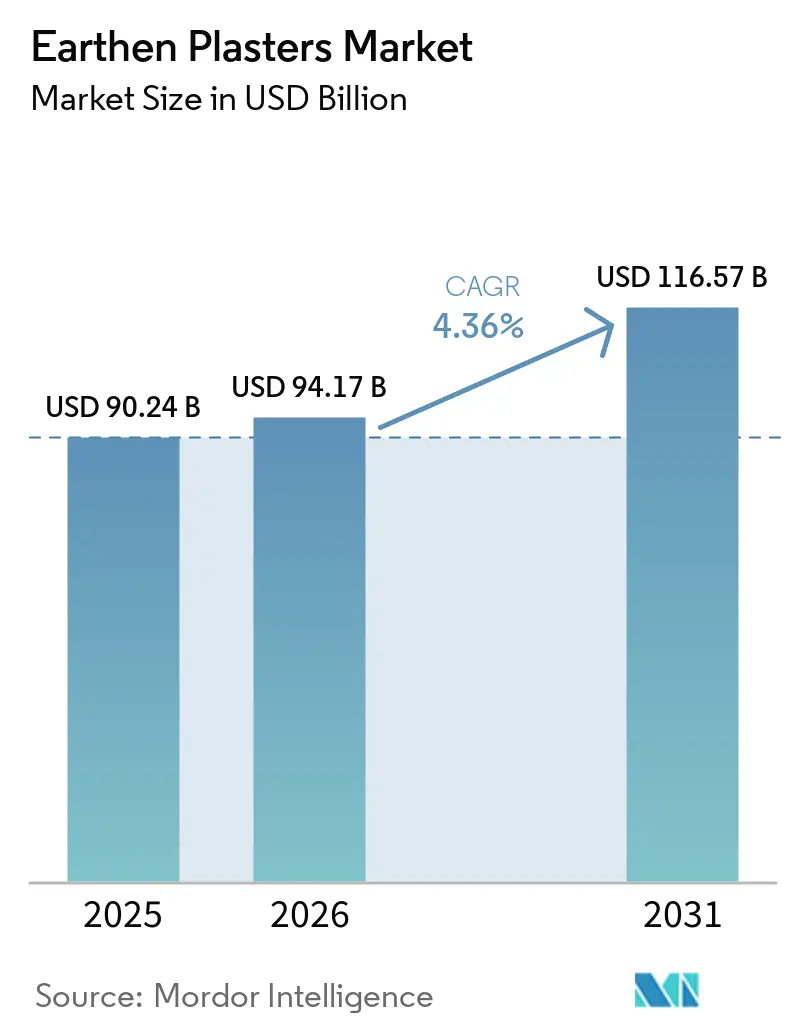
The Earthen Plasters Market size was valued at USD 90.24 billion in 2025 and is estimated to grow from USD 94.17 billion in 2026 to reach USD 116.57 billion by 2031, at a CAGR of 4.36% during the forecast period (2026-2031). The earthen plasters market is being supported by building rules that increasingly assess the full life-cycle carbon impact of construction products. It also benefits from demand for finishes that regulate indoor moisture without synthetic additives. Heritage renovation remains an important source of specifications because historic earthen substrates require compatible and vapor-permeable materials. Product documentation, tested performance, and installer capability are becoming more important for suppliers seeking commercial projects. The outlook remains constrained by uneven application quality, moisture-related concerns in humid climates, and incomplete fire-rating evidence in some jurisdictions.
Key Report Takeaways
- By product type, clay-based plasters held 42.45% of the earthen plasters market share in 2025, while fiber-reinforced earthen plasters are projected to advance at a 5.38% CAGR through 2031.
- By application, interior wall finishes held 37.67% of the earthen plasters market share in 2025, while restoration and heritage buildings are projected to advance at a 5.10% CAGR through 2031.
- By end-use, residential buildings held 48.26% of the earthen plasters market share in 2025, while institutional buildings are projected to advance at a 4.89% CAGR through 2031.
- By geography, Asia-Pacific held 41.03% of the earthen plasters market share in 2025 and is projected to advance at a 5.04% CAGR through 2031.
Note: Market size and forecast figures in this report are generated using Mordor Intelligence’s proprietary estimation framework, updated with the latest available data and insights as of January 2026.
Market Trends and Insights
Drivers Impact Analysis of Earthen Plasters Market*
| Driver | (~) % Impact on CAGR Forecast | Geographic Relevance | Impact Timeline |
|---|---|---|---|
| Low-Carbon and Healthy-Building Material Adoption | +1.2% | Global, with highest pull in EU, North America, and East Asia | Medium term (2–4 years) |
| Green-Building and Embodied-Carbon Disclosure Requirements | +1.0% | EU core, with spillover to North America and Australia | Medium term (2–4 years) |
| Indoor Humidity and Air-Quality Performance Demand | +0.7% | Global; especially APAC and Northern Europe | Short term (≤ 2 years) |
| Heritage Renovation and Traditional-Building Conservation | +0.5% | EU, Middle-East, North Africa, and South Asia | Medium term (2–4 years) |
| Standardized Premixes and Application-System Innovation | +0.3% | EU, North America | Short term (≤ 2 years) |
| Local Clay Mineralogy Digitization and Formulation Optimization | +0.2% | Global; early adoption in Germany and Netherlands | Long term (≥ 4 years) |
| Source: Mordor Intelligence | |||
Low-Carbon and Healthy-Building Material Adoption
Earth-based wall finishes can reduce the carbon burden of a wall assembly when compared with concrete-based alternatives. A 2025 study found that clay-based plaster on wood-frame walls improved thermal inertia while reducing the assembly’s environmental impact. The earthen plasters market, therefore, has a practical case in projects where material choices must demonstrate lower emissions as well as adequate thermal performance. A 2026 review reported that earthen systems can achieve U-values of 0.45 - 0.80 W/m²·K without added insulation. These values support use in residential and commercial envelopes that require passive thermal performance and robust material evidence, helping to narrow the practical specification gap with conventional finish systems. Zero Volatile Organic Compound (VOC) emissions, natural humidity regulation, and the absence of synthetic additives support health-focused procurement and can reinforce demand when sustainability and wellness requirements are considered together.
Green-Building and Embodied-Carbon Disclosure Requirements
Mandatory disclosure requirements are moving embodied carbon from a voluntary consideration into a documented building-performance measure. The European Commission’s December 2025 framework under the Energy Performance of Buildings Directive (EPBD) 2024/1275 requires life-cycle Global Warming Potential (GWP) disclosure in energy performance certificates for buildings above 1,000 m² from 2028 and for all new buildings from 2030[1]. The earthen plasters market is positioned to benefit because low-carbon finishes can be assessed alongside other materials in a project’s life-cycle calculation. This framework makes verified product information and environmental documentation more useful for producers seeking commercial specifications, particularly where design teams must compare materials line by line. The revised Construction Products Regulation became generally applicable on January 8, 2026, and began the transition toward digital product passports and climate-impact reporting for construction product families. Suppliers with established Environmental Product Declaration (EPD) systems can be better placed to meet documentation needs and explain the cost of an earthen finish against compliance and life-cycle considerations.
Indoor Humidity and Air-Quality Performance Demand
Demand for humidity control and indoor air quality is strengthening the case for breathable interior finishes. A doctoral study from the Indian Institute of Science found that regulated indoor humidity in vernacular and conventional buildings was associated with improved respiratory comfort. The study identified an acceptable comfortable humidity ratio of 17.4-22.6 g water vapor/kg dry air. The earthen plasters market benefits from clay’s ability to absorb and release water vapor through daily humidity cycles without energy input, chemical additives, or active mechanical controls. A 2026 review found that passive hygrothermal regulation from earthen envelopes can reduce reliance on mechanical conditioning systems. This is relevant to schools, healthcare buildings, and commercial renovations where indoor environmental quality is part of the project brief. CLAYWORKS has verified VOC emissions against Leadership in Energy and Environmental Design (LEED), Building Research Establishment Environmental Assessment Method (BREEAM), and WELL Building Standard requirements, giving project teams supporting documentation across these certification systems.
Heritage Renovation and Traditional-Building Conservation
Heritage work supports demand because earthen substrates require mineral-compatible repair materials. A review of earthen-site conservation stated that 17% of world heritage sites contain earthen components. The earthen plasters market consequently serves vernacular farmhouses, historic urban centers, rammed-earth buildings, and monuments where unsuitable finishes can damage original fabric or trap moisture within historic walls. UNESCO and the International Centre for Earthen Architecture (CRAterre) carried out emergency work at the Ziggurat of Ashur in Iraq during October and November 2025, including earthen plaster repair and practical training for Iraqi archaeologists. A 2025 study of the Mogao Grottoes examined deterioration caused by sodium chloride and sodium sulfate migration in earthen plasters. The findings support more evidence-based material selection for salt-affected historic fabric, while skills developed in heritage work can be used in premium residential and boutique hospitality projects.
Restraints Impact Analysis of Earthen Plasters Market*
| Restraint | (~) % Impact on CAGR Forecast | Geographic Relevance | Impact Timeline |
|---|---|---|---|
| Installer Skill Scarcity and Application Variability | -1.3% | EU (acute in Germany, Netherlands, UK); North America | Medium term (2–4 years) |
| Moisture, Drying-Time, and Durability Perception | -0.9% | Global; strongest in high-humidity APAC and tropical markets | Short term (≤ 2 years) |
| Inconsistent Regional Standards and Fire-Rating Evidence | -0.5% | Fragmented EU; North America; APAC | Medium term (2–4 years) |
| Local Raw-Material Variability and Logistics Exposure | -0.3% | APAC, South America, MEA | Long term (≥ 4 years) |
| Source: Mordor Intelligence | |||
Installer Skill Scarcity and Application Variability
Earthen plastering requires material knowledge that standard plastering training does not always provide. Clay workability, shrinkage, and surface quality depend on mixing consistency, ambient humidity, substrate preparation, and applicator experience. The earthen plasters market can lose repeat commercial specifications when an installation produces uneven results or raises durability concerns that remain associated with the material rather than the installation process. The European Construction Blueprint 2 reported in March 2026 that specialist finishing trades were among the urgent skills needs identified across 10 European Union countries. Factory-calibrated premixes and prefabricated panel systems can reduce some application variability. However, predictable outcomes in mainstream projects still depend on trained installers, clear trade certification pathways, and a widely recognized system that buyers can use to manage application risk.
Moisture, Drying-Time, and Durability Perception
Moisture buffering is a material benefit, but it can also raise questions in humid climates. A 2024 study of tropical earthen plastering mortars found that clay-rich formulations experienced a sharper reduction in compressive strength than flexural strength after high-humidity conditioning. A 2025 study of Mogao Grottoes plasters showed that samples containing 5% sodium chloride failed at relative humidity of 97.59% or higher because of deliquescence-related weakening. The earthen plasters market also faces schedule concerns because drying can take longer than gypsum-based alternatives, increasing delivery risk where construction sequencing is tightly managed. These concerns are pronounced in high-turnover commercial construction and tropical coastal locations. Fiber reinforcement and natural lime stabilization can improve durability, but inconsistent field application, uneven access to validated data, and the absence of common performance tests continue to reinforce caution among specifiers.
*Our forecasts treat driver/restraint impacts as directional, not additive. The impact forecasts reflect baseline growth, mix effects, and variable interactions.
Earthen Plasters Market Segment Analysis
By Product Type:
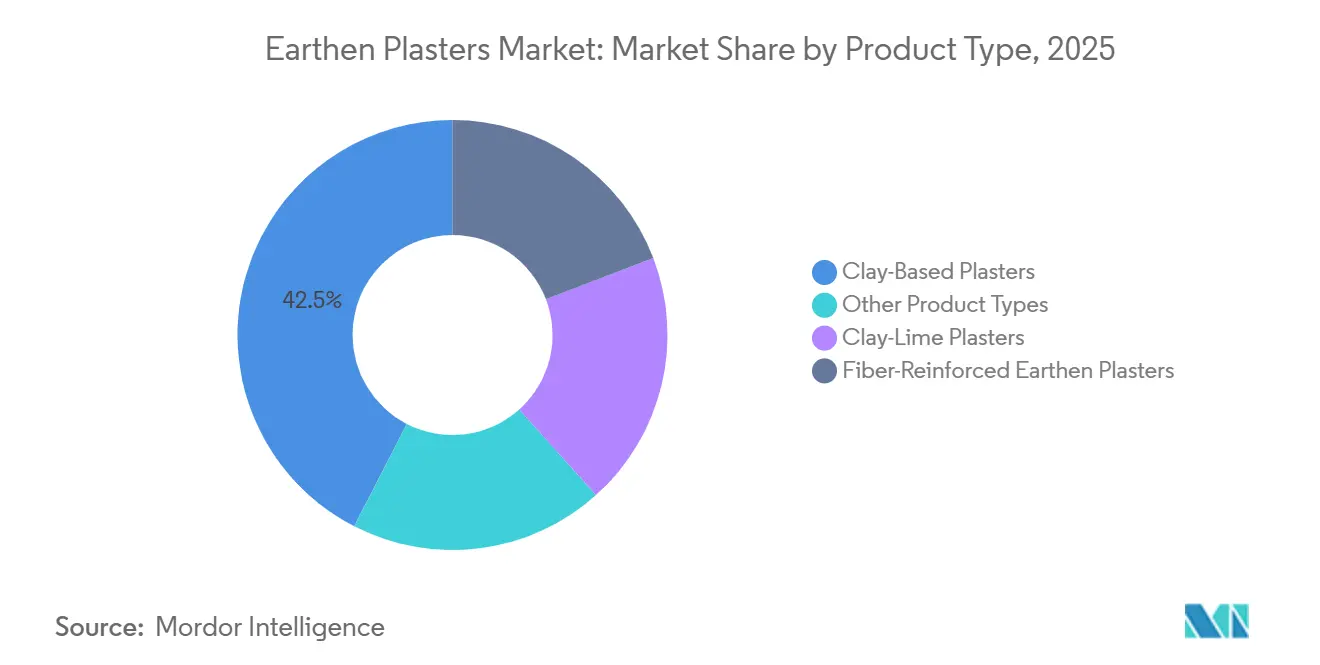
Fiber-Reinforced Earthen Plasters Shift the Performance BenchmarkClay-based plasters held a 42.45% share in 2025 and remained the leading product category because clay is widely available, installers are familiar with the material, and the systems align with natural-building requirements. Fiber-reinforced earthen plasters are projected to advance at a 5.38% CAGR through 2031. A 2025 review found that hemp, jute, straw, and cellulose fibers at concentrations of up to 5% by weight can improve tensile strength, crack resistance, and moisture buffering in earthen composites. This performance improvement supports the earthen plasters market by addressing a technical concern in commercial specifications. It also expands the range of interior and exterior applications that can be considered without materially increasing embodied carbon.
Clay-lime plasters have a meaningful position in European projects because lime additions improve formulation stability and support conservation work. SAINT-ASTIER upgraded BATICHANVRE PLUS in December 2025 with higher Natural Hydraulic Lime content to reduce its carbon footprint and improve site application. The earthen plasters industry also includes gypsum-clay blends, lime-stabilized earthen plasters, and specialty decorative earthen plasters for projects needing particular textural stability or better weather resistance. Hospitality projects use decorative finishes, while heritage projects select compatible formulations to avoid damage to original substrates and to preserve the physical behavior of older wall systems. Product development focuses on lower application risk while retaining low-carbon and breathable material characteristics.

By Application:
Restoration and Heritage Buildings Outpace Interior Wall Finishes in Growth RateInterior wall finishes held a 37.67% share in 2025 and remained the leading application because renovation projects value humidity regulation, low VOC emissions, and natural interior finishes. Restoration and heritage buildings are projected to advance at a 5.10% CAGR through 2031. Conservation requirements favor materials that support reversibility, vapor permeability, and compatibility with historic fabric. The scale of the requirement is reflected in the presence of earthen components at 17% of world heritage sites. In June 2026, the restored East gopuram of Kerala’s Vadakkunnathan Temple was formally dedicated after decorative lime plaster work was completed using traditional techniques.
The Luxembourg National School of Health opened in January 2025 with clay panels replacing conventional plasterboard throughout its interior. The project cited humidity regulation and indoor environmental quality and received Minergie-A-ECO certification. The earthen plasters market can gain from similar institutional and owner-occupier renovation projects that value measured indoor comfort and materials with clear environmental credentials. Exterior wall finishes remain relevant where climatic exposure permits their use, and lime stabilization and fiber reinforcement can extend use in wetter locations. Ceilings, decorative textured finishes, adobe construction, and cob construction provide additional application opportunities for the earthen plasters market in premium residences and hospitality projects.
By End-Use:
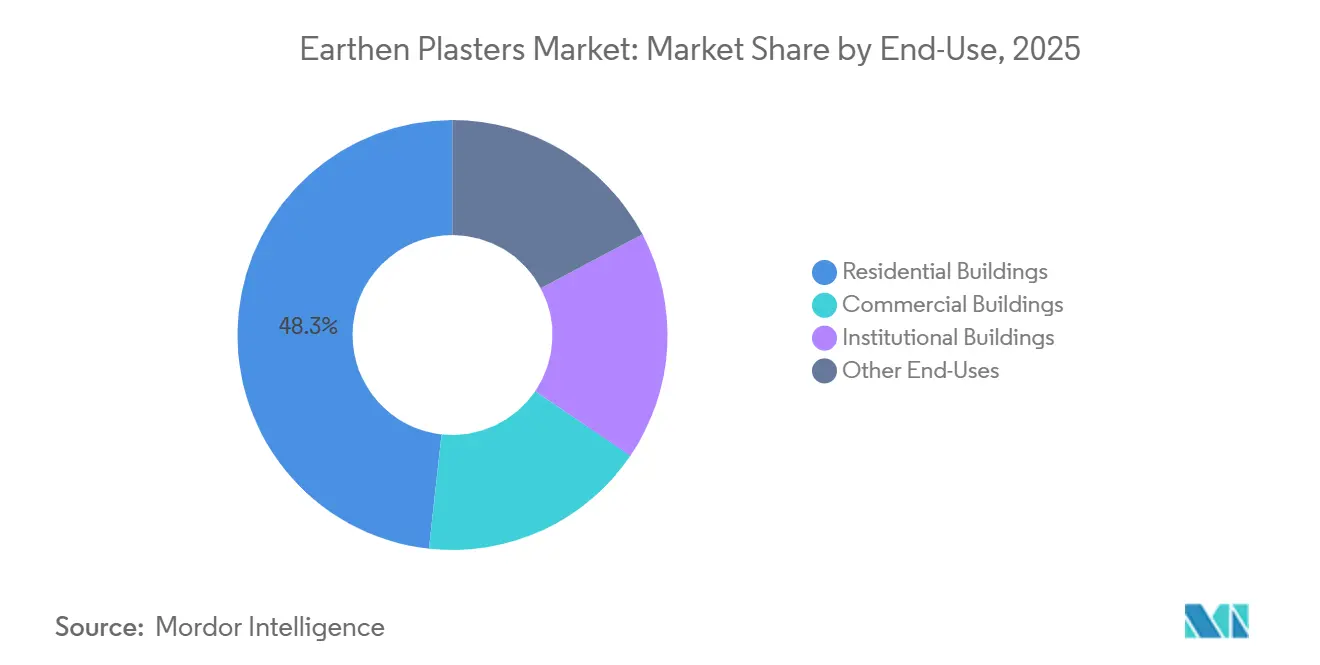
Institutional Buildings Emerge as a Growth EngineResidential buildings held 48.26% share in 2025 and remained the leading end-use category because homeowners select earthen finishes for humidity regulation, low VOC emissions, and natural surfaces. Institutional buildings are projected to advance at a 4.89% CAGR through 2031. Schools, hospitals, and public buildings can use these materials as part of healthy-building strategies. The Sai Kirupa Special School in India was completed in March 2025 with handmade adobe bricks and earthen finishes, showing the use of non-toxic and sensory-neutral materials for neurodiverse occupants. CRAterre also supported a raw-earth school extension in Nangis, France, designed for 700-1,200 pupils.
Commercial buildings use earthen plasters in hospitality and premium retail projects where documented finishes and design flexibility are valued. Armourcoat launched Raw Earth Clay Lime Plaster finishes in November 2025 with Environmental Product Declaration and Health Product Declaration documentation and Indoor Air Comfort Gold certification. The earthen plasters industry can use this type of documentation to support specifications with formal environmental criteria and higher expectations for product traceability. Hospitality, cultural buildings, and community structures contribute further demand where vernacular construction has cultural importance. Producers serving these end uses need to combine technical evidence with trained application support, especially when projects have conservation requirements and demanding visual standards.
Geography Analysis
APAC Earthen Plasters Market
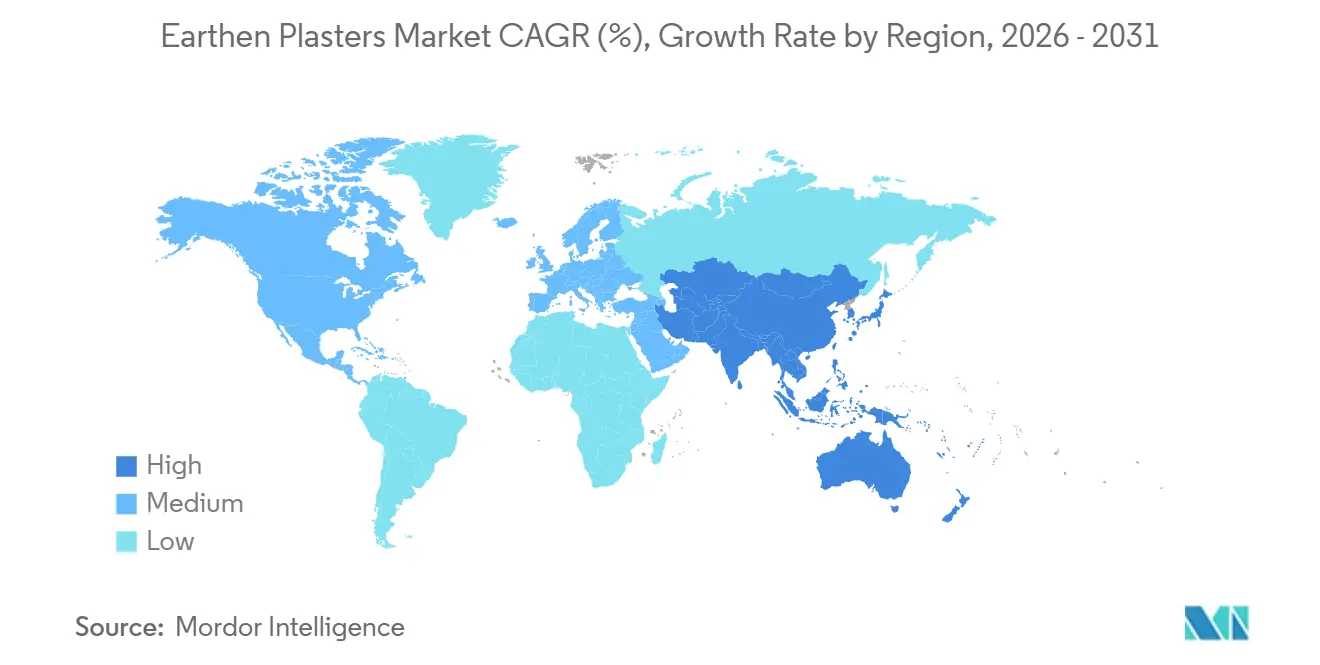
Asia-Pacific held 41.03% of the earthen plasters market share in 2025 and is projected to advance at a 5.04% CAGR through 2031. China provides a large base of residential and commercial construction activity for clay-based interior finishes, while India’s expanding middle class is supporting demand for higher-value interior materials in green-building-certified housing. The United Nations Economic and Social Commission for Asia and the Pacific reported that governments in the region are strengthening indoor air quality frameworks[2]. This creates a policy basis for non-emitting and hygroscopic materials in residential and institutional buildings. Japan and South Korea remain specialty markets where traditional plastering techniques are being used in curated residential and boutique hospitality projects, while Vietnam and Indonesia are also emerging as urbanization and awareness of material health credentials increase.
Europe Earthen Plasters Market
Europe held a substantial regional position and remains the most policy-driven geography in the earthen plasters market. The EPBD requires life cycle GWP disclosure for larger new buildings from 2028 and all new buildings from 2030. This framework supports consideration of low-carbon finishes across building procurement decisions. Germany has a mature natural-building materials base and established clay-plaster practices, while France is seeing interest in rammed earth and earthen plasters for public architecture. A community space extension in Marcoussis, Île-de-France, used pisé in October 2025 and highlighted low-carbon production and end-of-life recyclability.
The Americas and MEA Earthen Plasters Market
North America is shaped by premium residential and commercial specifications, with domestic producers using local mineral supply and documented product systems. The earthen plasters market in South America has long-term potential because traditional construction knowledge can support low-carbon housing approaches. A 2025 study in Andean Ecuador found that bahareque wood-clay shear-wall construction reduced building carbon footprints by 30%-40% compared with conventional masonry. The Middle-East and Africa benefit from heritage conservation activity and institutional construction that uses vernacular materials, while UNESCO’s work in Iraq and regional training programs support technical capability.
Competitive Landscape
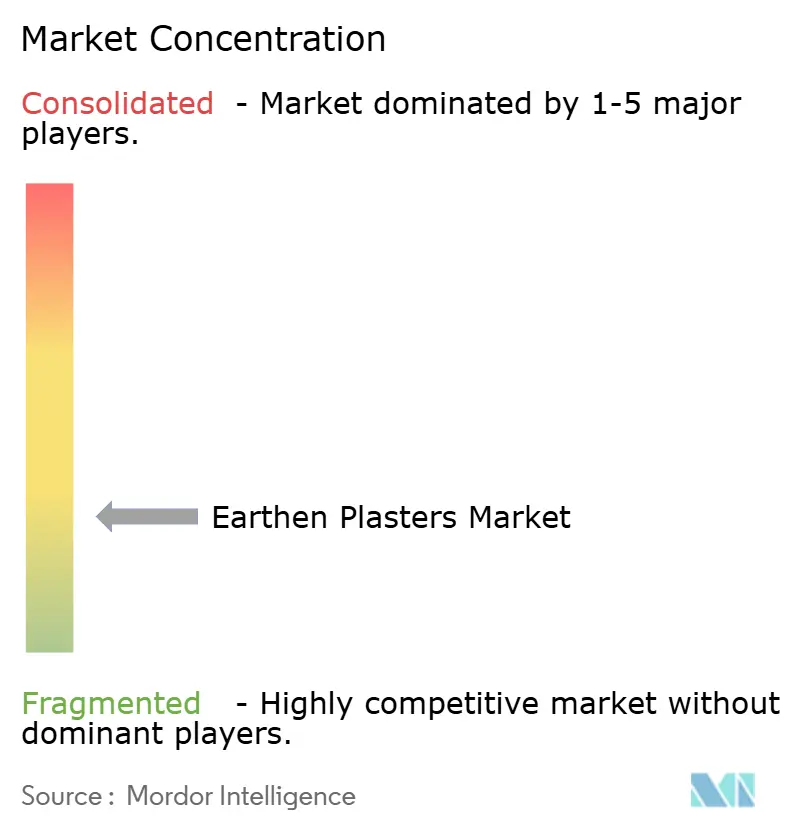
The earthen plasters market is highly fragmented, with the top five players including ClayTec GmbH & Co. KG, American Clay Enterprises, LLC, Clayworks, Armourcoat, and CLAYLIN. These players compete through local material access, trained installer networks, and technical product systems. Armourcoat, CLAYWORKS, and Tierrafino compete through finish design and documentation for premium interiors. This mix prevents a single supplier from defining the earthen plasters market across all regions and project types.
SAINT-ASTIER has differentiated its lime-earth offering through technical performance for heritage renovation. Its NOVASKIN range was presented to British building professionals in March 2025 and had a thermal conductivity of 0.129 W/(m·K) with A1 non-combustible fire classification. Armourcoat launched Raw Earth Clay Lime Plaster finishes in November 2025, using unfired kaolin clay, natural hydraulic lime, recycled crushed marble, and mineral pigments. The products were supplied with EPD and Health Product Declaration (HPD) documentation and achieved Indoor Air Comfort Gold certification, giving specifiers a documented route for projects with indoor air quality and material transparency requirements. In April 2026, ClayTec GmbH & Co. KG participated in the Sustainable Economy Summit in Berlin, increasing visibility in discussions on sustainable construction materials.
The earthen plasters market still lacks a universal installer accreditation that buyers can use to reduce application risk, leaving room for suppliers that establish clear training systems and repeatable installation methods. Local clay mineralogy tools can support formulation consistency when producers use regional deposits. Research at Sultan Qaboos University in 2025 demonstrated a mineralogy-driven machine-learning framework for optimizing calcined clay cementitious composites. Similar analytical approaches could help producers manage local raw-material variation without synthetic stabilizers, while LESANDO GmbH, Lehm-Laden GmbH & Co. KG, KREIDEZEIT Naturfarben GmbH, and UKU Pure Earth compete through proximity, natural-building claims, and bespoke formulations.
Earthen Plasters Industry Leaders
-
ClayTec GmbH & Co. KG
-
American Clay Enterprises, LLC
-
CLAYWORKS
-
Armourcoat
-
CLAYLIN
- *Disclaimer: Major Players sorted in no particular order
Earthen Plasters Market Companies Covered in this Report
- American Clay Enterprises, LLC
- Armourcoat
- BioLime
- CLAYLIN
- ClayTec GmbH & Co. KG
- CLAYWORKS
- Earthaus Plaster
- KREIDEZEIT Naturfarben GmbH
- Lehm-Laden GmbH & Co. KG
- LESANDO GmbH
- SAINT-ASTIER
- Tierrafino
- UKU Pure Earth
Recent Industry Developments in Earthen Plasters Market
- March 2026: Tracks Architectes completed a school in Mordelles, France, incorporating 317 m² of interior and exterior earth plaster alongside raw-earth walls, earth-straw insulation, and cob partitions. This reflects the growing use of earthen plaster in sustainable construction, particularly in low-carbon buildings that require natural materials, humidity regulation, and thermal comfort.
- November 2025: Armourcoat expanded its Clay Lime Plaster portfolio by launching Rammed Earth and Carved Earth finishes, formulated with unfired kaolin clay, natural hydraulic lime, recycled marble, and mineral pigments. These products combine low-embodied-carbon earthen materials with EPD, HPD, and Indoor Air Comfort Gold certifications, supporting their use in sustainable interior construction and driving demand for clay- and lime-based earthen plaster solutions.
Global Earthen Plasters Market Report Scope
Earthen plasters are natural wall and surface finishing materials made primarily from mineral-rich earth and other compatible binders, offering breathable and moisture-regulating surfaces for buildings. They are used to provide functional and aesthetic finishes while supporting traditional construction practices and environmentally conscious building approaches.
The Earthen Plasters Market is segmented by product type, application, end-use, and geography. By product type, the market is segmented into clay-based plasters, clay-lime plasters, fiber-reinforced earthen plasters, and other product types (gypsum-clay blends, lime-stabilized earthen plasters, and specialty decorative earthen plasters). By application, the market is segmented into interior wall finishes, exterior wall finishes, restoration and heritage buildings, and other applications (ceilings, decorative textured finishes, and adobe and cob construction). By end-use, the market is segmented into residential buildings, commercial buildings, institutional buildings, and other end-uses (hospitality, cultural buildings, and community structures). The report also covers the market size and forecasts for earthen plasters in 15 countries across major regions. For each segment, the market sizing and forecasts have been done on the basis of value (USD).
Segmentation Overview
| Clay-Based Plasters |
| Clay-Lime Plasters |
| Fiber-Reinforced Earthen Plasters |
| Other Product Types (Gypsum-Clay Blends, Lime-Stabilized Earthen Plasters, Specialty Decorative Earthen Plasters) |
| Interior Wall Finishes |
| Exterior Wall Finishes |
| Restoration and Heritage Buildings |
| Other Applications (Ceilings, Decorative Textured Finishes, Adobe and Cob Construction) |
| Residential Buildings |
| Commercial Buildings |
| Institutional Buildings |
| Other End-Uses (Hospitality, Cultural Buildings, Community Structures) |
| Asia-Pacific | China |
| India | |
| Japan | |
| South Korea | |
| ASEAN Countries | |
| Rest of Asia-Pacific | |
| North America | United States |
| Canada | |
| Mexico | |
| Europe | Germany |
| United Kingdom | |
| France | |
| Italy | |
| NORDIC Countries | |
| Rest of Europe | |
| South America | Brazil |
| Argentina | |
| Rest of South America | |
| Middle-East and Africa | Saudi Arabia |
| South Africa | |
| Rest of Middle-East and Africa |
| By Product Type | Clay-Based Plasters | |
| Clay-Lime Plasters | ||
| Fiber-Reinforced Earthen Plasters | ||
| Other Product Types (Gypsum-Clay Blends, Lime-Stabilized Earthen Plasters, Specialty Decorative Earthen Plasters) | ||
| By Application | Interior Wall Finishes | |
| Exterior Wall Finishes | ||
| Restoration and Heritage Buildings | ||
| Other Applications (Ceilings, Decorative Textured Finishes, Adobe and Cob Construction) | ||
| By End-Use | Residential Buildings | |
| Commercial Buildings | ||
| Institutional Buildings | ||
| Other End-Uses (Hospitality, Cultural Buildings, Community Structures) | ||
| By Geography | Asia-Pacific | China |
| India | ||
| Japan | ||
| South Korea | ||
| ASEAN Countries | ||
| Rest of Asia-Pacific | ||
| North America | United States | |
| Canada | ||
| Mexico | ||
| Europe | Germany | |
| United Kingdom | ||
| France | ||
| Italy | ||
| NORDIC Countries | ||
| Rest of Europe | ||
| South America | Brazil | |
| Argentina | ||
| Rest of South America | ||
| Middle-East and Africa | Saudi Arabia | |
| South Africa | ||
| Rest of Middle-East and Africa | ||
Key Questions Answered in the Report
What is the size of the earthen plasters market?
The earthen plasters market stands at USD 94.17 billion in 2026 and is projected to reach USD 116.57 billion by 2031.
What is driving demand for earthen plasters?
Demand is supported by life-cycle carbon disclosure, healthy-building requirements, humidity regulation, and heritage renovation needs.
Which product type led the market demand in 2025?
Clay-based plasters held a 42.45% share in 2025.
Which application is expected to grow fastest through 2031?
Restoration and heritage buildings are projected to advance at a 5.10% CAGR through 2031, supported by demand for compatible repair materials.