
Dumpster Rental and Leasing Market Size and Share
Market Overview
| Study Period | 2021 - 2032 |
|---|---|
| Market Size (2027) | USD 3.14 Billion |
| Market Size (2032) | USD 3.91 Billion |
| Growth Rate (2027 - 2032) | 4.48 % |
| Fastest Growing Market | Middle East and Africa |
| Largest Market | North America |
| Market Concentration | Low |
Major Players *Disclaimer: Major Players sorted in no particular order Image © Mordor Intelligence. Reuse requires attribution under CC BY 4.0. | |
Dumpster Rental and Leasing Market Analysis by Mordor Intelligence
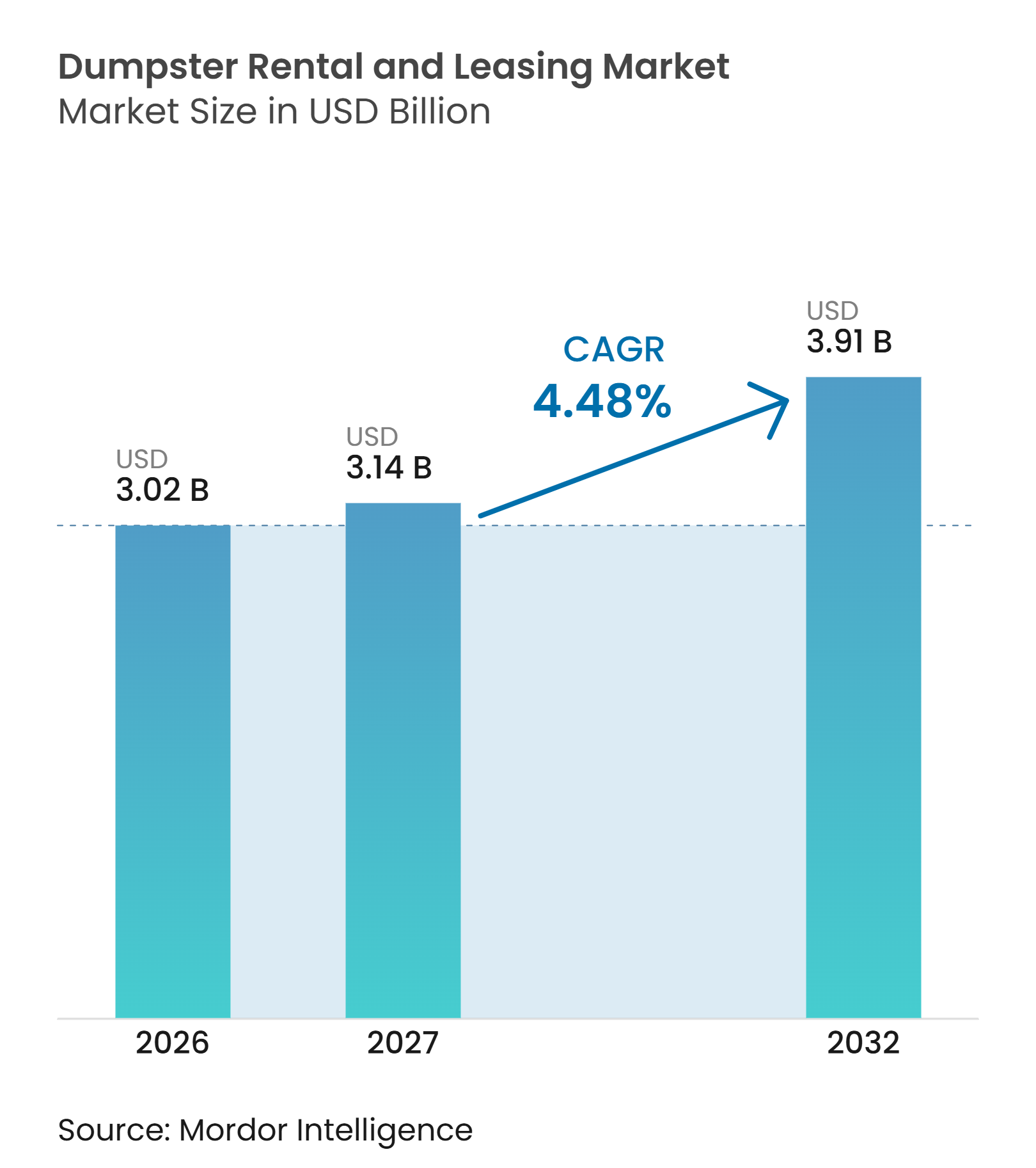
The Dumpster Rental And Leasing Market size was valued at USD 3.02 billion in 2026 and is estimated to grow from USD 3.14 billion in 2027 to reach USD 3.91 billion by 2032, at a CAGR of 4.48% during the forecast period (2027-2032).
The market serves construction activity, municipal collection systems, and commercial waste services. Leasing gives smaller haulers access to container fleets without the initial cost of direct purchases, and it lets operators adjust fleet capacity when contracts, project schedules, or material volumes change. Detachable containers support both construction debris and commercial waste collection, which improves asset use across several customer groups. Larger integrated haulers continue to favor owned fleets where container control supports collection and disposal operations, which limits some demand for independent leasing suppliers. The choice between rental, leasing, and ownership depends on the expected length of the customer relationship and the reliability of waste volumes.
Key Report Takeaways
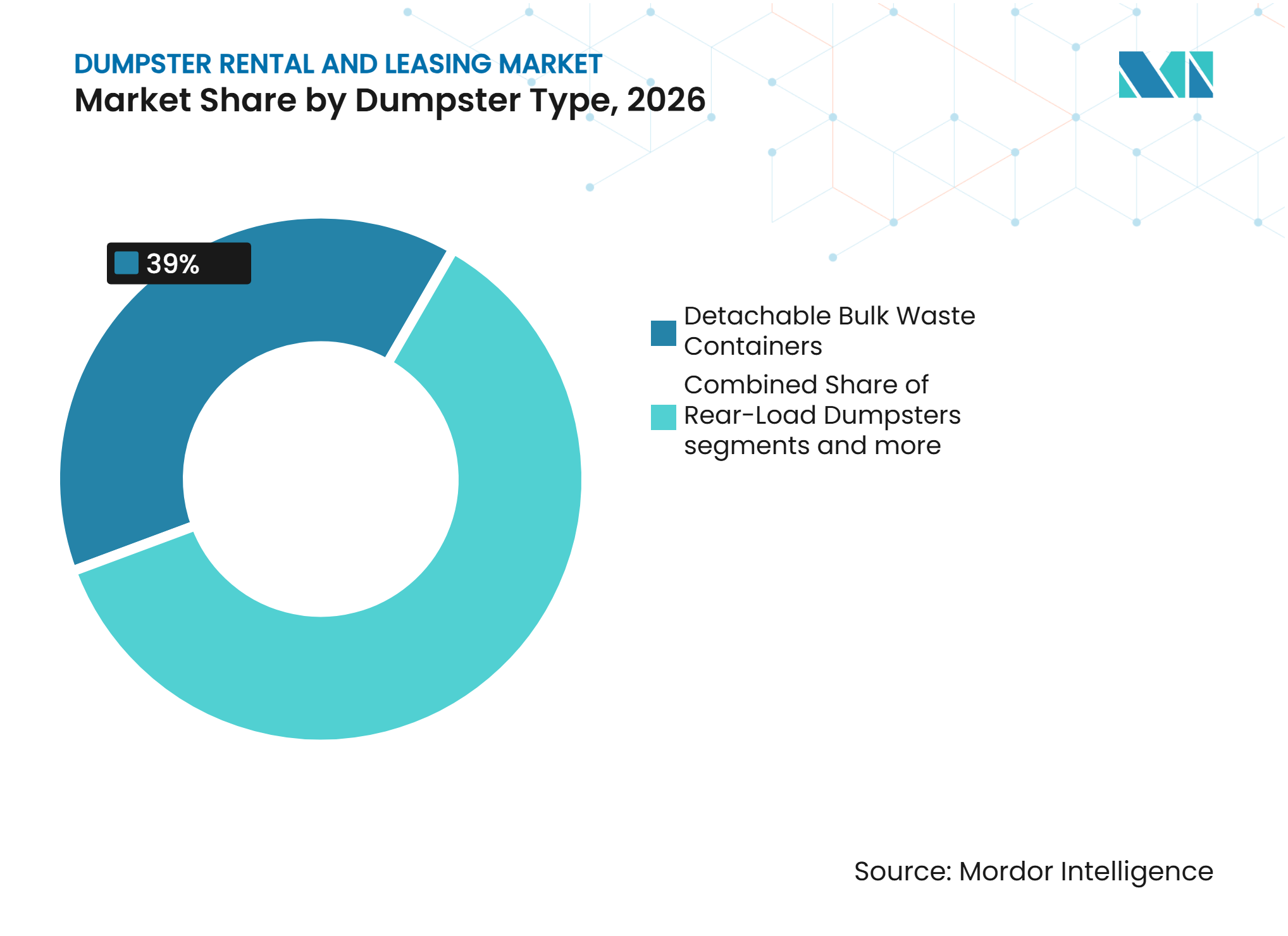
- By dumpster type, detachable bulk waste containers accounted for 39.0% of dumpster rental and leasing market share in 2026 and are projected to grow at a 5.6% CAGR through 2032.
- By dumpster capacity, above 20–30 cubic yards accounted for 30.0% of dumpster rental and leasing market size in 2026, while above 30–40 cubic yards segment is projected to grow at a 5.8% CAGR through 2032.
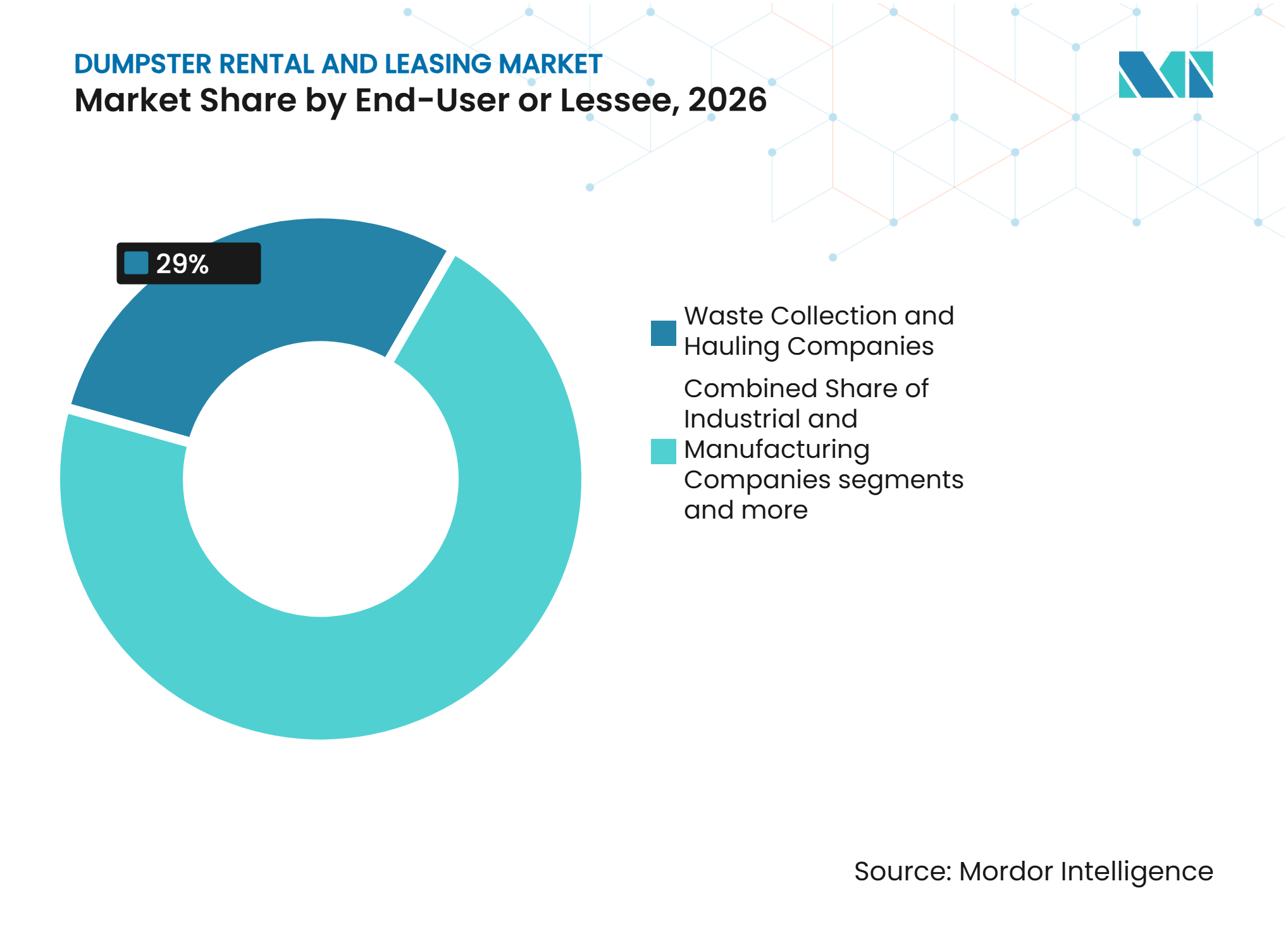
- By end-user and lessee, waste collection and hauling companies accounted for 29.0% revenue share in 2026, while recycling and material recovery operators are projected to grow at a 6.2% CAGR through 2032.
- By rental and leasing duration, rental accounted for 68.0% revenue share in 2026, while leases longer than 18 months are projected to grow at a 6.0% CAGR through 2032.
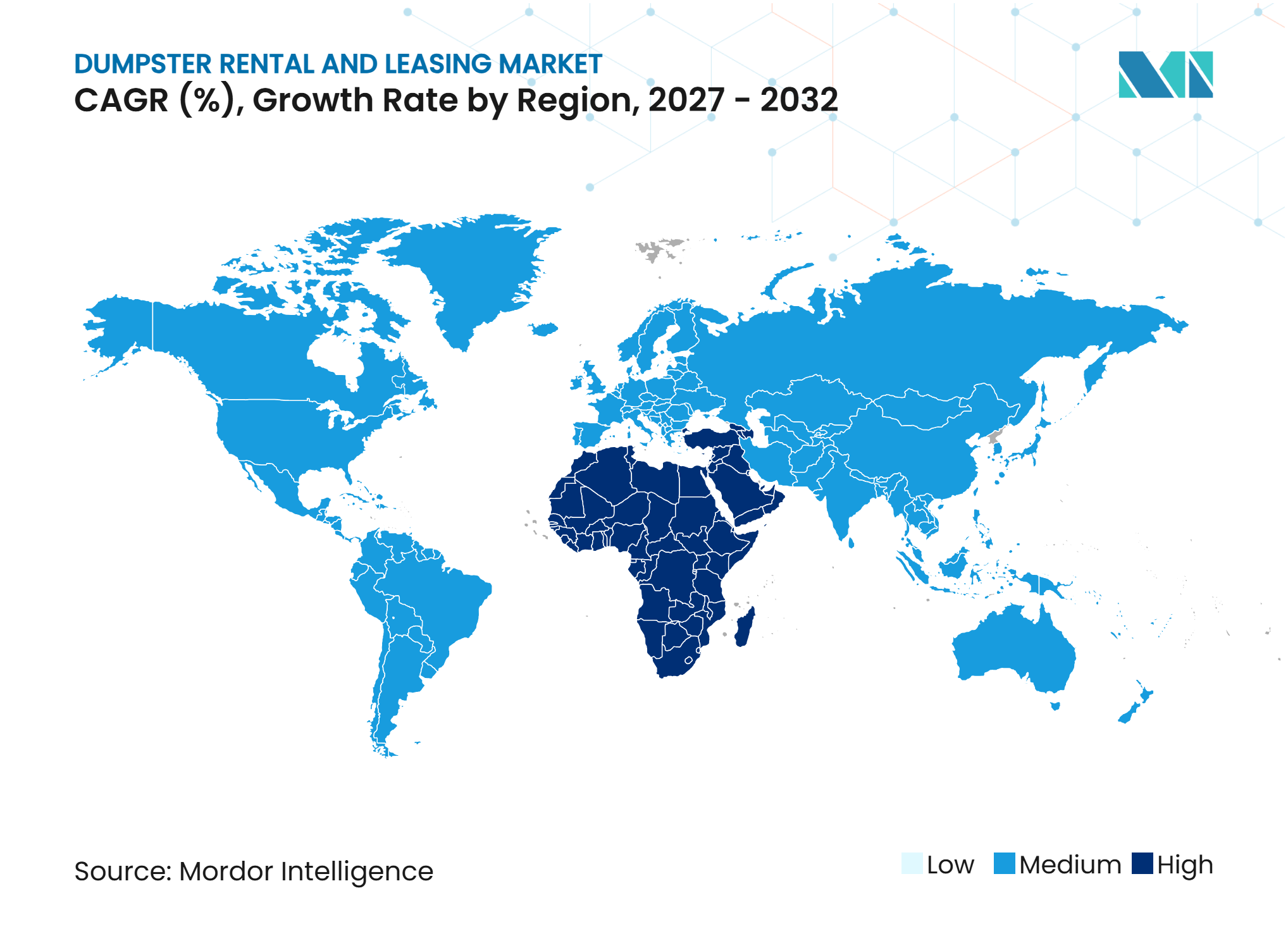
- By geography, North America held 45.7% revenue share in 2026, while Middle East and Africa is projected to grow at a 6.25% CAGR through 2032.
Note: Market numbers in this report are based on Mordor Intelligence's proprietary estimation framework, which combines nine months of actuals with Q4 projections for base year 2026.
Market Trends and Insights
Drivers Impact Analysis of Dumpster Rental and Leasing Market*
| Driver | (~) % Impact on CAGR Forecast | Geographic Relevance | Impact Timeline |
|---|---|---|---|
| Increasing Demand for Asset-Light Waste Collection Operations | +0.8% | Global, concentrated in North America and Western Europe | Medium term (2-4 years) |
| High Upfront Costs of Dumpster Fleet Acquisition | +0.7% | Global, strongest in Asia-Pacific and Middle East and Africa | Short term (≤ 2 years) |
| Growth in Construction and Demolition Waste Collection | +0.7% | North America, South America, Australia | Medium term (2-4 years) |
| Expansion of Independent Dumpster Rental and Hauling Operators | +0.6% | Global, especially APAC, Middle East and Africa, and Eastern Europe | Long term (≥ 4 years) |
| Commercial Waste Collection Network Expansion | +0.5% | North America, Europe, South and Southeast Asia | Medium term (2-4 years) |
| Municipal Dumpster Fleet Modernization | +0.4% | Europe, North America, Middle East and Africa | Long term (≥ 4 years) |
| Source: Mordor Intelligence | |||
Increasing Demand for Asset-Light Waste Collection Operations
Waste collection companies, contractors, and municipalities are increasingly adopting asset-light operating models to manage capital expenditure and improve fleet utilization. Purchasing dumpsters and roll-off containers requires substantial upfront investment, along with ongoing expenses for maintenance, storage, repairs, and replacement. Renting or leasing dumpsters allows waste haulers to access container capacity without committing significant capital to asset ownership. This model is particularly suitable for companies handling fluctuating waste volumes from construction projects, commercial cleanouts, renovation activities, and seasonal waste collection requirements. Rental arrangements also allow operators to scale container fleets based on project demand, expand service coverage, and manage temporary increases in collection volumes without purchasing additional equipment. Consequently, the preference for flexible asset utilization, lower upfront investment, and improved capital allocation is supporting demand in the dumpster rental and leasing market.[1]
High Upfront Costs of Dumpster Fleet Acquisition
The purchase cost of a container fleet can delay entry for smaller waste operators. Front-load and rear-load containers require a capital commitment separate from trucks and collection equipment, and larger roll-off units raise this cost further because they use more steel and need compatible handling equipment. Fixed lease payments give operators a known periodic cost when material and procurement prices vary, which matters most where financing is expensive or capital access is limited. Additionally, operators must account for expenses associated with container transportation, installation, maintenance, corrosion protection, repairs, and eventual replacement. These costs increase the financial burden of maintaining a sufficiently sized fleet, particularly for companies serving multiple locations or handling different waste streams. Although rental and leasing arrangements reduce the initial investment requirement, recurring rental charges and long-term contractual commitments can still affect operating margins.
Growth in Construction and Demolition Waste Collection
Construction and demolition activity produces waste flows that vary by project phase. Contractors need container capacity during demolition, site clearing, excavation, and foundation work, but not continuously throughout the construction cycle. Roll-off containers and skip bins are therefore placed for a specific project phase and collected once the required work is completed, making rental and medium-term leasing more practical than ownership. Detachable containers further support this demand pattern because they can accommodate different waste streams, including concrete, bricks, wood, metals, and mixed construction debris. Hook-lift systems also allow the same truck chassis to transport compatible containers between multiple project locations, improving vehicle utilization and reducing the need for dedicated transport equipment. Waste volumes can increase during demolition and structural work and decline during finishing activities, requiring rental providers to adjust container sizes, collection frequency, and fleet allocation according to project requirements.[2]
Expansion of Independent Dumpster Rental and Hauling Operators
The growing presence of independent dumpster rental and hauling operators is supporting demand in the dumpster rental and leasing market. Small and regional operators serve residential customers, local contractors, renovation companies, and small businesses that require flexible waste-container services without entering long-term agreements with large waste management companies. Their expansion increases the availability of roll-off dumpsters, front-load containers, and temporary waste collection services across underserved and secondary markets. Independent operators also rely on rental and leasing arrangements to expand container fleets without committing substantial capital to equipment purchases. As these businesses enter new service territories and add containers to meet local demand, the requirement for dumpster rentals, leasing, and fleet capacity continues to increase.
Restraints Impact Analysis of Dumpster Rental and Leasing Market*
| Restraint | (~) % Impact on CAGR Forecast | Geographic Relevance | Impact Timeline |
|---|---|---|---|
| Preference for Direct Equipment Ownership Among Large Waste Haulers | -0.9% | North America and Western Europe | Long term (≥ 4 years) |
| Bundled Waste Collection Contracts Limiting Standalone Leasing | -0.6% | North America and Europe | Medium term (2-4 years) |
| High Container Transportation and Repositioning Costs | -0.4% | Global | Short term (≤ 2 years) |
| Dumpster Damage, Theft and Residual Value Risks | -0.3% | Global, North America and emerging markets | Medium term (2-4 years) |
| Source: Mordor Intelligence | |||
Preference for Direct Equipment Ownership Among Large Waste Haulers
Large waste companies have economic reasons to own containers deployed at customer sites. Owned containers support collection routes and can direct waste into the owner’s disposal network. WM reported USD 3.48 billion in its Containers property and equipment category as of December 31, 2025. Republic Services reported USD 3.09 billion in large-container collection revenue for 2025.[3] The restraint arises when integrated haulers supply containers within their collection services, which limits the separate procurement opportunity for independent lessors. Furthermore, large operators benefit from economies of scale when purchasing containers in bulk, maintaining dedicated repair facilities, and deploying assets across established collection networks. Direct ownership also provides greater control over container availability, placement, servicing schedules, and replacement cycles, reducing dependence on third-party rental providers. As a result, independent dumpster rental and leasing providers may face challenges securing contracts with large integrated waste management companies, particularly in markets where established haulers offer bundled waste collection, transportation, and disposal services.
Bundled Waste Collection Contracts Limiting Standalone Leasing
Municipal and commercial contracts often combine container provision, collection, and disposal routing in one agreement. The waste collection company supplies the container as part of the service and recovers its cost through the collection fee, so the customer has no separate requirement to source a container. This limits the access independent lessors have to these customers. Permit requirements add further cost and administrative work for independent container operations; Berlin introduced a digital permit requirement for placing skip containers on public roads in 2025. Independent lessors therefore focus on flexible, project-led demand where bundled contracts are less dominant.
*Our forecasts treat driver/restraint impacts as directional, not additive. The impact forecasts reflect baseline growth, mix effects, and variable interactions.
Dumpster Rental and Leasing Market Segment Analysis
By Dumpster Type:
Detachable Containers Lead Demand and GrowthDetachable bulk waste containers accounted for 39.0% of the dumpster rental and leasing market size in 2026 and are projected to grow at a 5.6% CAGR through 2032. The category covers roll-off, hook-lift, and cable-hoist configurations. Their position reflects the need for assets that can serve construction debris, commercial waste, and material recovery uses. A detachable container can be moved between customer sites as service needs change, which supports higher utilization when lessors have a varied customer base. Hook-lift configurations let operators use one chassis across compatible containers, and standardized equipment simplifies maintenance planning and fleet assignment.
Front-load and rear-load containers remain important for recurring commercial service. They fit dense commercial locations and regular collection schedules, and their demand is more closely tied to service contracts than to one-off projects. Skip-lift and cable-hoist designs remain relevant in Europe, where equipment specifications can be shaped by municipal procurement requirements. Several container formats remain in use because customers differ in materials, space, and collection frequency. Lessors that maintain a balanced fleet can serve both repeat commercial accounts and construction-led demand, which reduces dependence on one waste stream.



By Dumpster Capacity:
Mid-Range Units Anchor Revenue While Larger Units AdvanceAbove 20–30 cubic yards accounted for 30.0% of the dumpster rental and leasing market share in 2026. This capacity supports construction debris, bulky materials, large commercial accounts, and municipal routes. It is large enough for high-volume work but remains manageable for a wide range of sites. The size is therefore common in longer leasing arrangements. Its versatility supports predictable demand across several end users. The tier remains a core part of the available rental fleet.
Above 30–40 Cubic Yards is projected to grow at a 5.8% CAGR through 2032. Recycling and material recovery operators use larger containers to consolidate source-separated materials, and larger units can reduce the number of collection swaps required on a route. They can also support industrial and commercial sites with larger waste volumes. RFID and GPS tools help lessors locate containers, reduce idle time, and schedule maintenance and recovery in this capacity range. WeighPay introduced RouteLink in 2025 with GPS- and RFID-based container visibility. The product supports fleet-management technology adoption and is not evidence of growth in container leasing by itself.
By End-User/Lessee:
Waste Haulers Lead While Recyclers ExpandWaste collection and hauling companies held 29.0% of the dumpster rental and leasing market share in 2026. These companies lease containers directly and provide them to commercial and municipal customers. Their demand is linked to route growth, contract renewals, and local service expansion. Leasing is useful during a new route launch because container availability is required before collections begin, and it helps an operator avoid a large initial fleet purchase. Construction and demolition contractors form another important customer group because their demand is linked to project schedules. Independent rental operators lease containers upstream and rent them to final customers and are treated here as a separate lessee group from waste haulers.
Recycling and material recovery operators are projected to grow at a 6.2% CAGR through 2032. These operators can use leasing while new recovery capacity is ramping up and collection volumes are still developing. Their demand follows investment in sorting capacity and the need to collect separated materials. Paper, cardboard, metals, and other recoverable materials require different collection arrangements, so new sorting capacity needs containers matched to each material stream. Leased fleets let operators add or release containers as a new facility reaches planned throughput. Customer requirements also differ by site and operating model. Municipal users value dependable service and compatible equipment. Industrial users need robust containers that fit production waste volumes. Commercial customers often require predictable placement and collection within restricted sites.

By Rental and Leasing Duration:
Rental Holds the Largest Position and Longer Leases GrowRental accounted for 68.0% of the dumpster rental and leasing market share in 2026. This share reflects the importance of short projects, temporary commercial needs, events, and recovery work. Customers use rental when they cannot predict volume or contract length. It also allows them to add units quickly when work peaks. Project demand can rise and fall within a short period, particularly in construction and demolition. Shorter contracts therefore remain important to fleet utilization. The rental model gives operators flexibility while keeping container access available.
Leases longer than 18 months are projected to grow at a 6.0% CAGR through 2032. Longer agreements offer customers greater cost certainty and a more stable supply of containers, and they are relevant for haulers and recycling operators with multiyear service contracts. TIP Group expanded specialized waste equipment options across Europe in 2025, including leasing, rental, and buy-to-sell arrangements. The offer covers hookloaders, garbage trucks, and vacuum trucks, so it is adjacent context and does not establish standalone container leasing. Longer agreements are also easier to pair with maintenance support and local service coverage.
Geography Analysis
North America: Market Leader with Deep Independent Operator Network
North America held 45.7% of the dumpster rental and leasing market share in 2026. The region has a dense base of independent haulers and established commercial waste routes. These conditions support demand for flexible containers, especially in construction and commercial collection. The region also has large integrated providers that operate proprietary fleets. This creates competition for independent lessors but also leaves opportunities in local, project-led, and specialized accounts. Republic Services reported a 3.8% decline in large-container volumes in the fourth quarter of 2025, reflecting softer construction and manufacturing activity. Lower collection volumes can reduce the number of containers deployed and put pressure on utilization and pricing for lessors. Municipal fleet renewal continues across the region. The City of Houston sought USD 12.5 million in 2025 for 25 new garbage and recycling trucks.
Middle East and Africa: Infrastructure Build-Out Drives Fastest-Growing Geography
Middle East and Africa is projected to grow at a 6.25% CAGR through 2032. The region is building waste collection, treatment, and recovery infrastructure as urban populations and service expectations increase. New facilities need reliable upstream collection from urban and peri-urban areas. Operators can use leased container fleets during rollout periods, when demand patterns are still developing, which reduces the initial capital commitment attached to a new collection network. The route to sustained demand depends on project execution, local finance, and service contracting. Egypt signed an MOU in 2026 for a USD 4.2 billion solid-waste management and treatment project with planned capacity of 5,000 metric tons of waste a day. Johannesburg’s infrastructure fund secured a ZAR 550 million (USD 30.8 million) grant towards an alternative waste treatment technology project valued at ZAR 5.7 billion (USD 0.32 billion).
Europe, Asia-Pacific, and South America: Distinct Conditions Across Mature and Developing Collection Systems
Europe has mature waste systems but remains complex for independent container lessors because collection contracts are frequently bundled. Municipal fleet investment continues to shape equipment demand; Birmingham activated a GBP 30 million (USD 39.5 million) waste collection fleet in 2025, which is context for municipal vehicle investment rather than direct evidence of leasing growth. Asia-Pacific presents mixed conditions, with Australia supporting recovery-focused collection and other countries still developing formal construction waste systems. Australia recorded an 86% recovery rate for construction and demolition waste in 2024–25. South America remains a longer-term opportunity as organized collection networks become more established. Regulation affects container placement, service procurement, and waste handling differently across these regions. Europe favors experienced providers that can operate within formal service arrangements. Australia offers demand linked to resource recovery and construction activity. Emerging markets may offer more room for leased assets but require careful management of financing, transport, and local service capability. Digital booking and fleet visibility can help regional providers reach fragmented local customers.
Competitive Landscape
Market Concentration
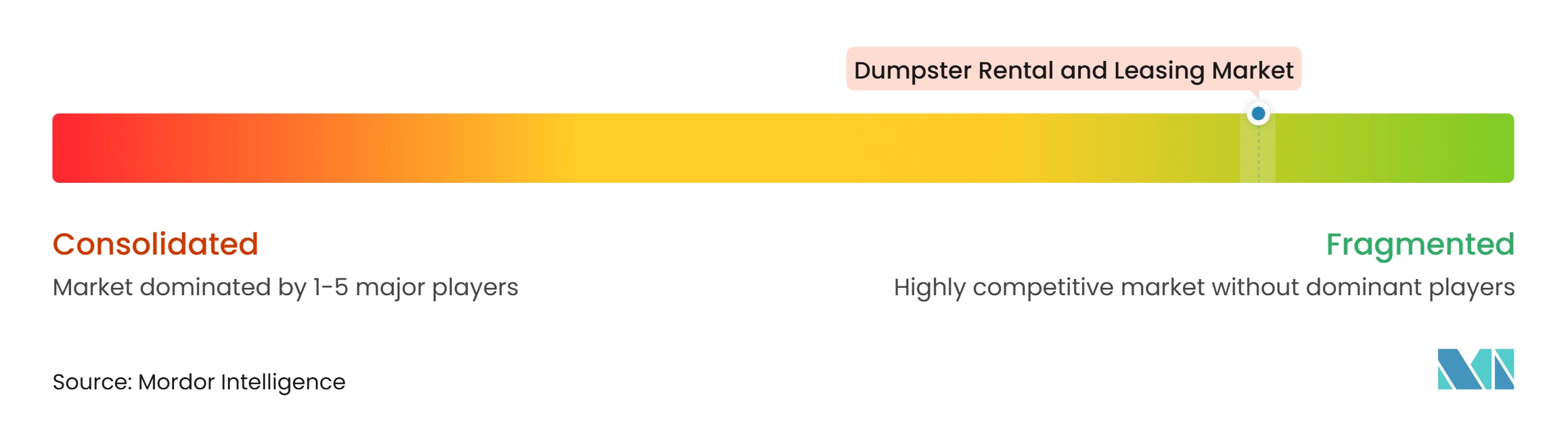
The dumpster rental and leasing market exhibits a low level of market concentration. Most independent businesses compete through delivery response, pricing, fleet availability, and local coverage. This structure leaves limited room for a single provider to dominate every geography. A provider that recovers containers quickly can improve fleet turns and reduce replacement costs, and digital visibility and maintenance support can strengthen customer retention.
TIP Group expanded specialized waste equipment leasing across 140 service locations in 17 countries during 2025. The offer covers hookloaders, garbage trucks, and vacuum trucks, so TIP Group is an adjacent equipment lessor rather than a confirmed standalone dumpster container lessor. Republic Services has applied algorithmic routing to its large-container operation, which shows the importance of route productivity and real-time asset information. Smaller providers can use third-party fleet tools to narrow this gap, and their advantage remains local route knowledge and responsiveness to smaller customer requirements.
Strategic opportunities center on multi-location accounts, maintenance-inclusive agreements, and service plans for municipalities that do not want to manage container assets directly. Long-term leasing may be attractive where new collection systems are scaling, while short-term rental remains important where construction activity produces temporary waste volumes. A lessor that combines predictable service with asset tracking can offer a clearer value proposition than a provider competing only on price. Lessors need to build dense routes, protect asset utilization, and target customer groups that need operational flexibility.
Dumpster Rental and Leasing Industry Leaders
-
PMB Commercial Services LLC
-
Wicked Haul LLC
-
Compactor Management Company
-
Triad Recycling & Container Services
-
United States Disposal Service
- *Disclaimer: Major Players sorted in no particular order
Dumpster Rental and Leasing Market Companies Covered in this Report
- PMB Commercial Services LLC
- Wicked Haul LLC
- Compactor Management Company
- Agecko
- Triad Recycling & Container Services
- United States Disposal Service
- SES (Zero Waste SES)
- Direct Waste Services Inc.
- Perfect Stripout & Demolition
- Recycling Solutions (RecyclingEZ)
- Trinity Recycling LLC
- Novo Demo Group Pty Ltd
- Can Man LLC
- Muller Welding Company Inc.
- Mobile Container Service Inc.
- Elite Containers LLC
- Dumpster Dudez
- Waste Removal USA
- ZTERS
- Bin There Dump That
Recent Industry Developments in Dumpster Rental and Leasing Market
- November 2026: Interstate Waste Services acquired Hometown Waste & Recycling, a New Jersey-based full-service dumpster rental company. The acquisition added 13 vehicles and 20 employees to IWS's operations. Hometown has completed more than 35,000 dumpster rentals and will continue operating under its established brand. The transaction strengthens IWS's roll-off dumpster rental capabilities across New Jersey.
- September 2026: Ecowaste Solutions acquired Wilson's Containers, a Florida-based industrial container and temporary dumpster rental company with more than 40 years of operating experience. The acquisition established an operational hub in Lake City, Florida, ahead of Ecowaste's October 1 municipal waste collection contract launch in Columbia County.
- September 2025: TIP Group, operating a fleet of 90,000 assets across 140+ service locations in 17 countries, expanded into specialized waste equipment including hookloaders, garbage trucks, and vacuum trucks across its key European markets, introducing flexible leasing, rental, and buy-to-sell arrangements. The offer covers specialized waste equipment and is not confirmed standalone dumpster container leasing.
- July 2025: WeighPay launched RouteLink, an IoT-driven fleet and container management platform integrating real-time GPS tracking, RFID-based container visibility, and Electronic Logging Device reporting. The launch is relevant to fleet-management technology adoption.
Global Dumpster Rental and Leasing Market Report Scope
The Dumpster Rental & Leasing Market is Segmented by Dumpster Type (Front-Load Dumpsters, Rear-Load Dumpsters, and More), by Dumpster Capacity (Up To 3 Cubic Yards, Above 3 To 6 Cubic Yards, and More), by End-User or Lessee (Waste Collection and Hauling Companies and More), by Rental and Leasing Duration (Rental and Leasing), and by Geography (North America and More). The Market Forecasts are Provided in Terms of Value (USD).
Segmentation Overview
| Front-Load Dumpsters | |
| Rear-Load Dumpsters | |
| Detachable Bulk Waste Containers | Cable-Hoist/Rail Roll-Off Containers |
| Hook-Lift Containers | |
| Skip-Lift/Chain-Lift Containers | |
| Other Detachable Container Configurations | |
| Other Dumpster Types |
| Up to 3 Cubic Yards |
| Above 3 to 6 Cubic Yards |
| Above 6 to 10 Cubic Yards |
| Above 10 to 20 Cubic Yards |
| Above 20 to 30 Cubic Yards |
| Above 30 to 40 Cubic Yards |
| Above 40 Cubic Yards |
| Waste Collection and Hauling Companies | |
| Independent Dumpster Rental Operators | |
| Municipalities and Public Waste Authorities | |
| Construction and Demolition Contractors | |
| Commercial and Institutional Establishments | Retail and Shopping Centers |
| Hospitality, Restaurants and Food Service | |
| Offices and Commercial Buildings | |
| Healthcare and Educational Institutions | |
| Real Estate and Facility Management Companies | |
| Other Commercial and Institutional Establishments | |
| Industrial and Manufacturing Companies | |
| Recycling and Material Recovery Operators | |
| Other End Users |
| Rental | Up to 3 Months |
| 3 to 6 Months | |
| 6 to 12 Months | |
| Above 12 | |
| Leasing | Upto 12 Months |
| 12 to 18 Months | |
| Above 18 Months |
| North America | United States |
| Canada | |
| Mexico | |
| South America | Brazil |
| Argentina | |
| Rest of South America | |
| Europe | Germany |
| United Kingdom | |
| France | |
| Italy | |
| Spain | |
| Poland | |
| Rest of Europe | |
| Asia-Pacific | China |
| Japan | |
| India | |
| South Korea | |
| Australia | |
| ASEAN | |
| Rest of Asia-Pacific | |
| Middle East and Africa | Saudi Arabia |
| United Arab Emirates | |
| South Africa | |
| Rest of Middle East and Africa |
| By Dumpster Type | Front-Load Dumpsters | |
| Rear-Load Dumpsters | ||
| Detachable Bulk Waste Containers | Cable-Hoist/Rail Roll-Off Containers | |
| Hook-Lift Containers | ||
| Skip-Lift/Chain-Lift Containers | ||
| Other Detachable Container Configurations | ||
| Other Dumpster Types | ||
| By Dumpster Capacity | Up to 3 Cubic Yards | |
| Above 3 to 6 Cubic Yards | ||
| Above 6 to 10 Cubic Yards | ||
| Above 10 to 20 Cubic Yards | ||
| Above 20 to 30 Cubic Yards | ||
| Above 30 to 40 Cubic Yards | ||
| Above 40 Cubic Yards | ||
| By End-User/Lessee | Waste Collection and Hauling Companies | |
| Independent Dumpster Rental Operators | ||
| Municipalities and Public Waste Authorities | ||
| Construction and Demolition Contractors | ||
| Commercial and Institutional Establishments | Retail and Shopping Centers | |
| Hospitality, Restaurants and Food Service | ||
| Offices and Commercial Buildings | ||
| Healthcare and Educational Institutions | ||
| Real Estate and Facility Management Companies | ||
| Other Commercial and Institutional Establishments | ||
| Industrial and Manufacturing Companies | ||
| Recycling and Material Recovery Operators | ||
| Other End Users | ||
| By Rental and Leasing Duration | Rental | Up to 3 Months |
| 3 to 6 Months | ||
| 6 to 12 Months | ||
| Above 12 | ||
| Leasing | Upto 12 Months | |
| 12 to 18 Months | ||
| Above 18 Months | ||
| By Geography | North America | United States |
| Canada | ||
| Mexico | ||
| South America | Brazil | |
| Argentina | ||
| Rest of South America | ||
| Europe | Germany | |
| United Kingdom | ||
| France | ||
| Italy | ||
| Spain | ||
| Poland | ||
| Rest of Europe | ||
| Asia-Pacific | China | |
| Japan | ||
| India | ||
| South Korea | ||
| Australia | ||
| ASEAN | ||
| Rest of Asia-Pacific | ||
| Middle East and Africa | Saudi Arabia | |
| United Arab Emirates | ||
| South Africa | ||
| Rest of Middle East and Africa | ||
Key Questions Answered in the Report
What is the projected growth rate for dumpster rental and leasing market?
The market is projected to grow at a 4.48% CAGR from 2027 to 2032, reaching USD 3.91 billion by 2032. Demand is supported by construction activity, commercial collection routes, municipal fleet requirements, and material recovery operations.
Which dumpster type leads demand?
Detachable bulk waste containers held 39.0% share in 2026 and are projected to grow at a 5.6% CAGR through 2032.
Why do waste operators lease dumpsters instead of buying them?
Leasing can limit initial capital outlay, provide flexible capacity, and include maintenance support for operators with changing route needs.
Which customers are growing fastest for dumpster leasing?
Recycling and material recovery operators are projected to grow at a 6.2% CAGR through 2032. These operators can use leasing while new recovery capacity is ramping up and collection volumes are still developing.
Which region is expanding fastest?
Middle East and Africa is projected to grow at a 6.25% CAGR through 2032 as waste collection and treatment infrastructure develops. New treatment facilities and expanding urban collection systems can create demand for flexible container fleets.