
Dry Mix Sprayed Concrete Market Size and Share
Market Overview
| Study Period | 2021 - 2031 |
|---|---|
| Market Size (2026) | USD 6.65 Billion |
| Market Size (2031) | USD 9.38 Billion |
| Growth Rate (2026 - 2031) | 7.13 % |
| Fastest Growing Market | Asia-Pacific |
| Largest Market | Asia-Pacific |
| Market Concentration | Medium |
Major Players *Disclaimer: Major Players sorted in no particular order Image © Mordor Intelligence. Reuse requires attribution under CC BY 4.0. | |
Dry Mix Sprayed Concrete Market Analysis by Mordor Intelligence
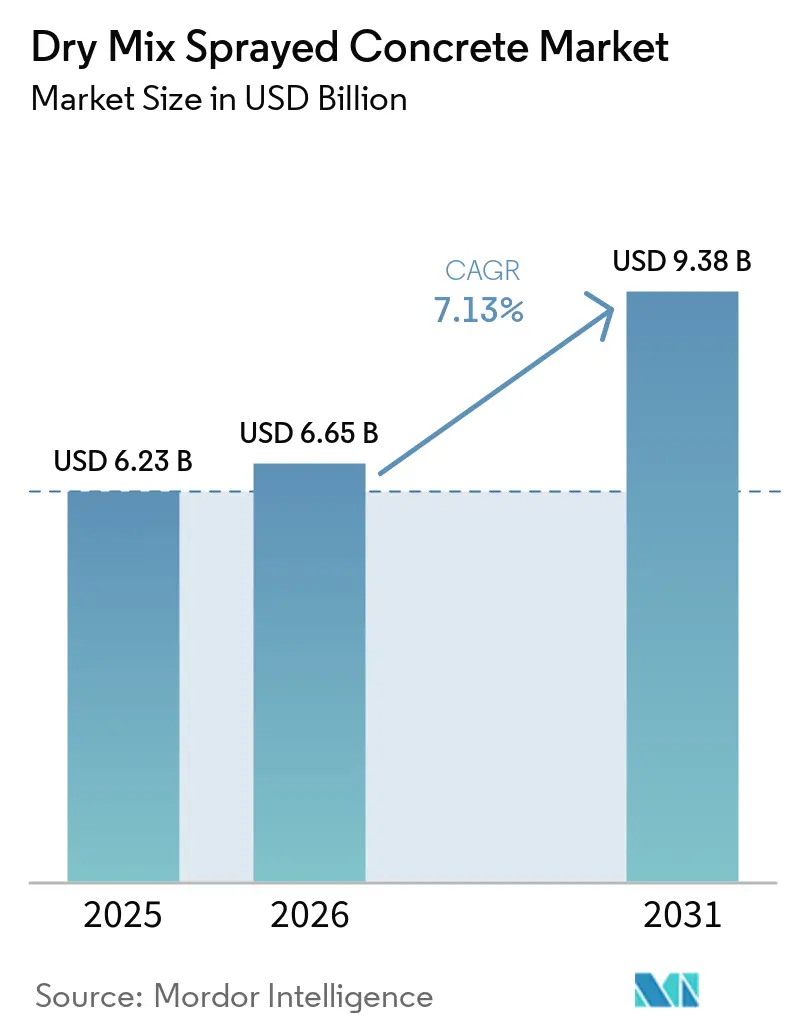
The Dry Mix Sprayed Concrete Market size was valued at USD 6.23 billion in 2025 and is estimated to grow from USD 6.65 billion in 2026 to reach USD 9.38 billion by 2031, at a CAGR of 7.13% during the forecast period (2026-2031). The dry mix sprayed concrete market benefits from rapid primary lining when on-site concrete batching is impractical. This capability remains relevant in small tunnels, repair projects, and remote mines. Long-term underground construction programs across Asia-Pacific, Europe, and the Middle East are expected to support future demand for materials. Producers are improving accelerator chemistry, developing fiber-compatible mixes, and adopting equipment that improves placement consistency. Labor availability, dust control, and input costs will determine which projects continue to favor dry mix systems.
Key Report Takeaways
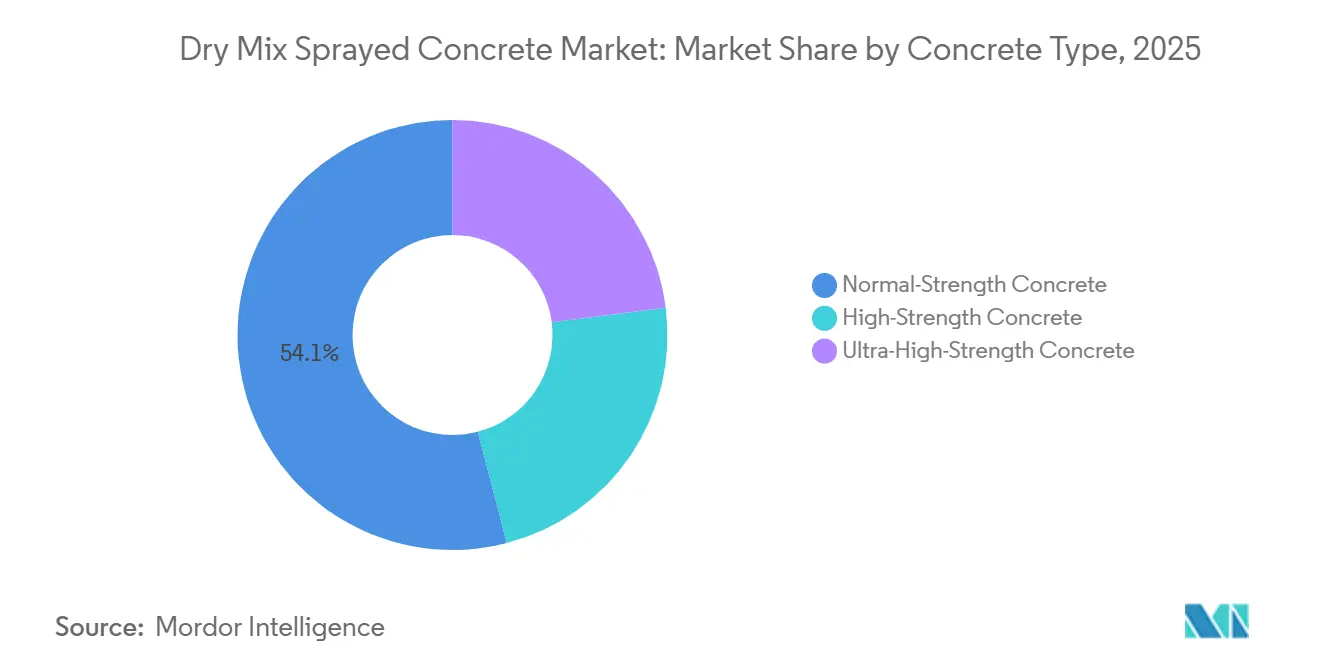
- By concrete type, normal-strength concrete held 54.06% of the dry mix sprayed concrete market share in 2025, while ultra-high-strength concrete is forecast to grow at a 7.67% CAGR through 2031.
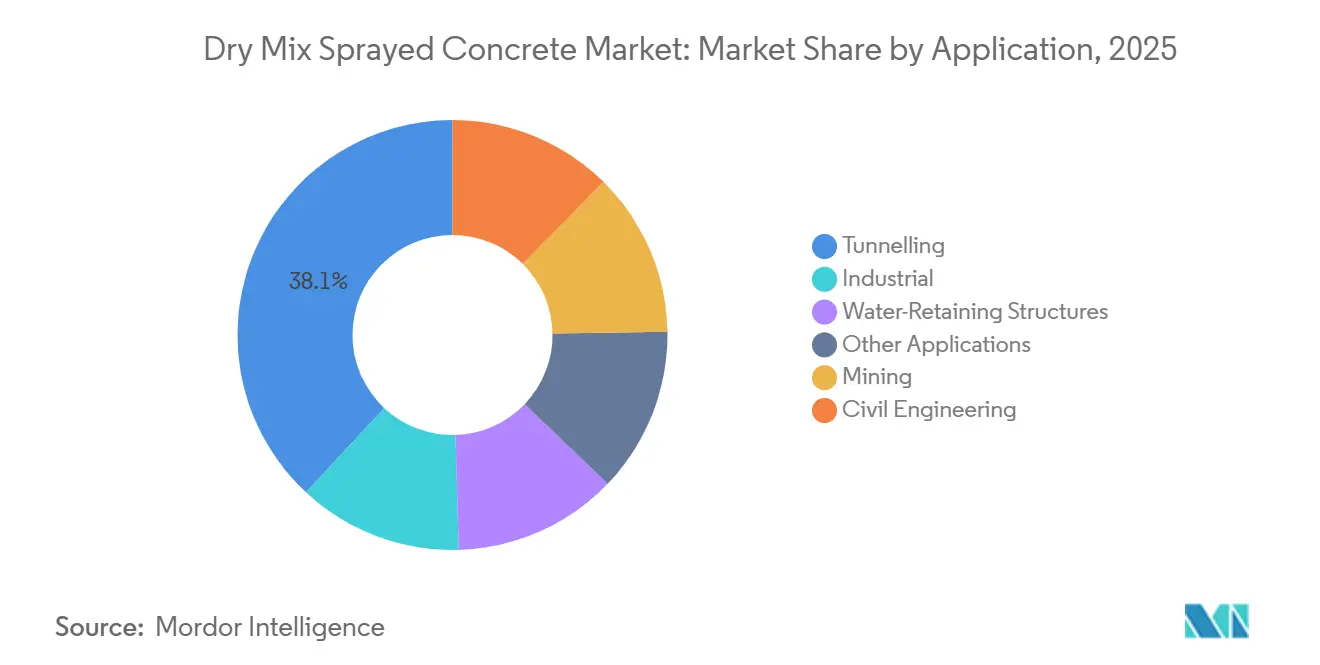
- By application, tunneling accounted for 38.07% of the dry mix sprayed concrete market share in 2025, while mining recorded the highest projected CAGR at 8.25% through 2031.
- By geography, Asia-Pacific held 40.18% of revenue in 2025 and is forecast to grow at a 7.76% CAGR through 2031.
Note: Market size and forecast figures in this report are generated using Mordor Intelligence’s proprietary estimation framework, updated with the latest available data and insights as of January 2026.
Market Trends and Insights
Drivers Impact Analysis of Dry Mix Sprayed Concrete Market*
| Drivers | (~) % Impact on CAGR Forecast | Geographic Relevance | Impact Timeline |
|---|---|---|---|
| Expansion of Metro, Road, Rail, Utility, and Hydropower Tunnels | +2.5% | Global, concentrated in Asia-Pacific and Europe | Long term (≥ 4 years) |
| Underground Mining Ground-Support Requirements | +1.8% | Asia-Pacific, South America, Australia, the Middle East, and Africa | Long term (≥ 4 years) |
| Aging Infrastructure Rehabilitation and Emergency Repair | +1.2% | North America and Europe, and emerging in the Asia-Pacific | Medium term (2-4 years) |
| Automation, Remote Operation, and Digital Thickness Verification | +0.8% | North America, Europe, and the Asia-Pacific | Medium term (2-4 years) |
| Low-Alkali Chemistry and Fiber-Reinforced Performance Upgrades | +0.5% | Global | Short term (≤ 2 years) |
| Source: Mordor Intelligence | |||
Expansion of Metro, Road, Rail, Utility, and Hydropower Tunnels
The dry mix sprayed concrete market is supported by concurrent underground transport programs in the Asia-Pacific and Europe. India's Mumbai-Ahmedabad Bullet Train project includes a 21 km underground tunnel, with its second tunnel-boring machine beginning a 7 km undersea drive below Thane Creek in July 2026. This configuration requires continuous primary lining and favors portable spraying equipment. Hyderabad Metro Phase II covers 122.9 km across 8 corridors and had a stated project cost of INR 38,595 crore (USD 4.6 billion) when its Detailed Project Report was submitted in May 2026. Hydropower tunnels in South and Southeast Asia add demand independent of transport budgets, broadening the project pipeline for the dry mix sprayed concrete market.
Underground Mining Ground-Support Requirements
Declining ore grades are pushing mine development to greater depths, where stable ground support becomes more critical. Dry mix sprayed concrete is used for rapid, high-adhesion support before secondary reinforcement is installed. The International Energy Agency expects global copper demand to rise by 30% by 2040, supporting continued development of underground copper projects. Epiroc Ground Support and Master Builders Solutions formed a partnership in March 2026 to develop chemical technologies for underground mining. Their first product, BoltX-P, is a thixotropic resin designed for deep and high-stress geological conditions. Open-pit-to-underground transitions at copper and gold mines can create new demand for access tunnels, stopes, and ventilation raises in the dry mix sprayed concrete market.
Aging Infrastructure Rehabilitation and Emergency Repair
Aging concrete assets support repair demand in North America and Europe. More than 40,000 bridges in the United States have been classified as structurally deficient. Florida International University researchers developed a sprayable Ultra-High Performance Concrete (UHPC) system that achieved a compressive strength of 30 MPa within 24 hours. The system delivered 2.5-5 times the 6-hour performance of ordinary sprayed concrete and recorded rebound below 5% in a Virginia field application. The Mont-Blanc Tunnel underwent structural rehabilitation from late 2024 through December 2025 in areas with water inflows of 280 liters per second. These repair programs can support the dry mix sprayed concrete market when new construction activity slows.
Automation, Remote Operation, and Digital Thickness Verification
Automation addresses inconsistent deposition thickness in dry mix applications. The RoBétArmé project is developing mobile spraying and finishing equipment with visual guidance and digital-twin integration[1]. The project also seeks to establish a European pre-standardization framework for automated spraying. Research presented at the International Conference on Intelligent Robots and Systems (IROS) 2025 showed that planned robot movements can manage disturbances on curved tunnel surfaces. These systems can reduce overspray and underspray while documenting application quality. For the dry mix sprayed concrete market, chemistry compatible with closed-loop equipment may become more important than standard product supply alone.
Restraints Impact Analysis of Dry Mix Sprayed Concrete Market*
| Restraints | (~) % Impact on CAGR Forecast | Geographic Relevance | Impact Timeline |
|---|---|---|---|
| Skilled Nozzleman Scarcity and Variable Application Quality | -1.0% | North America, Europe, Japan, and Southeast Asia | Medium term (2-4 years) |
| Dry Mix Rebound, Dust and Material-Waste Penalties | -0.7% | Global | Short term (≤ 2 years) |
| Cement, Fiber, and Admixture Cost Volatility | -0.6% | Global, most acute in import-dependent markets | Short term (≤ 2 years) |
| Source: Mordor Intelligence | |||
Skilled Nozzleman Scarcity and Variable Application Quality
Dry mix performance depends on the nozzle operator's control of water addition. Research found that rebound and waste can exceed 50% of the applied material when trained operators are unavailable. ACI CP-60 remains an established benchmark for nozzleman competency. Certified labor is concentrated in aging workforces in Germany, Japan, and North America. OSHA silica requirements also encourage enclosed-cab robotic sprayers, although their capital cost can limit use by smaller contractors. The dry mix sprayed concrete market is more exposed than the wet-mix market because water control depends directly on the operator.
Dry Mix Rebound, Dust and Material-Waste Penalties
Dry mix rebound creates raw material waste and increases disposal costs. A 2026 study identified incident kinetic energy, substrate elasticity, aggregate size, and cement content as key factors contributing to rebound. The study found that a spray distance of 1.2-1.5 m and a pressure of 0.5 MPa reduce rebound but do not eliminate it. WorkSafe Victoria recommends an 8-hour respirable crystalline silica exposure limit of 0.02 mg/m³[2]. Dust suppression additives can preserve strength while reducing airborne particles, but their adoption remains incomplete.
*Our forecasts treat driver/restraint impacts as directional, not additive. The impact forecasts reflect baseline growth, mix effects, and variable interactions.
Dry Mix Sprayed Concrete Market Segment Analysis
By Concrete Type:
Ultra-High-Strength Grade Reshaping the Premium TierNormal-strength concrete accounted for 54.06% of the dry mix sprayed concrete market share in 2025. It remains suitable for general tunnel lining, slope stabilization, and routine mining support, where moderate compressive strength is sufficient. High-strength concrete is well-suited to projects with more demanding geological conditions and metro tunnel requirements. Ultra-high-strength concrete is forecast to grow at a 7.67% CAGR from 2026 to 2031, driven by structural rehabilitation projects requiring rapid strength development.
Florida International University tested a sprayable Ultra-High-Performance Concrete (UHPC) mix that achieved 30 MPa in 24 hours, delivering 2.5 to 5 times the 6-hour performance of ordinary sprayed concrete, with rebound below 5%. An eco-friendly sprayed UHPC formulation using manufactured sand and industrial slag achieved 110.9 MPa at 28 days. These properties support seismic retrofitting and the strengthening of existing tunnel linings. Premium grades can generate higher unit margins than normal-strength mixes. Producers that standardize ultra-high-strength concrete products for modern dosing systems are positioned to serve a growing segment of the dry mix sprayed concrete market.

By Application:
Tunneling Leads by Share, While Mining Records the Fastest GrowthTunneling accounted for 38.07% of the dry mix sprayed concrete market share in 2025, with metro, rail, and road bores remaining the primary channels of consumption. Mining is forecast to expand at an 8.25% CAGR between 2026 and 2031, supported by deeper development and the transition to underground mining operations. Growth in copper demand also supports the need for new and expanded underground mines.
Basalt fibers can reduce rebound and increase deposited thickness, supporting the use of dry mixes in mining applications. Civil engineering contributes to demand through slope stabilization, dam protection, and road-cut reinforcement. Water-retaining structures, such as canals and reservoirs, require surface rehabilitation without full dewatering. MAPEI participated in the MENA Dams Conference in Abu Dhabi in June 2026, reflecting its focus on dam rehabilitation. Industrial uses include protective coatings, refractory linings, and emergency repairs. Heritage protection represents a further specialized application for high-specification dry mix sprayed concrete products.
Geography Analysis
APAC Dry Mix Sprayed Concrete Market
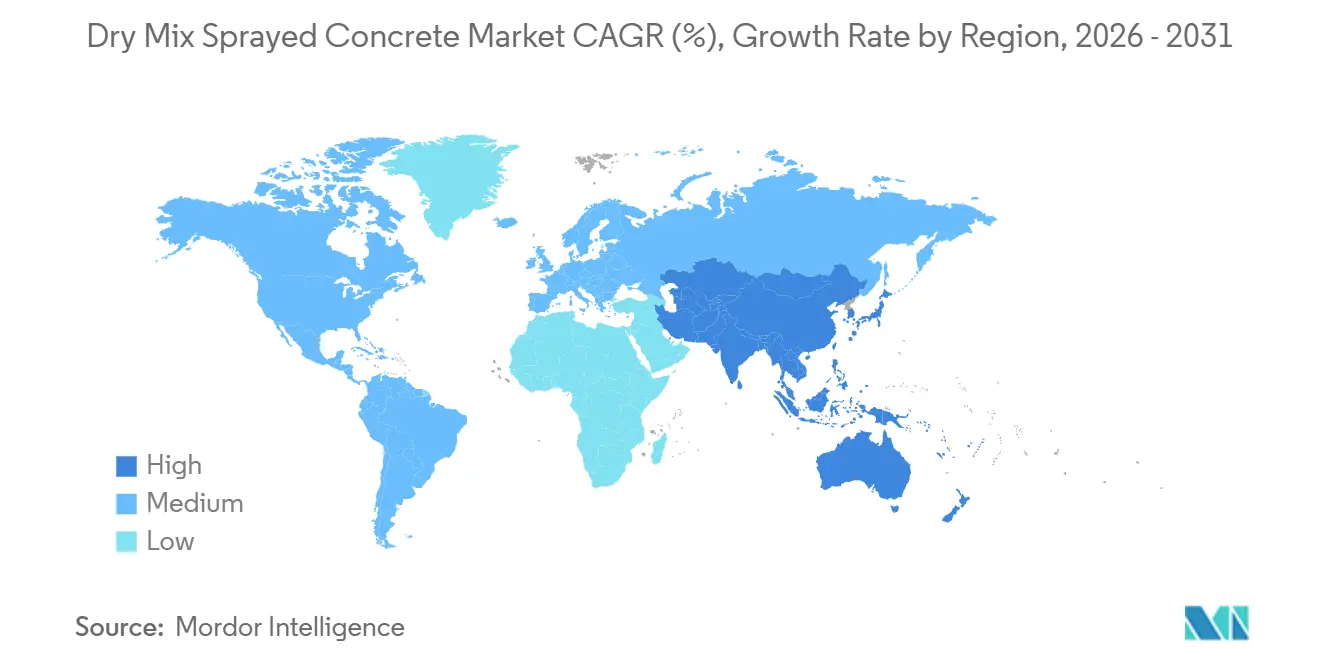
Asia-Pacific accounted for 40.18% of the dry mix sprayed concrete market share in 2025 and is forecast to grow at a 7.76% CAGR through 2031. China, India, Japan, and South Korea combine major tunnel programs with expanding underground mining activity. China completed the Yangtze River underwater breakthrough for the 14.25 km Chongming-Taicang high-speed railway tunnel in July 2026, with the full project targeted for completion by the end of 2026. India's metro and rail programs provide additional demand for lining materials and equipment.
Europe and North America Dry Mix Sprayed Concrete Market
Europe's demand is driven by construction in the Alpine corridor and tunnel rehabilitation. Germany's infrastructure funding and the Brenner Base Tunnel support high-specification shotcrete work. BAUER Group's SPESA division began rehabilitating the Holzminden tunnel in April 2025, using 1,000 tons of shotcrete for the tunnel crown reconstruction. North America remains a high-value dry mix sprayed concrete market, as permanent tunnel-lining specifications and silica controls support more controlled application methods.
MEA and South America Dry Mix Sprayed Concrete Market
South America, the Middle East, and Africa are developing demand centers. Chilean mine transitions and Brazil's hydropower tunnel activity support remote-site use where batching infrastructure is limited. Saudi Arabia's Jabal Sayid mine has maintained continuous underground contracting for 15 years. South Africa's deep gold and platinum mines require fiber-reinforced products suited to seismic conditions. Import-dependent accelerator supply can expose both regions to higher cost volatility, making local sourcing and dependable technical support key factors influencing the dry mix sprayed concrete market in these regions.
Competitive Landscape
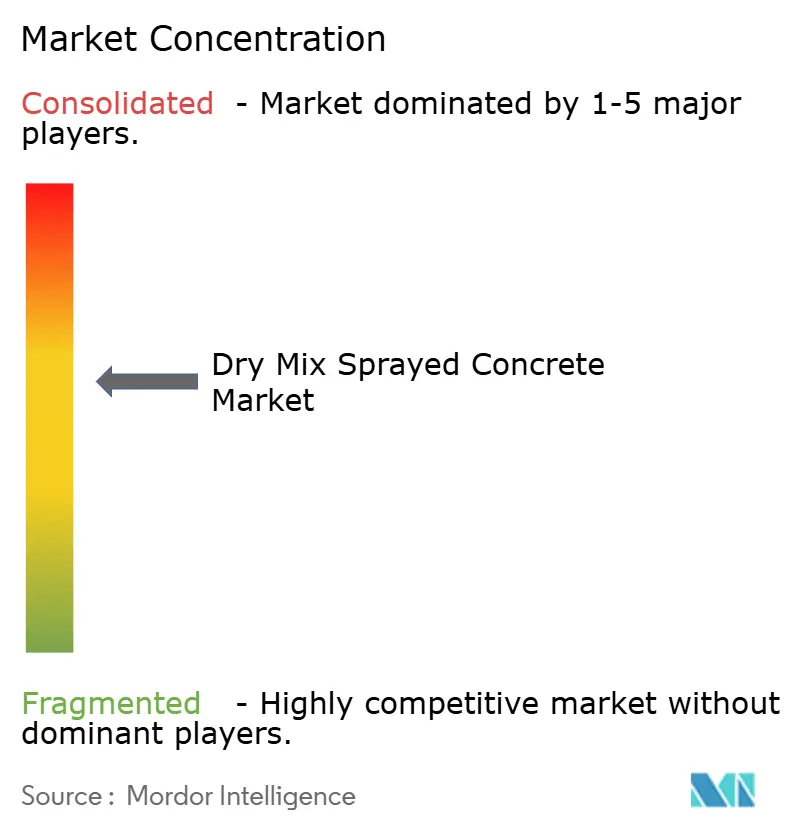
The dry mix sprayed concrete market is moderately consolidated. Sika, BASF, and MAPEI compete by offering alkali-free, fiber-compatible products that contractors can specify for demanding projects. Normet and Epiroc compete by offering machines that integrate spraying hardware with dosing and control systems. Sika's Sigunit alkali-free accelerator range supports specification-grade tunnel lining. Companies with tested formulations can compete on performance and technical service rather than on price alone.
Normet's Spraymec range covers small mine profiles through 28 m-wide caverns. Its closed-loop accelerator dosing and SmartSpray controls reduce reliance on manual consistency checks. Normet launched the Spraymec 2100 in June 2026 for small and mid-size mine envelopes. The machine has up to 10.5 m of vertical reach and a pump output of up to 27 m³/h. Epiroc and Master Builders Solutions partnered in March 2026 to develop chemical technologies for mining. These developments indicate that equipment and formulation development are becoming increasingly connected in the dry mix sprayed concrete market.
BASF filed patent WO2026131298A1 in June 2026 for a lower-carbon cementitious composition with 2-6 MPa early strength and 33-50 MPa strength at 28 days. In February 2026, Heidelberg Materials agreed to acquire Maas Group's construction materials business in Australia. The business includes 40 quarries with reserves above 350 million tons and 22 ready-mixed concrete plants. Such acquisitions can strengthen upstream supply positions for concrete inputs. Smaller regional suppliers continue to serve local contractors with standard formulations.
Dry Mix Sprayed Concrete Industry Leaders
-
Sika AG
-
Normet
-
MAPEI S.p.A.
-
Putzmeister
-
BASF
- *Disclaimer: Major Players sorted in no particular order
Dry Mix Sprayed Concrete Market Companies Covered in this Report
- BASF
- CEMEX S.A.B. de C.V.
- Epiroc AB
- GCP Applied Technologies Inc.
- Heidelberg Materials AG
- HOLCIM
- MAPEI S.p.A.
- Normet
- Putzmeister
- REED International
- Saint-Gobain
- Shotcrete Technologies Inc.
- Sika AG
- The Euclid Chemical Company
- The QUIKRETE Companies
Recent Industry Developments in Dry Mix Sprayed Concrete Market
- August 2026: Tunnel Boring Machine (TBM) Nilagiri achieved a breakthrough at Moolakadai station under Chennai Metro Rail Phase II Package TU-01, completing an 819-meter upline drive as part of 9 km of twin-bored tunnels. The project supports continued demand for dry mix sprayed concrete for primary shotcrete lining across the corridor.
- June 2026: Normet launched the Spraymec 2100, a self-propelled concrete sprayer designed for small and mid-size mine envelopes, with a maximum vertical reach of 10.5 m and a concrete pump output of 27 m³/h. The equipment is compatible with dry mix sprayed concrete applications in constrained underground environments.
Global Dry Mix Sprayed Concrete Market Report Scope
Dry mix sprayed concrete, commonly known as gunite, is a technique in which pre-blended dry materials are propelled through a hose with compressed air and mixed with water at the nozzle just before impact.
The dry mix sprayed concrete market is segmented by concrete type, application, and geography. By concrete type, the market is segmented into normal-strength concrete, high-strength concrete, and ultra-high-strength concrete. By application, the market is segmented into tunneling, mining, civil engineering, industrial, water-retaining structures, and other applications. The report also covers market size and forecasts for dry mix sprayed concrete across 16 countries in major regions. The market sizes and forecasts are provided in terms of value (USD).
Segmentation Overview
| Normal-Strength Concrete |
| High-Strength Concrete |
| Ultra-High-Strength Concrete |
| Tunneling |
| Mining |
| Civil Engineering |
| Industrial |
| Water-Retaining Structures |
| Other Applications |
| Asia-Pacific | China |
| India | |
| Japan | |
| South Korea | |
| Rest of Asia-Pacific | |
| North America | United States |
| Canada | |
| Mexico | |
| Europe | Germany |
| United Kingdom | |
| France | |
| Italy | |
| Rest of Europe | |
| South America | Brazil |
| Argentina | |
| Rest of South America | |
| Middle East and Africa | Saudi Arabia |
| South Africa | |
| Rest of Middle East and Africa |
| By Concrete Type | Normal-Strength Concrete | |
| High-Strength Concrete | ||
| Ultra-High-Strength Concrete | ||
| By Application | Tunneling | |
| Mining | ||
| Civil Engineering | ||
| Industrial | ||
| Water-Retaining Structures | ||
| Other Applications | ||
| By Geography | Asia-Pacific | China |
| India | ||
| Japan | ||
| South Korea | ||
| Rest of Asia-Pacific | ||
| North America | United States | |
| Canada | ||
| Mexico | ||
| Europe | Germany | |
| United Kingdom | ||
| France | ||
| Italy | ||
| Rest of Europe | ||
| South America | Brazil | |
| Argentina | ||
| Rest of South America | ||
| Middle East and Africa | Saudi Arabia | |
| South Africa | ||
| Rest of Middle East and Africa | ||
Key Questions Answered in the Report
What is current market size of Dry Mix Sprayed Concrete Market?
The Dry Mix Sprayed Concrete Market size was valued at USD 6.23 billion in 2025 and is estimated to grow from USD 6.65 billion in 2026 to reach USD 9.38 billion by 2031, at a CAGR of 7.13% during the forecast period (2026-2031).
Which concrete type is growing fastest?
Ultra-high-strength concrete is projected to grow at a 7.67% CAGR from 2026 to 2031.
Which application has the highest growth rate?
Mining is the fastest-growing application, with a projected 8.25% CAGR through 2031.
Which region leads in global consumption?
Asia-Pacific accounted for 40.18% of global consumption in 2025 and is forecast to grow at a 7.76% CAGR through 2031.