
Driver Monitoring System Market Size and Share
Market Overview
| Study Period | 2020 - 2032 |
|---|---|
| Market Size (2027) | USD 3.91 Billion |
| Market Size (2032) | USD 7.51 Billion |
| Growth Rate (2027 - 2032) | 13.94 % |
| Fastest Growing Market | Asia-Pacific |
| Largest Market | Europe |
| Market Concentration | Medium |
Major Players *Disclaimer: Major Players sorted in no particular order Image © Mordor Intelligence. Reuse requires attribution under CC BY 4.0. | |
Driver Monitoring System Market Analysis by Mordor Intelligence
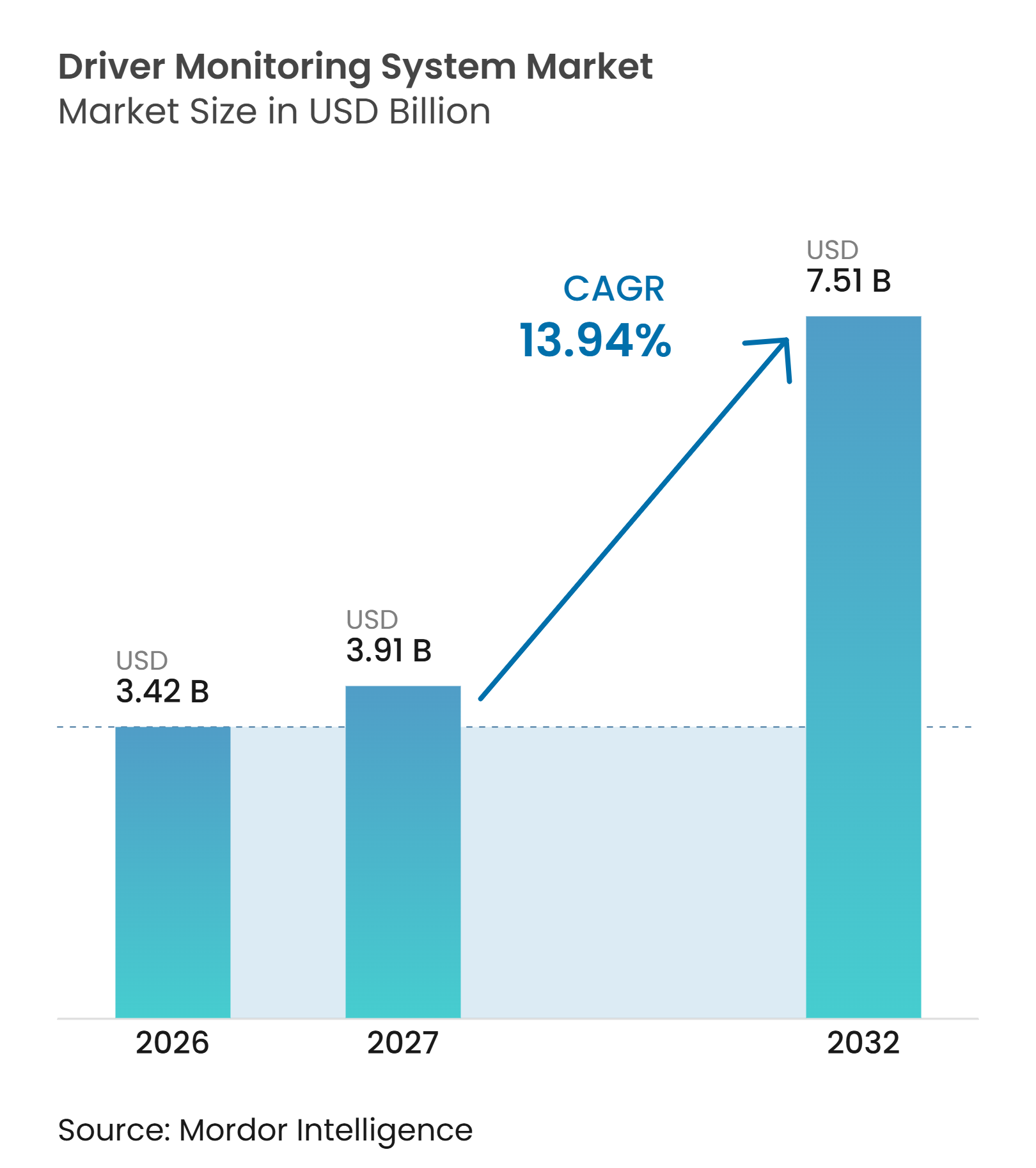
The driver monitoring system market size was valued at USD 3.42 billion in 2026, is estimated at USD 3.91 billion in 2027, and is projected to reach USD 7.51 billion by 2032, growing at a CAGR of 13.94% from 2027 to 2032. Europe’s July 2026 rules made advanced driver distraction warning a standard compliance requirement for newly sold vehicles, which moved demand beyond premium vehicle programs[1]. Euro NCAP’s 2026 protocols also increase the value of reliable driver monitoring because the assessment gives substantial weight to driver engagement and occupant monitoring performance [2]. The automotive driver monitoring system market is therefore expanding through both mandatory fitment and wider use in assisted-driving packages. Suppliers are moving camera, driver, occupant, and advanced driver-assistance functions onto shared compute platforms, which favors proven software and systems integration. Privacy requirements, validation costs, variable lighting, and legacy-fleet installation needs continue to limit adoption in some vehicle programs.
Key Report Takeaways
- By system type, Driver Monitoring Only held 68.27% of the automotive driver monitoring system market share in 2026, while Integrated DMS+OMS is forecast to expand at a 16.77% CAGR through 2032.
- By component, Hardware accounted for 71.27% of the automotive driver monitoring system market size in 2026, while Software and Algorithms is forecast to grow at a 15.00% CAGR through 2032.
- By technology, Camera-Based systems held 88.18% revenue share in 2026, while Others is forecast to grow at a 15.21% CAGR through 2032.
- By vehicle type, Passenger Cars held 76.26% revenue share in 2026, while Heavy Commercial Vehicles is forecast to grow at a 14.36% CAGR through 2032.
- By sales channel, OEM regulation-driven fitment held 84.27% revenue share in 2026 and is forecast to grow at a 14.03% CAGR through 2032.
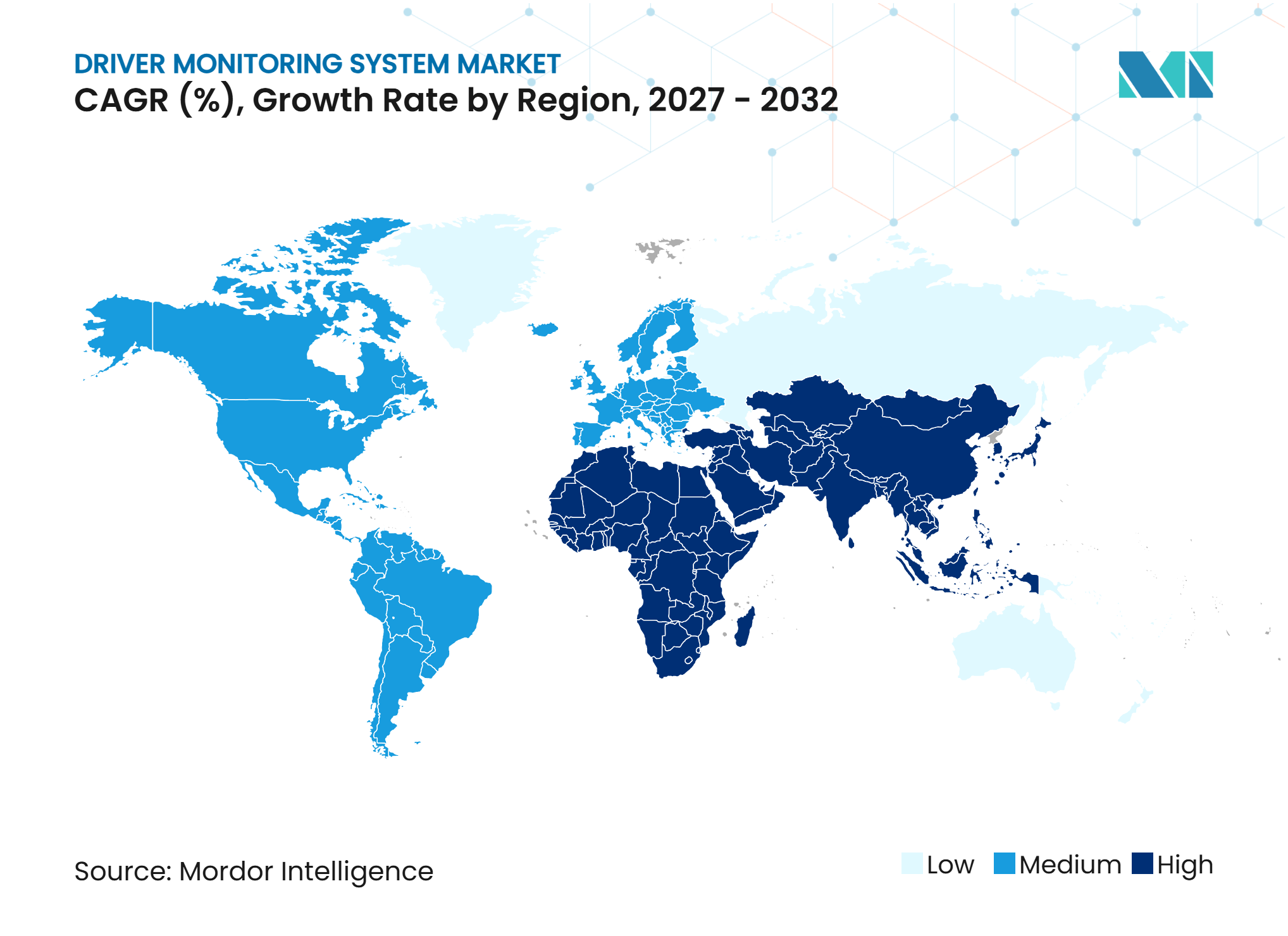
- By geography, Europe held 36.27% revenue share in 2026, while Asia-Pacific is forecast to grow at a 15.12% CAGR through 2032.
Note: Market numbers in this report are based on Mordor Intelligence's proprietary estimation framework, which combines nine months of actuals with Q4 projections for base year 2026.
Market Trends and Insights
Drivers Impact Analysis of Driver Monitoring System Market*
| Driver | (~) % Impact on CAGR Forecast | Geographic Relevance | Impact Timeline |
|---|---|---|---|
| EU General Safety Regulation Adoption | +4.0% | Europe core, with spillover to markets following EU vehicle homologation | Short term (≤ 2 years) |
| Euro NCAP Driver Engagement Scoring | +2.5% | Europe primary, with secondary relevance in Japan, South Korea, Australia, and markets using NCAP protocols | Short term (≤ 2 years) |
| Expansion of L2 and L2+ Assisted Driving | +2.3% | China, North America, and the EU | Medium term (2-4 years) |
| OEM Demand for Integrated DMS and OMS Platforms | +1.8% | Global, with fastest uptake in the EU and China | Medium term (2-4 years) |
| Commercial Fleet Safety and Insurance Programs | +1.4% | North America primary, with growing relevance in Europe and Asia-Pacific | Short term (≤ 2 years) |
| Falling Cost of Infrared Vision Hardware | +0.9% | Global, with greater benefit in India, Southeast Asia, and South America | Long term (≥ 4 years) |
| Source: Mordor Intelligence | |||
EU General Safety Regulation Adoption
The EU requirement for advanced driver distraction warning applies to all newly sold vehicles from July 2026. This change makes driver monitoring a compliance requirement across European new-vehicle programs rather than an optional premium feature. The automotive driver monitoring system market benefits because vehicle manufacturers must plan fitment across broad model ranges. The underlying rules require systems to work automatically, so suppliers need dependable detection rather than basic alert functions. This favors providers that can support vehicle validation, production integration, and regulatory documentation. The rule also encourages local processing of sensitive data, since vehicle designs must limit the handling of information beyond what is needed for the safety function.
Euro NCAP Driver Engagement Scoring
Euro NCAP’s 2026 assessment protocol places driver engagement within its Safe Driving evaluation, raising the commercial value of systems that perform well in test conditions. The protocol considers distraction, phone use, drowsiness, microsleep, and unresponsive driving. It also requires driver-monitoring functions to remain active by default in the assessed configuration. This creates a clear distinction between a system that merely meets a legal threshold and one that supports a strong consumer safety rating. The automotive driver monitoring system market gains from this distinction because automakers have a reason to improve camera placement, warning logic, and driver-state recognition. The scoring structure also links interior sensing quality more closely to the value of assisted-driving features.
Expansion of L2 and L2+ Assisted Driving
The International Energy Agency reported that nearly half of new cars sold globally in 2025 included Level 2 automation, while Level 2+ penetration reached 10% in China and 6% in the United States. These functions require drivers to remain available to resume control, making attention and readiness monitoring more important than conventional drowsiness alerts. The automotive driver monitoring system market therefore has a larger addressable base as assisted-driving systems move from a limited number of premium vehicles to more mainstream programs. Shared computing platforms can combine driver monitoring, occupant monitoring, and automated-driving functions, reducing the need for separate control units. Mobileye’s 2026 production program with a U.S. automaker illustrates this approach by integrating driver monitoring with ADAS on its EyeQ6L platform. The shift rewards suppliers with software that can operate across broader vehicle architectures and meet safety-related performance requirements.
Commercial Fleet Safety and Insurance Programs
Fleet use of driver monitoring increasingly depends on insurance, safety, and liability considerations, especially where a passenger-vehicle mandate does not exist. Motive and GEICO introduced a commercial fleet partnership in November 2025 that allows eligible new policyholders to receive up to 10% premium savings by sharing driving and camera data [3]. China also required advanced safety technologies on new operational trucks from July 2025, which supports factory and fleet demand for monitoring systems. The automotive driver monitoring system market can expand through these programs because operators can tie safety equipment to claims handling, driver coaching, and insurance outcomes. This route is especially relevant for heavy vehicles that operate long distances or carry higher liability exposure. Falling infrared hardware costs could support adoption in cost-sensitive fleet markets over a longer period.
Restraints Impact Analysis of Driver Monitoring System Market*
| Restraint | (~) % Impact on CAGR Forecast | Geographic Relevance | Impact Timeline |
|---|---|---|---|
| High Validation and Homologation Costs | -1.2% | Global, with the sharpest effect on smaller OEMs and Tier-2 suppliers in emerging markets | Medium term (2-4 years) |
| Privacy, Consent, and In-Vehicle Data Governance | -0.8% | EU, United States, and China | Medium term (2-4 years) |
| False Warnings Under Occlusion and Variable Lighting | -0.5% | Global, with higher difficulty across diverse driver populations and limited testing resources | Long term (≥ 4 years) |
| Fragmented Retrofit Integration Across Legacy Fleets | -0.4% | North America, Asia-Pacific, and emerging markets with older commercial fleets | Long term (≥ 4 years) |
| Source: Mordor Intelligence | |||
High Validation and Homologation Costs
Driver monitoring is a safety-critical function, so vehicle programs need extensive functional-safety, validation, and homologation work before production approval. ISO 26262 work can span 18 to 36 months for a vehicle platform, while requirements differ between European rules, Euro NCAP protocols, United Nations regulations, and national standards. These parallel requirements increase the cost and time needed to launch similar functions in multiple markets. Smaller automakers and suppliers have less ability to spread these costs across high production volumes. The issue is more visible in lower-priced vehicle segments, where system cost has a greater effect on program economics. Legacy fleets also face a separate integration burden because aftermarket systems must work with older vehicle electrical and telematics architectures.
Privacy, Consent, and In-Vehicle Data Governance
Driver-monitoring systems may process facial imagery, gaze direction, driving behavior, and vehicle-location information, which makes data governance a central design issue. The U.S. Federal Trade Commission finalized an order against General Motors and OnStar in January 2026 that addressed the collection and sharing of driver behavior and geolocation data without informed consent. Italy’s data protection authority imposed a EUR 120,000 fine in December 2025 over the use of satellite telematics to evaluate employee driving behavior without a valid legal basis. These actions make on-device processing and event-triggered recording more attractive for fleet and passenger-vehicle programs. Camera performance remains another practical issue because occlusion, sunglasses, and changing light can reduce recognition reliability. Developers must improve testing across different drivers and environments without expanding collection or retention of personal information.
*Our forecasts treat driver/restraint impacts as directional, not additive. The impact forecasts reflect baseline growth, mix effects, and variable interactions.
Driver Monitoring System Market Segment Analysis
By System Type:
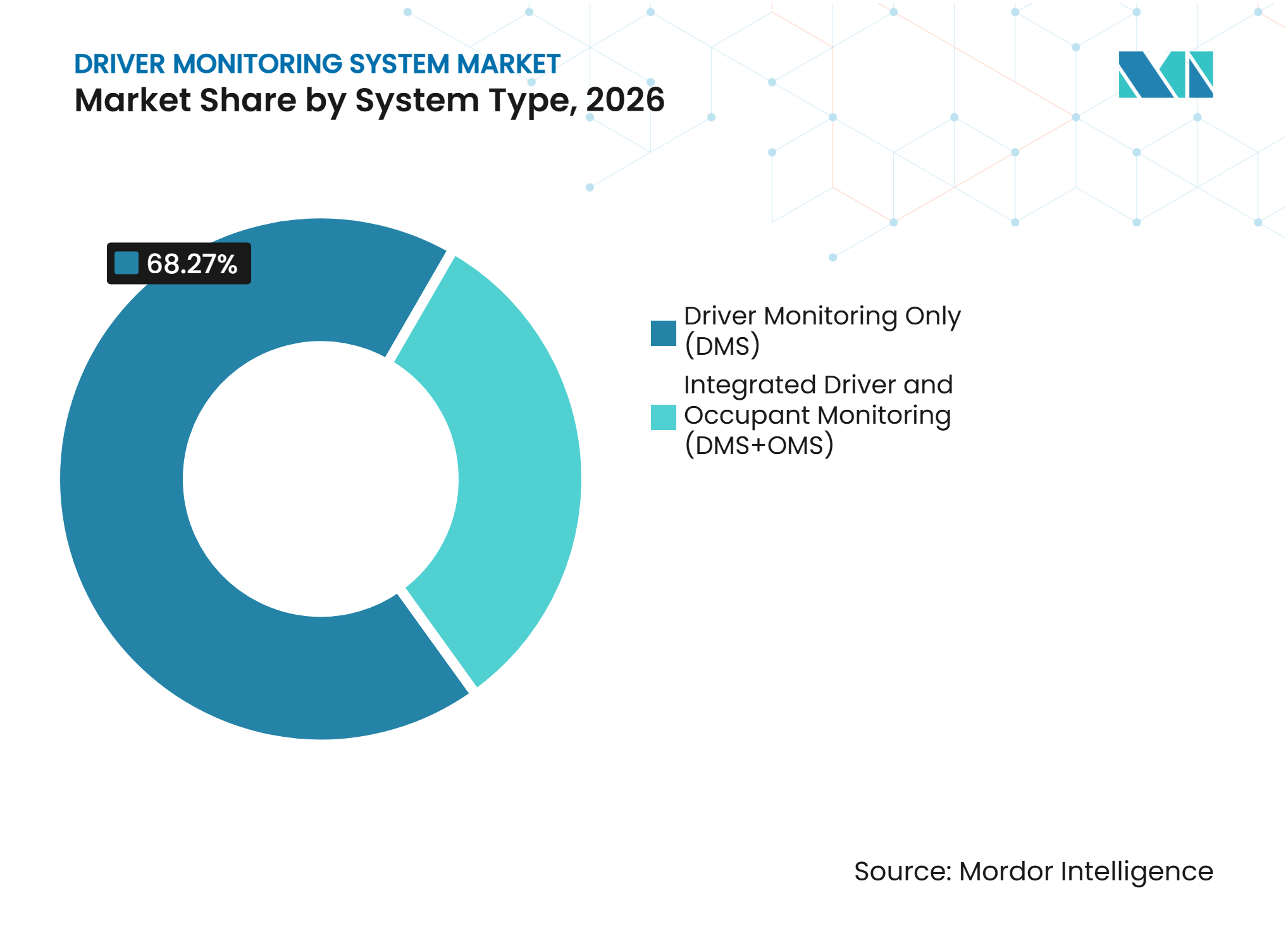
Integrated Monitoring Reorients the Revenue MixDriver Monitoring Only accounted for 68.27% of overall revenue in 2026, supported by the current European compliance cycle. It remains the standard option for vehicle programs focused on distraction detection and driver readiness. The EU requirement for advanced driver distraction warning has increased fitment across new light vehicles. This installed base gives DMS-only systems a strong near-term position, particularly where automakers seek a clear compliance path. Suppliers can use established near-infrared cameras and validated software to meet the immediate demand. The category also remains relevant in vehicle lines where cost and packaging constraints limit the broader use of cabin sensors. Its share reflects the fact that regulation initially focused on the driver rather than the full cabin. The automotive driver monitoring system market still needs this focused configuration because it offers a practical starting point for manufacturers that are entering the compliance cycle. It also lets vehicle makers retain a familiar cabin layout while meeting an immediate safety requirement. As a result, DMS-only programs provide an accessible path for high-volume models even when a full occupant-monitoring package is not yet planned.
Integrated DMS+OMS is forecast to grow at a 16.77% CAGR through 2032, ahead of the broader automotive driver monitoring system market. The segment combines driver observation and occupant sensing through a shared interior architecture. Mobileye’s 2026 program uses its EyeQ6L system-on-chip to combine driver monitoring and ADAS functions, avoiding a separate DMS control unit. Euro NCAP also gives distinct consideration to occupant monitoring and driver engagement within its Safe Driving evaluation. This gives automakers a stronger reason to use one sensing platform for several safety functions. Integrated systems can reduce hardware duplication, but they require more complex software integration and validation. The approach favors suppliers that can combine cameras, algorithms, and vehicle-level computing in a single program. For automakers, the main benefit is that one interior sensing architecture can support several functions during the life of a vehicle platform. This can simplify the path from initial compliance fitment to more advanced cabin-safety features. It also makes the selection of a software partner more important because the same system may be used across several vehicle models.


By Component:
Software Value Rises Against a Hardware BaseHardware held 71.27% of the automotive driver monitoring system market size in 2026 because near-infrared cameras and illuminators remain the physical basis of most systems. Camera modules, light-emitting diodes, wiring, and related electronic components must be installed in each vehicle. These parts have become more common as European rules extend advanced driver distraction warning across newly sold vehicles. Hardware suppliers also need to meet packaging, eye-safety, and durability requirements in different cabin layouts. Higher production volumes can lower component costs and improve access in lower-priced vehicle segments. However, standalone control-unit demand may weaken where vehicle makers place cabin sensing on centralized compute platforms. Hardware remains essential, but its share does not fully capture the value of the software that interprets the image stream. The automotive driver monitoring system market depends on this combination because reliable sensing requires both suitable cabin hardware and recognition software. Automakers must balance component cost against the need for consistent performance in different vehicle designs. This balance can shape whether a system is fitted as a standard safety function or offered with a broader assisted-driving package.
Software and Algorithms is forecast to grow at a 15.00% CAGR through 2032. Automakers increasingly need capabilities that go beyond basic eye-closure or head-position detection. These include driver identity, impairment signals, gaze-to-hazard correlation, handover readiness, and reliable operation across lighting conditions. Euro NCAP’s 2026 driver-engagement requirements strengthen the need for software that can identify several distraction and drowsiness states. Software also supports product differentiation because functions can be adapted as vehicle platforms gain more assisted-driving capability. The faster growth of this component reflects a shift in spending toward recognition quality and safety validation. Suppliers with completed safety qualification and production experience have an advantage because OEM software approvals can take several vehicle-development cycles. Software suppliers must also show that their functions perform consistently without creating unnecessary driver warnings. This makes data quality, validation coverage, and integration support important parts of the commercial offer. It also explains why established suppliers can retain a position even as new recognition features enter the automotive driver monitoring system market.
By Technology:
Camera Systems Remain Central as Sensor Fusion AdvancesCamera-Based technology held 88.18% revenue share in 2026 because it can identify gaze direction, eyelid movement, head position, and other driver-state signals. These capabilities align with the detection needs described in current European safety requirements and Euro NCAP tests. Near-infrared cameras can operate with limited visible light, which supports nighttime use and common vehicle-cabin layouts. The scale of camera deployment is also helping to lower unit costs. Camera systems are familiar to vehicle manufacturers and can be integrated behind mirrors, in clusters, or near the A-pillar. Their continued lead reflects both regulatory fit and established supply chains. However, individual cameras can face performance limits when the driver is obscured or the cabin environment changes sharply. Manufacturers are therefore refining illumination, placement, and image-processing approaches to improve performance in daily driving conditions. These improvements are relevant for systems that must remain active and dependable under regulatory and rating protocols. Camera suppliers also need to align optical design with vehicle styling and packaging constraints.
The Others category is forecast to grow at a 15.21% CAGR through 2032 as suppliers add radar, steering sensors, and seat sensors to camera-based architectures. These technologies can provide separate indications of hand position, occupancy, or movement. Sensor fusion can reduce dependence on one signal when sunglasses, face coverings, glare, or body position affect camera performance. China’s draft requirement for continuous hand and eye monitoring in Level 2 systems supports this broader technical direction. The segment is not displacing cameras in the near term because many safety functions still need visual driver-state data. Instead, it adds redundancy and improves the robustness of interior sensing. The automotive driver monitoring system market will likely see these technologies used most often in integrated driver and occupant monitoring systems. Additional signals can help a system distinguish a temporary visual obstruction from a genuine loss of driver attention. They can also support occupant-related functions without relying only on a driver-facing camera. This technical direction increases the need for coordinated software and vehicle-level calibration.
By Vehicle Type:
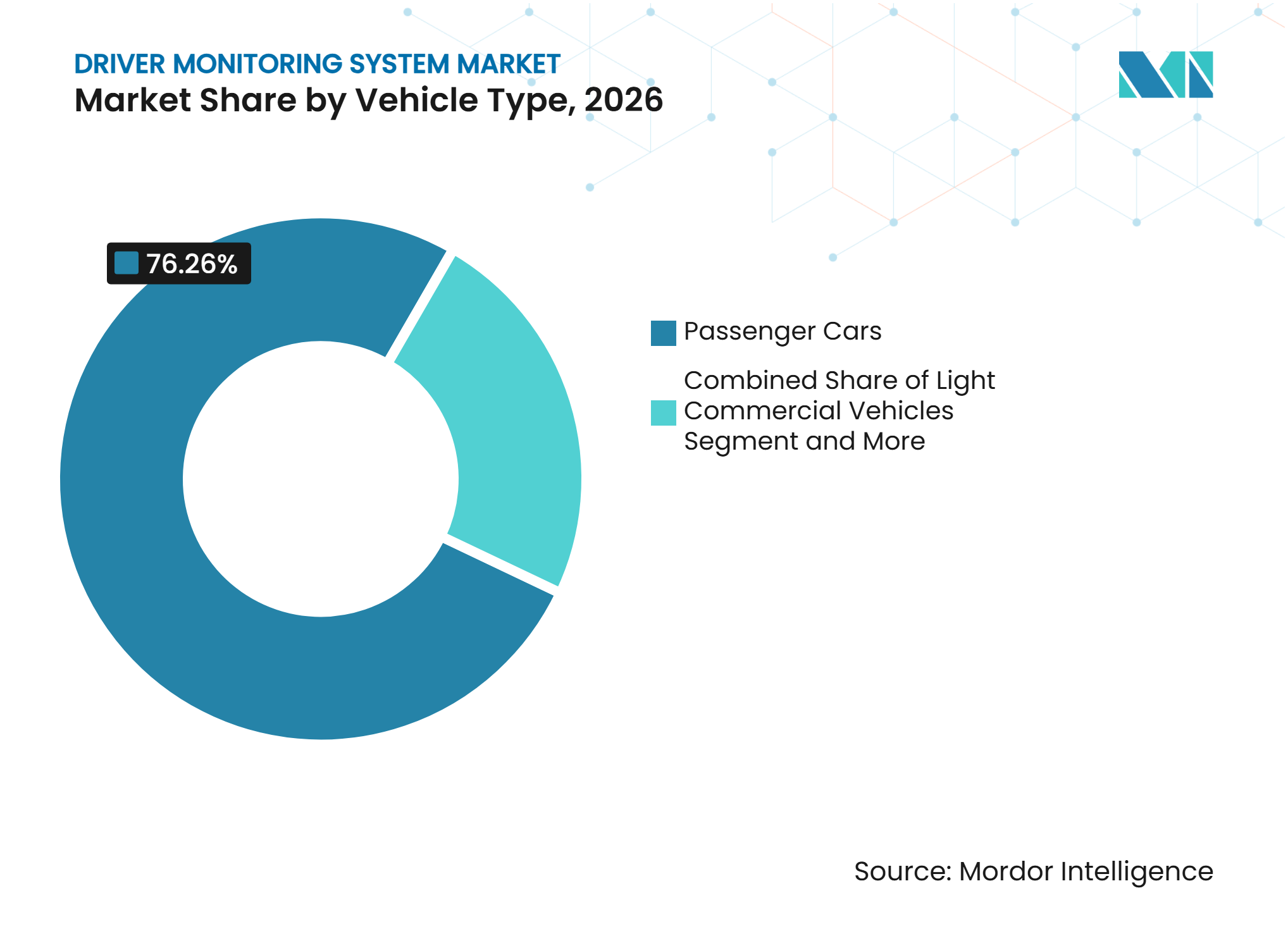
Commercial Vehicle Momentum Challenges Passenger Car SharePassenger Cars accounted for 76.26% of market value in 2026, reflecting their large production base and the scope of European advanced driver distraction warning requirements. The EU rules extend the safety requirement across newly sold vehicles, supporting broad fitment in mainstream passenger-car lines. Passenger vehicle systems are often linked to assisted-driving features, safety ratings, and brand positioning. Automakers also use the systems to support safe handovers when advanced functions are active. This combination gives passenger cars the widest immediate opportunity for factory-installed units. Cost remains important in entry-level models, so feature content may vary across price points. The segment will continue to anchor volume even as commercial applications grow faster. Passenger-car demand also gives suppliers a large base over which to validate software and improve production efficiency. The automotive driver monitoring system market can use this scale to make safety functions more available across vehicle price categories. At the same time, feature differentiation will remain strongest in models that combine monitoring with higher levels of assisted driving.
Heavy Commercial Vehicles is forecast to grow at a 14.36% CAGR through 2032. Long-distance operations create a stronger need to identify fatigue, distraction, and driver incapacitation. China required advanced safety technologies on newly operating trucks from July 2025, which adds a policy-based source of demand. Fleet owners can also connect monitoring systems with driver coaching, accident review, and insurance programs. Motive and GEICO’s 2025 partnership shows how insurance savings can add a financial case for adoption. Light commercial vehicles are subject to the broader European regulatory direction, while buses can benefit from lower accident and liability exposure. The commercial opportunity is broader than factory fitment because many fleet vehicles can use aftermarket equipment. Fleet buyers may place greater weight on operational outcomes than on the styling or feature differentiation that shape passenger-car purchases. This creates demand for systems that are simple to install, provide useful safety feedback, and manage data responsibly. It also allows suppliers to develop service and support capabilities alongside the physical monitoring equipment.


By Sales Channel:
OEM Compliance Fitment Drives Channel ConcentrationOEM regulation-driven fitment held 84.27% revenue share in 2026. This channel has become central because legal requirements apply at the vehicle-program level rather than through gradual customer adoption. The European Commission confirmed that the advanced safety rules apply to all newly sold vehicles from July 2026. A single compliance deadline can therefore bring an automaker’s entire relevant model range into the addressable base. OEM programs also offer suppliers predictable production volumes and closer integration with vehicle electronics. The channel favors companies that have existing relationships with vehicle makers and can support global validation. It also brings pricing pressure because large programs are usually sourced through competitive tenders. The automotive driver monitoring system market is shaped by these programs because an award can provide scale across several vehicle lines. Suppliers therefore compete on total integration capability, validation support, and long-term software performance as well as component price. The result is a channel where production scale and established OEM relationships carry substantial weight.
The same OEM channel is forecast to grow at a 14.03% CAGR through 2032. Its position reflects continuing regulatory fitment and the addition of DMS to broader assisted-driving packages. Integrated software can also be deployed on shared vehicle processors, which supports OEM interest in platform-wide architectures. Mobileye’s EyeQ6L production program demonstrates how driver monitoring can be included in a larger automated-driving computing package. The aftermarket and fleet channel serves older vehicles and markets without a unified new-vehicle mandate. It can grow through insurer incentives and operator safety policies, although installation complexity limits its scale. Event-triggered recording and local analysis can improve acceptance where employee surveillance and data privacy are material concerns. This channel can be useful where operators want safety benefits before a new-vehicle compliance requirement applies. It also gives providers a route to serve diverse fleets that may not use the same vehicle electronics or operating practices. Aftermarket growth will depend on installation quality, operator acceptance, and the ability to demonstrate a clear safety or insurance benefit.
Geography Analysis
Europe
Europe held 36.27% of the automotive driver monitoring system market share in 2026. The region benefits from being the first large vehicle market to apply advanced driver distraction warning requirements to all newly sold vehicles. Euro NCAP adds a competitive layer because its 2026 protocols assess driver engagement and occupant-monitoring performance. Germany, France, the United Kingdom, Italy, and Spain remain important vehicle-production and demand centers. European OEMs are adopting behind-glass and mirror-based camera placements to fit new cabin designs and centralized computing architectures. Privacy compliance is equally important because employee and consumer data rules affect how monitoring data can be handled. Italy’s 2025 enforcement action on telematics use illustrates the need for defensible consent and employment practices.
Asia-Pacific
Asia-Pacific is forecast to grow at a 15.12% CAGR through 2032. China is a major source of demand because local automakers are expanding Level 2 functions and competing through safety features. The country’s draft standard for Level 2 systems calls for continuous hand and eye monitoring, strengthening the case for multi-sensor systems. Japan has also set a future regulatory path for mandatory driver monitoring on new vehicle models. South Korea has a substantial OEM base that can adopt interior sensing before regulations take effect. In India, electric-vehicle safety positioning is encouraging voluntary use of driver and occupant monitoring software. The automotive driver monitoring system market size in this region is also supported by local supply expansion, which can reduce the cost of camera hardware over time.
Americas, South America, Middle East, and Africa
North American demand is developing through OEM safety systems and commercial fleet adoption rather than a unified federal requirement that matches Europe’s rule. The FTC’s January 2026 action against General Motors and OnStar makes consent, data sharing, and deletion controls important considerations for U.S. programs. Insurer-led fleet programs provide a practical adoption route, as shown by Motive and GEICO’s partnership offering eligible policyholders up to 10% premium savings. South America, the Middle East, and Africa have a stronger near-term opportunity in logistics, mining, energy, public transport, and other high-liability fleets. Older vehicle fleets make retrofit design and installation capability important in these regions. These geographies may adopt more gradually, but the safety and insurance case can support demand without a broad passenger-vehicle mandate.
Competitive Landscape
Market Concentration
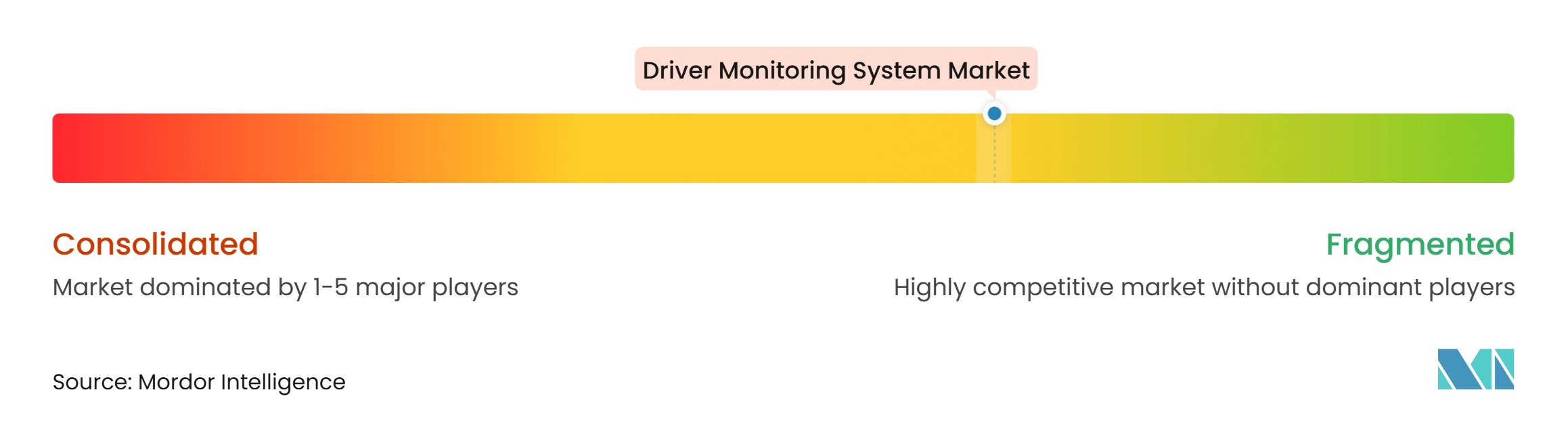
The driver monitoring system industry is moderately concentrated among Tier-1 integrators, including Valeo, Bosch, Magna, DENSO, and Aptiv, which supply cameras, software, vehicle integration, and related ADAS or cockpit functions. Specialized firms compete in the less concentrated software layer for recognition algorithms and OEM design wins. Suppliers increasingly integrate driver monitoring, occupant monitoring, and ADAS functions on shared system-on-chips to reduce hardware needs. Mobileye’s March 2026 production program with a U.S. automaker integrates driver monitoring on the EyeQ6L.
HARMAN acquired Cipia’s assets in June 2025, adding interior-sensing capabilities and OEM design wins to its portfolio. Valeo and Seeing Machines demonstrated gaze-tracking applications at CES 2026 that linked hazard awareness with adaptive warnings. Suppliers also compete through camera configurations, including mirror-integrated, cluster-mounted, and A-pillar solutions, which involve different styling, calibration, and field-of-view tradeoffs.
Privacy-preserving features, such as event-triggered recording and on-device analysis, are becoming important in fleet applications. Suppliers must also meet standards and certification requirements to demonstrate system reliability. The market favors suppliers that can support OEMs from early architecture decisions through production validation, although specialist software firms can secure design roles through technology partnerships. Vehicle manufacturers assess suppliers based on compliance readiness, system performance, software support, cost, and adaptability across vehicle models and regions.
Driver Monitoring System Industry Leaders
-
Seeing Machines Limited
-
Smart Eye AB
-
Robert Bosch GmbH
-
Valeo SE
-
AUMOVIO SE
- *Disclaimer: Major Players sorted in no particular order
Driver Monitoring System Market Companies Covered in this Report
- Seeing Machines Limited
- Smart Eye AB
- Cipia Vision Ltd.
- Robert Bosch GmbH
- AUMOVIO SE
- Valeo SE
- DENSO Corporation
- Aptiv PLC
- Magna International Inc.
- Hyundai Mobis Co., Ltd.
- Visteon Corporation
- Mobileye Global Inc.
- Samsung Electronics Co., Ltd. (Harman)
- OmniVision Technologies, Inc.
- Ambarella, Inc.
- Tobii AB
- Jungo Connectivity Ltd.
- Mitsubishi Electric Corporation
- FORVIA SE
- ZF Friedrichshafen AG
Recent Industry Developments in Driver Monitoring System Market
- July 2026: Seeing Machines won a driver and occupant monitoring program with a European automaker through an existing Tier-1 relationship, valued at about USD 5 million over its lifetime. The mirror-integrated system is scheduled for upcoming vehicle platforms starting in 2028.
- May 2026: AISIN selected Green Hills Software, the NXP i.MX 9 series, and Smart Eye AI for its next-generation driver monitoring system (DMS), which incorporates a passive alcohol detection system based on behavioral image analysis. The company targets the first commercial release for 2028.
- March 2026: Mobileye secured a production program with a leading U.S. automaker to integrate its Driver Monitoring System (DMS) on the EyeQ6L system-on-chip (SoC), with production scheduled to begin in 2027. The program will cover millions of vehicles across multiple models and eliminate the need for a standalone DMS electronic control unit (ECU) by integrating driver monitoring and advanced driver-assistance systems (ADAS) functions on a single chip.
- November 2025: Seeing Machines secured a new program with a Japanese automaker through Mitsubishi Electric Mobility, with production starting in 2028, and expanded an existing European program by about USD 10 million in initial lifetime value for production running from 2028 to 2031.
Global Driver Monitoring System Market Report Scope
The Driver Monitoring System Market is Segmented by System Type (Driver Monitoring Only (DMS) and Integrated Driver and Occupant Monitoring (DMS+OMS)), Component (Hardware, Software, and Algorithms), Technology (Camera-Based and Others), Vehicle Type (Passenger Cars, Light Commercial Vehicles (LCV), and Heavy Commercial Vehicles (HCV)), Sales Channel (OEM and Aftermarket), and Geography (North America, Europe, Asia-Pacific, South America, and Middle East and Africa (MEA)). The Market Forecasts are Provided in Terms of Value (USD) and Volume (Units).
Segmentation Overview
| Driver Monitoring Only (DMS) |
| Integrated Driver and Occupant Monitoring (DMS+OMS) |
| Hardware | Infrared Cameras |
| Infrared LEDs | |
| Electronic Control Units | |
| Software and Algorithms |
| Camera-Based | |
| Others | Steering and Seat Sensors |
| Radar |
| Passenger Cars | |
| Light Commercial Vehicles | |
| Heavy Commercial Vehicles | Trucks |
| Buses |
| OEM |
| Aftermarket |
| North America | United States |
| Canada | |
| Mexico | |
| Europe | Germany |
| United Kingdom | |
| France | |
| Italy | |
| Spain | |
| Russia | |
| Rest of Europe | |
| Asia-Pacific | China |
| Japan | |
| South Korea | |
| India | |
| Australia | |
| Southeast Asia | |
| Rest of Asia-Pacific | |
| South America | Brazil |
| Argentina | |
| Chile | |
| Rest of South America | |
| Middle East and Africa | United Arab Emirates |
| Saudi Arabia | |
| Israel | |
| South Africa | |
| Rest of Middle East and Africa |
| By System Type | Driver Monitoring Only (DMS) | |
| Integrated Driver and Occupant Monitoring (DMS+OMS) | ||
| By Component | Hardware | Infrared Cameras |
| Infrared LEDs | ||
| Electronic Control Units | ||
| Software and Algorithms | ||
| By Technology | Camera-Based | |
| Others | Steering and Seat Sensors | |
| Radar | ||
| By Vehicle Type | Passenger Cars | |
| Light Commercial Vehicles | ||
| Heavy Commercial Vehicles | Trucks | |
| Buses | ||
| By Sales Channel | OEM | |
| Aftermarket | ||
| By Geography | North America | United States |
| Canada | ||
| Mexico | ||
| Europe | Germany | |
| United Kingdom | ||
| France | ||
| Italy | ||
| Spain | ||
| Russia | ||
| Rest of Europe | ||
| Asia-Pacific | China | |
| Japan | ||
| South Korea | ||
| India | ||
| Australia | ||
| Southeast Asia | ||
| Rest of Asia-Pacific | ||
| South America | Brazil | |
| Argentina | ||
| Chile | ||
| Rest of South America | ||
| Middle East and Africa | United Arab Emirates | |
| Saudi Arabia | ||
| Israel | ||
| South Africa | ||
| Rest of Middle East and Africa | ||
Key Questions Answered in the Report
What is the projected growth rate for automotive driver monitoring systems?
The sector is projected to grow at a 13.94% CAGR from 2027 to 2032, reaching USD 7.51 billion by 2032.
Why are vehicle makers adopting driver monitoring systems?
European safety rules now require advanced driver distraction warning on newly sold vehicles, while Euro NCAP gives greater attention to driver engagement performance.
Which system type is growing fastest?
Integrated DMS+OMS is forecast to grow at a 16.77% CAGR through 2032 because it combines driver and occupant sensing on a shared platform.
Which region is expanding fastest?
Asia-Pacific is forecast to grow at a 15.12% CAGR through 2032, supported by assisted-driving expansion and new regulatory activity in China and Japan.
What technology is used most often for driver monitoring?
Camera-based systems held 88.18% revenue share in 2026 because they can assess gaze, eyelid movement, and head position.