
Disability Insurance Market Size and Share
Market Overview
| Study Period | 2021 - 2032 |
|---|---|
| Market Size (2027) | USD 57.10 Billion |
| Market Size (2032) | USD 80.90 Billion |
| Growth Rate (2027 - 2032) | 7.20 % |
| Fastest Growing Market | Asia-Pacific |
| Largest Market | North America |
| Market Concentration | High |
Major Players *Disclaimer: Major Players sorted in no particular order Image © Mordor Intelligence. Reuse requires attribution under CC BY 4.0. | |
Disability Insurance Market Analysis by Mordor Intelligence
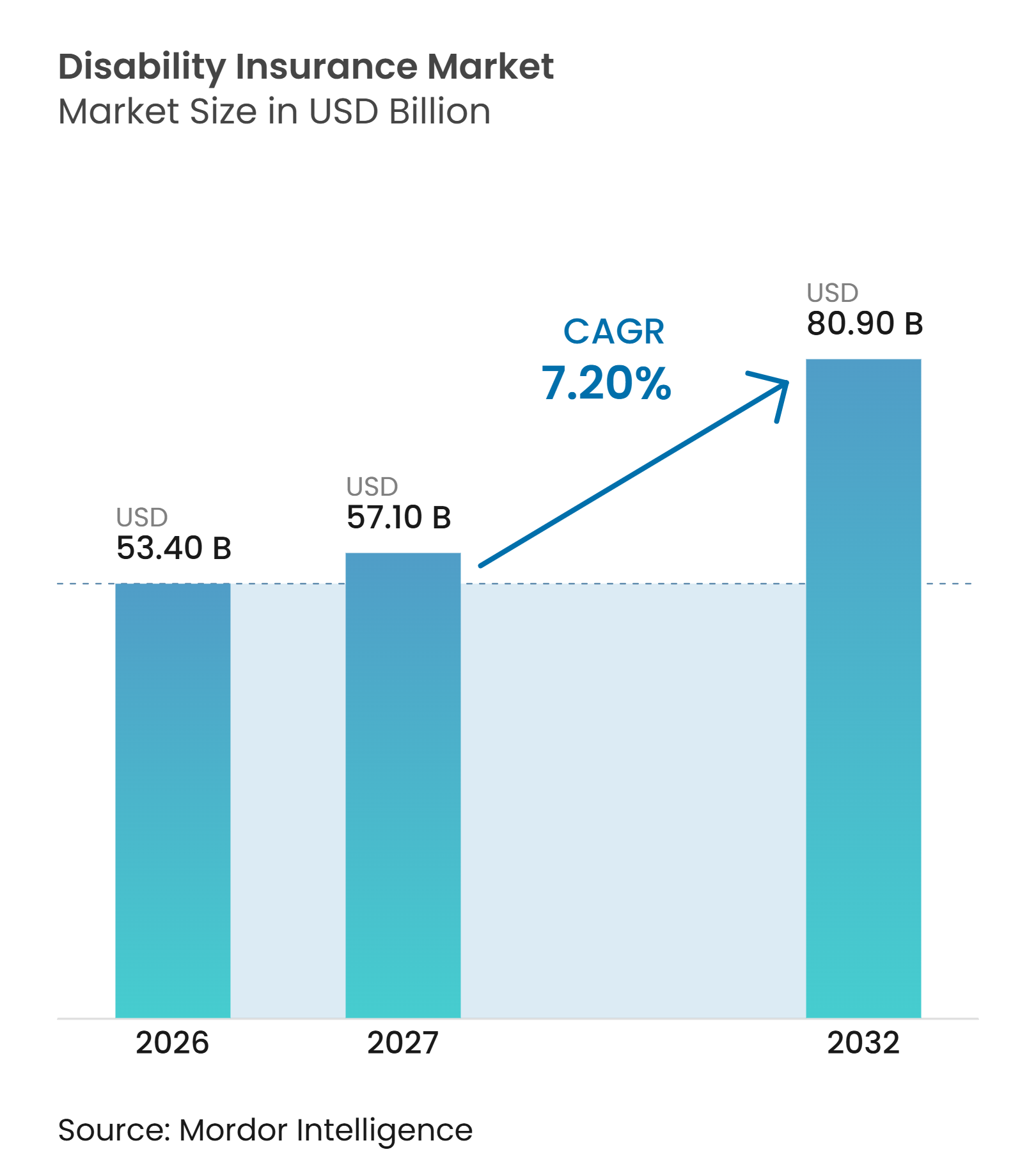
The disability insurance market size is USD 53.4 billion in 2026 and is projected to reach USD 80.9 billion by 2032, growing at a CAGR of 7.2% from 2027 to 2032. The disability insurance industry is supported by the rising prevalence of chronic health conditions that can limit a person’s ability to work. Gaps in public income replacement systems also encourage workers to consider private cover. Employers continue to use disability benefits to support retention, while self-employed and platform workers need portable protection. Digital enrollment, simplified underwriting, and claims tools are lowering friction for insurers and policyholders. These changes create room for established carriers and newer digital distributors, although affordability, claims volatility, and low public understanding remain material constraints.
Key Report Takeaways
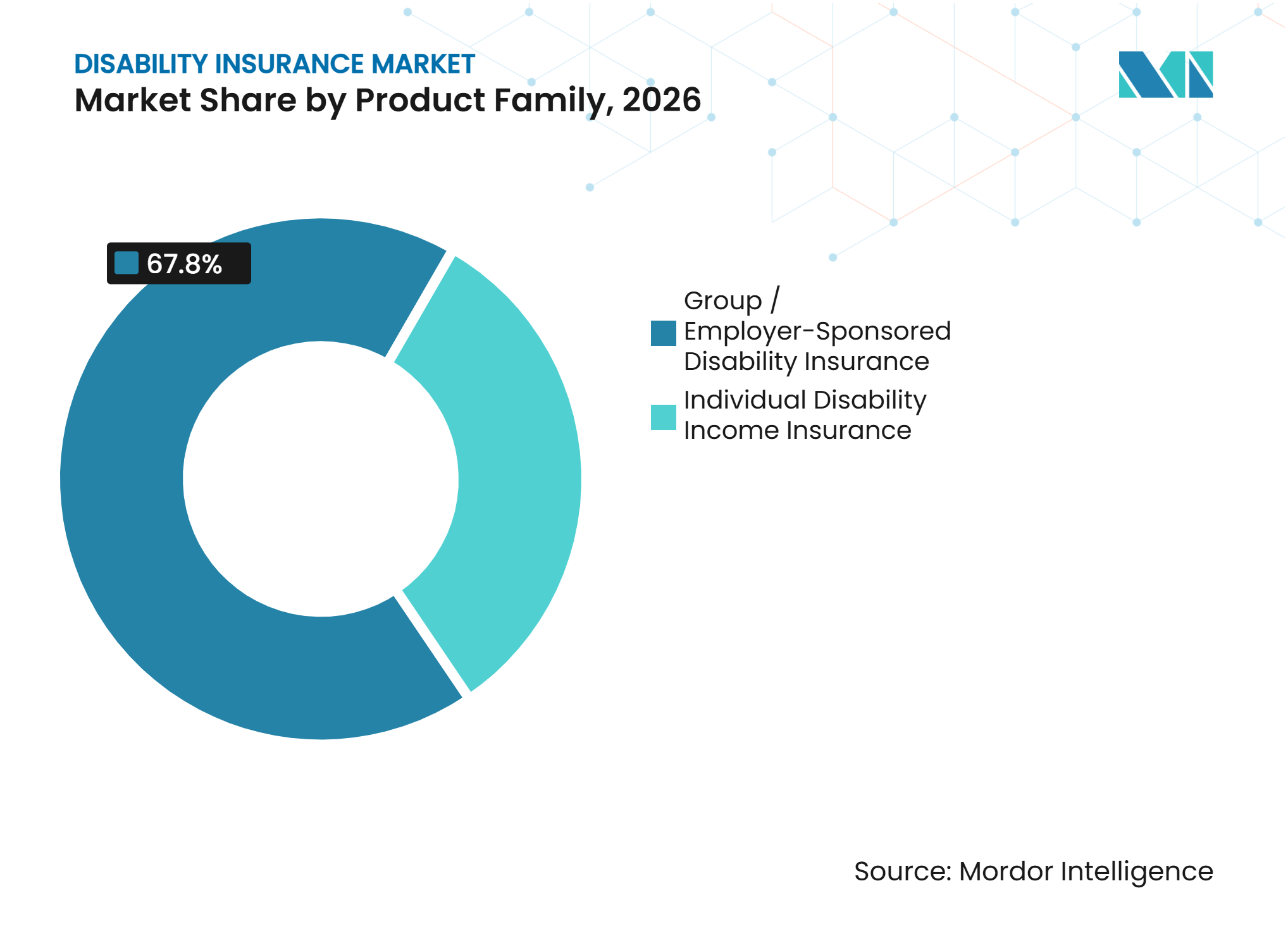
- By product family, Group and Employer-Sponsored Disability Insurance held 67.8% of the disability insurance market share in 2026, while Individual Disability Income Insurance is projected to grow at an 8.5% CAGR through 2032.
- By coverage duration, Long-Term Disability held 60.7% of the disability insurance market size in 2026, while Short-Term Disability is projected to grow at a 7.8% CAGR through 2032.
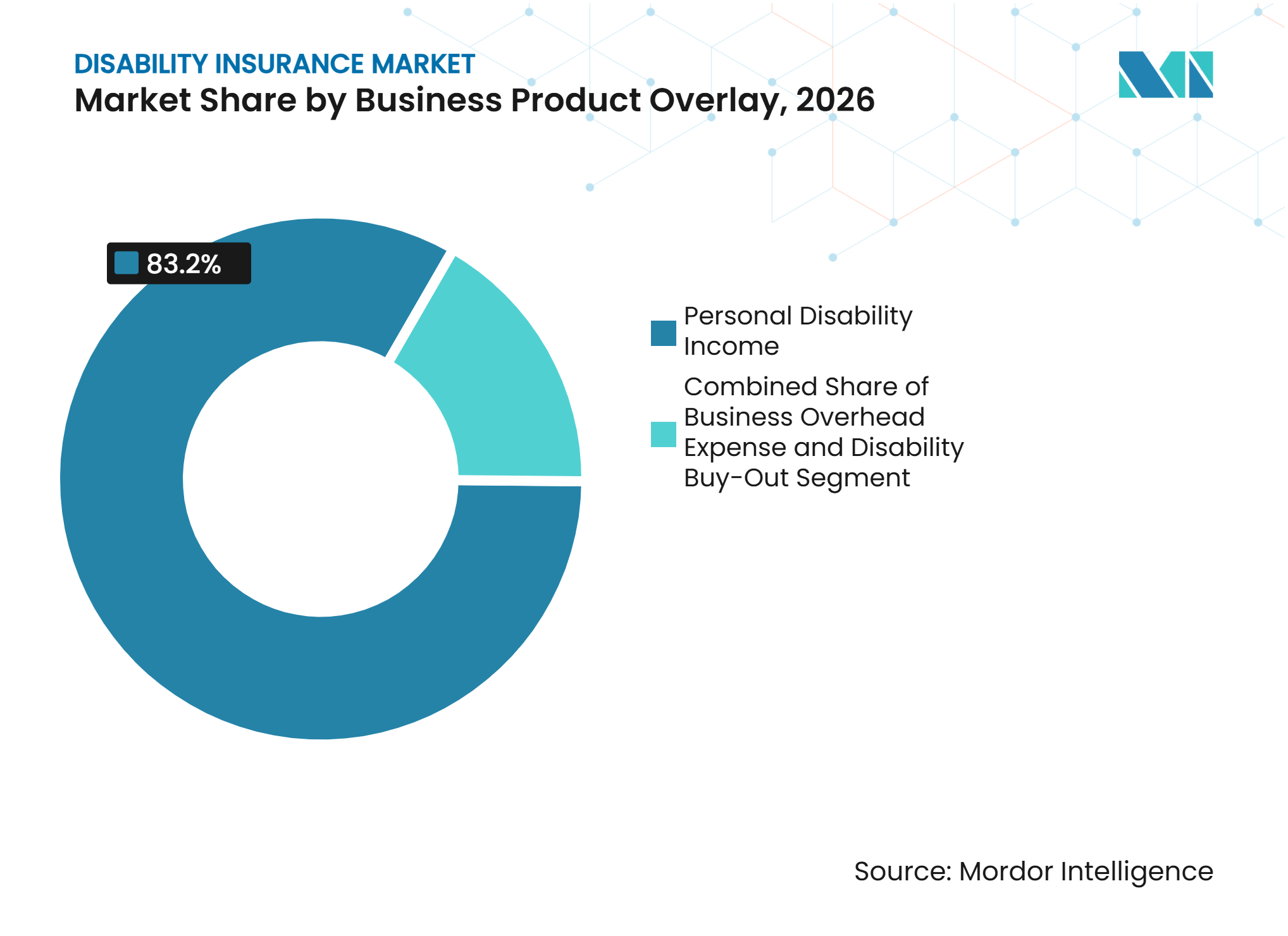
- By business product overlay, Personal Disability Income held 83.2% of the disability insurance market share in 2026, while Disability Buy-Out, Key-Person, and Other Business Products are projected to grow at a 9.5% CAGR through 2032.
- By distribution channel, Independent Brokers and Agents held 43.1% of the disability insurance industry share in 2026, while the Direct and Digital channel is projected to grow at a 10.5% CAGR through 2032.
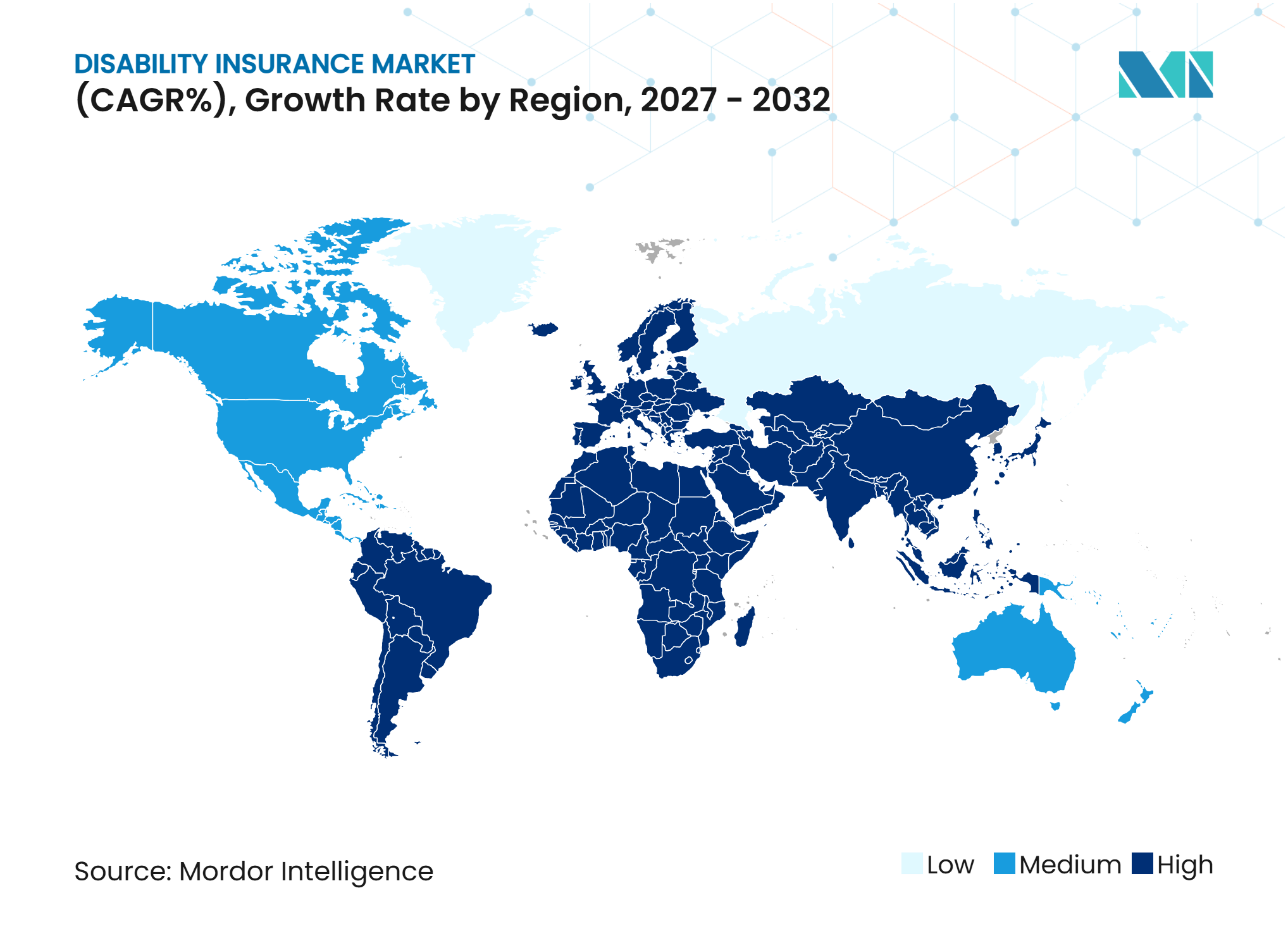
- By geography, North America held 52.3% of the disability insurance market size in 2026, while Asia-Pacific is projected to grow at a 9.5% CAGR through 2032.
Note: Market numbers in this report are based on Mordor Intelligence's proprietary estimation framework, which combines nine months of actuals with Q4 projections for base year 2026.
Market Trends and Insights
Drivers Impact Analysis of Disability Insurance Market*
| Driver | (~) % Impact on CAGR Forecast | Geographic Relevance | Impact Timeline |
|---|---|---|---|
| Rising Chronic Illnesses and Work-Limiting Conditions | +2.0% | Global | Short term (≤ 2 years) |
| Growing Employer-Sponsored Short-Term and Long-Term Coverage | +1.4% | North America and Europe | Medium term (2-4 years) |
| Gaps in Public Disability Income Protection | +0.9% | Global | Long term (≥ 4 years) |
| Demand for Individual Income Protection Among Self-Employed and Gig Workers | +0.8% | Global, with Asia-Pacific and Europe emphasis | Medium term (2-4 years) |
| Greater Financial Dependence on Employment Income and Income-Protection Awareness | +0.7% | North America and Asia-Pacific | Medium term (2-4 years) |
| Digital Distribution and Simplified Underwriting | +1.0% | Global | Short term (≤ 2 years) |
| Source: Mordor Intelligence | |||
Rising Incidence of Chronic Illnesses and Work-Limiting Health Conditions
The disability insurance market benefits from a growing need to protect income when chronic illness limits work. The Integrated Benefits Institute studied 47,450 U.S. employees in 2025 and found that more than 78% had at least 1 chronic condition. Workers with 3 or more conditions lost 7.8 workdays annually, compared with 2.2 days for healthier employees. The same research found a 41% higher short-term disability claim rate among employees facing barriers to health care access. Better survival outcomes for cancer, cardiovascular disease, and stroke can extend the period during which a worker needs income replacement. Carriers are therefore placing greater value on early intervention, rehabilitation, and return-to-work support in their disability insurance industry offerings.
Growing Employer-Sponsored Short-Term and Long-Term Disability Coverage
Employer benefit programs remain an important base for the disability insurance market, even where new business conditions are uneven. LIMRA projected 3.8% premium growth for long-term disability and 4% growth for short-term disability in 2025[1]. Employers use coverage to strengthen total rewards packages when they compete for skilled workers. The need is particularly clear where employees depend heavily on wages and have limited savings for an extended absence. Group plans also allow pooled underwriting and may give employers a lower-cost path to protection than individual arrangements. The disability insurance industry can benefit when insurers combine coverage with leave administration, absence management, and employee enrollment services.
Persistent Gaps in Public Disability Income Protection
Public programs often leave workers with long waits, partial benefits, or eligibility limits, supporting demand in the disability insurance market. The Arc reported that the U.S. Social Security Administration had more than 885,000 initial disability claims pending in September 2025, with an average processing time of 209 days[2]. A further hearings backlog increased the financial strain for applicants who had no private income protection. In Canada, only 10% of respondents held disability insurance in a 2025 RBC Insurance poll, although 31% said the protection was important[3]. These gaps create a clearer role for employer-sponsored and individual policies. They also make transparent benefit definitions and timely claims service central to the value proposition.
Expansion of Digital Distribution and Simplified Underwriting for Disability Insurance Products
Direct and digital distribution is the fastest-growing channel in the disability insurance market, with a projected 10.5% CAGR through 2032. Digital tools can reduce the time spent on applications, document collection, and routine underwriting review. Swiss Re has identified artificial intelligence applications in underwriting and claims that can help insurers process information and support claims decisions more consistently. The Standard expanded its EvolutionIQ partnership in May 2025 to use claims guidance across its disability products. The company said the technology reduces administrative work and helps identify claimants for return-to-work support. Digital capabilities can widen access, but they must be supported by clear customer communication and fair underwriting controls.
Restraints Impact Analysis of Disability Insurance Market*
| Restraint | (~) % Impact on CAGR Forecast | Geographic Relevance | Impact Timeline |
|---|---|---|---|
| Low Consumer Awareness and Limited Disability Income Insurance Penetration | -0.8% | Global | Short term (≤ 2 years) |
| High Premium Costs and Limited Affordability of Comprehensive Coverage | -0.6% | Global | Short term (≤ 2 years) |
| Complex Disability Definitions and Uncertain Medical Claims Assessment | -0.5% | Global | Medium term (2-4 years) |
| Fragmented Regulation and Inconsistent Disability Benefit Structures | -0.4% | Multi-region, particularly Asia-Pacific and the Middle East and Africa | Long term (≥ 4 years) |
| Source: Mordor Intelligence | |||
Low Consumer Awareness and Limited Penetration of Disability Income Insurance
Low awareness continues to limit the disability insurance market, particularly among workers without workplace benefits. Guardian Life reported that 43% of U.S. workers held disability insurance in 2025, down from 51% in 2023. The gap between perceived need and ownership shows that awareness alone does not always result in a purchase. Canada showed a similar pattern, with only 10% of respondents covered despite 31% stating that disability protection mattered. Consumers can find benefit definitions, exclusions, waiting periods, and premium choices difficult to compare. The disability insurance market needs simpler product explanations, relevant enrollment journeys, and voluntary options that make the value easier to understand.
High Premium Costs and Limited Affordability of Comprehensive Coverage
Premium affordability restricts participation in the disability insurance market, especially among freelancers and middle-income workers. Research cited in 2025 found that more than 80% of Dutch self-employed workers had no disability insurance, with cost cited as a major barrier[4]. Insurers must price for changing health experience and potentially long claims, which can make comprehensive cover less accessible. The cost issue is sharper for workers without an employer contribution or access to group underwriting. Simplified group eligibility can provide a different route for professional groups that need broad coverage. Product design must balance lower entry premiums with benefits that remain meaningful during an actual work interruption.
*Our forecasts treat driver/restraint impacts as directional, not additive. The impact forecasts reflect baseline growth, mix effects, and variable interactions.
Disability Insurance Market Segment Analysis
By Product Family:
Group Coverage Holds the Largest Base While Individual Coverage ExpandsGroup and Employer-Sponsored Disability Insurance accounted for 67.8% of the disability insurance market share in 2026. Its position reflects the role of workplace benefits in replacing part of an employee’s income during a covered absence. Employers can offer the benefit across a defined workforce, which spreads risk and supports consistent enrollment. The segment also aligns with employers’ broader efforts to manage leave, absence, and employee well-being. LIMRA’s 2025 outlook for both long-term and short-term disability premium growth supports continued employer interest in these benefits.
Individual Disability Income Insurance is projected to grow at an 8.5% CAGR through 2032. This part of the disability insurance market serves professionals, self-employed workers, and others who need coverage that is not linked to a single employer. Portable policies can be useful when workers change jobs or work through multiple income sources. The segment also has an important role where public programs do not maintain a household’s existing living standard. Demand may increase where insurers provide clearer online applications and explain how individual cover complements group benefits.


By Coverage Duration:
Long-Term Disability Provides the Core While Short-Term Cover Gains MomentumLong-Term Disability held 60.7% of the disability insurance market share in 2026. The segment addresses the financial impact of serious conditions that keep a person away from work for an extended period. It is commonly used within employer plans because it protects against a high-severity income loss that many households cannot absorb. The coverage supports the longer benefit periods that may follow cancer, cardiovascular events, stroke, or other disabling conditions. Its scale also reflects the established role of long-term benefits in large employer programs.
Short-Term Disability is projected to expand at a 7.8% CAGR through 2032. The segment is supported by the need for income replacement during temporary absences and by employers’ focus on structured leave policies. Short-term plans can work alongside long-term cover instead of replacing it. They are also relevant to employers that need practical support for employees during the earliest period of a health-related absence. The disability insurance market size for this segment benefits when plans are integrated with paid leave administration and return-to-work processes.
By Business Product Overlay:
Personal Income Protection Leads While Business Risk Cover BroadensPersonal Disability Income held 83.2% of the disability insurance market share in 2026. These policies focus on replacing a portion of the insured person’s earned income. They include group and individual arrangements that help employees, professionals, and self-employed people continue meeting personal expenses. This broad customer base explains the segment’s leading position. The segment remains important because household financial exposure rises when employment income is the primary source of cash flow.
Disability Buy-Out, Keyperson, and Other Business Products are projected to grow at a 9.5% CAGR through 2032. These products address the effect of disability on ownership continuity and operating capacity for small businesses. Business Overhead Expense coverage can support a sole practitioner’s fixed operating costs during a disability period. Buy-out and key-person solutions can help partners address an absence that affects ownership or decision-making. The disability insurance market offers a route for small and midsized business owners to separate business continuity needs from their personal income protection.


By Distribution Channel:
Brokers Retain a Strong Position as Direct Models ExpandIndependent Brokers and Agents held 43.1% of the disability insurance market share in 2026. Their role remains strong because employers and individual buyers often need help comparing complex benefits, definitions, and insurer options. Brokers are particularly relevant in group benefit design and in policies for professionals with specialized income needs. They can also advise employers on integrating disability coverage with leave and absence programs. This advisory role remains valuable where policy features require more explanation than a simple online transaction.
The Direct and Digital channel is projected to grow at a 10.5% CAGR through 2032. Digital enrollment can reduce application friction and give smaller employers and self-employed workers a more accessible route to cover. It can also support embedded offers through payroll, human resources, and platform-worker relationships. The disability insurance market is likely to see competition based on faster applications, clearer eligibility checks, and better digital claims communication. Broker distribution will still matter where customers need plan design support and claims advocacy.
Geography Analysis
North America: Mature Group Benefits Infrastructure With Continuing Coverage Gaps
North America held 52.3% of the disability insurance market share in 2026. The region has a large employer benefits base in the United States and an underinsured population in Canada. The Arc reported over 885,000 pending initial claims in September 2025 and an average processing time of 209 days, reinforcing the need for private income protection. The National Association of Insurance Commissioners provides an important regulatory influence on insurer conduct and product oversight. Canada presents a separate opportunity because RBC Insurance found that ownership did not match stated interest in protection.
Asia-Pacific: Faster Growth Through Formal Employment and Social Protection Reform
Asia-Pacific is projected to grow at a 9.5% CAGR through 2032, giving it the strongest regional growth rate in the disability insurance market. Rising formal employment and greater awareness of income risk support demand across the region. In Indonesia, 1.7 million online motorcycle taxi drivers remained without BPJS Employment protection in May 2025. This coverage gap shows why digital and group-based enrollment can be relevant for platform workers. Malaysia’s approval of a non-occupational accident scheme for gig and self-employed workers can help insurers develop complementary protection.
Europe, Latin America, and the Middle East and Africa: Different Starting Points and Local Product Needs
France Assureurs reported USD 33.5 billion in 2025 premium income for the French protection market, while incapacity, disability, and dependency charges rose 4.1%. Germany’s private occupational disability coverage remains limited despite a wide product choice, which makes simpler policy comparisons important. Solvency II influences capital decisions around European product portfolios, while Latin American insurtech investment is creating more digital routes to customers. Across the Middle East and Africa, formalization, affordability, employer benefit adoption, and local regulation will shape demand for income protection.
Competitive Landscape
Market Concentration
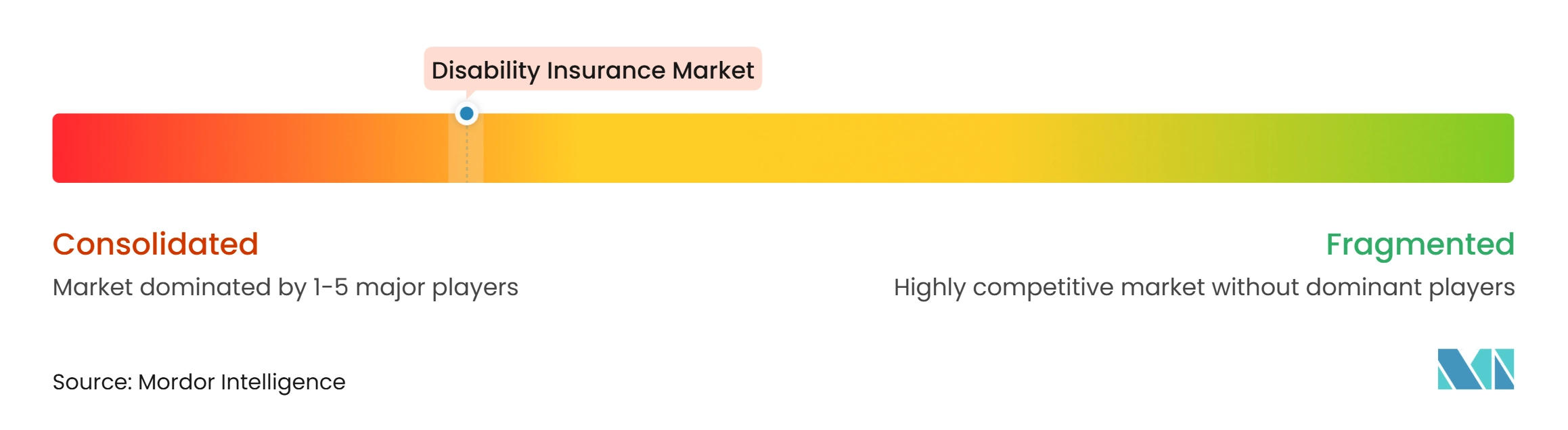
The disability insurance market has a concentrated structure in North American group coverage. Major established carriers include Unum Group, MetLife, Lincoln Financial, The Hartford, and The Standard in the United States. Their scale in employer benefits gives them strong distribution relationships and claims experience. Individual income protection for self-employed workers remains less developed, leaving room for carriers that can offer clear, portable policies. Insurers increasingly compete on service quality, claims operations, and relevant distribution partnerships.
Technology is becoming a practical area of competition in the disability insurance market. Unum stated in its 2025 results that it had invested in artificial intelligence for more than 5 years and had more than 2 million employees on its leave management platform. MetLife’s 2025 annual report identified Group Benefits leadership and international growth as parts of its New Frontier strategy. The Standard expanded its EvolutionIQ claims guidance relationship across all disability products in May 2025. These moves support examiner productivity, claims communication, and return-to-work programs.
Portfolio management and specialist distribution are also shaping competition in the disability insurance market. Fortitude Re completed a reinsurance agreement with Unum in August 2025 that included USD 120 million of multi-life individual disability in-force premium. Symetra completed its acquisition through reinsurance of Dearborn Group’s life and disability business in October 2025, adding 2.5 million covered lives. Amwins also joined with Nelligan in March 2025 to expand ancillary benefits distribution.
Disability Insurance Industry Leaders
-
Prudential Financial, Inc.
-
MetLife, Inc.
-
The Guardian Life Insurance Company of America
-
Massachusetts Mutual Life Insurance Company
-
Sun Life Financial Inc.
- *Disclaimer: Major Players sorted in no particular order
Disability Insurance Market Companies Covered in this Report
- Unum Group
- Prudential Financial, Inc.
- MetLife, Inc.
- Aflac Incorporated
- The Guardian Life Insurance Company of America
- Massachusetts Mutual Life Insurance Company
- The Hartford Financial Services Group, Inc.
- Principal Financial Group, Inc.
- Standard Insurance Company (The Standard)
- Sun Life Financial Inc.
- Assurity Life Insurance Company
- Ameritas Mutual Holding Company
- Mutual of Omaha Insurance Company
- Lincoln National Corporation
- AXA S.A.
- Aviva plc
- Assicurazioni Generali S.p.A.
- Zurich Insurance Group AG
- New York Life Insurance Company
- Northwestern Mutual
Recent Industry Developments in Disability Insurance Market
- September 2026: Sun Life U.S. launched Disability with Health Navigator, combining disability insurance with personalized healthcare navigation. Employees can access specialist referrals, second opinions, centers of excellence, and care coordination, including before filing a disability claim.
- July 2026: Unum Group entered into a USD 3.8 billion long-term-care reinsurance agreement with Fortitude Re, covering approximately 50,000 individual LTC policies. Combined with its 2025 transaction, this is expected to reduce Unum's total LTC statutory reserves by approximately 40%.
- May 2026: Canada Life acquired Santé Circle Health, a provider of disability management and occupational health services. Its capabilities include early intervention, provider management, digital intake, and care coordination.
- February 2026: Assurity launched Income Protection+, a long-term disability insurance product offering expanded occupation classes, multiple disability definitions, benefit periods ranging from one year to age 70, and optional riders. The launch also introduced its FastTrack digital application platform.
Global Disability Insurance Market Report Scope
Disability insurance provides financial protection to individuals who are unable to work and earn their regular income due to illness, injury, or a medical condition. It replaces a portion of their lost earnings for a specified period, either temporarily or over the long term, depending on the policy coverage. It helps policyholders manage essential living expenses, maintain financial stability, and meet ongoing financial commitments during periods of disability.
The Disability Insurance Market Report is Segmented by Product Family (Group/Employer-Sponsored, Individual DI), Coverage Duration (Short-Term, Long-Term), Business Product Overlay (Personal DI, BOE, Buy-Out/Key-Person), Distribution Channel (Brokers, Tied Agents, Bancassurance, Direct and Digital, Other), and Geography (North America, South America, Europe, Asia-Pacific, MEA). Market Forecasts are Provided in Terms of Value (USD).
Segmentation Overview
| Group / Employer-Sponsored Disability Insurance |
| Individual Disability Income Insurance |
| Short-Term Disability |
| Long-Term Disability |
| Personal Disability Income |
| Business Overhead Expense (BOE) |
| Disability Buy-Out / Key-Person / Other Business |
| Independent Brokers and Agents |
| Tied / Captive / Exclusive Agents |
| Bancassurance |
| Direct and Digital |
| Other Channels |
| North America | United States |
| Canada | |
| Mexico | |
| South America | Brazil |
| Argentina | |
| Rest of South America | |
| Europe | United Kingdom |
| Germany | |
| France | |
| Italy | |
| Spain | |
| Rest of Europe | |
| Asia-Pacific | China |
| Japan | |
| India | |
| South Korea | |
| Australia | |
| Indonesia | |
| Thailand | |
| Malaysia | |
| Singapore | |
| Vietnam | |
| Rest of Asia-Pacific | |
| Middle East and Africa | Saudi Arabia |
| United Arab Emirates | |
| Turkey | |
| South Africa | |
| Egypt | |
| Rest of Middle East and Africa |
| By Product Family | Group / Employer-Sponsored Disability Insurance | |
| Individual Disability Income Insurance | ||
| By Coverage Duration | Short-Term Disability | |
| Long-Term Disability | ||
| By Business Product Overlay | Personal Disability Income | |
| Business Overhead Expense (BOE) | ||
| Disability Buy-Out / Key-Person / Other Business | ||
| By Distribution Channel | Independent Brokers and Agents | |
| Tied / Captive / Exclusive Agents | ||
| Bancassurance | ||
| Direct and Digital | ||
| Other Channels | ||
| By Geography | North America | United States |
| Canada | ||
| Mexico | ||
| South America | Brazil | |
| Argentina | ||
| Rest of South America | ||
| Europe | United Kingdom | |
| Germany | ||
| France | ||
| Italy | ||
| Spain | ||
| Rest of Europe | ||
| Asia-Pacific | China | |
| Japan | ||
| India | ||
| South Korea | ||
| Australia | ||
| Indonesia | ||
| Thailand | ||
| Malaysia | ||
| Singapore | ||
| Vietnam | ||
| Rest of Asia-Pacific | ||
| Middle East and Africa | Saudi Arabia | |
| United Arab Emirates | ||
| Turkey | ||
| South Africa | ||
| Egypt | ||
| Rest of Middle East and Africa | ||
Key Questions Answered in the Report
What is the projected value of the disability insurance market by 2032?
The disability insurance market is projected to reach USD 80.9 billion by 2032, from USD 53.4 billion in 2026, at a 7.2% CAGR.
Which disability insurance product category is the largest?
Group and Employer-Sponsored Disability Insurance is the largest product family, with a 67.8% share in 2026.
Which disability insurance channel is growing the fastest?
The Direct and Digital channel is projected to expand at a 10.5% CAGR through 2032.
Why is individual disability income coverage growing?
Individual Disability Income Insurance is projected to grow at an 8.5% CAGR as self-employed professionals and workers outside employer plans seek portable income protection.
Which region has the strongest disability insurance growth outlook?
Asia-Pacific has the strongest outlook, with a projected 9.5% CAGR through 2032, supported by formal employment growth and social protection reforms.
What limits adoption of disability insurance?
Low consumer awareness and affordability remain major barriers, especially for workers without employer contributions or group underwriting.