
Dioctyl Terephthalate Market Size and Share
Market Overview
| Study Period | 2021 - 2031 |
|---|---|
| Market Size (2026) | USD 2.47 Billion |
| Market Size (2031) | USD 3.31 Billion |
| Growth Rate (2026 - 2031) | 6.04 % |
| Fastest Growing Market | Asia-Pacific |
| Largest Market | Asia-Pacific |
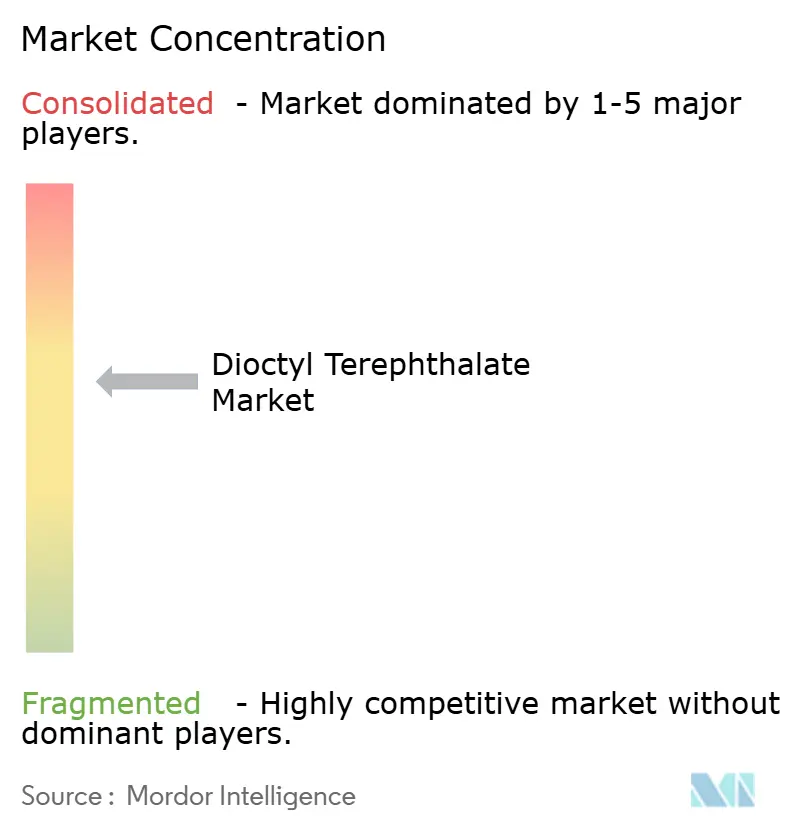
| Market Concentration | Medium |
Major Players *Disclaimer: Major Players sorted in no particular order Image © Mordor Intelligence. Reuse requires attribution under CC BY 4.0. | |
Dioctyl Terephthalate Market Analysis by Mordor Intelligence
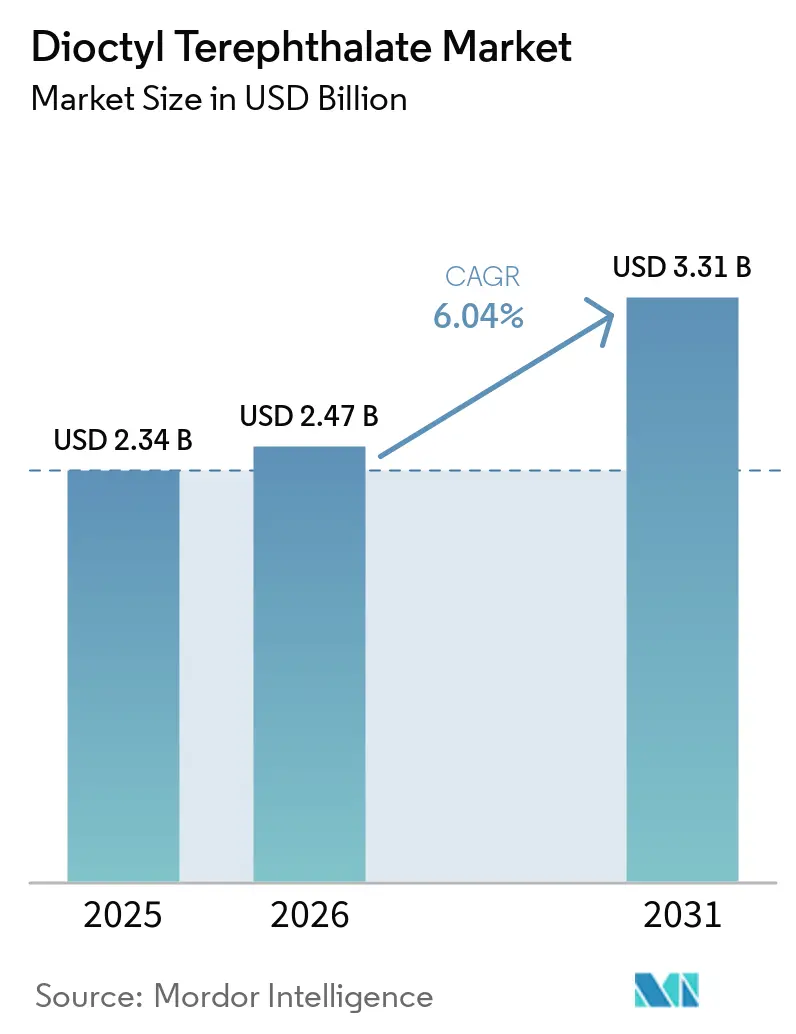
The Dioctyl Terephthalate market size was estimated at USD 2.34 billion in 2025 and is estimated to grow from USD 2.47 billion in 2026 to USD 3.31 billion by 2031, at a CAGR of 6.04% during the forecast period (2026-2031). The Dioctyl Terephthalate market is supported by the replacement of ortho-phthalates, continued use of flexible polyvinyl chloride (PVC), and demand for low-migration and low-fogging compounds. Construction, automotive interiors, and energy cables each drive demand through distinct procurement cycles, reducing dependence on a single end use. U.S. antidumping duty orders issued in May 2025 have reshaped import economics and may encourage additional domestic compounding capacity. Producers with integrated oxo-alcohol operations hold a cost advantage, while higher-purity and recycled-content products offer room for differentiation in the Dioctyl Terephthalate market. Feedstock disruptions and ongoing scientific review of terephthalate plasticizers remain barriers to long-term adoption.
Key Report Takeaways
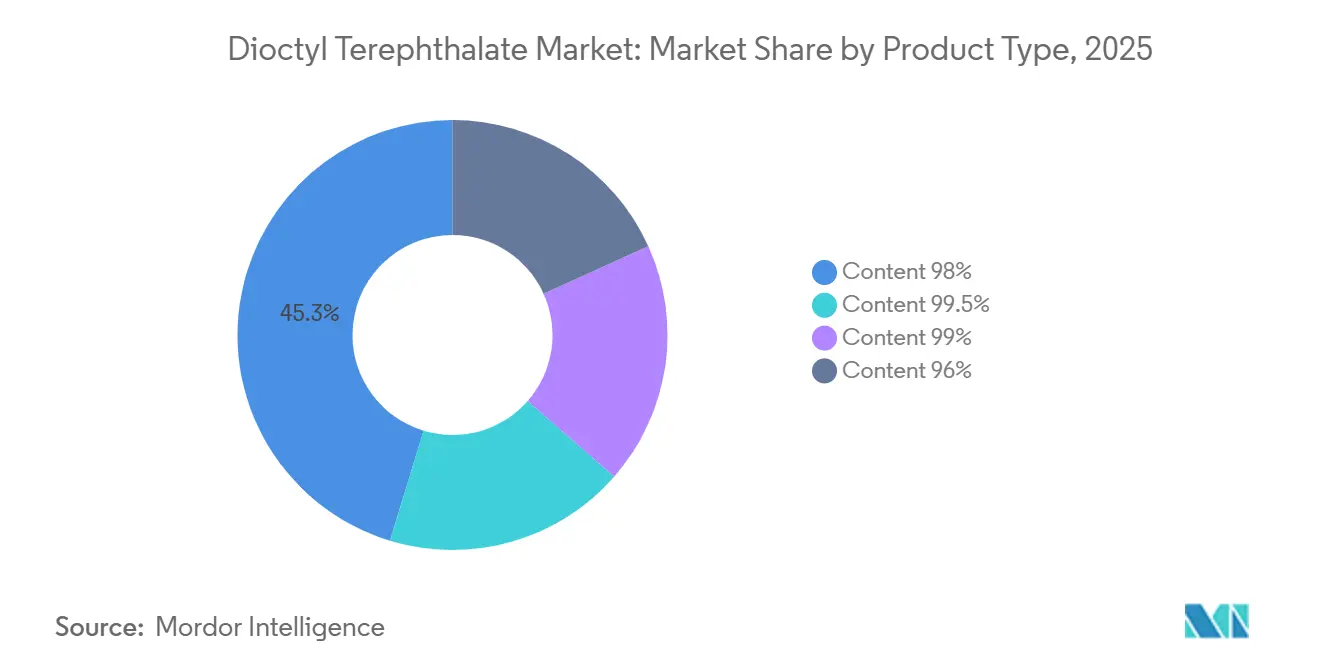
- By product type, Content 98% accounted for 45.31% of the Dioctyl Terephthalate market share in 2025, while Content 99% is projected to grow at a CAGR of 7.15% through 2031.
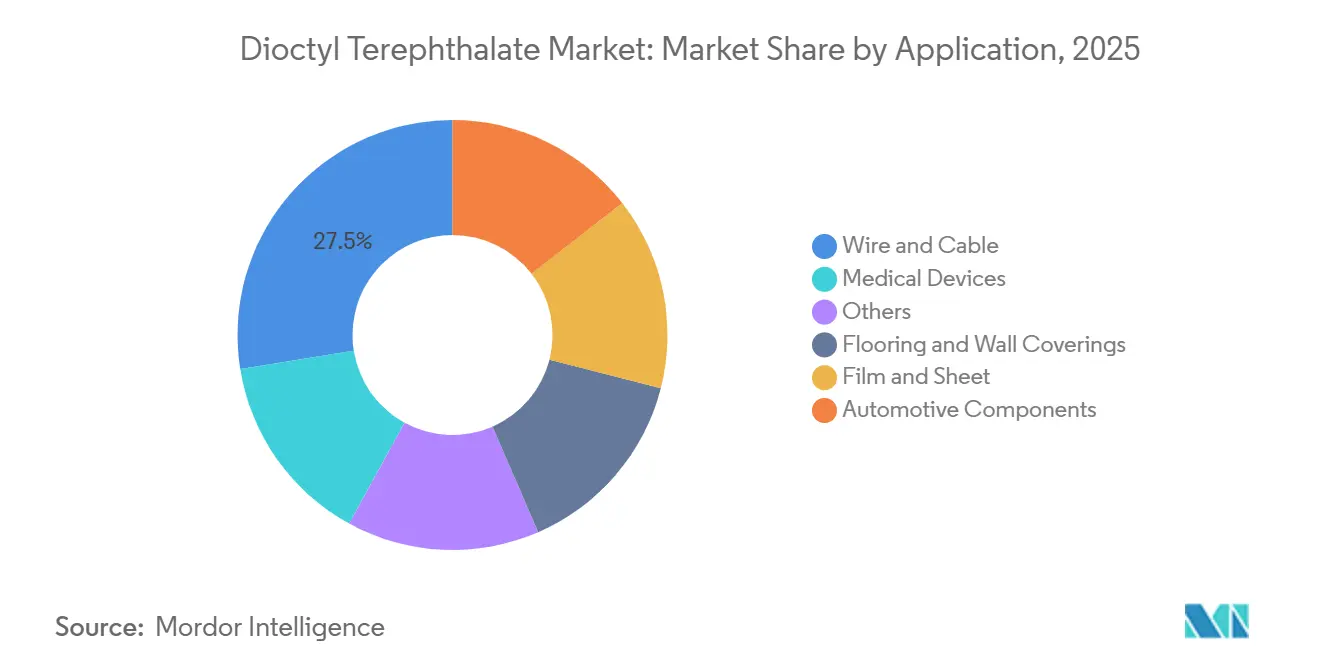
- By application, wire and cable accounted for 27.53% of the Dioctyl Terephthalate market size in 2025, while automotive components are projected to grow at a CAGR of 7.56% through 2031.
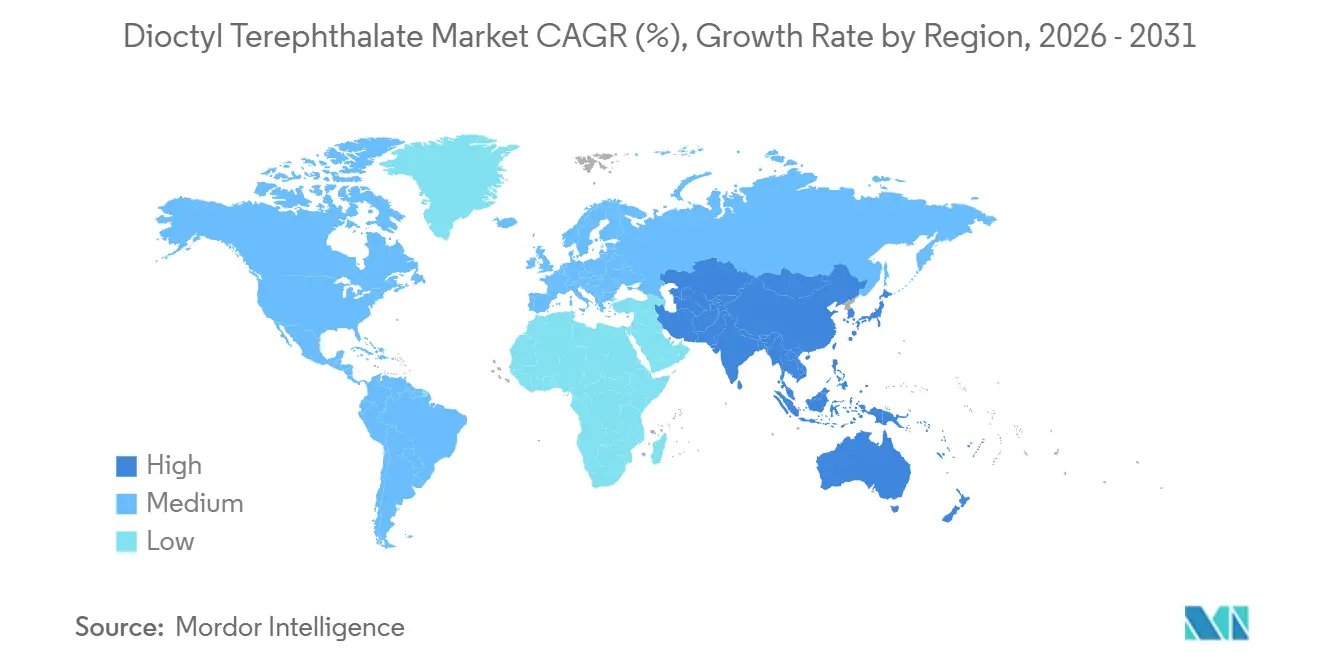
- By geography, Asia-Pacific accounted for 37.18% of Dioctyl Terephthalate revenue in 2025 and is projected to grow at a CAGR of 6.89% through 2031.
Note: Market size and forecast figures in this report are generated using Mordor Intelligence’s proprietary estimation framework, updated with the latest available data and insights as of January 2026.
Market Trends and Insights
Drivers Impact Analysis of Dioctyl Terephthalate Market*
| Drivers | (~) % Impact on CAGR Forecast | Geographic Relevance | Impact Timeline |
|---|---|---|---|
| Regulatory Replacement of Ortho-Phthalates | +1.6% | Global, most acute in Europe and North America | Short term (≤ 2 years) |
| Flexible PVC Demand in Construction and Infrastructure | +1.2% | Asia-Pacific core, spill-over to South America and Middle East, and Africa | Medium term (2-4 years) |
| Automotive Lightweighting and Low-Fogging Interior Formulations | +0.8% | Global, led by Europe and East Asia | Medium term (2-4 years) |
| Electrical Grid, Renewable Energy, and Communication Cable Expansion | +1.0% | Global, led by Europe, North America, and the Asia-Pacific | Long term (≥ 4 years) |
| Medical-Grade PVC Reformulation Toward DEHP Alternatives | +0.5% | Europe and North America | Long term (≥ 4 years) |
| Source: Mordor Intelligence | |||
Regulatory Replacement of Ortho-Phthalates
Regulatory action against DEHP, DBP, and related ortho-phthalates has made phthalate-free reformulation an ongoing procurement requirement. The European Chemicals Agency lists DEHP, DBP, BBP, and DIBP under REACH Annex XIV, restricting their use in many industrial applications[1]. This regulatory environment supports recurring demand for non-phthalate alternatives in the Dioctyl Terephthalate market, as converters must maintain compliant formulations across repeated customer and product approval cycles. In 2024, the U.S. Food and Drug Administration revoked authorization for 25 ortho-phthalates in food additive regulations, shortening reformulation timelines for food-contact PVC converters. The May 2025 U.S. antidumping duty orders on imports from Malaysia, Poland, Taiwan, and the Republic of Türkiye followed the expansion of domestic supply for this shifting demand base. Duty margins ranged from 7.50% to 80.71%, altering the landed-cost position of imported material in the U.S. market.
Flexible PVC Demand in Construction and Infrastructure
Flexible PVC remains the primary medium for Dioctyl Terephthalate (DOTP) use in flooring, wall coverings, waterproofing membranes, and flexible profiles, linking demand to building materials used across residential, commercial, and infrastructure projects. These applications connect the Dioctyl Terephthalate market to construction activity and infrastructure renewal rather than to a narrow specialty segment. Urbanization programs in Southeast Asia and South Asia support demand for flooring, profiles, and membranes used in residential and public projects, where flexible PVC is selected for its processing flexibility and broad range of end-product formats. Government-led affordable housing activity in India and infrastructure renewal in Brazil provide additional support for flexible PVC consumption. LEED, WELL, and European construction product emission-labeling requirements favor lower-VOC plasticizers in premium flooring and acoustic underlay systems. This creates a specification advantage for DOTP in the Dioctyl Terephthalate market, where VOC declarations influence material selection and where builders, designers, and converters must document material performance for premium flooring or underlay projects.
Automotive Lightweighting and Low-Fogging Interior Formulations
Automotive components are an important growth driver, as vehicle material requirements raise quality expectations across the Dioctyl Terephthalate industry and provide a stronger premium-grade demand channel. OEM interior specifications increasingly require fogging values below 250 µg under SAE J1756 and DIN 75201 conditions. This threshold limits the use of several DOP and DINP grades in interior parts, particularly where OEMs require documented compliance with cabin air-quality, odor, and appearance standards. DOTP has a linear molecular structure and lower volatility, supporting its use in door panels, seat surfaces, armrests, and flexible trim components exposed to changing temperature conditions inside a vehicle cabin. Research on automotive polymer matrices found that DOTP and related compounds had lower diffusion coefficients and reduced mass loss compared to legacy phthalates under comparable automotive-cabin conditions. EV manufacturers also favor Environmental Product Declarations and REACH-compliant supply chains, supporting the use of DOTP in door panels and cable conduits where low fogging and non-phthalate credentials are required.
Electrical Grid, Renewable Energy, and Communication Cable Expansion
Wire and cable demand gives the Dioctyl Terephthalate market a durable infrastructure-related base. The International Energy Agency projected global grid investment to exceed USD 400 billion in 2026, following a record USD 390 billion in 2024. Cable insulation and jacketing compounds require plasticizers that meet low-migration requirements over long service lives. DOTP also meets the REACH and RoHS criteria that European transmission system operators increasingly specify for cable systems. Prysmian and E.ON entered into a framework agreement for low- and medium-voltage cables to support German grid expansion, as part of an E.ON procurement program exceeding EUR 6 billion. This project pipeline supports demand for plasticized PVC compounds in grid, renewable-energy, and communication-cable applications, where cable manufacturers require reliable quantities of compliant material for long project schedules.
Restraints Impact Analysis of Dioctyl Terephthalate Market*
| Restraints | (~) % Impact on CAGR Forecast | Geographic Relevance | Impact Timeline |
|---|---|---|---|
| Terephthalic Acid and 2-Ethylhexanol Feedstock Volatility | -0.9% | Global, most acute in Asia-Pacific and Middle East-exposed supply chains | Short term (≤ 2 years) |
| Energy-Intensive Esterification and Conversion Costs | -0.5% | Europe and North America | Medium term (2-4 years) |
| Migration, Toxicology, and Regrettable-Substitution Scrutiny | -0.4% | Europe and North America | Long term (≥ 4 years) |
| Source: Mordor Intelligence | |||
Terephthalic Acid and 2-Ethylhexanol Feedstock Volatility
DOTP production depends on purified terephthalic acid (PTA) and 2-ethylhexanol, which face different supply risks. PTA tracks paraxylene and crude oil, while 2-ethylhexanol depends on propylene and oxo-synthesis capacity. This combination exposes the Dioctyl Terephthalate market to simultaneous feedstock disruptions, as separate movements in crude-linked intermediates and propylene-derived oxo alcohols can affect costs within the same production period. Geopolitical disruption to Middle Eastern naphtha flows in 2026 increased the vulnerability of these supply chains. Perstorp Oxo AB announced global price increases for 2-ethylhexanol and related oxo-chemicals during this period. Volatile input prices can compress producer margins and make fixed-price agreements harder for downstream compounders to offer, especially when procurement periods extend beyond the cost visibility available for PTA and oxo-alcohol inputs.
Migration, Toxicology and Regrettable-Substitution Scrutiny
Scientific scrutiny of terephthalate plasticizers could affect adoption in sensitive applications over time. A 2024 review in Green Chemistry identified DEHT, the IUPAC designation for DOTP, as one of the alternatives requiring more evidence on environmental fate and toxicology, with bioaccumulation concerns in aquatic environments comparable to those associated with legacy phthalates. This does not constitute a restriction on DOTP, but it increases uncertainty for medical devices, children's toys, and food-contact applications, where buyers may reassess materials before a formal regulatory decision is made. The Nature and Biodiversity Conservation Union (NABU) reported detectable concentrations of plasticizers in river sediment in 2025, adding to civil society pressure on environmental exposure[2]. The near-term concern is early specification replacement in high-value applications rather than an immediate broad restriction, as specification changes can move faster than formal restrictions in regulated customer supply chains.
*Our forecasts treat driver/restraint impacts as directional, not additive. The impact forecasts reflect baseline growth, mix effects, and variable interactions.
Dioctyl Terephthalate Market Segment Analysis
By Product Type:
High-Purity Grades Reflect PremiumizationContent 98% accounted for 45.31% of revenue in 2025, making it the largest grade in the Dioctyl Terephthalate market. Its position reflects broad industrial use in wire and cable, general-purpose flexible PVC, and construction products, where customers typically prioritize dependable processing, reliable supply, and cost-performance. These applications emphasize cost and processing performance, which support high-volume industrial-grade supply and allow producers to use established manufacturing assets efficiently across a wide customer base. Producers in China, South Korea, and Taiwan manufacture this tier at scale through established esterification processes. These processes favor throughput and consistent supply for the largest customer base, rather than the tighter controls required for specialized grades serving automotive, medical, or demanding cable applications. Content 96% remains the most cost-competitive grade, but it faces gradual pressure on share as customers require lower residual acid content and tighter color benchmarks. European flooring and automotive supply chains are particularly relevant because they impose more demanding product specifications. This shift moves more demand toward grades that meet narrower quality limits without additional converter processing, helping converters avoid additional steps when serving customers with detailed material approval requirements.
Content 99% is projected to grow at a CAGR of 7.15% between 2026 and 2031, the highest rate among product types in the Dioctyl Terephthalate market, as customers place greater value on performance stability and documented product quality. Automotive OEMs, medical-device manufacturers, and cable suppliers serving high-reliability applications support this demand because their approval processes require consistent purity and controlled extractable profiles. At 99% purity, the material can meet automotive Ü-certification fogging requirements without secondary processing by compounders. This reduces a processing step for customers who require consistent interior-material performance, simplifying converter operations while supporting tighter control of odor, fogging, and surface appearance. Eastman Chemical's Kingsport methanolysis facility reached full operational scale in January 2026 and produced 2.5 times more recycled-content feedstock than in 2024. The facility generated USD 60 million in incremental earnings and positioned recycled terephthalic acid (TPA)-derived material at the premium end of the product spectrum. The 99.5% content remains the smallest tier, but medical-device compounders are adopting it where tighter extractable profiles are required. European Pharmacopoeia requirements favor products with the tightest extractable profiles for those applications, making the smaller high-purity tier relevant even though its output remains below broader industrial grades.

By Application:
Grid and EV Investment Support DemandWire and cable accounted for 27.53% of application revenue in 2025, the largest application segment in the Dioctyl Terephthalate market, reflecting the continuing importance of compliant insulation and jacketing for power and communication networks. Grid investment cycles support this use because cable projects require PVC insulation and jacketing compounds at scale, benefiting the Dioctyl Terephthalate market from long-lived infrastructure procurement and planned network expansion. Contracted projects across multiple regions provide a durable output base under many demand scenarios, as grid and cable programs commonly proceed over extended schedules that require continued material procurement. DOTP addresses low-migration requirements for cables designed for long service lives, a characteristic that matters when insulation and jacketing must maintain performance over extended operating periods. It also supports compliance with the Registration, Evaluation, Authorization and Restriction of Chemicals (REACH) and RoHS criteria specified in certain cable procurement programs. Flooring and wall coverings constitute the second-largest application group and benefit from urbanization across the Asia-Pacific region. Indoor air quality requirements in premium residential and commercial buildings also favor low-volatile organic compound (VOC) plasticizers, reinforcing demand for flooring and wall-covering systems where emissions documentation affects material selection. Film and sheet products serve agricultural, industrial-packaging, and protective-covering uses where DOTP retains a broad processing window and a competitive cost position.
Automotive components are projected to grow at a CAGR of 7.56% from 2026 to 2031, the fastest growth rate among applications. EV platform expansion, low-fogging requirements, and OEM material compliance programs drive this growth. Electric vehicles use flexible PVC in battery cable conduits, door-panel skins, and instrument-cluster shrouds. These components require a balance of performance, low volatility, and regulatory compatibility, particularly when vehicle makers align interior materials with EV design, cabin-comfort, and supply-chain requirements. DOTP showed lower diffusion coefficients and lower cabin VOC contributions than DOP under DIN 75201 conditions in the cited research. This provides a technical basis for automotive material engineers considering non-phthalate plasticizers, while the same test conditions offer a common reference point for suppliers, compounders, and OEM purchasing teams. Medical devices account for a smaller revenue contribution but deliver higher unit-value margins, as their applications require more demanding quality assurance and can support products with narrower extractable profiles. They also set demanding quality-assurance standards that influence the wider supply chain, as producers and compounders seek grades able to meet the most tightly controlled end-use requirements.
Geography Analysis
APAC Dioctyl Terephthalate Market
Asia-Pacific held 37.18% of revenue in 2025 and is projected to expand at a CAGR of 6.89% through 2031, supported by integrated PVC downstream industries in China, South Korea, and India. China remains the largest single-country producer and consumer, with construction, automotive, and consumer-goods sectors providing a broad base of demand. Capacity additions in 2026 are deepening regional supply and may lower global price benchmarks for export-oriented producers. South Korean producers maintain high-purity exports to Japan, Europe, and North America, although the Korea Fair Trade Commission's May 2026 investigation into alleged price coordination involving LG Chem, Hanwha Solutions, OCI, and Aekyung Chemical introduces uncertainty. India's expanding construction and automotive manufacturing base makes it the region's most dynamic source of demand growth through 2031, while Japanese OEM requirements for fogging and odor continue to influence plasticizer quality specifications globally. The region's combined producer and consumer role gives it structural influence over prices, capacity utilization, and the availability of industrial and higher-purity grades across the broader Dioctyl Terephthalate market, particularly because its producers serve both domestic demand and export markets.
The Americas Dioctyl Terephthalate Market
North America's competitive structure has changed following the May 2025 U.S. antidumping duty orders covering DOTP imports from Malaysia, Poland, Taiwan, and the Republic of Türkiye. U.S. demand for construction-linked flexible PVC remains tied to wire and cable used in data-center construction, EV charging networks, and semiconductor fabrication sites, all of which require substantial quantities of compliant cable compounds. Brazil opened an antidumping investigation in 2026 into imports of DOP, DOTP, and DINP from Chile, Colombia, and South Korea, while Argentina and other South American countries remain smaller infrastructure-led demand centers shaped by regional construction cycles. These trade actions increase the importance of local supply, import sourcing, and customer relationships in the Americas portion of the Dioctyl Terephthalate market, where the cost impact of duties can influence supplier selection and long-term commercial agreements.
EMEA Dioctyl Terephthalate Market
Europe serves as a regulatory center for the global Dioctyl Terephthalate market, where Registration, Evaluation, Authorisation and Restriction of Chemicals (REACH) enforcement influences product selection in automotive interiors, industrial cable production, premium flooring, and other downstream applications. Buyers in the region set demanding quality expectations for suppliers. Germany, France, and Italy account for much of the regional consumption, and their supply chains impose stringent requirements on fogging, odor, and VOCs that often shape quality expectations beyond Europe. The EU Medical Device Regulation identifies di(2-ethylhexyl) phthalate (DEHP) as a Category 1B reproductive toxicant, and the 2030 sunset date for its final major blood-bag application remains under evaluation. Dioctyl terephthalate (DOTP) and di(2-ethylhexyl) terephthalate (DEHT) are among the plasticizers recognized as compliant alternatives in the European Pharmacopeia, supporting their use in medical-device applications that require a documented replacement path. The Middle East and Africa primarily serve as feedstock and precursor supply regions, although South Africa remains a significant center of polyvinyl chloride (PVC) compounding demand in sub-Saharan Africa.
Competitive Landscape
The Dioctyl Terephthalate market is moderately consolidated, allowing regional suppliers to retain stronger positions in domestic markets, while global benchmarks track movements in 2-ethylhexanol and terephthalic acid rather than a single producer's pricing strategy. Asian producers lead in installed capacity; Chinese facilities compete with 100,000 to 500,000 tons per year of esterification capacity, while Korean and Taiwanese producers focus on purity, application specifications, and technical service for automotive and medical customers, addressing higher-value requirements within the Dioctyl Terephthalate market. European and North American suppliers compete differently, using recycled-content credentials, higher-purity grades, and access to recycled purified terephthalic acid (PTA) feedstock to reduce direct exposure to commodity-grade price competition. The U.S. antidumping duty framework limits access to the higher-margin North American market for several foreign producers, reinforcing the value of local supply positions and differentiated product offerings. This supplier structure leaves room for medical-grade, recycled-content, and high-purity DOTP, where regulatory and technical requirements can generate premiums that large commodity plants do not capture at scale, giving specialized suppliers a path to compete without matching the largest regional plant sizes or relying entirely on commodity price movements.
Eastman Chemical's Kingsport methanolysis facility reached full operational scale in January 2026, produced 2.5 times more recycled-content feedstock than in 2024, and generated USD 60 million in incremental earnings. The project supports sustainable DOTP production at the premium end of the product range and demonstrates how chemical recycling can serve as a commercial differentiator for customers seeking recycled-content inputs and a clearer circular-economy proposition. Aekyung Chemical acquired a Korean competitor's Vietnam-based plasticizer subsidiary, increasing capacity from 550,000 to 600,000 tons per year and establishing a Southeast Asian footprint for export opportunities to Europe and North America.
BASF commissioned a world-scale steam cracker at its Zhanjiang Verbund site in December 2025 following the completion of a EUR 8.7 billion (~USD 10.16 billion) investment program, strengthening upstream integration in Asia-Pacific for plasticizer-adjacent chemistry. Producers integrated into oxo-alcohol chemistry hold a cost advantage, while merchant-feedstock suppliers faced greater exposure when naphtha and propylene disruptions affected supply chains in 2026, as reflected in LG Chem's force majeure notices to some DOTP export customers. High-purity and recycled-content formulations give suppliers options beyond output-led competition, and bio-based DOTP formulations grew at 18% annually in 2025, with Europe accounting for 42% of output. These product choices respond to customer demand for circular-economy credentials and reduce reliance on commodity-grade competition, without changing the fragmented character of the Dioctyl Terephthalate market or removing the cost advantage held by integrated regional producers.
Dioctyl Terephthalate Industry Leaders
-
Eastman Chemical Company
-
LG Chem
-
Oxea GmbH
-
Aekyung Chemical
-
NAN YA PLASTICS CORPORATION
- *Disclaimer: Major Players sorted in no particular order
Dioctyl Terephthalate Market Companies Covered in this Report
- Aekyung Chemical
- BASF
- Eastman Chemical Company
- Grupa Azoty ZAK S.A.
- Hanwha Group
- Jiangsu Raymond New Material Co., Ltd.
- LG Chem
- Lingchuang Chemical
- NAN YA PLASTICS CORPORATION
- Ningbo Kai Cheng
- Oxea GmbH
- Shandong Blue Sail Chemical Co., Ltd.
- UPC Technology Corporation
- Weifang Xinhohang Nmatl Technology Co., Ltd.
- Weifang Yuanli Chemical Co., Ltd.
Recent Industry Developments in Dioctyl Terephthalate Market
- March 2026: LG Chem issued force majeure notifications to select DOTP export customers, citing geopolitical disruption to naphtha and propylene supply chains critical to oxo-alcohol production. The declaration prompted discussions on upstream procurement diversification across the global polyvinyl chloride (PVC) compounding sector.
- January 2026: Eastman Chemical's Kingsport methanolysis facility reached full operational scale, producing 2.5 times as much recycled-content feedstock as in 2024 and generating an incremental USD 60 million in earnings. The facility confirmed chemical recycling as a viable input source for sustainable DOTP production, with implications for the premium-grade product tier.
Global Dioctyl Terephthalate Market Report Scope
Dioctyl Terephthalate is a clear, odorless, viscous liquid used as a phthalate-free plasticizer to soften PVC plastics and improve their flexibility. It serves as an environmentally preferable alternative to older, restricted ortho-phthalates.
The dioctyl terephthalate market is segmented by product type, application, and geography. By product type, the market is segmented into content 99.5%, content 99%, content 98%, and content 96%. By application, the market is segmented into wire and cable, flooring and wall coverings, film and sheet, automotive components, medical devices, and others. The report also covers market size and forecasts for the dioctyl terephthalate across 15 countries in major regions. The market sizes and forecasts are provided in terms of value (USD).
Segmentation Overview
| Content 99.5% |
| Content 99% |
| Content 98% |
| Content 96% |
| Wire and Cable |
| Flooring and Wall Coverings |
| Film and Sheet |
| Automotive Components |
| Medical Devices |
| Others |
| Asia-Pacific | China |
| India | |
| Japan | |
| South Korea | |
| Rest of Asia-Pacific | |
| North America | United States |
| Canada | |
| Mexico | |
| Europe | Germany |
| United Kingdom | |
| France | |
| Italy | |
| Rest of Europe | |
| South America | Brazil |
| Argentina | |
| Rest of South America | |
| Middle East and Africa | Saudi Arabia |
| South Africa | |
| Rest of Middle East and Africa |
| By Product Type | Content 99.5% | |
| Content 99% | ||
| Content 98% | ||
| Content 96% | ||
| By Application | Wire and Cable | |
| Flooring and Wall Coverings | ||
| Film and Sheet | ||
| Automotive Components | ||
| Medical Devices | ||
| Others | ||
| By Geography | Asia-Pacific | China |
| India | ||
| Japan | ||
| South Korea | ||
| Rest of Asia-Pacific | ||
| North America | United States | |
| Canada | ||
| Mexico | ||
| Europe | Germany | |
| United Kingdom | ||
| France | ||
| Italy | ||
| Rest of Europe | ||
| South America | Brazil | |
| Argentina | ||
| Rest of South America | ||
| Middle East and Africa | Saudi Arabia | |
| South Africa | ||
| Rest of Middle East and Africa | ||
Key Questions Answered in the Report
What is current market size of Dioctyl Terephthalate Market?
The Dioctyl Terephthalate market size was estimated at USD 2.34 billion in 2025 and is estimated to grow from USD 2.47 billion in 2026 to USD 3.31 billion by 2031, at a CAGR of 6.04% during the forecast period (2026-2031).
Which product grade is growing fastest?
Content 99% is projected to grow at a CAGR of 7.15% through 2031, supported by automotive, medical-device, and high-reliability cable uses that require consistent purity, tightly controlled extractables, and documented material performance.
Which application has the highest growth rate?
Automotive components are projected to expand at a CAGR of 7.56% between 2026 and 2031 due to EV material needs and low-fogging requirements, which drive their use in interior trim, door panels, and cable conduits.
Which region leads to dioctyl terephthalate demand?
Asia-Pacific accounted for 37.18% of revenue in 2025 and is projected to grow at a CAGR of 6.89% through 2031, led by integrated PVC industries in China, South Korea, and India.