
DIN Rail-Mounted Signal Processing Solutions Market Size and Share
Market Overview
| Study Period | 2021 - 2032 |
|---|---|
| Market Size (2027) | USD 0.91 Billion |
| Market Size (2032) | USD 1.22 Billion |
| Growth Rate (2027 - 2032) | 6.04 % |
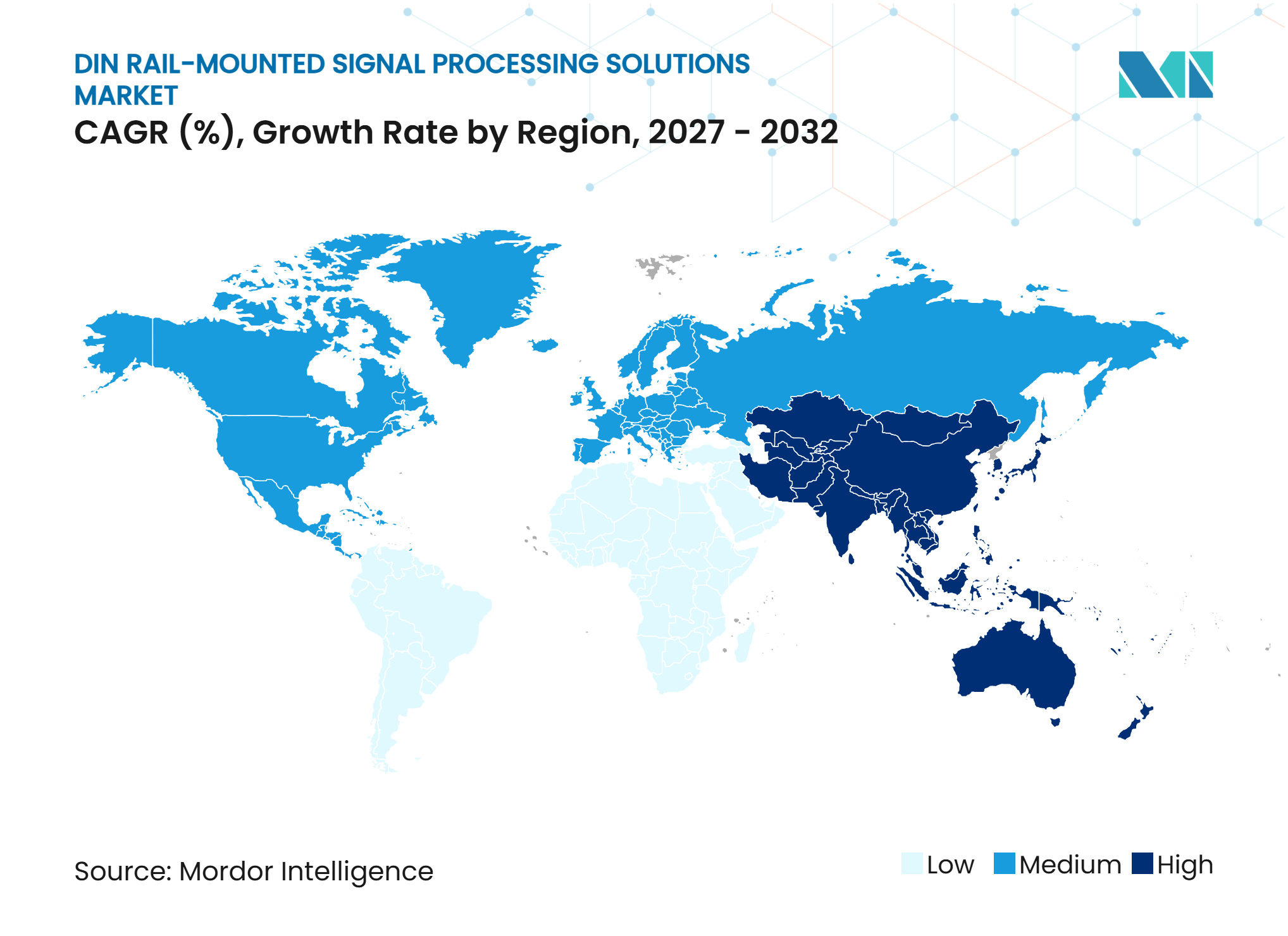
| Fastest Growing Market | Asia-Pacific |
| Largest Market | North America |
| Market Concentration | Medium |
Major Players *Disclaimer: Major Players sorted in no particular order Image © Mordor Intelligence. Reuse requires attribution under CC BY 4.0. | |
DIN Rail-Mounted Signal Processing Solutions Market Analysis by Mordor Intelligence
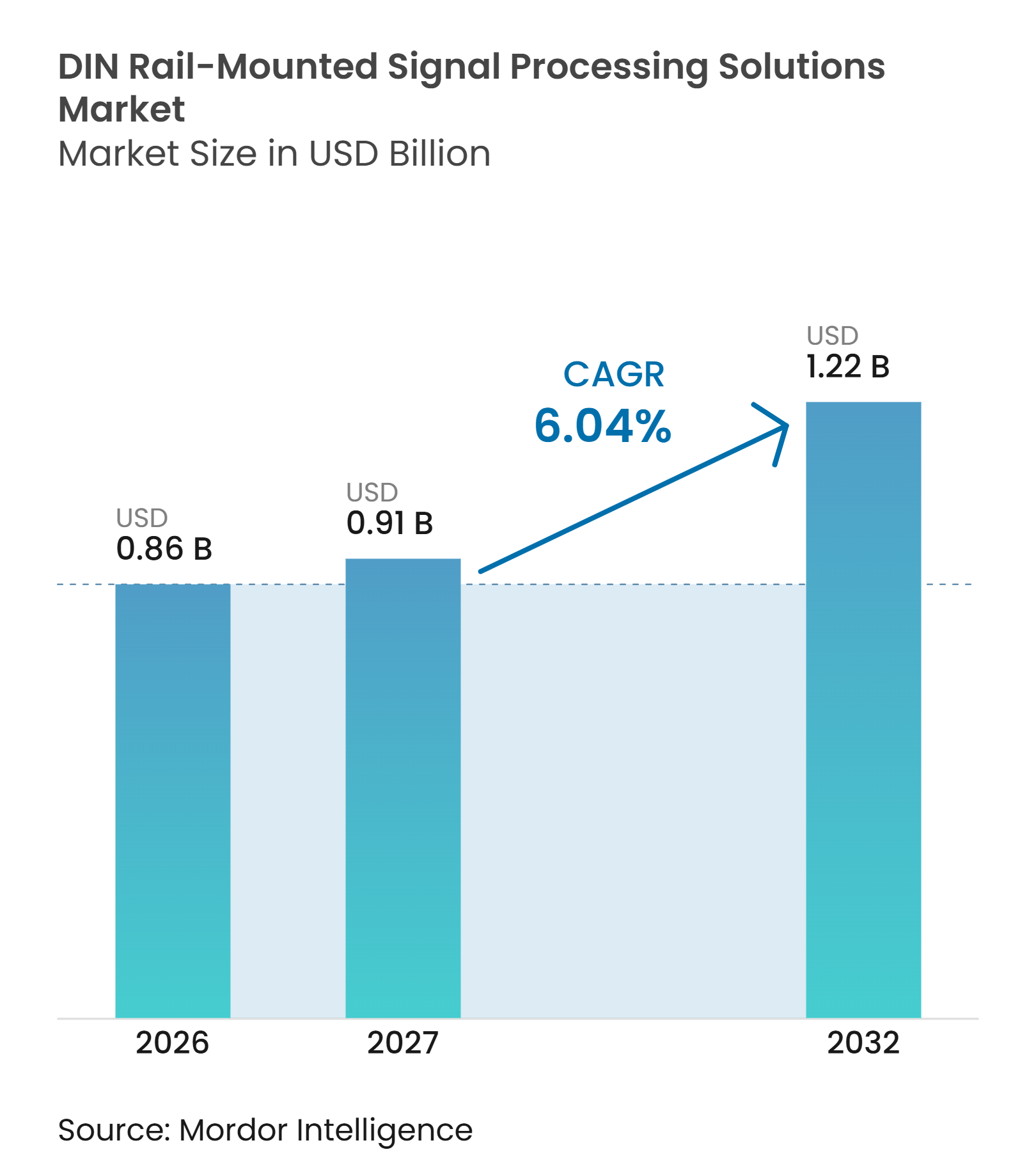
The DIN Rail-Mounted Signal Processing Solutions market size is valued at USD 0.86 billion in 2026 and is forecast to reach USD 1.22 billion by 2032, expanding at a CAGR of 6.04% over 2027-2032. These products isolate, convert, amplify, and filter sensor outputs before the information enters distributed control systems and programmable logic controllers. Industrial automation programs are increasing the number of field signals that require reliable conversion and isolation. Brownfield upgrades are also sustaining demand because plants must connect established 4-20 mA and HART devices with newer digital architectures. Suppliers are focusing on compact, certified, and configurable modules because regulated facilities require dependable signal paths and faster cabinet work. Ethernet-APL adoption is likely to preserve the role of standalone conditioners as a bridge between legacy field circuits and Ethernet-based plant networks.
Key Report Takeaways
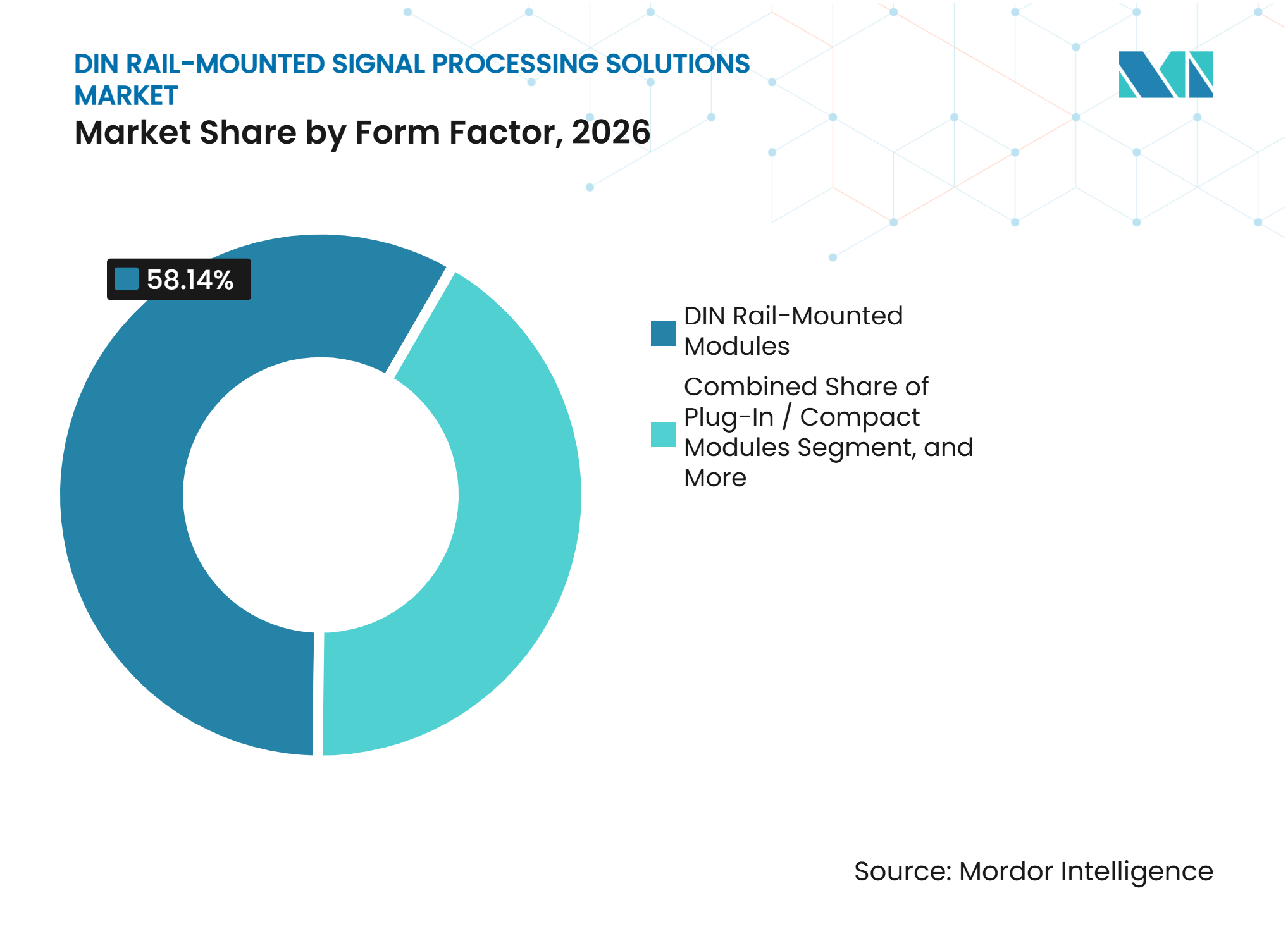
- By form factor, DIN rail-mounted modules held 58.14% of the DIN Rail-Mounted Signal Processing Solutions market share in 2026, while plug-in and compact modules are projected to expand at a 6.32% CAGR through 2032.
- By signal/input type, temperature inputs accounted for 24.42% of the DIN Rail-Mounted Signal Processing Solutions market size in 2026, while strain gauge, load cell, and bridge inputs are projected to expand at a 6.47% CAGR through 2032.
- By output signal, analog current output held 38.37% share in 2026, while HART-transparent and networked output configurations are projected to expand at a 6.71% CAGR through 2032.
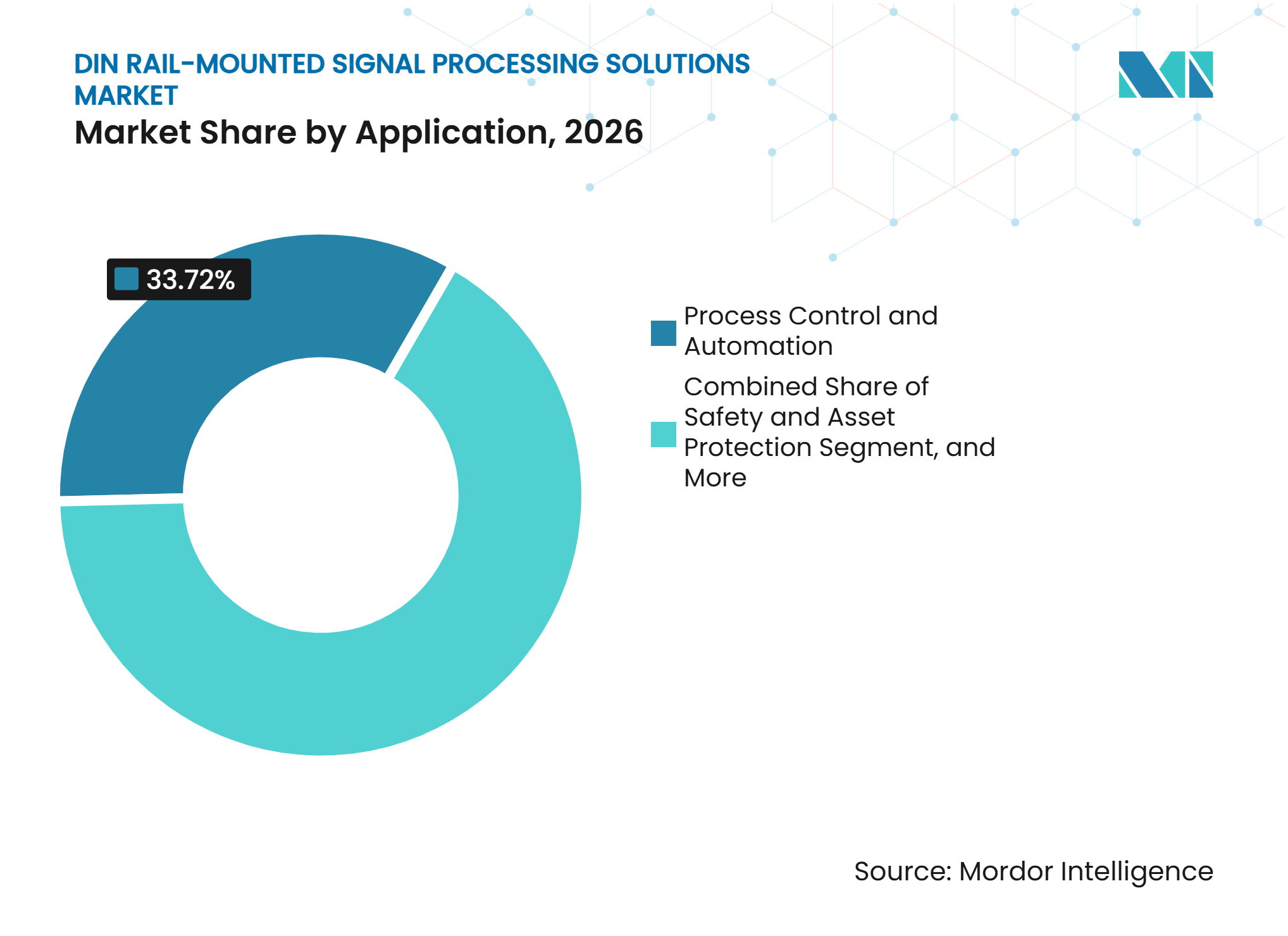
- By application, process control and automation accounted for 33.72% share in 2026, while condition monitoring and predictive maintenance is projected to expand at a 6.58% CAGR through 2032.
- By end-user industry, oil and gas held 22.09% share in 2026, while semiconductor and electronics manufacturing is projected to expand at a 6.69% CAGR through 2032.
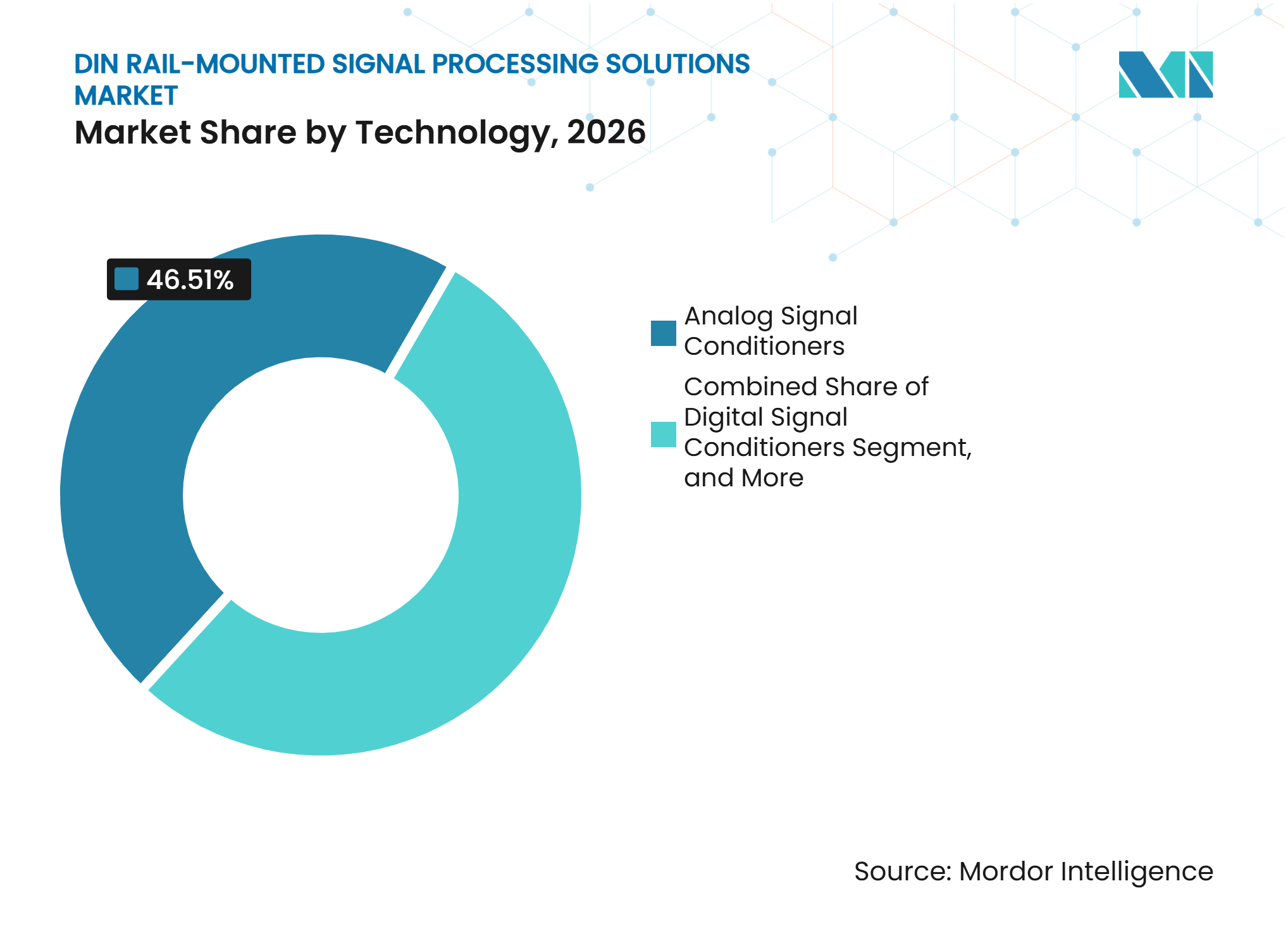
- By technology, analog signal conditioners accounted for 46.51% share in 2026, while edge-connected and IIoT-enabled signal conditioners are projected to expand at a 6.48% CAGR through 2032.
- By safety and certification, general-purpose modules held 55.81% share in 2026, while SIL-rated and functional-safety modules are projected to expand at a 6.37% CAGR through 2032.
- By geography, North America held 31.42% share in 2026, while Asia-Pacific is projected to expand at a 6.99% CAGR through 2032.
Note: Market numbers in this report are based on Mordor Intelligence's proprietary estimation framework, which combines nine months of actuals with Q4 projections for base year 2026.
Market Trends and Insights
Drivers Impact Analysis of DIN Rail-Mounted Signal Processing Solutions Market*
| Driver | (~) % Impact on CAGR Forecast | Geographic Relevance | Impact Timeline |
|---|---|---|---|
| Industrial Automation and IIoT Adoption | +1.2% | Global | Medium term (2-4 years) |
| Modernization of Legacy DCS and PLC Architectures | +0.8% | North America and Europe | Long term (≥ 4 years) |
| Functional Safety and SIL-Certification Requirements | +0.7% | Global | Medium term (2-4 years) |
| Hydrogen Economy and Renewable Energy Integration | +0.5% | Europe and Asia-Pacific | Long term (≥ 4 years) |
| Expansion of Semiconductor and Pharmaceutical Manufacturing | +0.4% | Asia-Pacific and North America | Short term (≤ 2 years) |
| Adoption of Single Pair Ethernet and Ethernet-APL | +0.3% | Europe and Asia-Pacific | Long term (≥ 4 years) |
| Source: Mordor Intelligence | |||
Industrial Automation and IIoT Adoption
Industrial automation and IIoT deployments are changing the path that connects field sensors with plant systems. Within the DIN Rail-Mounted Signal Processing Solutions market, DIN rail-mounted signal conditioners remain necessary where analog signals require isolation, conversion, or filtering before they are used by controllers. Process industries reported stronger performance than discrete manufacturing during 2025, with automation activity concentrated in data centers, LNG, and life sciences facilities. These facilities use many measurement points, including temperature, pressure, position, and flow inputs. Multi-protocol modules can link 4-20 mA, HART, and Modbus interfaces in the same cabinet. This capability allows operators to bring secondary equipment into monitoring systems without adding a separate conversion architecture for each device.
Modernization of Legacy DCS and PLC Architectures
Older distributed control systems and PLC installations create a sustained replacement opportunity for the DIN Rail-Mounted Signal Processing Solutions market. Many established plants retain field devices that communicate through analog wiring and need conditioning before digital systems can use their data. Emerson describes modern DCS environments as data platforms that use OPC UA and MQTT while continuing to connect with existing plant equipment.[1] ABB's 2025 Symphony Plus release supports upgrades for existing Harmony Rack-based systems without requiring a full process shutdown.[2] Brownfield projects can therefore retain installed sensors while adding conditioners with HART transparency, NFC setup, and connectivity features. IEC 61511 and ISA-99/IEC 62443 requirements further favor suppliers that can document safety and cybersecurity compliance.
Functional Safety and SIL-Certification Requirements
The DIN Rail-Mounted Signal Processing Solutions market continues to require SIL-rated modules in oil and gas, chemical, and pharmaceutical plants. IEC 61508 and related sector standards require documented fault tolerance and independent assessment for relevant equipment.Certification by organizations such as TÜV SÜD or TÜV Rheinland can take 18-24 months for a product family. Phoenix Contact introduced its MINI Analog Pro Ex family in June 2025 with SIL 3 capability in a 1oo1 architecture and ATEX and IECEx approvals in a 6.2 mm housing.[3] These approvals limit the ability of unqualified suppliers to enter regulated applications quickly. Requirements across ATEX, IECEx, FM/FM-C, and NEPSI can lead purchasers to select vendors with established certification coverage.
Hydrogen Economy and Renewable Energy Integration
The DIN Rail-Mounted Signal Processing Solutions market serves hydrogen infrastructure that requires reliable measurement for electrolyzers, storage systems, and distribution networks. A 2025 Wiley CITplus article states that measurement technology, digital networking, and signal processing are important to a scalable hydrogen supply chain. ARPA-E's H2SENSE program supports next-generation hydrogen sensing, including temperature, voltage, current, irradiance, and gas-flow measurements. Signal conditioners can support these measurements by isolating and stabilizing low-level sensor outputs before they reach a controller. Nature Electronics reported in 2025 that an organic hydrogen sensor detected hydrogen at 192 ppb within 1 second and remained stable for more than 646 days in ambient air. Solar and wind installations also require accurate AC RMS conversion for power-quality monitoring and plant management systems.
Restraints Impact Analysis of DIN Rail-Mounted Signal Processing Solutions Market*
| Restraint | (~) % Impact on CAGR Forecast | Geographic Relevance | Impact Timeline |
|---|---|---|---|
| Price Pressure From Integrated PLC Analog I/O Modules | -0.6% | Global | Short term (≤ 2 years) |
| High Certification Costs and Extended Approval Timelines | -0.4% | Global | Long term (≥ 4 years) |
| Long Asset Replacement Cycles in Process Industries | -0.3% | Europe and North America | Long term (≥ 4 years) |
| Cybersecurity Risks in Networked DIN Rail Modules | -0.2% | Global | Medium term (2-4 years) |
| Source: Mordor Intelligence | |||
Price Pressure From Integrated PLC Analog I/O Modules
Integrated analog I/O in PLC platforms limits demand for separate signal conditioners in some new installations. PLC suppliers now include galvanic isolation, signal linearization, and HART communication in native I/O cards. This reduces the need for standalone hardware in low-channel-count applications with limited technical requirements. Discrete products retain an advantage where higher isolation voltage, dense channel layouts, or hazardous-area approvals are required. Food and beverage and water and wastewater operators may choose integrated PLC platforms when capital budgets are constrained. This pressure is strongest where mature PLC ecosystems are already common in North America and Western Europe.
High Certification Costs and Extended Approval Timelines
Maintaining SIL, ATEX, IECEx, FM, and NEPSI approvals requires sustained engineering and testing investment. A new product family seeking parallel coverage across ATEX, IECEx, and FM/FM-C jurisdictions can require 3-5 years of testing before entering regulated end markets. CISA's 2025 Secure by Demand guidance also encourages purchasers to require auditable configuration management, baseline logging, and secure-by-design documentation. These expectations add work beyond conventional functional-safety requirements. Smaller manufacturers may direct a greater share of RandD resources toward maintaining approvals rather than developing new digital capabilities. The resulting burden supports incumbents but can slow the wider product refresh cycle.
*Our forecasts treat driver/restraint impacts as directional, not additive. The impact forecasts reflect baseline growth, mix effects, and variable interactions.
DIN Rail-Mounted Signal Processing Solutions Market Segment Analysis
By Form Factor:
DIN Rail Modules Remain the Standard Cabinet ChoiceDIN rail-mounted modules held 58.14% of the form factor share in 2026. Their position in the DIN Rail-Mounted Signal Processing Solutions market reflects widespread use of the EN/IEC 60715 TH35 mounting standard in industrial control cabinets. Panel builders use the format because it supports straightforward installation, orderly wiring, and accessible maintenance. The standardized 35 mm rail also lets users combine conditioners with relays, power supplies, terminals, and controllers. This common mechanical arrangement reduces redesign work when a cabinet is expanded or refurbished.
Rack and backplane products serve large DCS expansions where the I/O design is already centralized. Standalone and panel-mounted products remain relevant where field enclosures require IP65 or greater ingress protection. The DIN Rail-Mounted Signal Processing Solutions market size for the DIN rail format is supported by the need to preserve standard cabinet dimensions as plants move toward Ethernet-APL. FieldComm Group and partner organizations finalized Ethernet-APL Power Class B details in IEC TS 63444 during November 2025 for equipment that includes devices mounted on 35 mm DIN rails. Plug-in and compact products are projected to expand at a 6.32% CAGR through 2032 because semiconductor and pharmaceutical projects seek smaller cabinets. Phoenix Contact's 6.2 mm MINI Analog Pro Ex line shows that a narrow module can combine compact dimensions with functional-safety and hazardous-area approvals.



By Signal/Input Type:
Temperature Leads While Precision Inputs ExpandTemperature inputs accounted for 24.42% of the input-type share in 2026. RTDs and thermocouples are used across process plants because operators need continuous thermal measurement for control, quality, and safety. RTDs can support measurements up to 850°C, while thermocouples can be used at temperatures up to 2,320°C. Temperature conditioners convert these inputs into stable signals that controllers and recording systems can use. This broad installed base supports recurring DIN Rail-Mounted Signal Processing Solutions market demand in oil and gas, chemical, power, food processing, and pharmaceutical sites.
Strain gauge, load cell, and bridge inputs are projected to expand at a 6.47% CAGR through 2032. They support hydrogen fuel-cell diagnostics, fill-weight control, and structural health monitoring. Displacement measurements from LVDT and RVDT inputs are used for wafer handling and valve-position feedback. Frequency, pulse, and AC RMS inputs are used in renewable power and power-quality monitoring. Process voltage and current signals remain central to brownfield projects because 4-20 mA and 0-10 V transmitters are still widely installed. Pharmaceutical users also need validated records and audit trails under FDA 21 CFR Part 11 and EU Annex 11 compliance expectations.
By Output Signal:
HART Transparency Supports Digital MigrationAnalog current output held 38.37% of output-signal share in 2026. The 4-20 mA interface remains a common connection between field instruments and PLC or DCS analog input cards across the DIN Rail-Mounted Signal Processing Solutions market. Its continued role is important because it is understood by maintenance teams and works across a large installed base. Analog voltage output serves lower-noise applications over short distances. Relay and alarm outputs also remain necessary for safety loops and emergency shutdown functions.
HART-transparent and networked outputs are projected to expand at a 6.71% CAGR through 2032. This product group allows diagnostic information to pass through a conditioner without requiring additional field wiring. FieldComm Group stated in November 2025 that the Ethernet-APL and SPE updates support Ethernet extension into the field across intrinsically safe and non-intrinsically safe environments. The output configuration is valuable in brownfield settings because HART devices can remain in place during digital modernization. Digital, pulse, and frequency outputs also support condition-monitoring and energy-monitoring systems. These interfaces allow the DIN Rail-Mounted Signal Processing Solutions market to address both established analog systems and newer networked applications.
By Application:
Process Control Leads While Predictive Maintenance AdvancesProcess control and automation accounted for 33.72% of application share in 2026. This application needs dependable conversion of field signals from temperature, pressure, flow, level, and position instruments across the DIN Rail-Mounted Signal Processing Solutions market. Signal conditioners protect controller inputs from electrical noise and ground loops. They also isolate circuits where equipment uses different power references. These functions remain essential across continuous process facilities with large numbers of measurement points.
Condition monitoring and predictive maintenance is projected to expand at a 6.58% CAGR through 2032. The application uses vibration, strain, temperature, humidity, and equipment-status signals to detect developing faults. TURCK introduced the IM18-CCM45 in November 2026 with direct PROFINET, EtherNet/IP, and Modbus TCP communication for cabinet condition data. The product demonstrates how measurement and communication functions are being combined at the cabinet level. Data acquisition and test measurement, power-quality monitoring, and safety protection remain additional uses for conditioned signals. IEC 61511 requirements also sustain demand where process measurements are part of safety-instrumented functions.

By End-User Industry:
Oil and Gas Leads, Semiconductor Manufacturing AcceleratesOil and gas held 22.09% of end-user share in 2026. Upstream, midstream, and downstream facilities require SIL-rated, intrinsically safe, and HART-compatible signal paths, supporting the DIN Rail-Mounted Signal Processing Solutions market. These requirements apply to measurement and control loops in hazardous conditions. Chemical and petrochemical facilities share many of these specifications because they also handle flammable materials and operate complex continuous processes. Long equipment life cycles make replacement modules and retrofit upgrades an ongoing source of demand.
Semiconductor and electronics manufacturing is projected to expand at a 6.69% CAGR through 2032. SEMI expected global fab equipment investment to reach USD 110 billion in 2025 and to rise 18% to USD 130 billion in 2026. Cleanrooms use closely controlled temperature, pressure, gas-flow, and power-quality systems, creating dense instrumentation needs. FormFactor purchased a USD 55 million manufacturing facility in Texas in June 2025 and planned more than USD 140 million in capital investment in 2026. Pharmaceutical and life sciences plants also require validated and audit-trail-capable systems, while water, power, food, metals, automotive, and aerospace applications provide additional demand. SEMI S2 and FDA 21 CFR Part 11 compliance factors favor established product families with complete documentation.
By Technology:
Analog Systems Retain Their Installed Base as Edge Functions RiseAnalog signal conditioners held 46.51% of technology share in 2026. Oil and gas, chemical, power generation, and water treatment sites retain large installations of 4-20 mA and thermocouple circuits, which support the DIN Rail-Mounted Signal Processing Solutions market. The cost and operating risk of replacing every analog loop at once limits rapid technology substitution. Analog signal paths are also valued in high-consequence applications because they have a simple, familiar design. These conditions preserve demand for established conditioner architectures across long equipment lives.
Edge-connected and IIoT-enabled products are projected to expand at a 6.48% CAGR through 2032. Their role includes transferring real-time sensor data, supporting OPC UA integration, and performing local signal processing. Digital conditioners are more common in greenfield projects that can be designed around modern network systems. Hybrid products combine analog measurement integrity with digital configuration and communication features. This combination is useful for plants that want diagnostics without replacing their existing field devices. Cybersecurity remains an important product requirement as industrial users connect more cabinet-level equipment.
By Safety and Certification:
General-Purpose Modules Lead as SIL Demand IncreasesGeneral-purpose modules held 55.81% of safety and certification share in 2026. Food and beverage, water treatment, HVAC, and building automation account for substantial DIN Rail-Mounted Signal Processing Solutions market volumes that do not require certified functional safety. Cost and standard cabinet compatibility are important purchasing factors in these uses. General-purpose products serve common conversion, isolation, and alarm functions without the expense of specialized approvals. This maintains their volume position across non-hazardous installations.
SIL-rated and functional-safety modules are projected to expand at a 6.37% CAGR through 2032. IEC 61511 and IEC 62061 requirements are being applied beyond traditional oil and gas and chemical projects. G.M. International's D1093 and D1092 relay output modules are certified to SIL 3 under IEC 61508:2010 Edition 2 and hold TÜV, DNV, and KR approvals. Such approval coverage can support oil and gas, marine, and offshore specifications through a single design. Intrinsically safe and marine-approved modules address the remaining specialized requirements. The DIN Rail-Mounted Signal Processing Solutions industry uses these certifications to show that a product can meet documented risk and safety obligations.
Geography Analysis
North America
North America held 31.42% of the DIN Rail-Mounted Signal Processing Solutions market share in 2026. The United States has an extensive base of oil and gas processing assets, LNG export infrastructure, and semiconductor projects that require high-specification instrumentation. The CHIPS and Science Act supports domestic semiconductor manufacturing and supply-chain investment. Purchasers in regulated applications often specify SIL-certified, HART-transparent, and NFC-configurable modules, while CISA guidance raises the importance of auditable configuration management and baseline logging. Canada adds oil sands demand, and Mexico contributes electronics manufacturing demand, combining mature-asset replacement work with advanced-manufacturing requirements.
Asia-Pacific
Asia-Pacific is projected to expand at a 6.99% CAGR through 2032. China represents more than 40% of regional signal conditioner demand and is increasing industrial IoT deployment. South Korea's semiconductor and display-panel operations require close control of cleanroom and process conditions, while India's pharmaceutical and refinery modernization requires additional instrumentation. Japan provides steady replacement demand from automotive and precision machinery installations. Safety requirements in India and several Southeast Asian countries are increasing the use of intrinsically safe equipment in chemical plants and refineries, supporting certified DIN Rail-Mounted Signal Processing Solutions market offerings.
Europe and Emerging Regions
Europe's DIN Rail-Mounted Signal Processing Solutions market is supported by renewable integration and hydrogen projects, including Germany's electrolyzer deployments and power-quality measurement needs. Weidmüller and Power Plus Communications introduced the EEBUS Relais Converter in February 2026 to convert digital EEBUS control signals into analog relay commands for energy assets. The Middle East supports demand for SIL-rated and intrinsically safe products in petrochemical and LNG facilities, while Saudi Arabia and the UAE add industrial diversification demand. Brazil supports South American demand through oil and gas modernization, and South Africa and Egypt offer smaller opportunities in mining, water treatment, and power generation where infrastructure investment remains a constraint.
Competitive Landscape
Market Concentration
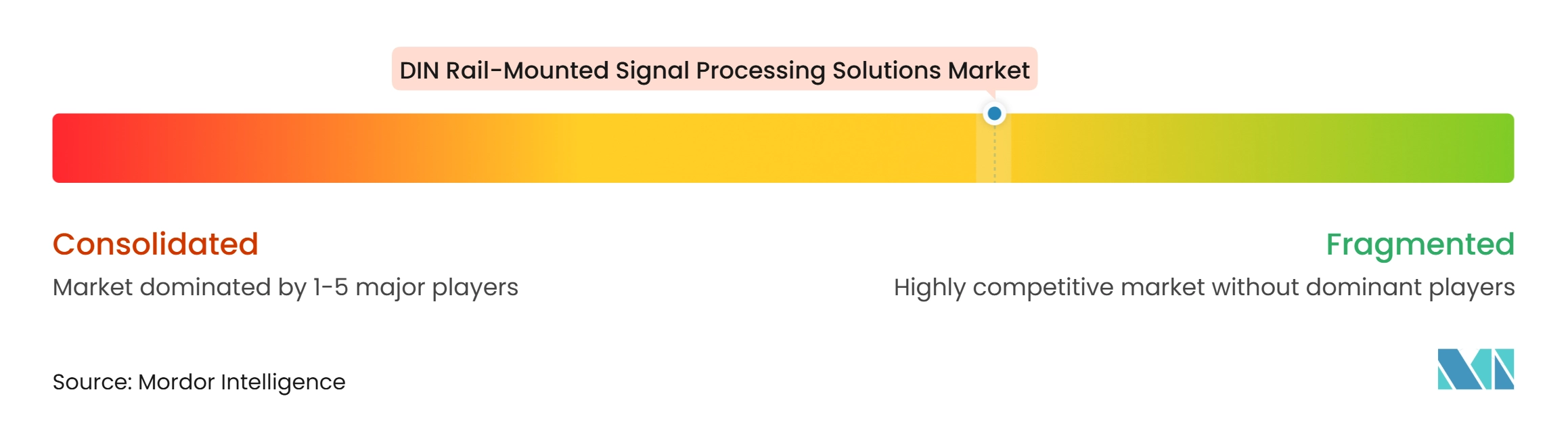
The DIN Rail-Mounted Signal Processing Solutions market is moderately concentrated. Phoenix Contact, Weidmüller, Pepperl+Fuchs, and TURCK hold leading positions through certified portfolios, distribution coverage, and links with DCS and PLC ecosystems. Suppliers differentiate through certifications, configuration tools, and common industrial protocols. ATEX, IECEx, FM, NEPSI, and marine approvals help suppliers serve customers across regions. Pepperl+Fuchs maintains a K-System portfolio with 200 isolated barriers and 150 signal conditioners for hazardous-area applications.
Standards participation influences product development in the DIN Rail-Mounted Signal Processing Solutions market. FieldComm Group, ODVA, the OPC Foundation, and PROFIBUS and PROFINET International finalized Ethernet-APL extensions in November 2025. Suppliers that align early with these specifications can support migration from legacy circuits to Ethernet-based networks. Phoenix Contact expanded the MINI Analog Pro Ex family in August 2025 with an additional 6.2 mm intrinsically safe variant for SIL 3 1oo1 use. Weidmüller introduced the EEBUS Relais Converter in 2026 for German energy-management applications.
Smaller participants, including Dataforth, Acromag, and Moore Industries-International, compete in specialized high-channel data acquisition, aerospace, and enclosure applications. Their customization speed can be valuable when standard catalog modules do not meet plant requirements. IO-Link architectures and Ethernet-APL-native field transmitters may replace some standalone conditioning functions in greenfield installations. Connected modules also increase demand for cybersecurity-hardened firmware and secure configuration processes under CISA's Secure by Demand guidance. TURCK's IM18-CCM45 demonstrates the move toward combining cabinet-monitoring sensors with multiprotocol Ethernet communication.
DIN Rail-Mounted Signal Processing Solutions Industry Leaders
-
Phoenix Contact GmbH & Co. KG
-
Weidmüller Interface GmbH & Co. KG
-
Pepperl+Fuchs SE
-
Rockwell Automation, Inc.
-
Siemens AG
- *Disclaimer: Major Players sorted in no particular order
DIN Rail-Mounted Signal Processing Solutions Market Companies Covered in this Report
- Phoenix Contact GmbH & Co. KG
- Weidmuller Interface GmbH & Co. KG
- Pepperl+Fuchs SE
- Siemens AG
- Rockwell Automation, Inc.
- OMEGA Engineering, Inc.
- WAGO Kontakttechnik GmbH & Co. KG
- M-System Co., Ltd.
- PR electronics A/S
- Turck GmbH & Co. KG
- Dataforth Corporation
- Acromag, Inc.
- Moore Industries-International, Inc.
- Status Instruments Ltd.
- Red Lion Controls, Inc.
- R. STAHL AG
- G.M. International s.r.l.
- Campbell Scientific, Inc.
- Gantner Instruments GmbH
- Dewesoft d.o.o.
Recent Industry Developments in DIN Rail-Mounted Signal Processing Solutions Market
- November 2026: TURCK launched the IM18-CCM45, an 18 mm-wide DIN rail condition monitoring device with integrated temperature, humidity, and cabinet-door-distance sensors and direct PROFINET, EtherNet/IP, and Modbus TCP connectivity, eliminating the discrete remote I/O module between field sensors and control systems, Zone 2 IECEx and ATEX certified for hazardous environments.
- October 2026: Submer and Saudi-based ACES signed an MoU to accelerate the development of AI-ready data centers in Saudi Arabia. The collaboration combines Submer's liquid and immersion-cooling technologies with ACES's local infrastructure engineering and deployment capabilities. The scope includes cooling-system design, new-build and retrofit projects, and potential co-investment in data-center capacity.
- February 2026: Khazna's QAJ01 facility in Ajman, UAE, received Uptime Institute Tier III Certification of Design Documents. The planned 100 MW AI-optimized facility is designed with advanced liquid cooling and 20 data halls of 5 MW each. It is positioned as the first certified AI data center with liquid cooling in the Middle East and North Africa region
- February 2026: Weidmüller and Power Plus Communications AG jointly introduced the EEBUS Relais Converter (ERC) at E-World 2026, a DIN rail-mounted product translating digital EEBUS control signals into analog relay switching commands, enabling non-digitally equipped energy assets to comply with German §14a EnWG and §9 EEG energy management mandates, serial delivery commenced mid-2026.
Global DIN Rail-Mounted Signal Processing Solutions Market Report Scope
The DIN Rail-Mounted Signal Processing Solutions Market refers to the market for compact, modular electronic devices, signal conditioners, isolators, transmitters, converters, splitters, and limit alarms designed to be snap-mounted on standard 35 mm DIN rails within industrial control cabinets, automation panels, and process control systems.
The DIN Rail-Mounted Signal Processing Solutions Market Report is Segmented by Form Factor (DIN Rail-Mounted Modules, Rack / Backplane-Mounted Modules, Stand-Alone / Panel Modules, and Plug-In / Compact Modules), Signal / Input Type (Temperature Inputs (RTD Inputs and Thermocouple Inputs), Process Voltage and Current Inputs (4-20 mA Inputs and 0-10 V and Related Standard Analog Inputs), Frequency, Pulse and AC RMS Inputs, Strain Gauge, Load Cell and Bridge Inputs, LVDT/RVDT and Displacement Inputs, and Other Signal / Input Types), Output Signal (Analog Current Output, Analog Voltage Output, Digital, Pulse and Frequency Output, Relay and Alarm Output, and HART-Transparent and Networked Output), Application (Data Acquisition and Test Measurement, Process Control and Automation, Condition Monitoring and Predictive Maintenance, Energy and Power-Quality Monitoring, and Safety and Asset Protection), End-User Industry (Oil and Gas, Chemical and Petrochemical, Water and Wastewater, Power Generation and Utilities, Including Renewable Energy, Food and Beverage, Metals and Mining, Pharmaceutical and Life Sciences, Semiconductor and Electronics Manufacturing, Automotive and Transportation, Aerospace and Defense, and Other End-User Industries), Technology (Analog Signal Conditioners, Digital Signal Conditioners, Hybrid Signal Conditioners, and Edge-Connected and IIoT-Enabled Signal Conditioners), Safety and Certification (General-Purpose Modules, Intrinsically Safe and Hazardous-Area Modules, SIL-Rated and Functional-Safety Modules, and Marine- and Transportation-Approved Modules), and Geography (North America (United States, Canada, and Mexico), South America (Brazil, Argentina, and Rest of South America), Europe (Germany, United Kingdom, France, Italy, Russia, and Rest of Europe), Asia-Pacific (China, Japan, South Korea, India, Australia, New Zealand, and Rest of Asia-Pacific), Middle East (Saudi Arabia, United Arab Emirates, Turkey, and Rest of Middle East), and Africa (South Africa, Egypt, and Rest of Africa)). The Market Forecasts Are Provided in Terms of Value (USD).
Segmentation Overview
| DIN Rail-Mounted Modules |
| Rack / Backplane-Mounted Modules |
| Stand-Alone / Panel Modules |
| Plug-In / Compact Modules |
| Temperature Inputs | RTD Inputs |
| Thermocouple Inputs | |
| Process Voltage and Current Inputs | 4-20 mA Inputs |
| 0-10 V and Related Standard Analog Inputs | |
| Frequency, Pulse and AC RMS Inputs | |
| Strain Gauge, Load Cell and Bridge Inputs | |
| LVDT/RVDT and Displacement Inputs | |
| Other Signal / Input Types |
| Analog Current Output |
| Analog Voltage Output |
| Digital, Pulse and Frequency Output |
| Relay and Alarm Output |
| HART-Transparent and Networked Output |
| Data Acquisition and Test Measurement |
| Process Control and Automation |
| Condition Monitoring and Predictive Maintenance |
| Energy and Power-Quality Monitoring |
| Safety and Asset Protection |
| Oil and Gas |
| Chemical and Petrochemical |
| Water and Wastewater |
| Power Generation and Utilities, Including Renewable Energy |
| Food and Beverage |
| Metals and Mining |
| Pharmaceutical and Life Sciences |
| Semiconductor and Electronics Manufacturing |
| Automotive and Transportation |
| Aerospace and Defense |
| Other End-User Industries |
| Analog Signal Conditioners |
| Digital Signal Conditioners |
| Hybrid Signal Conditioners |
| Edge-Connected and IIoT-Enabled Signal Conditioners |
| General-Purpose Modules |
| Intrinsically Safe and Hazardous-Area Modules |
| SIL-Rated and Functional-Safety Modules |
| Marine- and Transportation-Approved Modules |
| North America | United States |
| Canada | |
| Mexico | |
| South America | Brazil |
| Argentina | |
| Rest of South America | |
| Europe | Germany |
| United Kingdom | |
| France | |
| Italy | |
| Russia | |
| Rest of Europe | |
| Asia-Pacific | China |
| Japan | |
| South Korea | |
| India | |
| Australia | |
| New Zealand | |
| Rest of Asia-Pacific | |
| Middle East | Saudi Arabia |
| United Arab Emirates | |
| Turkey | |
| Rest of Middle East | |
| Africa | South Africa |
| Egypt | |
| Rest of Africa |
| By Form Factor | DIN Rail-Mounted Modules | |
| Rack / Backplane-Mounted Modules | ||
| Stand-Alone / Panel Modules | ||
| Plug-In / Compact Modules | ||
| By Signal / Input Type | Temperature Inputs | RTD Inputs |
| Thermocouple Inputs | ||
| Process Voltage and Current Inputs | 4-20 mA Inputs | |
| 0-10 V and Related Standard Analog Inputs | ||
| Frequency, Pulse and AC RMS Inputs | ||
| Strain Gauge, Load Cell and Bridge Inputs | ||
| LVDT/RVDT and Displacement Inputs | ||
| Other Signal / Input Types | ||
| By Output Signal | Analog Current Output | |
| Analog Voltage Output | ||
| Digital, Pulse and Frequency Output | ||
| Relay and Alarm Output | ||
| HART-Transparent and Networked Output | ||
| By Application | Data Acquisition and Test Measurement | |
| Process Control and Automation | ||
| Condition Monitoring and Predictive Maintenance | ||
| Energy and Power-Quality Monitoring | ||
| Safety and Asset Protection | ||
| By End-User Industry | Oil and Gas | |
| Chemical and Petrochemical | ||
| Water and Wastewater | ||
| Power Generation and Utilities, Including Renewable Energy | ||
| Food and Beverage | ||
| Metals and Mining | ||
| Pharmaceutical and Life Sciences | ||
| Semiconductor and Electronics Manufacturing | ||
| Automotive and Transportation | ||
| Aerospace and Defense | ||
| Other End-User Industries | ||
| By Technology | Analog Signal Conditioners | |
| Digital Signal Conditioners | ||
| Hybrid Signal Conditioners | ||
| Edge-Connected and IIoT-Enabled Signal Conditioners | ||
| By Safety and Certification | General-Purpose Modules | |
| Intrinsically Safe and Hazardous-Area Modules | ||
| SIL-Rated and Functional-Safety Modules | ||
| Marine- and Transportation-Approved Modules | ||
| By Geography | North America | United States |
| Canada | ||
| Mexico | ||
| South America | Brazil | |
| Argentina | ||
| Rest of South America | ||
| Europe | Germany | |
| United Kingdom | ||
| France | ||
| Italy | ||
| Russia | ||
| Rest of Europe | ||
| Asia-Pacific | China | |
| Japan | ||
| South Korea | ||
| India | ||
| Australia | ||
| New Zealand | ||
| Rest of Asia-Pacific | ||
| Middle East | Saudi Arabia | |
| United Arab Emirates | ||
| Turkey | ||
| Rest of Middle East | ||
| Africa | South Africa | |
| Egypt | ||
| Rest of Africa | ||
Key Questions Answered in the Report
What is the size of the DIN Rail-Mounted Signal Processing Solutions sector?
The sector is valued at USD 0.86 billion in 2026 and is forecast to reach USD 1.22 billion by 2032, expanding at a 6.04% CAGR from 2027 to 2032. Demand is supported by automation programs, brownfield modernization, and the continuing need to connect analog field devices with digital control systems.
Which form factor leads demand for signal processing solutions?
DIN rail-mounted modules lead with 58.14% share in 2026 because the DIN Rail-Mounted Signal Processing Solutions market relies on the widely used EN/IEC 60715 TH35 rail. The format supports organized cabinet wiring, maintenance access, and integration with relays, terminals, power supplies, and controllers.
Which application is expected to expand the fastest through 2032?
Condition monitoring and predictive maintenance is projected to expand at a 6.58% CAGR as the DIN Rail-Mounted Signal Processing Solutions market uses more sensor data for equipment reliability programs. These systems condition vibration, temperature, strain, humidity, and status signals before the information reaches monitoring and control platforms.
Why are HART-transparent signal conditioners important?
They allow HART diagnostic data to pass through existing signal paths, helping the DIN Rail-Mounted Signal Processing Solutions market modernize legacy systems without replacing all field devices. This supports brownfield upgrades where plants retain 4-20 mA circuits while introducing Ethernet-APL and digital communication capabilities.
Which end-user sector has the fastest forecast expansion?
Semiconductor and electronics manufacturing is projected to expand at a 6.69% CAGR through 2032, supported by investment in advanced fabrication capacity. Cleanrooms require dense temperature, pressure, gas-flow, and power-quality measurement systems, which creates demand for reliable conversion and isolation hardware.
Which region has the highest projected expansion rate?
Asia-Pacific is projected to expand at a 6.99% CAGR through 2032, supported by industrial IoT adoption and manufacturing investment. China, South Korea, India, and Japan provide demand through industrial modernization, semiconductor activity, pharmaceutical production, refineries, automotive production, and precision machinery.