
Digital Provenance Platform Market Size and Share
Market Overview
| Study Period | 2020 - 2031 |
|---|---|
| Market Size (2026) | USD 1.45 Billion |
| Market Size (2031) | USD 3.61 Billion |
| Growth Rate (2026 - 2031) | 20.01 % |
| Fastest Growing Market | Asia-Pacific |
| Largest Market | North America |
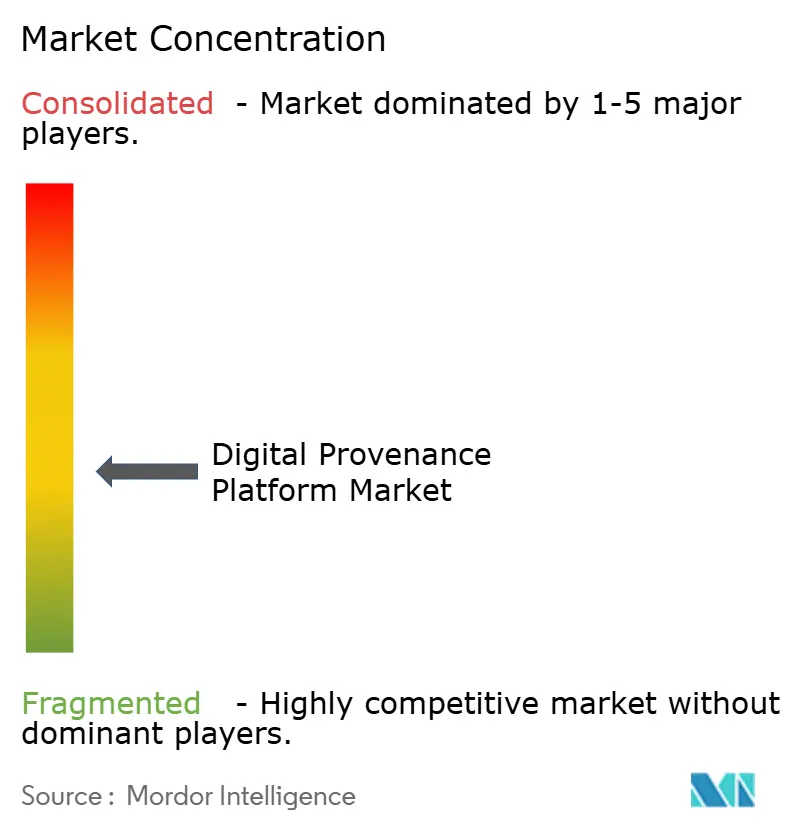
| Market Concentration | Medium |
Major Players *Disclaimer: Major Players sorted in no particular order Image © Mordor Intelligence. Reuse requires attribution under CC BY 4.0. | |
Digital Provenance Platform Market Analysis by Mordor Intelligence
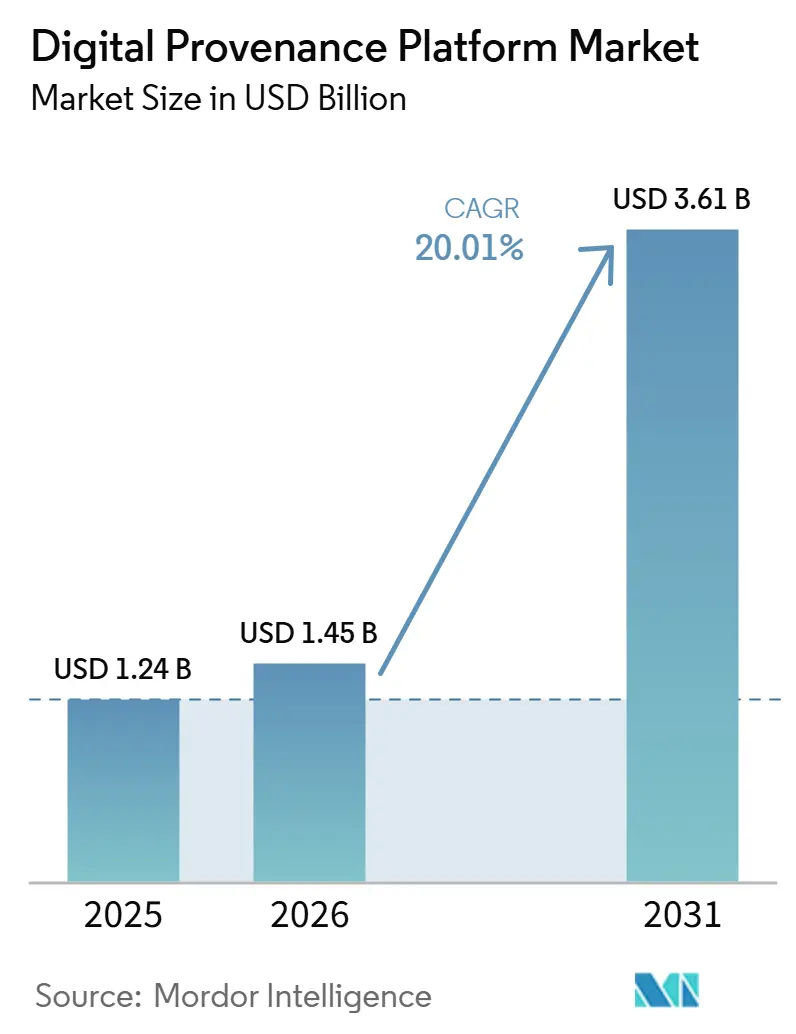
The Digital provenance platform market size is projected to expand from USD 1.24 billion in 2025 and USD 1.45 billion in 2026 to USD 3.61 billion by 2031, registering a CAGR of 20.01% between 2026 and 2031. Regulation is moving procurement from voluntary pilots toward long-term data infrastructure, especially for companies selling into the European Union. The February 18, 2027, battery passport deadline is forcing manufacturers, importers, and retailers to establish verified product data flows. The European Union's broader Digital Product Passport program extends this requirement to textiles, iron and steel, electronics, and furniture through later delegated acts. This sequence allows early adopters to reuse data systems across product lines rather than build separate compliance programs. It also favors providers that can support product identity, supplier evidence, and data exchange across several regulatory frameworks.
Key Report Takeaways
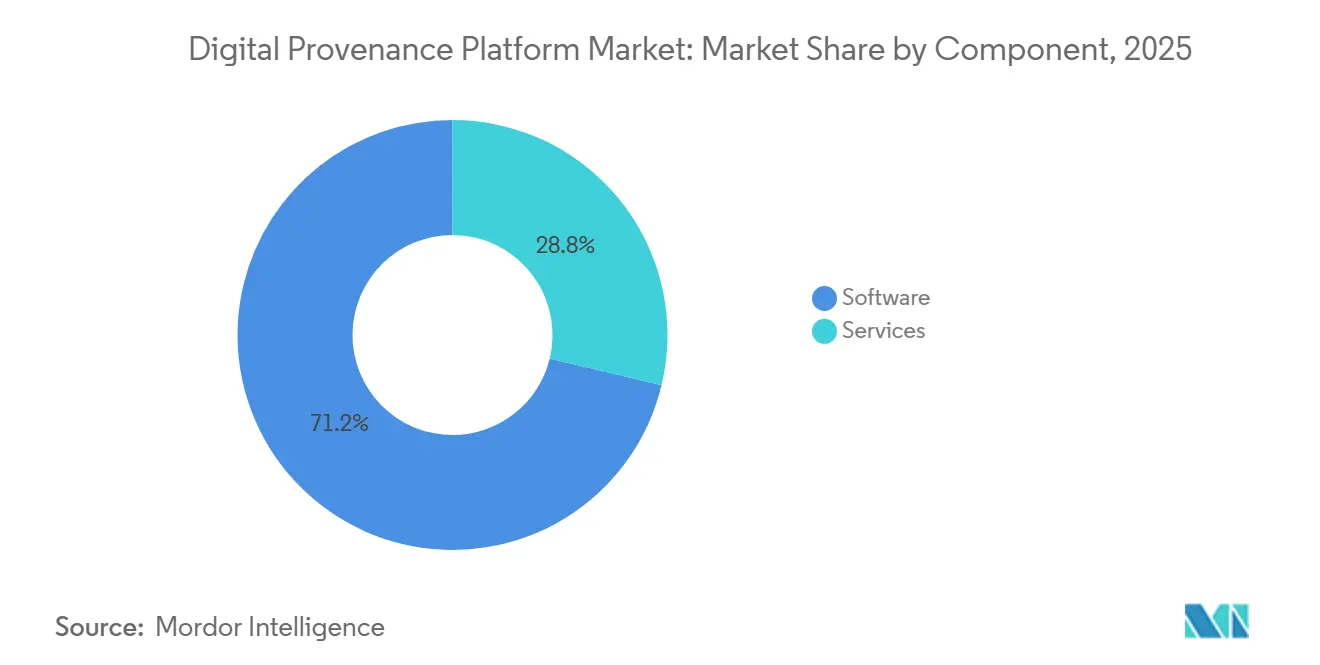
- By component, software held 71.24% of the Digital provenance platform market share in 2025, while services are projected to expand at a 23.82% CAGR through 2031.
- By deployment model, cloud held 68.41% of the Digital provenance platform market share in 2025, while hybrid deployment is projected to expand at a 22.69% CAGR through 2031.
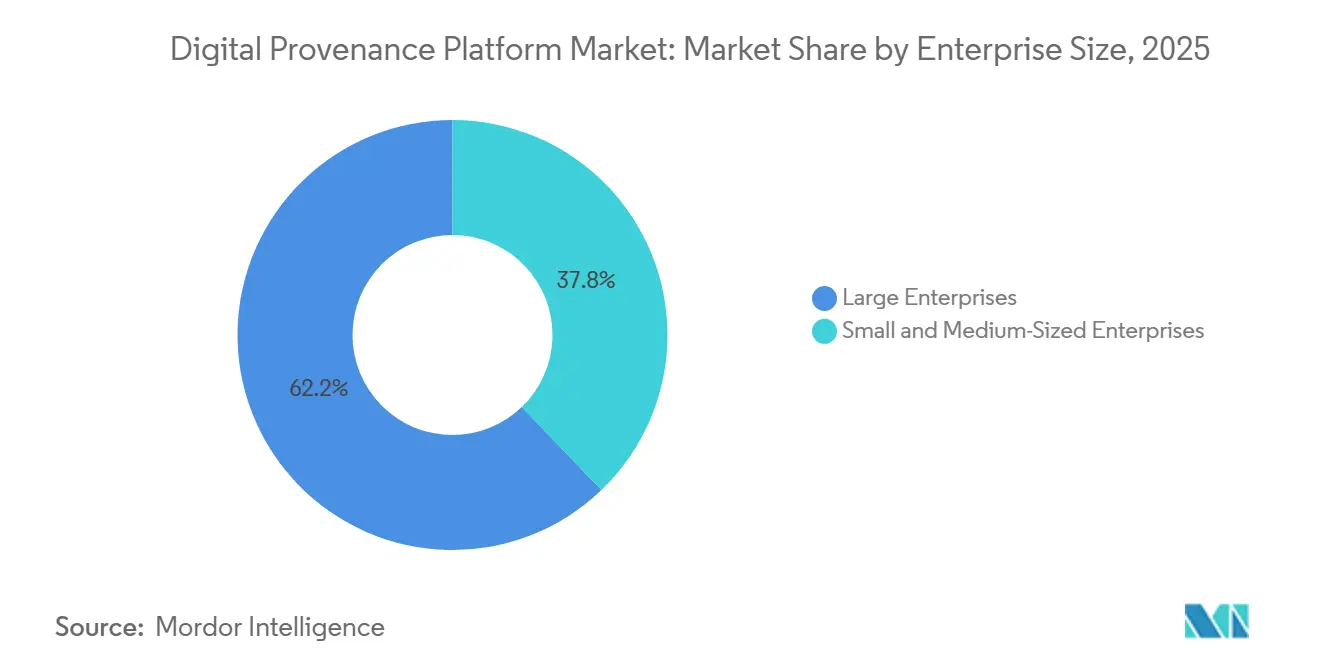
- By enterprise size, large enterprises held 62.18% share in 2025, while small and medium-sized enterprises are projected to expand at a 24.73% CAGR through 2031.
- By end user, retail and e-commerce held 24.86% share in 2025, while healthcare and life sciences are projected to expand at a 21.42% CAGR through 2031.
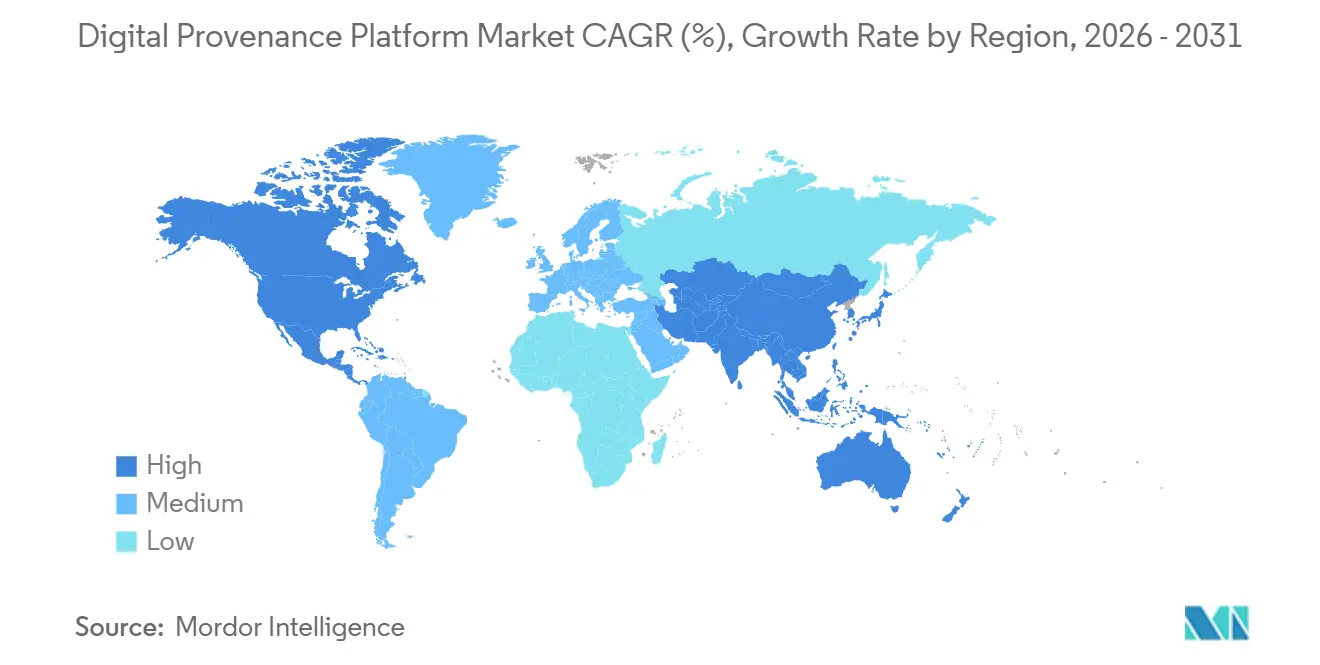
- By geography, North America held 34.62% share in 2025, while Asia-Pacific is projected to expand at a 24.19% CAGR through 2031.
Note: Market size and forecast figures in this report are generated using Mordor Intelligence’s proprietary estimation framework, updated with the latest available data and insights as of January 2026.
Market Trends and Insights
Drivers Impact Analysis of Digital Provenance Platform Market*
| Driver | (~) % Impact on CAGR Forecast | Geographic Relevance | Impact Timeline |
|---|---|---|---|
| EU Ecodesign and Battery Passport Compliance Mandates | +5.2% | Europe, with global spillover for exporters to the EU | Short term (≤ 2 years) |
| Supply Chain Transparency and Product Claims Verification | +3.8% | Global, concentrated in North America and Europe | Medium term (2-4 years) |
| Item-Level Serialization and Digital Identity Economics | +3.1% | Global, with early adoption in North America, Europe, and East Asia | Medium term (2-4 years) |
| Consumer Demand for Product Authenticity and Sustainability Data | +2.8% | North America, Europe, and Asia-Pacific | Medium term (2-4 years) |
| Circular Economy, Repair, Resale, and Recycling Enablement | +2.5% | Europe, followed by Asia-Pacific and North America | Long term (≥ 4 years) |
| Cross-Border Provenance Data Spaces and Verifiable Credentials | +2.1% | EU-Japan corridor, North America, and Asia-Pacific | Long term (≥ 4 years) |
| Source: Mordor Intelligence | |||
EU Ecodesign and Battery Passport Compliance Mandates
The EU Digital Product Passport Registry became operational on July 20, 2026, under Commission Implementing Regulation (EU) 2026/1778. It gives economic operators an infrastructure for registering unique product identifiers in regulated categories, including large batteries, construction products, toys, and detergents.[1] Six harmonized CEN standards issued simultaneously cover identifiers, data carriers, application programming interfaces, data exchange, and storage. The February 18, 2027, battery passport deadline makes reliable provenance data a condition of continued access to the European Union for affected products. The later schedules for iron and steel, textiles, electronics, and furniture mean that a Digital provenance platform market purchase for batteries can establish the architecture for several product categories. The same obligations apply to non-European Union exporters, making the regime important to supply chains well beyond Europe.
Supply Chain Transparency and Product Claims Verification
Buyers and regulators increasingly require evidence of recycled content, deforestation-free sourcing, and lower-carbon production, rather than relying solely on supplier declarations. The United Nations Transparency Protocol defines interoperable digital credentials for product passports, traceability events, and conformity records.[2] These credentials are designed to support verification across complex supply chains without relying on one central authority. The protocol establishes a common technical foundation for the Digital provenance platform market, where organizations must exchange data with many suppliers and customers. ISO 32120:2024 also provides guidance on sharing quality-assurance traceability information in e-commerce supply chains through a who, what, when, where, and why data model. The combined direction of these standards supports platforms that collect evidence once and reuse it across product, trade, and sustainability records.[3]
Item-Level Serialization and Digital Identity Economics
Item-level serialization assigns a persistent digital identity to each physical unit rather than to a batch or stock-keeping unit. EN 18219:2026 describes requirements for globally unique identifiers for products, economic operators, and facilities in Digital Product Passports. The standard supports model-level, batch-level, and individual-item identification, allowing companies to match the level of detail to the product and compliance needs. At GS1 Connect 2026, Antares Vision Group and Driscoll's demonstrated a fresh-produce pilot using GS1 Digital Link for item-level serialization. For the Digital provenance platform market, a unit identity can retain service, repair, condition, and ownership records through the product life cycle. That record can support resale, refurbishment, recycling, recalls, and asset management after the initial compliance activity.
Consumer Demand for Product Authenticity and Sustainability Data
Product authenticity and sustainability information are becoming more important in fashion, luxury goods, consumer electronics, and food. OECD and EUIPO research estimated global trade in counterfeit goods at USD 467 billion annually.[4] The scale of counterfeit trade makes verifiable product identity relevant to both brand protection and supply chain operations. In 2026, the Apparel Export Promotion Council of India and Green Story deployed live Digital Product Passports for 25 export companies at the Bharat-Tex trade show. The passports covered environmental footprints and material origin for products intended to meet European Union requirements. Retailer requirements, consumer scans, and supplier qualification rules can therefore make a provenance system part of a commercial relationship instead of a back-office compliance tool.
Restraints Impact Analysis of Digital Provenance Platform Market*
| Restraint | (~) % Impact on CAGR Forecast | Geographic Relevance | Impact Timeline |
|---|---|---|---|
| High Implementation and Data Onboarding Costs | -4.2% | Global, especially small and medium-sized enterprises in South Asia, Southeast Asia, and Africa | Short term (≤ 2 years) |
| Fragmented Standards and Legacy-System Integration | -3.5% | Global, especially North American and European mid-market manufacturers | Medium term (2-4 years) |
| Supplier Data Quality and Evidence-Verification Gaps | -2.8% | Global, concentrated among tier-2 and tier-3 suppliers in developing economies | Medium term (2-4 years) |
| Confidentiality Risks from Granular Product and Supplier Data | -2.1% | Global, with greater sensitivity in the EU and Asia-Pacific | Long term (≥ 4 years) |
| Source: Mordor Intelligence | |||
High Implementation and Data Onboarding Costs
Implementation and supplier onboarding costs remain a major limit on adoption, especially for smaller companies that face the same information requests as large original equipment manufacturers. Research presented at ECIS 2026 described how small and medium-sized enterprises may move through assessment, temporary withdrawal from constrained supply chains, and later digital adoption. This pattern shows that limited funding, expertise, and staff can delay participation rather than merely slow technology selection. The Digital provenance platform market must therefore support service models that reduce the need for costly internal development. The European Union-funded CIRPASS-2 project is testing Digital Product Passport service models in textiles, electronics, tires, and construction. These pilots recognize that accessible subscriptions and shared implementation resources are important before regulatory deadlines affect more suppliers.
Fragmented Standards and Legacy-System Integration
Organizations often need to connect enterprise resource planning, manufacturing execution, and product lifecycle systems that were not built to provide detailed, audit-ready provenance records. Different data schemas, distributed ledger designs, and exchange frameworks add to the integration effort after a company has selected a provider. The Digital provenance platform market also has to accommodate centralized software, permissioned networks, and public distributed ledgers within customer environments. GS1 Digital Link is moving toward a common identifier approach through its work on product data carriers and links to online information. Gaia-X has also published a framework for federated data spaces that uses verifiable credentials and identity controls. Wider use of these approaches could reduce cross-border integration work, although adoption remains at an early stage across jurisdictions.
*Our forecasts treat driver/restraint impacts as directional, not additive. The impact forecasts reflect baseline growth, mix effects, and variable interactions.
Digital Provenance Platform Market Segment Analysis
By Component, Software Leads While Services Grow Faster
Software held 71.24% of the Digital provenance platform market in 2025. It provides the core functions for identity issuance, credential management, traceability-event recording, and Digital Product Passport publication. The software position reflects the platform-centered design of most deployments across regulated and voluntary product categories. Services are projected to grow at a 23.82% CAGR from 2026 to 2031. This service category includes system integration, data onboarding, implementation support, and managed compliance operations.
Supplier data collection requires process design, supplier engagement, and data-quality controls that software licensing alone does not provide. This requirement explains why companies are allocating material effort to implementation and data governance after selecting a platform. Gaia-X's COMPLIANCE4DPP initiative is developing ways to integrate compliance verification into provenance infrastructure. The initiative points to a closer connection between software and managed services over the forecast period. Providers that can deliver both parts of the work may be better placed to retain customers as reporting needs widen.
By Deployment Model, Cloud Leads While Hybrid Use Expands
Cloud deployment held 68.41% of the Digital provenance platform market in 2025. Organizations use cloud systems for scalable application programming interfaces and for the high data volumes generated by item-level serialization. Hybrid deployment is projected to grow at a 22.69% CAGR from 2026 to 2031. Commission Implementing Regulation (EU) 2026/1778 requires detailed product data to remain with the responsible economic operator rather than in the central registry.
This arrangement supports a hybrid design where company-controlled data stores connect to a cloud-accessible identity and registry layer. On-premises systems retain a role in defense supply chains, regulated utilities, and some healthcare settings where data residency rules or procurement policies limit cloud use. The regulatory design means that data hosting and registry identification are separate responsibilities. A purely cloud-based or purely on-premises design may not meet every operating need. The Digital provenance platform market can benefit from providers that make these connections easier to manage as compliance decisions become urgent.
By Enterprise Size, Small and Medium-Sized Enterprises Gain Momentum
Large enterprises held 62.18% of the Digital provenance platform market in 2025. Their early adoption reflects a greater ability to absorb implementation costs and their role in setting supplier requirements. Small and medium-sized enterprises are projected to grow at a 24.73% CAGR from 2026 to 2031. Large brands and retailers are extending provenance requirements to smaller suppliers through qualification and reporting processes. This creates demand among businesses that need a lower-cost and simpler path to participation.
ECIS 2026 research found that smaller supply chain participants can rely on external knowledge, funding, and personnel when introducing Digital Product Passport practices. In March 2026, Kezzler and GS1 Mexico launched a pilot to help smaller businesses address food traceability obligations under FSMA Section 204. The pilot used a central EPCIS repository to standardize key data elements across shipping, receiving, and transformation events. CIRPASS-2 identified service-based models as a practical route for smaller firms that cannot build internal systems. This part of the Digital provenance platform market will depend on tools that combine guided onboarding with recurring support.
By End User, Retail Scale Meets Healthcare Need
Retail and e-commerce accounted for 24.86% of the Digital provenance platform market in 2025. Consumer interest in authenticity, marketplace obligations, and retailer requests for verified sustainability information supported this position. Healthcare and life sciences are projected to grow at a 21.42% CAGR from 2026 to 2031. Pharmaceutical serialization requirements in the United States and the European Union are strengthening demand for traceable unit-level records. Temperature-sensitive biologics and high-value oncology medicines also require closer controls against diversion and fraud.
In January 2026, p-Chip Corporation, Choice One Rx, and RxERP began a pharmaceutical traceability trial with Light Activated Microtransponders embedded in prescription vials. The trial covered more than 1,000 patients receiving oncology, urology, rheumatology, and gastroenterology medicines. In July 2026, OriginTrail, BSI, and AidTrust used Digital Product Passports to follow donated medical supplies from distribution to patient delivery. Automotive, financial services, industrial manufacturing, education, government, energy, and other users add further demand for verified records. The broad end-user base supports the need for platforms that can operate across several data and regulatory settings.
Geography Analysis
North America Digital Provenance Platform Market
North America accounted for 34.62% of the Digital provenance platform market in 2025. Pharmaceutical serialization under the Drug Supply Chain Security Act, food traceability under FSMA 204, and financial document verification created demand in several sectors. The United States led regional adoption, while Canada and Mexico became more relevant through integrated supply chains. The region benefits from platform vendors that serve customers in domestic and international markets. This diverse demand base gives North America support beyond any single product regulation.
Europe Digital Provenance Platform Market
Europe is the leading regulatory center for Digital Product Passport adoption. The EU registry became operational in July 2026 and created a product-level registration infrastructure for regulated categories. Germany, the United Kingdom, and France have active adoption, with Germany facing particular urgency in battery-related manufacturing. Pilot activity in Spain, France, and the Benelux region covers fashion, food, and pharmaceuticals. The Digital provenance platform market in Europe is moving from compliance preparation toward product, supplier, and commercial use cases.
APAC, South America and MEA Digital Provenance Platform Market
Asia-Pacific is projected to grow at a 24.19% CAGR from 2026 to 2031. China, India, South Korea, and Southeast Asian manufacturing hubs must provide data to European Union-regulated supply chains. China's GB/T 46881-2025 standard sets out a framework for digital supply chain traceability. India's 2026 Bharat-Tex deployment showed that export companies are using Digital Product Passports to provide product-level material and environmental information. South America, the Middle East, and Africa remain at an earlier stage, although industrial digitalization in Saudi Arabia and battery-mineral supply chains in South Africa are creating specific data needs.
Competitive Landscape
The Digital provenance platform market is moderately to highly fragmented. Providers tend to specialize by product category or pursue broader systems that can serve many regulated sectors. Circulor has a position in battery and automotive traceability through relationships that include Polestar and Volvo. TrusTrace focuses on fashion supply chains and launched One Retail Hub with 7 fashion retailers in February 2026. The shared reporting system can extend the provider's network without requiring a separate sales process for each supplier.
Minespider addresses mineral provenance and battery due diligence, while Everledger applies provenance records to diamonds, critical minerals, and battery supply chains. Kezzler participates in CEN-CENELEC technical work and CIRPASS-2 pilots, while Circularise takes part in the CIRPASS-2 expert group. These activities give providers practical familiarity with requirements while standards are being developed. In June 2026, the Hashgraph Group and Merck announced a collaboration that combined physical authentication with cryptographically signed provenance records. The approach shows how infrastructure companies can enter high-security applications that have traditionally relied on software-led platforms.
Opportunities remain in cross-sector data exchange, services for smaller suppliers in developing economies, and assisted verification for multi-tier supply chains. Commission Implementing Regulation (EU) 2026/1778 also requires qualified electronic signatures and operator identity verification aligned with eIDAS rules. These requirements raise the entry threshold for providers without identity, security, or regulatory capabilities. The Digital provenance platform market could consolidate as compliance requirements become more demanding and supplier networks favor platforms already used by large customers, while its structure leaves room for specialized providers and raises the value of established customer networks.
Digital Provenance Platform Industry Leaders
-
Siemens AG
-
Det Norske Veritas Group AS
-
Kezzler AS
-
Optel Group
-
iPoint-systems GmbH
- *Disclaimer: Major Players sorted in no particular order
Digital Provenance Platform Market Companies Covered in this Report
- Arianee SAS
- Billon Group Limited
- Circularise B.V.
- Circulor Limited
- Det Norske Veritas Group AS
- EON Group Holding Inc.
- Everledger Limited
- iPoint-systems GmbH
- Kezzler AS
- Minespider GmbH
- Narravero GmbH
- OPTEL GROUP
- Protokol Group B.V.
- Qliktag Software Inc.
- Scantrust SA
- Spherity GmbH
- THE ID FACTORY S.R.L.
- TrusTrace Technologies AB
- ubloquity Ltd.
- Weafs Ltd.
Recent Industry Developments in Digital Provenance Platform Market
- July 2026: The European Commission launched the EU Digital Product Passport Registry on July 20, 2026, under Commission Implementing Regulation (EU) 2026/1778, alongside a testing environment and six harmonized CEN interoperability standards. The registry is mandatory for regulated product categories including large batteries, construction materials, toys, and detergents, with the first compliance deadline for qualifying battery categories set for February 18, 2027. This milestone materially accelerates enterprise procurement timelines for provenance platforms globally.
- July 2026: OriginTrail and BSI launched AidTrust, a Digital Product Passport system backed by blockchain to track donated medical supplies from distribution through to patient delivery, demonstrating that verifiable provenance infrastructure is extending into humanitarian and public health supply chains where AI logistics systems increasingly depend on verified data inputs.
- June 2026: The Hashgraph Group announced a strategic collaboration with Merck to extend the TrackTrace Digital Product Passport platform on the Hedera distributed ledger, combining Merck's M-Trust physical authentication technology with cryptographically signed provenance records. The combined architecture targets EU ESPR and EU Deforestation Regulation compliance across pharmaceuticals, food, luxury goods, electronics, and industrial components.
- April 2026: TrusTrace announced a strategic partnership with FYUL, the on-demand merchandise platform representing Printify, Printful, and Snow Commerce, to build supply chain visibility and compliance infrastructure across FYUL's global manufacturing network using AI-enhanced primary data collection and material traceability capabilities.
Global Digital Provenance Platform Market Report Scope
The digital provenance platform market refers to the ecosystem of software solutions and associated services designed to track, record, and verify the origin, ownership, chain of custody, and lifecycle history of both physical and digital assets. These platforms leverage advanced technologies such as blockchain, distributed ledger technology (DLT), cryptographic hashing, and IoT integrations to create immutable, transparent, and tamper-proof records of an asset's journey across complex supply chains or data networks. Deployed via cloud, hybrid, or on-premises models, these solutions cater to organizations of varying sizes across diverse industries, including retail, BFSI, healthcare, manufacturing, and government. By providing a secure, verifiable single source of truth, digital provenance platforms enable organizations to combat counterfeiting, ensure regulatory compliance, verify ethical sourcing, streamline dispute resolution, and build end-consumer trust through transparent, authentic product and data tracking.
The Digital Provenance Platform Market Report is Segmented by Component (Software, and Services), Deployment Model (Cloud, Hybrid, and On-Premises), Enterprise Size (Large Enterprises, and Small and Medium-Sized Enterprises), End User (IT and Telecommunication, BFSI, Automotive and Transportation, Healthcare and Life Sciences, Retail and E-Commerce, Industrial Manufacturing, Education and Research Institutions, Government and Administration, Energy and Utilities, and Other End Users), and Geography (North America, South America, Europe, Asia-Pacific, and Middle East and Africa). The Market Forecasts are Provided in Terms of Value (USD).
| Software |
| Services |
| Cloud |
| Hybrid |
| On-Premises |
| Large Enterprises |
| Small and Medium-Sized Enterprises |
| IT and Telecommunication |
| BFSI |
| Automotive and Transportation |
| Healthcare and Life Sciences |
| Retail and E-Commerce |
| Industrial Manufacturing |
| Education and Research Institutions |
| Government and Administration |
| Energy and Utilities |
| Other End Users |
| North America | United States | |
| Canada | ||
| Mexico | ||
| South America | Brazil | |
| Argentina | ||
| Rest of South America | ||
| Europe | Germany | |
| United Kingdom | ||
| France | ||
| Russia | ||
| Spain | ||
| Rest of Europe | ||
| Asia-Pacific | China | |
| Japan | ||
| India | ||
| South Korea | ||
| Southeast Asia | ||
| Rest of Asia-Pacific | ||
| Middle East and Africa | Middle East | Saudi Arabia |
| United Arab Emirates | ||
| Rest of Middle East | ||
| Africa | South Africa | |
| Nigeria | ||
| Rest of Africa | ||
| By Component | Software | ||
| Services | |||
| By Deployment Model | Cloud | ||
| Hybrid | |||
| On-Premises | |||
| By Enterprise Size | Large Enterprises | ||
| Small and Medium-Sized Enterprises | |||
| By End-User | IT and Telecommunication | ||
| BFSI | |||
| Automotive and Transportation | |||
| Healthcare and Life Sciences | |||
| Retail and E-Commerce | |||
| Industrial Manufacturing | |||
| Education and Research Institutions | |||
| Government and Administration | |||
| Energy and Utilities | |||
| Other End Users | |||
| By Geography | North America | United States | |
| Canada | |||
| Mexico | |||
| South America | Brazil | ||
| Argentina | |||
| Rest of South America | |||
| Europe | Germany | ||
| United Kingdom | |||
| France | |||
| Russia | |||
| Spain | |||
| Rest of Europe | |||
| Asia-Pacific | China | ||
| Japan | |||
| India | |||
| South Korea | |||
| Southeast Asia | |||
| Rest of Asia-Pacific | |||
| Middle East and Africa | Middle East | Saudi Arabia | |
| United Arab Emirates | |||
| Rest of Middle East | |||
| Africa | South Africa | ||
| Nigeria | |||
| Rest of Africa | |||
Key Questions Answered in the Report
What is the size of the Digital provenance platform market?
The Digital provenance platform market size is USD 1.45 billion in 2026 and is projected to reach USD 3.61 billion by 2031, at a 20.01% CAGR.
What is driving adoption of digital provenance platforms?
European Union Digital Product Passport requirements, battery passport deadlines, traceability needs, and stronger verification of product claims are driving adoption.
Which component has the largest share?
Software led with 71.24% share in 2025 because it provides identity, credential, traceability, and passport publication capabilities.
Which deployment model is growing fastest?
Hybrid deployment is projected to grow at a 22.69% CAGR through 2031 as organizations connect company-controlled data with registry and identity layers.
Which end-user segment is expanding fastest?
Healthcare and life sciences are projected to grow at a 21.42% CAGR through 2031, supported by pharmaceutical serialization and demand for verified unit-level records.
Which region is expected to grow fastest?
Asia-Pacific is projected to grow at a 24.19% CAGR through 2031 as export manufacturers align with European Union supply-chain requirements.