
Digital Microscopes Market Size and Share
Market Overview
| Study Period | 2020 - 2031 |
|---|---|
| Market Size (2026) | USD 0.73 Billion |
| Market Size (2031) | USD 1.02 Billion |
| Growth Rate (2026 - 2031) | 6.84 % |
| Fastest Growing Market | Asia-Pacific |
| Largest Market | North America |
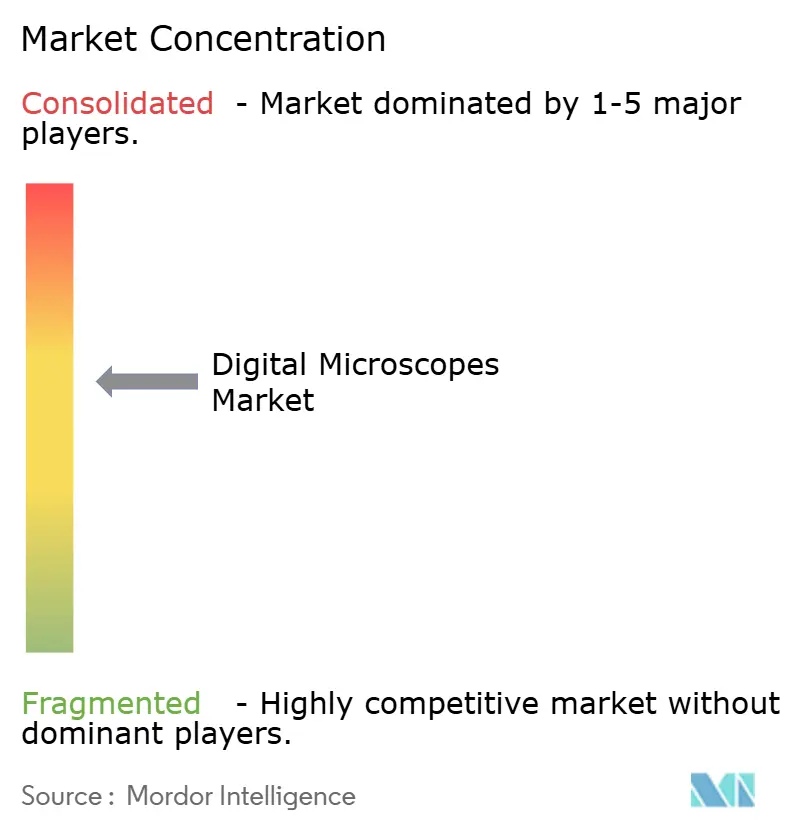
| Market Concentration | Medium |
Major Players *Disclaimer: Major Players sorted in no particular order Image © Mordor Intelligence. Reuse requires attribution under CC BY 4.0. | |
Digital Microscopes Market Analysis by Mordor Intelligence
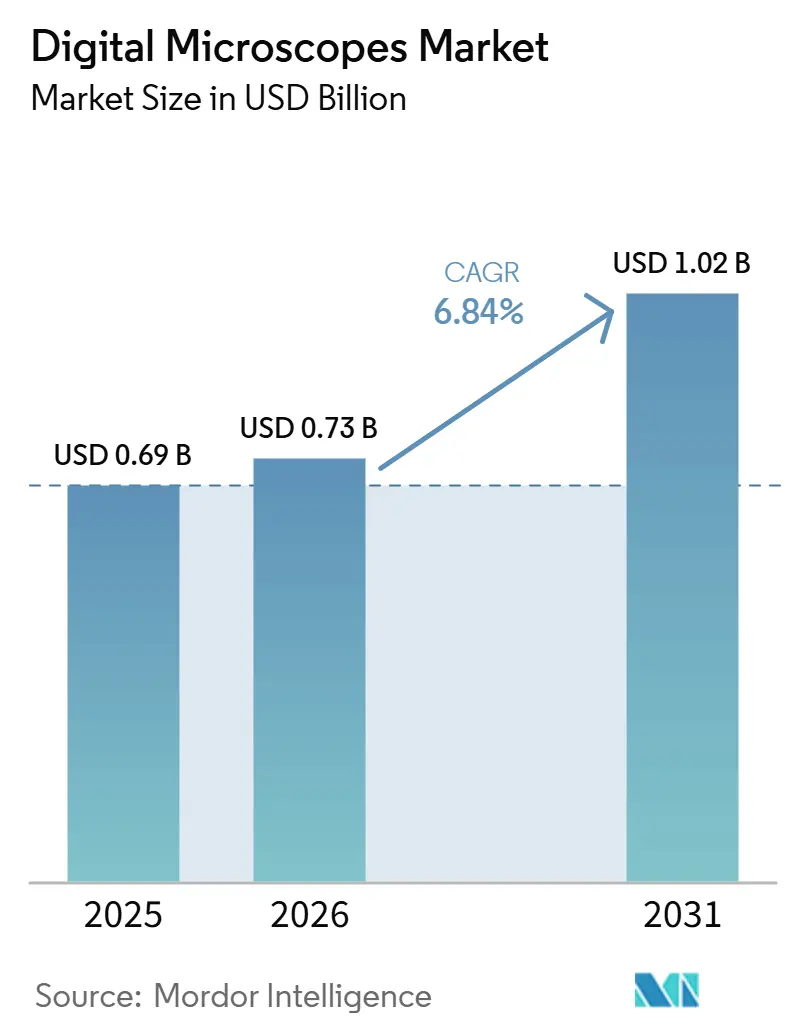
The Digital Microscopes Market size was valued at USD 0.69 billion in 2025 and is estimated to grow from USD 0.73 billion in 2026 to reach USD 1.02 billion by 2031, at a CAGR of 6.84% during the forecast period (2026-2031).
The digital microscopes market is moving from stand-alone optical equipment toward imaging platforms that create analyzable and shareable data for clinical and research workflows. Demand is supported by automated image analysis, digital pathology networks, and drug discovery programs that need more precise cellular imaging. Buyers also place more weight on software compatibility, service support, and data handling when they select equipment. This shift favors suppliers that can connect instruments with laboratory systems and analytical tools. The digital microscopes market also has room for portable systems, software upgrades for installed equipment, and pricing models that reduce initial capital requirements.
Key Report Takeaways
- By product type, Digital Biological Microscopes held 31.46% of the digital microscopes market share in 2025, while Confocal Digital Microscopes are forecast to grow at a 9.51% CAGR through 2031.
- By imaging technology, Brightfield Imaging held 29.68% of the digital microscopes market share in 2025, while Quantitative Phase Imaging is forecast to grow at a 10.32% CAGR through 2031.
- By application, Surgical and Intraoperative Visualization accounted for 29.23% of the digital microscopes market size in 2025, while Cancer Research is forecast to grow at a 9.78% CAGR through 2031.
- By end user, Hospitals and Clinics held 23.36% revenue share in 2025, while Biotechnology Companies are forecast to grow at a 9.56% CAGR through 2031.
- By geography, North America held 41.32% revenue share in 2025, while Asia-Pacific is forecast to grow at a 9.17% CAGR through 2031.
Note: Market size and forecast figures in this report are generated using Mordor Intelligence’s proprietary estimation framework, updated with the latest available data and insights as of January 2026.
Market Trends and Insights
Drivers Impact Analysis of Digital Microscopes Market*
| Driver | (~) % Impact on CAGR Forecast | Geographic Relevance | Impact Timeline |
|---|---|---|---|
| AI-Enabled Image Analysis and Workflow Automation | +1.8% | Global, with the highest concentration in North America and Europe | Short term (≤ 2 years) |
| Semiconductor Miniaturization and Automated Defect Inspection | +1.2% | Asia-Pacific core, especially Taiwan, South Korea, and Japan, with spillover to North America | Medium term (2-4 years) |
| Digital Pathology and Remote Diagnostic Collaboration | +1.4% | North America and Europe, with early gains in Brazil and India | Medium term (2-4 years) |
| Life-Science Research and Drug-Discovery Investment | +1.0% | Global, concentrated in North America, Europe, and Asia-Pacific | Medium term (2-4 years) |
| On-Site Inspection Through Portable and Wireless Systems | +0.7% | Asia-Pacific core, with spillover to the Middle East, Africa, and Latin America | Short term (≤ 2 years) |
| Software-Led Retrofit of Installed Microscope Bases | +0.5% | Global, with early adoption in North America and Europe | Long term (≥ 4 years) |
| Source: Mordor Intelligence | |||
AI-Enabled Image Analysis and Workflow Automation
AI-enabled analysis helps laboratories process more images without increasing manual review requirements. Instrument-level models can support morphological classification, cell segmentation, and anomaly flagging during image acquisition. This reduces variation between operators and makes quality-control procedures more consistent. Nikon introduced the ECLIPSE LV100AMS in May 2026[1]Nikon Corporation, “Nikon Launches New ECLIPSE LV Series Microscopes,” Nikon Industry, industry.nikon.com. as a one-click automated industrial microscope with AI-powered image analysis for inspection workflows. The digital microscopes market benefits when existing optical assets can receive analytical upgrades without complete replacement. Suppliers that offer compatible software layers can serve laboratories that need better throughput but cannot justify a new instrument purchase.
Digital Pathology and Remote Diagnostic Collaboration
Whole-slide imaging and remote review systems allow pathology expertise to be used across a wider network of sites. The shift is relevant for laboratories that need faster consultation on cancer and complex disease cases. Digital pathology adoption also increases demand for tools that connect scanners, image archives, and review applications. In Europe, the IVDR framework makes certification important for routine diagnostic use and separates validated clinical products from research-only systems. The digital microscopes market is therefore affected by the availability of DICOM-compatible systems and open interfaces. Suppliers that make multi-vendor workflows easier to manage are better placed in large hospital procurement processes.
Life-Science Research and Drug-Discovery Investment
Life-science research remains an important source of demand for confocal, fluorescence, and high-content imaging systems. The National Institutes of Health[2]National Institutes of Health, “Fiscal Year 2025 By the Numbers: Extramural Grant Investments in Research,” National Institutes of Health, grants.nih.gov. awarded USD 35.3 billion in extramural biomedical research grants in fiscal year 2025. A 2026 biophotonics review reported that NIH grants connected to biophotonics research totaled USD 3.3 billion in 2024. These funding flows support applications that require optical sectioning, fluorescence detection, and high-resolution image analysis. ZEISS partnered with Concept Life Sciences in 2025[3]ZEISS, “Advanced Workflow Automation and Scalable Image Analysis in Spatial Biology,” ZEISS Newsroom, zeiss.com. to provide workflow automation and scalable image analysis for spatial biology work in pharmaceutical and biotechnology research. The digital microscopes market gains from the growing need to connect imaging results with drug discovery decisions.
Semiconductor Miniaturization and Automated Defect Inspection
Smaller semiconductor features increase the importance of reliable inspection during packaging, materials analysis, and production quality control. Optical digital microscopes can complement electron-beam methods for larger-scale defects and for faster routine inspection. ZEISS designed the Smartzoom 100 digital microscope for quality assurance in electronics manufacturing. Nikon launched the ECLIPSE LV100NDA LED series in March 2025 for semiconductor and materials inspection. The digital microscopes market can benefit when suppliers link defect classification software with imaging hardware. Semiconductor customers increasingly consider workflow cost, inspection consistency, and service capacity alongside instrument specifications.
Restraints Impact Analysis of Digital Microscopes Market*
| Restraint | (~) % Impact on CAGR Forecast | Geographic Relevance | Impact Timeline |
|---|---|---|---|
| High Capital Cost and Total Cost of Ownership | -1.4% | Global, most acute in the Middle East, Africa, and South America | Medium term (2-4 years) |
| Shortage of Imaging and Image-Analysis Skills | -0.8% | Global, with the highest severity in the Middle East, Africa, South America, and emerging Asia-Pacific | Long term (≥ 4 years) |
| Data Interoperability and Cybersecurity Qualification Burden | -0.6% | North America and Europe, with early spillover to Asia-Pacific | Medium term (2-4 years) |
| Short Product Cycles and Component-Availability Risk | -0.5% | Global | Medium term (2-4 years) |
| Source: Mordor Intelligence | |||
High Capital Cost and Total Cost of Ownership
Premium confocal systems and AI-integrated surgical microscopes can cost USD 100,000 to USD 500,000 before maintenance, software licenses, and upgrade contracts. This cost separates well-funded hospitals and pharmaceutical companies from smaller diagnostic laboratories, academic institutions, and contract research organizations. Precision optics and proprietary sensor arrays have not experienced the same cost reductions seen in some other technology categories. The result is intense competition for funded buyers and greater price pressure in cost-sensitive settings. Leasing, subscriptions, and reagent-rental models can reduce this barrier, although their use remains limited outside North America and selected European countries. The digital microscopes market must balance performance gains with procurement models that make advanced equipment more attainable.
Data Interoperability and Cybersecurity Qualification Burden
Digital microscopy produces high-resolution data that may pass into picture archiving systems, laboratory information systems, and cloud-based analytical tools. Hospitals operating under HIPAA or GDPR must verify data residency, access controls, and audit trails before approving a platform. This review can delay procurement of new systems for 6 to 18 months. Products without native HL7 FHIR or DICOM support can be rejected even when their optical performance is strong. The burden is particularly important in Europe under IVDR and in large United States health systems with strict vendor security reviews. Early investment in open standards and cybersecurity validation can create a durable advantage in the digital microscopes market.
*Our forecasts treat driver/restraint impacts as directional, not additive. The impact forecasts reflect baseline growth, mix effects, and variable interactions.
Digital Microscopes Market Segment Analysis
By Product Type:
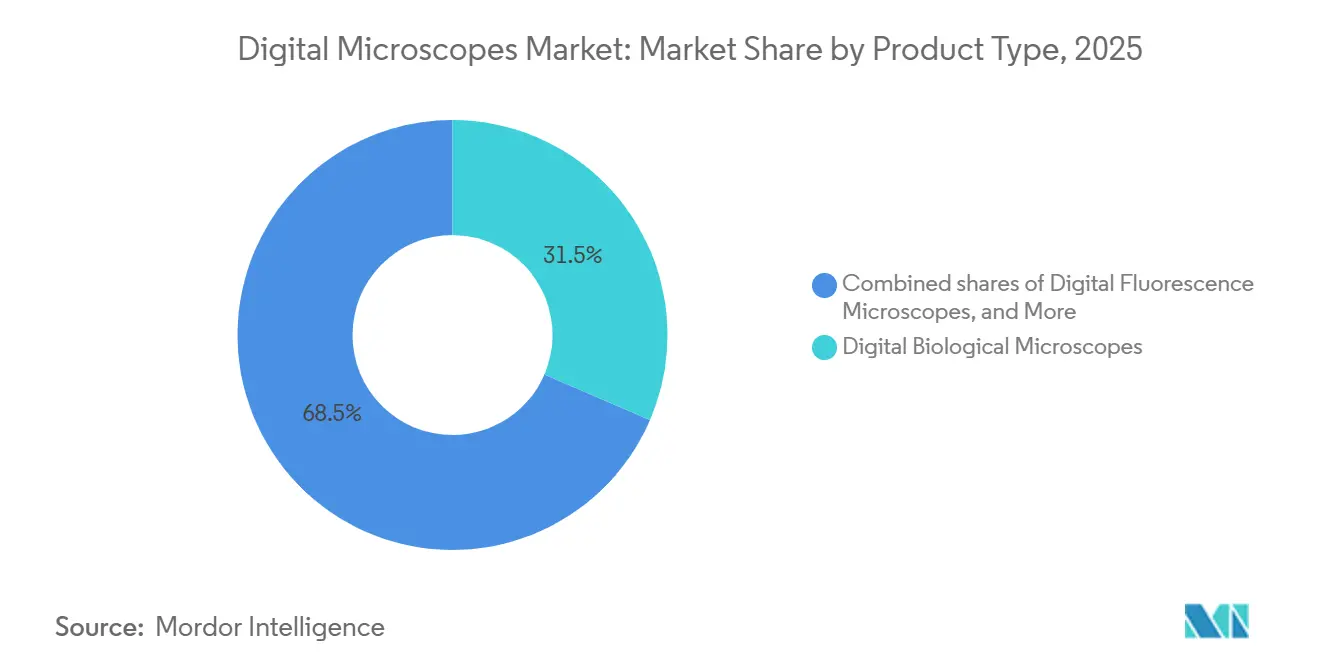
Confocal Platforms Support Research-Grade ImagingDigital Biological Microscopes accounted for 31.46% of product-type revenue in 2025. This largest position reflects their use in clinical diagnostics, pathology review, teaching, and routine life-science work. Their broad utility makes them a common purchase for hospital networks and university departments. Replacement demand is tied to instrument lifespan as well as changes in imaging requirements.
Confocal Digital Microscopes are forecast to expand at a 9.51% CAGR through 2031. They support optical sectioning, 3D fluorescence mapping, and live-cell analysis used in precision oncology and spatial biology. ZEISS introduced Lightfield 4D for its LSM 910 and LSM 990 platforms in March 2025. The system supports up to 80 volume Z-stacks per second and is intended to reduce phototoxicity during live imaging.[4]ZEISS, “ZEISS Lightfield 4D for Instant Volumetric High-Speed Imaging,” ZEISS Newsroom, zeiss.com.



By Imaging Technology:
Quantitative Phase Imaging Builds a Label-Free OptionBrightfield Imaging held 29.68% of revenue in 2025, the largest share within imaging technology. Its position reflects long-established use in pathology, hematology, and education. Existing workflow protocols and staff training make institutions cautious about changing to another modality. A competing technology needs a clear accuracy or throughput benefit before it can displace brightfield procedures.
Quantitative Phase Imaging is forecast to grow at a 10.32% CAGR through 2031. It measures cell mass, morphology, and dynamics without fluorescent labels. This can remove staining steps and support long-duration live-cell experiments. The digital microscopes market size for imaging technology is therefore increasingly influenced by demand for lower-intervention cell analysis.
By Application:
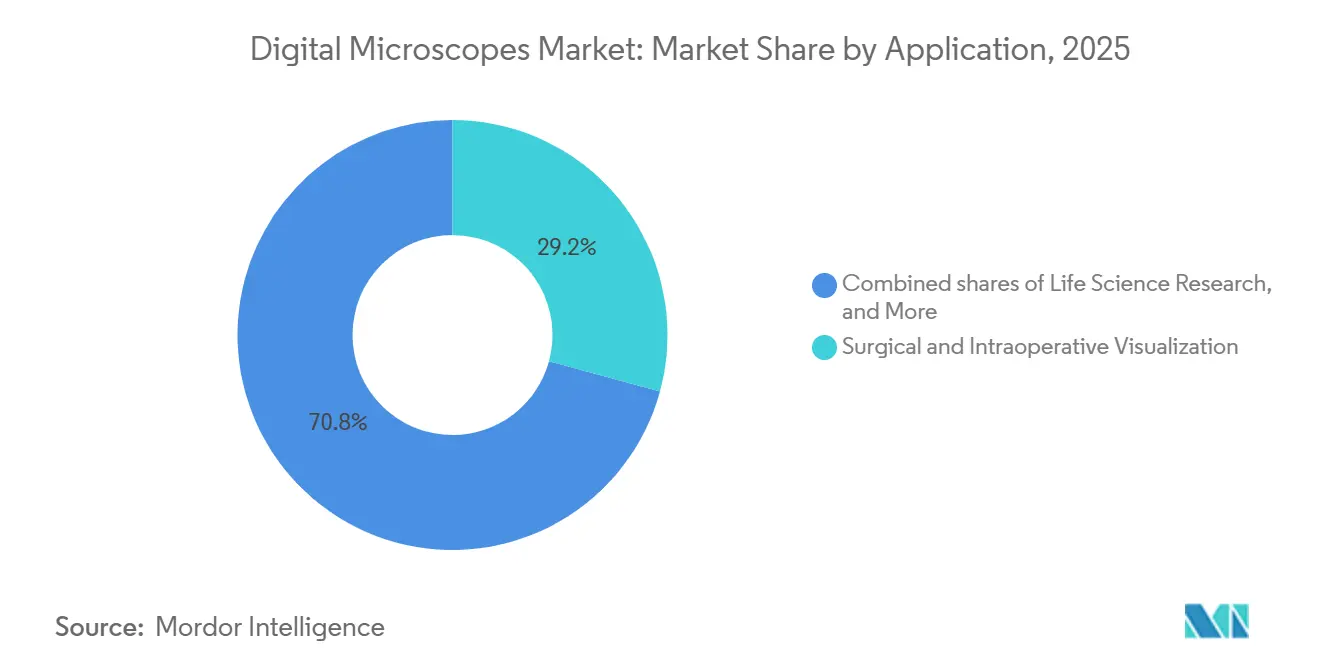
Cancer Research Increases Demand for Advanced ImagingSurgical and Intraoperative Visualization held 29.23% of application revenue in 2025. High average selling prices for operating-room microscopes increase its revenue contribution relative to unit volume. Hospitals also replace equipment as they expand procedure rooms and add specialized surgical services. Established suppliers can reinforce this position through service contracts and software updates.
Cancer Research is forecast to expand at a 9.78% CAGR through 2031. Spatial biology, tumor microenvironment work, and margin assessment all require high-resolution and multi-modal imaging. A 2025 systematic review found a growing role for confocal microscopy in oncologic surgery, including AI-supported tumor discrimination and lower inter-observer variation during margin assessment. This gives the digital microscopes market a direct connection to evolving surgical oncology workflows.
By End User:
Biotechnology Companies Increase High-Content Imaging UseHospitals and Clinics accounted for 23.36% of end-user revenue in 2025. They use digital microscopes across surgical visualization, clinical diagnostics, and pathology workflows. Procurement committees increasingly assess the full ecosystem from slide digitization through AI-assisted review. This places value on interoperability, service coverage, and portfolio breadth. Biotechnology Companies are forecast to grow at a 9.56% CAGR through 2031.
Their demand is linked to high-content imaging, spatial multiomics, and live-cell kinetics. The digital microscopes market size for biotechnology users is supported by pipeline-driven research activity. ZEISS and Concept Life Sciences announced a 2025 partnership focused on automation and scalable image analysis for pharmaceutical and biotechnology contract research workflows.
Geography Analysis
North America Digital Microscopes Market
North America held 41.32% of revenue in 2025, the largest regional position. The region has a dense concentration of academic medical centers, biotechnology clusters, and pharmaceutical research campuses. This creates a substantial demand base for advanced digital microscopy. The National Institutes of Health shared instrumentation program supported access to high-value research equipment in fiscal year 2025.
Europe Digital Microscopes Market
Europe combines a substantial demand base with a major precision-optics manufacturing cluster. Germany hosts primary research, development, and manufacturing operations for Leica Microsystems, ZEISS, and Jenoptik. This can improve product launch timing and collaboration with application-development partners. The EU IVDR framework creates a division between certified platforms for diagnostic use and products limited to research.
APAC Digital Microscopes Market
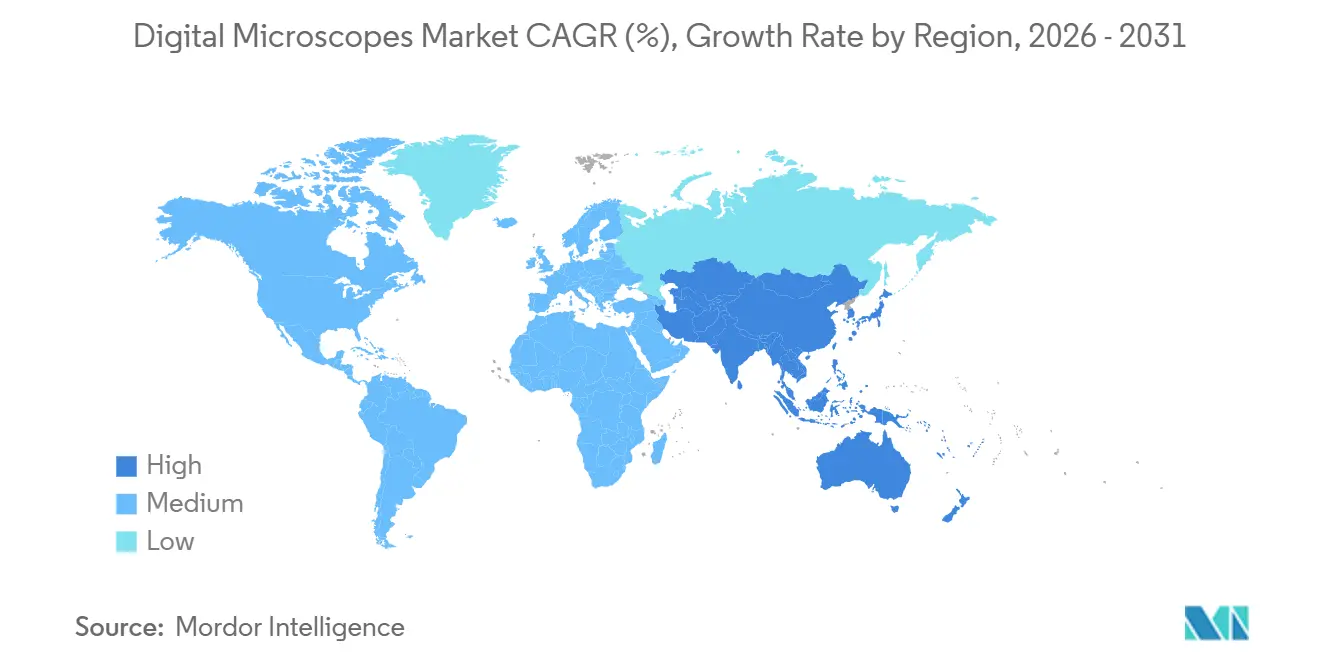
Asia-Pacific is forecast to grow at a 9.17% CAGR through 2031, the fastest regional rate. Its growth draws on healthcare demand and industrial inspection requirements. China, South Korea, and Japan support demand through semiconductor manufacturing and precision medical imaging. Japan also has ongoing demand for sCMOS and cooled cameras in life-science research and semiconductor inspection.

Competitive Landscape
The digital microscopes market is moderately consolidated in the premium tier. Carl Zeiss AG, Leica Microsystems GmbH, Nikon Corporation, and Evident Corporation compete across high-value clinical and research applications. Their differentiation increasingly rests on software ecosystems, AI partnerships, clinical workflow integration, and service support. These features increase switching costs for institutions with multi-year equipment and data-management programs. ZEISS made a minority investment in Arcoris Bio in January 2025. The investment supported the development of MUSE multiplex signal enhancement technology for spatial multiomics. Nikon and Leica have also introduced products across industrial inspection, life science, and clinical visualization. Their broad portfolios allow them to serve several customer groups while limiting the reach of single-category suppliers. Leica Microsystems launched the Viventis SCAPE light sheet microscope in March 2026 for high-speed volumetric imaging using standard sample carriers. Leica expanded the Viventis Deep platform in June 2026 with cleared-sample imaging capability on the same light sheet system.
Digital Microscopes Industry Leaders
Leica Microsystems GmbH
Evident Corporation
Keyence Corporation
Nikon Corporation
Carl Zeiss AG
- *Disclaimer: Major Players sorted in no particular order
Digital Microscopes Market Companies Covered in this Report
- ACCU-SCOPE Inc.
- AmScope
- Bruker
- Carl Zeiss
- Euromex Microscopen B.V.
- Evident Corporation
- Hirox Co., Ltd.
- Hitachi
- Jenoptik AG
- Keyence Corporation
- Labomed Inc.
- Danaher
- Meiji Techno Co., Ltd.
- Motic Instruments Inc.
- Nikon
- Thermo Fisher Scientific
- Vision Engineering Ltd.

Recent Industry Developments in Digital Microscopes Market
- March 2026: Leica Microsystems launched the Viventis SCAPE light sheet microscope, enabling rapid 3D imaging of biological samples using standard sample carriers. The system expands Leica's portfolio of advanced digital microscopy solutions for life-science research applications.
- November 2025: Metavista3D Inc. announced the completion of development of its new 3D digital microscope, designed to integrate with the company's 3D display technologies for healthcare, dental, training, and inspection applications. The system can function as a 3D digital dental microscope with software-based detection capabilities for identifying cavities, tartar, and artificial dental materials, while also supporting medical component inspection and collaborative clinical workflows.


Global Digital Microscopes Market Report Scope
As per the scope of the report, a digital microscope is a type of microscope that uses a digital camera and computer technology to magnify and display images of small objects. The digital microscopes market is segmented by product type into digital biological microscopes, digital fluorescence microscopes, digital surgical microscopes, confocal digital microscopes, inverted digital microscopes, and others; by imaging technology into brightfield imaging, fluorescence imaging, confocal imaging, 3D and extended-depth imaging, quantitative phase imaging, and others, including darkfield, phase contrast, DIC, multispectral, and AI-enabled imaging; by application into clinical diagnostics and pathology, life science research, drug discovery and development, surgical and intraoperative visualization, cancer research, and others, including education and training and academic research; and by end user into hospitals and clinics, diagnostic and pathology laboratories, pharmaceutical companies, biotechnology companies, academic and research institutes, and others, including contract research organizations and contract quality control organizations.
Geographically, the market is segmented into North America, Europe, Asia-Pacific, the Middle East & Africa, and South America. The market report also covers the estimated market sizes and trends for 17 countries across major regions globally. For each segment, the market size and forecast are provided in terms of value (USD).
| Digital Biological Microscopes |
| Digital Fluorescence Microscopes |
| Digital Surgical Microscopes |
| Confocal Digital Microscopes |
| Inverted Digital Microscopes |
| Others |
| Brightfield Imaging |
| Fluorescence Imaging |
| Confocal Imaging |
| 3D & Extended-Depth Imaging |
| Quantitative Phase Imaging |
| Others (Darkfield, Phase Contrast, DIC, Multispectral, AI-enabled Imaging) |
| Clinical Diagnostics & Pathology |
| Life Science Research |
| Drug Discovery & Development |
| Surgical & Intraoperative Visualization |
| Cancer Research |
| Others (Education and Training, Academic Research) |
| Hospitals & Clinics |
| Diagnostic & Pathology Laboratories |
| Pharmaceutical Companies |
| Biotechnology Companies |
| Academic & Research Institutes |
| Others (Contract Research and Contract Quality-Control Organizations) |
| North America | United States |
| Canada | |
| Mexico | |
| Europe | Germany |
| United Kingdom | |
| France | |
| Italy | |
| Spain | |
| Rest of Europe | |
| Asia-Pacific | China |
| India | |
| Japan | |
| Australia | |
| South Korea | |
| Rest of Asia-Pacific | |
| Middle East and Africa | GCC |
| South Africa | |
| Rest of Middle East and Africa | |
| South America | Brazil |
| Argentina | |
| Rest of South America |
| By Product Type | Digital Biological Microscopes | |
| Digital Fluorescence Microscopes | ||
| Digital Surgical Microscopes | ||
| Confocal Digital Microscopes | ||
| Inverted Digital Microscopes | ||
| Others | ||
| By Imaging Technology | Brightfield Imaging | |
| Fluorescence Imaging | ||
| Confocal Imaging | ||
| 3D & Extended-Depth Imaging | ||
| Quantitative Phase Imaging | ||
| Others (Darkfield, Phase Contrast, DIC, Multispectral, AI-enabled Imaging) | ||
| By Application | Clinical Diagnostics & Pathology | |
| Life Science Research | ||
| Drug Discovery & Development | ||
| Surgical & Intraoperative Visualization | ||
| Cancer Research | ||
| Others (Education and Training, Academic Research) | ||
| By End User | Hospitals & Clinics | |
| Diagnostic & Pathology Laboratories | ||
| Pharmaceutical Companies | ||
| Biotechnology Companies | ||
| Academic & Research Institutes | ||
| Others (Contract Research and Contract Quality-Control Organizations) | ||
| By Geography | North America | United States |
| Canada | ||
| Mexico | ||
| Europe | Germany | |
| United Kingdom | ||
| France | ||
| Italy | ||
| Spain | ||
| Rest of Europe | ||
| Asia-Pacific | China | |
| India | ||
| Japan | ||
| Australia | ||
| South Korea | ||
| Rest of Asia-Pacific | ||
| Middle East and Africa | GCC | |
| South Africa | ||
| Rest of Middle East and Africa | ||
| South America | Brazil | |
| Argentina | ||
| Rest of South America | ||


Key Questions Answered in the Report
What is the projected value of digital microscopes in 2031?
The Digital Microscopes Market is projected to reach USD 1.02 billion by 2031, growing at a 6.84% CAGR from 2026.
Which product type leads digital microscope demand?
Digital Biological Microscopes led product-type revenue with a 31.46% share in 2025.
Which imaging technology is growing fastest?
Quantitative Phase Imaging is forecast to grow at a 10.32% CAGR through 2031 because it supports label-free cell analysis.
Why are biotechnology companies increasing microscope purchases?
Biotechnology Companies are projected to grow at a 9.56% CAGR through 2031 as they use high-content imaging, spatial multiomics, and live-cell analysis.
Which region has the largest digital microscopy revenue base?
North America held 41.32% of revenue in 2025, supported by research institutions, biotechnology clusters, and pharmaceutical research sites.
What limits adoption of advanced digital microscopes?
High equipment costs, image-analysis skill shortages, data interoperability requirements, and short product cycles can delay purchasing decisions.
Page last updated on:





