
Digital Asset Insurance Market Size and Share
Market Overview
| Study Period | 2021 - 2032 |
|---|---|
| Market Size (2027) | USD 394.30 Million |
| Market Size (2032) | USD 964.80 Million |
| Growth Rate (2027 - 2032) | 19.60 % |
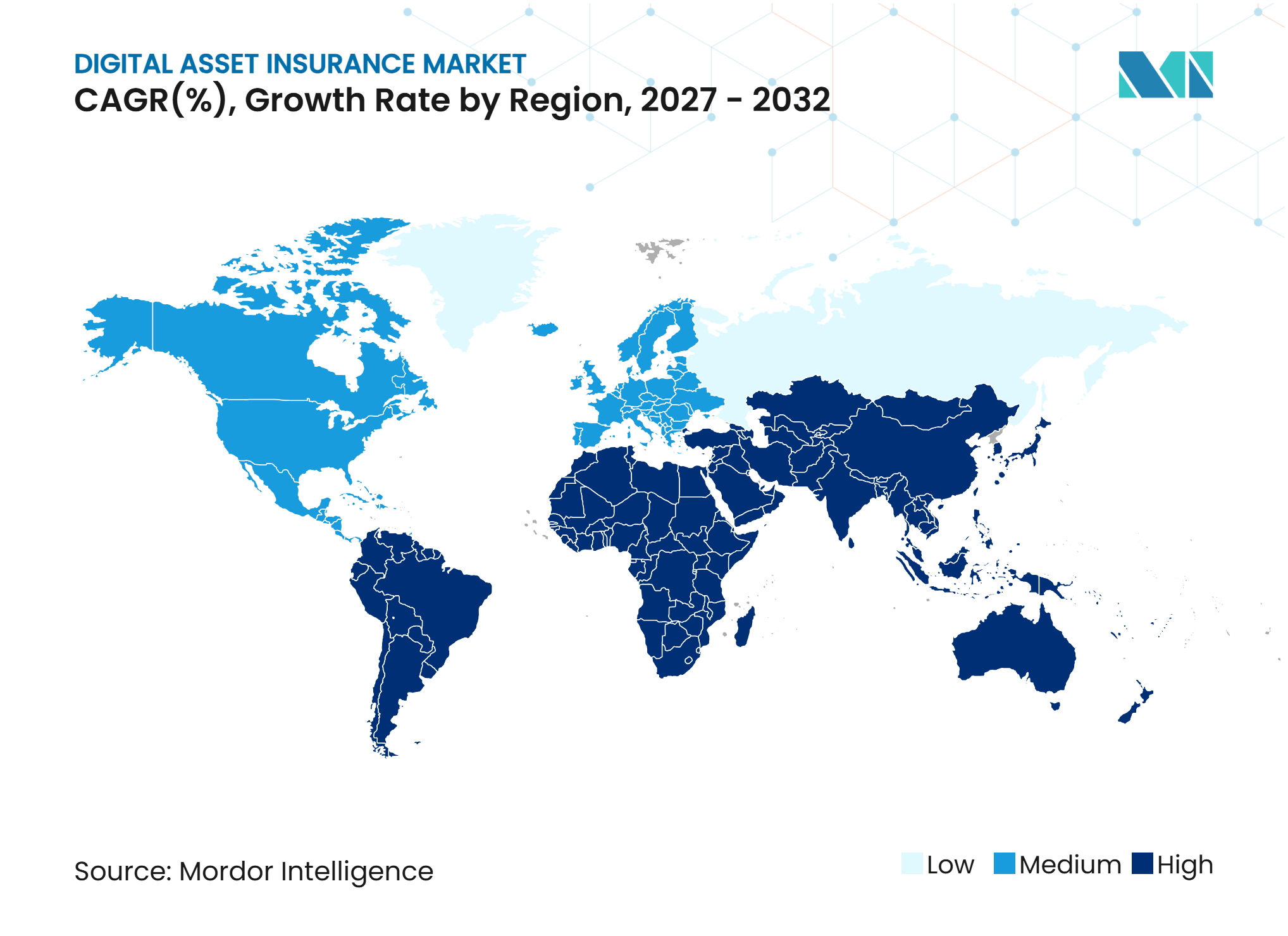
| Fastest Growing Market | Asia-Pacific |
| Largest Market | North America |
| Market Concentration | Low |
Major Players *Disclaimer: Major Players sorted in no particular order Image © Mordor Intelligence. Reuse requires attribution under CC BY 4.0. | |
Digital Asset Insurance Market Analysis by Mordor Intelligence
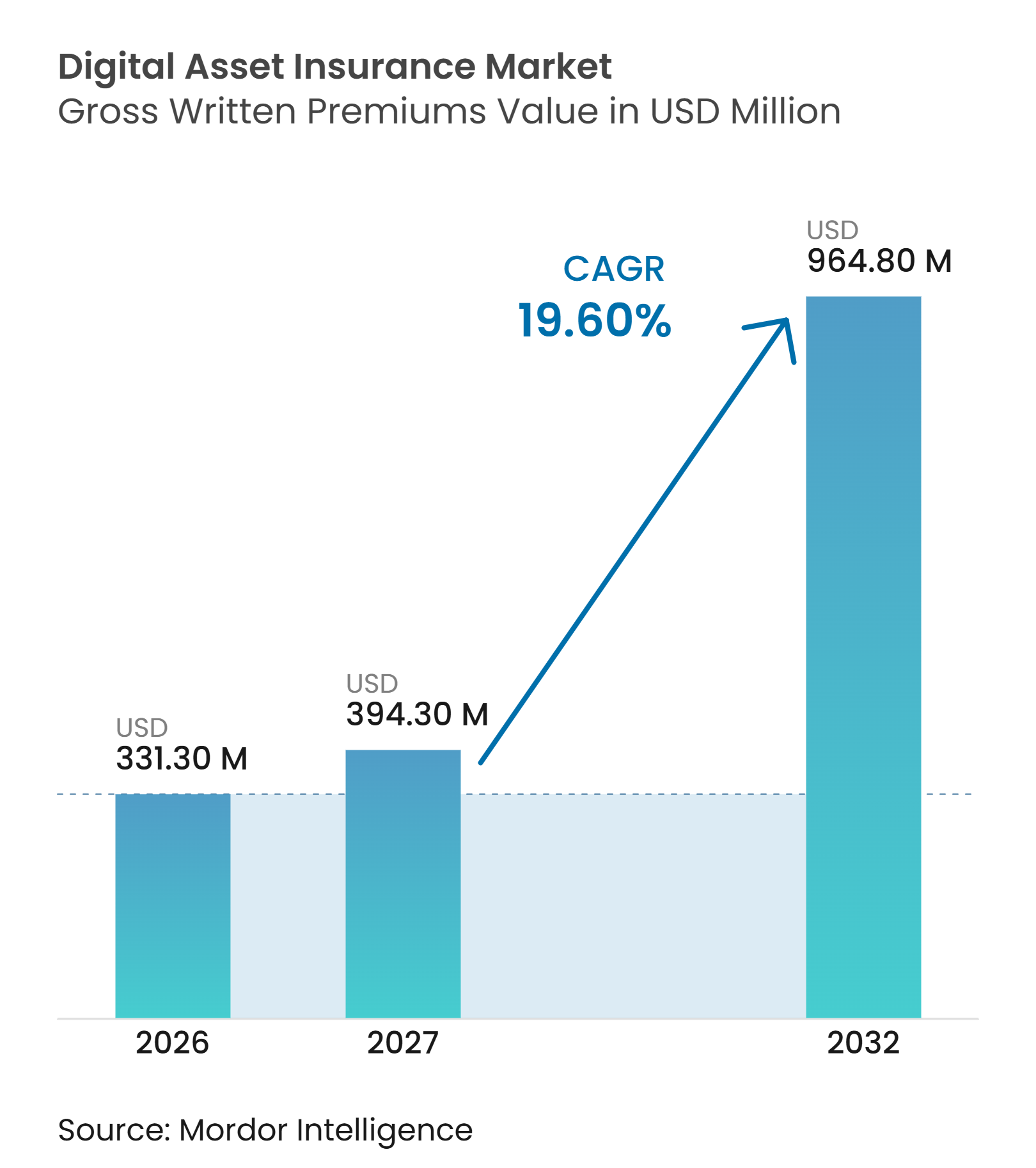
The Digital Asset Insurance Market size in terms of gross written premiums was valued at USD 331.30 million in 2026 and is estimated to grow from USD 394.30 million in 2027 to reach USD 964.80 million by 2032, at a CAGR of 19.60% during the forecast period (2027-2032).
Demand is moving beyond exchange crime protection as institutions, custodians, and financial firms treat coverage as a requirement for selecting counterparties. Regulatory requirements in the European Union, South Korea, Hong Kong, Singapore, and the United Arab Emirates are also turning insurance into a licensing and safeguarding consideration. Digital asset theft, key compromise, and custody failures continue to shape underwriting needs, while tokenized real-world assets and stablecoin operations create exposures that conventional insurance products do not fully address. Traditional licensed insurers still provide most risk-bearing capacity, but embedded distribution and on-chain protection models are gaining traction. The Digital Asset Insurance Market therefore offers insurers and brokers room to develop specialized policy forms, provided they can manage correlated risks across custodians, exchanges, and connected infrastructure.
Key Report Takeaways
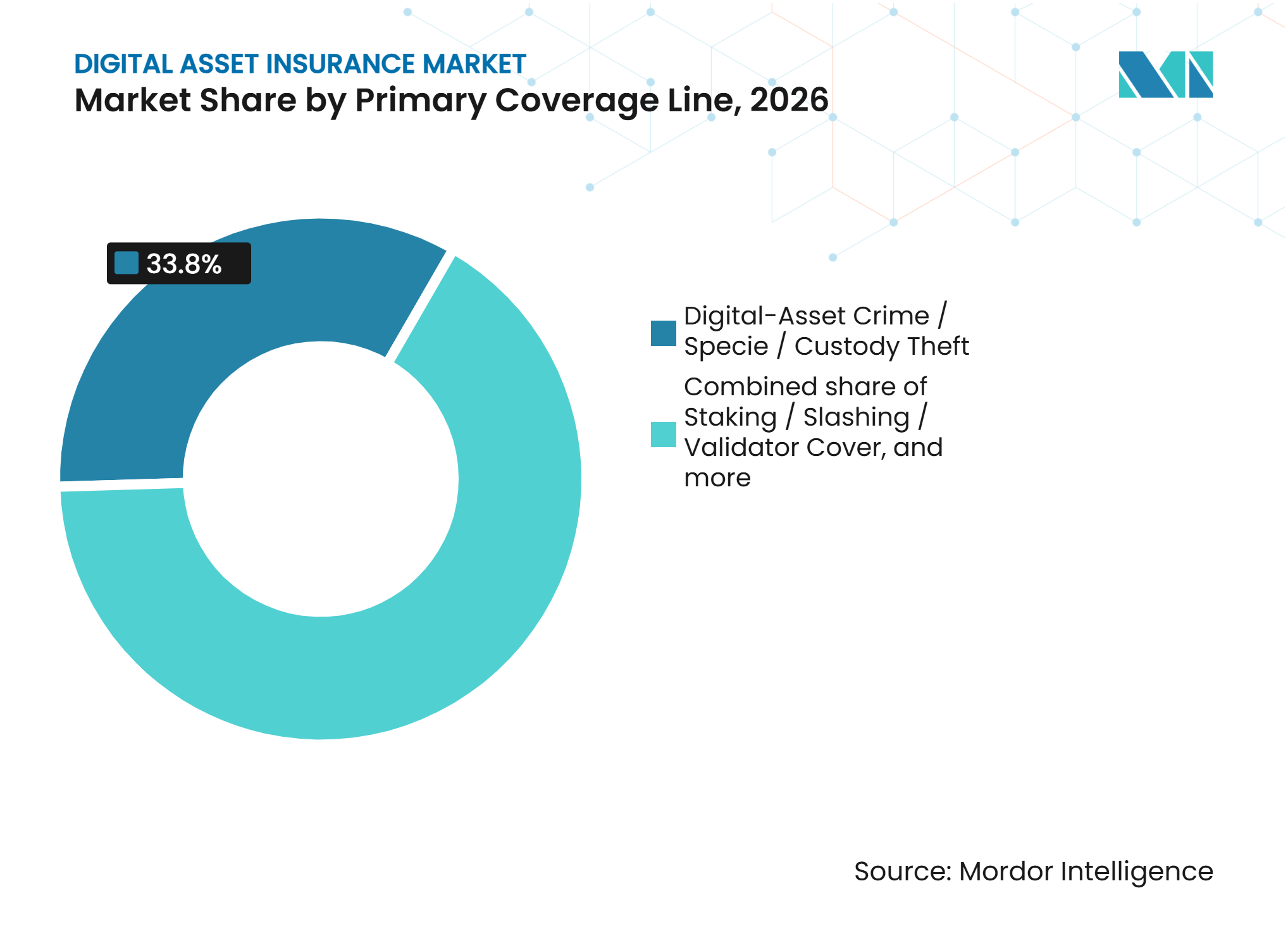
- By primary coverage line, digital-asset crime, specie, and custody theft captured 33.8% of the digital asset insurance market share in 2026, while smart-contract and DeFi protocol coverage is projected to grow at a 28.5% CAGR through 2032.
- By asset exposure, cryptocurrencies captured 58.3% of the digital asset insurance market share in 2026, while tokenized real-world assets and securities are projected to grow at a 29.4% CAGR through 2032.
- By customer or buyer type, exchanges and trading platforms captured 28.6% of the digital asset insurance market share in 2026, while institutional investors, asset managers, and corporate treasuries are projected to grow at a 26.5% CAGR through 2032.
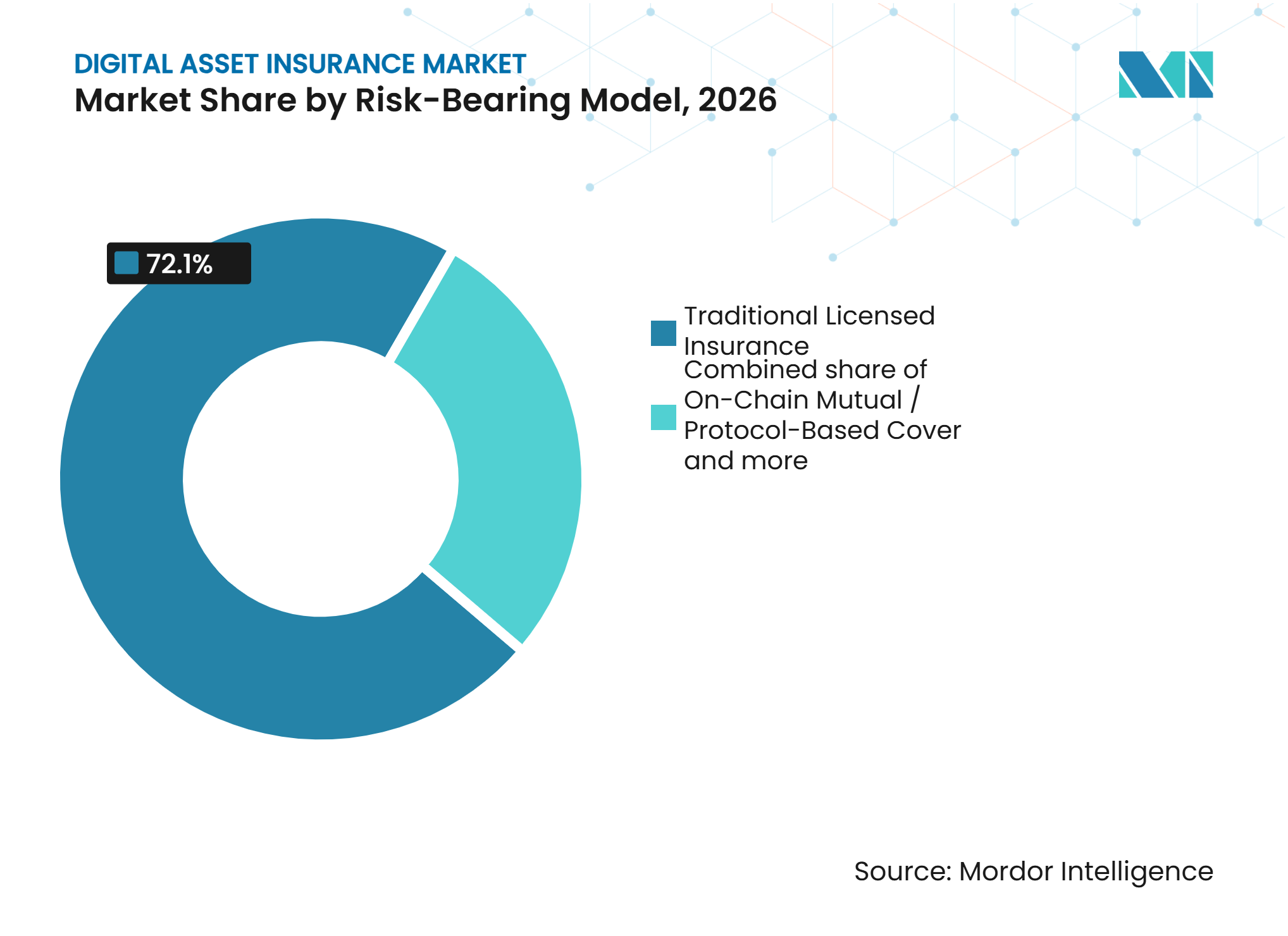
- By risk-bearing model, traditional licensed insurance captured 72.1% of the digital asset insurance market share in 2026, while on-chain mutual and protocol-based cover is projected to grow at a 28.6% CAGR through 2032.
- By distribution channel, specialty brokers and MGAs captured 48.4% of the digital asset insurance market share in 2026, while direct and embedded channels are projected to grow at a 27.5% CAGR through 2032.
- By geography, North America captured 38.7% of the digital asset insurance market share in 2026, while Asia-Pacific is projected to grow at a 25.5% CAGR through 2032.
Note: Market numbers in this report are based on Mordor Intelligence's proprietary estimation framework, which combines nine months of actuals with Q4 projections for base year 2026.
Market Trends and Insights
Drivers Impact Analysis of Digital Asset Insurance Market*
| Driver | (~) % Impact on CAGR Forecast | Geographic Relevance | Impact Timeline |
|---|---|---|---|
| Institutional Adoption Expanding Demand for Specialized Cover | +4.5% | Global, led by North America and Western Europe | Medium term (2-4 years) |
| Stronger Regulatory and Prudential Requirements | +3.8% | European Union, South Korea, Hong Kong, Singapore, and United Arab Emirates | Short term (≤ 2 years) |
| Cyber Theft, Wallet Compromise, and Custody Breaches | +3.5% | Global, with high loss concentration in Asia-Pacific and North America | Short term (≤ 2 years) |
| Tokenized Real-World Assets and Stablecoin Infrastructure | +2.8% | Asia-Pacific, with spillover to Europe and North America | Medium term (2-4 years) |
| Demand for Custody, Crime, Professional Indemnity, and D&O Cover | +2.6% | North America and Europe, with early gains in the United Arab Emirates and Singapore | Medium term (2-4 years) |
| Digital Assets in Financial Services and Investment Portfolios | +2.0% | Global, with early gains in the United States, United Kingdom, and Germany | Long term (≥ 4 years) |
| Source: Mordor Intelligence | |||
Increasing Institutional Adoption of Digital Assets and Demand for Specialized Insurance Coverage
Institutional participation is making insurance a more regular part of counterparty review in the Digital Asset Insurance Market. A survey of 260 institutional investors and wealth managers with USD 14 trillion in assets found that 55% require insurance from digital asset providers. This expectation extends beyond exchanges to asset managers, banks, and corporate treasuries that need protection for their own balance-sheet exposures. The United States Securities and Exchange Commission removed the balance-sheet gross-up requirement for safeguarded crypto through SAB 122 in January 2025, reducing an accounting barrier for bank participation. The wider buyer base supports demand for custody crime, professional liability, and management liability cover. Insurers that can assess operational controls and asset segregation are better placed to serve these institutional buyers.
Strengthening Regulatory and Prudential Requirements for Digital Asset Custodians, Exchanges, and Service Providers
Regulatory requirements are changing coverage from a voluntary purchase into a compliance need in several jurisdictions. Article 67 of the European Union’s Markets in Crypto-Assets Regulation requires crypto-asset service providers to maintain own funds or qualifying insurance for specified professional liability and custody risks. South Korea requires exchanges and custodians to maintain insurance or reserves tied to hot-wallet assets, while Hong Kong requires licensed trading platforms to maintain cold-storage safeguards. Singapore’s Monetary Authority has also established safeguarding standards for licensed digital payment token services. The United Arab Emirates applies risk-management expectations through the Virtual Assets Regulatory Authority, Abu Dhabi Global Market, and Dubai International Financial Centre. These rules give insurers a clearer route to develop policies for licensed providers, especially where policy terms can support regulatory compliance.
Rising Cyber Theft, Wallet Compromise, Custody Breaches, and Digital Asset Crime Exposure
Cyber incidents remain a direct reason for buyers to obtain specialist protection in the Digital Asset Insurance Market. The 2025 Bybit compromise involved USD 1.5 billion, demonstrating the scale of a custody loss that can arise from a single event. Losses increasingly involve compromised keys, signing workflows, social engineering, and vendor systems rather than only smart-contract failures. These loss modes create difficult questions around employee conduct, third-party liability, and the verification of control failures. Policy wording must therefore address the boundary between crime, cyber, technology errors and omissions, and operational risk. The growing gap between current loss patterns and conventional exclusions creates demand for more specific digital asset coverage.
Expansion of Tokenized Real-World Assets and Stablecoin Infrastructure Increasing Insurable Risk Exposure
Tokenized real-world assets are adding new forms of exposure to the Digital Asset Insurance Market. The tokenized real-world asset segment exceeded USD 24 billion by June 2025, following growth from USD 15.2 billion at the end of 2024. BlackRock’s BUIDL fund exceeded USD 2.8 billion across 7 blockchains, showing the role of large financial firms in this development. Coverage for these products must consider oracle failure, smart-contract minting logic, redemption processes, fractional ownership, and off-chain asset title. Stablecoin issuers face further operational and management liability needs as reserve, disclosure, and audit obligations become more formal. These exposures support demand for combined policies that address technology failures and professional responsibilities.
Restraints Impact Analysis of Digital Asset Insurance Market*
| Restraint | (~) % Impact on CAGR Forecast | Geographic Relevance | Impact Timeline |
|---|---|---|---|
| Limited Claims Data and Inconsistent Underwriting Models | -1.8% | Global, most acute in emerging DeFi and tokenized real-world asset segments | Long term (≥ 4 years) |
| Concentration and Accumulation Risk Across Critical Providers | -1.5% | Global, especially North American and Asia-Pacific custodian clusters | Medium term (2-4 years) |
| Cybersecurity Exposure and Difficult Loss Verification | -1.3% | Global, most acute for on-chain and hybrid cover | Medium term (2-4 years) |
| Limited Capacity, High Premiums, and Restrictive Exclusions | -1.2% | Global, most restrictive in hot-wallet and DeFi segments | Short term (≤ 2 years) |
| Source: Mordor Intelligence | |||
Limited Historical Claims Data, Inconsistent Risk Classification, and Lack of Standardized Underwriting Models
Limited claims history constrains capacity because insurers cannot rely on mature actuarial records for many digital asset loss categories. Private-key compromise, oracle manipulation, governance takeover, and failures in signing processes do not align neatly with conventional insurance classifications. Underwriters must often create tailored assessments for each prospective insured, which increases placement time and pricing uncertainty. The Federal Insurance Office has recognized the need to work with the National Association of Insurance Commissioners and state regulators on standardized policy terms. More consistent reporting could improve comparability across policies and claims over time. Until those records develop, exclusions and higher premiums are likely to remain common in complex DeFi and tokenized asset placements.
Concentration and Accumulation Risk Across Digital Asset Custodians, Exchanges, and Critical Infrastructure Providers
Digital asset activity is concentrated among a limited number of custodians, exchanges, and infrastructure providers. A disruption at one provider can affect many insured firms that rely on related custody, settlement, bridge, or protocol services. Independent security audits alone do not remove this concern because audited platforms can still experience losses through operational weaknesses or connected systems. Reinsurers may respond with strict event and aggregate limits, which restrict the insurance capacity available to large customers. This issue is especially relevant in North American and Asia-Pacific custody clusters where high asset values may be held through shared infrastructure. More granular exposure monitoring and diversified risk transfer will be needed to expand capacity without increasing systemic vulnerability.
*Our forecasts treat driver/restraint impacts as directional, not additive. The impact forecasts reflect baseline growth, mix effects, and variable interactions.
Digital Asset Insurance Market Segment Analysis
By Primary Coverage Line:
Crime and Custody Programs Anchor the Market While DeFi Cover AcceleratesDigital-asset crime, specie, and custody theft held 33.8% of the digital asset insurance market share in 2026. This position reflects the early development of cold-storage crime programs, which adapted familiar approaches from bullion and high-value property coverage. These programs address theft and custody failures that remain central to institutional concerns. Cyber and technology E&O and professional liability policies cover system failures, negligent technical services, and failures to meet regulatory obligations. Article 67 of MiCA strengthens the relevance of this cover because it includes professional liability and safeguarding responsibilities.
D&O and management liability is becoming more relevant as larger crypto businesses face shareholder, governance, and regulatory disputes. The digital asset insurance market size for smart-contract and DeFi protocol cover is projected to expand at a 28.5% CAGR through 2032. This line addresses protocol risks that conventional policies may exclude or limit. Nexus Mutual launched entry, essential, and Elite plans in February 2025 with coverage for 10, 40, and more than 70 protocols, respectively, and a maximum individual limit of USD 6 million[1]. Staking, slashing, validator, and residual lines remain relevant for proof-of-stake networks and service providers that operate validator infrastructure.


By Asset Exposure:
Cryptocurrencies Lead While Tokenized Real-World Assets Expand Coverage NeedsCryptocurrencies held 58.3% of the digital asset insurance market share in 2026. Bitcoin and Ethereum custody were among the first institutional digital asset exposures to receive specialist protection. Crypto.com’s United States custody trust had USD 120 million in crime and specie insurance arranged through Aon and Lloyd’s in June 2025[2]. The program included USD 100 million for cold-storage assets and USD 20 million for warm or hot-wallet crime and third-party theft. Stablecoins form another important exposure because reserve management, operational controls, and issuer obligations can create professional indemnity and management liability claims.
Tokenized real-world assets and securities are the fastest-growing asset exposure at a 29.4% CAGR through 2032. The segment includes tokenized funds, securities, and other financial instruments that link on-chain records with off-chain rights and processes. BlackRock’s tokenization activity illustrates how established asset managers are expanding in this area. Insurance policies for tokenized assets need to address oracle integrity, contract execution, redemption processes, custody, and asset-title risks together. NFTs, digital collectibles, and multi-asset operator exposures complete the asset framework, with the latter relevant where custodians and exchanges hold diversified client portfolios.
By Customer or Buyer Type:
Exchanges Lead Current Demand While Institutions Add Future Capacity NeedsExchanges and trading platforms held a 28.6% share in 2026, making them the most established buyer group. They were early purchasers of digital asset crime cover after a series of visible exchange hacks and custody incidents. Custodians and wallet providers form another major buyer group because licensing frameworks in the European Union, South Korea, and Hong Kong link safeguarding arrangements with insurance or reserve expectations. These firms need policies that respond to asset theft, internal controls, key management, and customer losses. DeFi protocols and Web3 operating businesses are also entering the buyer base as their balance sheets and user obligations become more material.
Institutional investors, asset managers, and corporate treasuries are projected to grow at a 26.5% CAGR through 2032. Their requirements are often broader than a single custody policy because they may hold exposures across investment, treasury, management, and third-party service arrangements. Native arranged USD 25 million in blockchain-based cover for Bittensor validators through Nexus Mutual’s syndicate infrastructure in February 2025. Miners, staking providers, validators, individual investors, and high-net-worth holders remain smaller but active customer groups, with needs ranging from equipment cover to slashing and self-custody protection. Retail products remain limited, but Lloyd’s-backed self-custody offerings indicate an emerging route for buyers below institutional thresholds.
By Risk-Bearing Model:
Traditional Insurers Lead While On-Chain Mutuals Build an AlternativeTraditional licensed insurance held a 72.1% share of risk-bearing capacity in 2026. Lloyd’s of London syndicates and admitted carriers support most large commercial placements because they offer established legal frameworks, policy enforcement, and subrogation rights. AnchorWatch and Canopius operate through Lloyd’s structures, while Evertas writes policies with limits up to USD 360 million backed by Arch and Lloyd’s syndicates. Mosaic entered the segment in July 2025 through Lloyd’s Syndicate 1609, offering up to USD 10 million in cyber and technology capacity per risk[3]. These structures remain important for customers that require recognized insurance capacity and clear legal recourse.
On-chain mutual and protocol-based cover is projected to grow at a 28.6% CAGR through 2032. Hybrid models combine traditional policy structures with digital asset premium or claim settlement, or combine insurers with on-chain capital pools. Soter Insure placed a Bitcoin-denominated crime policy for Deus X Capital in July 2025 alongside USD-denominated D&O and professional indemnity limits. Nexus Mutual integrated with Symbiotic in November 2025 to introduce underwriting vaults intended to support capital reallocation and faster claim settlement. The developing model gives protocol-native buyers another route to arrange cover, although traditional insurers continue to provide the majority of capacity.

By Distribution Channel:
Specialist Brokers Lead Placements While Embedded Channels Gain GroundSpecialty brokers and MGAs held 48.4% channel share in 2026. Their role reflects the complex underwriting information required for custody architecture, multi-party controls, private-key management, and smart-contract security. Brokers can help insurers assess these technical controls and present risks to appropriate capacity providers. Howden launched an integrated crypto theft insurance and legal recovery solution with Lawrence Stephens in July 2025. The product combined crime insurance, forensic tracing, asset-freezing proceedings, and partial reimbursement of legal recovery costs.
Direct and embedded channels are projected to grow at a 27.5% CAGR through 2032. Custodians and exchanges can incorporate insurance within service agreements, making protection easier to access when clients open or maintain accounts. AnchorWatch has offered optional Lloyd’s-backed coverage within custody tiers beginning at USD 250,000. On-chain platforms, including Nexus Mutual and OpenCover, offer another distribution route for DeFi-native users. Embedded models may improve access, but they also require clear disclosure of what is insured, the applicable limits, and exclusions. The digital asset insurance market will continue to rely on specialist intermediaries where risk placement needs detailed underwriting support.
Geography Analysis
North America: Institutional Custody Concentration Supports Regional Leadership
North America held 38.7% of the digital asset insurance market share in 2026. The region combines a large concentration of institutional custodians, digital asset exchange-traded fund structures, and specialty underwriting capacity. The United States market recorded gross revenue of USD 3.11 billion in 2025, up from USD 1.94 billion in 2024, and the Federal Insurance Office identified 20 commercial insurers offering digital asset coverage with limits up to USD 1 billion. SAB 122 reduced a balance-sheet disincentive for United States banks safeguarding crypto assets in January 2025. The federal stablecoin framework and market-structure initiatives also increase the need for professional indemnity and D&O policies among issuers and exchanges.
AnchorWatch Trust Company launched as a Nevada-chartered Bitcoin custodian in October 2026 with optional Lloyd’s-backed insurance of up to USD 370 million per client. This move reflects the region’s split between high-limit institutional programs and products aimed at self-custody users. Insurers must manage accumulation around major custodians because the same providers can create large connected exposures. Regulatory influence from the Securities and Exchange Commission and state financial authorities will continue to shape the requirements that buyers bring to insurance placements. The regional opportunity rests on the ability to pair recognized insurance capacity with detailed operational risk review.
Asia-Pacific: Regulatory Activation Drives the Fastest Regional Expansion
Asia-Pacific is projected to grow at a 25.5% CAGR through 2032, the fastest rate among the regional segments. South Korea’s Virtual Asset User Protection Act requires virtual asset service providers to maintain insurance or reserves equal to at least 5% of hot-wallet assets. Korea Digital Asset partnered with Samsung Fire & Marine in July 2025 on a custodian-specific policy with up to USD 20 million in coverage. Hong Kong’s Securities and Futures Commission requires licensed virtual asset trading platforms to maintain cold-storage protection and client-asset segregation controls. Canopius appointed Qubit Underwriting Limited as its first Lloyd’s Coverholder for digital asset insurance in the Asia-Pacific region in February 2025.
Singapore’s Monetary Authority applies safeguarding standards to digital payment token services, reinforcing demand for professional indemnity and custody coverage. The Digital Asset Insurance Market size in Asia-Pacific is supported by several large trading jurisdictions introducing requirements at the same time. India represents a longer-term opportunity because of its large and expanding base of crypto owners, even though the current insurance market remains less developed. Insurers entering the region need policy language that responds to local licensing expectations and client-asset controls. The region also needs more local underwriting expertise because global capacity may be cautious about concentrated exchange and custody risks. These developments favor providers that can work with regulated institutions across South Korea, Hong Kong, Singapore, and other Asia-Pacific markets.
Europe, Latin America, and the Middle East and Africa: Compliance Frameworks Build Smaller Regional Markets
Europe’s framework is shaped by MiCA, which applies across the European Union’s 27 member states for licensed crypto-asset service providers. France requires registered providers to maintain professional indemnity coverage with minimum guarantees of EUR 400,000 (USD 433,000) per claim and EUR 800,000 (USD 866,000) per insurance year. Germany’s BaFin and other national authorities are implementing the MiCA framework for local service providers. The United Kingdom’s Financial Services and Markets Act crypto-asset regime, administered by the Financial Conduct Authority, maintains parallel prudential and conduct expectations for United Kingdom-based firms. London remains important for Lloyd’s market access and specialist insurance placement.
Latin American demand is emerging as fintech regulation develops and businesses seek more formal risk protection. Brazil’s evolving financial technology environment and Argentina’s high digital asset adoption are building a prospective policyholder base, although capacity remains smaller than in North America, Europe, or Asia-Pacific. In the Middle East and Africa, the United Arab Emirates is a focal point because the Virtual Assets Regulatory Authority, Abu Dhabi Global Market, and Dubai International Financial Centre set licensing and risk-management expectations. Soter Insure and Deus X Capital announced an Abu Dhabi-based partnership in July 2025, demonstrating local structuring of institutional cover in the Gulf Cooperation Council. These mixed regional markets offer growth where insurers can align policy terms with local compliance requirements and cross-border risk transfer needs.
Competitive Landscape
Market Concentration
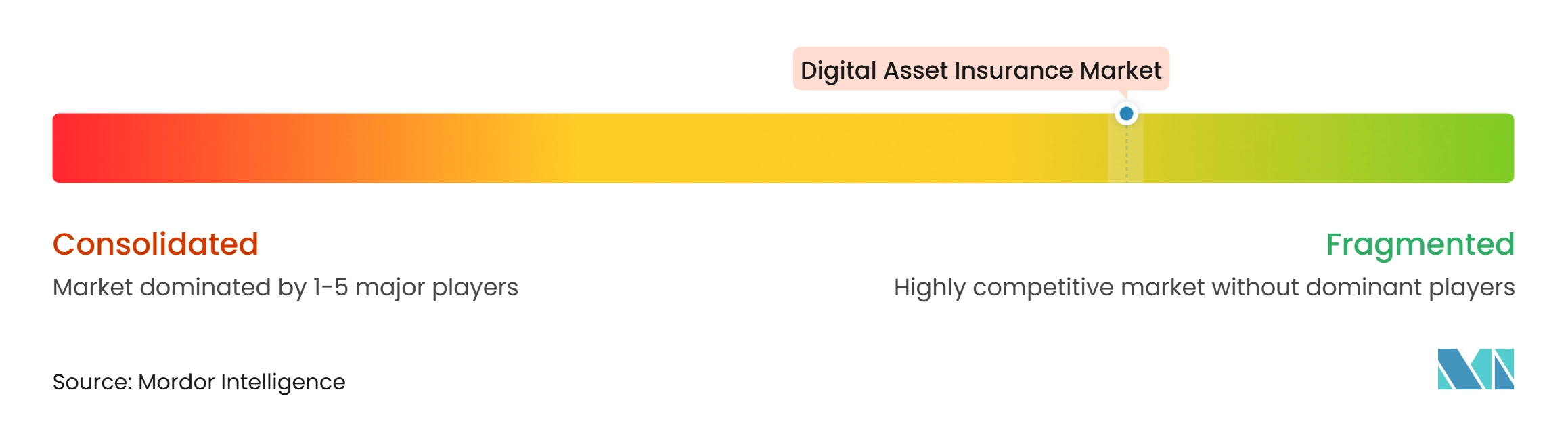
The Digital Asset Insurance Market includes established brokers, Lloyd’s syndicates, specialty MGAs, admitted carriers, and on-chain risk platforms. Aon, Marsh, WTW, Lockton, and Howden remain important intermediaries because they have established relationships with institutional buyers and Lloyd’s capacity providers. Evertas has a high single-policy limit of USD 360 million per risk and focuses on custody, crime, D&O, and digital property exposures. Canopius, Mosaic, and Relm have expanded their presence since 2025 as the market has required more tailored underwriting. Mosaic launched a combined cyber and financial institutions crime product through Lloyd’s Syndicate 1609 in July 2025, covering exchanges, custodians, tokenized real-world asset platforms, exchange-traded fund structures, and blockchain analytics firms.
Competition is also shifting toward models that make cover easier to place through platforms or protocol-native structures. Native arranged USD 25 million in Bittensor validator hack cover in 4 weeks during February 2025, demonstrating a shorter placement route for a novel protocol exposure. Nexus Mutual’s integration with Symbiotic created underwriting vaults designed to reallocate capital and settle claims more quickly. Howden’s combined theft insurance and recovery service provides a separate example of firms extending beyond policy placement into legal and forensic support.
Lloyd’s market requirements and insurer financial-strength ratings remain important for high-limit programs. ISO and IEC information security standards, including ISO/IEC 27001 and ISO/IEC 27002, are increasingly relevant to policy conditions that assess cryptographic key management and information security controls. Opportunities remain in retail self-custody cover, cross-border programs that address MiCA-equivalent rules, and more standardized protection for smart-contract failure. The market has not yet established broad product fit for all of these needs, especially when exposures involve systemic protocol risk. Traditional insurers retain an advantage where buyers require regulated capacity and established claims processes.
Digital Asset Insurance Industry Leaders
-
Marsh McLennan
-
Aon
-
WTW
-
Evertas
-
Munich Re
- *Disclaimer: Major Players sorted in no particular order
Digital Asset Insurance Market Companies Covered in this Report
- Aon
- Marsh
- WTW
- Evertas
- Munich Re
- Relm Insurance
- Native
- Lockton
- Price Forbes
- Mosaic Insurance
- Canopius
- OneDegree Insurance
- Qubit Underwriting Limited
- AnchorWatch
- Soter Insure
- Vouch Insurance
- Chainproof
- Dubai Insurance Company P.S.C.
Recent Industry Developments in Digital Asset Insurance Market
- October 2026: AnchorWatch Trust Company launched Nevada-chartered Bitcoin custody with up to USD 370 million in insurance per client. Authorized by the Nevada Financial Institutions Division, it offers optional Lloyd’s-backed insurance, subject to underwriting approval. The service provides regulated custody for individual and institutional Bitcoin holders.
- July 2025: Howden and Lawrence Stephens launched an integrated crypto theft insurance and legal recovery solution. The offering combines crime coverage, forensic asset tracing, legal asset-freezing capabilities, and partial reimbursement of legal recovery costs. It supports digital asset recovery after theft.
- July 2025: Mosaic Insurance entered the Digital Asset Insurance Market through Lloyd’s Syndicate 1609. Its modular product offers up to USD 10 million in cyber and technology E&O capacity and up to USD 5 million in crime capacity for digital asset firms. Its partnership with Native supports distribution across varied digital asset business models.
- July 2025: Soter Insure and Deus X Capital placed a hybrid USD- and Bitcoin-denominated risk-transfer product. The policy combines USD-denominated D&O and professional indemnity limits with Bitcoin-denominated crime coverage and allows BTC premium payments. It reduces currency mismatch risks for digital asset holders and highlights institutional risk-transfer arrangements in Abu Dhabi.
Global Digital Asset Insurance Market Report Scope
Segmentation Overview
| Digital-Asset Crime / Specie / Custody Theft |
| Cyber and Technology E&O / Professional Liability |
| Directors’ & Officers’ (D&O) and Management Liability |
| Smart-Contract / DeFi Protocol Cover (Including Parametric) |
| Staking / Slashing / Validator Cover |
| Other / Residual |
| Cryptocurrencies |
| Stablecoins |
| Tokenized Real-World Assets and Securities |
| NFTs and Digital Collectibles |
| Multi-Asset or Operator-Level |
| Exchanges and Trading Platforms |
| Custodians and Wallet Providers |
| DeFi Protocols and Web3 Operating Businesses |
| Miners, Staking Providers and Validators |
| Institutional Investors, Asset Managers and Corporate Treasuries (Including Banks) |
| Individual and High-Net-Worth Investors |
| Others |
| Traditional Licensed Insurance |
| On-Chain Mutual / Protocol-Based Cover |
| Hybrid / Other |
| Specialty Brokers and MGAs |
| Direct / Embedded (Platform- or Custodian-Placed) |
| On-Chain Platforms |
| Others |
| North America | United States |
| Canada | |
| Mexico | |
| South America | Brazil |
| Argentina | |
| Rest of South America | |
| Europe | United Kingdom |
| Germany | |
| France | |
| Italy | |
| Spain | |
| Rest of Europe | |
| Asia-Pacific | China |
| Japan | |
| India | |
| South Korea | |
| Australia | |
| Indonesia | |
| Thailand | |
| Malaysia | |
| Singapore | |
| Vietnam | |
| Rest of Asia-Pacific | |
| Middle East and Africa | Saudi Arabia |
| United Arab Emirates | |
| Turkey | |
| South Africa | |
| Egypt | |
| Rest of Middle East and Africa |
| By Primary Coverage Line | Digital-Asset Crime / Specie / Custody Theft | |
| Cyber and Technology E&O / Professional Liability | ||
| Directors’ & Officers’ (D&O) and Management Liability | ||
| Smart-Contract / DeFi Protocol Cover (Including Parametric) | ||
| Staking / Slashing / Validator Cover | ||
| Other / Residual | ||
| By Asset Exposure | Cryptocurrencies | |
| Stablecoins | ||
| Tokenized Real-World Assets and Securities | ||
| NFTs and Digital Collectibles | ||
| Multi-Asset or Operator-Level | ||
| By Customer / Buyer Type | Exchanges and Trading Platforms | |
| Custodians and Wallet Providers | ||
| DeFi Protocols and Web3 Operating Businesses | ||
| Miners, Staking Providers and Validators | ||
| Institutional Investors, Asset Managers and Corporate Treasuries (Including Banks) | ||
| Individual and High-Net-Worth Investors | ||
| Others | ||
| By Risk-Bearing Model | Traditional Licensed Insurance | |
| On-Chain Mutual / Protocol-Based Cover | ||
| Hybrid / Other | ||
| By Distribution Channel | Specialty Brokers and MGAs | |
| Direct / Embedded (Platform- or Custodian-Placed) | ||
| On-Chain Platforms | ||
| Others | ||
| By Geography | North America | United States |
| Canada | ||
| Mexico | ||
| South America | Brazil | |
| Argentina | ||
| Rest of South America | ||
| Europe | United Kingdom | |
| Germany | ||
| France | ||
| Italy | ||
| Spain | ||
| Rest of Europe | ||
| Asia-Pacific | China | |
| Japan | ||
| India | ||
| South Korea | ||
| Australia | ||
| Indonesia | ||
| Thailand | ||
| Malaysia | ||
| Singapore | ||
| Vietnam | ||
| Rest of Asia-Pacific | ||
| Middle East and Africa | Saudi Arabia | |
| United Arab Emirates | ||
| Turkey | ||
| South Africa | ||
| Egypt | ||
| Rest of Middle East and Africa | ||
Key Questions Answered in the Report
What is the projected size of the Digital Asset Insurance Market by 2032?
The Digital Asset Insurance Market is projected to reach USD 964.8 million by 2032, expanding at a 19.6% CAGR from 2027 to 2032, with institutional custody and regulatory demand supporting the forecast.
What is driving demand for digital asset insurance?
Institutional due diligence, custody risk, cyber theft, and regulatory insurance requirements are expanding demand. Tokenized assets and stablecoin operations also create technology, management liability, and operational exposures that need specialist cover.
Which digital asset insurance coverage line is growing fastest?
Smart-Contract and DeFi Protocol Cover is projected to grow at a 28.5% CAGR through 2032. Its development reflects demand for coverage that responds to protocol risks not fully addressed by traditional crime or custody policies.
Which asset exposure is expanding fastest for insurers?
Tokenized Real-World Assets and Securities is projected to expand at a 29.4% CAGR through 2032. Policies in this area may need to combine protection for smart-contract, oracle, custody, asset-title, and professional liability risks.
Which region is expected to grow fastest for digital asset insurance?
Asia-Pacific is projected to grow at a 25.5% CAGR through 2032, supported by regulatory developments in South Korea, Hong Kong, and Singapore.
What insurance model currently provides most digital asset risk capacity?
Traditional Licensed Insurance held 72.1% of risk-bearing capacity in 2026, supported largely by Lloyd’s syndicates and admitted insurers.