
Dental Hand Tools Market Size and Share
Market Overview
| Study Period | 2020 - 2031 |
|---|---|
| Market Size (2026) | USD 1.92 Billion |
| Market Size (2031) | USD 2.53 Billion |
| Growth Rate (2026 - 2031) | 5.64 % |
| Fastest Growing Market | Asia-Pacific |
| Largest Market | North America |
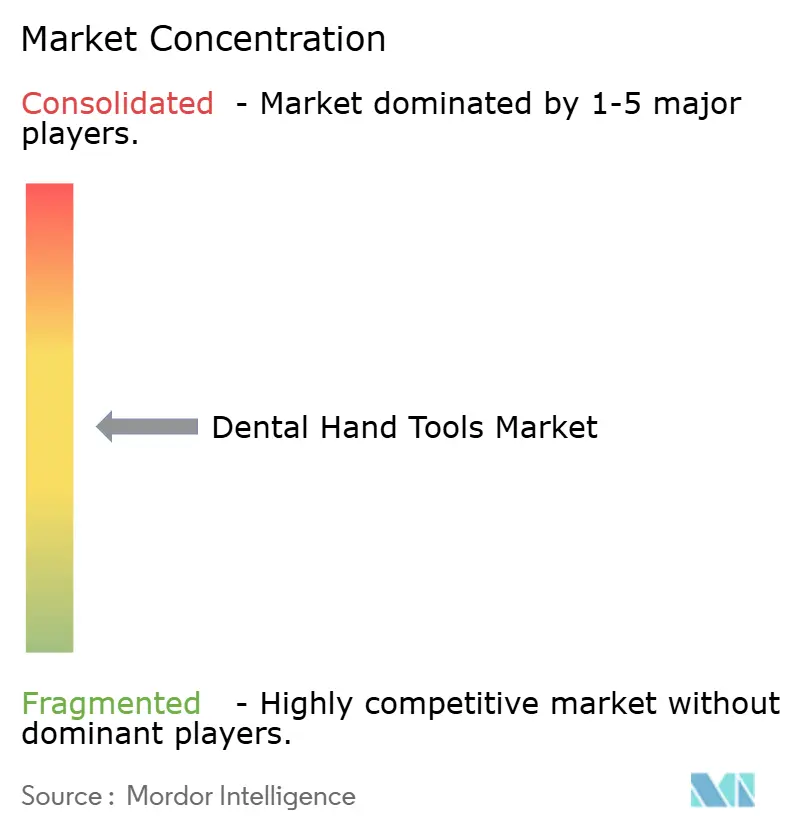
| Market Concentration | Medium |
Major Players *Disclaimer: Major Players sorted in no particular order Image © Mordor Intelligence. Reuse requires attribution under CC BY 4.0. | |
Dental Hand Tools Market Analysis by Mordor Intelligence
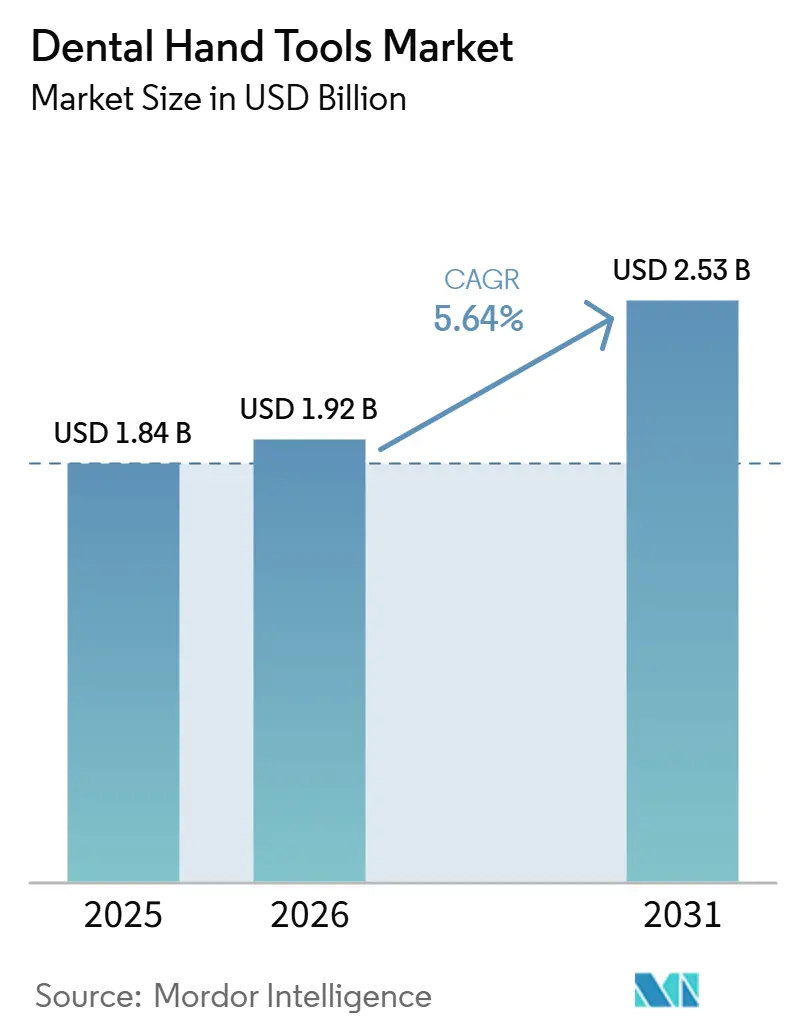
The Dental Hand Tools Market size is expected to increase from USD 1.84 billion in 2025 to USD 1.92 billion in 2026 and reach USD 2.53 billion by 2031, growing at a CAGR of 5.64% over 2026-2031.
The dental hand tools market is supported by the continuing global burden of oral disease, which affects nearly 3.7 billion people. This clinical burden keeps demand for examination and diagnostic instruments steady across advanced networks and primary care settings. Procurement is moving from individual instruments toward kits and cassettes that fit infection management programs. That change favors suppliers with broad portfolios, validated reprocessing information, and traceable products. Digital planning has also raised the value of manual confirmation during treatment, rather than removing the need for high-tactility instruments.
Key Report Takeaways
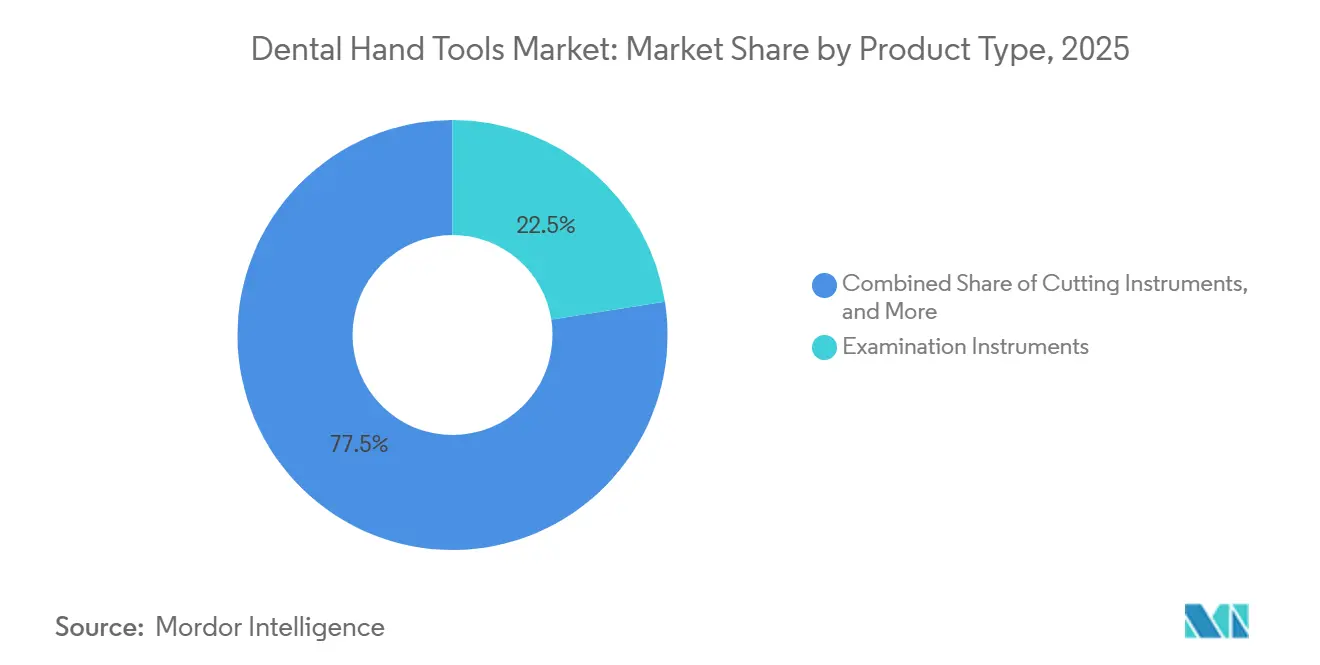
- By product type, examination instruments led with 22.45% of dental hand tools market share in 2025, while endodontic instruments are forecast to expand at a 6.89% CAGR through 2031.
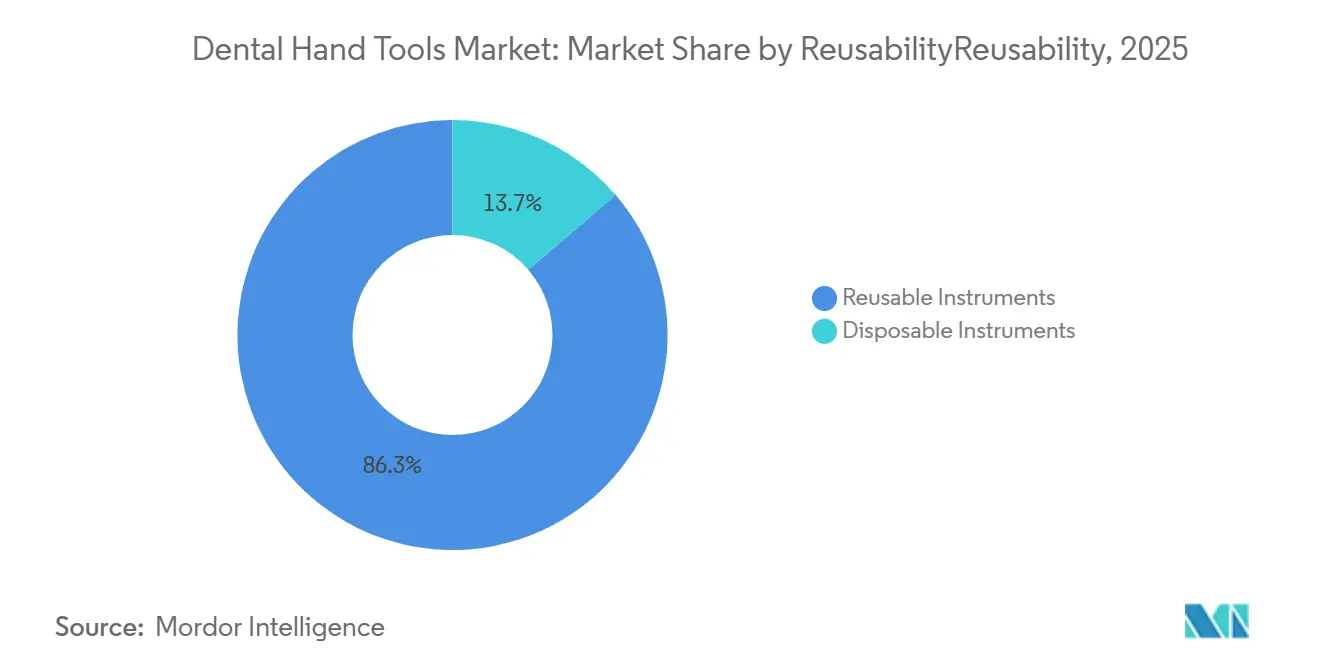
- By reusability, reusable instruments held 86.32% of dental hand tools market share in 2025, while disposable instruments are forecast to grow at a 7.89% CAGR through 2031.
- By end user, dental clinics held 68.12% revenue share in 2025, while dental hospitals are forecast to grow at a 7.21% CAGR through 2031.
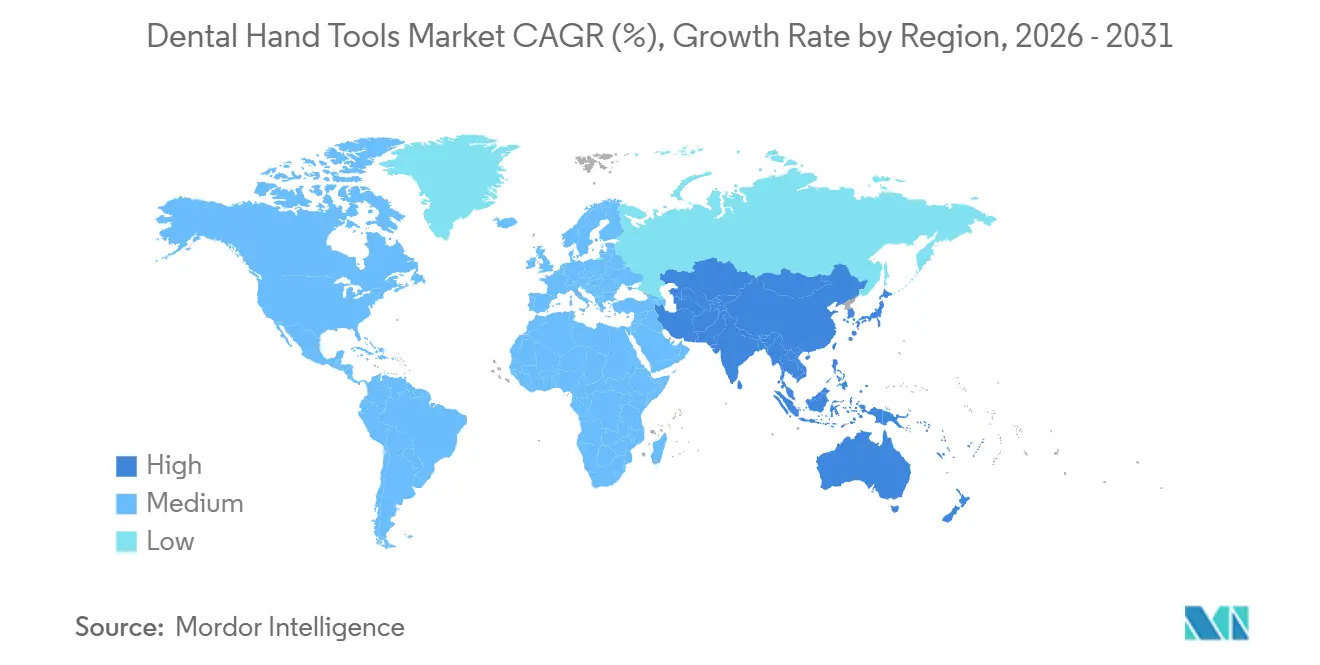
- By geography, North America led with 43.67% revenue share in 2025, while Asia-Pacific is forecast to grow at a 7.56% CAGR through 2031.
Note: Market size and forecast figures in this report are generated using Mordor Intelligence’s proprietary estimation framework, updated with the latest available data and insights as of January 2026.
Global Dental Hand Tools Market Trends and Insights
Drivers Impact Analysis*
| Driver | (~) % Impact on CAGR Forecast | Geographic Relevance | Impact Timeline |
|---|---|---|---|
| Rising Global Burden of Dental Caries and Periodontal Disease | +1.5% | Global, with elevated burden in South Asia, Sub-Saharan Africa, and Southeast Asia | Long term (≥ 4 years) |
| Aging Population and Growth in Restorative Procedures | +1.2% | North America, Western Europe, Japan, and South Korea | Long term (≥ 4 years) |
| Expansion of Dental Clinics and Organized Dental Service Networks | +0.9% | North America, Western Europe, and core Asia-Pacific markets | Medium term (2-4 years) |
| Growing Demand for Preventive, Cosmetic, and Minimally Invasive Dentistry | +0.8% | North America, Europe, and urban Asia-Pacific | Medium term (2-4 years) |
| Instrument Tracking and Digital Reprocessing Workflows | +0.5% | North America, the European Union, Australia, and South Korea | Short term (≤ 2 years) |
| Demand for High-Tactility Instruments in Digitally Planned Procedures | +0.4% | North America, Germany, Scandinavia, and Australia | Medium term (2-4 years) |
| Source: Mordor Intelligence | |||
Rising Global Burden of Dental Caries and Periodontal Disease
A 2026 analysis projects continuing increases in dental caries and periodontal disease through 2035 as populations grow and age[1]BMC Oral Health Editorial, “Global, Regional, and National Levels and Trends in Burden of Dental Caries and Periodontal Disease From 1990 to 2035,” BMC Oral Health, springer.com. The dental hand tools market, therefore, has a durable clinical base for diagnostic and periodontal instruments. South Asia and Southeast Asia combine a high disease burden with expanding dental infrastructure. This combination raises demand for both entry-level examination sets and instruments used in routine periodontal care. The World Health Organization’s Global Oral Health Action Plan for 2023-2030 also supports government action to reduce untreated caries and expand oral health services.
Aging Population and Growth in Restorative Procedures
Adults aged 65 and older represented 16.5% of the U.S. population in 2025 and are projected to represent 21.6% by 2034[2]U.S. Census Bureau, “The Nation’s Older Population Is Still Growing,” U.S. Census Bureau, census.gov. Older patients often need restorative, extraction, and implant-related care that uses several instrument types in one appointment. Cutting instruments, extraction forceps, and implant maintenance tools can therefore be required within the same practice kit. U.S. consumer dental spending rose 4% in the year ending January 2026[3]American Dental Association Health Policy Institute, “The Dental Care Market,” American Dental Association, ada.org. The dental hand tools industry also benefits as implant-supported restorations increase the need for titanium probes, plastic scalers, and interproximal cleaning instruments. These categories extend procurement beyond conventional extraction kits and increase the number of specialized products held by a practice.
Expansion of Dental Clinics and Organized Dental Service Networks
Dental service organization expansion is changing how clinics buy instruments. Heartland Dental supported more than 1,900 practices in 39 U.S. states in 2025[4]Heartland Dental, “Heartland Dental Celebrates Transformative Growth, Innovation, and Community Impact in 2025,” Heartland Dental Blog, heartland.com.. MB2 Dental surpassed 800 partner practices in 2025 and added 60 locations during the year. Large networks standardize brands across sites and place larger orders through multi-year arrangements. This makes compliance records, reprocessing instructions, and dependable supply more important in the dental hand tools market. European Dental Group extended its network to more than 344 clinics across 5 countries after acquiring Fresh Tandartsen in November 2025. Network standardization can displace locally preferred brands when suppliers cannot support consistent programs across several locations or countries.
Growing Demand for Preventive, Cosmetic, and Minimally Invasive Dentistry
Minimally invasive cosmetic procedures are becoming more common in general dental practices. Bonding, whitening, veneer preparation, and aesthetic contouring require fine placement and polishing instruments. Detailed margin assessment and shade matching also raise the use of precise probes and explorers during consultations. Canada’s federal dental care program, enacted in 2024, broadened coverage for preventive and basic care among eligible lower-income residents. Higher preventive consultation volumes can increase procurement of prophylaxis and examination instruments. The dental hand tools market has room to benefit when public reimbursement programs expand routine oral care access in other countries.
Restraints Impact Analysis*
| Restraint | (~) % Impact on CAGR Forecast | Geographic Relevance | Impact Timeline |
|---|---|---|---|
| High Cost of Premium Instruments and Total Cost of Ownership | -0.8% | Global, most acute in price-sensitive Asia-Pacific and Middle East and Africa markets | Long term (≥ 4 years) |
| Sterilization, Validation, and Regulatory Compliance Burden | -0.6% | European Union, North America, and Australia | Medium term (2-4 years) |
| Counterfeit and Low-Quality Instrument Leakage Through Fragmented Distribution | -0.5% | Global, with high risk in South Asia, Southeast Asia, and online channels | Medium term (2-4 years) |
| SKU-Level Supply Volatility for Specialty Alloys and Replacement Tips | -0.4% | Global, most acute for nickel-titanium-dependent endodontic lines | Short term (≤ 2 years) |
| Source: Mordor Intelligence | |||
High Cost of Premium Instruments and Total Cost of Ownership
Premium ergonomic curettes, precision cutting sets, and cassette-integrated periodontal kits cost more than standard stainless-steel alternatives. The price difference is a barrier in regions where patients pay directly for much of their dental care. Costs also include sterilization consumables, biological indicator testing, cassette maintenance, and replacement after alloy fatigue. Independent practices outside group purchasing arrangements may find these expenses difficult to plan for. Digital workflows and CAD/CAM can improve productivity, but the case for premium purchases is stronger in large networks than in single-practice settings. The dental hand tools market will therefore continue to show a difference between demand for premium systems and demand for lower-cost reusable tools.
Sterilization, Validation, and Regulatory Compliance Burden
Reprocessing rules are becoming more demanding across major dental markets. The European Commission updated harmonized standards for healthcare product sterilization under the Medical Device Regulation through Implementing Decision EU 2026/197 in January 2026. A 2025 decision had already adopted revised EN 556 sterilization standards for medical devices. Manufacturers must maintain risk management, post-market surveillance, and clinical evaluation documentation under the Medical Device Regulation. These requirements can extend product launch timelines and favor established firms with regulatory teams. Smaller purchasers can also face added costs when their hospital procurement policies require serialized instruments and tracking infrastructure.
*Our forecasts treat driver/restraint impacts as directional, not additive. The impact forecasts reflect baseline growth, mix effects, and variable interactions.
Segment Analysis
By Product Type: Examination Instruments Support Volume and Endodontic Lines Drive Premium Growth
Examination instruments held 22.45% share in 2025. Mirrors, explorers, and probes are used at the start of every patient encounter across dental specialties. Their role in periodontal staging and margin evaluation supports steady use even in clinics with advanced scanning systems. A calibrated manual probe provides tactile feedback that a digital image does not replace.
Endodontic instruments are forecast to grow at a 6.89% CAGR through 2031, the fastest rate among product types. The category benefits when clinicians preserve teeth through root canal treatment rather than choose extraction. Nickel-titanium file systems also create repeat purchasing needs because they are replaced regularly. Orthodontic and accessory instruments are expanding alongside organized orthodontic practice networks. Smile Doctors had more than 580 locations in 2025, which broadened the institutional base for specialty tools.



By Reusability: Reusable Sets Lead While Disposable Formats Gain Momentum
Reusable instruments held 86.32% share in 2025. Their position reflects clinical practice norms and the durability of stainless steel and titanium products through repeated autoclave cycles. Reusable sets can be economical when clinics have established cleaning and sterilization processes.
Disposable instruments are forecast to grow at a 7.89% CAGR through 2031. The Centers for Disease Control and Prevention recommends single-use devices where cleaning is difficult or reuse could compromise performance. Canadian infection prevention guidance also sets expectations for critical instruments in dental practice.
By End User: Dental Clinics Lead Volume and Dental Hospitals Drive Premium Demand
Dental clinics held 68.12% of the dental hand tools market in 2025. General practitioners and hygienists produce high examination and preventive instrument use in primary care. The segment includes independent practices, group practices, and expanding dental service organizations. These buyers use different purchasing models, from individual orders through dealers to centralized group purchasing contracts.
Dental hospitals are forecast to grow at a 7.21% CAGR through 2031. Multi-specialty referral units, oral surgery departments, and training programs need a wider range of instruments. They also require clear sterility documentation and traceability. Complex endodontic, periodontal, surgical, and implant procedures raise the number of instruments used per treatment.
Geography Analysis
North America held 43.67% share in 2025. U.S. national dental spending reached USD 189 billion in 2024, while consumer dental spending rose 4% in the year ending January 2026. Dental service organizations are standardizing brand selection and purchasing across large practice networks. Heartland Dental supported more than 1,900 practices in 2025. Canada’s federal dental program is expanding access to preventive and basic oral health services for eligible residents. FDA device regulation adds compliance requirements and also provides quality credentials sought by institutional buyers.
Europe is the second-largest regional area for the dental hand tools market. Germany, France, Italy, Spain, and the U.K. support premium procurement through strong preventive and restorative care frameworks. Asia-Pacific is forecast to grow at a 7.56% CAGR through 2031. Regional clinic networks are expanding and increasing demand for durable, cost-effective reusable sets. Clove Dental operated more than 650 clinics in India in 2025, which illustrates the growing scale of organized clinic purchasing.

Competitive Landscape
The dental hand tools market has moderate concentration in premium institutional purchasing and substantial fragmentation in lower-priced products. The dental hand tools market rewards suppliers that can meet institutional documentation and service requirements. HuFriedyGroup, Dentsply Sirona, and others serve large accounts through infection prevention programs, cassette systems, and group purchasing relationships. Product differentiation increasingly rests on materials, ergonomic design, validated reprocessing, and documentation. American Eagle Instruments launched the XP² range in October 2025 with a patented titanium nitride fusing process designed to reduce sharpening needs. Competition in the dental hand tools market will remain centered on clinical performance, infection prevention support, service reliability, and evidence that products meet procurement requirements.
Dental Hand Tools Industry Leaders
Dentsply Sirona
Medesy S.r.l.
Integra LifeSciences Corporation
Kerr Corporation
HuFriedyGroup
- *Disclaimer: Major Players sorted in no particular order

Recent Industry Developments
- June 2026: HuFriedyGroup announced a strategic partnership with the International Team for Implantology (ITI), embedding its implant maintenance instrument portfolio within ITI's global evidence-based education programs and research network.
- November 2025: European Dental Group completed the acquisition of Fresh Tandartsen in the Netherlands, extending its network to 344+ clinics across 5 European countries and driving consolidated instrument procurement standardization across a broader multi-country footprint.


Global Dental Hand Tools Market Report Scope
The scope of the dental hand tools market report comprises manual and hand-operated instruments used by dental professionals for the diagnosis, examination, prevention, treatment, restoration, extraction, and orthodontic management of oral health conditions. These instruments include examination, cutting, periodontal, restorative, extraction, orthodontic, and endodontic tools that are utilized across dental clinics, hospitals, laboratories, and other dental care settings.
The report analyzes the global dental hand tools market across product type, reusability, end-user, and geography segments. It evaluates market trends, demand patterns, technological advancements, competitive landscape, and growth opportunities for examination instruments, cutting instruments, periodontal instruments, restorative instruments, extraction instruments, orthodontic instruments, endodontic instruments, accessories, and other hand tools used in various dental procedures. Additionally, the report examines demand by reusable and disposable instruments and analyzes procurement trends among dental clinics, dental hospitals, dental laboratories, and other end users, including mobile/community dental services and academic and research institutes, across key global regions. Geographically, the market is segmented into North America, Europe, Asia-Pacific, the Middle East & Africa, and South America. The market report also covers the estimated market sizes and trends for 17 countries across major regions globally. For each segment, the market size and forecast are provided in terms of value (USD).
| Examination Instruments |
| Cutting Instruments |
| Periodontal Instruments |
| Restorative Instruments |
| Extraction Instruments |
| Orthodontic Instruments |
| Endodontic Instruments |
| Other Product Types |
| Reusable Instruments |
| Disposable Instruments |
| Dental Clinics |
| Dental Hospitals |
| Dental Laboratories |
| Others (Mobile and Community Dental Services, Academic and Research Institutes) |
| North America | United States |
| Canada | |
| Mexico | |
| Europe | Germany |
| United Kingdom | |
| France | |
| Italy | |
| Spain | |
| Rest of Europe | |
| Asia-Pacific | China |
| India | |
| Japan | |
| Australia | |
| South Korea | |
| Rest of Asia-Pacific | |
| Middle East and Africa | GCC |
| South Africa | |
| Rest of Middle East and Africa | |
| South America | Brazil |
| Argentina | |
| Rest of South America |
| By Product Type | Examination Instruments | |
| Cutting Instruments | ||
| Periodontal Instruments | ||
| Restorative Instruments | ||
| Extraction Instruments | ||
| Orthodontic Instruments | ||
| Endodontic Instruments | ||
| Other Product Types | ||
| By Reusability | Reusable Instruments | |
| Disposable Instruments | ||
| By End User | Dental Clinics | |
| Dental Hospitals | ||
| Dental Laboratories | ||
| Others (Mobile and Community Dental Services, Academic and Research Institutes) | ||
| By Geography | North America | United States |
| Canada | ||
| Mexico | ||
| Europe | Germany | |
| United Kingdom | ||
| France | ||
| Italy | ||
| Spain | ||
| Rest of Europe | ||
| Asia-Pacific | China | |
| India | ||
| Japan | ||
| Australia | ||
| South Korea | ||
| Rest of Asia-Pacific | ||
| Middle East and Africa | GCC | |
| South Africa | ||
| Rest of Middle East and Africa | ||
| South America | Brazil | |
| Argentina | ||
| Rest of South America | ||


Key Questions Answered in the Report
What is the projected value of the dental hand tools market by 2031?
The dental hand tools market is forecast to reach USD 2.53 billion by 2031, growing at a 5.64% CAGR from 2026.
Which product category leads dental hand tool sales?
Examination instruments led product demand with 22.45% share in 2025 because mirrors, explorers, and probes are used in every clinical encounter.
Why are endodontic instruments growing faster than other product types?
Endodontic instruments are forecast to grow at a 6.89% CAGR through 2031 as clinicians increasingly preserve teeth through root canal treatment and replace file systems regularly.
Are reusable or disposable dental instruments more widely used?
Reusable instruments held 86.32% share in 2025, although disposable instruments are forecast to grow faster at a 7.89% CAGR through 2031.
Which end users purchase the most dental hand tools?
Dental clinics held 68.12% of revenue in 2025, supported by high volumes of routine examination and preventive care.
Which region is growing fastest for dental hand tools?
Asia-Pacific is forecast to grow at a 7.56% CAGR through 2031 as clinic networks expand and procure durable reusable sets.
Page last updated on:





