
Dead Sea Mud Cosmetics Market Size and Share
Market Overview
| Study Period | 2021 - 2031 |
|---|---|
| Market Size (2026) | USD 1.59 Billion |
| Market Size (2031) | USD 2.18 Billion |
| Growth Rate (2026 - 2031) | 6.52 % |
| Fastest Growing Market | Asia-Pacific |
| Largest Market | Europe |
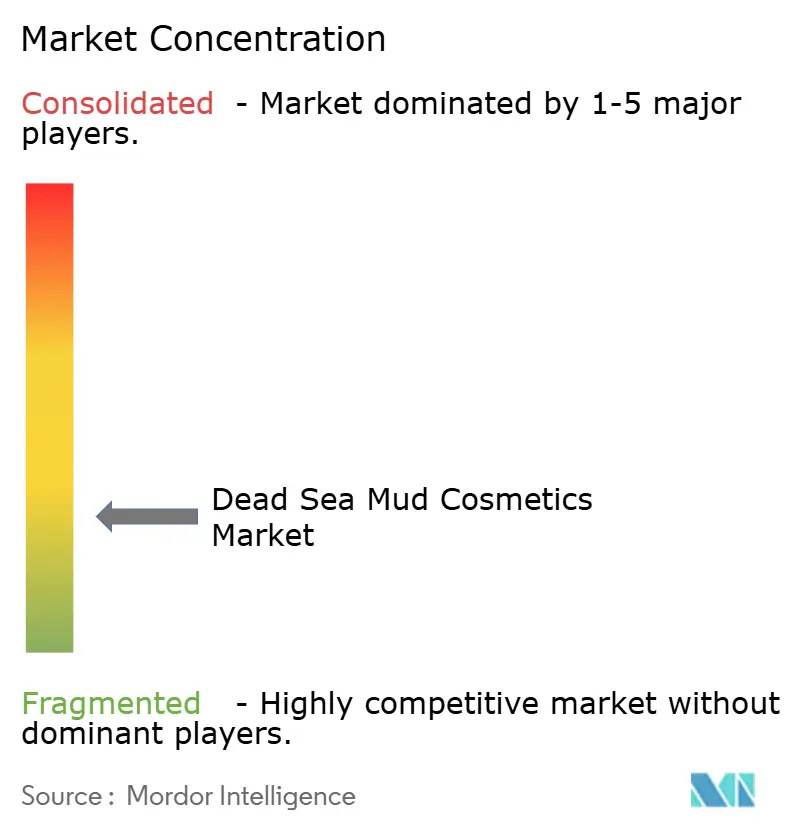
| Market Concentration | Low |
Major Players
*Disclaimer: Major Players sorted in no particular order Image © Mordor Intelligence. Reuse requires attribution under CC BY 4.0. |
|
Dead Sea Mud Cosmetics Market Analysis by Mordor Intelligence
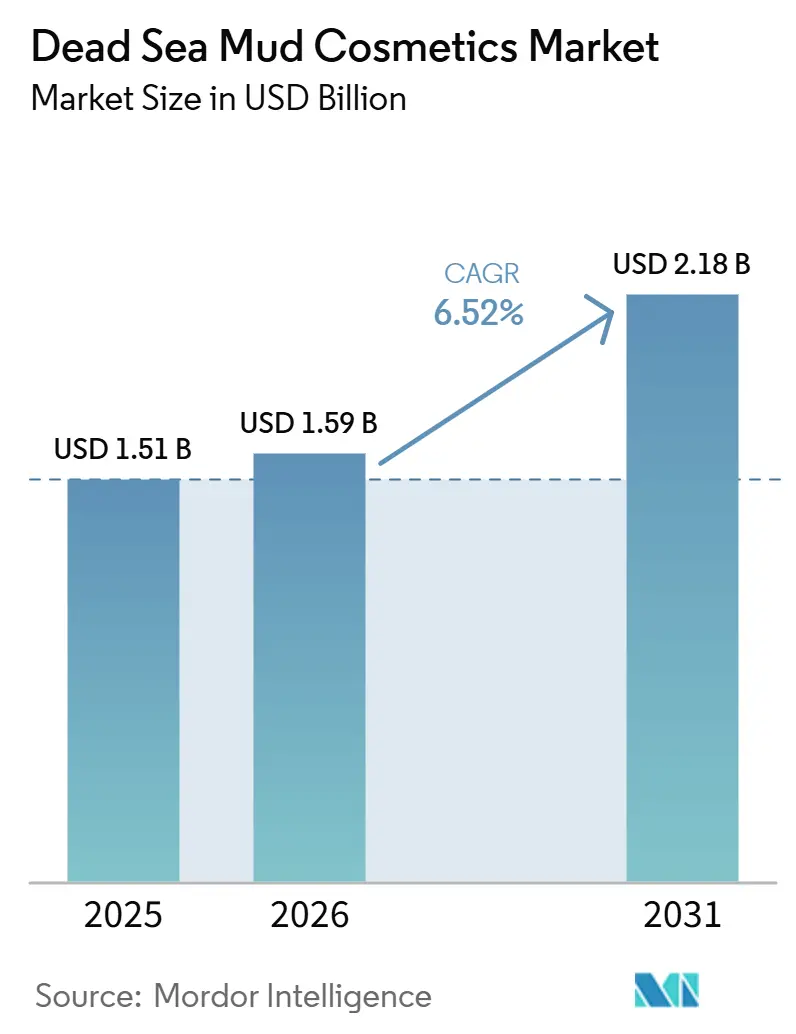
The dead sea mud cosmetics market size is expected to grow from USD 1.51 billion in 2025 to USD 1.59 billion in 2026 and is forecast to reach USD 2.18 billion by 2031 at 6.52% CAGR over 2026-2031. The market is supported by demand for mineral-based skincare with clear ingredient origins and evidence-backed claims. Consumers increasingly compare ingredients before purchasing, which favors brands that can document mineral composition and sourcing practices. Premium facial products remain central to category value, while at-home body and spa formats broaden the occasions for use. Digital retail and expansion in Asia-Pacific are widening access beyond the category’s established European base. Competition is centered on specialist brands with Dead Sea sourcing relationships, proprietary delivery systems, and premium brand positioning.
Key Report Takeaways
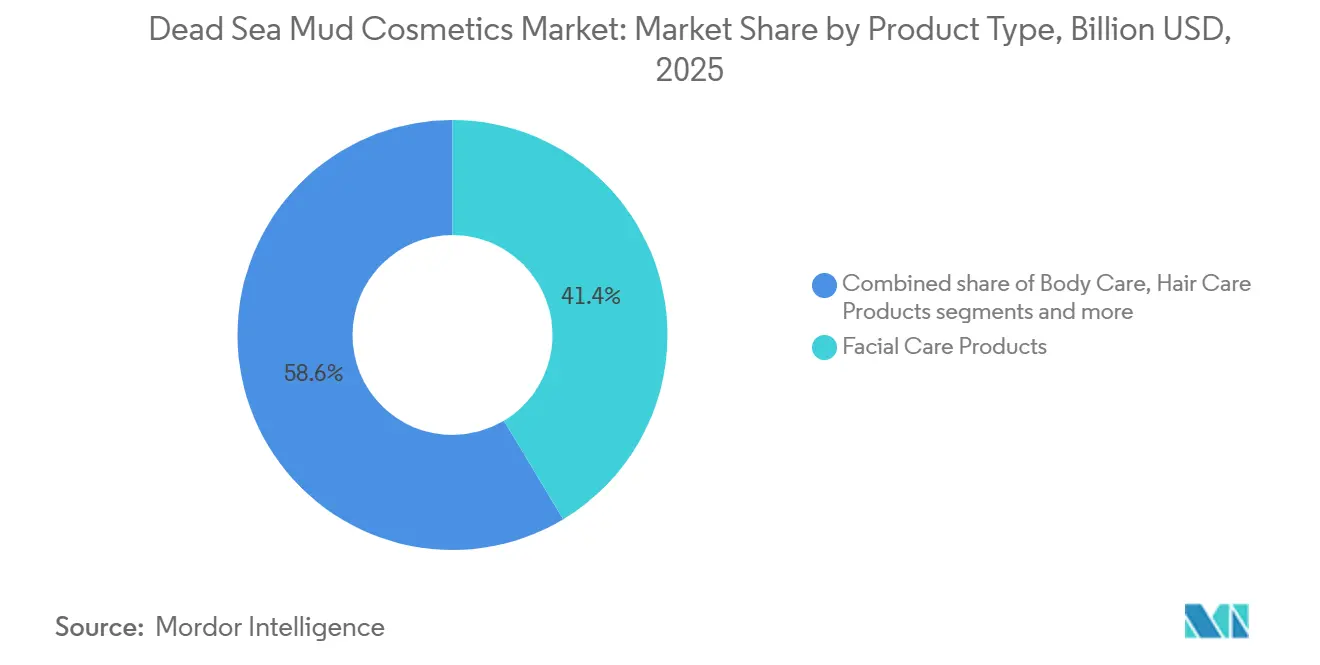
- By product type, facial care products held 41.38% of the dead sea mud cosmetics market share in 2025, while body care products recorded the highest projected CAGR at 7.74% through 2031.
- By skin concern, hydration and dryness held 24.51% of the dead sea mud cosmetics market share in 2025, while anti-aging and firming recorded the highest projected CAGR at 7.98% through 2031.
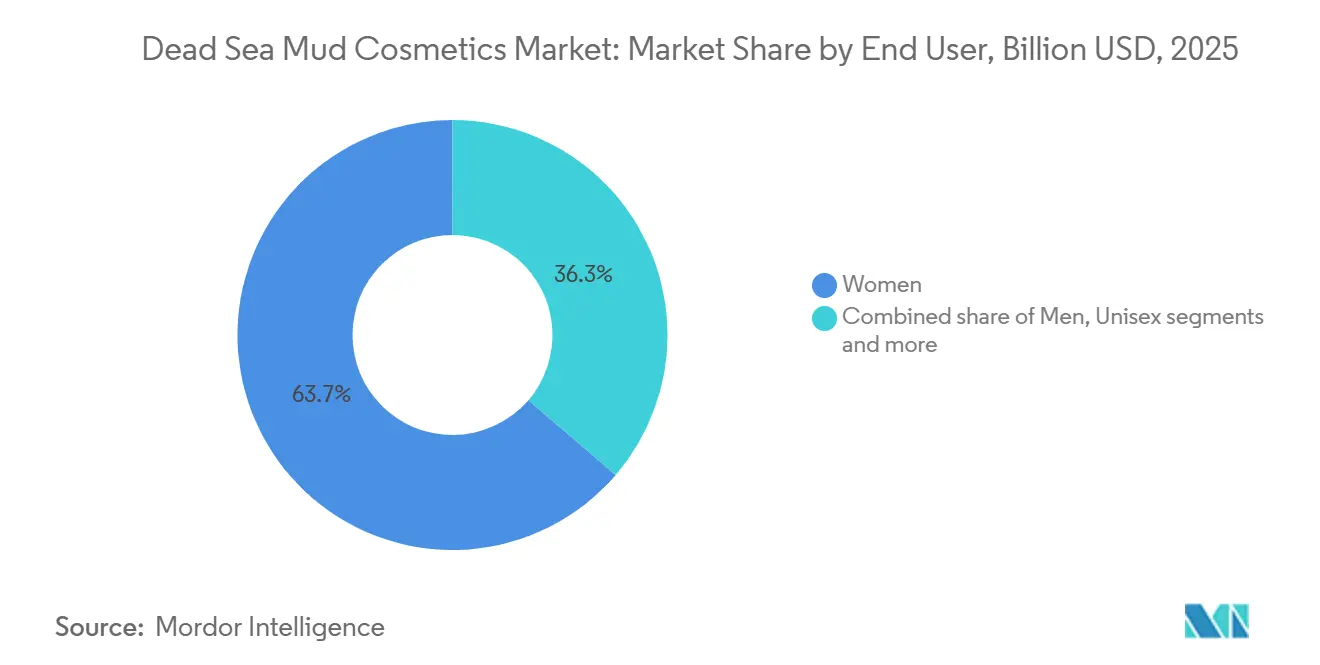
- By end user, women accounted for 63.71% of revenue in 2025, while men recorded the highest projected CAGR at 8.11% through 2031.
- By distribution channel, health and beauty Stores held 34.61% of revenue in 2025, while online retail stores recorded the highest projected CAGR at 8.41% through 2031.
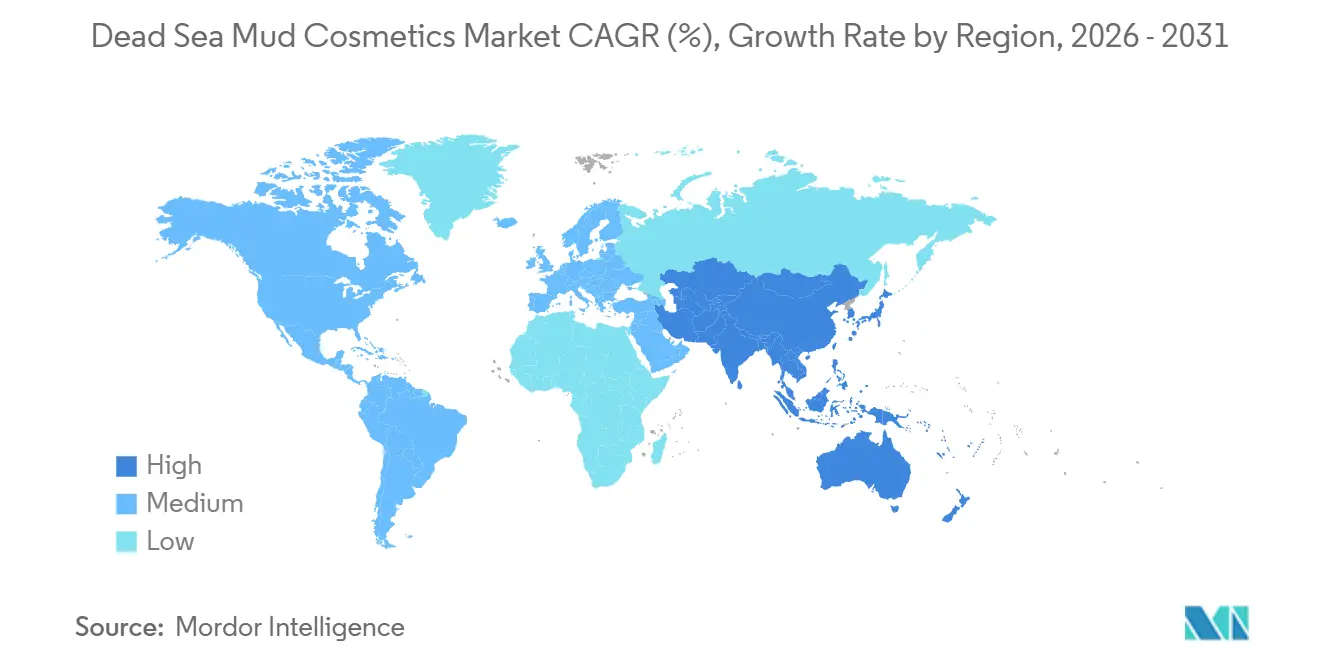
- By geography, Europe held 35.44% of revenue in 2025, while Asia-Pacific recorded the highest projected CAGR at 8.38% through 2031.
Note: Market size and forecast figures in this report are generated using Mordor Intelligence’s proprietary estimation framework, updated with the latest available data and insights as of January 2026.
Market Trends and Insights
Drivers Impact Analysis of Dead Sea Mud Cosmetics Market*
| Driver | (~) % Impact on CAGR Forecast | Geographic Relevance | Impact Timeline |
|---|---|---|---|
| Rising consumer demand for natural and mineral-based skincare products | +2.1% | Global, concentrated in North America, Europe, and Asia-Pacific core | Long term (≥ 4 years) |
| Growing awareness of Dead Sea mud’s therapeutic skincare benefits | +1.5% | Global, with early adoption in Europe and North America and emerging adoption in Asia-Pacific | Medium term (2-4 years) |
| Increasing preference for premium and luxury skincare products | +1.3% | Global, led by the Europe and North America, with spillover to Asia-Pacific and Middle East and Africa | Medium term (2-4 years) |
| Expansion of clean beauty and organic cosmetics trends | +1.0% | North America, Europe, and Asia-Pacific, particularly Japan, South Korea, and China | Long term (≥ 4 years) |
| Rising demand for anti-aging and skin rejuvenation products | +0.9% | Europe, North America, China, and South Korea | Long term (≥ 4 years) |
| Product innovation with Dead Sea mud-infused formulations | +0.8% | Global, with innovation hubs in Israel and South Korea | Medium term (2-4 years) |
| Source: Mordor Intelligence | |||
Rising consumer demand for natural and mineral-based skincare products
The Dead Sea mud cosmetics market benefits from interest in skincare ingredients with a clear natural origin. Dead Sea mud gives formulators a mineral profile that can be measured and disclosed in product documentation. The input material contains illite-smectite clay and minerals including magnesium, calcium, potassium, strontium, zinc, manganese, copper, and bromide. This composition gives brands a factual basis for explaining product ingredients without relying only on heritage claims. Growing consumer preference for clean-label, naturally derived, and mineral-based skincare products is further accelerating market demand. A 2024 consumer survey commissioned by the National Sanitation Foundation (NSF) found that 74% of U.S. consumers consider organic ingredients important in skincare and personal care products, highlighting strong acceptance of natural formulations[1]Source: National Sanitation Foundation, “74% of Consumers Consider Organic Ingredients Important in Personal Care Products”, nsf.org. As a result, cosmetic manufacturers are increasingly incorporating Dead Sea mud into facial masks, cleansers, scrubs, and body care products to meet evolving consumer preferences for ingredient transparency and naturally sourced skincare solutions.
Growing awareness of Dead Sea mud’s therapeutic skincare benefits
Clinical research has helped distinguish Dead Sea mud from general mineral skincare products by documenting its effects under controlled conditions. In a four-week study, researchers found that long-term use of Dead Sea mud did not alter transepidermal water loss, pH, or erythema in healthy skin. The same study identified a measurable firming effect from salted Dead Sea mud formulations, supporting their relevance in cosmetic applications. Magnesium and calcium remain important to the category’s skincare narrative, as researchers associate these minerals with inflammatory response, keratinocyte differentiation, and barrier function. Controlled research on Dead Sea climatotherapy also strengthens consumer awareness of Dead Sea-origin treatments among individuals managing psoriasis. These findings support premium product positioning when brands use claims that comply with cosmetic requirements.
Expansion of clean beauty and organic cosmetics trends
Demand for clean beauty products supports the Dead Sea mud cosmetics market, as the ingredient is mineral-based and minimally processed. According to research by the CBI Ministry of Foreign Affairs, clean-label products are projected to account for over 70% of portfolios in 2025 and 2026, rising sharply from 52% in 2021[2]Source: CBI Ministry of Foreign Affairs, “Which trends offer opportunities”, cbi.eu. Product documentation has become increasingly important as consumers and retailers review ingredient lists and product files more closely. The EU Cosmetics Regulation establishes requirements for cosmetic product safety, labeling, and restricted substances across European distribution channels[3]Source: European Union, "Consolidated text: Regulation (EC) No 1223/2009 of the European Parliament and of the Council of 30 November 2009 on cosmetic products (recast) (Text with EEA relevance)", eur-lex.europa.eu. Commission Implementing Decision (EU) 2025/1175 updated the glossary of common ingredient names used for cosmetic labeling. These requirements favor brands that provide specific composition details rather than vague mineral descriptions. Certification and full ingredient disclosure can also strengthen the credibility of premium Dead Sea mud product lines.
Rising demand for anti-aging and skin rejuvenation products
The growing demand for anti-aging and skin rejuvenation products is a key driver of the Dead Sea mud cosmetics market. Consumers are increasingly seeking skincare solutions that help reduce the appearance of fine lines, wrinkles, uneven skin texture, and loss of firmness while promoting healthier-looking skin. Dead Sea mud is widely used in facial masks, exfoliators, and spa treatments due to its mineral-rich composition, which supports deep cleansing, gentle exfoliation, and improved skin hydration. The rising aging population, coupled with greater awareness of preventive skincare among younger consumers, is expanding demand for premium anti-aging formulations. Cosmetic manufacturers are incorporating Dead Sea mud with active ingredients such as hyaluronic acid, collagen, peptides, and botanical extracts to enhance product efficacy.
Restraints Impact Analysis of Dead Sea Mud Cosmetics Market*
| Restraint | (~) % Impact on CAGR Forecast | Geographic Relevance | Impact Timeline |
|---|---|---|---|
| High cost of Dead Sea mud extraction and processing | -0.6% | Global, with greater pressure on brands outside the Middle East | Long term (≥ 4 years) |
| Limited availability of authentic Dead Sea mineral resources | -0.5% | Global, with the supply constraint centered on Middle East source geography | Long term (≥ 4 years) |
| Competition from alternative natural skincare ingredients | -0.4% | North America, Europe, and Asia-Pacific | Medium term (2-4 years) |
| High product prices limiting mass-market adoption | -0.3% | Emerging Asia-Pacific markets, South America, and non-Gulf Middle East and Africa | Medium term (2-4 years) |
| Source: Mordor Intelligence | |||
High cost of Dead Sea mud extraction and processing
Limited availability and the resource-intensive nature of sourcing genuine Dead Sea mud create cost pressures across the cosmetic value chain. Since authentic Dead Sea mud is obtained from a geographically restricted region, manufacturers incur substantial expenses for extraction, transportation, and processing before it can be used in skincare formulations. Additional investments in purification, quality assurance, and compliance with international cosmetic regulations further increase production costs. These higher manufacturing expenses are often reflected in premium product prices, making Dead Sea mud cosmetics less accessible to price-sensitive consumers. Consequently, many buyers shift toward lower-cost skincare products formulated with alternative mineral clays or synthetic ingredients.
Limited availability of authentic Dead Sea mineral resources
The limited availability of authentic Dead Sea mineral resources poses a significant challenge to the growth of the Dead Sea mud cosmetics market. Dead Sea mud and mineral salts can only be sourced from the Dead Sea region, making the supply of raw materials inherently constrained by geography. Increasing global demand for mineral-based skincare products places additional pressure on these finite natural resources. Environmental concerns, conservation measures, and regulatory controls on extraction activities further restrict the availability of authentic raw materials. Supply limitations can lead to fluctuations in raw material availability, longer procurement timelines, and increased sourcing costs for manufacturers.
*Our forecasts treat driver/restraint impacts as directional, not additive. The impact forecasts reflect baseline growth, mix effects, and variable interactions.
Dead Sea Mud Cosmetics Market Segment Analysis
By Product Type:
Facial Care Anchors Revenue, Body Formats Scaling FastestFacial Care Products held 41.38% of the dead sea mud cosmetics market share in 2025. The segment is supported by established demand for deep-cleansing, detoxifying, and firming products. Face masks, exfoliators, and face washes account for much of the volume because rinse-off formats can accommodate higher mud concentrations. The format also gives consumers a familiar way to use mineral mud at home. Facial serums and creams are expanding the segment into leave-on products with more clinical positioning. AHAVA’s mineral serum portfolio shows how brands are applying Dead Sea-derived ingredients to premium facial treatments. Eye products remain a smaller niche, but they support a higher-value product mix.
Body Care Products are projected to expand at 7.74% CAGR between 2026 and 2031. The dead sea mud cosmetics market size for Body Care Products is supported by demand for spa-style use at home. Body masks, wraps, scrubs, lotions, creams, soaps, and cleansers address both treatment and daily-care routines. These products can offer a more accessible entry point than premium facial serums. Hair-care products include shampoos, conditioners, masks, and scalp treatments. The category also draws on clinical interest in Dead Sea minerals for scalp health and seborrheic dermatitis. Bath salts and mineral baths provide high unit volumes through spa, wellness, and retail channels.



By Skin Concern:
Hydration Leads, Anti-Aging Accelerating SharplyHydration and dryness emerged as the leading segment of the Dead Sea mud cosmetics market, accounting for 24.51% of the market share in 2025. The dominance of this segment is attributed to increasing consumer focus on maintaining skin moisture balance and addressing common concerns such as dry, rough, and dehydrated skin. Dead Sea mud is widely recognized for its high mineral content, including magnesium, calcium, and potassium, which supports skin nourishment and moisture retention. The rising adoption of natural and mineral-based skincare products has further contributed to the demand for hydration-focused Dead Sea mud formulations.
Anti-aging and firming is projected to be the fastest-growing segment in the Dead Sea mud cosmetics market, registering a CAGR of 7.98% during the forecast period through 2031. The growth of this segment is driven by increasing demand for skincare products that help reduce visible signs of aging, such as fine lines, wrinkles, and loss of skin elasticity. Dead Sea mud’s rich mineral composition and detoxifying properties have increased its popularity among consumers seeking natural solutions for skin rejuvenation and firmness.
By End User:
Women Anchor Revenue, Men’s Segment Rewriting Growth DynamicsWomen accounted for 63.71% of revenue in 2025 in the dead sea mud cosmetics market. Women remain the main customer base for facial skincare, body care, and spa products. This reflects longstanding multi-step skincare routines and category communication that was often directed to women. Product design and packaging historically gave limited attention to men’s grooming needs. That pattern left room for companies to create more targeted offers for men. Women will remain important to revenue because they purchase across several product types. Unisex products also allow brands to use spa and wellness positioning without a gender-specific shelf message.
The Men segment is forecast to grow at 8.1% CAGR between 2026 and 2031. This rate is higher than the forecast for the overall category. The dead sea mud cosmetics market can benefit as skincare becomes more normal within male grooming routines. Men’s offers can use facial cleansing, body care, shaving-adjacent care, and wellness-oriented products. The opportunity is not limited to new formulations because packaging, gifting, and channel placement also influence adoption. A targeted range can broaden the customer base without changing the mineral ingredient story. Brands need to avoid treating men only as a seasonal gifting audience if they want recurring product use.
By Distribution Channel:
Specialty Stores Sustain Revenue, Digital Channels Gaining ShareHealth and Beauty Stores held 34.6% of revenue in 2025. These outlets remain important because consumers can assess product texture, fragrance, packaging, and brand presentation before purchasing. Physical discovery is especially useful for premium mud masks and spa products that need sensory demonstration. Supermarkets and hypermarkets provide wider access to bath salts, scrubs, and other entry products. Spa and resort boutiques, professional wellness channels, and brand-owned stores support a premium niche. Their setting reinforces the therapeutic and relaxation associations of Dead Sea products. Specialty stores therefore remain important to the dead sea mud cosmetics market even as online sales expand.
Online Retail Stores are forecast to grow at 8.4% CAGR through 2031. This makes online retail the fastest-growing distribution channel. Digital stores allow brands to explain ingredients, routines, certifications, and product use in more detail than a physical shelf can provide. They also extend specialist brands beyond spa, travel-retail, and local-store networks. AHAVA entered select Ulta Beauty stores in the United States in February 2025, adding access through an omnichannel beauty retailer. The combination of physical availability and online product discovery can improve reach for brands that were previously concentrated in specialty channels. Digital growth also increases the need to protect authentic Dead Sea labeling from misleading claims.
Geography Analysis
Europe Dead Sea Mud Cosmetics Market
Europe held 35.44% of the dead sea mud cosmetics market share in 2025. Germany, France, the United Kingdom, Italy, Spain, and the Netherlands provide the region’s core demand base. European consumers have a strong history of examining skincare ingredients and product claims. This supports products with a visible mineral origin and complete composition information. The EU regulatory framework strengthens the importance of safety files, labeling, and restricted-substance compliance. Commission Regulation (EU) 2026/78 further restricted certain CMR substances in cosmetics during 2026.
North America Dead Sea Mud Cosmetics Market
North America is the second-largest regional market, led by the United States. The region has established premium skincare distribution and a large consumer base for natural-product claims. AHAVA’s February 2025 entry into select Ulta Beauty locations improved access beyond specialty and travel-retail channels. Canada adds demand for natural skincare products through premium channels. Mexico provides an early mass-premium opportunity as skincare spending grows. Dermatology and clinical channels in the United States remain less developed for many Dead Sea mud brands, despite the relevance of evidence related to psoriasis and atopic dermatitis.
APAC, South America and MEA Dead Sea Mud Cosmetics Market
Asia-Pacific is projected to grow at 8.38% CAGR from 2026 to 2031. China, India, South Korea, Japan, Indonesia, and Australia are the major country markets. China provides a large skincare consumer base and gives brands a significant digital commerce opportunity. India offers substantial volume potential as younger urban consumers add premium skincare products to their routines. South Korea’s beauty ecosystem can raise the visibility of Dead Sea formulations through distribution partnerships. Japan’s established interest in high-efficacy anti-aging products aligns with the fast growth of Anti-Aging and Firming. South America and the Middle East and Africa remain smaller, but Israel and Jordan hold source-region importance while Gulf markets support premium wellness demand.

Competitive Landscape
The Dead Sea mud cosmetics market is highly fragmented, with the presence of numerous regional and international players offering a wide range of skincare products incorporating Dead Sea minerals. The market consists of established cosmetic brands, specialty skincare companies, wellness-focused manufacturers, and small-scale producers competing across product categories such as facial masks, scrubs, cleansers, body treatments, and anti-aging formulations. Companies such as AHAVA, Seacret, and Premier Dead Sea have built strong brand recognition through premium positioning and the use of mineral-rich Dead Sea ingredients.
The fragmented nature of the market is driven by increasing consumer demand for natural skincare solutions, personalized beauty products, and mineral-based cosmetic formulations. Market participants are focusing on product innovation, including the integration of Dead Sea mud with botanical extracts, essential oils, hyaluronic acid, and other active ingredients to enhance skin benefits such as hydration, detoxification, and anti-aging. Many companies are also expanding their product portfolios through online platforms and direct-to-consumer channels to reach global customers beyond traditional retail networks.
Competition in the Dead Sea mud cosmetics market remains intense as companies compete through branding, geographic expansion, strategic partnerships, and e-commerce penetration. Leading players are investing in marketing campaigns emphasizing the therapeutic properties of Dead Sea minerals and their association with wellness and spa treatments. At the same time, regional manufacturers are leveraging proximity to Dead Sea resources to maintain cost advantages and develop authentic product offerings.
Dead Sea Mud Cosmetics Industry Leaders
-
AHAVA Dead Sea Laboratories Ltd.
-
Aroma Dead Sea Spa & Cosmetics Ltd.
-
Kawar Cosmetics Co. Ltd.
-
Sea of Spa Laboratories Ltd.
-
Dead Sea Premier Cosmetics Laboratories Ltd.
- *Disclaimer: Major Players sorted in no particular order
Dead Sea Mud Cosmetics Market Companies Covered in this Report
- AHAVA Dead Sea Laboratories Ltd.
- Aroma Dead Sea Spa & Cosmetics Ltd.
- Kawar Cosmetics Co. Ltd.
- H&B Health and Beauty Ltd.
- Sea of Spa Laboratories Ltd.
- Dead Sea Premier Cosmetics Laboratories Ltd.
- SABON NYC LLC
- Seacret Direct LLC
- Ein Gedi Cosmetics & Pharma Ltd.
- Rivage Dead Sea Cosmetics Ltd.
- Aqua Mineral Cosmetics Ltd.
- Jericho Cosmetics Ltd.
- Daor Cosmetics Ltd.
- Bio-Rom Ltd.
- Jordan Integrated For Mineral Dead Sea Products Co. Ltd.
- Tourmaline Marketing & Investment Company Ltd.
- KCD Cosmetics Inc.
- Asutra LLC
- AVANI Supreme Inc.
- Al Anwaar Cosmetics LLC

Recent Industry Developments in Dead Sea Mud Cosmetics Market
- May 2026: AHAVA Dead Sea Laboratories held its 2026 International Distributors Conference in Zagreb, Croatia, bringing together global partners from 11 countries to align on skincare innovation strategy and brand execution priorities for the year ahead. The event reinforced the company’s agenda for multi-continent distribution expansion.
- April 2026: AHAVA participated in the ANTHOS’26 sustainability conference in Vienna as part of the SSbD4CheM collaborative project. The company presented its development of nanocellulose-based alternatives to plastic microbeads in rinse-off cosmetics, a formulation advancement that directly aligned with impending EU microplastics restrictions in cosmetic products.
- October 2025: AHAVA introduced Smartuim™, a patented pH-responsive encapsulation system that releases the brand’s proprietary Osmoter™ Dead Sea mineral blend during overnight skin regeneration cycles. The technology represented a significant formulation innovation for the company’s anti-aging and skin-firming product line.


Global Dead Sea Mud Cosmetics Market Report Scope
Dead Sea mud cosmetics refer to skincare and beauty products formulated using mineral-rich mud extracted from the Dead Sea, which is located between Jordan and Israel. The dead sea mud cosmetics market is segmented by product type, skin concern, end user, distribution channel and geography. Based on product type, the market is segmented into facial care products, body care products, hair care products, eye care products, bathing and spa products. Based on skin concern, the market is segmented into hydration and dryness, acne and blemish control, anti-aging and firming, detoxification and pore cleansing, sensitive and irritated skin, uneven tone and texture. Based on end user, the market is segmented into men, women and unisex. Based on distribution channel, the market is segmented into supermarkets/hypermarkets, health and beauty stores, online retail stores and other distribution channels. By geography, the market is segmented into North America, Europe, Asia-Pacific, South America, and Middle-East and Africa. For each segment, the market sizing and forecasting have been done in value terms (USD million).
| Facial Care Products |
| Body Care Products |
| Hair Care Products |
| Eye Care Products |
| Bathing and Spa Products |
| Hydration and Dryness |
| Acne and Blemish Control |
| Anti-Aging and Firming |
| Detoxification and Pore Cleansing |
| Sensitive and Irritated Skin |
| Uneven Tone and Texture |
| Men |
| Women |
| Unisex |
| Supermarkets/Hypermarkets |
| Health and Beauty Stores |
| Online Retail Stores |
| Other Distribution Channels |
| North America | United States |
| Canada | |
| Mexico | |
| Rest of North America | |
| Europe | Germany |
| United Kingdom | |
| Italy | |
| France | |
| Spain | |
| Netherlands | |
| Rest of Europe | |
| Asia-Pacific | China |
| India | |
| Japan | |
| Australia | |
| Indonesia | |
| South Korea | |
| Rest of Asia-Pacific | |
| South America | Brazil |
| Argentina | |
| Rest of South America | |
| Middle East and Africa | South Africa |
| Saudi Arabia | |
| United Arab Emirates | |
| Israel | |
| Jordan |
| By Product Type | Facial Care Products | |
| Body Care Products | ||
| Hair Care Products | ||
| Eye Care Products | ||
| Bathing and Spa Products | ||
| By Skin Concern | Hydration and Dryness | |
| Acne and Blemish Control | ||
| Anti-Aging and Firming | ||
| Detoxification and Pore Cleansing | ||
| Sensitive and Irritated Skin | ||
| Uneven Tone and Texture | ||
| By End User | Men | |
| Women | ||
| Unisex | ||
| By Distribution Channel | Supermarkets/Hypermarkets | |
| Health and Beauty Stores | ||
| Online Retail Stores | ||
| Other Distribution Channels | ||
| By Geography | North America | United States |
| Canada | ||
| Mexico | ||
| Rest of North America | ||
| Europe | Germany | |
| United Kingdom | ||
| Italy | ||
| France | ||
| Spain | ||
| Netherlands | ||
| Rest of Europe | ||
| Asia-Pacific | China | |
| India | ||
| Japan | ||
| Australia | ||
| Indonesia | ||
| South Korea | ||
| Rest of Asia-Pacific | ||
| South America | Brazil | |
| Argentina | ||
| Rest of South America | ||
| Middle East and Africa | South Africa | |
| Saudi Arabia | ||
| United Arab Emirates | ||
| Israel | ||
| Jordan | ||


Key Questions Answered in the Report
What is driving demand for Dead Sea mud cosmetics?
Demand is supported by mineral-based ingredient positioning, evidence-backed skincare claims, premium facial care, and wider online access.
How large is the Dead Sea mud cosmetics market?
It is valued at USD 1.59 billion in 2026 and is projected to reach USD 2.18 billion by 2031, growing at a 6.52% CAGR.
Which product category leads sales?
Facial Care Products led with 41.38% revenue share in 2025, supported by masks, exfoliators, face washes, serums, and creams.
Which consumer group is growing fastest?
Men are the fastest-growing end-user group, with a projected CAGR of 8.11% through 2031.
Which sales channel is expanding fastest?
Online Retail Stores are projected to grow at 8.41% CAGR through 2031, the highest rate among distribution channels.
Page last updated on:





