
DDR5 DRAM Reliability Technology Market Size and Share
Market Overview
| Study Period | 2019 - 2031 |
|---|---|
| Market Size (2026) | USD 17.93 Billion |
| Market Size (2031) | USD 35.86 Billion |
| Growth Rate (2026 - 2031) | 14.87 % |
| Fastest Growing Market | North America |
| Largest Market | Asia-Pacific |
| Market Concentration | High |
Major Players *Disclaimer: Major Players sorted in no particular order Image © Mordor Intelligence. Reuse requires attribution under CC BY 4.0. | |
DDR5 DRAM Reliability Technology Market Analysis by Mordor Intelligence
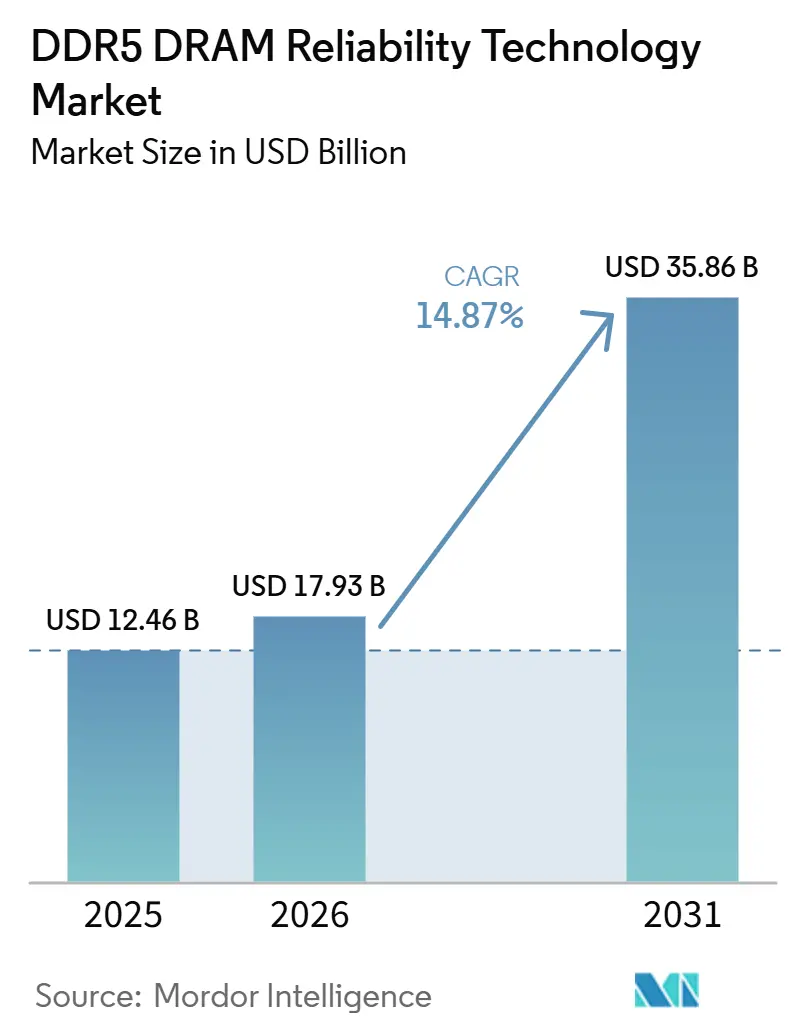
The DDR5 DRAM reliability technology market size is projected to be USD 12.46 billion in 2025, USD 17.93 billion in 2026, and reach USD 35.86 billion by 2031, growing at a CAGR of 14.87% from 2026 to 2031. AI training and inference systems are making memory faults more expensive because a small error can affect uptime, output quality, and recovery time across dense server environments. The move from DDR4 to DDR5 platforms is also changing what buyers treat as standard server memory, since on-die ECC, per-row activation counting, and post-package repair now sit closer to mainstream qualification requirements. This is pushing the DDR5 DRAM reliability technology market away from simple speed comparisons and toward verified resilience across the full memory path. Suppliers that already work closely with processor vendors, server OEMs, and hyperscale buyers are in a better position to secure design wins and defend allocation. The strongest openings remain in higher-density modules, faster data-rate tiers, and memory expansion architectures that extend DDR5 reliability requirements into new server and accelerator configurations.
Key Report Takeaways
- By technology, Advanced Reliability DDR5 held 58.65% share of the DDR5 DRAM reliability technology market in 2025, and Advanced Reliability DDR5 Modules are projected to expand at a 16.10% CAGR through 2031.
- By module type, RDIMM held 44.21% share in 2025, while MRDIMM is projected to expand at a 16.30% CAGR through 2031.
- By capacity, 64 GB to 128 GB held 33.72% share of the DDR5 DRAM reliability technology market in 2025, while Above 256 GB is projected to expand at a 17.70% CAGR through 2031.
- By data rate, 5,600 MT/s to 6,400 MT/s held 42.78% share in 2025, while Above 7,200 MT/s is projected to expand at a 17.31% CAGR through 2031.
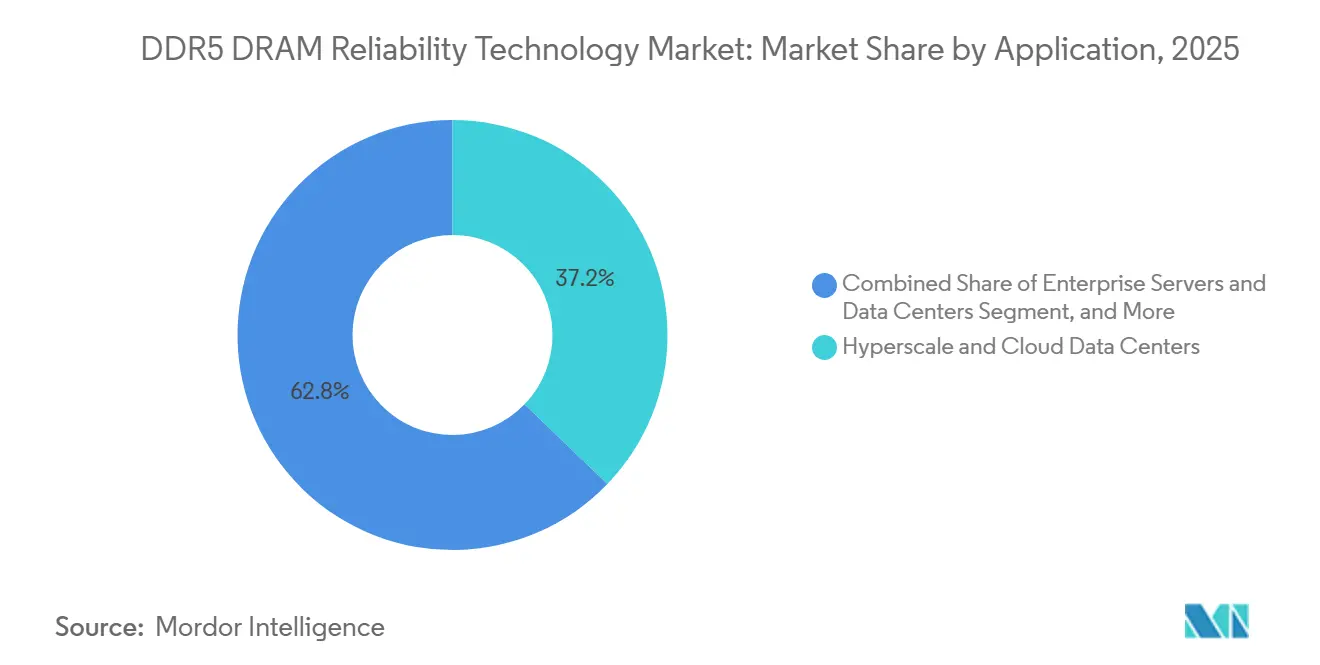
- By application, Hyperscale and Cloud Data Centers held 37.19% share of the DDR5 DRAM reliability technology market in 2025, while AI Servers and HPC Systems are projected to expand at a 16.90% CAGR through 2031.
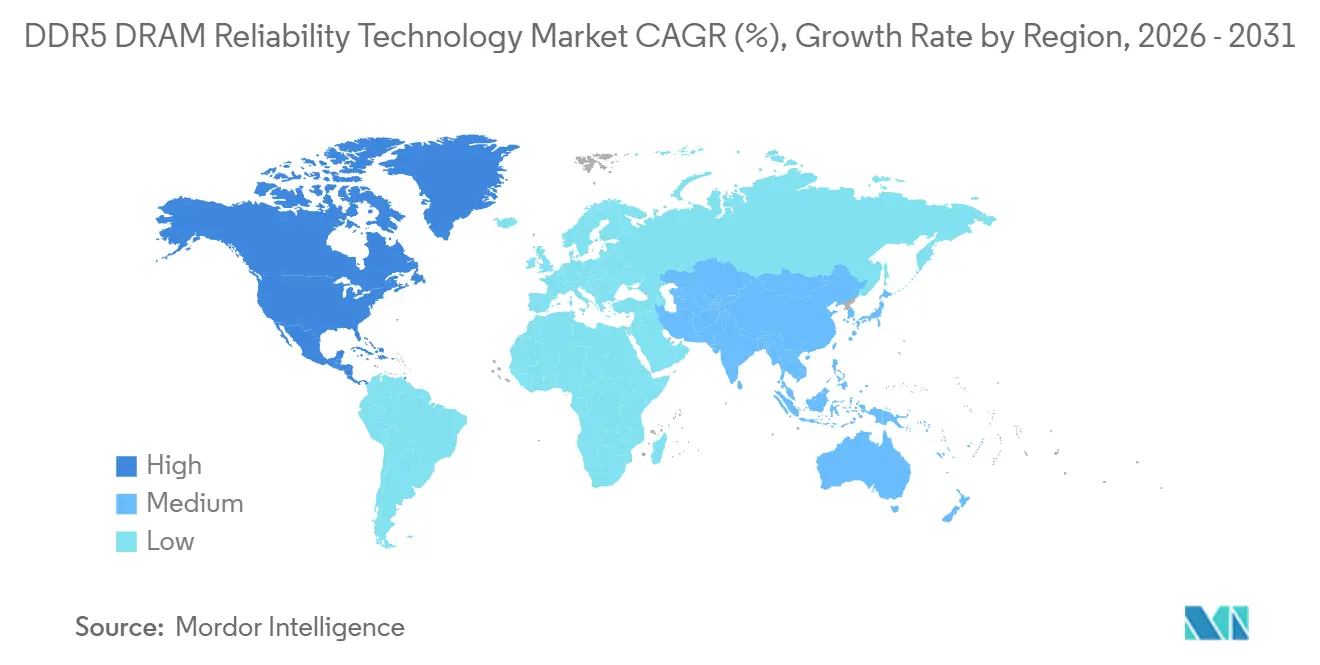
- By geography, Asia-Pacific held 49.39% share in 2025, while North America is projected to expand at an 18.09% CAGR through 2031.
Note: Market size and forecast figures in this report are generated using Mordor Intelligence’s proprietary estimation framework, updated with the latest available data and insights as of January 2026.
Global DDR5 DRAM Reliability Technology Market Trends and Insights
Drivers Impact Analysis*
| Driver | (~) % Impact on CAGR Forecast | Geographic Relevance | Impact Timeline |
|---|---|---|---|
| AI Server Memory Reliability Requirements | +4.5% | Global, with highest concentration in North America and APAC core (South Korea, Taiwan, China) | Short term (≤ 2 years) |
| DDR5 Platform Transition in Servers and Workstations | +3.8% | Global, with early leadership in North America and Europe followed by APAC mid-range enterprise | Short term (≤ 2 years) |
| Higher Memory Density and Bandwidth per Socket | +2.5% | Global - North America hyperscale and South Korean manufacturing drive initial adoption | Medium term (2-4 years) |
| Compliance-Driven Adoption in Regulated and Safety-Critical Systems | +1.8% | North America and EU; spill-over to Japan and South Korea government and defense channels | Medium term (2-4 years) |
| CXL-Enabled Memory Expansion and Pooling | +1.2% | APAC core and North America; emerging in EU enterprise and telecom sectors | Long term (≥ 4 years) |
| Field-Level Memory Fault Analytics and Fleet RAS Automation | +0.8% | Global - greatest uptake in hyperscale fleets; spill-over to mid-tier enterprise | Medium term (2-4 years) |
| Source: Mordor Intelligence | |||
AI Server Memory Reliability Requirements
AI server memory requirements are raising the minimum reliability threshold across the DDR5 DRAM reliability technology market. Large language model inference systems can turn a single uncorrected multi-bit fault into silent output corruption, which makes memory resilience a direct operating requirement rather than a secondary feature. A 2025 IEEE DSN field study found that DDR5 showed lower corrected error rates than DDR4, but it also noted that the opacity of on-die ECC can reduce diagnostic visibility for vendors and operators.[1]Majed Valad Beigi et al., “DDR5 DRAM Faults in the Field,” IEEE DSN Supplemental, doi.org. The Open Compute Project stated in its 2025 GPU and Accelerator RAS requirements that AI server memory subsystems should support DDR5 x10 chip-kill capability, which pushes demand toward stronger system-level correction and recovery layers. This leaves the DDR5 DRAM reliability technology market more dependent on qualification depth, telemetry handling, and fleet-level fault management than on raw speed alone.
DDR5 Platform Transition in Servers and Workstations
The server platform transition is compressing the DDR4 phase-out cycle and accelerating adoption across the DDR5 DRAM reliability technology market. New Intel Xeon 6 and AMD EPYC Turin platforms center on DDR5, so buyers building fresh server fleets no longer use DDR4 support as a procurement hedge. JEDEC updated the JESD79-5C DDR5 standard in April 2024 and extended timing parameters to 8,800 MT/s while adding per-row activation counting to address rowhammer-class fault behavior.[2]JEDEC Solid State Technology Association, “JEDEC Updates JESD79-5C DDR5 SDRAM Standard, Elevating Performance and Security for Next-Gen Technologies,” Business Wire, businesswire.com. This means many platform migrations now deliver a reliability upgrade and a bandwidth upgrade at the same time, which changes how enterprise buyers think about refresh timing and validation priorities. The shorter transition window favors vendors that already have qualification coverage across processors, boards, firmware stacks, and server OEM ecosystems.
Higher Memory Density and Bandwidth per Socket
Higher density and higher bandwidth are supporting the DDR5 DRAM reliability technology market because they improve slot efficiency as well as performance. Micron stated in May 2026 that its 256 GB DDR5 RDIMM, sampled at up to 9,200 MT/s on 1-gamma technology, reduced operating power by more than 40% compared with two 128 GB modules, using 11.1 W instead of 19.4 W.[3]Micron Technology, Inc., “Micron Redefines AI Performance With Sampling of 256GB DDR5 Server Module,” GlobeNewswire, globenewswire.com. JEDEC said in October 2025 that the JESD400-5D SPD standard added support for DDR5-9200 speeds and expanded MRDIMM error logging, which improves the firmware base for monitoring high-density modules in production. Cadence also announced in April 2025 that it had validated the first DDR5 12.8 Gbps MRDIMM Gen2 memory IP solution on TSMC N3, which showed that much higher bandwidth can be achieved with multiplexed rank designs using current-generation DRAM components. As a result, the DDR5 DRAM reliability technology market is benefiting from a design path where higher-capacity modules can reduce slot count, slot power, and cooling pressure at the same time.
Compliance-Driven Adoption in Regulated and Safety-Critical Systems
Compliance needs are giving the DDR5 DRAM reliability technology market a steadier demand base outside pure hyperscale deployments. Buyers in healthcare, financial services, government, defense, telecom, and industrial environments often need clear fault-handling behavior, repeatable validation, and long deployment support before approving system changes. JEDEC stated in October 2025 that the JESD400-5D SPD update added expanded MRDIMM error logging, which improves the diagnostic record available to IT teams during production use. That stronger telemetry trail matters in environments where system behavior must be documented and reviewed across long asset lives rather than short refresh cycles. This keeps the DDR5 DRAM reliability technology market favorable for vendors that can pair performance claims with qualification evidence, lifecycle continuity, and support for stricter operating conditions.
Restraints Impact Analysis*
| Restraint | (~) % Impact on CAGR Forecast | Geographic Relevance | Impact Timeline |
|---|---|---|---|
| DRAM Supply Concentration and Allocation Risk | -1.2% | Global, most acute for non-LTA enterprise buyers in North America and EU; spill-over to South America and MEA | Short term (≤ 2 years) |
| Qualification Complexity Across New DDR5 Form Factors | -0.8% | Global, most pronounced in industrial and defense markets in North America, EU, and Japan | Medium term (2-4 years) |
| High Price Premium for DDR5 ECC and High-Reliability Modules | -0.6% | Global, most restrictive for SME buyers and emerging-market data centers | Medium term (2-4 years) |
| Limited Transparency in Vendor-Specific Fault Diagnostics | -0.4% | Global, most acute in multi-vendor hyperscale deployments | Long term (≥ 4 years) |
| Source: Mordor Intelligence | |||
DRAM Supply Concentration and Allocation Risk
Supply concentration remains a clear restraint on the DDR5 DRAM reliability technology market. Samsung, SK hynix, and Micron dominate the upstream DRAM die layer, which limits sourcing flexibility for module vendors that need consistent die characteristics and validated firmware behavior. When allocation tightens, buyers outside long-term supply structures face a harder path to stable pricing, production planning, and delivery timing. This is especially important in the DDR5 DRAM reliability technology market because reliability-tier modules are not interchangeable commodities, since they depend on qualified die, interface logic, repair features, and system-level validation working together. Even when end-demand is strong, growth can slow because new design wins do not remove bottlenecks in qualified upstream supply.
Qualification Complexity Across New DDR5 Form Factors
Qualification complexity is rising as more form factors compete for attention across the DDR5 DRAM reliability technology market. RDIMM, LRDIMM, MRDIMM, CAMM2, CSODIMM, SOCAMM2, and embedded variants each require their own signal integrity work, power management validation, SPD compliance, and platform-specific certification before broad deployment. JEDEC stated in April 2026 that MRDIMM Gen2 depended on new multiplexed rank data buffer logic and that the specification was nearing completion at 12,800 MT/s, which means vendors must qualify a new electrical architecture rather than extend a familiar RDIMM design. Rambus reinforced that point in July 2026 when it launched a DDR5 9600 server RDIMM chipset with RCD, PMIC, and SPD hub components tailored for next-generation designs, showing how much readiness depends on validated interface logic as well as DRAM content.[4]Rambus Inc., “Rambus Enables Next-Generation AI and Data Center Platforms With DDR5 9600 Server RDIMM Chipset,” Business Wire via Morningstar, morningstar.com. This longer engineering cycle slows smaller vendors more than large ones, because they must spread qualification resources across several module paths at the same time.
*Our forecasts treat driver/restraint impacts as directional, not additive. The impact forecasts reflect baseline growth, mix effects, and variable interactions.
Segment Analysis
By Technology: Advanced Reliability Modules Anchor AI-Driven Architecture
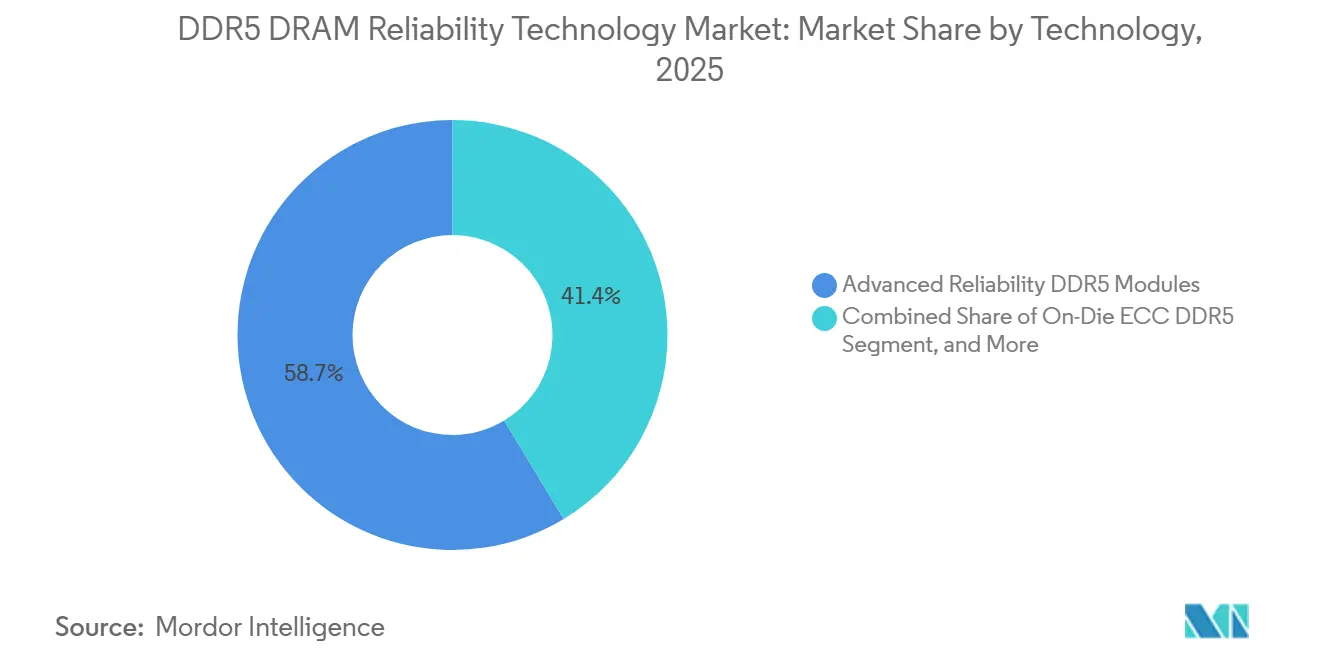
Advanced Reliability DDR5 Modules held 58.65% share of the By Technology segmentation in 2025, which shows where the DDR5 DRAM reliability technology market is concentrating its highest-value demand. These modules combine on-die ECC with stronger system-level correction, patrol scrub, and repair features, so they address faults across more than one layer of the memory path. The Open Compute Project stated in 2025 that AI server memory subsystems should support DDR5 x10 chip-kill capability, which reinforced demand for modules that go beyond baseline error correction. That requirement effectively raises the minimum acceptable design level for suppliers targeting accelerator-heavy server fleets. As a result, the DDR5 DRAM reliability technology market is rewarding vendors that can prove resilience at the die, module, and system levels in one validated package.
On-Die ECC DDR5 and System-Level ECC DDR5 Modules remain relevant in workstations and mid-range enterprise systems where cost discipline is stronger, and platform demands are less severe. They still serve an important part of the DDR5 DRAM reliability technology market because many buyers need dependable correction without paying for the most complex chipkill-class architectures. JEDEC stated in October 2025 that the JESD400-5D SPD update added expanded MRDIMM error logging, which gives enterprise teams a stronger firmware basis for production fault monitoring. JEDEC also said in April 2026 that MRDIMM Gen2 was nearing completion at 12,800 MT/s and that Gen3 development had started, which shows that the top end of the technology stack will keep moving away from standard DDR5 over time. This keeps the technology mix tilted toward modules that pair speed with repairability and telemetry rather than pursuing bandwidth alone.



By Module Type: MRDIMM Redefines Bandwidth Economics in Server Memory
In module type terms, RDIMM represented 44.21% of the DDR5 DRAM reliability technology market size in 2025, which reflects its incumbency across Intel Xeon and AMD EPYC server platforms. RDIMM remains the most broadly validated form factor for general-purpose enterprise and hyperscale workloads that run at mainstream production speeds. The current role of MRDIMM is not to replace RDIMM in every server, but to expand the DDR5 DRAM reliability technology market into workloads where memory bandwidth has become the limiting factor. A May 2026 academic analysis found that MRDIMMs delivered performance and energy benefits in AI and data-intensive workloads by enabling dual-rank interleaving without the signal integrity tradeoffs that limited earlier scaling paths. That keeps RDIMM in the volume center of the segment while giving MRDIMM a clear path in the premium tier.
JEDEC stated in April 2026 that MRDIMM Gen2 was nearing completion and targeting 12,800 MT/s, which gives the form factor a stronger standards base for broader server adoption. Rambus added to that momentum in July 2026 when it launched its DDR5 9600 server RDIMM chipset, including a sixth-generation RCD, which supports the interface layer needed for higher-speed server modules. LRDIMM still has a role in large memory footprints, and HPE said in May 2026 that its Compute Scale-up Server 3250 supported up to 64 TB of DDR5 across 16 sockets for business-critical in-memory workloads. Smaller form factors are also expanding the addressable base, since Innodisk said in August 2025 that its DDR5 and LPDDR5X CAMM2 modules cut space use by 60% compared to SODIMMs and added screw-lock mounting for rugged deployments. This leaves the DDR5 DRAM reliability technology market with a broad module map, where volume remains with RDIMM, while future differentiation centers on MRDIMM and specialized small-form-factor designs.
By Capacity: High-Density Modules Drive the Economics of Slot Efficiency
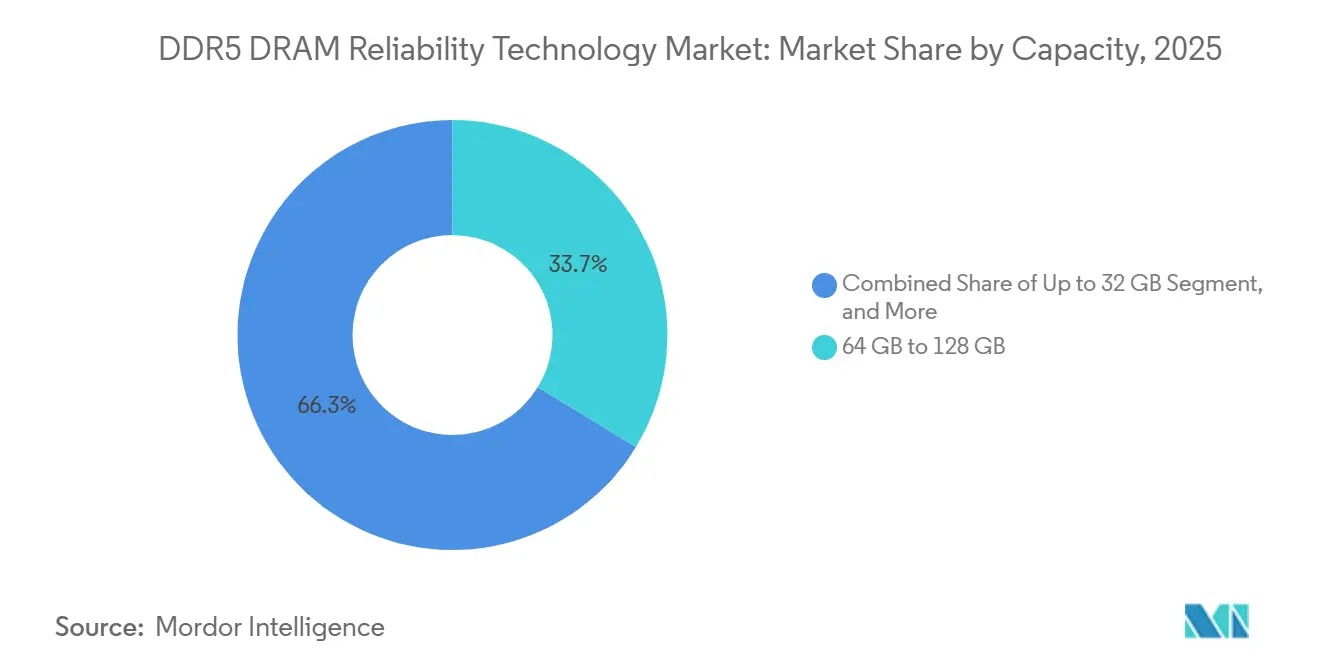
The 64 GB to 128 GB tier held a 33.72% share in 2025, making it the volume center of the capacity mix for enterprise and cloud deployments. This range fits well with current server refresh cycles because it balances capacity, cost per slot, and qualification familiarity. The Above 256 GB tier is expanding fastest in the DDR5 DRAM reliability technology market because operators want more memory per socket without adding the same number of modules, slots, and power draws. Micron said in May 2026 that its 256 GB DDR5 RDIMM used 1-gamma DRAM and 3D stacking with through-silicon vias while reducing operating power by more than 40% compared with two 128 GB modules. That makes high-density modules attractive not only for capacity gains but also for energy and cooling discipline across large deployments.
Smaller tiers, such as Up to 32 GB and 32 GB to 64 GB, continue to support workstations, edge systems, and cost-sensitive server configurations where price per bit matters more than maximum density. Those tiers still matter to the DDR5 DRAM reliability technology market because not every deployment needs extreme per-socket memory footprints. The 128 GB to 256 GB range serves as a practical migration band for enterprises moving off older DDR4 LRDIMM-heavy estates and looking for more capacity without shifting immediately to the largest modules. Micron’s May 2026 sampling program also shows how quickly the product roadmap is moving at the top end, since buyers now have a reference point for validated 256 GB DDR5 server modules at 9,200 MT/s. The result is a capacity ladder where the middle tiers still carry volume, but the highest-density tier is setting the direction of future qualification and procurement priorities in the DDR5 DRAM reliability technology market.
By Data Rate: Ultra-High-Speed Tiers Emerging as Platform Differentiators
The 5,600 MT/s to 6,400 MT/s tier held a 42.78% share in 2025, making it the mainstream production range for many enterprise server deployments. This band reflects the first large DDR5 adoption cycle on established server platforms, where buyers preferred stable qualification over immediate adoption of the highest speeds. At the same time, the Above 7,200 MT/s tier is becoming the fastest-growing segment of the DDR5 DRAM reliability technology market as hyperscale and AI platforms demand more bandwidth per slot. Rambus said in July 2026 that its DDR5 9600 server RDIMM chipset delivered a 20% increase in bandwidth over the prior generation and supported RDIMM operation up to 9,600 MT/s. That announcement matters because it shows the enabling logic for ultra-high-speed modules is moving into production-ready form.
JEDEC said in October 2025 that the JESD400-5D SPD standard added formal support for DDR5-9200 speeds, providing module vendors with a stronger framework for certifying next-generation designs across processor ecosystems. The Up to 5,600 MT/s tier still serves workstations and embedded platforms where board layout limits and cost targets remain tighter. The 6,400 MT/s to 7,200 MT/s range is becoming a practical bridge for new enterprise systems that want more bandwidth without stepping into the most demanding qualification envelope. This stratification is changing vendor positioning inside the DDR5 DRAM reliability technology market, because validated designs at 8,000 MT/s and above carry stronger pricing and earlier access to premium server programs. As a result, data rate is no longer just a performance label, it is now part of how buyers screen reliability readiness and future platform fit.
By Application: AI Workloads Are Reshaping Server Memory Architecture Fundamentals
Hyperscale and Cloud Data Centers held a 37.19% share in 2025, keeping them at the center of procurement activity in the DDR5 DRAM reliability technology market. These buyers influence validation cycles, product timing, and supply allocation because they order at scales that shape vendor roadmaps. Even so, AI Servers and HPC Systems are expanding faster because they impose tighter requirements on host memory reliability, not just on accelerator memory bandwidth. The Open Compute Project’s 2025 RAS document shows why, since it specified DDR5 x10 chip-kill capability for AI server memory subsystems. That requirement pulls the DDR5 DRAM reliability technology market toward modules that can maintain error handling under denser, hotter, and more fault-sensitive operating conditions.
Enterprise Servers and Data Centers remain a steady demand base, because DDR5 adoption in those environments follows broader CPU refresh cycles and the arrival of cost-effective, validated ECC modules. Enterprise Workstations are also relevant, since professional AI and scientific systems need memory behavior that remains stable under sustained compute loads. Telecom and Networking Infrastructure, Industrial and Edge Computing Systems, and Government, Defense, and Research Systems form a smaller but durable layer of the DDR5 DRAM reliability technology market, where qualification lives are longer and replacement cycles are less frequent. Marvell’s March 2026 launch of a 260-lane CXL switch for rack-level DDR5 memory pooling also showed how the application scope can expand beyond traditional DIMM-slot use by enabling shared and disaggregated memory architectures. This leaves the application mix balanced between hyperscale volume, AI-led growth, and specialized long-life deployments that value documented reliability over lowest-cost memory.
Geography Analysis
Asia-Pacific held 49.39% of the DDR5 DRAM reliability technology market share in 2025, which kept the region at the center of both supply and demand. South Korea anchors the regional base because Samsung and SK Hynix remain critical to advanced DRAM output and related qualification flows. Taiwan supports the DDR5 DRAM reliability technology market through module assembly, interface logic development, and broader ecosystem coordination around server memory platforms. Japan adds weight through packaging materials and process equipment, while China remains an important end-market as domestic cloud infrastructure continues to absorb more advanced server memory. This combination keeps Asia-Pacific deeply embedded in manufacturing, ecosystem support, and large-scale deployment.
North America is the fastest-growing region through 2031, and its growth is tied to rapid AI infrastructure buildout across server, accelerator, and memory subsystems. Micron’s May 2026 sampling of a 256 GB DDR5 RDIMM at up to 9,200 MT/s showed that North America remains central to the next wave of high-density server memory development. Marvell’s March 2026 launch of a CXL switch for rack-level DDR5 memory pooling showed that memory expansion and disaggregation are also becoming part of the regional architecture path. HPE’s May 2026 64 TB scale-up server announcement and Dell’s June 2026 AI infrastructure launch further show that North American system vendors are pushing platforms that absorb more advanced DDR5 configurations.
Europe holds a moderate but strategically distinct position in the DDR5 DRAM reliability technology market, where data integrity, industrial compliance, and longer validation cycles matter more than pure volume expansion. The region benefits as older server fleets move through replacement cycles and as enterprise buyers place more weight on fault telemetry and documented qualification. JEDEC’s 2025 and 2026 updates on SPD logging and the MRDIMM roadmap progression support this trend, as they provide European buyers with a stronger standards base for high-reliability deployment planning. The Rest of the World remains a smaller contributor, but telecom operators, government data center programs, and industrial users are expanding the installed base of validated DDR5 reliability modules. That keeps the global footprint of the DDR5 DRAM reliability technology market wider than hyperscale alone, even though the highest growth still clusters around the main AI and server investment centers.

Competitive Landscape
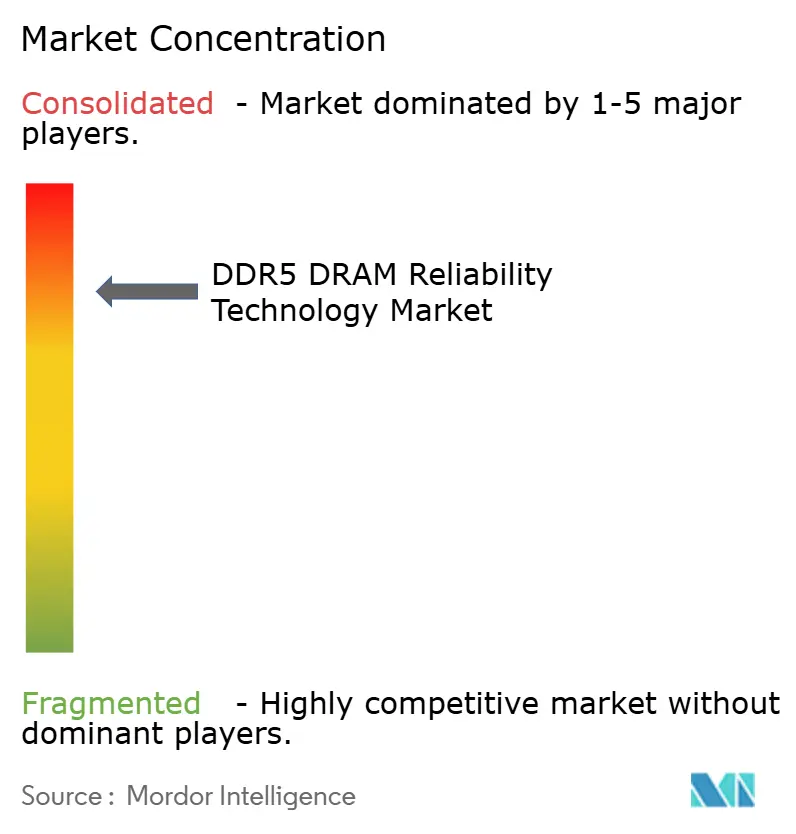
The DDR5 DRAM reliability technology market has a concentrated upstream and a more fragmented downstream. Samsung Electronics, SK hynix, and Micron Technology dominate the DRAM die base, giving them a structural advantage in cost, allocation, and qualification timing. Downstream competition is broader, spanning module specialists, server OEMs, and interface logic providers, each controlling a different part of the value chain. This means success in the DDR5 DRAM reliability technology market depends on how well vendors align die supply, interface components, firmware, and platform validation rather than on brand reach alone.
Rambus occupies a strategically important middle layer in the DDR5 DRAM reliability technology market, supplying register, power, and SPD logic for next-generation server modules. Its July 2026 DDR5 9600 server RDIMM chipset launch showed a clear move to support higher-bandwidth server memory with a full supporting logic set rather than a single component. Micron made a separate strategic move in May 2026 by sampling a 256 GB DDR5 RDIMM at up to 9,200 MT/s, positioning it for higher-density AI server deployments and delivering a strong power-efficiency message. These moves show that competition is tightening around validated high-speed and high-density designs rather than around standard module availability.
SK hynix also strengthened its position when it completed Intel Data Center Certification for a 256 GB DDR5 RDIMM in December 2025, which gave it a stronger foothold in certified AI inference deployments. In April 2026, the same company began mass production of 192 GB SOCAMM2 modules for the NVIDIA Vera-Rubin platform, which showed a willingness to pursue new server memory form factors as well as mainstream RDIMM paths. Marvell added another competitive angle in March 2026 with a 260-lane CXL switch for rack-level DDR5 memory pooling, linking memory reliability demands with disaggregated server design. HPE’s 64 TB scale-up server launch in May 2026 and Dell’s June 2026 AI infrastructure launch also show how OEM validation programs are shaping which module classes gain enterprise traction first. Industrial-focused vendors such as Innodisk, SMART Modular Technologies, Viking Technology, and Apacer continue to compete where ruggedization, lifecycle support, and qualification longevity matter more than scale. This leaves the DDR5 DRAM reliability technology market open to specialist participation downstream, even though upstream control remains in the hands of a few integrated memory suppliers.
DDR5 DRAM Reliability Technology Industry Leaders
Samsung Electronics Co., Ltd.
SK hynix Inc.
Micron Technology, Inc.
Kingston Technology Company, Inc.
Corsair Gaming, Inc.
- *Disclaimer: Major Players sorted in no particular order

Recent Industry Developments
- July 2026: Rambus announced its DDR5 9600 Server RDIMM chipset built around the 6th-generation Registering Clock Driver, delivering a 20% bandwidth increase over the prior generation and supporting RDIMMs operating up to 9,600 MT/s. The launch provides the chipset infrastructure for next-generation agentic AI and HPC server memory configurations.
- June 2026: Super Micro Computer launched 12 new server platforms optimized for Intel Xeon 6+ processors, targeting high-density cloud, virtualization, and 5G analytics workloads. The X14 platforms deliver up to 576 efficiency cores per server with DDR5 memory subsystems, designed for large-scale data centers prioritizing performance-per-watt.
- June 2026: Dell Technologies announced the Dell PowerEdge XE8812, a purpose-built liquid-cooled server featuring NVIDIA Vera Rubin NVL4 architecture with 50% more memory per socket than the prior generation GB200 NVL4 platform, targeting HPC and large-scale AI inference workloads requiring extensive in-memory model residency.
- May 2026: Micron Technology began sampling its 256 GB DDR5 RDIMM to key server ecosystem partners, built on 1-gamma DRAM technology at speeds up to 9,200 MT/s, with a single module reducing operating power by more than 40% compared to two 128 GB modules, positioning the product for hyperscale AI infrastructure that prioritizes both capacity and energy efficiency.


Global DDR5 DRAM Reliability Technology Market Report Scope
The DDR5 DRAM Reliability Technology Market Report is Segmented by Technology (On-Die ECC DDR5, System-Level ECC DDR5 Modules, Advanced Reliability DDR5 Modules), Module Type (RDIMM, LRDIMM, MRDIMM, UDIMM and CUDIMM, SODIMM and CSODIMM, CAMM2, Industrial and Embedded DDR5 Modules), Capacity (Up to 32 GB, 32 GB to 64 GB, 64 GB to 128 GB, 128 GB to 256 GB, 256 GB), Data Rate (Up to 5,600 MT/s, 5,600 MT/s to 6,400 MT/s, 6,400 MT/s to 7,200 MT/s, 7,200 MT/s), Application (Hyperscale and Cloud Data Centers, Enterprise Servers and Data Centers, AI Servers and HPC Systems, Enterprise Workstations, Telecom and Networking Infrastructure, Industrial and Edge Computing Systems, Consumer PCs and Notebooks, Government, Defense, and Research Systems), and Geography. The Market Forecasts are Provided in Terms of Value (USD).
| On-Die ECC DDR5 |
| System-Level ECC DDR5 Modules |
| Advanced Reliability DDR5 Modules |
| RDIMM |
| LRDIMM |
| MRDIMM |
| UDIMM and CUDIMM |
| SODIMM and CSODIMM |
| CAMM2 |
| Industrial and Embedded DDR5 Modules |
| Up to 32 GB |
| 32 GB to 64 GB |
| 64 GB to 128 GB |
| 128 GB to 256 GB |
| Above 256 GB |
| Up to 5,600 MT/s |
| 5,600 MT/s to 6,400 MT/s |
| 6,400 MT/s to 7,200 MT/s |
| Above 7,200 MT/s |
| Hyperscale and Cloud Data Centers |
| Enterprise Servers and Data Centers |
| AI Servers and HPC Systems |
| Enterprise Workstations |
| Telecom and Networking Infrastructure |
| Industrial and Edge Computing Systems |
| Consumer PCs and Notebooks |
| Government, Defense, and Research Systems |
| North America | |
| Europe | |
| Asia-Pacific | China |
| Japan | |
| South Korea | |
| Taiwan | |
| Rest of Asia-Pacific | |
| Rest of the World |
| By Technology | On-Die ECC DDR5 | |
| System-Level ECC DDR5 Modules | ||
| Advanced Reliability DDR5 Modules | ||
| By Module Type | RDIMM | |
| LRDIMM | ||
| MRDIMM | ||
| UDIMM and CUDIMM | ||
| SODIMM and CSODIMM | ||
| CAMM2 | ||
| Industrial and Embedded DDR5 Modules | ||
| By Capacity | Up to 32 GB | |
| 32 GB to 64 GB | ||
| 64 GB to 128 GB | ||
| 128 GB to 256 GB | ||
| Above 256 GB | ||
| By Data Rate | Up to 5,600 MT/s | |
| 5,600 MT/s to 6,400 MT/s | ||
| 6,400 MT/s to 7,200 MT/s | ||
| Above 7,200 MT/s | ||
| By Application | Hyperscale and Cloud Data Centers | |
| Enterprise Servers and Data Centers | ||
| AI Servers and HPC Systems | ||
| Enterprise Workstations | ||
| Telecom and Networking Infrastructure | ||
| Industrial and Edge Computing Systems | ||
| Consumer PCs and Notebooks | ||
| Government, Defense, and Research Systems | ||
| By Geography | North America | |
| Europe | ||
| Asia-Pacific | China | |
| Japan | ||
| South Korea | ||
| Taiwan | ||
| Rest of Asia-Pacific | ||
| Rest of the World | ||


Key Questions Answered in the Report
What is the current and forecast value of the DDR5 DRAM reliability technology space?
The DDR5 DRAM reliability technology market size stood at USD 12.46 billion in 2025, reached USD 17.93 billion in 2026, and is forecast to reach USD 35.86 billion by 2031 at a 14.87% CAGR.
Which technology category leads demand?
Advanced Reliability DDR5 Modules led the technology mix with a 58.65% share in 2025 because AI and enterprise server fleets increasingly require stronger correction, repair, and telemetry capabilities.
Why are MRDIMMs gaining attention in server memory planning?
MRDIMMs are gaining traction because they raise bandwidth without relying only on native DRAM speed scaling, and JEDECs Gen2 roadmap is moving toward 12,800 MT/s.
Which application area is driving the fastest expansion?
AI Servers and HPC Systems are expanding fastest, while Hyperscale and Cloud Data Centers remained the largest application group with a 37.19% share in 2025.
Which regions matter most for growth and supply?
Asia-Pacific remained the largest region with a 49.39% share in 2025 because of its manufacturing base, while North America is expanding fastest due to AI server and platform deployment activity.
What is shaping competition among suppliers?
Competition is being shaped by upstream DRAM concentration, downstream module specialization, and strategic moves such as Microns 256 GB RDIMM sampling, Rambuss DDR5 9600 chipset launch, and SK hynixs certified 256 GB server modules.
Page last updated on:





