
Data Center Water and Wastewater Treatment Chemicals Market Size and Share
Market Overview
| Study Period | 2021 - 2031 |
|---|---|
| Market Size (2026) | USD 1.99 Billion |
| Market Size (2031) | USD 3.08 Billion |
| Growth Rate (2026 - 2031) | 9.12 % |
| Fastest Growing Market | Asia-Pacific |
| Largest Market | North America |
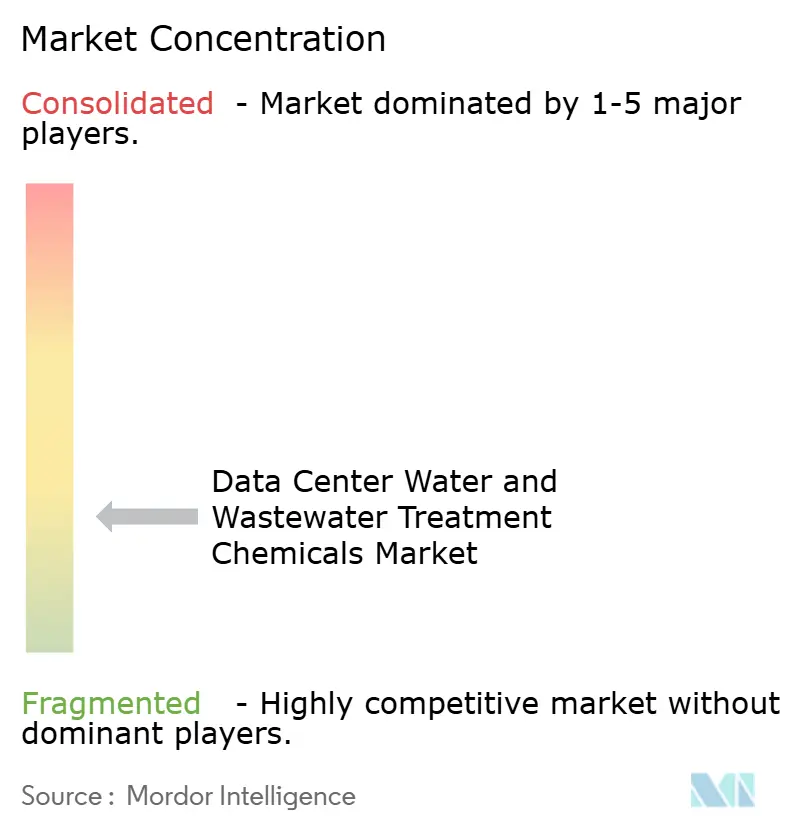
| Market Concentration | Low |
Major Players *Disclaimer: Major Players sorted in no particular order Image © Mordor Intelligence. Reuse requires attribution under CC BY 4.0. | |
Data Center Water and Wastewater Treatment Chemicals Market Analysis by Mordor Intelligence
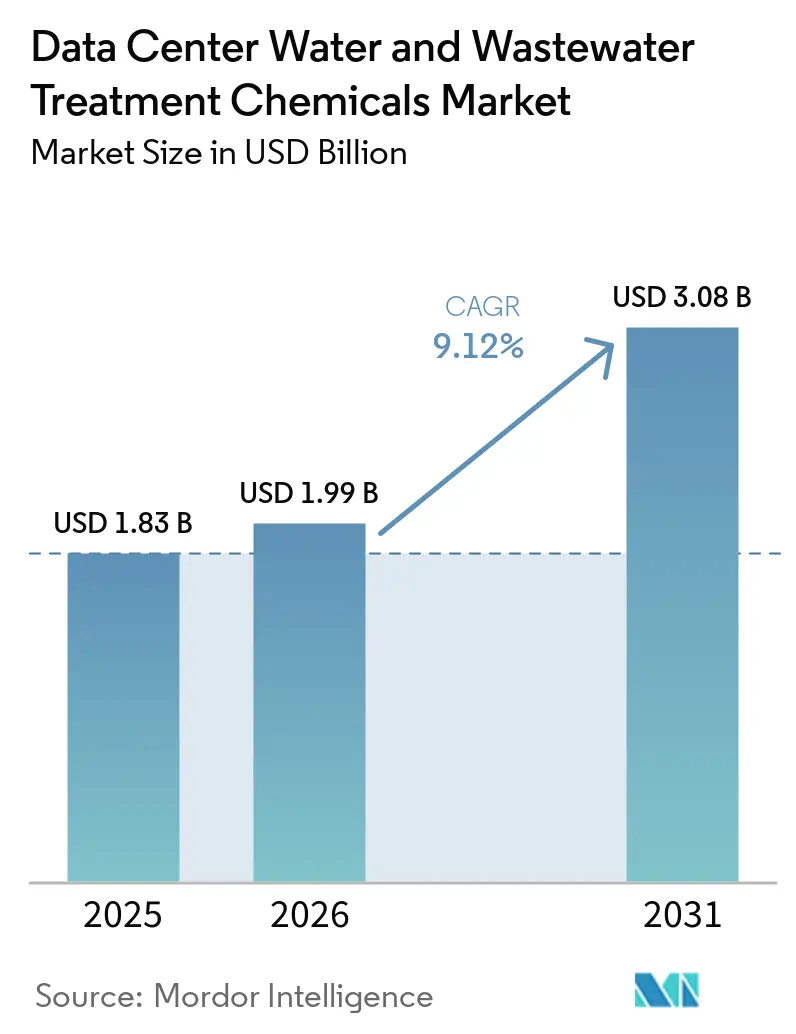
The data center water and wastewater treatment chemicals market size was estimated at USD 1.83 billion in 2025 and is estimated to grow from USD 1.99 billion in 2026 to USD 3.08 billion by 2031, at a CAGR of 9.12% during the forecast period (2026-2031). Hyperscale and colocation construction is increasing the demand for controlled cooling-water programs and wastewater treatment at large campuses. Higher rack densities are also increasing the importance of precise water chemistry, particularly where liquid cooling operates alongside conventional facility cooling systems. Water reuse requirements and tighter discharge regulations are shifting chemical treatment from a routine operating purchase to a site-planning and uptime requirement. The data center water and wastewater treatment chemicals market is, therefore, favoring suppliers that combine formulations, monitoring, and responsive local service. This creates opportunities for programs that can manage reclaimed-water variability without disrupting heat transfer or equipment protection.
Key Report Takeaways
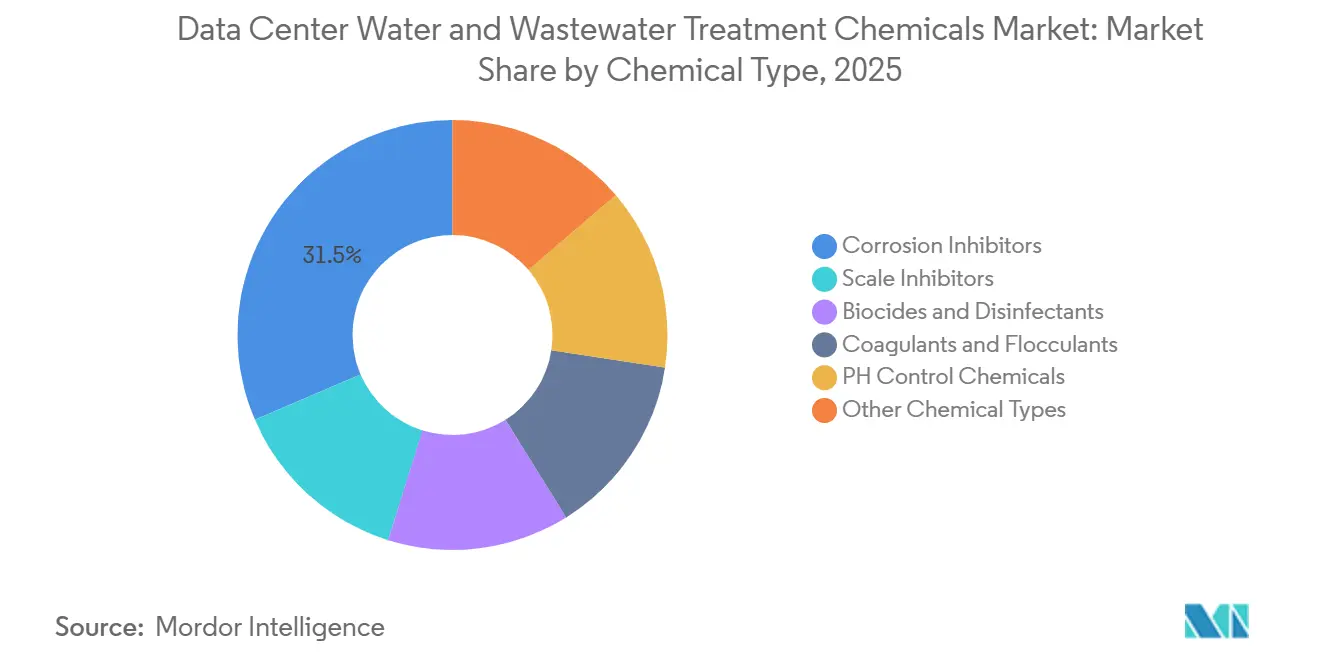
- By chemical type, corrosion inhibitors accounted for 31.45% of revenue in 2025, while biocides and disinfectants are forecast to expand at a CAGR of 10.56% through 2031.
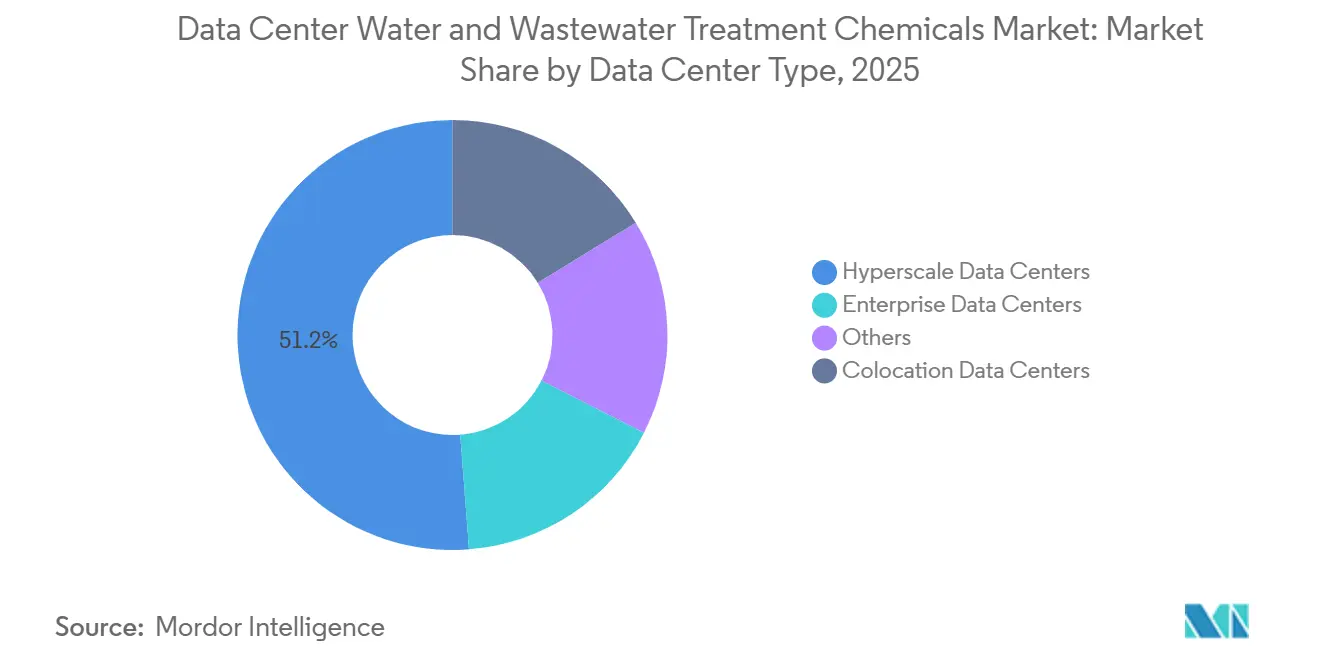
- By data center type, hyperscale facilities accounted for 51.23% of revenue in 2025 and are forecast to expand at a CAGR of 11.35% through 2031.
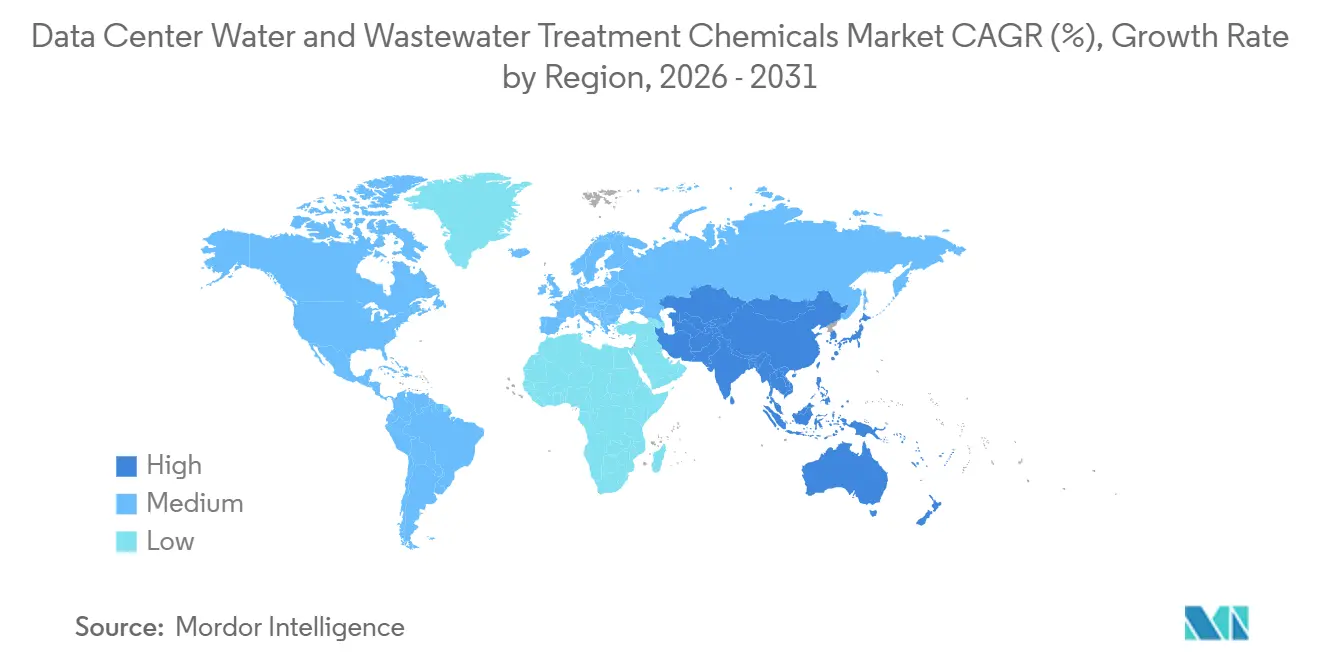
- By geography, North America held 38.55% revenue share in 2025, while the Asia-Pacific region is forecast to expand at a CAGR of 10.73% through 2031.
Note: Market size and forecast figures in this report are generated using Mordor Intelligence’s proprietary estimation framework, updated with the latest available data and insights as of January 2026.
Market Trends and Insights
Drivers Impact Analysis of Data Center Water and Wastewater Treatment Chemicals Market*
| Drivers | (~) % Impact on CAGR Forecast | Geographic Relevance | Impact Timeline |
|---|---|---|---|
| Hyperscale and Colocation Capacity Expansion | +3.2% | Global, with North America and Asia-Pacific as primary anchors | Short term (≤ 2 years) |
| High-Density AI and Liquid-Cooling Adoption | +2.4% | North America and the Asia-Pacific core, extending to Europe | Short term (≤ 2 years) |
| Water Scarcity and Reuse Requirements | +1.3% | Asia-Pacific, U.S. Southwest, and Middle East | Medium term (2-4 years) |
| Stricter Discharge and Water-Quality Compliance | +0.9% | Europe, North America, and the Asia-Pacific national frameworks | Medium term (2-4 years) |
| Variable Feedwater Chemistry in Reclaimed-Water Cooling | +0.7% | North America and Asia-Pacific, with spillover to the Middle East and Africa | Long term (≥ 4 years) |
| Source: Mordor Intelligence | |||
Hyperscale and Colocation Capacity Expansion
Global data center capacity is expected to increase sixfold from 2025 to 2035, increasing water volumes and the chemical programs used to control scale, corrosion, and biological contamination[1]. This expansion increases the number of large facilities that require water treatment designed for continuous operation. The data center water and wastewater treatment chemicals market benefits when a campus requires ongoing management rather than occasional maintenance treatment. Large campuses can consume substantial quantities of cooling water and cannot rely on manual chemical checks alone. Facilities using 5 million or more gallons per day need automated dosing, sensor-based delivery, and routine data review to keep chemistry within operating limits. These systems support higher contract values because water quality must be continuously measured, documented, and adjusted. Colocation operators face a related challenge: a single water-quality failure can affect multiple tenants with different service commitments, creating a broader service issue than it would at a single-user facility. Water management plans are also becoming increasingly important in site permitting across North America and Europe. This regulatory focus establishes a practical minimum for treatment programs and strengthens demand for suppliers capable of combining field support with measurement and reporting.
High-Density AI and Liquid-Cooling Adoption
AI training racks can reach 60-100 kW per rack, and some liquid-cooled configurations exceed 200 kW, compared with the 20-25 kW range associated with conventional air-cooled systems. This higher heat load increases the need to manage dissolved solids, deposits, and corrosion on heat-transfer surfaces. It also narrows the operating tolerance for water chemistry in systems that support high-density computing equipment. Open facility-water systems still require corrosion inhibitors, biocides, and scale control. Closed-loop cooling systems require more tightly controlled water quality and formulations compatible with aluminum and copper components, including low-conductivity water and inhibitors suited to mixed-metal circuits. As a result, a single campus may operate two distinct chemistry programs rather than one conventional cooling-water program. In August 2025, ChemTreat launched CTSolutions D2C for direct-to-chip cooling, combining treatment, monitoring, pre-commissioning passivation, operational chemistry, and digital trending. The data center water and wastewater treatment chemicals market is consequently shifting toward programs that address both facility-side and technology-side cooling requirements. Suppliers that can manage the interaction between these systems are better positioned to serve AI-focused campuses.
Water Scarcity and Reuse Requirements
Water scarcity is prompting operators to use reclaimed municipal wastewater as makeup water for cooling. This shift is especially relevant in locations where municipal supplies are constrained or where new data center capacity is subject to water-use conditions. Reclaimed supplies can contain more variable silica, phosphate, ammonia, and organic matter than potable water, making fixed-dose treatment schedules less suitable as the chemistry of the incoming water can change over time. The data center water and wastewater treatment chemicals market benefits from this change, as operators require adaptive chemical programs, continuous monitoring, and timely dosing adjustments. More complex feedwater also raises the importance of protecting cooling surfaces while maintaining blowdown quality. In April 2026, the U.S. Environmental Protection Agency's Water Reuse Action Plan 2.0 encouraged regulators to permit the use of reclaimed water for industrial cooling. China also links energy and water performance through a power-usage-effectiveness limit of 1.3 for new builds in Beijing and Shanghai. These requirements increase demand for inhibitor packages that can protect equipment under changing feedwater conditions and move water treatment closer to core operational control rather than treating it as a standard utility service.
Stricter Discharge and Water-Quality Compliance
Cooling-tower blowdown can contain concentrated biocides, phosphate-based corrosion inhibitors, heavy metals, and heat, placing the stream under closer regulatory review. Discharge management is therefore connected to the treatment plan used inside the facility. U.S. state actions through mid-2026 included data-center-specific water-use disclosure and efficiency requirements. Minnesota's 2025 law requires water-conservation measures for large consumptive-use permits, linking facility operation to documented water management. Compliance has practical consequences for the selection, application, and monitoring of treatment chemicals. The European Union Biocidal Products Regulation limits the formulations that may be used in recirculating cooling water. ASHRAE Standard 188 also makes Legionella risk management central to cooling-water programs. Together, these frameworks reduce the scope for informal dosing or unverified products. The data center water and wastewater treatment chemicals market supports suppliers that can provide compliant formulations, operating guidance, and evidence of effective control, which can favor established suppliers with the resources to maintain product registrations and technical support.
Restraints Impact Analysis of Data Center Water and Wastewater Treatment Chemicals Market*
| Restraints | (~) % Impact on CAGR Forecast | Geographic Relevance | Impact Timeline |
|---|---|---|---|
| High Cost of Advanced Treatment and Monitoring Programs | -0.5% | Global, most acute in Asia-Pacific price-sensitive markets | Medium term (2-4 years) |
| Integration Complexity in Live Mission-Critical Facilities | -0.3% | Global, particularly high-density North American campuses | Short term (≤ 2 years) |
| Non-Chemical Disinfection and Closed-Loop Substitution | -0.7% | North America and Europe, with Asia-Pacific adoption accelerating | Long term (≥ 4 years) |
| Source: Mordor Intelligence | |||
High Cost of Advanced Treatment and Monitoring Programs
AI-focused treatment programs can combine continuous sensors, automated dosing controllers, real-time analytics, and field service. These features give operators better control over water quality, but they increase program costs. Operating costs can be two to four times those of a conventional fixed-dose cooling program. This difference can delay adoption among enterprise facilities and smaller colocation sites where water-treatment budgets compete with equipment refresh spending. It can also slow the adoption of advanced monitoring, where the value of avoiding downtime has not been quantified. Price pressure is particularly strong in Asia-Pacific, where domestic suppliers offer lower-cost programs. The data center water and wastewater treatment chemicals market must therefore demonstrate how improved control protects uptime, reduces water waste, and supports regulatory compliance. Advanced programs can deliver USD 200,000 to USD 600,000 in annual efficiency savings at a scale-focused mid-tier data center, but operators need a clear life-cycle case before selecting them. This constraint is most visible in the long tail of enterprise facilities, which have meaningful installed capacity but limited ability to fund premium programs. Suppliers need to demonstrate operating savings and reduced equipment risk before price-sensitive customers switch to simpler alternatives.
Non-Chemical Disinfection and Closed-Loop Substitution
Electrochemical disinfection, ultraviolet irradiation, and advanced filtration are being used alongside, or partly in place of, oxidizing biocide programs where discharge conditions restrict residual halogen. These technologies can reduce the need for particular chemical inputs under certain operating conditions. Closed direct-to-chip systems also use less biocide and scale inhibitor per unit of heat rejected than open towers do, because they do not concentrate dissolved solids through evaporation. This lowers chemical intensity for the technology cooling portion of the new AI capacity. The change is more significant where direct-liquid cooling replaces a larger share of conventional air cooling. Most facilities, however, retain hybrid arrangements, with closed-loop systems for Graphics Processing Unit (GPU) clusters and open evaporative towers for ambient conditioning. Those open systems continue to require broad treatment for corrosion, scale, and biological control. The data center water and wastewater treatment chemicals market, therefore, continues to meet facility water demand even as cooling technology becomes more controlled and uses less water. This represents a long-term shift in the chemical mix rather than an immediate reduction in demand. Suppliers without digital monitoring or integrated services may face a weaker competitive position as this substitution develops.
*Our forecasts treat driver/restraint impacts as directional, not additive. The impact forecasts reflect baseline growth, mix effects, and variable interactions.
Data Center Water and Wastewater Treatment Chemicals Market Segment Analysis
By Chemical Type:
Corrosion Inhibitors Anchor Revenue While Biocides Lead GrowthCorrosion inhibitors accounted for 31.45% of the data center water and wastewater treatment chemicals market share in 2025, making them the largest chemical category. They are used in open recirculating towers and in a growing number of closed liquid-cooling loops, where water remains in contact with critical equipment for extended periods. Their role is to protect heat exchangers, cold plates, piping, and other wetted components from corrosion that could reduce heat transfer or damage equipment. Modern inhibitor packages use phosphonates and azoles to address mixed-metal systems containing steel, copper alloys, and aluminum. This is relevant because high-density cooling systems increasingly bring several material types into the same operating environment. These formulations must protect equipment without creating deposits or interfering with other treatment chemicals used in the system. The market is therefore moving toward packages designed for specific materials, water conditions, and cooling configurations, which require more complex chemistry than programs used in older single-metal cooling systems.
Biocides and disinfectants are forecast to grow at a 10.56% CAGR through 2031, the highest rate among chemical types. Their growth is tied to Legionella control and the continued use of open cooling towers at hyperscale campuses. Open towers create conditions that require regular biological control, particularly when facilities operate at high cycles of concentration. Higher cycles can reduce the effectiveness of conventional chlorine programs and increase the role of stabilized bromine, isothiazolinone-based non-oxidizing biocides, and chlorine dioxide. Chemical selection must also remain consistent with applicable regulatory and operational requirements. Scale inhibitors remain important because deposits on heat-transfer surfaces can cause thermal throttling and reduce cooling efficiency. Coagulants and flocculants support blowdown treatment and reclaimed-water conditioning, while pH chemicals maintain the protection provided by inhibitor packages. Other chemical types, including oxygen scavengers, antifoams, and specialty dispersants, become more relevant when facilities recover blowdown water to reduce freshwater withdrawals. Together, these categories support the data center water and wastewater treatment chemicals market across a facility's cooling and wastewater systems.

By Data Center Type:
Hyperscale Dominates While AI Campuses Redefine Treatment EconomicsHyperscale facilities held 51.23% of the data center water and wastewater treatment chemicals market share in 2025 and are forecast to grow at an 11.35% CAGR through 2031. Their scale supports comprehensive treatment programs that combine chemicals, sensors, automated dosing, field support, and continuous performance review. These campuses operate large cooling systems where small changes in water quality can affect energy use and equipment reliability. High-density AI workloads also increase the need for liquid cooling and controlled water chemistry at these sites. A scale-fouled chiller at a 100 MW hyperscale campus can generate USD 200,000 to USD 600,000 in annual excess electricity costs compared with a properly treated unit. The potential cost of lost performance makes premium treatment programs more acceptable to hyperscale operators and increases the market's dependence on suppliers that can respond quickly as operating conditions change. Longer service arrangements can give operators access to specialist support while providing suppliers with more stable revenue than individual chemical purchases.
Colocation facilities constitute the second-largest revenue segment and carry a distinct operating risk, as a single issue can affect multiple tenants simultaneously. Their operators can use chemical program quality as a service differentiator, particularly where Legionella control and remediation risk are material concerns. The multi-tenant setting places a higher value on verified procedures, reliable monitoring, and rapid correction of cooling-water problems. Enterprise facilities have lower treatment quantities and more fragmented supplier relationships, creating room for regional chemical providers. The other category includes edge and micro data centers, where sealed cooling systems are designed to limit chemical treatment needs, representing a constraint for conventional water chemistry in this smaller part of the market. The installed base was historically led by enterprise facilities, but the 2026 to 2031 period is being shaped by hyperscale additions. This shifts the demand mix toward sites that favor managed-service contracts and integrated support, which carry higher annual values than the spot-supply relationships more common in enterprise purchasing.
Geography Analysis
North America Data Center Water and Wastewater Treatment Chemicals Market
North America accounted for 38.55% of regional revenue in 2025. Large hubs, including Northern Virginia, the Pacific Northwest, Phoenix, Chicago, and Columbus, support the region's demand for cooling-water treatment. Northern Virginia's high concentration of digital infrastructure places particular importance on dependable facility water systems. US state legislatures are placing greater emphasis on water-management plans, disclosure requirements, and efficiency requirements for large data centers[2]. These requirements encourage facilities to implement treatment programs that document conservation, discharge management, and water quality control. Water constraints in parts of the US South and West are also encouraging a shift toward reclaimed sources, which raises chemical complexity because incoming water can have a more variable composition than potable supplies. Canada and Mexico add regional output through growing colocation activity in Toronto, Montreal, and Querétaro, where local water quality requires tailored treatment. The data center water and wastewater treatment chemicals market in North America is therefore shaped by both capacity concentration and water-management requirements.
APAC Data Center Water and Wastewater Treatment Chemicals Market
Asia-Pacific is forecast to grow at the fastest regional rate in the data center water and wastewater treatment chemicals market, at a CAGR of 10.73% through 2031. China's hyperscale expansion under the Eastern Data, Western Compute initiative shifts workloads to inland provinces, where water availability can differ from coastal locations, altering the source-water conditions that cooling-water programs must address. India is expanding hyperscale activity across Bangalore, Hyderabad, Mumbai, and Chennai. Rajasthan's Data Center Policy 2025 requires zero liquid discharge, rainwater harvesting, and groundwater replenishment for new facilities, increasing the need for advanced water treatment and raising the technical requirements for blowdown treatment, recovery, and reuse. In May 2026, Gradiant announced deployments of HyperSolved with large hyperscale operators across North America, Europe, and Asia. Singapore and South Korea also support higher treatment specifications through water recycling and industrial water requirements. These country-level conditions support demand for adaptive programs across the data center water and wastewater treatment chemicals market.
EMEA and South America Data Center Water and Wastewater Treatment Chemicals Market
Europe is the third-largest regional market. Germany provides a demanding regulatory environment for cooling-water chemistry, with the 42nd Federal Immission Control Ordinance (BImSchV) and the Verein Deutscher Ingenieure (VDI) 6044 standard requiring documented corrosion protection, deposit prevention, and microbiological control. These requirements make verified treatment practices more important for data center operators. The European Union Biocidal Products Regulation is narrowing the permitted range of biocides, increasing reformulation requirements for suppliers, which can benefit providers that maintain compliant product portfolios and support customers with technical documentation. South America is at an earlier stage of hyperscale development, led by activity in Brazil's São Paulo and Rio de Janeiro corridors. The Middle East and Africa are also attracting investment, including in Saudi Arabia and South Africa. Severe water scarcity in the Arabian Peninsula creates an incentive for high-recovery programs that minimize blowdown and increase cycles of concentration. These conditions present a long-term opportunity for the data center water and wastewater treatment chemicals market as large facilities transition from generic industrial treatment to data-center-specific programs.
Competitive Landscape
The data center water and wastewater treatment chemicals market is fragmented, with Ecolab, Veolia, Kemira, Kurita Water Industries, and Solenis among the largest participants. This structure leaves room for regional and mid-tier suppliers offering specialized formulations, local service, or monitoring capabilities. Large suppliers benefit from a broader technical base and the ability to combine chemistry, digital monitoring, and managed services. Major suppliers are expanding beyond chemical supply into monitoring platforms, hardware-adjacent offerings, and multiyear service contracts, positioning water treatment as part of a broader cooling and resource-management program. The competitive focus is increasingly on a supplier's ability to support uptime, water reuse, and regulatory compliance within a single operating model, thereby increasing the relevance of companies that can work across treatment chemistry, equipment protection, and operational data.
Veolia launched its Data Center Resource 360 offering in April 2026 to support carbon-neutral and water-positive data centers through closed-loop designs, reclaimed-water sourcing, and AI-driven operating controls. The offering targets up to a 75% reduction in the water footprint and integrates water chemistry into a broader site performance program. Gradiant deployed its HyperSolved platform with several large hyperscalers by May 2026. HyperSolved combines CURE Chemicals, SmartOps AI-driven dosing, alternative-source water treatment, and brine management within one provider relationship. ChemTreat's August 2025 launch of CTSolutions for direct-to-chip (D2C) cooling further illustrates the industry shift toward products designed specifically for direct-to-chip cooling applications.
Reclaimed-water makeup represents an opportunity for suppliers that can adapt dosing to variations in dissolved solids, alkalinity, and organic loads. Regional biocide formulators can compete in the Asia-Pacific market, where local water profiles and national Legionella regulations require tailored treatment programs. Product registration under the European Union Biocidal Products Regulation and alignment with ASHRAE Standard 188 can provide a competitive advantage that price alone cannot match. Digital modeling enables suppliers to assess scale risk, corrosion rates, and biocide performance before making physical changes to cooling systems, supporting a shift from periodic chemical deliveries to more continuous water-management support. The market is rewarding companies that integrate chemistry with data, equipment compatibility, and operational support a position that is particularly relevant at hyperscale sites, where treatment changes must be managed without disrupting service continuity.
Data Center Water and Wastewater Treatment Chemicals Industry Leaders
-
Veolia
-
Ecolab Inc.
-
Xylem
-
Solenis
-
Kurita Water Industries Ltd.
- *Disclaimer: Major Players sorted in no particular order
Data Center Water and Wastewater Treatment Chemicals Market Companies Covered in this Report
- Aquatech International LLC
- Buckman
- DuPont
- Ecolab Inc.
- Gradiant Corporation
- IDE Technologies
- Kemira Oyj
- Kurita Water Industries Ltd.
- Lenntech B.V.
- Saltworks Technologies Inc.
- SNF Group
- Solenis
- SUEZ
- Veolia
- Xylem
Recent Industry Developments in Data Center Water and Wastewater Treatment Chemicals Market
- July 2026: Ecolab completed its acquisition of CoolIT Systems for approximately USD 4.75 billion, adding direct-to-chip liquid-cooling hardware to its water chemistry and digital monitoring portfolio. CoolIT's year-to-date sales grew by over 100% at the close, driven by demand for AI data centers. Ecolab plans to launch an integrated 3D TRASAR cooling platform that combines CoolIT hardware with advanced cooling fluids at Supercomputing 2026 in November.
- May 2026: Gradiant announced the commercial deployment of HyperSolved, its AI data center cooling-water solution, with several of the world's largest hyperscale operators across North America, Europe, and Asia. The platform integrates CURE Chemicals, SmartOps AI-driven dosing, alternative-source water treatment, and brine management into a single vendor relationship, replacing fragmented multi-supplier models. Gradiant expects data centers to represent approximately 25% of its global revenue by 2027.
Global Data Center Water and Wastewater Treatment Chemicals Market Report Scope
Data center water and wastewater treatment chemicals are specialized compounds used to condition, maintain, and clean the large volumes of water required for server cooling. They prevent scale, corrosion, and bacterial growth that can damage equipment, and treat discharge water before it leaves the facility.
The data center water and wastewater treatment chemicals market is segmented by chemical type, data center type, and geography. By chemical type, the market is segmented into corrosion inhibitors, scale inhibitors, biocides and disinfectants, coagulants and flocculants, pH control chemicals, and other chemical types. By data center type, the market is segmented into hyperscale data centers, colocation data centers, enterprise data centers, and others. The report also covers market size and forecasts for the data center water and wastewater treatment chemicals across 15 countries in major regions. The market sizes and forecasts are provided in terms of value (USD).
Segmentation Overview
| Corrosion Inhibitors |
| Scale Inhibitors |
| Biocides and Disinfectants |
| Coagulants and Flocculants |
| pH Control Chemicals |
| Other Chemical Types |
| Hyperscale Data Centers |
| Colocation Data Centers |
| Enterprise Data Centers |
| Others |
| Asia-Pacific | China |
| India | |
| Japan | |
| South Korea | |
| Rest of Asia-Pacific | |
| North America | United States |
| Canada | |
| Mexico | |
| Europe | Germany |
| United Kingdom | |
| France | |
| Italy | |
| Rest of Europe | |
| South America | Brazil |
| Argentina | |
| Rest of South America | |
| Middle East and Africa | Saudi Arabia |
| South Africa | |
| Rest of Middle East and Africa |
| By Chemical Type | Corrosion Inhibitors | |
| Scale Inhibitors | ||
| Biocides and Disinfectants | ||
| Coagulants and Flocculants | ||
| pH Control Chemicals | ||
| Other Chemical Types | ||
| By Data Center Type | Hyperscale Data Centers | |
| Colocation Data Centers | ||
| Enterprise Data Centers | ||
| Others | ||
| By Geography | Asia-Pacific | China |
| India | ||
| Japan | ||
| South Korea | ||
| Rest of Asia-Pacific | ||
| North America | United States | |
| Canada | ||
| Mexico | ||
| Europe | Germany | |
| United Kingdom | ||
| France | ||
| Italy | ||
| Rest of Europe | ||
| South America | Brazil | |
| Argentina | ||
| Rest of South America | ||
| Middle East and Africa | Saudi Arabia | |
| South Africa | ||
| Rest of Middle East and Africa | ||
Key Questions Answered in the Report
What is current market size of Data Center Water and Wastewater Treatment Chemicals Market?
The data center water and wastewater treatment chemicals market size was estimated at USD 1.83 billion in 2025 and is estimated to grow from USD 1.99 billion in 2026 to USD 3.08 billion by 2031, at a CAGR of 9.12% during the forecast period (2026-2031).
Which chemical type drives revenue in data center cooling water treatment?
Corrosion inhibitors led with a 31.45% revenue share in 2025 because they protect equipment in open towers and closed liquid-cooling loops.
Which chemical category is growing fastest through 2031?
Biocides and disinfectants are projected to grow at a 10.56% CAGR through 2031, supported by Legionella control and the use of open cooling towers.
Why do AI data centers need specialized water treatment?
AI racks can operate at 60-100 kW, with some liquid-cooled systems exceeding 200 kW and requiring tighter chemistry control. Facility water and technology cooling systems may require different formulations, monitoring methods, and material compatibility controls. This separation matters because open towers and closed loops operate under different water conditions and use different materials.