
Data Center Security Services Market Size and Share
Market Overview
| Study Period | 2021 - 2032 |
|---|---|
| Market Size (2027) | USD 5.72 Billion |
| Market Size (2032) | USD 11.37 Billion |
| Growth Rate (2027 - 2032) | 14.73 % |
| Fastest Growing Market | Asia-Pacific |
| Largest Market | North America |
| Market Concentration | Medium |
Major Players *Disclaimer: Major Players sorted in no particular order Image © Mordor Intelligence. Reuse requires attribution under CC BY 4.0. | |
Data Center Security Services Market Analysis by Mordor Intelligence
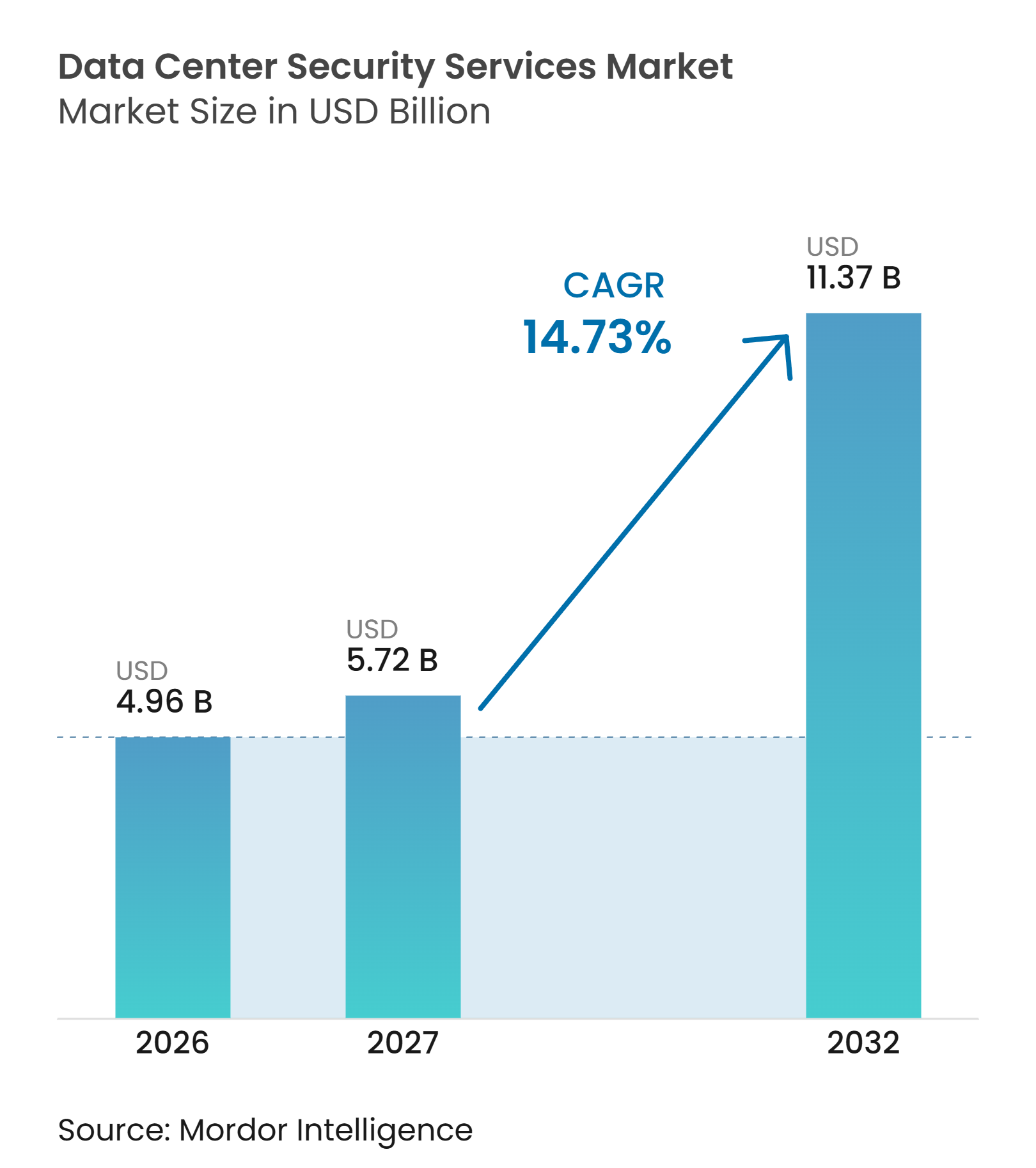
The data center security services market size is projected to expand from USD 4.96 billion in 2026 and USD 5.69 billion in 2027 to USD 11.37 billion by 2032, registering a CAGR of 14.73% between 2027 and 2032. The data center security services market is benefiting from the rapid construction of AI-focused campuses, sovereign cloud facilities, and distributed edge locations. Operators are treating physical protection, cyber monitoring, and compliance reporting as connected operating requirements rather than separate purchases. This changes provider selection because buyers increasingly seek partners that can coordinate people, systems, response procedures, and audit records. The data center security services market also faces higher delivery costs and a limited pool of people with both facility and cybersecurity expertise.
Key Report Takeaways
- By service type, manned guarding and physical security held 32.71% of the data center security services market in 2026, while Security Operations Center Services are projected to expand at a 15.26% CAGR through 2032.
- By service delivery model, on-site security services held 47.28% in 2026, while remote and centralized security services are projected to expand at a 16.92% CAGR through 2032.
- By contract type, dedicated site-level contracts held 38.74% in 2026, while managed service agreements are projected to expand at a 16.39% CAGR through 2032.
- By customer type, colocation providers held 46.54% in 2026, while cloud service providers are projected to expand at an 18.59% CAGR through 2032.
- By data center size, hyperscale data centers held 46.21% in 2026 and are projected to expand at a 17.27% CAGR through 2032.
- By geography, North America held 39.31% in 2026, while Asia-Pacific is projected to expand at a 17.96% CAGR through 2032.
Note: Market numbers in this report are based on Mordor Intelligence's proprietary estimation framework, which combines nine months of actuals with Q4 projections for base year 2026.
Market Trends and Insights
Drivers Impact Analysis of Data Center Security Services Market*
| Driver | (~) % Impact on CAGR Forecast | Geographic Relevance | Impact Timeline |
|---|---|---|---|
| Hyperscale and AI Data Center Expansion | +3.5% | Global, with concentration in North America and Asia-Pacific core | Short term (≤ 2 years) |
| Escalating Cyberattack Sophistication | +3.2% | Global | Short term (≤ 2 years) |
| Compliance-by-Design Requirements | +2.3% | Europe, North America, expanding to Asia-Pacific and Middle East and Africa | Medium term (2-4 years) |
| Cloud and Hybrid IT Attack-Surface Expansion | +1.9% | Global | Short term (≤ 2 years) |
| AI-Enabled Zero-Trust Fabric Inside Data Centers | +1.4% | North America and Europe | Medium term (2-4 years) |
| Autonomous Security for Edge and Modular Data Centers | +0.9% | Global, particularly Asia-Pacific, Middle East and Africa, and rural North America | Long term (≥ 4 years) |
| Source: Mordor Intelligence | |||
Hyperscale and AI Data Center Expansion
AI infrastructure development is increasing the need for security coverage throughout construction, commissioning, and normal operations. Each additional megawatt increases the number of access points, equipment areas, contractors, and operational systems requiring supervision. The data center security services market, therefore, requires both visible site protection and continuous monitoring of events that may affect critical equipment. Johnson Controls reported that data center-related orders rose 56% year over year in its first fiscal quarter of 2026, while its backlog reached USD 13.3 billion, up 22%.[1] This purchasing pattern indicates that controls and security requirements are being included early in facility investment programs. Hyperscale campuses also favor suppliers that can apply a consistent standard across multiple locations and changing project phases.
Escalating Cyberattack Sophistication
The severity of cyber incidents has increased the consequences of weak coordination between physical and logical controls. Uptime Institute reported that 2025 was the first year in which operators identified their most significant incidents as costing more than USD 50 million, and it documented 8 cyberattacks on digital infrastructure with combined losses of USD 8 billion.[2] The Identity Theft Resource Center recorded 3,322 U.S. data compromises in 2025, the highest annual total in its reporting. An attacker can exploit an unauthorized device, an insider action, or a network pathway, which makes separate security programs less effective. The data center security services market is responding with packages that combine guarding, intelligent surveillance, and 24-hour monitoring. This approach gives operators a clearer route for escalation when a physical event and a network anomaly occur together.
Compliance-by-Design Requirements
Security requirements are increasingly built into operating procedures and vendor contracts from the first stages of a facility program. The data center security services market is affected because customers need auditable access records, incident documentation, testing processes, and response evidence. These requirements make simple staffing arrangements less suitable for sites with strict customer, government, or financial-sector obligations. Providers with reporting platforms can make compliance tasks easier to review across a portfolio of facilities. They can also support consistent procedures when a customer operates in more than 1 jurisdiction. International standards such as ISO 27001 and SOC 2 remain important baseline references, while customer obligations can add further controls.
Cloud and Hybrid IT Attack-Surface Expansion
Hybrid environments combine data hall operations, public cloud workloads, remote management tools, and third-party connections. That architecture gives security teams more systems and events to track simultaneously. IBM and Palo Alto Networks found that enterprises manage an average of 83 security solutions from 29 vendors, which can create gaps across tools and slow response times. The data center security services market benefits when operators consolidate these responsibilities under fewer service relationships. Cloud shared-responsibility models also do not remove a tenant's responsibility for the security of cages, cabinets, and cross-connects. This leaves a defined role for providers to connect access events to digital security monitoring.
Restraints Impact Analysis of Data Center Security Services Market*
| Restraint | (~) % Impact on CAGR Forecast | Geographic Relevance | Impact Timeline |
|---|---|---|---|
| High Capital and Operating Costs for Multilayer Security | -2.2% | Global, most acute in emerging-market Asia-Pacific and Middle East and Africa | Medium term (2-4 years) |
| Cybersecurity Skills Shortage | -1.9% | Global, most severe in North America and Europe | Long term (≥ 4 years) |
| Power and Cooling Budgets Crowding Out Security Investment | -1.3% | North America and Europe, power-constrained locations | Medium term (2-4 years) |
| Data-Localization Architecture Complexity | -0.8% | Europe, Asia-Pacific, including India, Indonesia, and China, and Middle East and Africa | Medium term (2-4 years) |
| Source: Mordor Intelligence | |||
High Capital and Operating Costs for Multilayer Security
Multilayer protection requires spending on personnel, access control, screening, surveillance, monitoring, and operating procedures. That cost burden is more difficult for smaller facilities and edge sites, where fixed security costs are spread across less capacity. The data center security services market must therefore offer service structures that give customers more predictable costs. Separate contracts for guarding, electronic controls, and cyber monitoring can lead to duplicate management costs and slower handoffs. A managed contract can reduce these coordination gaps by establishing a single service scope, a single reporting method, and a single response process. Providers that price coverage on a per-site or per-megawatt basis may be better placed to serve customers seeking clearer cost planning.
Cybersecurity Skills Shortage
The shortage of qualified security professionals limits how quickly operators can build internal security teams. Uptime Institute found that fewer than half of data center operators maintain a dedicated cybersecurity team, while cyberattacks were the leading publicly reported cause of major facility outages. Its 2025 outage analysis also found that the share of human-error outages caused by failure to follow procedures rose by 10% from the previous year. The data center security services market can address this shortage through centralized teams, defined playbooks, and technology that reduces routine alert workloads. However, an external provider still needs staff who understand the customer's facility design and operating rules. Long-term service relationships can better retain site knowledge than a sequence of short staffing assignments.
*Our forecasts treat driver/restraint impacts as directional, not additive. The impact forecasts reflect baseline growth, mix effects, and variable interactions.
Data Center Security Services Market Segment Analysis
By Service Type:
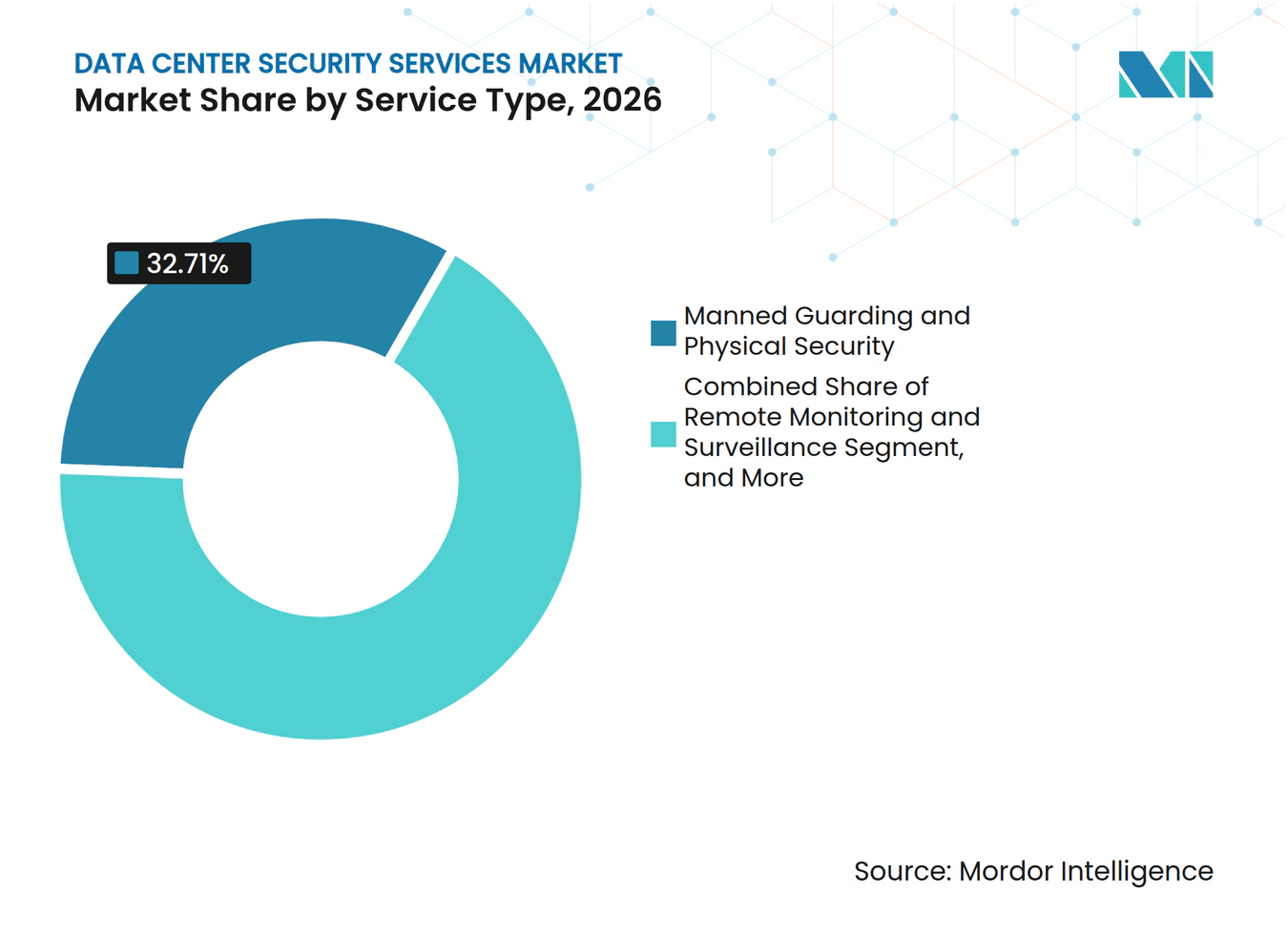
SOC Services Support a Shift Toward Continuous MonitoringManned guarding and physical security held a 32.71% data center security services market share in 2026, reflecting the continuing need to control physical access at critical facilities. Guards remain necessary for screening, escorts, visitor handling, response to alarms, and protection during construction activities. Security Operations Center Services are projected to expand at a 15.26% CAGR through 2032 as customers seek continuous review of physical and digital signals. The value opportunity for SOC services is supported by demand for faster incident triage and documented response processes. Remote monitoring and surveillance also benefit from better camera resolution, edge analytics, and improved connectivity. Security risk assessment and consulting become more important when customers need evidence that procedures match their risk profile.
The service mix is shifting from headcount-based work toward arrangements that combine trained personnel with automated detection. NTT DATA states that its AI-powered Cyber Defense Centers can reduce investigation times by up to 60% and alert volumes by up to 90%.[3] These tools do not remove the need for human review, but they help analysts focus on incidents requiring action. Access control and visitor management offer an additional opportunity where facilities use biometric credentials or need detailed contractor records. System maintenance and support can provide recurring work for integrators already serving a major campus. In this segment, the data center security services industry is moving toward packages that link physical events, cyber signals, and compliance reporting.



By Service Delivery Model:
Centralization Changes Coverage EconomicsOn-site security services held 47.28% of the data center security services market in 2026 because many physical duties require personnel at the facility. Screening visitors, escorting technicians, and responding to immediate incidents cannot be fully delivered from a remote location. Remote and centralized security services are projected to expand at a 16.92% CAGR through 2032, with a single operations center monitoring multiple sites. The data center security services market benefits from this model when customers want a common operating picture across their estate. Centralized teams can observe alarms, access activity, and video feeds while local personnel retain responsibility for physical intervention. This model is particularly relevant for operators with sites in several cities or countries.
Hybrid services combine centralized analytics with on-site response for customers who need both capabilities. They are suited to colocation operators because an event can affect several tenants and require immediate local action. Prosegur describes intelligent SOC capabilities used with data center clients in China and Singapore to support oversight of multiple sites.[4] The transition is likely to be gradual for government facilities and high-security AI training campuses because they retain substantial on-site obligations. Securitas formalized a partnership with Rohde and Schwarz in September 2025 to integrate millimeter-wave personnel screening into its offer. Such technology can extend officer coverage without requiring equivalent increases in staffing.
By Contract Type:
Managed Agreements Increase Service ScopeDedicated site-level contracts held 38.74% of the data center security services market in 2026, reflecting earlier procurement practices in which campuses sourced services separately. Managed service agreements are projected to grow at a 16.39% CAGR through 2032 as buyers increasingly seek a single provider for technology, labor, reporting, and compliance documentation. The value opportunity for managed contracts benefits from fees that are easier to forecast across a defined service period. Multi-site and regional arrangements provide an intermediate option for customers who want common standards without a fully integrated agreement. Securitas reported that its standardized approach expanded from protecting around 20 customer data centers to more than 300 globally. This supports the value of repeatable service delivery across a broad customer estate.
Integrated contracts combine physical protection and cyber monitoring under one service-level agreement. They remain a smaller category but are relevant where a customer's threat model crosses facility and network boundaries. Long-duration managed agreements can support more predictable staffing and technology planning for both parties. They can also reduce the customer's need to coordinate multiple suppliers during an incident. Providers need credible monitoring tools and clear governance to compete for this work. The data center security services industry favors firms that can demonstrate that their people, technology, and compliance reporting operate as one service rather than a loose collection of products.
By Customer Type:
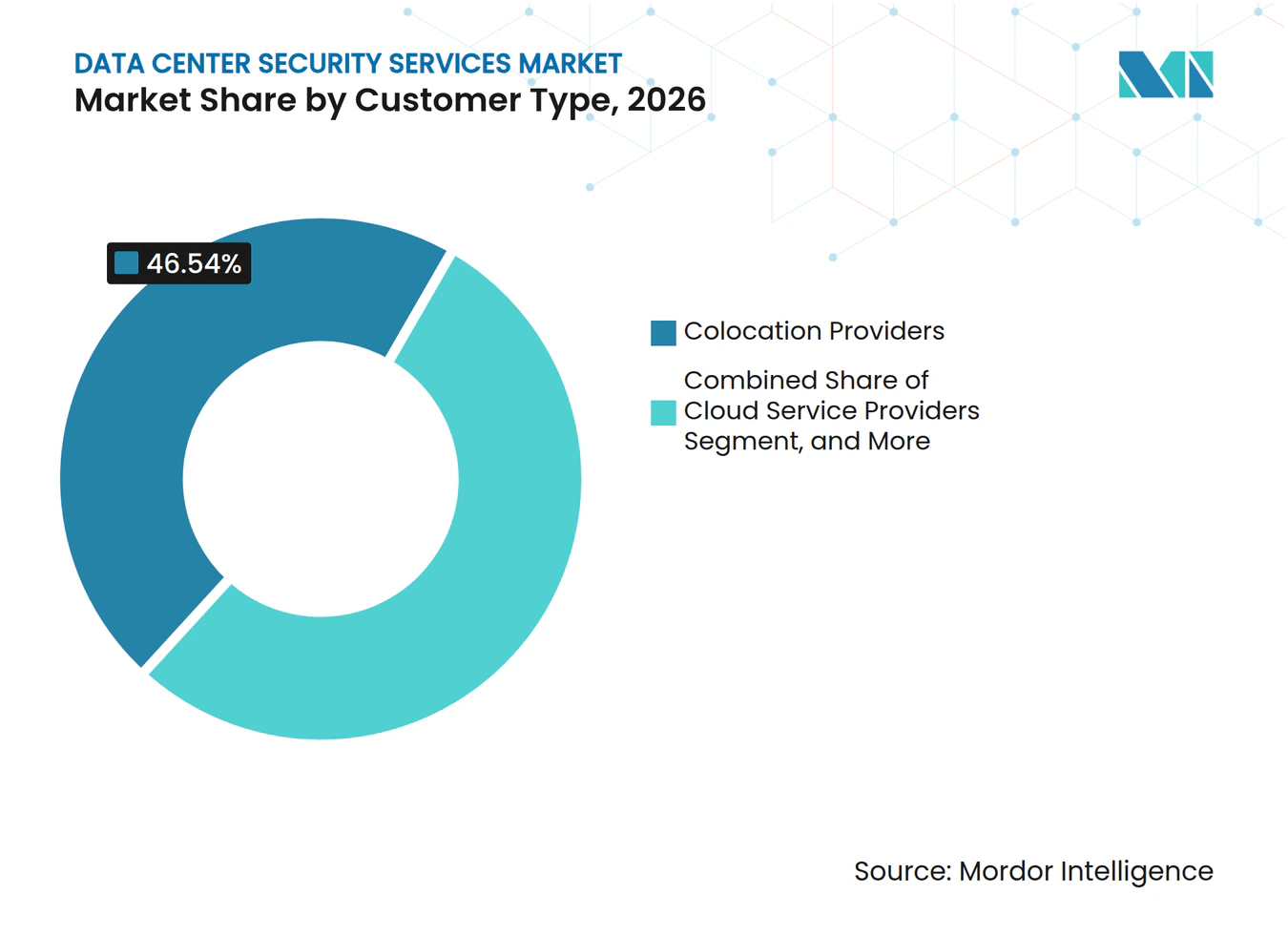
Cloud Providers Add the Strongest Demand MomentumColocation providers held 46.54% of the data center security services market in 2026 because multi-tenant facilities must separate customer access and maintain detailed records. Their security programs must manage visitors, contractors, cages, cabinets, and common areas without allowing one tenant to affect another. Cloud service providers are projected to expand at an 18.59% CAGR through 2032 as AI-related campus development increases. The data center security services market has an opportunity to serve these customers through long-term contracts that cover new construction and operations. Owned campuses may use integrated service agreements, while leased capacity generally follows the colocation operator's base program. This difference means some cloud providers will procure security directly, and others will rely on their facility partner.
Enterprise and edge operators are often more cost-sensitive because they manage smaller facilities and may have fewer security specialists. Their interest in managed services can increase when cyber risks become a board-level operational issue. The data center security services market can serve this group with remote monitoring, scheduled assessment, and scalable response services. Edge sites create a specific need because they may be lightly staffed or unmanned. Autonomous monitoring can help close this protection gap, but customers still need a clear method for physical response. A flexible service model is therefore important for providers seeking business beyond major colocation and hyperscale campuses.

By Data Center Size:
Hyperscale Facilities Lead on Scale and ExpansionHyperscale data centers accounted for 46.21% of the data center security services market in 2026 and are projected to grow at a 17.27% CAGR through 2032. This dual position reflects the concentration of capital and critical equipment at large AI-focused campuses. Hyperscale operators require extensive perimeter control, visitor management, contractor oversight, surveillance, and incident coordination. The value opportunity for this group is also shaped by the need to protect high-value compute infrastructure and sensitive customer workloads. Large facilities form the next tier, while medium and small sites have different operating needs. Uptime Institute noted that distributed resiliency tools are expanding, while hybrid architecture also creates new failure modes and unclear incident responsibility.
A large campus can spread management, training, and technology costs over more capacity than a smaller site. This creates an advantage for suppliers that can deploy a repeatable program at scale. Small and edge facilities remain important because they need protection even when they lack permanent security teams. Applied Digital selected Securitas for an AI factory campus in Ellendale, North Dakota, under a contract announced in August 2025. The example shows that structured managed security relationships are becoming relevant beyond the largest established hubs. Suppliers that can adapt remote tools to local response conditions may be best positioned for this dispersed segment.
Geography Analysis
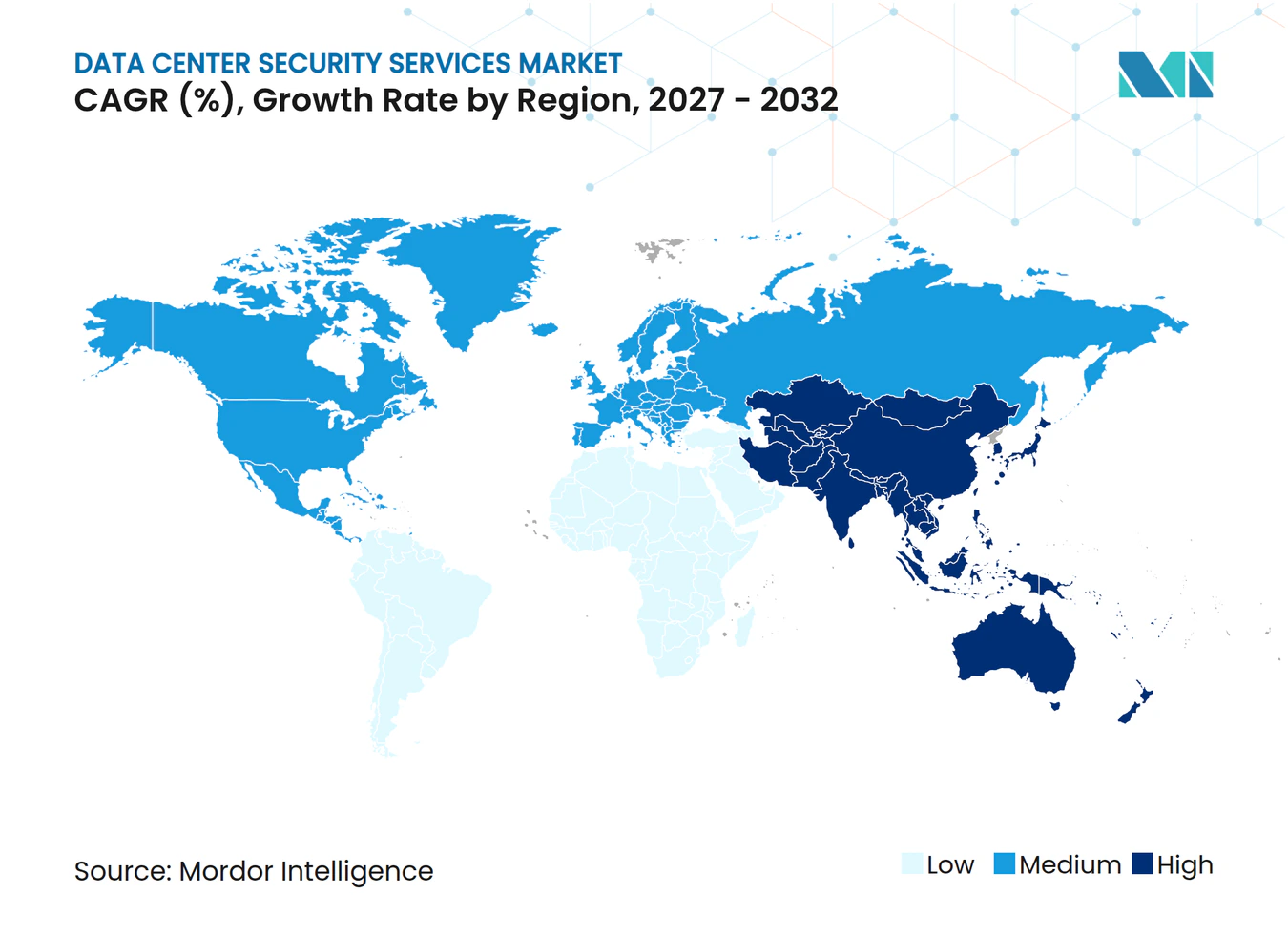
North America
North America held 39.31% of the data center security services market in 2026, supported by its large base of hyperscale and colocation facilities. The region includes important campuses in Northern Virginia, Dallas, and Phoenix, where operators need experienced service providers and consistent operating procedures. The United States has more than 3,000 operational data centers and a further 1,500 in development, according to the supplied research. A large share of planned facilities is in rural areas, where dedicated security coverage may be more important than in established urban hubs. GardaWorld and Allied Universal were among the winners of a USD 10.3 billion U.S. Army security contract in June 2025, reflecting the scale of leading protective-services providers in the country. Canada and Mexico also add to regional demand as capacity investment and data-residency needs broaden activity beyond the U.S. core.
Asia-Pacific
Asia-Pacific is projected to expand at a 17.96% CAGR through 2032, making it the fastest-growing regional part of the data center security services market. Sovereign AI investment and national data-localization requirements are increasing demand for locally delivered monitoring and security operations. India's data center security services activity is supported by sovereign AI initiatives and approvals for colocation and hyperscale projects. Singapore's data-protection environment supports demand for certified managed services, while Japan's cybersecurity requirements are encouraging upgrades from older on-site models. China adds a large domestic hyperscale base, which creates opportunities for integrated security vendors. Proofpoint expanded its local data security infrastructure in Singapore, India, and Japan in September 2026 to address data-sovereignty needs associated with AI use.
Europe
Europe has a significant presence through Germany, the United Kingdom, and France, with Frankfurt remaining a leading regional hub. Colt Data Center Services announced four new facilities across Frankfurt and Berlin in April 2025, representing EUR 2 billion (USD 2.22 billion) at 2025 average exchange rates, and 117 MW of added capacity. The region's compliance requirements make auditable and continuously updated security documentation especially valuable. The Middle East and Africa are seeing increased activity through sovereign wealth-backed development in the United Arab Emirates and Saudi Arabia. Pure DC's 45 MW facility on Yas Island in Abu Dhabi became operational in 2025 with Securitas as its security partner. South America, led by Brazil and Chile, remains a smaller opportunity, but cloud investment by U.S. hyperscalers is expanding the regional base.
Competitive Landscape
Market Concentration
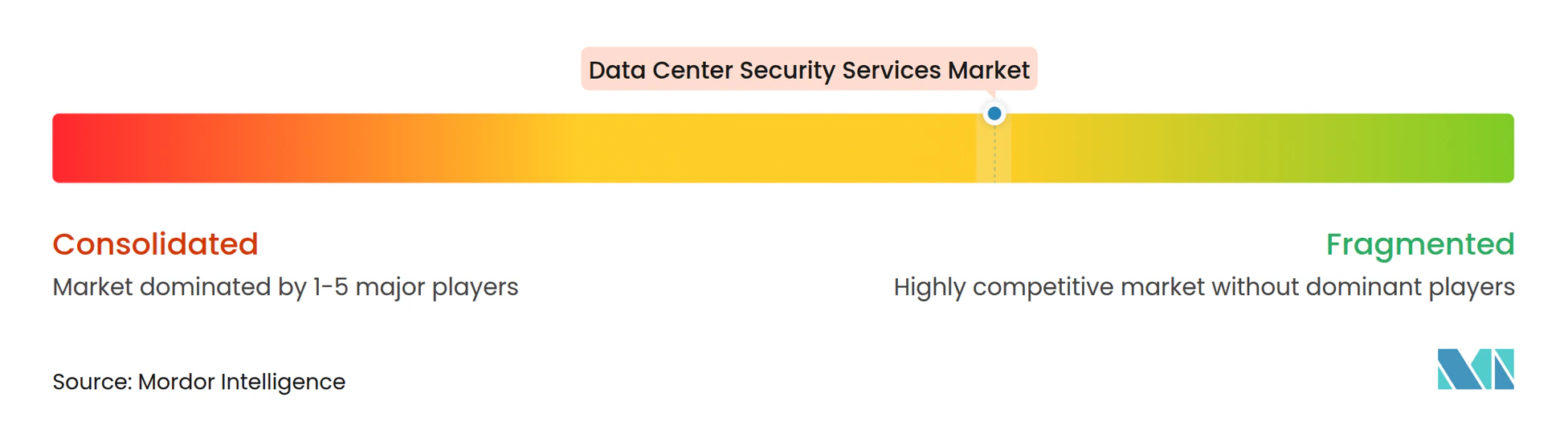
The data center security services market is moderately fragmented, with large uniformed security companies, managed security providers, systems integrators, and SOC specialists competing for contracts. Larger suppliers use broad geographic coverage and technology platforms to support complex, multi-site customers. Their offers increasingly include video analytics, centralized operations centers, and compliance reporting rather than guarding alone. Convergint reported the acquisition of Fiber Solutions in May 2025, adding fiber-optic, structured cabling, and electronic security capabilities in the Southeast United States. The transaction reflects the value of integrating the infrastructure that supports surveillance, access control, and connectivity. Competitive strength depends on whether providers can deliver reliable physical protection while handling a growing volume of security data.
There is room for differentiated offers in edge and modular facilities, where unmanned or lightly staffed sites need cost-effective remote oversight. Integrated physical and cyber managed services are also an open area, as relatively few suppliers provide both under a single, clear agreement. Accenture agreed in June 2026 to acquire a majority stake in Dragos, as well as all of runZero and NetRise, with a combined enterprise value of USD 4.175 billion, to expand its critical-infrastructure cybersecurity platform. The move illustrates the importance of operational-technology and IT security convergence for critical infrastructure customers. Technology-led differentiation can shift purchasing discussions away from guard hours and toward response quality, monitoring coverage, and documented outcomes. Providers that can meet certification and reporting needs have a stronger basis for multi-year awards.
Securitas is emphasizing technology-integrated services rather than labor-only guarding. Its third-quarter 2026 report identified data centers, defense, and pharmaceuticals as high-growth segments, while technology and solutions revenue reached 35% of group revenue, compared with 33% a year earlier. The September 2025 Rohde and Schwarz partnership provides another example of this strategy through non-contact personnel screening. The data center security services market remains accessible to specialists, but they need a clear technology, service, or geographic advantage. Buyers are likely to favor suppliers that can maintain consistent procedures across campuses and show evidence of effective incident management.
Data Center Security Services Industry Leaders
-
GardaWorld
-
Johnson Controls International plc
-
Prosegur Compañía de Seguridad, S.A.
-
Convergint Technologies LLC
-
Mitie Group plc
- *Disclaimer: Major Players sorted in no particular order
Data Center Security Services Market Companies Covered in this Report
- GardaWorld
- G4S
- Prosegur
- Convergint
- Mitie
- ICTS Europe
- Securitas AB
- Allied Universal
- Johnson Controls International plc
- Cisco Systems, Inc.
- IBM Corporation
- Palo Alto Networks, Inc.
- Fortinet, Inc.
- Honeywell International Inc.
- Check Point Software Technologies Ltd.
- Genetec Inc.
- Axis Communications AB
- ASSA ABLOY AB
- Siemens AG
- Schneider Electric SE
- Bosch Sicherheitssysteme GmbH
- Hewlett Packard Enterprise Company
- Juniper Networks, Inc.
- Trend Micro Incorporated
- Broadcom Inc.
- Dell Technologies Inc.
- Arista Networks, Inc.
Recent Industry Developments in Data Center Security Services Market
- September 2026: Convergint delivered a complex, scalable physical security solution for a confidential hyperscale data center in Frankfurt, Germany, encompassing enterprise video surveillance, access control, biometric authentication, anti-tailgating technology, intelligent key management, and server cabinet locks, demonstrating a replicable delivery model for large-campus critical infrastructure.
- June 2026: Accenture entered agreements to acquire a majority stake in Dragos and 100% of runZero and NetRise at a combined enterprise value of USD 4.175 billion to deliver end-to-end OT cybersecurity for critical infrastructure including data centers, building on its USD 10 billion cybersecurity business, with transactions expected to close in late 2026.
- March 2026: Johnson Controls reinforced its data center and mission-critical security leadership at ISC West 2026, launching C•CURE IQ 3.2 with built-in video management and standardized incident workflows, alongside hardware updates spanning PowerSeries Neo 5, IQ Panel 5, Kantech EntraPass 9.10, and exacqVision 26.0.
- February 2026: Securitas signed a binding agreement to acquire Liferaft, a SaaS-based threat intelligence platform focused on North America, to add digital risk intelligence capabilities and expand high-margin recurring monthly revenue.
Global Data Center Security Services Market Report Scope
The data center security services market comprises the revenue generated from security services delivered to data center facilities, including manned guarding, remote monitoring and surveillance, security operations center services, risk assessment and consulting, access control and visitor management, and security system maintenance and support. It covers services provided to colocation providers, cloud service providers, and enterprise or edge data center operators to protect facilities, assets, personnel, and critical infrastructure against physical, cyber-physical, and operational security threats.
The Data Center Security Services Market Report is Segmented by Service Type (Manned Guarding and Physical Security, Remote Monitoring and Surveillance, Security Operations Center Services, Security Risk Assessment and Consulting, Access Control and Visitor Management Services, and Security System Maintenance and Support), Service Delivery Model (On-Site Security Services, Remote and Centralized Security Services, and Hybrid Security Services), Contract Type (Dedicated Site-Level Contracts, Multi-Site and Regional Contracts, Integrated Security Service Contracts, and Managed Service Agreements), Customer Type (Colocation Providers, Cloud Service Providers (CSPs), and Enterprise / Edge Data Center Operators), Data Center Size (Small, Medium, Large, and Hyperscale), and Geography (North America, South America, Europe, Asia-Pacific, and Middle East and Africa). The Market Forecasts are Provided in Terms of Value (USD).
Segmentation Overview
| Manned Guarding and Physical Security |
| Remote Monitoring and Surveillance |
| Security Operations Center Services |
| Security Risk Assessment and Consulting |
| Access Control and Visitor Management Services |
| Security System Maintenance and Support |
| On-Site Security Services |
| Remote and Centralized Security Services |
| Hybrid Security Services |
| Dedicated Site-Level Contracts |
| Multi-Site and Regional Contracts |
| Integrated Security Service Contracts |
| Managed Service Agreements |
| Colocation Providers |
| Cloud Service Providers (CSPs) |
| Enterprise / Edge Data Center Operators |
| Small |
| Medium |
| Large |
| Hyperscale |
| North America | United States |
| Canada | |
| Mexico | |
| South America | Brazil |
| Argentina | |
| Chile | |
| Rest of South America | |
| Europe | Germany |
| United Kingdom | |
| France | |
| Italy | |
| Rest of Europe | |
| Asia-Pacific | China |
| Japan | |
| India | |
| Singapore | |
| Rest of Asia-Pacific | |
| Middle East and Africa | Saudi Arabia |
| United Arab Emirates | |
| South Africa | |
| Nigeria | |
| Rest of Middle East and Africa |
| By Service Type | Manned Guarding and Physical Security | |
| Remote Monitoring and Surveillance | ||
| Security Operations Center Services | ||
| Security Risk Assessment and Consulting | ||
| Access Control and Visitor Management Services | ||
| Security System Maintenance and Support | ||
| By Service Delivery Model | On-Site Security Services | |
| Remote and Centralized Security Services | ||
| Hybrid Security Services | ||
| By Contract Type | Dedicated Site-Level Contracts | |
| Multi-Site and Regional Contracts | ||
| Integrated Security Service Contracts | ||
| Managed Service Agreements | ||
| By Customer Type | Colocation Providers | |
| Cloud Service Providers (CSPs) | ||
| Enterprise / Edge Data Center Operators | ||
| By Data Center Size | Small | |
| Medium | ||
| Large | ||
| Hyperscale | ||
| By Geography | North America | United States |
| Canada | ||
| Mexico | ||
| South America | Brazil | |
| Argentina | ||
| Chile | ||
| Rest of South America | ||
| Europe | Germany | |
| United Kingdom | ||
| France | ||
| Italy | ||
| Rest of Europe | ||
| Asia-Pacific | China | |
| Japan | ||
| India | ||
| Singapore | ||
| Rest of Asia-Pacific | ||
| Middle East and Africa | Saudi Arabia | |
| United Arab Emirates | ||
| South Africa | ||
| Nigeria | ||
| Rest of Middle East and Africa | ||
Key Questions Answered in the Report
What is the data center security services market size?
The data center security services market is projected to increase from USD 4.96 billion in 2026 and USD 5.69 billion in 2027 to USD 11.37 billion by 2032, at a 14.73% CAGR.
Which service is expanding fastest in data center security services?
Security Operations Center Services are projected to expand at a 15.26% CAGR through 2032, supported by demand for continuous monitoring and coordinated response.
Why do data centers need integrated physical and cyber security?
Physical access events and network threats can be linked, so integrated programs can improve escalation, monitoring, and incident documentation.
Which customer group has the strongest demand outlook?
Cloud service providers are projected to expand at an 18.59% CAGR through 2032 as AI-related campus construction progresses.
Which region has the fastest data center security services expansion?
Asia-Pacific is projected to expand at a 17.96% CAGR through 2032, supported by sovereign AI investment and data-localization requirements.
What contract model is gaining traction with data center operators?
Managed service agreements are projected to expand at a 16.39% CAGR through 2032 because they combine technology, personnel, reporting, and compliance documentation.