
Dairy Cattle Feed Additives Market Size and Share
Market Overview
| Study Period | 2021 - 2031 |
|---|---|
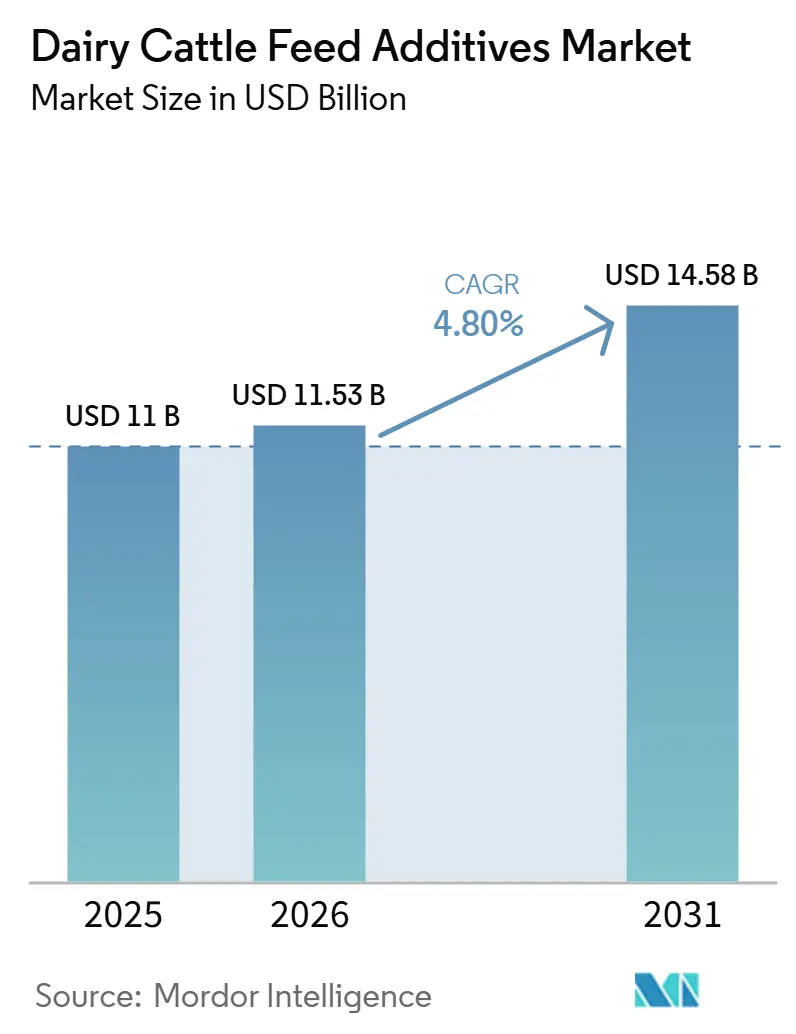
| Market Size (2026) | USD 11.53 Billion |
| Market Size (2031) | USD 14.58 Billion |
| Growth Rate (2026 - 2031) | 4.80 % |
| Fastest Growing Market | Asia-Pacific |
| Largest Market | Asia-Pacific |
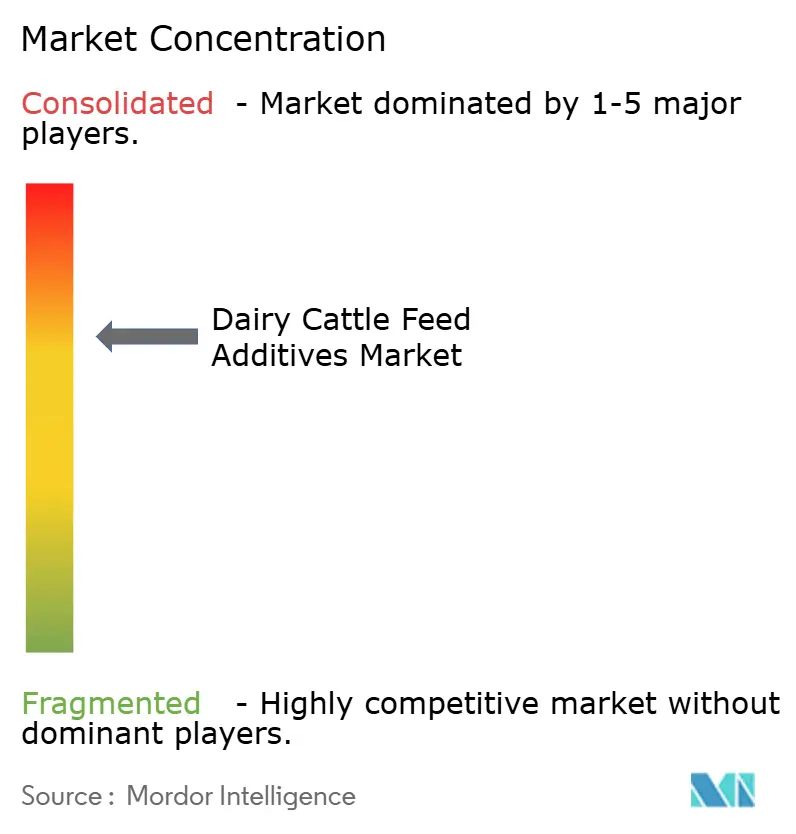
| Market Concentration | Medium |
Major Players *Disclaimer: Major Players sorted in no particular order Image © Mordor Intelligence. Reuse requires attribution under CC BY 4.0. | |
Dairy Cattle Feed Additives Market Analysis by Mordor Intelligence
The dairy cattle feed additives market size is USD 11 billion in 2025 and projected to reach USD 11.53 billion in 2026, expanding to USD 14.58 billion by 2031, registering a CAGR of 4.8% during 2026-2031. Market growth is also supported by tighter antibiotic regulations, increased emphasis on feed safety, and the growing adoption of digital ration-management tools in large dairy operations. The market remains price-sensitive among smallholder producers, but commercial farms are increasingly incorporating efficacy-backed additives into routine nutritional management. Competition centers on product validation, regulatory approvals, and suppliers' ability to combine feed additives with nutritional advisory and digital support services. In Europe, Regulation (EU) 2019/6 on veterinary medicinal products and Regulation (EU) 2019/4 on medicated feed have accelerated the transition toward functional alternatives to routine antibiotic use, influencing procurement practices in many export-oriented dairy markets.
Key Report Takeaways
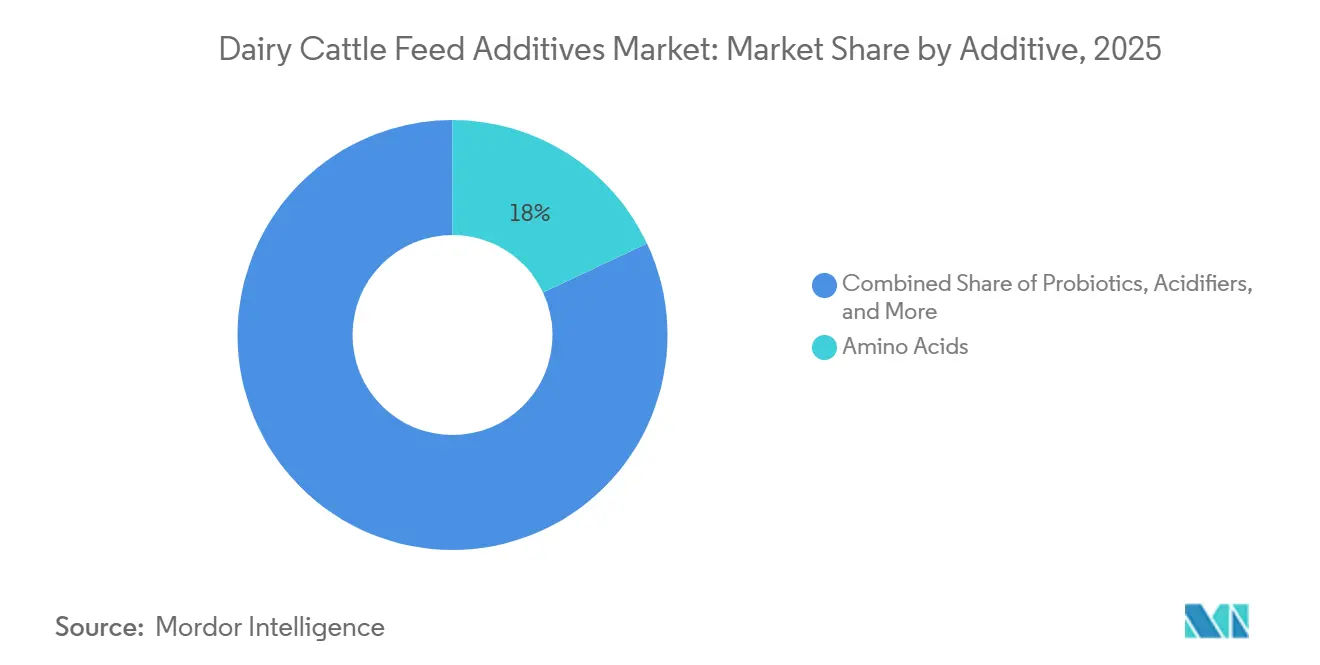
- The dairy cattle feed additives market share was led by amino acids, accounted for 18% in 2025, while the dairy cattle feed additives market size for probiotics is projected to expand at the highest CAGR of 9.1% during the 2025–2031 forecast period.
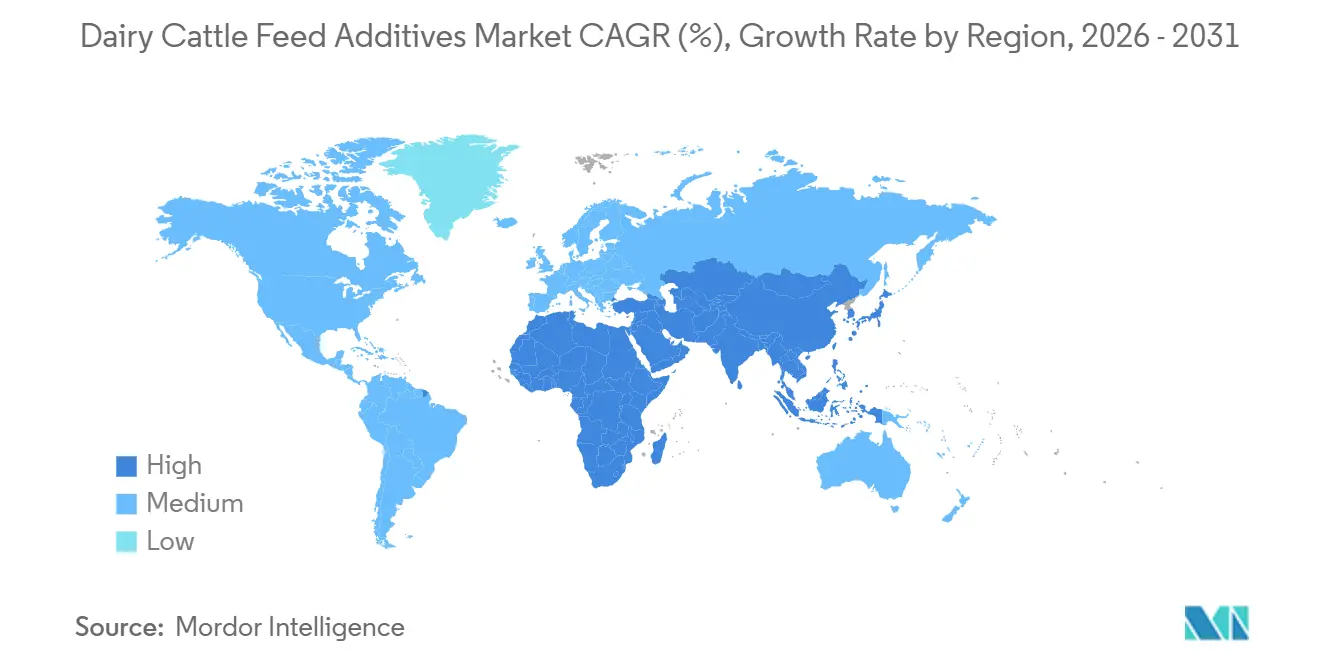
- By geography, Asia-Pacific held 28% of global revenue in 2025, while the region is also projected to record the highest CAGR at 7.6% through 2031.
Note: Market size and forecast figures in this report are generated using Mordor Intelligence’s proprietary estimation framework, updated with the latest available data and insights as of January 2026.
Market Trends and Insights
Drivers Impact Analysis of Dairy Cattle Feed Additives Market*
| Driver | (~) % Impact on CAGR Forecast | Geographic Relevance | Impact Timeline |
|---|---|---|---|
| Rising Demand for Higher Milk Yield and Feed Efficiency | +1.5% | Global, with the strongest pull from large commercial herds in Asia-Pacific and North America where ration economics are closely measured | Short term (≤ 2 years) |
| Expanding Use of Rumen Health Optimization Solutions | +1.0% | North America, Europe, and rising commercial dairy systems in Asia-Pacific where subacute ruminal acidosis prevention has become routine | Medium term (2-4 years) |
| Growing Adoption of Precision Nutrition in Commercial Dairy Farms | +1.0% | North America and Europe first, with Asia-Pacific following as feed mills and herd monitoring tools scale up | Medium term (2-4 years) |
| Strong Shift Toward Antibiotic Reduction in Dairy Herd Management | +0.8% | Europe leads, with growing spillover into North America and regulated Asian dairy systems | Short term (≤ 2 years) to Medium term (2-4 years) |
| Higher Need for Mycotoxin Risk Control in Stored Feed Ingredients | +0.7% | Global, with especially strong relevance in South America, Africa, and South Asia where hot and humid storage conditions raise risk | Short term (≤ 2 years) |
| Rising Demand for Residue-Conscious and Clean Label Dairy Production | +0.6% | Europe first, then North America and export-oriented Asian producers serving premium processors | Long term (≥ 4 years) |
| Source: Mordor Intelligence | |||
Rising Demand for Higher Milk Yield and Feed Efficiency
Commercial dairy farms are increasingly focused on improving milk output per cow while controlling feed costs, creating stronger demand for technologies that enhance feed efficiency and animal performance. According to Novonesis A/S in April 2026, feed costs account for 60% to 70% of total milk production expenses in commercial dairy systems, highlighting why even modest improvements in productivity can justify the use of feed additives. This is particularly relevant in intensive herds using high-energy total mixed rations, where rumen-active products can help maintain performance when forage quality or feed ingredient costs fluctuate. As a result, additives that deliver measurable improvements in milk yield, feed conversion, or milk composition are becoming increasingly important within dairy feeding programs. The competitive value of these products is further strengthened when suppliers provide technical support, local trial data, and evidence generated under commercial farm conditions rather than relying solely on laboratory results.
Expanding Use of Rumen Health Optimization Solutions
High-yielding dairy herds are particularly vulnerable to rumen instability when diets contain elevated levels of fermentable energy, which has increased interest in nutritional strategies that support digestive efficiency and animal health. As a result, feed additive programs are increasingly emphasizing daily preventive approaches based on live yeast, probiotics, and enzyme technologies rather than relying solely on corrective interventions. According to Lallemand Animal Nutrition, in October 2025, the company launched LEVUCELL Trivantage in the United States, a multi-component solution combining live rumen yeast, a Bacillus-based lower-gut component, and a yeast cell wall postbiotic. The introduction reflects the broader trend toward integrated additive platforms designed to address multiple aspects of animal performance simultaneously. Such approaches simplify inclusion and monitoring while supporting more comprehensive management of milk production, feed intake stability, and gut health. Consequently, suppliers capable of demonstrating consistent benefits across several performance parameters are likely to strengthen their competitive position in the dairy cattle feed additives market.
Growing Adoption of Precision Nutrition in Commercial Dairy Farms
Precision feeding is increasingly being adopted by large dairy operations as producers seek to optimize nutrient utilization and improve production efficiency. According to a 2025 review published in Frontiers in Animal Science, rumen-protected methionine plays an important role in dairy cattle health, performance, and supplementation strategies, supporting the wider adoption of targeted amino acid balancing. In March 2026, Evonik Industries AG announced a price increase for MetAMINO and reported EUR 5.9 billion (USD 6.37 billion) in sales from its Advanced Technologies segment during 2025[1]Source: Evonik Industries AG, “Evonik to Increase Its Global Price for MetAMINO,” Evonik, evonik.com, reflecting continued investment in specialty nutrition technologies. According to dsm-firmenich AG, the company launched the Lore artificial intelligence module for dairy cattle in August 2025 and integrated it with FarmTell Milk[2]Source: dsm-firmenich AG, “dsm-firmenich Launches New Lore Artificial Intelligence Module for Dairy Cattle at Agroleite 2025,” dsm-firmenich, dsm-firmenich.com, which the company stated is used by more than 15,000 farms worldwide. Collectively, these developments highlight the growing convergence of digital technologies and precision nutrition in modern dairy production systems.
Strong Shift Toward Antibiotic Reduction in Dairy Herd Management
Antimicrobial stewardship is increasingly becoming a long-term priority in dairy production, supporting demand for nutritional solutions that help maintain animal health while reducing reliance on antibiotics. In 2025, the International Dairy Federation (IDF) updated its Guide to Prudent Use of Antimicrobial Agents in Dairy Production, reinforcing stewardship expectations across producers, feed manufacturers, and the broader dairy value chain. In July 2025, the European Medicines Agency (EMA) recommended selective dry cow therapy in place of routine blanket treatment, further encouraging management practices that minimize antibiotic use. These developments are increasing interest in nutritional and microbial solutions that support transition cow health and overall herd performance.
Restraints Impact Analysis of Dairy Cattle Feed Additives Market*
| Restraint | (~) % Impact on CAGR Forecast | Geographic Relevance | Impact Timeline |
|---|---|---|---|
| Price Sensitivity Among Small and Mid-Sized Dairy Farms | -0.60% | Strongest in Africa, South America, and South Asia where herd sizes are smaller and processor premiums are less consistent | Short term (≤ 2 years) to Medium term (2-4 years) |
| Uneven Farm-Level Proof of Return on Investment Across Additive Classes | -0.40% | Global, with the biggest effect where advisory support and local validation are still limited | Medium term (2-4 years) |
| Regulatory Scrutiny on Functional Claims and Microbial Ingredients | -0.40% | Europe and North America, where strain-level approval and claim review are strict | Medium term (2-4 years) to Long term (≥ 4 years) |
| Formulation Complexity Across Forage Quality, Breed, and Lactation Stage | -0.30% | Global, especially in mixed production systems with varied forage bases and breed profiles | Long term (≥ 4 years) |
| Source: Mordor Intelligence | |||
Price Sensitivity Among Small and Mid-Sized Dairy Farms
The adoption of feed additives tends to be slower when producers are unable to recover higher feed costs through improved milk revenue or stronger herd performance. This challenge is particularly evident in smallholder and mid-scale dairy systems, where milk pricing structures often provide limited incentives for improvements in composition, animal health, or feed efficiency. As a result, the barrier is not solely a reluctance to invest, but also a mismatch between premium product offerings and the cash flow realities of developing commercial dairy systems. In these markets, even technically effective additives may experience slower adoption when processor incentives, milk quality premiums, and cooperative purchasing mechanisms are underdeveloped. Consequently, actual feed additive usage per cow often lags behind the broader growth potential of the dairy sector in many emerging markets.
Uneven Farm-Level Proof of Return on Investment Across Additive Classes
The commercial adoption of feed additives does not always progress at the same pace as scientific evidence because performance outcomes can vary across forage quality, herd management, climate conditions, breed characteristics, and disease pressure. This challenge is particularly relevant for newer categories such as prebiotics, phytogenics, and multi-strain probiotics, where results observed under experimental conditions may not be consistently replicated across different production systems. The complexity increases in total mixed ration programs, where several additives are often used simultaneously, making it difficult to isolate the contribution of individual products. Consequently, adoption can be slower even for categories with strong long-term potential. This environment favors suppliers that complement published research with local demonstrations, technical support, and farm-level validation, helping producers evaluate product performance under their own operating conditions.
*Our forecasts treat driver/restraint impacts as directional, not additive. The impact forecasts reflect baseline growth, mix effects, and variable interactions.
Dairy Cattle Feed Additives Market Segment Analysis
By Additive Type:
Nutrition Science and Regulatory Shifts Reshape the PortfolioAmino acids held 18% of the dairy cattle feed additives market share in 2025, making them the largest additive category as rumen-protected methionine and lysine remained central to commercial dairy ration programs. Minerals formed the next major spending block, supported by their roles in milk synthesis and electrolyte balance, while chelated trace minerals gained ground under European feed inclusion limits. Enzymes and vitamins also remained important because they improved digestibility, phosphorus efficiency, transition health, and reproductive outcomes in commercial dairy systems. Acidifiers continued to hold a steady role in the dairy cattle feed additives market through feed preservation and rumen pH management across silage and in-ration use.
The probiotics segment is the fastest-growing category, and the dairy cattle feed additives market size for probiotics is projected to expand at 9.1% CAGR from 2026 to 2031 as antibiotic reduction efforts support wider microbial adoption. Mycotoxin detoxifiers have become a priority area because biotransformer solutions address Fusarium toxins that traditional clay-based products cannot effectively control, supported by Q1 2026 monitoring data. Phytogenics, prebiotics, and yeast are also gaining commercial relevance as producers look for stronger gut health, immune support, and microbiota management tools. At the same time, the antibiotics segment faces structural pressure in the dairy cattle feed additives market as its use narrows under tighter veterinary oversight in regulated regions.



Geography Analysis
APAC Dairy Cattle Feed Additives Market
Asia-Pacific held 28% of global revenue in 2025, making it the largest regional contributor to the dairy cattle feed additives market. The region is also projected to register the fastest CAGR of 7.6% during 2026-2031. According to a 2025 study published in Xu Mu Shou Yi Za Zhi, compound enzyme preparations included at 0.2% improved rumen fermentation parameters and microbial diversity in periparturient dairy cows, highlighting growing scientific support for advanced feed additives in the region. In February 2026, Cargill, Incorporated commissioned its second dairy feed plant in Wazirabad, Punjab, India, with an investment of USD 36 million and described it as the largest dairy feed plant in South Asia[3]Source: Cargill, Incorporated, “Cargill Opens Largest Dairy Feed Plant in South Asia in Punjab,” Cargill, cargill.com. According to dsm-firmenich AG, Japan authorized Bovaer for dairy and beef cattle under the MIDORI strategy in November 2024, demonstrating that regulated Asian markets are expanding beyond basic vitamin and mineral demand.
Europe and North America Dairy Cattle Feed Additives Market
Europe and North America remain among the highest-spending regions per cow, supported by established precision nutrition practices, feed mills, advisory networks, and compliance systems. In North America, farms are increasingly linking ration formulation with herd monitoring and productivity software, supporting sustained demand for amino acids, rumen stabilizers, trace minerals, and broader multi-additive programs. These regions are likely to remain the principal test beds for high-value additive strategies even as faster percentage growth emerges elsewhere.
MEA and South America Dairy Cattle Feed Additives Market
South America, the Middle East, and Africa are smaller in market size but remain strategically important due to their distinct demand patterns. South America exhibits strong demand for toxin control and feed protection, with grain-based feeding systems and warm storage conditions increasing contamination risks. Africa is gradually transitioning from smallholder production toward more commercial dairy systems, although price sensitivity continues to limit widespread adoption of premium products. According to a 2025 study published in Discover Applied Sciences, aflatoxin B1 contamination was identified in dairy feeds in Ethiopia, highlighting the continued importance of binder products and feed safety solutions in African markets. The Middle East supports demand from technology-intensive dairy systems focused on output quality and food security. These regions offer significant long-term opportunities, although the pace of adoption will continue to depend on affordability, local validation, and supply chain development.

Competitive Landscape
The dairy cattle feed additives market exhibits a moderately concentrated structure. Cargill, Incorporated, Archer Daniels Midland Company (ADM), dsm-firmenich AG, BASF SE, and Evonik Industries AG form the leading group, while a broad second tier includes Alltech, Inc., Adisseo, Novus International, Inc., Novonesis A/S, Lallemand Inc., Kemin Industries, Inc., and AB Vista Ltd. This competitive mix indicates that scale remains important, although specialization continues to create opportunities for differentiated suppliers. As a result, the market is not dominated by a single company or a single technology platform.
Competitive positioning increasingly depends on documented efficacy, regulatory readiness, and the ability to support product use at farm level. Suppliers that combine additives with digital tools, diagnostics, and nutritional advisory services are strengthening their market positions. According to dsm-firmenich AG, the company launched the Lore module for dairy cattle in August 2025 and integrated it with FarmTell Milk, demonstrating how digital tools are being linked directly with additive programs. According to Lallemand Animal Nutrition, LEVUCELL Trivantage was introduced in October 2025, highlighting the industry's move toward integrated microbial platforms rather than stand-alone products. In April 2026, Novonesis A/S launched Bovacillus in the European Union, emphasizing the importance of strong regulatory dossiers and scientific validation before commercialization.
Geographic expansion is also influencing competition. According to Cargill, Incorporated, the company commissioned a major dairy feed plant in India in February 2026, while dsm-firmenich AG opened its Jadcherla facility in India in August 2025 to support mycotoxin risk management solutions across the Asia-Pacific region. These investments underline the strategic importance of Asia-Pacific as a key growth region. Companies with the capability to manage complex regulatory approvals in Europe and North America are also better positioned to accelerate commercialization. Smaller suppliers can continue to compete by offering strong mode-of-action evidence or targeted local solutions. Nevertheless, scale, regulatory dossiers, and field-level technical support remain important barriers to building durable market share in the dairy cattle feed additives market.
Dairy Cattle Feed Additives Industry Leaders
Cargill, Incorporated
Archer Daniels Midland Company
dsm-firmenich AG
BASF SE
Evonik Industries AG
- *Disclaimer: Major Players sorted in no particular order
Dairy Cattle Feed Additives Market Companies Covered in this Report
- Cargill, Incorporated
- Archer Daniels Midland Company
- dsm-firmenich AG
- BASF SE
- Evonik Industries AG
- Alltech, Inc.
- Kemin Industries, Inc.
- Adisseo
- Nutreco N.V.
- Phibro Animal Health Corporation
- Novus International, Inc.
- Elanco Animal Health Incorporated
- Novonesis A/S
- Lallemand Inc.
- AB Vista Ltd.
- Denkavit Feed Ingredients

Recent Industry Developments in Dairy Cattle Feed Additives Market
- April 2026: Novonesis A/S launched Bovacillus in the European Union, the continent's first approved Bacillus probiotic specifically for lactating dairy cows.
- October 2025: Lallemand Animal Nutrition launched LEVUCELL Trivantage in the United States, an all-in-one yeast-based feed supplement combining LEVUCELL SC, PROTERNATIVE, and AGRIMOS for dairy and beef cattle producers.
- August 2025: DSM-Firmenich AG inaugurated its first feed additive manufacturing plant in Jadcherla, India, an 11,200-square-meter facility equipped with Bühler technology and dedicated to producing Mycofix Secure and Mycofix Shield mycotoxin risk management solutions for dairy and other livestock feeds across the Asia-Pacific region.


Global Dairy Cattle Feed Additives Market Report Scope
The dairy cattle feed market comprises nutritionally formulated feed products supporting milk production and herd health. The Dairy Cattle Feed Additives Market Report is Segmented by Additive (Acidifiers, Amino Acids, Antibiotics, Antioxidants, Binders, Enzymes, Flavors and Sweeteners, Minerals, Mycotoxin Detoxifiers, and more) and Geography (North America, South America, Europe, Asia-Pacific, Middle East, and Africa). The Market Forecasts are Provided in Terms of Value (USD) and Volume (Metric Tons)
| Acidifiers | By Sub Additive | Fumaric Acid |
| Lactic Acid | ||
| Propionic Acid | ||
| Other Acidifiers | ||
| Amino Acids | By Sub Additive | Lysine |
| Methionine | ||
| Threonine | ||
| Tryptophan | ||
| Other Amino Acids | ||
| Antibiotics | By Sub Additive | Bacitracin |
| Penicillins | ||
| Tetracyclines | ||
| Tylosin | ||
| Other Antibiotics | ||
| Antioxidants | By Sub Additive | Butylated Hydroxyanisole (BHA) |
| Butylated Hydroxytoluene (BHT) | ||
| Citric Acid | ||
| Ethoxyquin | ||
| Propyl Gallate | ||
| Tocopherols | ||
| Other Antioxidants | ||
| Binders | By Sub Additive | Natural Binders |
| Synthetic Binders | ||
| Enzymes | By Sub Additive | Carbohydrases |
| Phytases | ||
| Other Enzymes | ||
| Flavors and Sweeteners | By Sub Additive | Flavors |
| Sweeteners | ||
| Minerals | By Sub Additive | Macrominerals |
| Microminerals | ||
| Mycotoxin Detoxifiers | By Sub Additive | Binders |
| Biotransformers | ||
| Phytogenics | By Sub Additive | Essential Oil |
| Herbs and Spices | ||
| Other Phytogenics | ||
| Pigments | By Sub Additive | Carotenoids |
| Curcumin and Spirulina | ||
| Prebiotics | By Sub Additive | Fructo Oligosaccharides |
| Galacto Oligosaccharides | ||
| Inulin | ||
| Lactulose | ||
| Mannan Oligosaccharides | ||
| Xylo Oligosaccharides | ||
| Other Prebiotics | ||
| Probiotics | By Sub Additive | Bifidobacteria |
| Enterococcus | ||
| Lactobacilli | ||
| Pediococcus | ||
| Streptococcus | ||
| Other Probiotics | ||
| Vitamins | By Sub Additive | Vitamin A |
| Vitamin B | ||
| Vitamin C | ||
| Vitamin E | ||
| Other Vitamins | ||
| Yeast | By Sub Additive | Live Yeast |
| Selenium Yeast | ||
| Spent Yeast | ||
| Torula Dried Yeast | ||
| Whey Yeast | ||
| Yeast Derivatives |
| North America | United States |
| Canada | |
| Rest of North America | |
| South America | Brazil |
| Argentina | |
| Rest of South America | |
| Europe | Germany |
| France | |
| United Kingdom | |
| Italy | |
| Spain | |
| Russia | |
| Rest of Europe | |
| Asia-Pacific | China |
| India | |
| Japan | |
| Australia | |
| New Zealand | |
| Rest of Asia-Pacific | |
| Middle East | Saudi Arabia |
| United Arab Emirates | |
| Turkey | |
| Rest of Middle East | |
| Africa | South Africa |
| Egypt | |
| Kenya | |
| Rest of Africa |
| By Additive | Acidifiers | By Sub Additive | Fumaric Acid |
| Lactic Acid | |||
| Propionic Acid | |||
| Other Acidifiers | |||
| Amino Acids | By Sub Additive | Lysine | |
| Methionine | |||
| Threonine | |||
| Tryptophan | |||
| Other Amino Acids | |||
| Antibiotics | By Sub Additive | Bacitracin | |
| Penicillins | |||
| Tetracyclines | |||
| Tylosin | |||
| Other Antibiotics | |||
| Antioxidants | By Sub Additive | Butylated Hydroxyanisole (BHA) | |
| Butylated Hydroxytoluene (BHT) | |||
| Citric Acid | |||
| Ethoxyquin | |||
| Propyl Gallate | |||
| Tocopherols | |||
| Other Antioxidants | |||
| Binders | By Sub Additive | Natural Binders | |
| Synthetic Binders | |||
| Enzymes | By Sub Additive | Carbohydrases | |
| Phytases | |||
| Other Enzymes | |||
| Flavors and Sweeteners | By Sub Additive | Flavors | |
| Sweeteners | |||
| Minerals | By Sub Additive | Macrominerals | |
| Microminerals | |||
| Mycotoxin Detoxifiers | By Sub Additive | Binders | |
| Biotransformers | |||
| Phytogenics | By Sub Additive | Essential Oil | |
| Herbs and Spices | |||
| Other Phytogenics | |||
| Pigments | By Sub Additive | Carotenoids | |
| Curcumin and Spirulina | |||
| Prebiotics | By Sub Additive | Fructo Oligosaccharides | |
| Galacto Oligosaccharides | |||
| Inulin | |||
| Lactulose | |||
| Mannan Oligosaccharides | |||
| Xylo Oligosaccharides | |||
| Other Prebiotics | |||
| Probiotics | By Sub Additive | Bifidobacteria | |
| Enterococcus | |||
| Lactobacilli | |||
| Pediococcus | |||
| Streptococcus | |||
| Other Probiotics | |||
| Vitamins | By Sub Additive | Vitamin A | |
| Vitamin B | |||
| Vitamin C | |||
| Vitamin E | |||
| Other Vitamins | |||
| Yeast | By Sub Additive | Live Yeast | |
| Selenium Yeast | |||
| Spent Yeast | |||
| Torula Dried Yeast | |||
| Whey Yeast | |||
| Yeast Derivatives | |||
| By Geography | North America | United States | |
| Canada | |||
| Rest of North America | |||
| South America | Brazil | ||
| Argentina | |||
| Rest of South America | |||
| Europe | Germany | ||
| France | |||
| United Kingdom | |||
| Italy | |||
| Spain | |||
| Russia | |||
| Rest of Europe | |||
| Asia-Pacific | China | ||
| India | |||
| Japan | |||
| Australia | |||
| New Zealand | |||
| Rest of Asia-Pacific | |||
| Middle East | Saudi Arabia | ||
| United Arab Emirates | |||
| Turkey | |||
| Rest of Middle East | |||
| Africa | South Africa | ||
| Egypt | |||
| Kenya | |||
| Rest of Africa | |||


Key Questions Answered in the Report
What is the 2026 size outlook for dairy cattle feed additives?
The dairy cattle feed additives market is estimated at USD 11.53 billion in 2026.
Which additive category held the largest share in the dairy cattle feed additives market?
Amino acids held the largest share at 18% in 2025, supported by strong use of rumen-protected methionine and lysine in commercial dairy ration programs.
Why are probiotics gaining importance in dairy cattle nutrition?
Growth is tied to antibiotic reduction, gut health focus, and better commercial validation. Novonesis launched Bovacillus in the European Union in April 2026, which marked a major step for Bacillus probiotics in dairy cows.
How are regulations affecting feed additive demand in dairy farming?
European rules on veterinary medicines, medicated feed, feed additive approvals, and antimicrobial reduction are pushing demand toward probiotics, yeast, phytogenics, amino acids, and other functional alternatives.
Page last updated on:





