
Customer Feedback Software Market Size and Share
Market Overview
| Study Period | 2020 - 2031 |
|---|---|
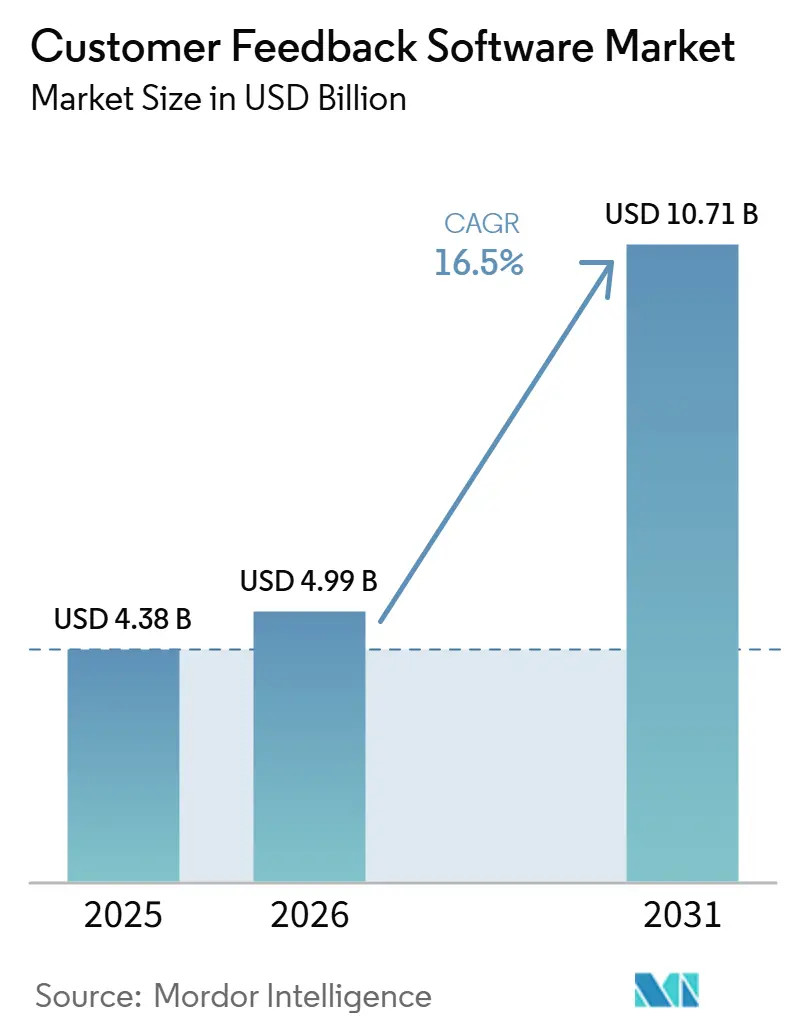
| Market Size (2026) | USD 4.99 Billion |
| Market Size (2031) | USD 10.71 Billion |
| Growth Rate (2026 - 2031) | 16.50 % |
| Fastest Growing Market | Asia-Pacific |
| Largest Market | North America |
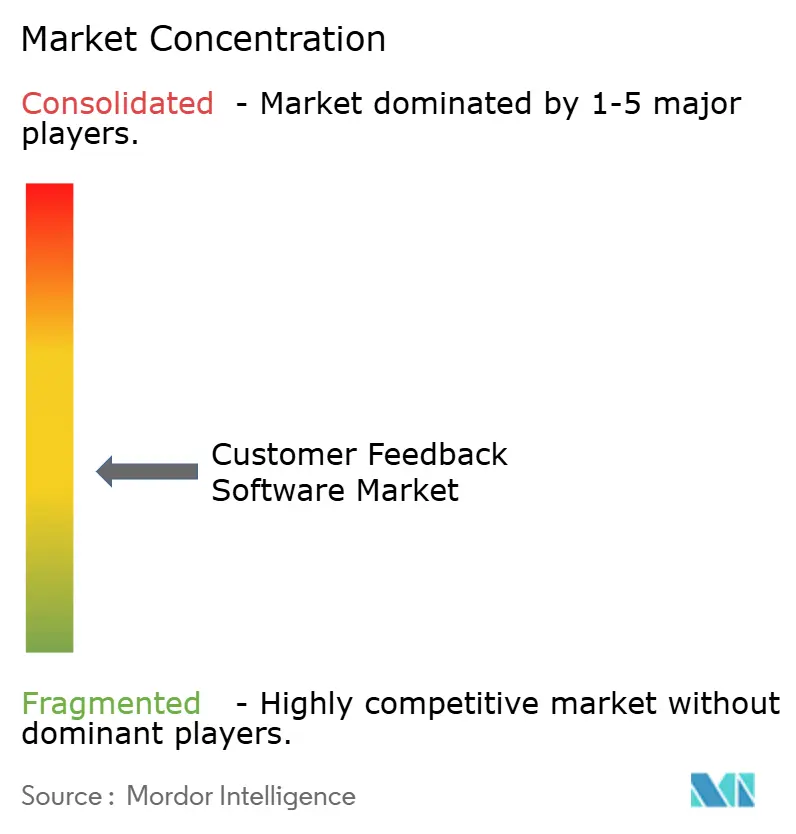
| Market Concentration | Medium |
Major Players *Disclaimer: Major Players sorted in no particular order Image © Mordor Intelligence. Reuse requires attribution under CC BY 4.0. | |
Customer Feedback Software Market Analysis by Mordor Intelligence
The customer feedback software market size was USD 4.38 billion in 2025 and is forecast to reach USD 10.71 billion by 2031, growing at a CAGR of 16.50% during 2026-2031. Growth reflects a broader shift from occasional surveys toward continuous listening across digital and physical customer interactions. Organizations increasingly expect feedback systems to support service recovery, workflow decisions, and retention activities, rather than producing reports alone. AI text analysis is making larger volumes of comments, call transcripts, and chat records usable within normal business processes. The customer feedback software market also benefits from more digital touchpoints across websites, mobile apps, contact centers, and in-product journeys.
Key Report Takeaways
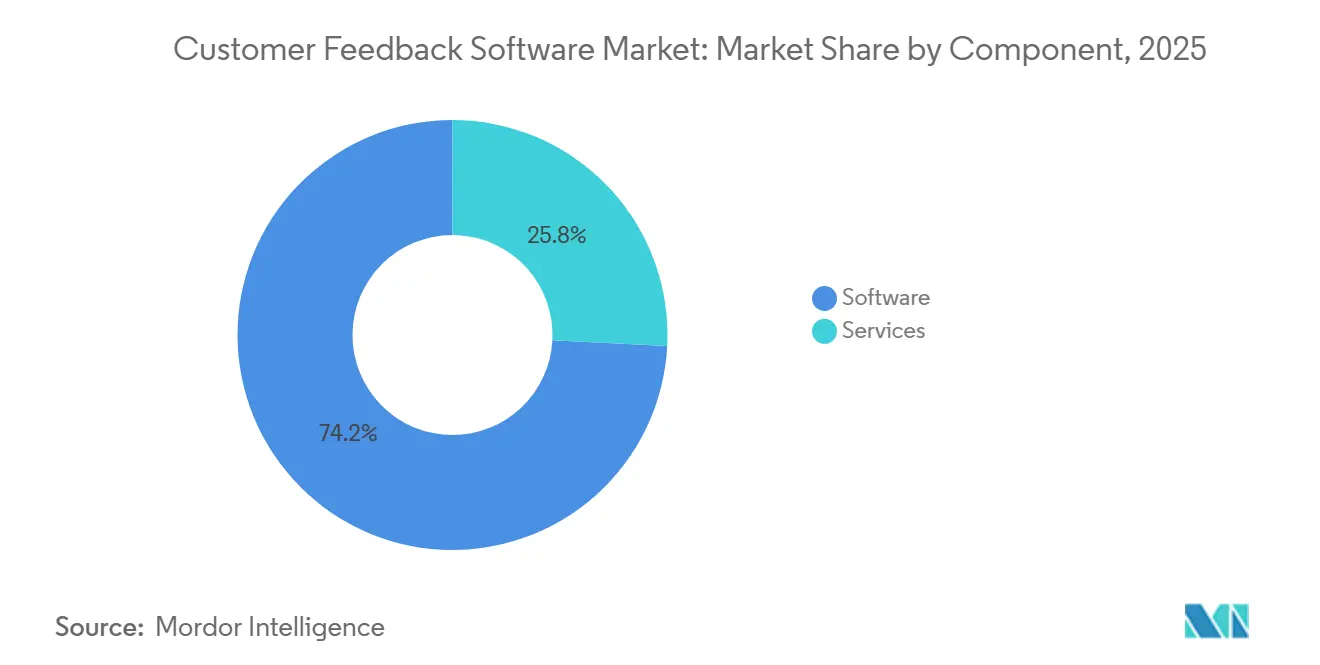
- By component, software held 74.18% of the customer feedback software market share in 2025, while services are projected to expand at a 19.24% CAGR through 2031.
- By feedback collection channel, websites and web applications accounted for 28.41% of the customer feedback software market share in 2025, while in-product interfaces are projected to grow at a 20.83% CAGR through 2031.
- By deployment mode, cloud held 71.26% of the customer feedback software market size in 2025, while hybrid deployment is expected to expand at an 18.72% CAGR through 2031.
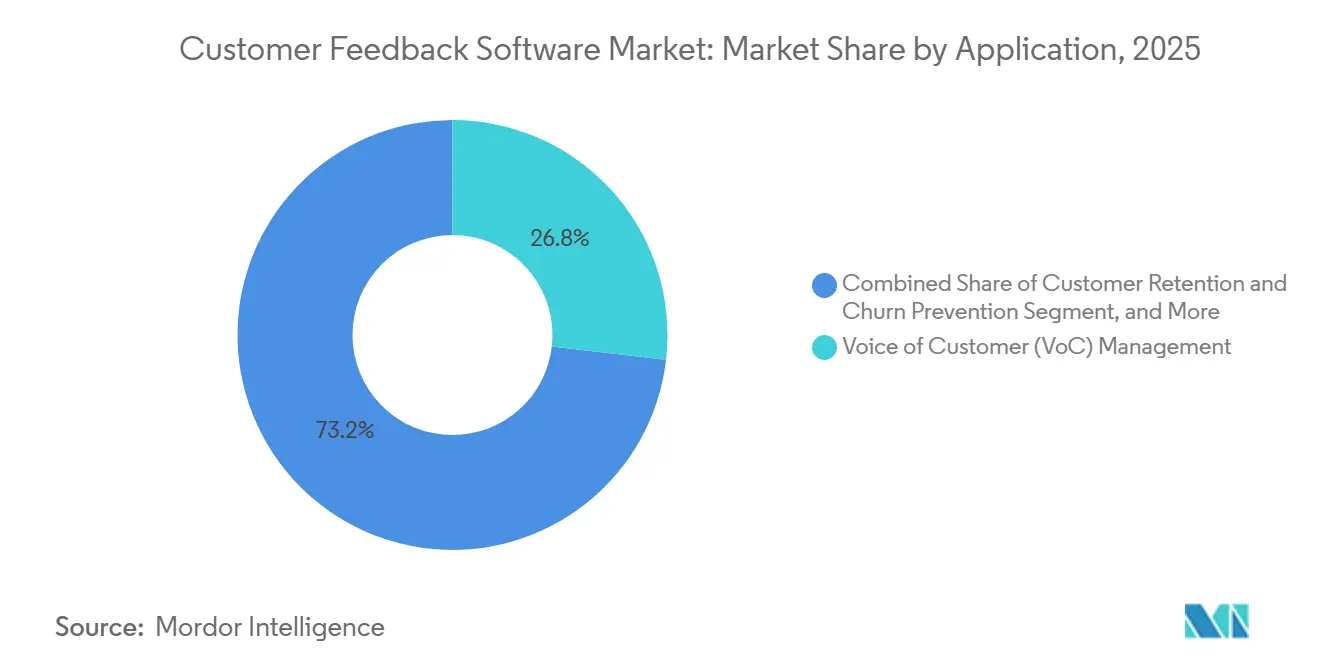
- By application, Voice of Customer management led with a 26.84% share in the customer feedback software market in 2025, while customer retention and churn prevention is projected to grow at a 19.46% CAGR through 2031.
- By end user, retail and e-commerce held 22.19% share in 2025, while healthcare and life sciences are expected to expand at an 18.93% CAGR through 2031.
- By geography, North America held a 34.62% share of the customer feedback software market in 2025, while Asia-Pacific is projected to grow at a 19.68% CAGR through 2031.
Note: Market size and forecast figures in this report are generated using Mordor Intelligence’s proprietary estimation framework, updated with the latest available data and insights as of January 2026.
Global Customer Feedback Software Market Trends and Insights
Drivers Impact Analysis*
| Driver | (~) % Impact on CAGR Forecast | Geographic Relevance | Impact Timeline |
|---|---|---|---|
| Continuous Omnichannel Voice-of-Customer Programs | +3.8% | Global | Medium term (2-4 years) |
| AI-Based Analysis of Unstructured Feedback | +3.2% | Global | Medium term (2-4 years) |
| Integration of Feedback With Customer Experience Workflows | +2.7% | North America and Europe | Medium term (2-4 years) |
| Rising Adoption of Cloud Software by Small and Medium-Sized Enterprises | +2.2% | Asia-Pacific core, spillover to Middle East and Africa | Short term (≤ 2 years) |
| Expansion of In-App and Digital Journey Feedback | +1.8% | Global | Short term (≤ 2 years) |
| Feedback-Linked Personalization and Retention Programs | +1.5% | North America and Europe | Long term (≥ 4 years) |
| Source: Mordor Intelligence | |||
Continuous Omnichannel Voice-of-Customer Programs
Enterprise customer experience programs increasingly collect signals from websites, mobile apps, contact centers, social media, and in-product interfaces. This approach gives teams a more complete view of a customer journey than a survey sent after a single interaction. The customer feedback software market is therefore moving away from isolated survey tools toward platforms that bring together multiple data types. Buyers are seeking fewer systems with broader capabilities, which can increase both contract scope and contract duration. Unified platforms can combine requested feedback, public social comments, and behavioral signals into a single view. This makes it harder for vendors with disconnected point products to compete for large enterprise deployments.
AI-Based Analysis of Unstructured Feedback
Open-ended survey comments, transcripts, social posts, and chat records were difficult to use at scale when review depended on manual effort. AI-based analysis now allows organizations to classify, summarize, and route those records more quickly. This allows teams to work with a larger share of feedback that was previously left outside formal analysis. Faster processing can also shorten the time between a customer signal and a possible operational response. The customer feedback software market is placing greater value on data sets that can support useful analysis for specific sectors, rather than generic sentiment results. The ability to identify service problems in healthcare, retail, and banking will depend on both model quality and the data available to train it.
Integration of Feedback With Customer Experience Workflows
Feedback has limited value when it remains in a dashboard without a defined operational response. Organizations are integrating feedback platforms with customer relationship management, case management, and service processes. Negative feedback can trigger an escalation, while a decline in satisfaction can appear in a renewal or service queue. Stanford Health Care combined 600,000 modernized survey responses with contact center data, portal messages, rounding input, and complaint management into a single listening system. The program reduced open and in-progress patient cases by 30%. The customer feedback software market gains from this need for connectors, implementation support, and clear internal governance over how each signal is handled.
Rising Adoption of Cloud Software by Small and Medium-Sized Enterprises
Cloud delivery has made feedback tools more accessible for smaller organizations that could not support a large enterprise platform. Subscription pricing, no-code survey design, and self-service dashboards reduce the cost and effort of starting a program. Intuit reported that 7 in 10 small businesses across the United States, Canada, the United Kingdom, and Australia were using AI-powered tools by early 2026.[1]Intuit, “2026 AI Impact Report,” Intuit, intuit.com Customer-facing tools were among the areas with strong adoption. Regional language support and lower-priced cloud plans are particularly relevant in Asia-Pacific. This demand also increases the need for onboarding and configuration assistance, which smaller businesses lack because they lack internal customer experience specialists.
Restraints Impact Analysis*
| Restraint | (~) % Impact on CAGR Forecast | Geographic Relevance | Impact Timeline |
|---|---|---|---|
| Data Privacy and Consent Management Complexity | -1.8% | Global | Medium term (2-4 years) |
| Survey Fatigue and Declining Response Quality | -1.4% | North America and Europe | Short term (≤ 2 years) |
| Integration Barriers Across Legacy Customer Systems | -1.1% | North America, Europe, and Asia-Pacific | Medium term (2-4 years) |
| Feedback Ownership Fragmentation Across Business Functions | -0.8% | Global | Long term (≥ 4 years) |
| Source: Mordor Intelligence | |||
Data Privacy and Consent Management Complexity
Broader feedback collection brings together data such as conversation transcripts, behavioral records, health information, and financial interaction details. That creates greater responsibility for vendors and users regarding consent and data handling. GDPR, the California Consumer Privacy Act, and related state laws, and India’s Digital Personal Data Protection Act impose different requirements for collecting and managing personal data. Cisco found that 95% of consumers would not buy from a provider that did not protect their data properly.[2]Cisco, “Cisco’s 2025 Data Privacy Benchmark Study: Privacy Landscape Grows Increasingly Complex in the Age of AI,” Cisco Newsroom, cisco.com The customer feedback software market faces additional pressure because AI models benefit from long-running datasets, while privacy rules may require data minimization and limited retention. Compliance evidence, including ISO 27001 practices and processor obligations, can determine whether a vendor reaches technical evaluation in healthcare and financial services.
Survey Fatigue and Declining Response Quality
High survey volume can reduce both participation and response quality. The American Customer Satisfaction Index stated in April 2026 that frequent survey programs can draw a disproportionate number of responses from customers with very positive or very negative experiences.[3]American Customer Satisfaction Index, “Can Fewer Surveys Provide Better Customer Insights?,” American Customer Satisfaction Index, theacsi.org That pattern can distort the picture available to service and product teams. It also limits the usefulness of a feedback program even when the distribution volume is high. The customer feedback software market has an opening for platforms that use behavior-based prompts, passive signals, in-product feedback, and moderated interview methods. These approaches can place requests closer to the moment of use and reduce dependence on repeated email outreach.
*Our forecasts treat driver/restraint impacts as directional, not additive. The impact forecasts reflect baseline growth, mix effects, and variable interactions.
Segment Analysis
By Component: Software Leads While Services Gain From Integration Needs
Software accounted for 74.18% of the customer feedback software market share in 2025. The segment includes survey design and distribution tools, feedback collection systems, Voice of Customer platforms, analysis and reporting products, and workflow and case management functions. Organizations have focused spending on systems that convert large volumes of feedback into structured information for operating teams. Voice of Customer management and data analysis products were important areas of enterprise investment in 2025. These tools help companies organize feedback received across multiple channels. They can also identify recurring service issues that might be missed when customer comments sit in separate systems. Reporting functions make it easier for teams to compare input from different locations, channels, or customer groups. Workflow and case management functions then help assign a response to the appropriate operational team. The value of software depends not only on collection capacity, but also on whether users can apply the resulting information.
Services are projected to expand at a 19.24% CAGR from 2026 to 2031. Growth reflects the work required to connect feedback applications with customer relationship management, enterprise resource planning, and service management systems. A feedback deployment often requires data design, workflow configuration, change management, and ongoing support. Stanford Health Care’s program combined 600,000 survey responses with operational data sources, which illustrates that large projects extend beyond survey configuration.[4]Qualtrics, “Stanford Health Care and Qualtrics Customer Success Story,” Qualtrics, qualtrics.com The work can include defining how teams classify feedback, where information is stored, and which events trigger alerts. Organizations also need to decide which customer issues need a direct response and which should inform broader service improvements. Professional services can help align these decisions with existing business processes. Vendors that package professional services with subscriptions can support larger starting contracts and longer customer relationships. This model also makes integrated platforms harder to replace than simple survey products.


By Feedback Collection Channel: In-Product Interfaces Shift Feedback Toward The Point Of Use
Websites and web applications held 28.41% of the customer feedback software market share in 2025. They benefit from established embedding methods and wide compatibility with web analytics and testing tools. Website collection remains useful because it can capture feedback during browsing, service, and transaction journeys. Feedback can be requested after a purchase, during a support journey, or when a visitor leaves a page without completing an action. This broad coverage makes web collection relevant to many organizations, regardless of their primary customer channel. Mobile applications also provide an important setting for feedback, where customers interact on their phones. Social media and review platforms extend listening beyond the organization's owned channels. Those sources can highlight issues that customers may not report in a formal survey. Each channel adds a different context that can improve the understanding of customer concerns.
In-product interfaces are projected to grow at a 20.83% CAGR from 2026 to 2031. These tools request feedback while a user is actively using a product, avoiding the delay created by an external email invitation. This makes the response more closely connected to a specific feature, task, or point of friction. Pendo stated that in-app survey delivery can generate up to a 1,300% increase in responses compared with email-only programs. Physical locations and kiosks serve a different need in retail, airports, and healthcare settings where anonymous, immediate input can be useful. These physical systems can capture a reaction before the customer leaves the location or forgets the experience. Unison Retail Management used HappyOrNot Smiley Sign devices across more than 180 concessions at Chicago O’Hare International Airport. The deployment collected more than 23,000 feedback interactions in its first 6 months. The customer feedback software industry will need to support consistent analysis across these varied collection settings.
By Deployment Mode: Cloud Remains The Default While Hybrid Meets Governance Needs
Cloud deployment accounted for 71.26% of the customer feedback software market size in 2025. The model offers scalable capacity, continuous product updates, and lower operating costs for many new implementations. It also fits omnichannel programs that receive data from websites, mobile apps, social channels, and contact centers. Those programs may need the capacity to change as response volumes change. Cloud systems can provide that flexibility without requiring each customer to maintain the same level of internal infrastructure. The delivery model can also simplify access for distributed teams that need to review the same feedback and workflow information. Continuous updates can help organizations use new analysis and integration features without managing a separate upgrade project. For these reasons, the cloud has become the standard option for many new deployments.
Hybrid deployment is forecast to expand at an 18.72% CAGR from 2026 to 2031. Healthcare, banking, and cross-border retailers may need cloud analytics while retaining some data under local storage and processing rules. On-premise systems remain relevant for defense, government administration, and selected financial services uses with strict residency requirements. The customer feedback software market, therefore, includes buyers whose selection criteria center on governance and system architecture rather than software features alone. Hybrid environments allow organizations to separate sensitive records from workloads that can operate more flexibly in the cloud. They may also help global organizations respond to differing rules across the countries where they operate. Vendors that can provide consistent analytics across cloud, on-premises, and hybrid configurations can address a broader set of regulated customers. Providers that offer only one delivery model may not qualify for certain large enterprise programs.
By Application: Retention Use Cases Become More Important Alongside Voice Of Customer Programs
Voice of Customer management accounted for 26.84% of the market share in 2025. The application is widely used across enterprise sectors because it collects, organizes, and interprets feedback from several interactions. It has become the data layer for many customer experience programs. Organizations use it to identify service gaps and monitor changes in sentiment. Teams can use the same listening base to compare experiences across journeys, locations, and customer groups. This supports routine service oversight and the identification of longer-running issues. The broad adoption of these platforms supports their leading position in application. It also gives vendors a base from which to extend into related operational uses.
Customer retention and churn prevention are projected to expand at a 19.46% CAGR through 2031. Companies increasingly want feedback signals to prompt revenue-protection actions rather than use them only for retrospective reporting. A negative interaction can be more useful when it appears early enough for a service team to respond or a customer success team to intervene. Product experience management and brand and reputation management also benefit from linking product changes and brand activity to customer responses. Huron used generative AI analytics on AWS to analyze patient feedback in healthcare, achieving 90% accuracy in sentiment analysis across patient interactions. Customer service quality management remains important in contact centers, where surveys, call analysis, and escalation routing support ongoing service measurement. In regulated settings, those measures can also support required service reporting. This closer connection between listening systems and customer action is shaping the customer feedback software market.

By End User: Retail Provides Scale While Healthcare Records The Fastest Growth
Retail and e-commerce accounted for 22.19% of the market in 2025. The sector generates high volumes of feedback through transactions, returns, loyalty programs, customer support, and online browsing. It has also used customer satisfaction measures and behavioral data for many years. This combination creates large, established customer groups for feedback platforms in retail and e-commerce. A single retailer may need to connect store interactions, delivery feedback, online support, and product reviews. That need gives the sector a strong reason to use platforms that can bring different signals into a common view. Organizations in this sector need to manage input from both physical stores and digital channels simultaneously. They also need timely alerts because service issues can quickly affect brand perception and repeat purchases.
The healthcare and life sciences industry is expected to expand at a 18.93% CAGR from 2026 to 2031. Patient experience reporting, outcome-linked reimbursement models, and the use of clinical AI are driving demand for specialized feedback systems. Healthcare providers need tools that can interpret large volumes of feedback while respecting privacy, access, and data-handling requirements. Qualtrics completed its USD 6.75 billion acquisition of Press Ganey Forsta in May 2026, combining experience data resources that serve more than 41,000 healthcare facilities. BFSI, IT, and telecommunication are established users of digital service and contact center feedback. Industrial manufacturing, government administration, and education and research institutions are growing use cases for supplier feedback, citizen services, and institutional research. These groups have different service journeys, but each needs a practical way to capture and act on input. Travel, hospitality, media, and entertainment require flexible capacity because feedback volumes can change with seasonal activity.
Geography Analysis
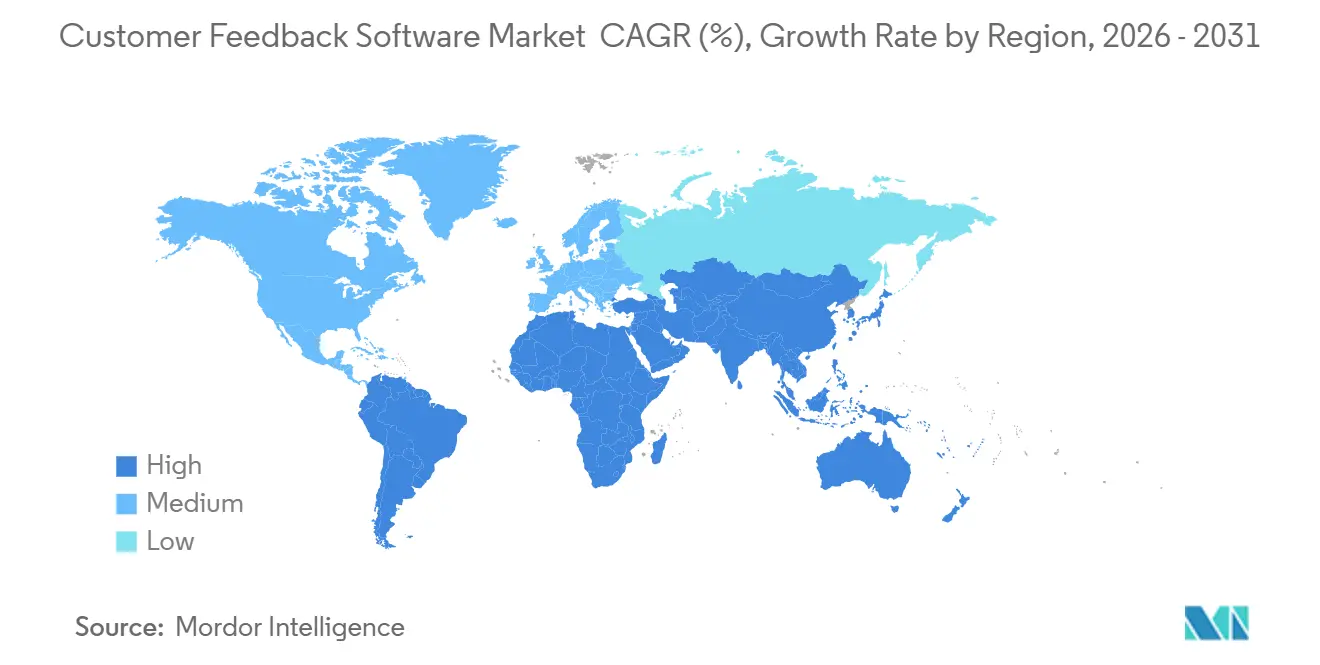
North America held 34.62% of the customer feedback software market share in 2025. The region has mature enterprise software purchasing, a concentrated vendor base, and broad adoption of customer experience across retail, healthcare, and financial services. The United States accounts for much of the regional demand because large enterprises deploy feedback platforms across several business units and customer channels. Canada is increasingly adopting cloud-based solutions in financial services and government administration, where organizations need to organize digital service feedback. Mexico is becoming a deployment location as retailers and manufacturers standardize customer experience programs across North American operations. The region’s installed base and long renewal cycles continue to support its leading position even as growth moderates relative to Asia-Pacific and South America.
Asia-Pacific is projected to grow at a 19.68% CAGR from 2026 to 2031. Genesys reported that 44% of customer experience organizations in the region use agentic AI-powered virtual agents, compared with a global average of 41%. China, India, Japan, South Korea, and Southeast Asia provide the main growth base, although their operating conditions differ. China favors local providers and global vendors that can localize products, while India’s Digital Personal Data Protection Act increases demand for consent-aware architectures. Southeast Asia’s mobile-first users support demand for in-product and mobile feedback collection. Japan and South Korea support analytics-focused deployments, while Australia provides a testing ground for AI-based feedback capabilities.
Europe had meaningful demand in 2025, with Germany, the United Kingdom, and France as important enterprise deployment markets. GDPR requires strong consent management, data minimization, audit trails, and data residency options, which affect both procurement and product design. South America is expanding through Brazil and Argentina, particularly in retail, banking, and telecommunications, with localization requirements influencing vendor choice. The Middle East and Africa present early-stage opportunities as Saudi Arabia and the United Arab Emirates invest in digital infrastructure for government, retail, and financial services. South Africa and Nigeria have more established enterprise software adoption, while growing mobile connectivity can support broader feedback collection across Africa during the forecast period.

Competitive Landscape
The customer feedback software market has a concentrated enterprise tier and a broader mid-market segment. Qualtrics, Medallia, and InMoment support major Voice of Customer deployments, while Typeform, SurveySparrow, Mopinion, AskNicely, and Survicate address smaller and departmental users. Larger providers compete through broad platform capability, deep data resources, and integrations with enterprise systems. They also benefit from established relationships with large organizations that have complex service and compliance requirements. Smaller vendors often focus on simpler setups, shorter implementation periods, and transparent usage-based pricing. This creates different purchasing paths for large organizations and smaller buyers.
AI product development is central to enterprise competition. Leading vendors are emphasizing automated workflows, generative summaries, and the ability to ingest feedback from several channels. Qualtrics strengthened its position in healthcare through the May 2026 acquisition of Press Ganey Forsta. The transaction joined its experience management platform with a healthcare experience data set and customer base serving more than 41,000 facilities. This strengthens the combined organization’s position in a regulated segment where domain data and compliance capabilities matter. It also makes it harder for smaller providers to reproduce a comparable healthcare benchmarking position.
Medallia’s stated three-stage AI roadmap following its 2025 recapitalization signals a move from reactive analysis toward predictive and automated customer experience management. Qualtrics launched XM Discover in March 2025 to aggregate feedback from websites, mobile apps, emails, chatbots, and social media. Mopinion partnered with Netigate in 2025 to expand AI analytics for digital feedback, including open-feedback summaries and automated categorization. These moves reflect an effort to connect wider listening coverage with practical service and retention actions. The competitive position of each provider increasingly depends on the quality of its data, the relevance of its analytical models, and its ability to fit within a customer’s operating systems.
Customer Feedback Software Industry Leaders
Qualtrics International Inc.
Medallia, Inc.
Momentive Inc.
InMoment, Inc.
Alchemer LLC
- *Disclaimer: Major Players sorted in no particular order

Recent Industry Developments
- May 2026: Qualtrics completed its USD 6.75 billion acquisition of Press Ganey Forsta, creating the world's largest proprietary Experience Management AI and data platform and adding the world's largest healthcare experience dataset to its XM platform. The combined entity serves over 41,000 healthcare facilities, including the majority of US hospitals. The deal represents the largest technology acquisition in Utah history and one of the most significant consolidation events in the customer feedback software category to date.
- April 2026: Qualtrics launched synthetic panels for the United Kingdom, Ireland, Canada, and Australia and New Zealand markets, enabling enterprise research teams to extend human panel studies with follow-up synthetic responses and to stress-test ideas through real-time conversation-based interactions with audience segments.
- April 2025: Unison Retail Management deployed HappyOrNot Smiley Sign microfeedback solutions across more than 180 concessions at Chicago O'Hare International Airport, capturing over 23,000 feedback interactions in the first six months. The deployment enabled three-tier reporting to airport leadership, Unison management, and individual tenant operators, demonstrating real-time anonymous feedback collection at scale in a high-traffic physical environment.
- March 2026: Qualtrics launched XM Discover, its omnichannel VoC listening platform aggregating real-time customer feedback from websites, mobile apps, emails, chatbots, and social media, with embedded AI sentiment analysis. The platform targets retail, banking, telecommunications, and healthcare organizations seeking to identify service gaps and optimize digital experience across channels in near real time.


Global Customer Feedback Software Market Report Scope
The customer feedback software market refers to the ecosystem of software solutions and services that systematically capture, manage, and analyze customer opinions, sentiments, and experiences across multiple digital and physical touchpoints. This market encompasses a wide array of tools, including survey design and distribution, omnichannel feedback collection, advanced data analysis and reporting, and workflow or case management platforms used to close the loop on customer issues. These solutions gather structured and unstructured data via websites, mobile apps, email, contact centers, social media, and in-store kiosks to provide organizations with actionable, real-time insights. Deployed across cloud, on-premise, or hybrid environments, these platforms cater to organizations of all sizes across diverse industries such as retail, BFSI, healthcare, and travel. By leveraging these tools for applications like voice of the customer (VoC) management, product experience optimization, brand reputation monitoring, and churn prevention, businesses can move beyond basic surveying to establish continuous, closed-loop feedback processes that drive customer-centric decision-making, enhance brand loyalty, and improve overall service quality.
The Customer Feedback Software Market Report is Segmented by Component (Software, (Survey Design and Distribution Tools, Omnichannel Feedback Collection Solutions, Voice of Customer (VoC) Management Platforms, Data Analysis and Reporting Tools, and Feedback Workflow and Case Management Software) and Services), Feedback Collection Channel (Websites and Web Applications, Mobile Applications, Email, Contact Centers, Social Media and Review Platforms, In-Product Interfaces, and Physical Locations and Kiosks), Deployment Mode (Cloud, On-Premise, and Hybrid), Application (Voice of Customer (VoC) Management, Product Experience Management, Brand and Reputation Management, Customer Service Quality Management, Customer Research and Market Validation, and Customer Retention and Churn Prevention), End User (IT and Telecommunication, BFSI, Healthcare and Life Sciences, Retail and E-Commerce, Industrial Manufacturing, Education and Research Institutions, Media and Entertainment, Government and Administration, Travel and Hospitality, and Other End Users), and Geography (North America, South America, Europe, Asia-Pacific, and Middle East and Africa). The Market Forecasts are Provided in Terms of Value (USD).
| Software | Survey Design and Distribution Tools |
| Omnichannel Feedback Collection Solutions | |
| Voice of Customer (VoC) Management Platforms | |
| Data Analysis and Reporting Tools | |
| Feedback Workflow and Case Management Software | |
| Services |
| Websites and Web Applications |
| Mobile Applications |
| Contact Centers |
| Social Media and Review Platforms |
| In-Product Interfaces |
| Physical Locations and Kiosks |
| Cloud |
| On-Premise |
| Hybrid |
| Voice of Customer (VoC) Management |
| Product Experience Management |
| Brand and Reputation Management |
| Customer Service Quality Management |
| Customer Research and Market Validation |
| Customer Retention and Churn Prevention |
| IT and Telecommunication |
| BFSI |
| Healthcare and Life Sciences |
| Retail and E-Commerce |
| Industrial Manufacturing |
| Education and Research Institutions |
| Media and Entertainment |
| Government and Administration |
| Travel and Hospitality |
| Other End Users |
| North America | United States | |
| Canada | ||
| Mexico | ||
| South America | Brazil | |
| Argentina | ||
| Rest of South America | ||
| Europe | Germany | |
| United Kingdom | ||
| France | ||
| Russia | ||
| Spain | ||
| Rest of Europe | ||
| Asia-Pacific | China | |
| Japan | ||
| India | ||
| South Korea | ||
| Southeast Asia | ||
| Rest of Asia-Pacific | ||
| Middle East and Africa | Middle East | Saudi Arabia |
| United Arab Emirates | ||
| Rest of Middle East | ||
| Africa | South Africa | |
| Nigeria | ||
| Rest of Africa | ||
| By Component | Software | Survey Design and Distribution Tools | |
| Omnichannel Feedback Collection Solutions | |||
| Voice of Customer (VoC) Management Platforms | |||
| Data Analysis and Reporting Tools | |||
| Feedback Workflow and Case Management Software | |||
| Services | |||
| By Feedback Collection Channel | Websites and Web Applications | ||
| Mobile Applications | |||
| Contact Centers | |||
| Social Media and Review Platforms | |||
| In-Product Interfaces | |||
| Physical Locations and Kiosks | |||
| By Deployment Mode | Cloud | ||
| On-Premise | |||
| Hybrid | |||
| By Application | Voice of Customer (VoC) Management | ||
| Product Experience Management | |||
| Brand and Reputation Management | |||
| Customer Service Quality Management | |||
| Customer Research and Market Validation | |||
| Customer Retention and Churn Prevention | |||
| By End User | IT and Telecommunication | ||
| BFSI | |||
| Healthcare and Life Sciences | |||
| Retail and E-Commerce | |||
| Industrial Manufacturing | |||
| Education and Research Institutions | |||
| Media and Entertainment | |||
| Government and Administration | |||
| Travel and Hospitality | |||
| Other End Users | |||
| By Geography | North America | United States | |
| Canada | |||
| Mexico | |||
| South America | Brazil | ||
| Argentina | |||
| Rest of South America | |||
| Europe | Germany | ||
| United Kingdom | |||
| France | |||
| Russia | |||
| Spain | |||
| Rest of Europe | |||
| Asia-Pacific | China | ||
| Japan | |||
| India | |||
| South Korea | |||
| Southeast Asia | |||
| Rest of Asia-Pacific | |||
| Middle East and Africa | Middle East | Saudi Arabia | |
| United Arab Emirates | |||
| Rest of Middle East | |||
| Africa | South Africa | ||
| Nigeria | |||
| Rest of Africa | |||


Key Questions Answered in the Report
What is the customer feedback software market size?
The customer feedback software market size was USD 4.38 billion in 2025 and is forecast to reach USD 10.71 billion by 2031, at a 16.50% CAGR during 2026-2031.
What is driving growth in customer feedback software?
Continuous omnichannel listening, AI analysis of unstructured feedback, workflow integration, and cloud adoption among smaller businesses support demand.
Which component has the largest share?
Software led with 74.18% share in 2025, while services are projected to grow at a 19.24% CAGR through 2031.
Which feedback collection channel is growing fastest?
In-product interfaces are projected to grow at a 20.83% CAGR through 2031 as companies seek feedback during active product use.
Which end-user sector is growing fastest?
Healthcare and life sciences is expected to grow at an 18.93% CAGR through 2031, supported by patient experience requirements and AI use.
Which region is expected to grow fastest?
Asia-Pacific is projected to expand at a 19.68% CAGR through 2031, supported by digital adoption, cloud use, and mobile-first customer journeys.
Page last updated on:





