
Cryogenic Spice Grinding Market Size and Share
Market Overview
| Study Period | 2021 - 2031 |
|---|---|
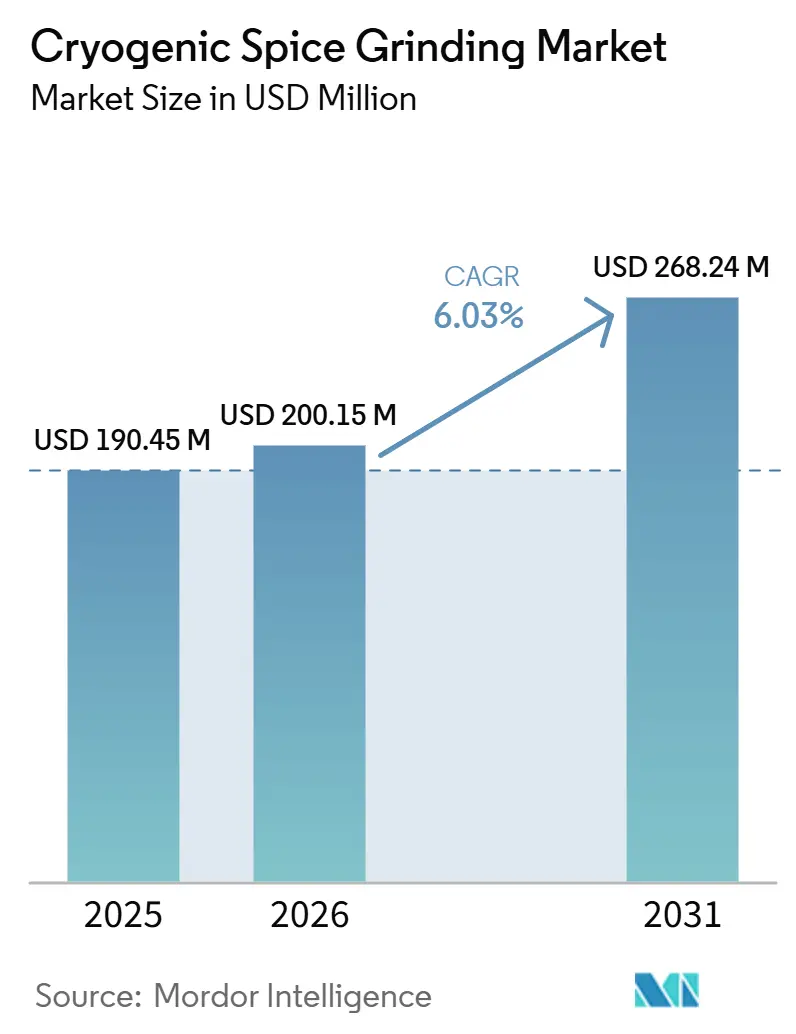
| Market Size (2026) | USD 200.15 Million |
| Market Size (2031) | USD 268.24 Million |
| Growth Rate (2026 - 2031) | 6.03 % |
| Fastest Growing Market | Asia-Pacific |
| Largest Market | Asia-Pacific |
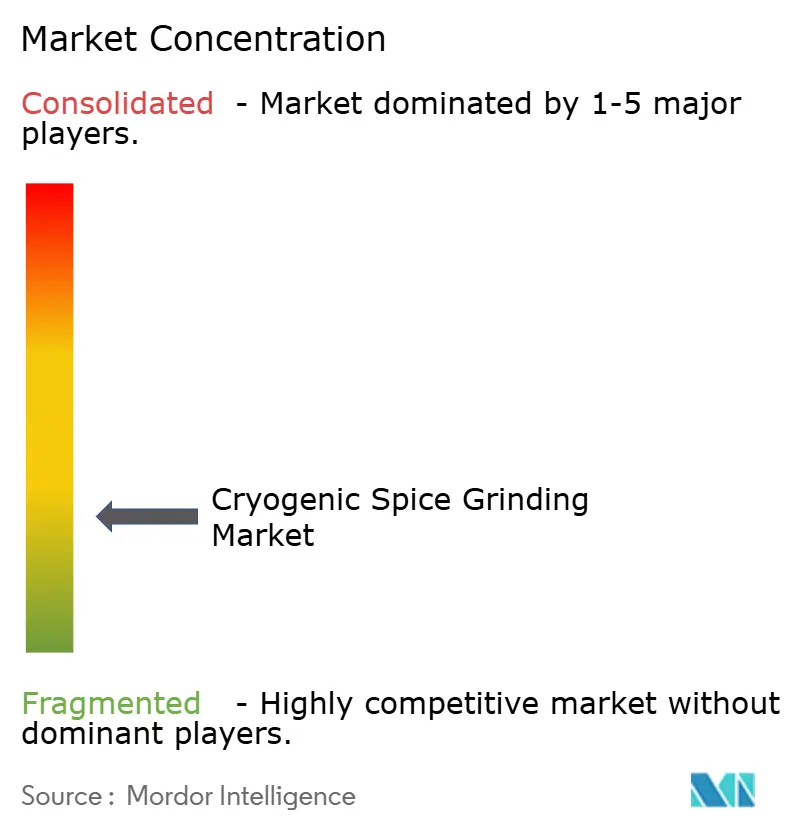
| Market Concentration | Low |
Major Players
*Disclaimer: Major Players sorted in no particular order Image © Mordor Intelligence. Reuse requires attribution under CC BY 4.0. |
|
Cryogenic Spice Grinding Market Analysis by Mordor Intelligence
The cryogenic spice grinding market is expected to grow from USD 190.45 million in 2025 to USD 200.15 million in 2026 and is forecast to reach USD 268.24 billion by 2031 at 6.03% CAGR over 2026-2031. The Cryogenic spice grinding market is supported by buyers that need stable aroma, color, and particle size in premium spice ingredients. Controlled low-temperature milling limits heat exposure during grinding and helps processors protect volatile compounds in oil-rich spices. Export-oriented processors have a stronger reason to invest when higher-value spices require consistent quality after milling. Equipment suppliers are reducing adoption risk through testing centers, modular units, and integrated gas-and-equipment services. The Cryogenic spice grinding market also faces a practical cost barrier because equipment, cryogen storage, utilities, and operator skills raise the cost of entry.
Key Report Takeaways
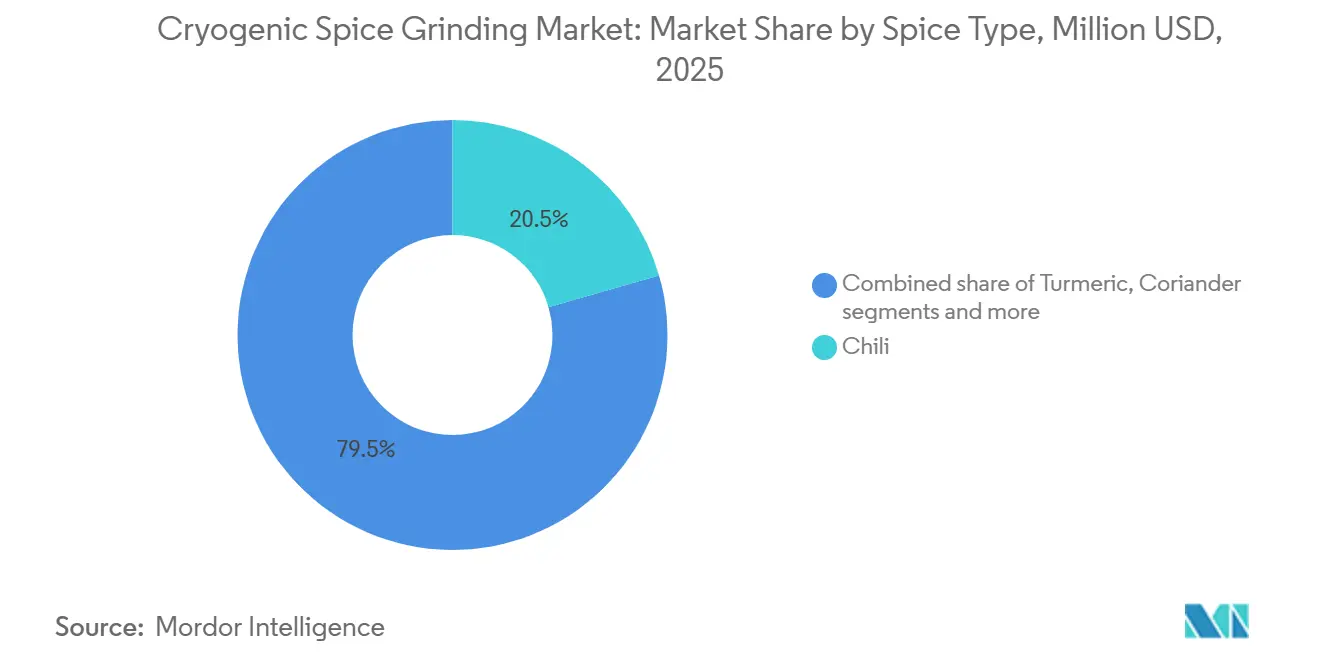
- By spice type, chili held 20.53% of the market share in 2025, while cardamom is forecast to grow at a 7.24% CAGR through 2031.
- By grinding technology, liquid nitrogen-based systems held 86.71% of revenue in 2025, while carbon dioxide-based systems are projected to grow at a 7.56% CAGR through 2031.
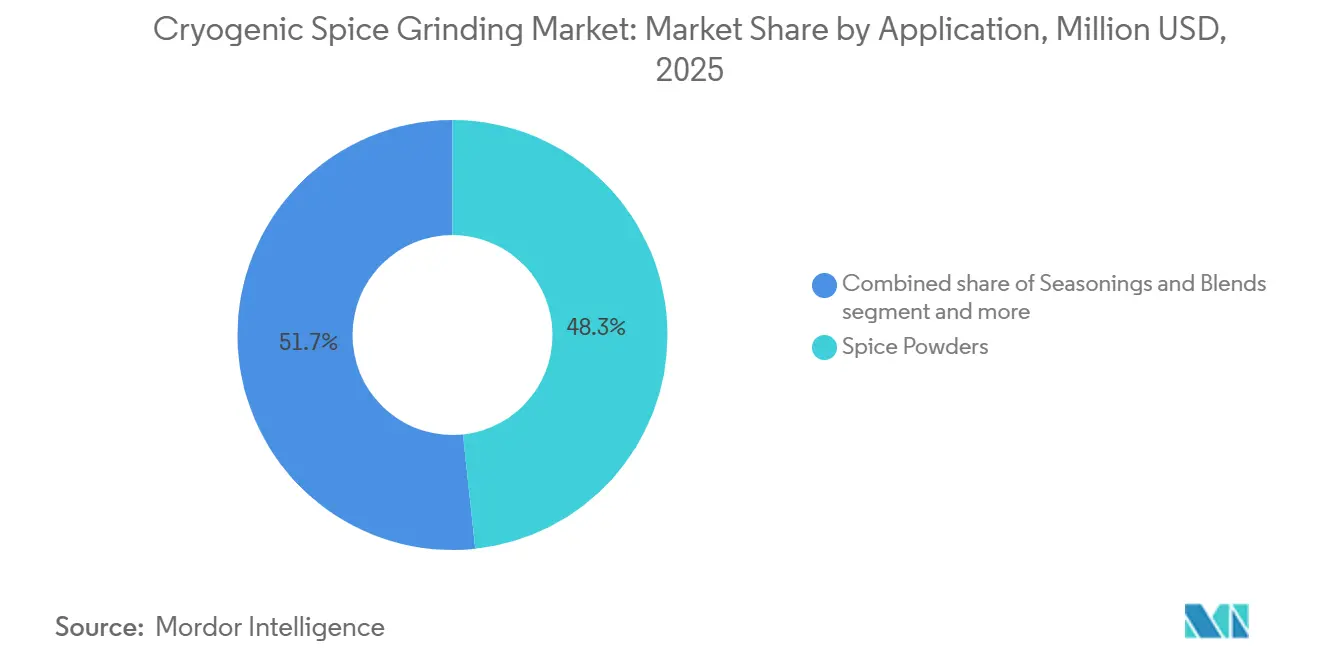
- By application, spice powders accounted for 48.31% of the market size in 2025, while functional ingredients are forecast to expand at an 8.02% CAGR through 2031.
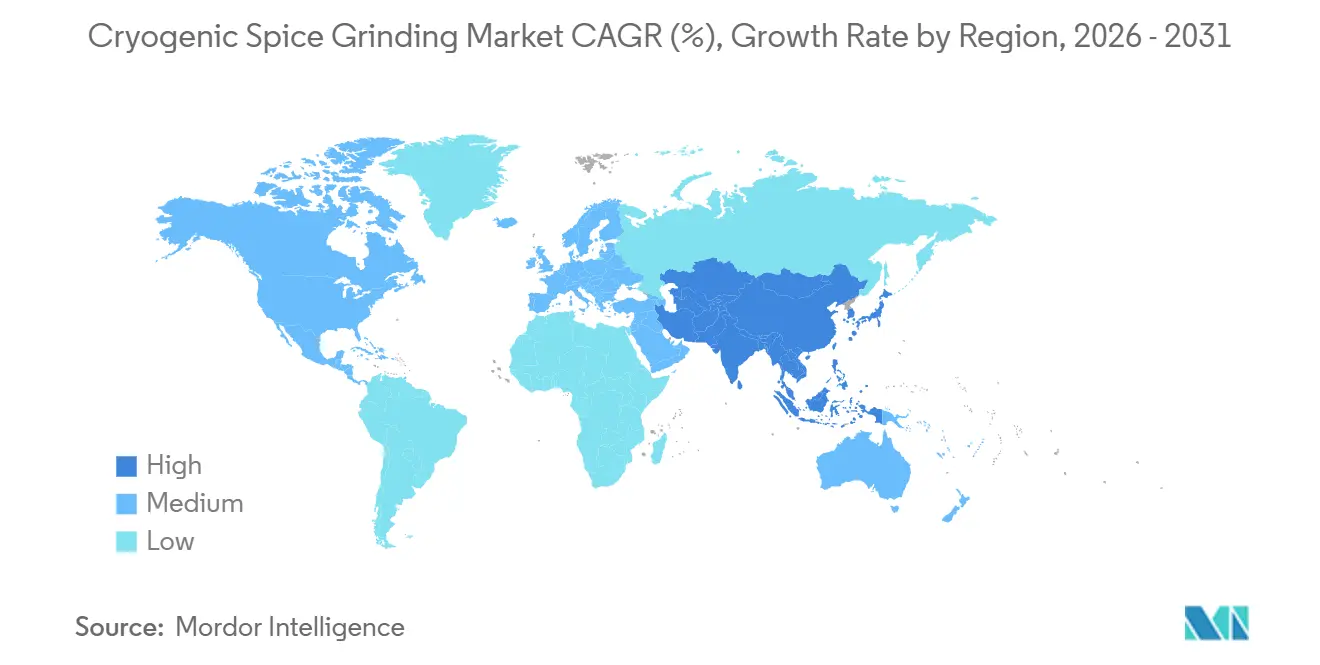
- By geography, Asia-Pacific held 38.24% of revenue in 2025 and is expected to record a 7.75% CAGR through 2031.
Note: Market size and forecast figures in this report are generated using Mordor Intelligence’s proprietary estimation framework, updated with the latest available data and insights as of January 2026.
Market Trends and Insights
Drivers Impact Analysis of Cryogenic Spice Grinding Market*
| Driver | (~) % Impact on CAGR Forecast | Geographic Relevance | Impact Timeline |
|---|---|---|---|
| Rising Demand for High-Quality Ground Spices | +1.2% | Global | Medium term (2-4 years) |
| Growing Adoption of Low-Temperature Grinding Technologies | +1.0% | Asia-Pacific, North America | Medium term (2-4 years) |
| Increasing Demand for Aroma and Flavor Retention | +0.8% | Asia-Pacific, Europe | Long term (≥ 4 years) |
| Expansion of the Processed Food Industry | +0.7% | Global | Short term (≤ 2 years) |
| Rising Demand for Natural and Clean-Label Spices | +0.5% | North America and Europe | Medium term (2-4 years) |
| Growing Spice Export and International Trade | +0.5% | India, Southeast Asia, Middle East and Africa | Medium term (2-4 years) |
| Source: Mordor Intelligence | |||
Rising Demand for High-Quality Ground Spices
Premium spice buyers, including multinational food manufacturers and pharmaceutical ingredient procurement teams, increasingly require aromatic retention standards that ambient-temperature grinding cannot reliably meet. Research published in the Journal of Applied Horticulture (2024) found that cryogenic grinding of ajwain seeds at −60°C using liquid nitrogen retained volatile oil content at 2.9%, while liquid nitrogen consumption rose from 2.4 kg to 7.1 kg as grinding temperature fell from 0°C to −100°C[1]Source: Journal of Applied Horticulture, "Optimizing volatile oil retention in ajwain (Trachyspermum ammiL.) through cryogenic grinding techniques", horticultureresearch.net. According to Commerce Ministry data, India’s cardamom export value is expected to rise from USD 131.9 million in 2023-24 to USD 436.8 million in 2025-26, partly because its aroma profile commands a premium over competing origins. Quality-preserving post-harvest processing sustains this premium. As raw cardamom prices rise amid supply scarcity, processors are adopting cryogenic grinding to preserve margins and extract maximum aromatic yield per kilogram of input. For high-value spice segments, cryogenic grinding has become a value chain imperative.
Growing Adoption of Low-Temperature Grinding Technologies
Modular equipment formats and no-cost application testing services are expanding adoption beyond large-scale exporters to mid-tier processors. Hosokawa Micron B.V. lets customers test production-scale cryogenic grinding with their own spice materials at its 2,000 m² Test and Process Development Centre in the Netherlands, reducing adoption barriers. Air Products and Chemicals, Inc. offers production-scale equipment testing at no capital cost at its food and grinding laboratory in Allentown, Pennsylvania, as noted in its Summer Fancy Food Show 2026 participation announcement. RIECO Industries Limited’s planned 2026 launch of India’s first skid-mounted Air Classifier Mill (ACM) at Indusfood Manufacturing, designed to reduce installation complexity and commissioning time, could lower access thresholds for smaller processors[2]Source: FoodTechBiz, "RIECO At 50: Driving innovation and customer-centric growth in food and spice processing", foodtechbiz.com. ISO 22000 food safety management compliance in B2B spice trade also pushes processors toward controlled-temperature grinding systems that document particle size and thermal exposure parameters.
Increasing Demand for Aroma and Flavor Retention
Flavor integrity differentiates the export spice trade, and researchers now validate cryogenic grinding’s retention advantage at the molecular level. A 2025 study in Sustainable Chemistry and Pharmacy (Yan et al., Nanjing Forestry University, supported by China’s National Key Research and Development Program) shows that cryogenic grinding with ultrasonic pretreatment improves essential oil yield and quality in nutmeg, with implications for industrial-scale processing of tropical high-oil spice varieties. Earlier ICAR research on commercial-scale cryogenic grinding of cardamom seeds recorded 87.08% volatile oil retention and 80.50% retention of the marker compound 1,8-cineole, which export procurement specifications now use as quality benchmarks. Messer France SAS highlights heat exchanger systems that recover cold energy from exhausted nitrogen, reducing liquid nitrogen consumption per unit of output and improving operating economics. As foodservice and retail buyers demand spice powders that replicate freshly crushed aroma profiles, this aroma advantage is becoming a baseline expectation in high-value distribution channels.
Expansion of the Processed Food Industry
The processed food sector represents the primary industrial demand center for standardized, aroma-stable spice ingredients at scale. Global trade in goods and commercial services grew 7% to USD 34.65 trillion in 2025 per WTO's World Trade Statistics 2025, with agricultural categories including processed and packaged food registering above-average growth[3]Source: World Trade Organization, "World Trade Statistics- Key Insights and Trends 2025", wto.org. High-throughput food manufacturers producing packaged snacks, ready-to-eat meals, and seasoned sauces require spice powders with defined particle size distributions and consistent essential oil concentrations — specifications that only controlled-temperature grinding can guarantee for oil-rich species like cardamom, cumin, and nutmeg. The inability of conventional ambient milling to deliver batch-to-batch aroma consistency for these spice types creates a structural demand pull that scales with processed food production volume. As quick-service restaurant chains and organized food retail expand across APAC and South America, procurement of cryogenically processed spice inputs is moving from a procurement preference to a supply chain standard in B2B channels.
Restraints Impact Analysis of Cryogenic Spice Grinding Market*
| Restraint | (~) % Impact on CAGR Forecast | Geographic Relevance | Impact Timeline |
|---|---|---|---|
| High Capital Investment in Cryogenic Grinding Equipment | -0.6% | Global, most pronounced in South and Southeast Asia | Short term (≤ 2 years) |
| High Maintenance and Technical Expertise Requirements | -0.4% | Asia-Pacific, Southeast Asia, Middle East and Africa | Long term (≥ 4 years) |
| Limited Awareness Among Small and Medium-Sized Spice Processors | -0.3% | Southeast Asia, South America, Middle East and Africa | Long term (≥ 4 years) |
| High Energy and Infrastructure Requirements | -0.3% | South Asia, Middle East and Africa, South America | Long term (≥ 4 years) |
| Source: Mordor Intelligence | |||
High Capital Investment in Cryogenic Grinding Equipment
High capital investment in cryogenic grinding equipment remains a major challenge for the growth of the cryogenic spice grinding market, as the technology requires considerable upfront expenditure. Unlike conventional grinding systems, cryogenic operations involve specialized grinding machinery, cooling systems, cryogenic storage units, gas delivery infrastructure, and safety equipment. The overall investment is further increased by installation costs, facility upgrades, regular maintenance, and the need for trained personnel to operate the systems safely. In addition, the continuous requirement for cryogenic agents such as liquid nitrogen or carbon dioxide adds to recurring operational expenses. These financial requirements can create significant barriers for small and medium-sized spice processors that have limited access to capital.
High Maintenance and Technical Expertise Requirements
The technical complexity of cryogenic grinding systems and the need for specialized maintenance can restrain the growth of the cryogenic spice grinding market. These systems require regular servicing of grinding chambers, cooling units, gas supply lines, insulation components, and temperature-control equipment to maintain consistent performance. Effective operation also depends on precise control of temperature, pressure, and cryogenic gas flow throughout the grinding process. As a result, processors need trained personnel with expertise in cryogenic equipment operation, maintenance, gas handling, and safety procedures. The limited availability of skilled technicians can increase maintenance costs, equipment downtime, and operational disruptions, particularly for small and medium-sized processors.
*Our forecasts treat driver/restraint impacts as directional, not additive. The impact forecasts reflect baseline growth, mix effects, and variable interactions.
Cryogenic Spice Grinding Market Segment Analysis
By Spice Type:
Chili Leads Volume While Cardamom Gains From Export DemandChili accounted for the largest share of the cryogenic spice grinding market by spice type, representing 20.53% of the market in 2025. The leading position of chili is supported by its extensive use across household cooking, foodservice, and processed food applications. Chili is a core ingredient in a wide range of cuisines and is increasingly used in sauces, seasonings, ready-to-eat foods, snacks, and spice blends. Cryogenic grinding helps preserve the color, aroma, flavor, and volatile compounds of chili, making the process particularly attractive for manufacturers producing premium-quality chili powders. The growing demand for high-quality and consistent chili-based ingredients is further supporting the adoption of cryogenic grinding technologies.
Cardamom is projected to be the fastest-growing spice type in the cryogenic spice grinding market, expanding at a CAGR of 7.24% through 2031. The growth of the segment is primarily driven by the increasing demand for premium spices with strong aroma, flavor, and high-quality sensory attributes. Cardamom contains valuable volatile oils that can be better preserved through low-temperature cryogenic grinding compared with conventional grinding methods. This makes cryogenic processing particularly suitable for maintaining the characteristic aroma and flavor profile of cardamom. Rising applications of cardamom in beverages, bakery products, confectionery, dairy products, spice blends, and traditional food preparations are further expanding its market potential.



By Grinding Technology:
Liquid Nitrogen Leads While Carbon Dioxide ExpandsLiquid nitrogen-based systems dominated the cryogenic spice grinding market by grinding technology, accounting for 86.71% of total revenue in 2025. The strong market position of this technology is primarily attributed to the effective cooling capabilities of liquid nitrogen during the grinding process. Rapid cooling helps reduce heat generation and minimizes the loss of sensitive oils, aromas, colors, and flavors in spices. This makes liquid nitrogen-based grinding particularly suitable for processing high-value and heat-sensitive spices used in food, beverage, seasoning, and nutraceutical applications.
Carbon dioxide-based systems are projected to be the fastest-growing technology segment in the cryogenic spice grinding market, registering a CAGR of 7.56% through 2031. The growth of this segment is supported by increasing interest in alternative cryogenic grinding technologies that can provide effective temperature control during spice processing. Carbon dioxide-based systems can help limit heat buildup and preserve important sensory characteristics, including flavor and aroma, in temperature-sensitive spices. Their potential applications across specialty spice processing and premium ingredient production are creating additional opportunities for market expansion.
By Application:
Spice Powders Form the Core While Functional Ingredients Grow FastestSpice powders represented the largest application segment in the cryogenic spice grinding market, accounting for 48.31% of the market size in 2025. The segment’s leading position is supported by the widespread use of powdered spices across household cooking, foodservice, food processing, and packaged food applications. Cryogenic grinding is particularly beneficial for producing high-quality spice powders because it helps reduce heat generation and preserve natural aromas, flavors, colors, and volatile oils. The technology also enables manufacturers to achieve consistent particle sizes and improved product quality, which are important requirements for commercial spice powder production.
Functional ingredients are projected to be the fastest-growing application segment in the cryogenic spice grinding market, expanding at a CAGR of 8.02% through 2031. The growth of this segment is being supported by increasing demand for natural, functional, and value-added ingredients across food, beverage, nutraceutical, and health-oriented product categories. Cryogenic grinding can help preserve sensitive bioactive compounds, essential oils, and other functional properties of spices that may be affected by conventional high-temperature processing.
Geography Analysis
APAC Cryogenic Spice Grinding Market
Asia-Pacific held 38.24% of the cryogenic spice grinding market share in 2025 and grow at a CAGR of 7.75% through 2031. India remains a major demand center, with processors serving export markets for cardamom, chili, turmeric, pepper, and cumin while supplying domestic food manufacturers that require standardized ingredients. Government data identifies spices as a key agricultural trade category, and international trade growth supports demand for higher-value processing. China drives demand through pharmaceutical ingredients and nutraceutical formulations that use spice bioactives. Japan and Australia remain smaller but premium destinations with strict ingredient specifications for traceability, product consistency, and sensory quality. India’s food safety requirements encourage documented processing conditions for export-grade products within the cryogenic spice grinding market.
North America and Europe Cryogenic Spice Grinding Market
North America and Europe remain mature destinations for controlled spice processing. In the United States, equipment and industrial gas suppliers support trials, engineering, food processing applications, and scale-up work before processors commit to commercial installations. Air Products operates a food and grinding laboratory in Allentown for customer application testing. Food safety requirements in these regions encourage traceability and documentation of processing conditions. Germany and the United Kingdom serve domestic demand and the premium spice-blend trade. Hosokawa Alpine is expected to launch its Alpine Dual Mill in September 2025 for fine grinding applications in food and other sectors. Italy supports demand through its flavor and fragrance manufacturing base, which uses botanical ingredients that require dependable aromatic performance after size reduction.
South America and MEA Cryogenic Spice Grinding Market
South America offers a medium-term opportunity as Brazil expands packaged food production and Argentina supplies regional seasoning markets. Middle East and Africa demand remains strongest in Gulf markets that purchase premium aromatic spice products. The cryogenic spice grinding market can benefit where importers prioritize strong aroma and consistent quality. Infrastructure gaps and uneven cryogen supply limit adoption in parts of sub-Saharan Africa, where cold-chain capability, plant utilities, and technical support may be less consistent. Suppliers are designing application-specific equipment to reduce condensation risks in tropical operating conditions. The cryogenic spice grinding industry needs local service capacity and dependable gas logistics to convert this potential into installations.

Competitive Landscape
The cryogenic spice grinding market is highly fragmented, with competition distributed across specialized equipment manufacturers, industrial-gas suppliers, and integrated spice-processing companies. Equipment suppliers compete by offering cryogenic grinding systems, pulverizers, mills, and supporting technologies designed to control temperature and preserve the sensory characteristics of spices. Industrial-gas companies play an important role by supplying liquid nitrogen, carbon dioxide, and related cryogenic gases required for temperature-controlled grinding operations. Integrated spice processors further strengthen competition by combining raw-material sourcing, grinding, blending, packaging, and distribution capabilities.
Competition among equipment suppliers is primarily based on grinding efficiency, temperature control, particle-size consistency, processing capacity, energy efficiency, and system customization. Manufacturers are increasingly developing solutions that can handle different spice types and accommodate the requirements of food processors operating at various production scales. The ability to minimize heat generation and retain volatile oils, aromas, colors, and flavors remains a key differentiating factor.
Integrated spice processors and established food ingredient companies add further competitive pressure by leveraging their established customer relationships, processing infrastructure, sourcing networks, and distribution capabilities. These companies can offer customers a broader range of value-added products, including finely milled spice powders, blends, extracts, and functional ingredients. Market participants are also focusing on product quality, clean-label processing, customization, and the ability to meet the specifications of food, beverage, nutraceutical, and industrial customers.
Cryogenic Spice Grinding Industry Leaders
-
YENCHEN MACHINERY CO., LTD.
-
Gandhi Spices Private Limited
-
Rieco Industries Limited
-
Finex Sieves Pvt. Ltd.
-
Granny’s Spices
- *Disclaimer: Major Players sorted in no particular order
Cryogenic Spice Grinding Market Companies Covered in this Report
- YENCHEN MACHINERY CO., LTD.
- Gandhi Spices Private Limited
- Rieco Industries Limited
- Finex Sieves Pvt. Ltd.
- Granny's Spices
- Air Products and Chemicals, Inc.
- DGF Flavour System GmbH & Co. KG
- Hosokawa Micron B.V.
- The Fitzpatrick Company
- MechAir
- Jiangyin Baoli Machinery Manufacturing Co., Ltd.
- Sifter International
- GEA Group Aktiengesellschaft
- Retsch GmbH
- Jacobson Products Company
- Hyperbaric Technologies Pvt. Ltd.
- Cryogas Equipment Private Limited
- Schutte Hammermill, LLC
- Linde plc
- Prater Industries, Inc.

Recent Industry Developments in Cryogenic Spice Grinding Market
- June 2026: Air Products and Chemicals, Inc. highlighted its Freshline® solutions, which use liquid nitrogen and carbon dioxide, at the Summer Fancy Food Show 2026 in New York City. The company also promoted its food and grinding laboratory in Allentown, Pennsylvania, emphasizing its capabilities in food processing and ingredient grinding applications.
- March 2026: Linde plc presented its CRYOLINE® cryogenic freezer and broader food-processing portfolio at the International Pizza Expo in Las Vegas. The portfolio included liquid nitrogen and carbon dioxide applications relevant to spice and flavoring ingredients, supporting freezing, cooling, and processing requirements in food production.
- September 2025: Hosokawa Alpine AG launched the Alpine Dual Mill at POWTECH Technopharm in Nuremberg. The mill combined features from the ACM and ZPS series and supported fine grinding applications that require flexibility and precision.


Global Cryogenic Spice Grinding Market Report Scope
Cryogenic spice grinding is a specialized grinding process in which spices are cooled to very low temperatures, typically using cryogenic substances such as liquid nitrogen or carbon dioxide, before or during size reduction. The cryogenic spice grinding market is segmented by spice type, grinding technology, application and geography. Based on spice type, the market is segmented into pepper, turmeric, chili, coriander, cumin, cardamom, clove, nutmeg and other spices. Based on grinding technology, the market is segmented into liquid nitrogen-based cryogenic grinding, carbon dioxide-based cryogenic grinding and other cryogenic grinding technologies. Based on application, the market is segmented into spice powders, seasonings and blends, flavors and fragrances, functional ingredients and pharmaceutical ingredients. By geography, the market is segmented into North America, Europe, Asia-Pacific, South America, and Middle-East and Africa. For each segment, the market sizing and forecasting have been done in value terms (USD million).
| Pepper |
| Turmeric |
| Chili |
| Coriander |
| Cumin |
| Cardamom |
| Clove |
| Nutmeg |
| Other Spices |
| Liquid Nitrogen-Based Cryogenic Grinding |
| Carbon Dioxide-Based Cryogenic Grinding |
| Other Cryogenic Grinding Technologies |
| Spice Powders |
| Seasonings and Blends |
| Flavors and Fragrances |
| Functional Ingredients |
| Pharmaceutical Ingredients |
| North America | United States |
| Canada | |
| Mexico | |
| Rest of North America | |
| Europe | Germany |
| United Kingdom | |
| Italy | |
| Rest of Europe | |
| Asia-Pacific | China |
| India | |
| Japan | |
| Australia | |
| Rest of Asia-Pacific | |
| South America | Brazil |
| Argentina | |
| Rest of South America | |
| Middle East and Africa | South Africa |
| Saudi Arabia | |
| United Arab Emirates | |
| Rest of Middle East and Africa |
| By Spice Type | Pepper | |
| Turmeric | ||
| Chili | ||
| Coriander | ||
| Cumin | ||
| Cardamom | ||
| Clove | ||
| Nutmeg | ||
| Other Spices | ||
| By Grinding Technology | Liquid Nitrogen-Based Cryogenic Grinding | |
| Carbon Dioxide-Based Cryogenic Grinding | ||
| Other Cryogenic Grinding Technologies | ||
| By Application | Spice Powders | |
| Seasonings and Blends | ||
| Flavors and Fragrances | ||
| Functional Ingredients | ||
| Pharmaceutical Ingredients | ||
| By Geography | North America | United States |
| Canada | ||
| Mexico | ||
| Rest of North America | ||
| Europe | Germany | |
| United Kingdom | ||
| Italy | ||
| Rest of Europe | ||
| Asia-Pacific | China | |
| India | ||
| Japan | ||
| Australia | ||
| Rest of Asia-Pacific | ||
| South America | Brazil | |
| Argentina | ||
| Rest of South America | ||
| Middle East and Africa | South Africa | |
| Saudi Arabia | ||
| United Arab Emirates | ||
| Rest of Middle East and Africa | ||


Key Questions Answered in the Report
What is the projected value of cryogenic spice grinding by 2031?
The Cryogenic spice grinding market is projected to reach USD 268.24 million by 2031, growing at a 6.03% CAGR from 2026 as processors prioritize ingredient quality, standardized production, and better preservation of aromatic compounds.
Which spice type leads cryogenic grinding demand?
Chili led with 20.53% revenue share in 2025, supported by demand from sauces, seasonings, packaged foods, and foodservice preparations that depend on consistent sensory attributes, color, and manageable powder flow.
Which grinding technology is most widely used for spices?
Liquid nitrogen-based systems held 86.71% revenue share in 2025 because they deliver deep cooling, controlled particle formation, and strong protection for heat-sensitive spice materials.
Why do processors use low-temperature grinding for spices?
It helps protect essential oils, aroma, color, and particle consistency in oil-rich and premium spice ingredients, which can support higher-quality finished products, more repeatable formulations, and lower thermal damage during milling.
Which application is growing fastest through 2031?
Functional ingredients are forecast to grow at an 8.02% CAGR because nutraceutical buyers need standardized, high-potency spice powders with controlled active-compound and essential-oil characteristics.
Page last updated on:





