
Crowdsourced On-Demand Same-Day Parcel Delivery Market Size and Share
Market Overview
| Study Period | 2021 - 2032 |
|---|---|
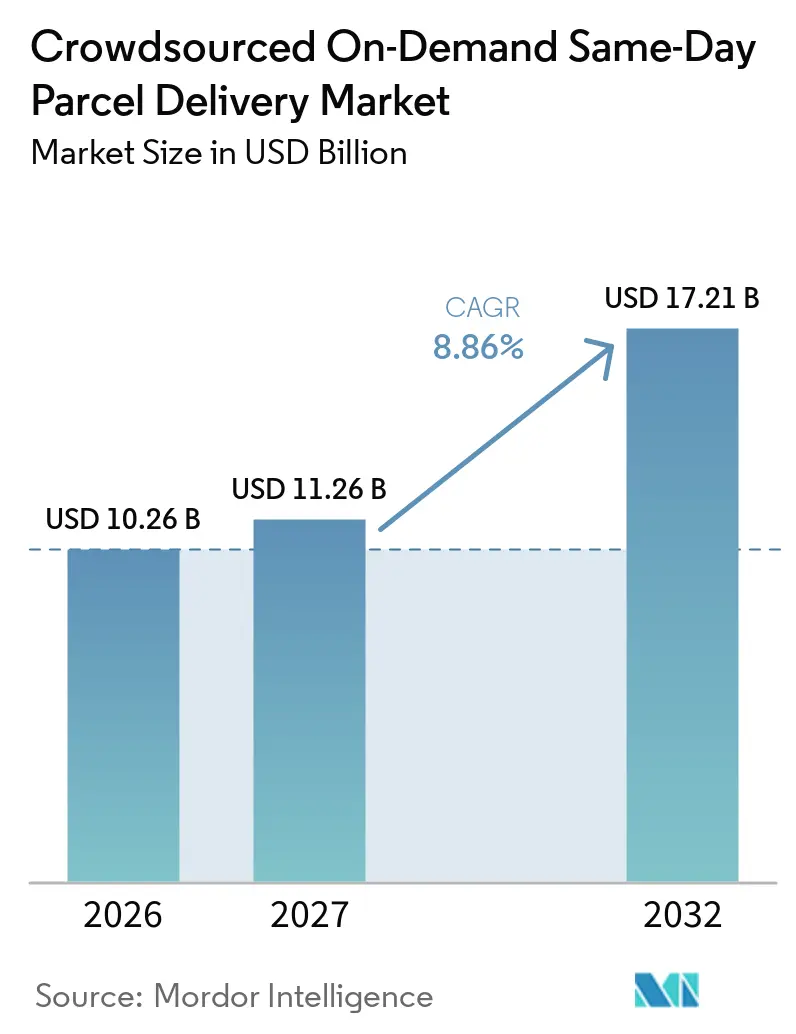
| Market Size (2027) | USD 11.26 Billion |
| Market Size (2032) | USD 17.21 Billion |
| Growth Rate (2027 - 2032) | 8.86 % |
| Fastest Growing Market | Asia-Pacific |
| Largest Market | North America |
| Market Concentration | Medium |
Major Players *Disclaimer: Major Players sorted in no particular order Image © Mordor Intelligence. Reuse requires attribution under CC BY 4.0. | |
Crowdsourced On-Demand Same-Day Parcel Delivery Market Analysis by Mordor Intelligence
The crowdsourced on-demand same-day parcel delivery market size is valued at USD 10.26 billion in 2026 and is estimated to grow from USD 11.26 billion in 2027 to reach USD 17.21 billion by 2032, at a CAGR of 8.86% during the forecast period from 2027 to 2032.
The crowdsourced on-demand same-day parcel delivery market is being reshaped by retailers that need faster fulfillment without building dedicated delivery fleets. Merchant-facing delivery APIs are bringing third-party dispatch into retailer-owned checkout experiences. Micro-fulfillment sites near dense customer areas support shorter pickup trips and more reliable delivery windows. Quick commerce adds frequent, impulse-led orders to scheduled parcel flows. Platform operators are responding through fulfillment partnerships, broader courier coverage, and autonomous delivery pilots.
Key Report Takeaways
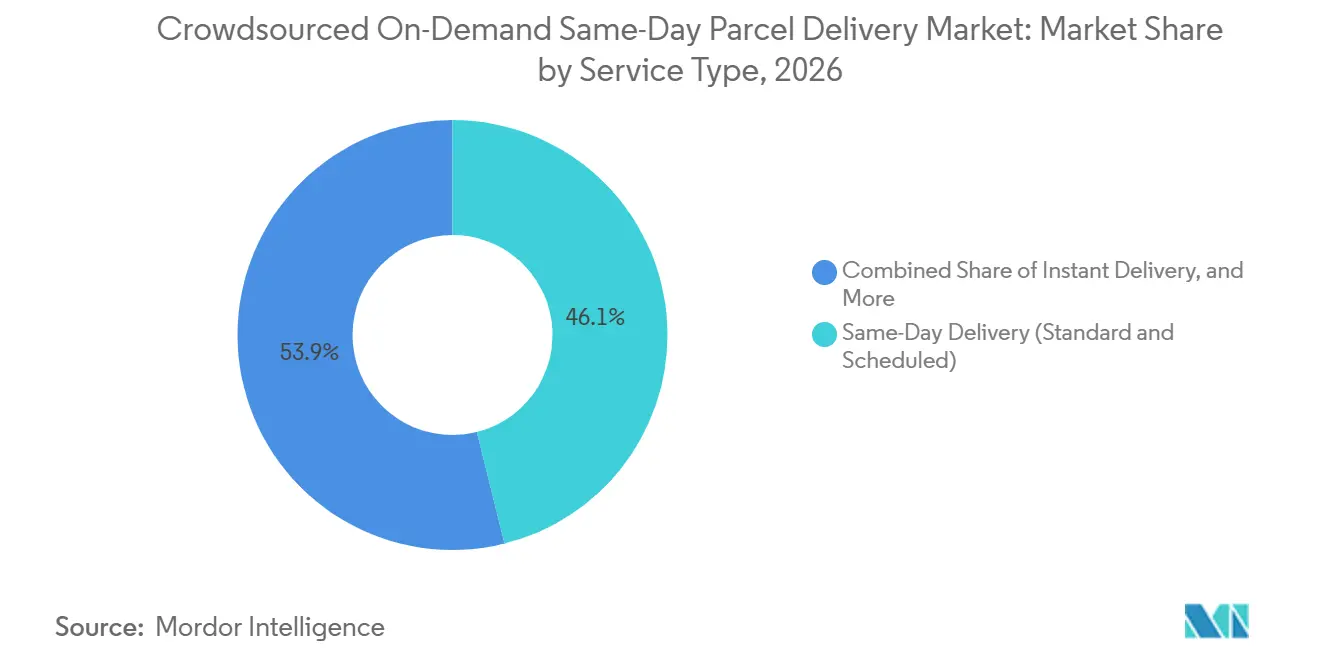
- By service type, same-day delivery (standard and scheduled) held 46.11% of the crowdsourced on-demand same-day parcel delivery market share in 2026, while instant delivery is advancing at a 12.08% CAGR through 2032.
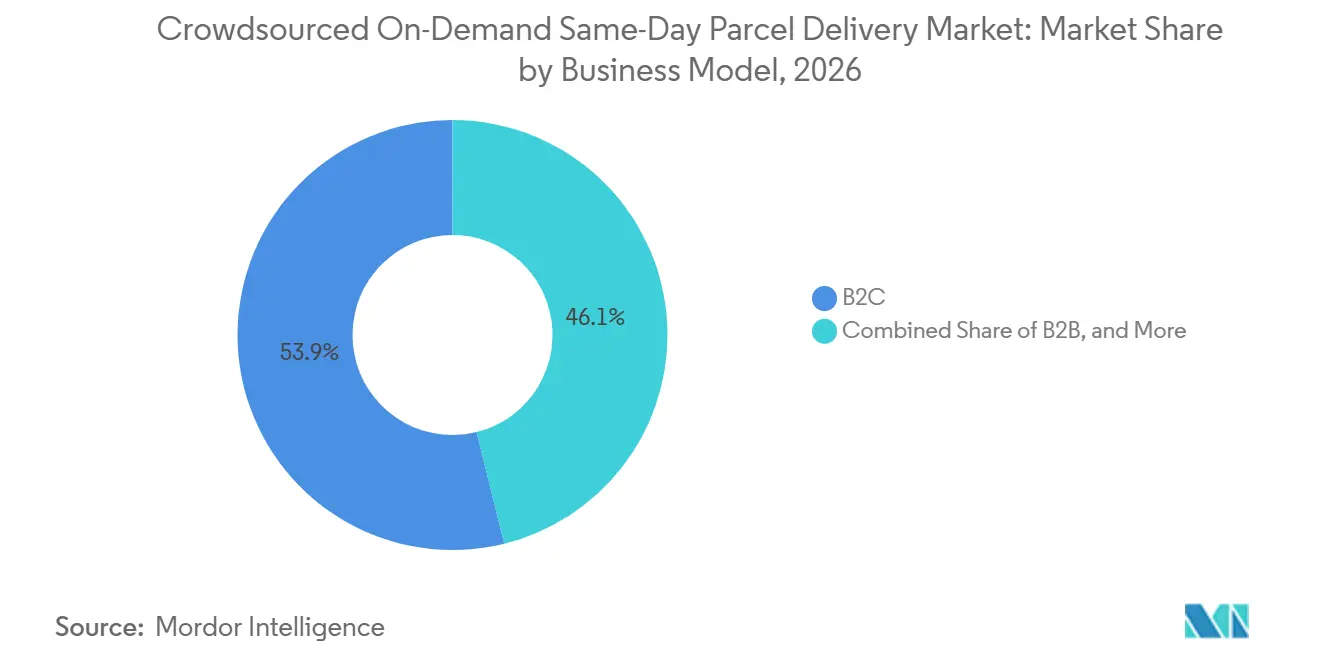
- By business model, B2C held 53.87% of the crowdsourced on-demand same-day parcel delivery market size in 2026 and is growing at a 10.26% CAGR through 2032.
- By delivery distance, urban and intra-city delivery held 48.14% of the crowdsourced on-demand same-day parcel delivery market share in 2026, while extended urban and peri-urban delivery is growing at a 10.20% CAGR through 2032.
- By courier engagement model, independent gig couriers held 60.84% of the crowdsourced on-demand same-day parcel delivery market size in 2026, while part-time contracted drivers are growing at a 9.29% CAGR through 2032.
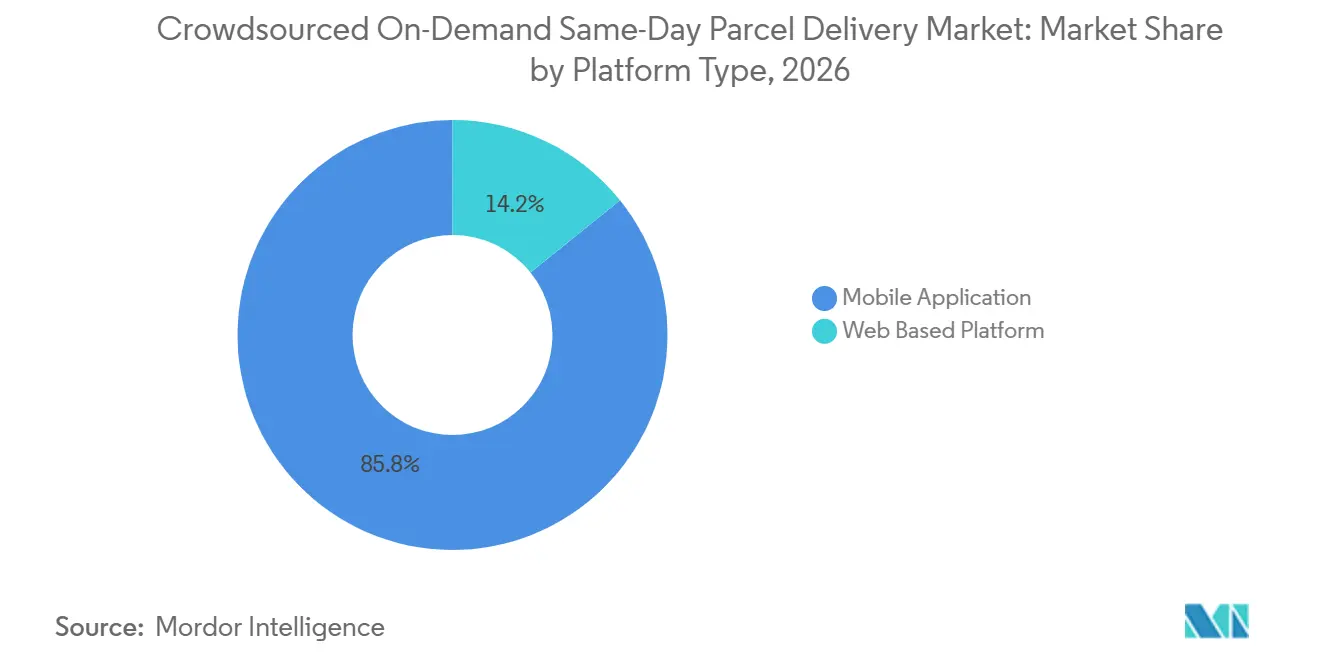
- By platform type, mobile applications held an 85.77% share in the crowdsourced on-demand same-day parcel delivery market size 2026, while web-based platforms are growing at a 9.27% CAGR through 2032.
- By vehicle type, two-wheelers held 52.12% of the crowdsourced on-demand same-day parcel delivery market share in 2026, while drones and autonomous vehicles are growing at a 22.64% CAGR through 2032.
- By end user, e-commerce and online retail held 33.92% of the crowdsourced on-demand same-day parcel delivery market share in 2026, while quick commerce is growing at a 15.97% CAGR through 2032.
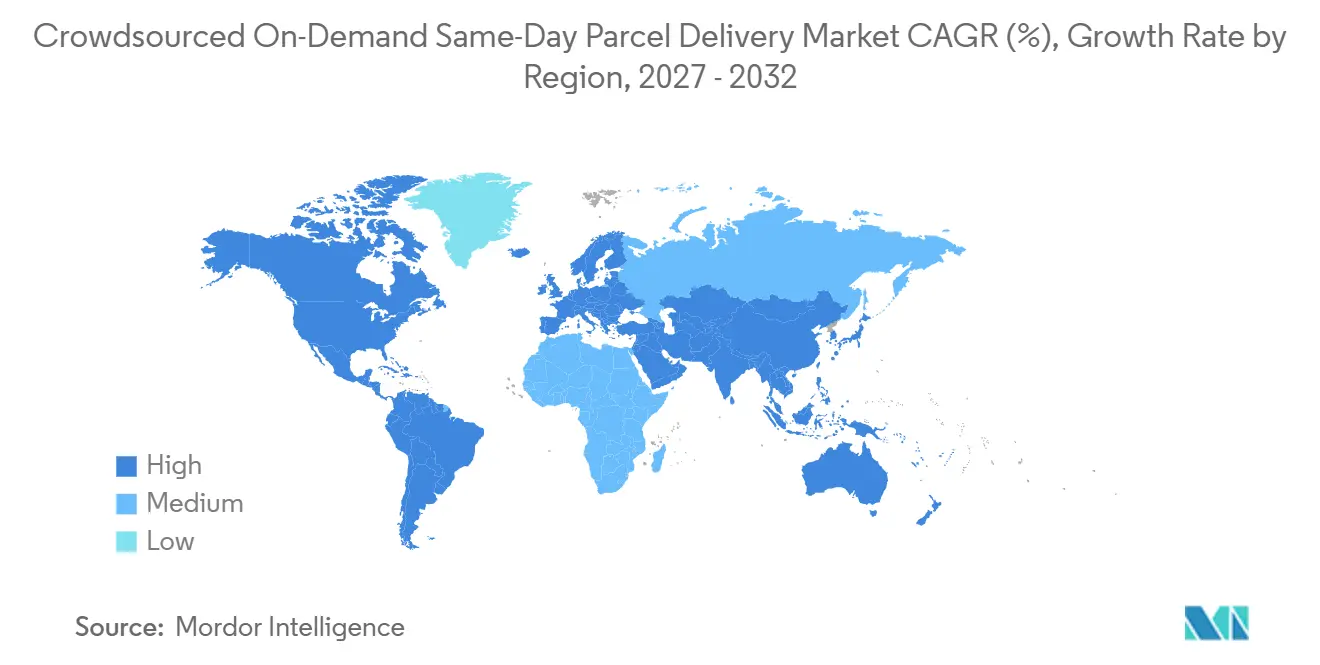
- By geography, North America held 34.10% share in 2026, while Asia-Pacific is growing at a 12.15% CAGR through 2032.
Note: Market numbers in this report are based on Mordor Intelligence's proprietary estimation framework, which combines nine months of actuals with Q4 projections for base year 2026.
Market Trends and Insights
Drivers Impact Analysis of Crowdsourced On-Demand Same-Day Parcel Delivery Market*
| Driver | (~) % Impact on CAGR Forecast | Geographic Relevance | Impact Timeline |
|---|---|---|---|
| E-Commerce and Omnichannel Same-Day Commitments | +2.1% | Global, concentrated in North America, Western Europe, and APAC urban corridors | Short term (≤ 2 years) |
| Variable-Capacity Requirements During Demand Peaks | +1.4% | Global, most acute in North America and APAC during holiday and promotional cycles | Short term (≤ 2 years) |
| White-Label Delivery APIs and Owned-Channel Fulfillment | +0.9% | North America and Europe primary, expanding into APAC and Latin America | Medium term (2-4 years) |
| Smartphone-Based Courier Availability and Digital Payments | +1.3% | APAC, MEA, and Latin America core, with spillover to underserved urban pockets in Europe | Medium term (2-4 years) |
| Real-Time Capacity Matching in Low-Density Catchments | +0.7% | North America rural-suburban areas and emerging APAC Tier-2 cities | Long term (≥ 4 years) |
| Store, Warehouse, and Micro-Fulfillment Proximity to Consumers | +1.0% | Global, with the highest impact in North American and APAC metropolitan areas | Medium term (2-4 years) |
| Source: Mordor Intelligence | |||
E-Commerce and Omnichannel Same-Day Commitments
Retailer same-day commitments are moving from a point of differentiation toward a basic service expectation in many United States customer segments. Amazon invested USD 4 billion to expand its delivery network and planned to bring same-day and next-day coverage to more than 4,000 smaller United States cities, towns, and rural communities by 2026. This expansion raises the delivery-speed benchmark for retailers that lack owned delivery capacity.[1] The crowdsourced on-demand same-day parcel delivery market benefits when merchants use platform courier networks to match these delivery commitments. In leading urban areas, difficulty in reliably approaching 1-hour delivery windows can push merchants toward integrated retail delivery models. This makes delivery reliability as important as the availability of a same-day option.
Variable-Capacity Requirements During Demand Peaks Entrench the Gig Delivery Model
Peak retail events create delivery volume surges that scheduled carrier networks may not absorb without additional capacity. The crowdsourced on-demand same-day parcel delivery market gives merchants access to flexible courier pools during promotions, holidays, and high-demand periods. This flexibility is particularly relevant for speed-critical product categories that cannot wait for a scheduled parcel route.[2] Retailers are, therefore, using gig delivery capacity for core order flows as well as overflow demand. Operators that meet delivery commitments during peak periods can secure stronger merchant relationships. Their performance at the 90th percentile of delivery times can affect contracted service commitments.
Smartphone-Based Courier Availability and Digital Payments Expand Gig Supply in Emerging Markets
Smartphone access and digital payment systems reduce friction for courier recruitment and payment in developing delivery ecosystems. In the Philippines, GCash and Flash Express introduced Scan on Delivery in July 2025, enabling QR-code payments at the door and automated rider commission disbursement through digital wallets. Faster payment can support courier retention by reducing cash-handling needs. The World Bank stated that inclusive, low-cost payment infrastructure might improve the speed of earnings access and financial inclusion for platform workers. These conditions widen the available courier base in APAC, the Middle East and Africa, and Latin America. They also support the crowdsourced on-demand same-day parcel delivery market where local delivery networks are still being established.
Store, Warehouse, and Micro-Fulfillment Proximity to Consumers Determines Window Viability
Short delivery windows depend on keeping the distance between inventory and customers low. Fulfillment nodes located within 2 to 5 miles of a large share of urban orders can reduce pickup time and increase the number of orders that qualify for same-day service. Micro-fulfillment investments in Bengaluru, Delhi, and Mumbai reflect the need to keep inventory close to high-demand areas in India. Dark-store expansion also supports quick commerce platforms that require delivery in under 2 hours. For crowdsourced operators, closer pickup locations reduce deadhead travel between acceptance and collection. This can improve courier hourly yield and make shorter service windows more viable.
Restraints Impact Analysis of Crowdsourced On-Demand Same-Day Parcel Delivery Market*
| Restraint | (~) % Impact on CAGR Forecast | Geographic Relevance | Impact Timeline |
|---|---|---|---|
| High Cost per Stop and Uneven Route Density | -1.2% | Global, most pronounced in North American suburban-rural zones and South American corridors | Short term (≤ 2 years) |
| Driver Availability Volatility and Peak-Time Service-Level Risk | -0.8% | North America and Europe, with spillover to APAC during festival peak periods | Short term (≤ 2 years) |
| Worker Classification, Pay, Insurance, and Algorithmic Management Compliance | -0.9% | Europe and North America primary, with expanding regulatory pressure in APAC | Medium term (2-4 years) |
| Parcel Chain-of-Custody Friction Across Multi-Category Courier Networks | -0.6% | Global, most acute in MEA and Latin American multi-stop urban networks | Medium term (2-4 years) |
| Source: Mordor Intelligence | |||
High Cost per Stop and Uneven Route Density Constrain the Viable Service Zone
Cost per stop rises as delivery density falls, which limits the service area for many platforms. In suburban and rural corridors with fewer than 4 stops per route hour, delivery revenue can fail to cover courier guarantees and variable operating costs. The crowdsourced on-demand same-day parcel delivery market, therefore, remains concentrated in urban and peri-urban zones with higher order density. Fragmented demand across competing platforms can prevent any operator from building adequate route density in Tier-2 and Tier-3 locations.[3] Platforms are testing zone-based order batching across multiple merchant pickups to improve unit economics. Low-density expansion remains difficult where order volumes stay dispersed.
Worker Classification, Pay, Insurance, and Algorithmic Management Compliance Increase Operating Costs
Labor rules for platform couriers are tightening in several jurisdictions during the forecast period. Ontario's Digital Platform Workers' Rights Act took effect in July 2025, with minimum hourly wage obligations, tip protections, and record-keeping requirements for delivery platforms. The International Labour Organization adopted Convention No. 193 on platform work in June 2026, setting global standards concerning remuneration, occupational safety, and algorithmic management disclosures. The European Union Platform Work Directive has a December 2026 implementation deadline across 27 member states and provides for greater transparency in algorithmic management.[4] These requirements can raise cost per delivery for affected operators. Hybrid models that combine independent couriers with contracted part-time drivers can provide more flexibility in managing this exposure.
*Our forecasts treat driver/restraint impacts as directional, not additive. The impact forecasts reflect baseline growth, mix effects, and variable interactions.
Crowdsourced On-Demand Same-Day Parcel Delivery Market Segment Analysis
By Service Type:
Scheduled Windows Lead While Sub-Hour Delivery Gains PaceSame-day delivery (standard and scheduled) accounted for 46.11% of the crowdsourced on-demand same-day parcel delivery market share in 2026. It is supported by planned-window fulfillment across e-commerce, retail, and B2B replenishment. Merchants use scheduled windows where delivery timing matters, but immediate dispatch is not essential. This approach can align courier availability with predictable order volumes. It also gives customers a defined delivery period without the higher operating intensity of instant service.
Instant delivery is growing at a 12.08% CAGR from 2027 to 2032 as quick commerce expands and customers become more familiar with deliveries under 60 minutes. Under-two-hour delivery serves healthcare and specialty retail orders where urgency is high, but preparation requirements delay immediate dispatch. End-of-day delivery supports cost-sensitive merchants that accept a later window in exchange for lower delivery costs. Within the crowdsourced on-demand same-day parcel delivery market, platforms are pre-positioning couriers near high-demand micro-zones to reduce time to pickup. This improves the share of orders that operators can commit to instant service levels.

By Business Model:
B2C Concentration Shapes Platform EconomicsB2C held a 53.87% share of the crowdsourced on-demand same-day parcel delivery market in 2026 and is growing at a 10.26% CAGR through 2032. This reflects the volume of individual consumer purchases and the frequent ordering behavior of mobile platform users. Consumer orders often have lower values than business shipments but occur at higher frequency. The crowdsourced on-demand same-day parcel delivery market gains scale from the breadth of retail, grocery, foodservice, and general merchandise categories. B2C scale gives operators a large base for expanding merchant integrations.
Large retailer partnerships show the reach of B2C delivery arrangements with national chains. B2B has a different operating profile, with higher package values, regular order patterns, and tighter chain-of-custody needs. Industrial supply, construction materials, and pharmaceutical distribution are relevant B2B use cases. C2C delivery supports peer-to-peer and second-hand marketplace transactions in Latin America and Southeast Asia. The large B2C base leaves room for platforms to serve retailers that have not yet connected to third-party same-day delivery channels.
By Delivery Distance:
Urban Core Supports Volume While Peri-Urban Coverage ExpandsUrban and intra-city delivery held 48.14% of the crowdsourced on-demand same-day parcel delivery market size in 2026. Dense metropolitan areas concentrate customer demand and courier supply within shorter travel distances. Higher stop density supports better delivery economics across basket sizes and service levels. These areas also have the greatest availability of stores and micro-fulfillment locations. The urban core remains the operational base for the crowdsourced on-demand same-day parcel delivery market.
Extended urban and peri-urban delivery is growing at a 10.20% CAGR from 2027 to 2032 as residential development moves outward from city centers. Short-distance and hyperlocal delivery supports quick commerce because sub-20-minute windows require minimal travel between pickup and destination. Amazon's USD 4 billion rural and small-town delivery investment is adding coverage in corridors that previously had limited same-day options. Retailers with suburban store networks can give third-party platforms pickup access without owning separate fulfillment sites. This can extend coverage while preserving a lighter capital model.
By Courier Engagement Model:
Independent Couriers Lead While Hybrid Pools ExpandIndependent gig couriers held a 60.84% share of the crowdsourced on-demand same-day parcel delivery market size in 2026. The crowdsourced on-demand same-day parcel delivery market uses this model to scale courier supply without fixed headcount obligations. It is strongest in cities with large groups of workers seeking flexible earning opportunities. This supply structure helps platforms respond to variable order volumes. It also exposes operators to changing rules around worker classification, pay, and insurance.
Part-time contracted drivers are growing at a 9.29% CAGR from 2027 to 2032 as platforms build hybrid courier pools. In the crowdsourced on-demand same-day parcel delivery market, minimum-hour commitments and baseline benefits can help platforms address labor compliance exposure. Full-time partnered drivers are relevant for enterprise and B2B delivery needs that require predictable routes and dedicated relationships. Lower courier earnings can weaken voluntary retention where other earning options are available. Faster earnings disbursement and vehicle-financing programs can strengthen recruitment and retention in competitive courier markets.
By Platform Type:
Mobile Applications Lead While Web Channels Serve Enterprise NeedsMobile applications held 85.77% of the crowdsourced on-demand same-day parcel delivery market share in 2026. Consumer ordering patterns and the mobile origins of crowdsourced delivery underpin this position. Real-time tracking, delivery confirmation, location-based dispatch, and one-tap reordering are central to the mobile experience. These functions are especially useful for urban consumers who place frequent orders. The crowdsourced on-demand same-day parcel delivery market continues to rely on mobile applications for most consumer transactions.
Web-based platforms are growing at a 9.27% CAGR from 2027 to 2032 as B2B users seek browser-based procurement, bulk order management, and enterprise system connections. Instacart launched more than 70 net-new retailer websites through Storefront and Storefront Pro in 2025, more than double the previous year's count. The crowdsourced on-demand same-day parcel delivery market uses web channels for white-label delivery APIs within retailer-owned digital properties. They give merchants a branded checkout while using third-party fulfillment infrastructure. Uber Direct and DoorDash Drive are supporting this type of merchant-branded fulfillment arrangement.
By Vehicle Type:
Two-Wheelers Retain Urban Efficiency While Autonomous Options AccelerateTwo-wheelers held 52.12% of the crowdsourced on-demand same-day parcel delivery market size in 2026. They are especially relevant in Asian and Latin American cities with congestion, dense road networks, and accessible vehicle entry costs for couriers. Scooters and motorcycles can support high stop-per-hour performance in compact urban areas. They also suit small parcels and food orders that require fast movement. Their operating role is central to the crowdsourced on-demand same-day parcel delivery market in many emerging urban locations.
Drones and autonomous vehicles are growing at a 22.64% CAGR from 2027 to 2032 as pilots move toward commercial operations. Four-Wheelers, vans, and light commercial vehicles serve larger goods, including furniture, home improvement products, and multi-parcel business shipments. DoorDash introduced Dot in September 2025 and paired it with an autonomous delivery platform that coordinated dashers, robots, drones, and autonomous vehicles through a single dispatch layer. Meituan's Keeta launched Hong Kong's first commercial drone delivery route in June 2025, covering a 1.8-kilometer sea crossing in 5 minutes. These initiatives show how automated dispatch can complement conventional courier networks where local rules and operating conditions permit.
By End User:
E-Commerce Leads While Quick Commerce Changes Delivery RequirementsE-commerce and online retail held 33.92% of the crowdsourced on-demand same-day parcel delivery market share in 2026. It represents the broadest and most established source of crowdsourced delivery demand. Retailers use same-day services for products that customers want quickly but do not require a dedicated fleet. The crowdsourced on-demand same-day parcel delivery market is also extending into home improvement and other general merchandise categories. This broadens the product types that can use flexible local delivery.
Quick commerce is growing at a 15.97% CAGR from 2027 to 2032 as delivery in under 30 minutes becomes more common for groceries, pharmaceuticals, and general merchandise. Foodservice and restaurant delivery remains a large source of absolute order volume. In the crowdsourced on-demand same-day parcel delivery market, grocery and traditional retailers are using stores as fulfillment hubs for same-day service. Healthcare and pharmaceuticals can command higher prices because temperature control and chain-of-custody requirements raise operating standards. Other commercial and specialized deliveries include industrial parts and construction materials served by specialized B2B platforms.
Geography Analysis
North America held 34.10% of the crowdsourced on-demand same-day parcel delivery market share in 2026. The United States combines extensive platform infrastructure, high consumer digital adoption, and widespread retailer commitments to faster fulfillment. Major grocery and warehouse retailers are connecting more locations to platform delivery networks. These arrangements expand same-day and scheduled delivery options for consumers. Canada and Mexico remain active expansion areas for established quick commerce operators and global platforms.
Asia-Pacific is growing at a 12.15% CAGR from 2027 to 2032. The region has an established base in instant delivery activity, which gives local operators experience in handling high order volumes. The crowdsourced on-demand same-day parcel delivery market is expanding in India through quick commerce activity in Tier-1 cities and more micro-fulfillment capacity. Grab agreed to acquire foodpanda's Taiwan delivery business for USD 600 million in March 2026, marking its first market entry outside Southeast Asia. Southeast Asia has a diverse delivery landscape with regional platforms serving different local demand patterns.
Europe, South America, and the Middle East and Africa each have different operating conditions and growth paths. Geopost committed GBP 330 million (USD 417 million) to 7 new United Kingdom distribution centers in June 2025, increasing sortation capacity across key national corridors. The crowdsourced on-demand same-day parcel delivery market in South America is shaped by Rappi's quick commerce rider network and Lalamove's city-level expansion in Brazil and Mexico, while Lalamove launched in Riyadh in July 2026 to serve Saudi Arabian logistics needs associated with Vision 2030. Nigeria, Egypt, and South Africa are important African growth locations because smartphone use and digital payment coverage are enabling new crowdsourced delivery platforms.
Competitive Landscape
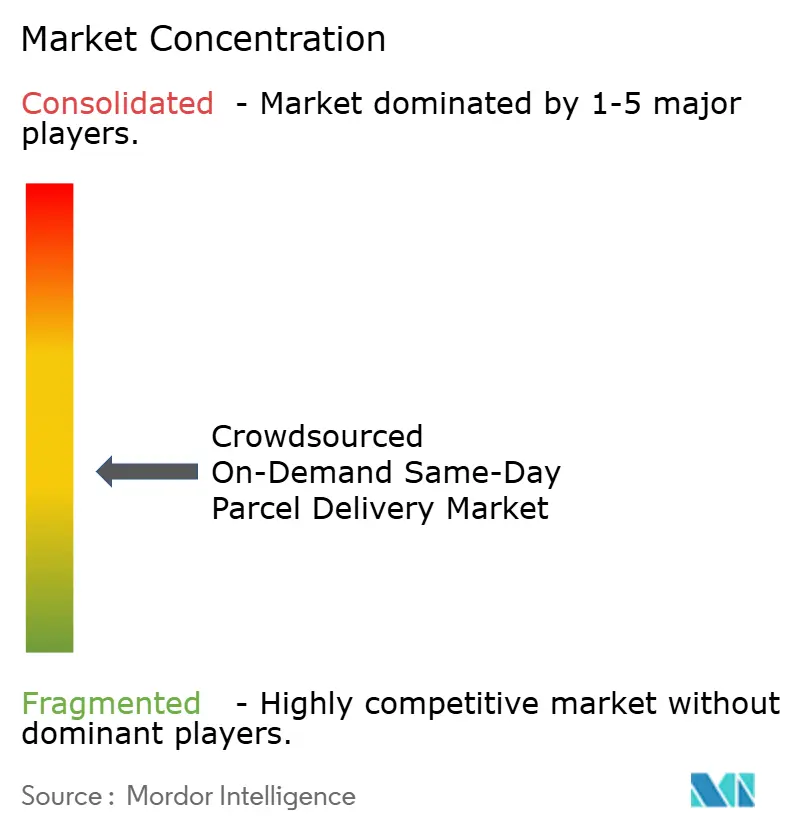
The crowdsourced on-demand same-day parcel delivery market is moderately fragmented globally, though 2 to 4 platforms commonly lead in individual geographies. Companies are using retail ecosystem partnerships, white-label API connections, autonomous dispatch tools, and geographic expansion to protect order volume. DHL eCommerce signed a new exclusive multi-year contract with the United States Postal Service in May 2026, valued at more than USD 10 billion and covering last-mile delivery across more than 170 million United States delivery points. This arrangement highlights how established parcel carriers are securing long-term last-mile volume. Regional concentration is stronger in North America than in Asia and Latin America, where more regional operators compete.
The crowdsourced on-demand same-day parcel delivery market also contains regional leaders with strong local network density. Lalatech Holdings facilitated more than 1.027 billion fulfilled orders globally in 2025, generated freight GTV of USD 12.36 billion, and held almost 61.0% mainland China market share. Its scale shows the importance of sustained network-density investment in building a strong regional position. Smaller operators such as Dispatch in the United States B2B delivery and Borzo across India, Brazil, Mexico, Turkey, and Russia compete through service reliability and focused operating models. This leaves the competitive structure concentrated within some regions but fragmented at the global level.
Opportunities remain in B2B replenishment for industrial and construction customers, peri-urban areas with insufficient fulfillment coverage, and healthcare last-mile services with stronger chain-of-custody requirements, which favor operators that can manage specialized handling and consistent service levels. The crowdsourced on-demand same-day parcel delivery market is also seeing broader use of decentralized delivery-provider networks for 2-hour and end-of-day options. DoorDash and Waymo launched an autonomous delivery service in Metro Phoenix in October 2025. These moves reflect a competitive focus on broader capacity, retailer integration, and service automation.
Crowdsourced On-Demand Same-Day Parcel Delivery Industry Leaders
-
DoorDash, Inc.
-
Uber Technologies, Inc.
-
Lalatech Holdings Limited (Lalamove)
-
Walmart Inc.
-
Amazon, Inc.
- *Disclaimer: Major Players sorted in no particular order
Crowdsourced On-Demand Same-Day Parcel Delivery Market Companies Covered in this Report
- DoorDash, Inc.
- Uber Technologies, Inc.
- Lalatech Holdings Limited (Lalamove)
- Amazon.com, Inc.
- Walmart, Inc.
- Borzo
- La Poste Group (Including Geopost)
- United Parcel Service, Inc.
- FedEx
- DHL Group
- Aramex
- Delivery Hero SE
- Grab Holdings Limited
- Rappi Inc.
- Shadowfax Technologies Private Limited
- Delhivery Limited
- Swiggy Ltd
- Maplebear Inc.
- Dispatch, Inc.
- Curri, Inc.
Recent Industry Developments in Crowdsourced On-Demand Same-Day Parcel Delivery Market
- September 2026: DoorDash and Uber Technologies each concluded nationwide United States delivery partnerships with Costco, providing same-day and scheduled delivery from approximately 630 DoorDash and 600 Uber Eats locations across 47 states. The agreements position both platforms as the primary crowdsourced delivery channels for the United States' second-largest retailer by revenue.
- September 2026: Maplebear Inc. (Instacart) and Gopuff announced a marketplace partnership under which Gopuff joined the Instacart Marketplace, enabling Instacart customers to order Gopuff inventory for delivery in as fast as 15 minutes and extending the Instacart Carrot Ads ecosystem to Gopuff's on-demand customer base.
- September 2026: Shadowfax Technologies expanded its Shadowfax 360 platform with a structured channel partner network, targeting 1,000 logistics partners over three years to broaden D2C and quick commerce delivery coverage across India.
- July 2026: Uber Technologies announced a voluntary public takeover offer for Delivery Hero SE at a minimum of EUR 41.50 (USD 48.82) per share, with committed financing of at least EUR 11.5 billion (USD 13.53 billion), subject to regulatory approvals across multiple jurisdictions. The transaction would consolidate Delivery Hero's food and quick commerce delivery operations across more than a dozen markets into Uber's global platform ecosystem.
Global Crowdsourced On-Demand Same-Day Parcel Delivery Market Report Scope
Segmentation Overview
| Instant Delivery |
| Under-Two-Hour Delivery |
| Same-Day Delivery (Standard and Scheduled) |
| End-of-Day Delivery |
| Business-to-Business (B2B) |
| Business-to-Consumer (B2C) |
| Consumer-to-Consumer (C2C) |
| Short-Distance and Hyperlocal |
| Urban and Intra-City |
| Extended Urban and Peri-Urban |
| Independent Gig Couriers |
| Part-Time Contracted Drivers |
| Full-Time Partnered Drivers |
| Mobile Application |
| Web-Based Platform |
| Two-Wheelers |
| Four-Wheelers |
| Vans and Light Commercial Vehicles |
| Drones and Autonomous Vehicles |
| Other Vehicle Types |
| E-Commerce and Online Retail |
| Quick Commerce (Q-Commerce) |
| Foodservice and Restaurant |
| Grocery and Traditional Retail |
| Healthcare and Pharmaceuticals |
| Documents, Legal, and Financial Services |
| Other Commercial and Specialized Deliveries |
| North America | United States |
| Canada | |
| Mexico | |
| South America | Brazil |
| Argentina | |
| Peru | |
| Chile | |
| Rest of South America | |
| Europe | Germany |
| United Kingdom | |
| France | |
| Italy | |
| Spain | |
| Russia | |
| Nordics (Denmark, Finland, Iceland, Norway, and Sweden) | |
| Rest of Europe | |
| Asia-Pacific | China |
| India | |
| Japan | |
| South Korea | |
| Australia | |
| Southeast Asia (ASEAN) | |
| Rest of Asia-Pacific | |
| Middle East and Africa | Saudi Arabia |
| United Arab Emirates | |
| Qatar | |
| South Africa | |
| Nigeria | |
| Egypt | |
| Rest of Middle East and Africa |
| By Service Type | Instant Delivery | |
| Under-Two-Hour Delivery | ||
| Same-Day Delivery (Standard and Scheduled) | ||
| End-of-Day Delivery | ||
| By Business Model | Business-to-Business (B2B) | |
| Business-to-Consumer (B2C) | ||
| Consumer-to-Consumer (C2C) | ||
| By Delivery Distance | Short-Distance and Hyperlocal | |
| Urban and Intra-City | ||
| Extended Urban and Peri-Urban | ||
| By Courier Engagement Model | Independent Gig Couriers | |
| Part-Time Contracted Drivers | ||
| Full-Time Partnered Drivers | ||
| By Platform Type | Mobile Application | |
| Web-Based Platform | ||
| By Vehicle Type | Two-Wheelers | |
| Four-Wheelers | ||
| Vans and Light Commercial Vehicles | ||
| Drones and Autonomous Vehicles | ||
| Other Vehicle Types | ||
| By End User | E-Commerce and Online Retail | |
| Quick Commerce (Q-Commerce) | ||
| Foodservice and Restaurant | ||
| Grocery and Traditional Retail | ||
| Healthcare and Pharmaceuticals | ||
| Documents, Legal, and Financial Services | ||
| Other Commercial and Specialized Deliveries | ||
| By Geography | North America | United States |
| Canada | ||
| Mexico | ||
| South America | Brazil | |
| Argentina | ||
| Peru | ||
| Chile | ||
| Rest of South America | ||
| Europe | Germany | |
| United Kingdom | ||
| France | ||
| Italy | ||
| Spain | ||
| Russia | ||
| Nordics (Denmark, Finland, Iceland, Norway, and Sweden) | ||
| Rest of Europe | ||
| Asia-Pacific | China | |
| India | ||
| Japan | ||
| South Korea | ||
| Australia | ||
| Southeast Asia (ASEAN) | ||
| Rest of Asia-Pacific | ||
| Middle East and Africa | Saudi Arabia | |
| United Arab Emirates | ||
| Qatar | ||
| South Africa | ||
| Nigeria | ||
| Egypt | ||
| Rest of Middle East and Africa | ||
Key Questions Answered in the Report
What is the value of crowdsourced on-demand same-day parcel delivery in 2026?
The sector is valued at USD 10.26 billion in 2026 and is projected to reach USD 17.21 billion by 2032 at an 8.86% CAGR (2027-2032).
Which service type leads same-day parcel delivery?
Same-day delivery (standard and scheduled) leads with 46.11% share in 2026, while instant delivery has the highest service-type growth rate at 12.08% CAGR through 2032.
Why is quick commerce important for parcel delivery platforms?
Quick commerce is growing at a 15.97% CAGR through 2032 and requires rapid fulfillment for groceries, pharmaceuticals, and general merchandise.
Which region is growing fastest for crowdsourced parcel delivery?
Asia-Pacific is growing at a 12.15% CAGR through 2032, supported by China's large instant-delivery order base and India's expanding micro-fulfillment network.
What are the main operating challenges for crowdsourced delivery platforms?
Low route density raises cost per stop, while labor rules on pay, classification, insurance, and platform management can increase operating costs.
Which delivery vehicle segment is growing fastest?
Drones and autonomous vehicles are growing at a 22.64% CAGR through 2032 as commercial pilots move toward broader operations.