
Crisis Communication Services Market Size and Share
Market Overview
| Study Period | 2020 - 2031 |
|---|---|
| Market Size (2026) | USD 6.70 Billion |
| Market Size (2031) | USD 10.09 Billion |
| Growth Rate (2026 - 2031) | 8.53 % |
| Fastest Growing Market | Asia-Pacific |
| Largest Market | North America |
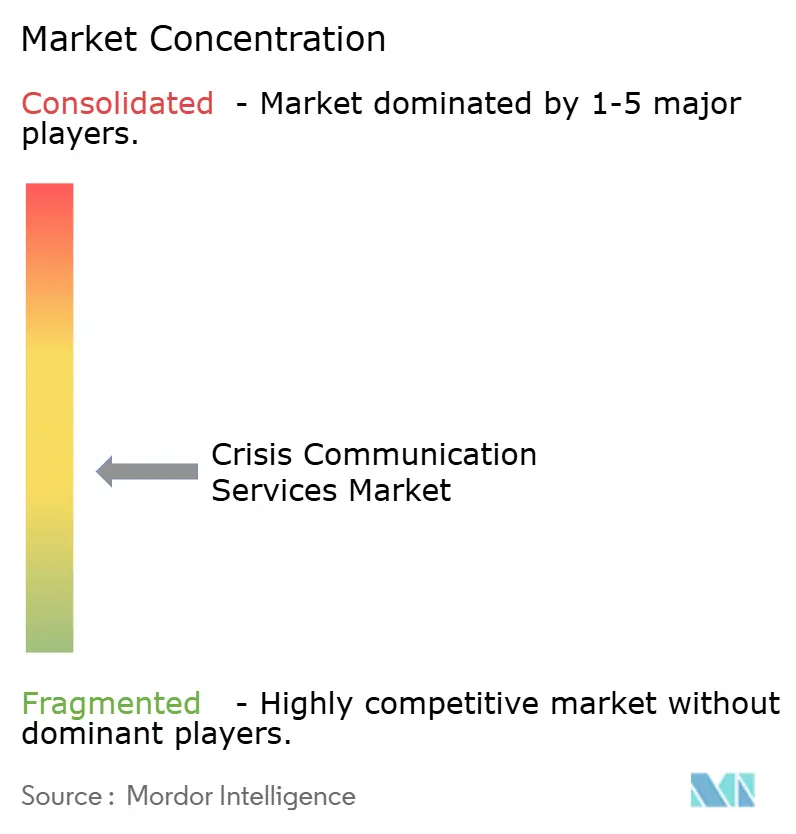
| Market Concentration | Medium |
Major Players *Disclaimer: Major Players sorted in no particular order Image © Mordor Intelligence. Reuse requires attribution under CC BY 4.0. | |
Crisis Communication Services Market Analysis by Mordor Intelligence
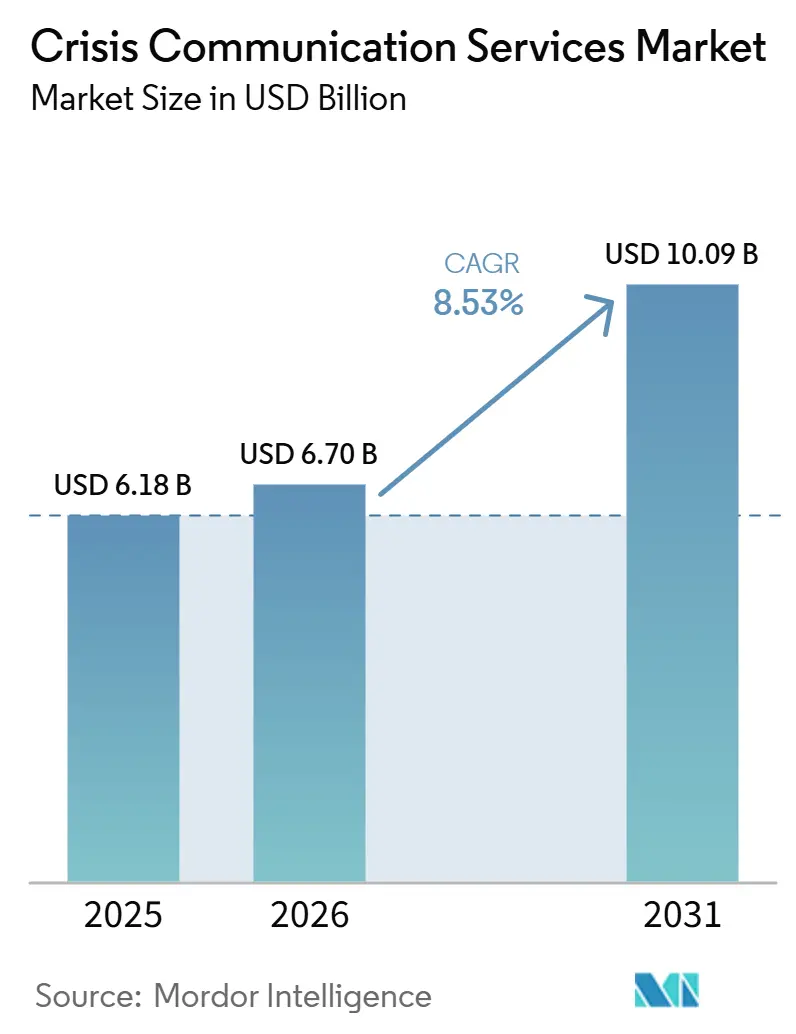
The crisis communication services market size is projected to expand from USD 6.18 billion in 2025 and USD 6.70 billion in 2026 to USD 10.09 billion by 2031, registering a CAGR of 8.53% between 2026 and 2031. The crisis communication services market is growing as organizations place reputational risk within board-level governance and wider resilience programs, rather than treating it as a communications issue that begins only after public attention has increased. Faster social media distribution, AI-generated false content, and shorter public response expectations are increasing demand for teams that can assess and address issues quickly across customers, employees, regulators, investors, and other audiences. Regulatory disclosure rules make clear and timely communication a formal operating requirement in financial services, healthcare, technology, and other regulated settings, where delayed or inconsistent messages can exacerbate operational challenges. Providers are responding with retained advisory services, continuous monitoring tools, pre-approved communication processes, crisis exercises, and technology-supported response planning. This creates opportunities for firms that combine senior counsel with early detection, practical decision support, coordinated stakeholder communication, and enough sector knowledge to work within the client’s established governance process.
Key Report Takeaways
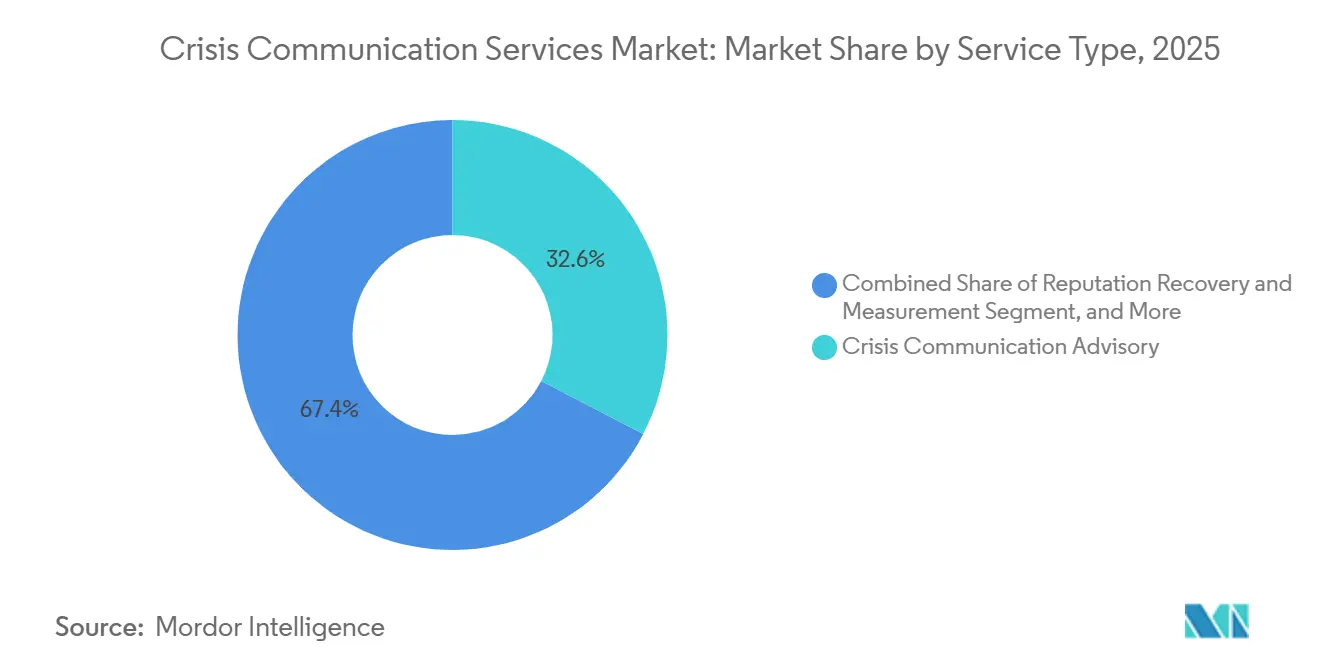
- By service type, crisis communication advisory accounted for 32.62% of the crisis communication services market share in 2025, while monitoring and alerting services are projected to expand at a 9.32% CAGR through 2031.
- By deployment model, cloud-based deployments accounted for 48.72% of the crisis communication services market in 2025 and are projected to grow at a 9.26% CAGR through 2031.
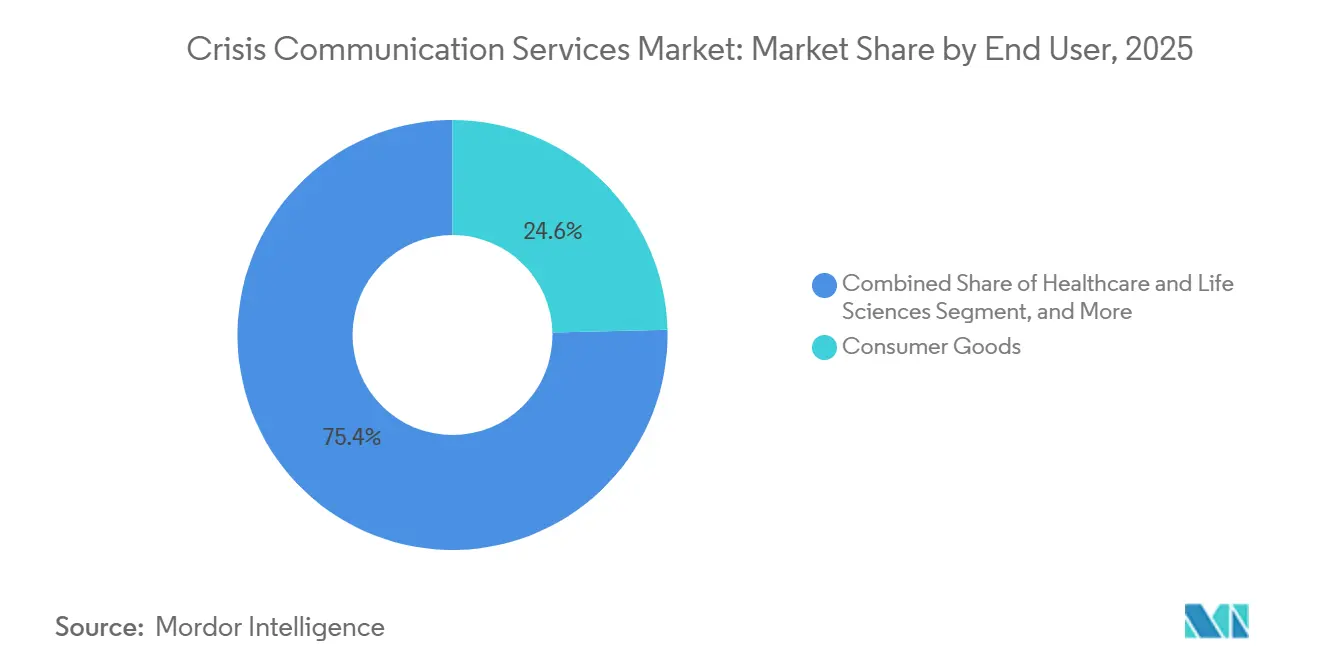
- By end user, consumer goods accounted for 24.62% of the crisis communication services market in 2025, while healthcare and life sciences are projected to grow at a 9.03% CAGR through 2031.
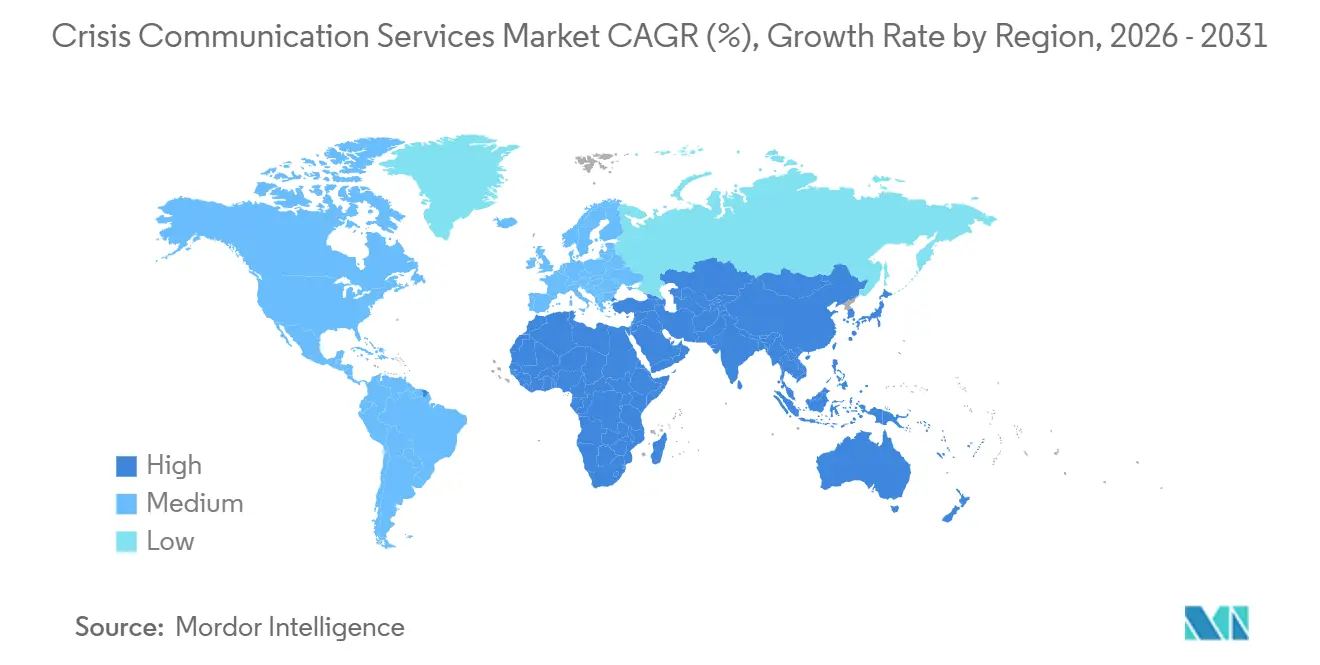
- By geography, North America held 36.93% of the crisis communication services market in 2025, while Asia-Pacific is projected to grow at a 9.12% CAGR through 2031.
Note: Market size and forecast figures in this report are generated using Mordor Intelligence’s proprietary estimation framework, updated with the latest available data and insights as of January 2026.
Market Trends and Insights
Drivers Impact Analysis of Crisis Communication Services Market*
| Driver | (~) % Impact on CAGR Forecast | Geographic Relevance | Impact Timeline |
|---|---|---|---|
| Rising Frequency of Brand-Led Crisis Events | +2.5% | Global | Short term (≤ 2 years) |
| Mandatory Disclosure Timelines in Regulated Sectors | +2.0% | North America and Europe, with spillover to Asia-Pacific and Middle East and Africa | Medium term (2-4 years) |
| Always-On AI Monitoring and Alert Orchestration | +1.4% | Global | Short term (≤ 2 years) |
| Enterprise Resilience Program Expansion | +0.9% | North America and Asia-Pacific | Medium term (2-4 years) |
| Executive Exposure to Deepfakes and Employee-Generated Content | +0.6% | Global, with highest relevance in North America and Asia-Pacific | Short term (≤ 2 years) |
| Third-Party Reputation Spillover Risk | +0.4% | Global | Medium term (2-4 years) |
| Source: Mordor Intelligence | |||
Rising Frequency of Brand-Led Crisis Events
The crisis communication services market is responding to a shorter time between a brand incident and wider reputational damage, leaving less time for internal fact-finding and message approval. Social platforms and AI-generated content can carry a claim across public, private, and fringe channels within hours, allowing separate audiences to see competing versions of the same event. The World Economic Forum reported that 70% of large employers increased their attention to threat intelligence, compared with 30% of small organizations.[1]World Economic Forum, “Global Cybersecurity Outlook 2026,” World Economic Forum, weforum.org. This difference leaves smaller organizations more reliant on reactive support after an issue has spread, creating a clear divide in preparedness between large and smaller employers. Reduced moderation activity on major platforms in 2025 adds to exposure to coordinated false narratives and removes external controls that had limited some harmful content. Companies, therefore, need monitoring that identifies unusual activity before it reaches journalists, customers, investors, or employees and before a response is shaped by inaccurate information.
Mandatory Disclosure Timelines in Regulated Sectors
The crisis communication services market benefits from disclosure requirements that make response timing a governance concern rather than a matter for communications teams alone. Public companies must file a Form 8-K within 4 business days after determining that a cybersecurity incident is material. The NIS2 Directive requires essential entities to issue an early warning within 24 hours and a detailed notification within 72 hours of becoming aware of an incident. DORA also requires financial entities to report major ICT incidents within an initial window of 4 to 24 hours. These requirements bring together the legal, investor relations, technology, compliance, and communications teams into a single response process, even when they have different priorities and evidence standards. Specialized advisors can help clients establish message approvals, incident roles, disclosure workflows, and practical rehearsal processes before an incident occurs.
Always-On AI Monitoring and Alert Orchestration
The crisis communication services market is shifting from retrospective social listening toward earlier detection of unusual narratives and coordinated activity. Weber Shandwick launched RADIUS in June 2025 to guide response teams through crisis situations, develop scenarios, and prepare stakeholder materials. Meltwater announced in May 2026 that its Mira AI assistant was available across media, social, and consumer intelligence workflows. The company stated that Mira had handled more than 1.3 million enterprise client prompts at that time, indicating that AI assistance had moved into routine intelligence work and crisis preparation. FGS Global’s 2026 acquisition of Memetica shows that threat intelligence and deepfake detection are becoming part of crisis advisory services rather than an optional specialist capability. These tools are most useful when analysts and senior advisors can interpret an alert, verify its relevance, and decide whether action is needed.
Enterprise Resilience Program Expansion
Enterprise resilience programs are moving crisis communication from a supporting activity into a regular management capability with clearer executive ownership. FleishmanHillard launched Global Executive Advisory in May 2025 with more than 50 senior advisors across the United States, EMEA, and Asia-Pacific. The group offers counsel on financial communications, crisis management, ESG, public affairs, and related areas, which reflects the overlap between reputation issues and wider business decisions. Business continuity programs increasingly include communication protocols in resilience planning, particularly when incidents can affect customers, investors, employees, and regulators simultaneously. Pre-retained arrangements allow teams to use approved message frameworks and briefed spokespersons when a situation develops, reducing the time lost to basic preparation. This recurring model in the crisis communication services market can provide steadier revenue for leading providers and faster access to experienced support for clients.
Restraints Impact Analysis of Crisis Communication Services Market*
| Restraint | (~) % Impact on CAGR Forecast | Geographic Relevance | Impact Timeline |
|---|---|---|---|
| Limited Supply of Senior Crisis Counsel | -1.5% | Global | Long term (≥ 4 years) |
| Weak Return on Investment Measurement | -1.1% | Global | Long term (≥ 4 years) |
| Cross-Functional Approval Bottlenecks | -0.7% | Global, with highest relevance in large enterprises | Medium term (2-4 years) |
| Data Privacy and Archiving Constraints | -0.5% | Europe and Asia-Pacific | Medium term (2-4 years) |
| Source: Mordor Intelligence | |||
Limited Supply of Senior Crisis Counsel
A limited supply of experienced practitioners can constrain the crisis communication services market, as complex assignments cannot be handled solely by technology or junior teams. Effective counsel requires sector knowledge, media judgment, legal awareness, regulatory familiarity, and the ability to work under time pressure while helping leaders make difficult choices. These skills are concentrated among a relatively small group of senior professionals, and they take years of varied incident experience to develop. AKCG acquired Hennes Communications in May 2026, while PPHC acquired Tancredi Intelligent Communication in July 2026, showing that firms are using acquisitions to add established capabilities and specialized practitioners. The shortfall is especially visible at the mid-career level, where professionals must manage complex client situations with limited supervision and coordinate multiple internal functions. Demand is also rising faster than local talent supply in Southeast Asia and Africa, where international firms may need to adapt their staffing and development models.
Weak Return on Investment Measurement
Weak measurement makes it harder for buyers to justify long-term preparedness spending, especially when the benefit is an event that did not become a public crisis. The Barcelona Principles provide guidance for communications measurement, but they do not fully measure avoided revenue loss, reduced litigation exposure, or preserved customer loyalty. Legal, investor relations, and communications teams may also use separate measures for the same event, leaving senior leaders without a single view of the outcome. Davis+Gilbert reported that analytics and measurement capabilities were among the service attributes sought in communications acquisition targets during the first half of 2026. When budgets tighten, organizations without a clear value case can defer preparedness investments and rely on reactive support when an incident occurs. Providers in the crisis communication services market that link response activity to employee retention, customer satisfaction, share-price stability, and operational recovery may be better placed to retain budget-conscious clients.
*Our forecasts treat driver/restraint impacts as directional, not additive. The impact forecasts reflect baseline growth, mix effects, and variable interactions.
Crisis Communication Services Market Segment Analysis
By Service Type:
Advisory Holds the Largest Share While Monitoring Grows FastestCrisis communication advisory accounted for 32.62% of the total market demand in 2025. It remains important in the crisis communication services market because larger organizations seek senior counsel that understands regulatory disclosures, sector-specific risks, and the expectations of customers, employees, investors, and public authorities. Pre-retained advisors can help leaders assess an emerging issue, agree on responsibilities, and make decisions before a public response is required. Media and stakeholder relations, emergency coordination, and reputation recovery services can cover the stages of an event from the first alert through post-event rebuilding. This breadth allows providers to offer connected support rather than a single response service, while clients retain access to trusted specialists when pressure is greatest.
Monitoring and alerting services are projected to record the highest service-type growth at a 9.32% CAGR from 2026 to 2031. In the crisis communication services market, demand reflects the need for continuous monitoring across social platforms, news coverage, private channels, the dark web, and other digital threat environments. Weber Shandwick’s RADIUS and Meltwater’s Mira AI illustrate a focus on tools that support crisis simulation and training, which are also gaining attention as financial services and healthcare organizations formalize exercises, spokesperson preparation, and response drills. Providers who join monitoring data with senior advice can support clients across multiple service needs and reduce handoffs during fast-moving situations.



By Deployment Model:
Cloud Delivery Supports Distributed Response TeamsCloud-based deployment accounted for 48.72% of total market demand in 2025. This model allows teams in different locations, functions, and time zones to access current information without relying on local hardware or a single office location. Cloud platforms can integrate with communications, case management, and workflow tools that employees already use in their day-to-day operations. They can also reduce the time required to introduce a service, train response teams, and establish common access across the organization. These features matter when a client needs a functioning response process quickly and cannot wait for a long internal technology project.
Within the crisis communication services market, hybrid deployment remains relevant for clients that need cloud access during an active incident but must keep sensitive records in internal archives. This approach is common in sectors with data sovereignty, recordkeeping, legal review, or internal policy requirements. On-premises systems still serve defense, critical infrastructure, and financial services users who cannot place all communications or decision records in external environments. European organizations may favor cloud tools for active coordination, stakeholder notifications, and real-time workflows while using internal systems for long-term records and sensitive deliberations.
By End User:
Consumer Goods Leads While Healthcare and Life Sciences Expand FasterConsumer goods accounted for 24.62% of total market demand in 2025. Within the crisis communication services market, product recalls, ingredient concerns, supply-chain issues, packaging debates, and influencer-driven controversies can create repeated communication demands for brands with broad public exposure. Organizations in this crisis communication service sector often need ongoing monitoring and advisory services rather than occasional project support, as several reputation issues can arise simultaneously. Retail and e-commerce companies face similar pressure from product reviews, social commerce channels, delivery failures, and quickly shared customer complaints. Travel and hospitality users place particular importance on emergency coordination, customer updates, employee communication, and stakeholder relations during operational disruptions or travel advisories.
Healthcare and life sciences are projected to grow at a 9.03% CAGR from 2026 to 2031, the highest rate among end-user groups. Patient confidence, drug-safety disclosures, and crisis communication services market requirements, clinical concerns, and regulatory oversight require timely, accurate, and specialized communications that account for a wide range of stakeholders. The 2026 HIMSS APAC Health Conference centered on trust, intelligence, and agility in AI-enabled health systems.[2]HIMSS, “HIMSS APAC Health Conference 2026,” HIMSS, himss.org. IHH Healthcare appointed a specialist communications partner for its Singapore and Malaysia mandate in 2025, reflecting the need for local expertise across regional health systems. Media and entertainment organizations are also investing in simulations and training because false content can target talent, productions, and content properties before conventional communications teams have time to respond.
Geography Analysis
North America Crisis Communication Services Market
North America accounted for 36.93% of global demand in 2025. The region’s position in the crisis communication services market is shaped by strict disclosure requirements, a high concentration of listed companies, and an established base of global communications networks and specialist providers. The United States drives demand in financial services, technology, consumer goods, and healthcare, where incidents can simultaneously create legal, operational, and reputational consequences. Each of these sectors operates under specific disclosure and governance requirements, so response plans often require input from legal, technology, investor relations, and communications teams. Canada and Mexico are smaller regional markets, but operational resilience guidance and cross-border corporate activity are increasing the need for formal protocols, local understanding, and clear escalation procedures.
APAC Crisis Communication Services Market
Asia-Pacific is projected to expand at a 9.12% CAGR from 2026 to 2031. Within the crisis communication services market, India, South Korea, Australia, and Southeast Asian countries are becoming important demand centers as digital activity rises, corporate governance practices mature, and public expectations for timely communication increase. Companies operating across these markets must often coordinate messages across different languages, regulatory settings, media environments, and stakeholder expectations. Japan remains distinct because formal apology practices and executive accountability have a significant role in local crisis management. IHH Healthcare’s regional communications appointment in 2025 shows how health organizations are formalizing their approach amid increasing regulatory and competitive pressure across the region.
EMEA and South America Crisis Communication Services Market
Europe retains a substantial position in the crisis communication services market because its layered regulatory architecture creates tight reporting timelines. NIS2, DORA, and ESMA’s February 2026 consultation on delayed disclosure of inside information reinforces the importance of prepared communication processes. Germany has a mature crisis communication advisory base across food, energy, healthcare, and financial services, and Bully Pulpit International acquired 365 Sherpas in May 2026 to strengthen its corporate affairs offering across the Atlantic.[3]Bully Pulpit International, “BPI Strengthens Transatlantic Corporate Affairs Offer with Acquisition of 365 Sherpas,” Bully Pulpit International, bpigroup.com. South America, the Middle East, and Africa remain developing markets, though limited specialist talent and infrastructure gaps can slow adoption in parts of those regions.

Competitive Landscape
The crisis communication services market is moderately fragmented. Large multinational networks compete with specialist boutiques, regional advisors, and technology-led monitoring providers that focus on distinct client needs. The combination of Omnicom and Interpublic Group brought Weber Shandwick, FleishmanHillard, Ketchum, and Porter Novelli into 1 holding structure after its late-2025 closing. This changed the range of global advisory, sector, and geographic capabilities available within a single group for large multinational clients. It also increased pressure on competitors to protect senior talent, maintain client relationships, and show where their specialist knowledge offers a clearer fit than a large network.
In the crisis communication services market, technology is a central area of competition in monitoring and alerting, as clients increasingly expect an earlier view of a developing issue. Weber Shandwick’s RADIUS supports scenario planning and response preparation for communications teams. Meltwater expanded Mira AI across its intelligence workflows in May 2026, bringing assistance for briefs, analysis, reports, and stakeholder communications into a single platform. FGS Global added Memetica’s threat intelligence capability through an acquisition in 2026. Weber Shandwick also partnered with ZENDATA Cybersecurity across EMEA to combine cyber threat support and crisis communications, which reflects closer coordination between technical incident work and external response planning.
Within the crisis communication services market, acquisitions remain an important route for adding specialist teams, senior practitioners, and regional reach. FleishmanHillard integrated Porter Novelli in February 2026 to expand its depth in health and life sciences, technology, financial services, ESG, and public-sector communications.[4]FleishmanHillard, “FleishmanHillard Integrates Porter Novelli,” FleishmanHillard, fleishmanhillard.com. BPI’s purchase of 365 Sherpas strengthened its presence in Germany and its transatlantic offer. PPHC’s acquisition of Tancredi added corporate affairs, financial communications, crisis advisory, and litigation communications capability, while openings remain for integrated cyber and communications support, deep-fake response expertise, and healthcare specialization in Asia-Pacific.
Crisis Communication Services Industry Leaders
Weber Shandwick, LLC
FleishmanHillard, Inc.
APCO Worldwide LLC
FTI Consulting, Inc.
Edelman Holdings, Inc.
- *Disclaimer: Major Players sorted in no particular order
Crisis Communication Services Market Companies Covered in this Report
- Edelman Holdings, Inc.
- Weber Shandwick, LLC
- FleishmanHillard, Inc.
- APCO Worldwide LLC
- FTI Consulting, Inc.
- Teneo Holdings, LLC
- Control Risks Group Holdings Limited
- Finn Partners, Inc.
- Ketchum, Inc.
- Hill & Knowlton Strategies LLC
- Porter Novelli, Inc.
- MSL Group
- Golin, LLC
- Ruder Finn, Inc.
- Allison Worldwide
- Cision Ltd.
- Meltwater Group AS
- Sprinklr, Inc.

Recent Industry Developments in Crisis Communication Services Market
- July 2026: Clario Group acquired Ted Miller Group, a Miami-based boutique communications agency with expertise in technology, travel and leisure, and financial services. The acquisition broadens Clario's integrated crisis and reputation management capabilities and adds XROI, Clario's AI-enabled executive authority tool, to TMG's client base.
- July 2026: Public Policy Holding Company acquired London-headquartered Tancredi Intelligent Communication Ltd for USD 10.8 million, of which USD 9.6 million was in cash. Tancredi generated USD 5.7 million in revenue in 2025 and specializes in corporate affairs, financial communications, crisis advisory, and litigation communications. The acquisition deepens PPHC's Trailrunner International unit in the United Kingdom and extends its reach to Milan and Los Angeles.
- May 2026: AKCG-Public Relations Counselors acquired Hennes Communications, a Cleveland-based crisis communications agency. The acquisition combines 2 crisis advisory practices to strengthen AKCG's national reputation management and crisis planning platform. Both firms have established experience in crisis planning and response work, which supports a broader national client offering.
- May 2026: Meltwater announced its 2026 Mid-Year Product Release and embedded Mira AI across media, social, and consumer intelligence workflows. Mira had handled more than 1.3 million customer prompts, supporting media briefs, coverage analysis, crisis reports, and stakeholder communications. The release positions the company’s intelligence platform for work ranging from ongoing monitoring to real-time crisis response.


Global Crisis Communication Services Market Report Scope
Crisis communication services help organizations plan, manage, and deliver timely communication during disruptive events, including natural disasters, cybersecurity incidents, product recalls, public relations crises, operational disruptions, and other emergencies. The scope of the report covers services such as crisis communication strategy, media relations, stakeholder communication, digital and social media monitoring, message development, response planning, training, and post-crisis evaluation across end-user industries.
The Crisis Communication Services Market Report is Segmented by Service Type (Crisis Communication Advisory, Monitoring and Alerting Services, Media and Stakeholder Relations, Crisis Simulation and Training, Reputation Recovery and Measurement, and Emergency Response Coordination), Deployment Model (Cloud-Based, On-Premises, and Hybrid), End User (Retail and E-commerce, Media and Entertainment, Healthcare and Life Sciences, Travel and Hospitality, Consumer Goods, and Other End Users), and Geography (North America, South America, Europe, Asia-Pacific, Middle East, and Africa). The Market Forecasts are Provided in Terms of Value (USD).
| Crisis Communication Advisory |
| Monitoring and Alerting Services |
| Media and Stakeholder Relations |
| Crisis Simulation and Training |
| Reputation Recovery and Measurement |
| Emergency Response Coordination |
| Cloud-Based |
| On-Premises |
| Hybrid |
| Retail and E-commerce |
| Media and Entertainment |
| Healthcare and Life Sciences |
| Travel and Hospitality |
| Consumer Goods |
| Other End Users |
| North America | United States |
| Canada | |
| Mexico | |
| South America | Brazil |
| Argentina | |
| Chile | |
| Rest of South America | |
| Europe | Germany |
| United Kingdom | |
| France | |
| Italy | |
| Spain | |
| Rest of Europe | |
| Asia-Pacific | China |
| Japan | |
| India | |
| South Korea | |
| Australia | |
| Rest of Asia-Pacific | |
| Middle East | Saudi Arabia |
| United Arab Emirates | |
| Qatar | |
| Rest of Middle East | |
| Africa | South Africa |
| Egypt | |
| Nigeria | |
| Rest of Africa |
| By Service Type | Crisis Communication Advisory | |
| Monitoring and Alerting Services | ||
| Media and Stakeholder Relations | ||
| Crisis Simulation and Training | ||
| Reputation Recovery and Measurement | ||
| Emergency Response Coordination | ||
| By Deployment Model | Cloud-Based | |
| On-Premises | ||
| Hybrid | ||
| By End User | Retail and E-commerce | |
| Media and Entertainment | ||
| Healthcare and Life Sciences | ||
| Travel and Hospitality | ||
| Consumer Goods | ||
| Other End Users | ||
| By Geography | North America | United States |
| Canada | ||
| Mexico | ||
| South America | Brazil | |
| Argentina | ||
| Chile | ||
| Rest of South America | ||
| Europe | Germany | |
| United Kingdom | ||
| France | ||
| Italy | ||
| Spain | ||
| Rest of Europe | ||
| Asia-Pacific | China | |
| Japan | ||
| India | ||
| South Korea | ||
| Australia | ||
| Rest of Asia-Pacific | ||
| Middle East | Saudi Arabia | |
| United Arab Emirates | ||
| Qatar | ||
| Rest of Middle East | ||
| Africa | South Africa | |
| Egypt | ||
| Nigeria | ||
| Rest of Africa | ||


Key Questions Answered in the Report
What is the size of the crisis communication services market?
The crisis communication services market was USD 6.70 billion in 2026 and is projected to reach USD 10.09 billion by 2031, at an 8.53% CAGR. The expansion reflects higher demand for preparedness, monitoring, and specialist response support.
What is driving demand for crisis communication services?
Faster spread of false content, disclosure deadlines, AI-supported monitoring, and formal resilience programs are increasing demand. Organizations also need clear processes that connect communications with legal, technology, and investor relations teams.
Which service type is growing fastest?
Monitoring and alerting services are projected to grow at a 9.32% CAGR from 2026 to 2031. Buyers are using these services to detect unusual narratives and digital threats before they become a wider public issue.
Which deployment model leads to demand?
Cloud-based deployment held 48.72% of total demand in 2025 because it supports distributed teams and faster implementation. Hybrid configurations remain relevant where recordkeeping and sensitive-data requirements limit full cloud adoption.
Which end-user group is expanding fastest?
Healthcare and life sciences are projected to grow at a 9.03% CAGR through 2031, supported by patient trust and regulatory needs. Drug-safety disclosures and high expectations for clear patient communications support this demand.
Which region is growing fastest?
Asia-Pacific is projected to expand at a 9.12% CAGR through 2031 as digital activity and governance expectations increase. In the crisis communication services market, India, South Korea, Australia, and Southeast Asian countries are key markets of demand.
Page last updated on:





