
Crawler Dozers Market Size and Share
Market Overview
| Study Period | 2020 - 2032 |
|---|---|
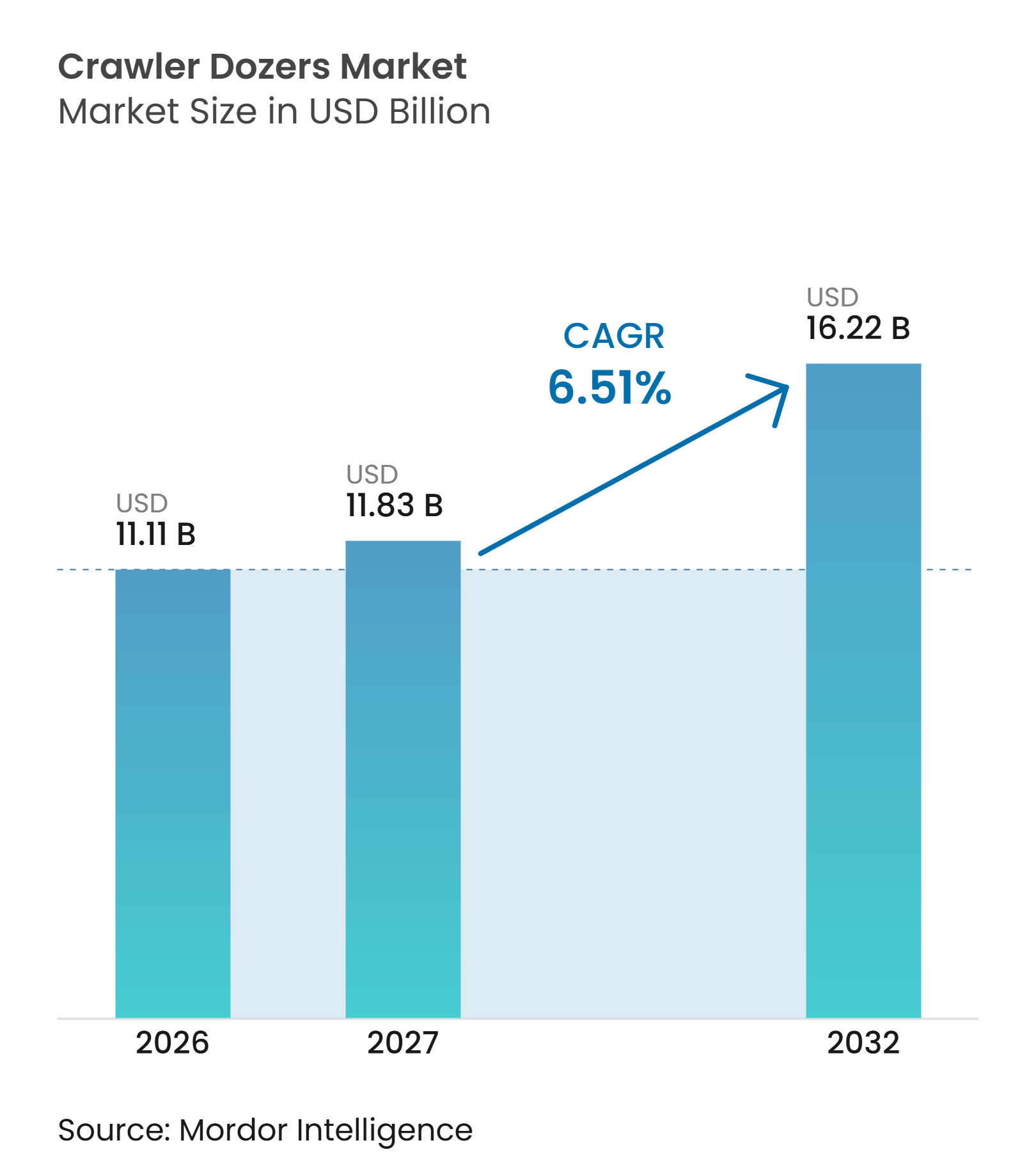
| Market Size (2027) | USD 11.83 Billion |
| Market Size (2032) | USD 16.22 Billion |
| Growth Rate (2027 - 2032) | 6.51 % |
| Fastest Growing Market | Middle East and Africa |
| Largest Market | Asia-Pacific |
| Market Concentration | High |
Major Players *Disclaimer: Major Players sorted in no particular order Image © Mordor Intelligence. Reuse requires attribution under CC BY 4.0. | |
Crawler Dozers Market Analysis by Mordor Intelligence
The Crawler Dozers Market size was valued at USD 11.11 billion in 2026, is estimated at USD 11.83 billion in 2027, and is projected to reach USD 16.22 billion by 2032, registering a CAGR of 6.51% between 2027 and 2032. The crawler dozers market is supported by public investment in transport and site preparation, mining development, and replacement demand for older diesel fleets. These demand sources serve different end uses, which reduces reliance on any single project cycle. Equipment suppliers are also competing through machine guidance, electric-drive systems, remote operation, and broader dealer support. The crawler dozers market therefore offers opportunities for suppliers that can provide dependable service, lifecycle support, and machines suited to demanding job conditions. High purchase costs, uneven project awards, and limited charging support at remote sites remain important constraints.
Key Report Takeaways
- By engine power, 150-300 HP held a 38.46% share in 2026, while Above 500 HP is forecast to expand at a 7.38% CAGR through 2032.
- By blade type, Semi-Universal (SU) Blade held a 34.27% share in 2026, while Angle/Power-Angle-Tilt (PAT) Blade is forecast to expand at a 7.16% CAGR through 2032.
- By drive type, Mechanical/Powershift held a 56.38% share in 2026, while Electric Drive (Diesel-Electric, Battery-Electric) is forecast to expand at a 10.47% CAGR through 2032.
- By application, Construction and Infrastructure held a 48.27% share in 2026, while Mining and Quarrying is forecast to expand at a 7.43% CAGR through 2032.
- By sales channel, Dealers and Distributors held an 81.36% share in 2026, while Direct Sales is forecast to expand at a 6.94% CAGR through 2032.
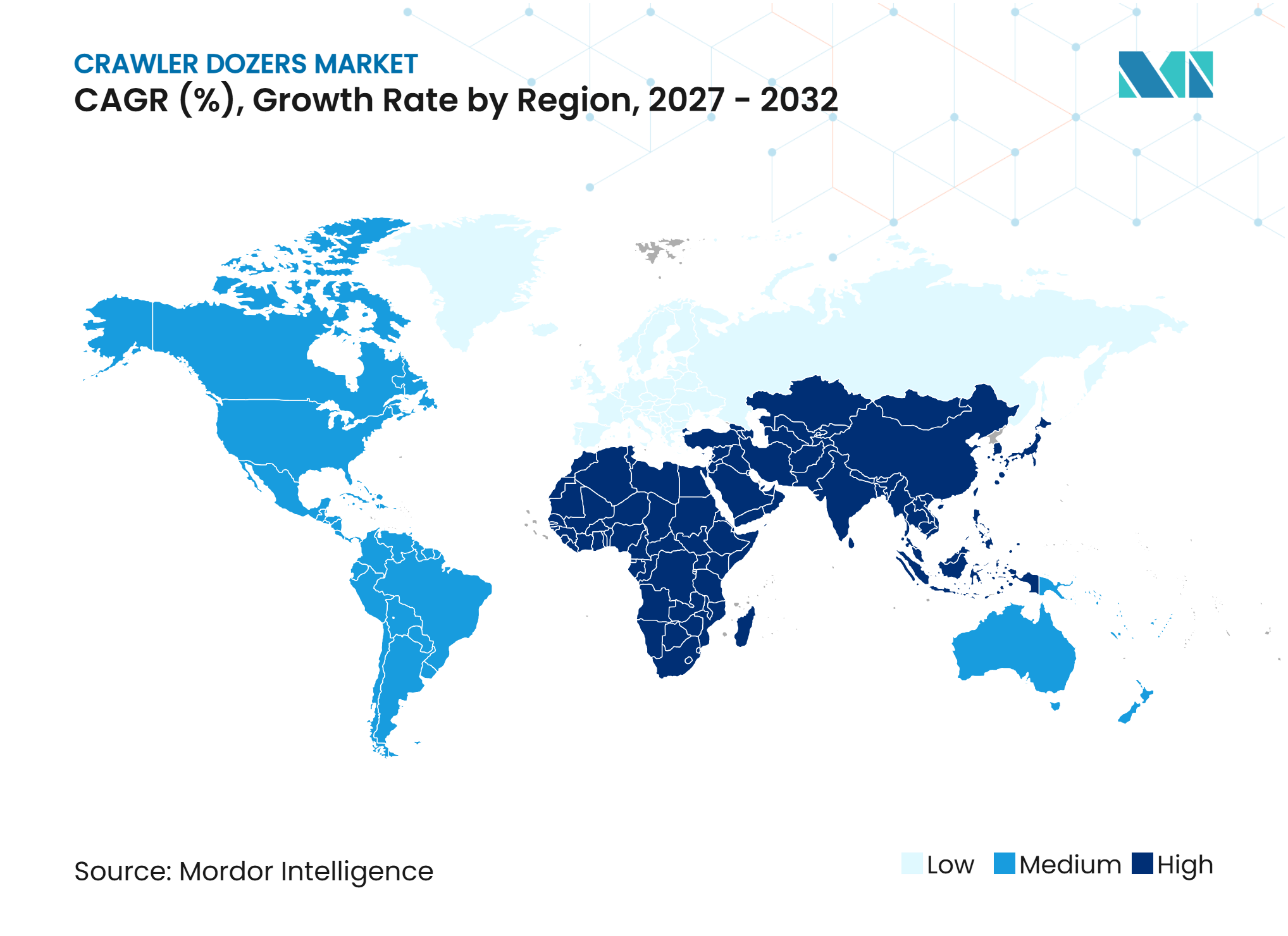
- By geography, Asia-Pacific held a 41.28% share in 2026, while the Middle East and Africa is forecast to expand at a 7.62% CAGR through 2032.
Note: Market numbers in this report are based on Mordor Intelligence's proprietary estimation framework, which combines nine months of actuals with Q4 projections for base year 2026.
Market Trends and Insights
Drivers Impact Analysis of Crawler Dozers Market*
| Driver | (~) % Impact on CAGR Forecast | Geographic Relevance | Impact Timeline |
|---|---|---|---|
| Public Infrastructure and Road Development Spending | +2.1% | Global, strongest pull in Asia-Pacific, Middle East and Africa, and North America | Medium term (2-4 years) |
| Mining Expansion and Mine-Restart Capital Expenditure | +1.8% | Australia, North America, Latin America, West Africa, MENA core | Long term (≥ 4 years) |
| Replacement of Aging Diesel Dozer Fleets for Emissions Compliance | +0.8% | North America, EU, China | Short term (≤ 2 years) |
| Grade-Control and Operator-Assistance Adoption to Address Labor Shortages | +0.7% | North America, EU, Australia | Medium term (2-4 years) |
| Electrified Powertrains Lowering Fuel Exposure in High-Utilization Duty Cycles | +0.5% | North America, Australia, EU low-emission zones | Long term (≥ 4 years) |
| Remote Operation Demand for Hazardous and Geotechnically Difficult Sites | +0.3% | Australia, North America, MENA, West Africa | Long term (≥ 4 years) |
| Source: Mordor Intelligence | |||
Public Infrastructure and Road Development Spending
Public construction programs support the crawler dozers market because grading, clearing, and earthmoving begin early in a project schedule, often before structures, utilities, and other visible elements are ready to proceed. State and local construction spending in the United States reached an estimated USD 479 billion in 2025, while highway construction remained above USD 150 billion at a seasonally adjusted annual rate during mid-2026[1]. India assigned INR 1,21,999 crore (~USD 14.2 billion) for roads and bridges in fiscal year 2026-27, and PMGSY-IV targets 62,500 km of new all-weather rural connections through 2029[2]. These programs require repeated preparation of rights-of-way, embankments, access roads, and working platforms. Funding releases can extend equipment-hire periods after construction allocations are announced. This pattern supports both new-machine demand and activity in used equipment and service networks.
Mining Expansion and Mine-Restart Capital Expenditure
Mining development is an important support for the crawler dozers market, particularly for large machines used on haul roads, waste dumps, and stripping work. Copper, lithium, gold, and potash projects are directing capital toward sites that need sustained earthmoving before production begins. Restarted mines can create a sharper short-term need for dozers than established sites, since access routes and operational areas may need substantial preparation before regular extraction activity can resume. Operators must restore access roads, prepare dumps, clear declines, and remove overburden before other production equipment arrives. That work raises machine utilization and parts demand even when fleet counts do not rise at the same pace. The crawler dozers market also benefits when mine owners choose equipment with established local service coverage for these time-sensitive tasks.
Replacement of Aging Diesel Dozer Fleets for Emissions Compliance
Fleet renewal is supporting the crawler dozers market in areas where emissions requirements affect new equipment registrations and procurement decisions. United States Tier 4 standards limit particulate matter and nitrogen oxide emissions from heavy compression-ignition equipment, including much of the relevant dozer power range. China Nonroad Stage IV and EU Stage V create similar pressure to move away from older machines. A portion of operating fleets remains in older configurations under permitted grandfathering arrangements. Newer machines equipped with aftertreatment systems can retain stronger value when fleet owners update their equipment, particularly when buyers expect to redeploy or resell machines into locations with tighter operating rules. This makes compliance, residual value, and access to regulated worksites part of the purchasing decision.
Grade-Control and Operator-Assistance Adoption to Address Labor Shortages
Increasing labor availability is driving interest in grade control and operator-assistance systems in the crawler dozer market. The U.S. construction sector needs to attract 349,000 net new workers in 2026, and many contractors report difficulty filling craft roles[3]. Automated blade steering and GNSS-guided slope control help less-experienced operators meet design requirements, while giving experienced operators a means to maintain consistency over longer shifts and more complex site layouts. Komatsu presented IMC 3.0 on the D61PXi-25 at CONEXPO-CON/AGG 2026 for this purpose[4]. Caterpillar also presented Cat Grade as a system intended to shorten work time and reduce repeated corrections. These systems can support residual values by addressing labor costs as well as cycle-time performance.
Restraints Impact Analysis of Crawler Dozers Market*
| Restraint | (~) % Impact on CAGR Forecast | Geographic Relevance | Impact Timeline |
|---|---|---|---|
| High Acquisition and Ownership Costs for Heavy Crawler Dozers | -0.8% | Global, most acute in emerging markets and SME contractor segments | Medium term (2-4 years) |
| Volatility in Construction and Mining Equipment Investment Cycles | -0.6% | Global, peak sensitivity in China, Southeast Asia, and commodity-linked economies | Short term (≤ 2 years) |
| Undercarriage Wear and Site-Specific Maintenance Burden | -0.4% | Global, highest burden in rock, abrasive soil, and extreme-temperature environments | Long term (≥ 4 years) |
| Limited Charging, Grid and Battery-Service Infrastructure for Electric-Drive Dozers | -0.3% | Remote mine sites, emerging-market greenfield construction, off-grid landfill applications | Long term (≥ 4 years) |
| Source: Mordor Intelligence | |||
High Acquisition and Ownership Costs for Heavy Crawler Dozers
High acquisition and operating costs can delay purchases in the crawler dozers market, especially among smaller contractors. Undercarriage service can represent a substantial part of lifetime maintenance spending, and replacement tracks create a major cost event. Financing conditions in 2025 and 2026 encouraged some buyers to extend the useful life of existing fleets. This effect is strongest among mid-range contractors that make up much of the largest equipment band. Buyers therefore compare expected fuel use, service requirements, machine availability, and residual value rather than just the purchase price. Suppliers that cannot show an advantage in total ownership cost can lose tenders even with an attractive initial price.
Volatility in Construction and Mining Equipment Investment Cycles
The crawler dozers market remains exposed to the timing of project awards and mining capital decisions. Equipment demand follows funded work and site mobilization, rather than early project announcements. Private construction starts can weaken when financing costs remain high. Mining equipment demand can move more sharply when commodity prices reduce spending at major producing sites. These swings can force manufacturers to change output plans and can lengthen lead times for parts or components. Abrasive ground, hard rock, extreme temperatures, and poor maintenance practices further increase undercarriage wear, while limited grid access and battery service capability slow electric-dozer deployment at isolated sites.
*Our forecasts treat driver/restraint impacts as directional, not additive. The impact forecasts reflect baseline growth, mix effects, and variable interactions.
Crawler Dozers Market Segment Analysis
By Engine Power:
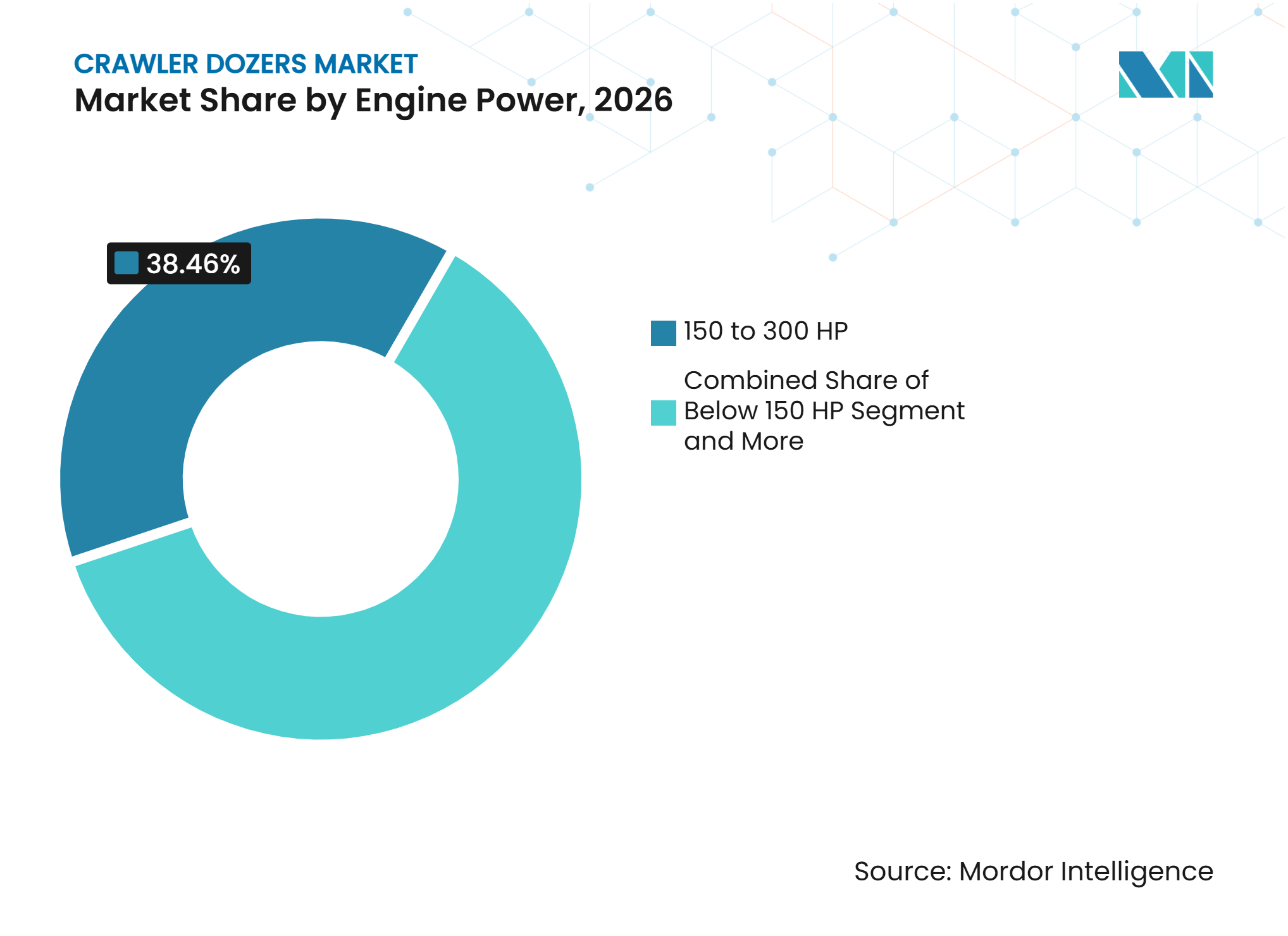
Mid-Range HP Dominates, High HP Defines the Mining FrontierThe 150 to 300 HP class accounted for 38.46% of the crawler dozers market share in 2026. This range fits road construction, site development, land clearing, and other jobs that need a balance of blade capacity, maneuverability, and steady performance through varied ground conditions, rather than a machine designed only for narrow finishing work or the heaviest production tasks. Contractors favor these machines because dealer support, standard attachments, and trained technicians are widely available. Their flexibility allows the same fleet to move between grading, clearing, general earthmoving, and work on scattered projects without lengthy reconfiguration. Lower-power machines remain useful for compact urban, utility, and confined-site work where access and turning space are limited. The 301 to 500 HP class serves heavier site preparation and medium-scale mining where a larger machine is needed without moving to the largest category.
The above-500 HP segment is forecast to grow at a 7.38% CAGR through 2032 within the crawler dozers market. Large copper and gold operations need heavy dozers for haul-road upkeep, waste-dump work, and high-volume stripping, where the equipment must move substantial material reliably across repeated shifts and changing site conditions. At these sites, fuel use per tonne moved becomes more important than a low initial purchase price. Caterpillar introduced the D11 XE electric-drive dozer in September 2026 for this demanding class. The model is intended to improve productivity and reduce operating costs in large mining applications. Its arrival also indicates that electric-drive development is moving into the highest-power equipment categories.



By Blade Type:
Semi-U Leads, PAT Fastest on Grade-Control MomentumSemi-universal blades accounted for 34.27% of the share of the crawler dozers market in 2026. They combine useful material-carrying capacity with penetration suited to a varied contractor workload, allowing operators to handle loose material, intermediate ground preparation, and changing material conditions without moving to a specialist blade. This makes them a common choice where stripping, intermediate grading, and general site preparation take place on the same project. Straight blades remain useful for hard-rock ripping and work where tight turns are important. Universal blades continue to serve specialist bulk-pushing tasks at large mining operations. Blade selection still depends on soil type, material volume, desired finish, and the machine’s normal job mix.
Angle/power-angle-tilt blades are forecast to advance at a 7.16% CAGR through 2032. These assemblies offer the tilt and angle response needed for guidance systems that adjust blade position to GNSS elevation inputs, giving an operator and the control system more practical scope to respond to changing contours across a work area. Their value is strongest when contractors need accurate final surfaces and fewer correction passes. Komatsu’s IMC 3.0 example on the D61PXi-25 links machine controls with blade management. Contractors adding automated guidance can therefore select compatible blade hardware at the same time. This connection gives PAT blades a demand path that extends beyond routine blade replacement.
By Drive Type:
Mechanical Drive Entrenched, Electric Drive the Fastest-Growing CategoryMechanical/powershift systems held 56.38% of the share of the crawler dozers market in 2026. Their established service base, proven durability, and lower upfront cost remain attractive to many fleet owners, particularly where a contractor has existing technicians, stocked parts, and operating routines built around conventional machinery. Remote jobsites also benefit from technicians who are familiar with conventional drivetrains. Hydrostatic systems retain a role in precision grading and finish work because they support variable speed control. This is useful when surface quality and controlled movement are more important than bulk production. The crawler dozers industry continues to rely on mechanical systems where service access and operating familiarity are the deciding factors.
Electric drive is forecast to grow at a 10.47% CAGR through 2032. Caterpillar’s D6 XE diesel-electric arrangement shows how a motor-generator system can replace a conventional transmission in a working dozer. The D11 XE expands that approach to a large-dozer design with fewer drivetrain parts. These systems can lower fuel use and reduce some maintenance demands in high-utilization duty cycles, which matters most when equipment works for long periods, and a small efficiency improvement can accumulate across the life of a machine. Battery-electric options will depend more heavily on charging access, grid capacity, and on-site technical support. The crawler dozers industry is therefore likely to see diesel-electric adoption ahead of wider battery-electric use at isolated mining sites.
By Application:
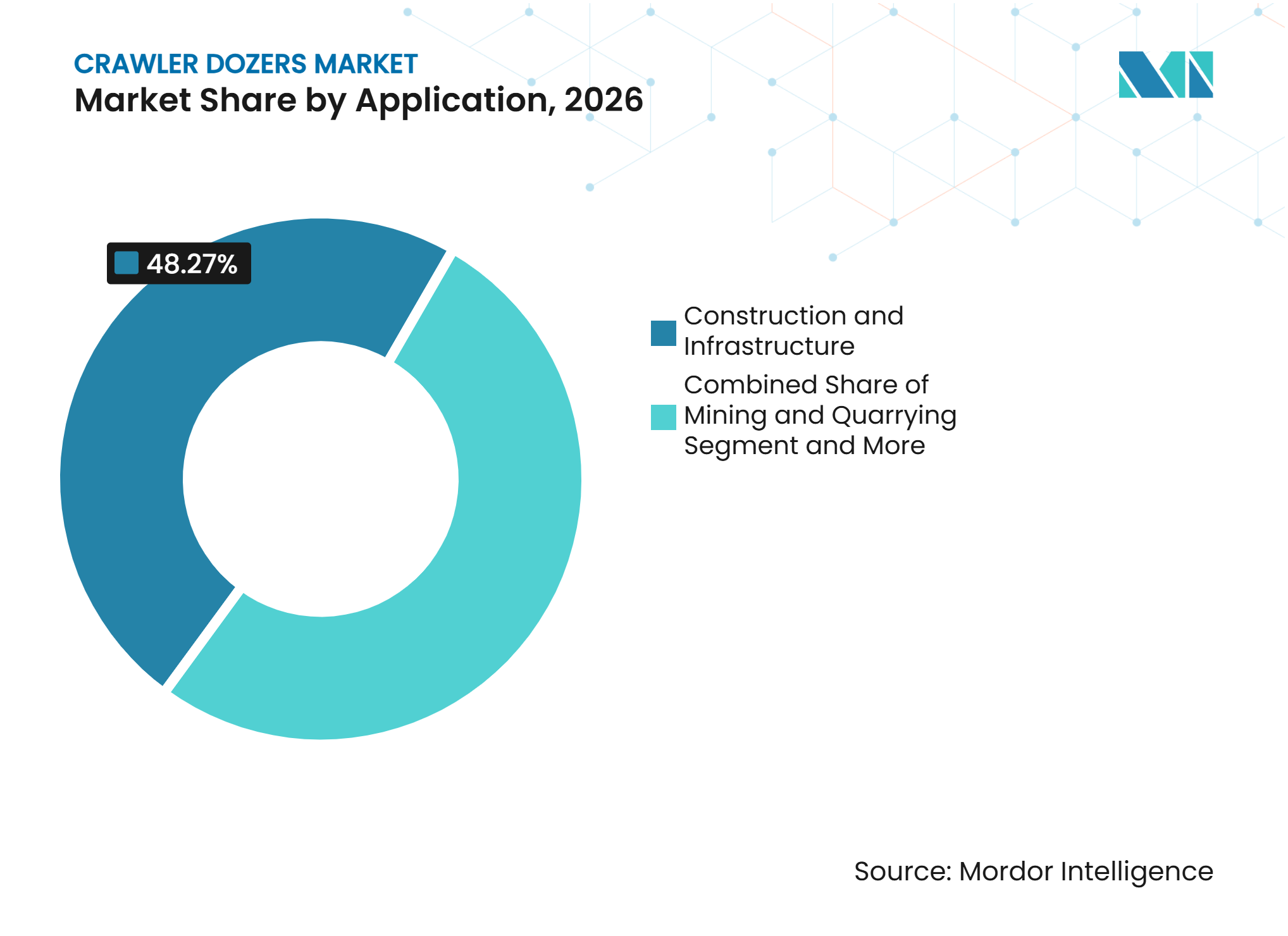
Construction Leads by Share, Mining Accelerates FastestConstruction and infrastructure accounted for 48.27% of crawler dozers market share in 2026. Road, bridge, utility, and large earthmoving projects require clearing, bulk movement, and grade preparation before later construction stages can begin, so dozers often arrive before other equipment categories and remain involved as the site changes. Public investment supports a steady flow of work across both established and developing economies, even though procurement and mobilization can occur at different times. Agricultural and forestry users also need dozers for plantation clearing, logging road construction, access preparation, and other recurring land management work. Waste management involves recurring equipment activities, including landfill-cell development, compaction support, cover placement, and site maintenance. These uses make construction the broadest demand base for the crawler dozers market.
Mining and quarrying is forecast to grow at a 7.43% CAGR through 2032. New and restarted operations require dozers to prepare access roads, remove overburden, and maintain dumps before production reaches a stable level, making dependable availability important as mine plans move from preparation to regular operations. This work can create concentrated machine-hour demand over a limited period. Large mining operators also place a high value on uptime and local parts availability. Their requirements favor machines designed for continuous loads and service plans that reduce unplanned interruptions. The crawler dozers industry gains from this application because mining work creates demand for both high-capacity equipment and lifecycle support.

By Sales Channel:
Dealer Networks Dominant, Direct Sales Gaining Strategic GroundDealers and distributors held an 81.36% market share in the crawler dozer market in 2026. Their role goes beyond equipment delivery because they provide parts, field service, financing support, telematics assistance, and a local point of contact when equipment needs attention at an active jobsite. A strong dealer network can reduce downtime at remote projects and influence a buyer’s repeat purchase decision. This is why equipment producers are expanding dealer coverage in regions where their service presence has been limited. Shantui has developed a logistics hub in Genk, Belgium, alongside dealer recruitment and distribution activity in European markets. For most construction buyers, a nearby dealer remains central to their decision about which dozer brand to choose.
Direct sales are forecast to grow at a 6.94% CAGR through 2032. Large mining operators can buy fleets directly, negotiate performance commitments, and use embedded manufacturer technicians for planned service, which can reduce administrative layers when a site operates a large and standardized machine fleet. These arrangements are more practical where fleet size and site utilization justify a dedicated support model. Direct contracts can also combine equipment, maintenance, telematics, and availability obligations into a single commercial arrangement. Construction customers and smaller fleet owners are less likely to move away from dealer-led relationships. The crawler dozers market is therefore developing a split between direct support for high-volume mining fleets and distributor support for broader contractor demand.
Geography Analysis
Asia-Pacific accounted for 41.28% of the crawler dozer market in 2026. China’s urban infrastructure activity, India’s public works programs, and equipment needs in Indonesia’s mining and plantation sectors underpin regional demand, creating a broad base spanning urban construction, rural connectivity, resource activity, and land development. India’s road and bridge allocation for fiscal year 2026-27, along with the PMGSY-IV rural connectivity objective, supports sustained grading and site-clearing activities. Japan’s domestic construction equipment demand softened in fiscal year 2025, helping to moderate the regional picture. Export activity and aftermarket revenue nevertheless help support the broader Asia-Pacific equipment base. The crawler dozers market in this region benefits from a mix of transportation construction, industrial development, mining, and agricultural land work.
North America is a medium-growth area with a relatively high average selling price for heavy equipment. Public spending on roads and other infrastructure supports demand for machines with reliable dealer coverage and regulatory-compliant engines, while fleet owners also consider technology features that can improve grading accuracy and simplify reporting. U.S. state and local construction spending reached an estimated USD 479 billion in 2025, and highway construction was above USD 150 billion at a seasonally adjusted annual rate in mid-2026. Europe has slower fleet growth because many markets are mature and private-sector starts have been softer. EU Stage V requirements still support replacement purchases in low-emission work zones. South America adds mining-led demand in Chile, Peru, Colombia, and Brazil, where buyers increasingly value grade-control and emissions-compliance features.
Middle East and Africa is forecast to grow at a 7.62% CAGR through 2032 in the crawler dozers market. Saudi Arabia’s Vision 2030 programs, Egypt’s New Administrative Capital, and Morocco’s FIFA 2030 projects support demand for earthmoving across major development sites. The region’s infrastructure pipeline also includes transportation, urban development, and basic services projects, which require work across different soil conditions, project scales, and levels of contractor capability. Existing fleet penetration is lower in many local markets than in older equipment regions. This means demand can include new unit purchases rather than only replacement of established fleets. Manufacturers that combine available machines, parts access, and responsive service are best placed to address this growth.
Competitive Landscape
Market Concentration
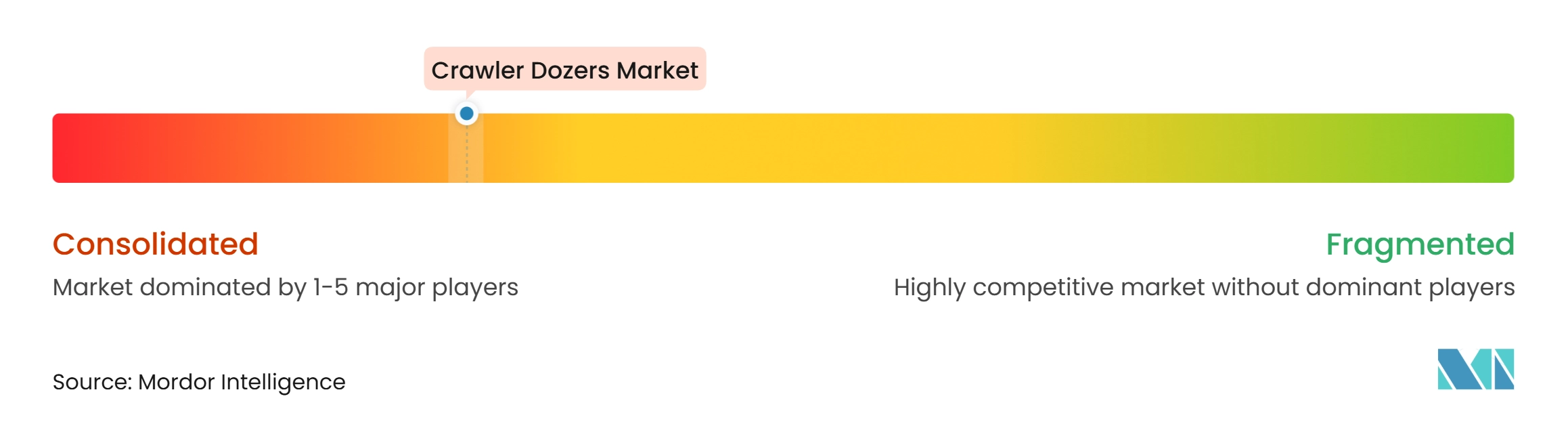
The crawler dozers market is highly concentrated, led by Caterpillar Inc., Komatsu Ltd., Shantui Construction Machinery, Deere and Company, and Liebherr Group. Their positions reflect established brands, wide dealer coverage, and the ability to support machines over long operating lives, all of which matter when a buyer must manage uptime, planned maintenance, and equipment residual value. Caterpillar has developed an electric-drive progression across the D7E, D6 XE, D8 XE, and D11 XE. This offers customers a route to adopt new drivetrain technology while remaining within an existing service relationship. Komatsu focuses on connected workflows through Smart Construction and IMC 3.0. These capabilities add value through jobsite planning, guidance, and equipment data as well as the physical machine.
Caterpillar also expanded its work with NVIDIA in 2026, focusing on on-board AI features and industrial AI applications. Komatsu announced a partnership with AIM Intelligent Machines in August 2026 to commercialize autonomous bulldozers and hydraulic excavators at customer job sites in Japan and the United States. These moves show that suppliers are seeking differentiation through automated operations and machine data, not only through engine output, as customers increasingly assess how equipment fits into a connected workflow across the entire project. The crawler dozers market is also seeing greater competition in the mid-range range as Chinese manufacturers improve their export networks. SANY’s 2025 Hong Kong listing was intended to support international sales and service expansion, research and development, and overseas manufacturing. Shantui’s activity in Europe similarly shows the importance of service infrastructure in markets where established brands have deep dealer ties.
Chinese producers can compete strongly where local emissions requirements align with China Nonroad Stage IV. They face a higher barrier in Europe and North America, where full Stage V or Tier 4 Final certification is necessary for many fleet-renewal opportunities. This compliance gap affects which suppliers can compete for higher-value tenders, especially where equipment buyers need certainty that a new machine can work across regulated sites throughout its expected service life. Price pressure is most visible in the mid-range classes, where buyers have more equipment choices. Established suppliers respond by emphasizing grade control, electric drives, autonomous operation, and lifecycle service. These strategies are consistent with a market where support quality can matter as much as machine cost. Buyers still face risks from uneven construction activity, mining investment cycles, and the cost of maintaining heavy undercarriage systems.
Crawler Dozers Industry Leaders
-
Caterpillar Inc.
-
Komatsu Ltd.
-
Shantui Construction Machinery Co., Ltd.
-
Deere and Company
-
Liebherr Group
- *Disclaimer: Major Players sorted in no particular order
Crawler Dozers Market Companies Covered in this Report
- Caterpillar Inc.
- Komatsu Ltd.
- Deere & Company
- Liebherr Group
- Shantui Construction Machinery Co., Ltd.
- CNH Industrial N.V.
- HD Hyundai Infracore Co., Ltd.
- XCMG Construction Machinery Co., Ltd.
- SANY Heavy Industry Co., Ltd.
- Zoomlion Heavy Industry Science and Technology Co., Ltd.
- Guangxi LiuGong Machinery Co., Ltd.
- SINOMACH Heavy Industry Corporation
- HBIS Xuanhua Construction Machinery Co., Ltd.
- BEML Limited
- Shanghai Pengpu Machinery Co., Ltd.
- The Struck Corporation
- Foton Lovol Heavy Industry Co., Ltd.
- Xiamen XGMA Machinery Co., Ltd.
- YTO Group Corporation
- Lingong Heavy Machinery Co., Ltd.
Recent Industry Developments in Crawler Dozers Market
- March 2026: Komatsu showcased two next-generation crawler dozers, the D61PXi-25 and the D175AX-10, at ConExpo 2026. The D61PXi-25 is a redesigned midsize IMC dozer, while the D175AX-10 succeeds the D155AX-8 with a new frame, powertrain, cab, and blade system.
- March 2026: CASE Construction Equipment showcased more than 40 machines at CONEXPO-CON/AGG 2026, highlighting the new N Series dozer, expected in late 2026, with upgrades to performance management, visibility, and operator experience.
- March 2026: Caterpillar introduced the Cat D8 XE, a Next Generation dozer with an electric drive powertrain that used up to 10% less fuel and moved up to 6% more material than the standard D8 in internal testing, with availability from the second half of 2026.
- March 2026: Liebherr completed the full availability of its Generation 8 crawler dozer line-up, ranging from the PR 716 G8 to the 73-tonne PR 776 G8, supported by investments at its Telfs plant in Austria.
Global Crawler Dozers Market Report Scope
The Crawler Dozers Market is Segmented by Engine Power, Blade Type, Drive Type, Application, Sales Channel, and Geography. By Engine Power, the market is segmented into Below 150 HP, 150 to 300 HP, 301 to 500 HP, and Above 500 HP. By Blade Type, the market is segmented into Straight (S) Blade, Universal (U) Blade, Semi-Universal (SU) Blade, and Angle/Power-Angle-Tilt (PAT) Blade. By Drive Type, the market is segmented into Mechanical/Powershift, Hydrostatic, and Electric Drive (Diesel-Electric, Battery-Electric). By Application, the market is segmented into Construction and Infrastructure, Mining and Quarrying, Agriculture and Forestry, Waste Management and Landfill, and Other Applications. By Sales Channel, the market is segmented into Direct Sales and Dealers and Distributors. By Geography, the market is segmented into North America (United States, Canada, and Mexico), Europe (Germany, France, United Kingdom, Italy, Spain, Russia, Poland, Norway, and Rest of Europe), Asia-Pacific (China, India, Japan, South Korea, Indonesia, Australia, and Rest of Asia-Pacific), South America (Brazil, Argentina, Colombia, Chile, Peru, and Rest of South America), and Middle East and Africa (Saudi Arabia, United Arab Emirates, Qatar, Türkiye, Egypt, South Africa, Nigeria, Algeria, Morocco, and Rest of Middle East and Africa). The Market Forecasts are Provided in Terms of Value (USD) and Volume (Units).
Segmentation Overview
| Below 150 HP |
| 150 to 300 HP |
| 301 to 500 HP |
| Above 500 HP |
| Straight (S) Blade |
| Universal (U) Blade |
| Semi-Universal (SU) Blade |
| Angle/Power-Angle-Tilt (PAT) Blade |
| Mechanical/Powershift |
| Hydrostatic |
| Electric Drive (Diesel-Electric, Battery-Electric) |
| Construction and Infrastructure |
| Mining and Quarrying |
| Agriculture and Forestry |
| Waste Management and Landfill |
| Other Applications |
| Direct Sales |
| Dealers and Distributors |
| North America | United States |
| Canada | |
| Mexico | |
| Europe | Germany |
| France | |
| United Kingdom | |
| Italy | |
| Spain | |
| Russia | |
| Poland | |
| Norway | |
| Rest of Europe | |
| Asia-Pacific | China |
| India | |
| Japan | |
| South Korea | |
| Indonesia | |
| Australia | |
| Rest of Asia-Pacific | |
| South America | Brazil |
| Argentina | |
| Colombia | |
| Chile | |
| Peru | |
| Rest of South America | |
| Middle East and Africa | Saudi Arabia |
| United Arab Emirates | |
| Qatar | |
| Türkiye | |
| Egypt | |
| South Africa | |
| Nigeria | |
| Algeria | |
| Morocco | |
| Rest of Middle East and Africa |
| By Engine Power | Below 150 HP | |
| 150 to 300 HP | ||
| 301 to 500 HP | ||
| Above 500 HP | ||
| By Blade Type | Straight (S) Blade | |
| Universal (U) Blade | ||
| Semi-Universal (SU) Blade | ||
| Angle/Power-Angle-Tilt (PAT) Blade | ||
| By Drive Type | Mechanical/Powershift | |
| Hydrostatic | ||
| Electric Drive (Diesel-Electric, Battery-Electric) | ||
| By Application | Construction and Infrastructure | |
| Mining and Quarrying | ||
| Agriculture and Forestry | ||
| Waste Management and Landfill | ||
| Other Applications | ||
| By Sales Channel | Direct Sales | |
| Dealers and Distributors | ||
| By Geography | North America | United States |
| Canada | ||
| Mexico | ||
| Europe | Germany | |
| France | ||
| United Kingdom | ||
| Italy | ||
| Spain | ||
| Russia | ||
| Poland | ||
| Norway | ||
| Rest of Europe | ||
| Asia-Pacific | China | |
| India | ||
| Japan | ||
| South Korea | ||
| Indonesia | ||
| Australia | ||
| Rest of Asia-Pacific | ||
| South America | Brazil | |
| Argentina | ||
| Colombia | ||
| Chile | ||
| Peru | ||
| Rest of South America | ||
| Middle East and Africa | Saudi Arabia | |
| United Arab Emirates | ||
| Qatar | ||
| Türkiye | ||
| Egypt | ||
| South Africa | ||
| Nigeria | ||
| Algeria | ||
| Morocco | ||
| Rest of Middle East and Africa | ||
Key Questions Answered in the Report
What is the forecast for the crawler dozers market?
The crawler dozers market is projected to grow from USD 11.83 billion in 2027 to USD 16.22 billion by 2032 at a 6.51% CAGR. Demand is supported by infrastructure work, mining activity, and fleet replacement needs.
Which engine power range leads crawler dozer demand?
The 150 to 300 HP class led with 38.46% share in 2026 because it suits road construction, site development, and land clearing. Its broad use also supports dealer familiarity and attachment availability.
Which crawler dozer drive type is growing the fastest?
Electric drive is forecast to grow at a 10.47% CAGR through 2032, supported by interest in fuel efficiency and reduced drivetrain complexity. Charging access will remain important for wider battery-electric adoption.
Why are mining companies buying more crawler dozers?
Mining and quarrying segment is forecast to grow at a 7.43% CAGR as new and restarted sites require access-road work, stripping, and waste-dump preparation. Operators also need dependable machines that can work under heavy loads.