
Craft Rum Market Size and Share
Market Overview
| Study Period | 2021 - 2031 |
|---|---|
| Market Size (2026) | USD 1.56 Billion |
| Market Size (2031) | USD 1.98 Billion |
| Growth Rate (2026 - 2031) | 4.86 % |
| Fastest Growing Market | Asia-Pacific |
| Largest Market | North America |
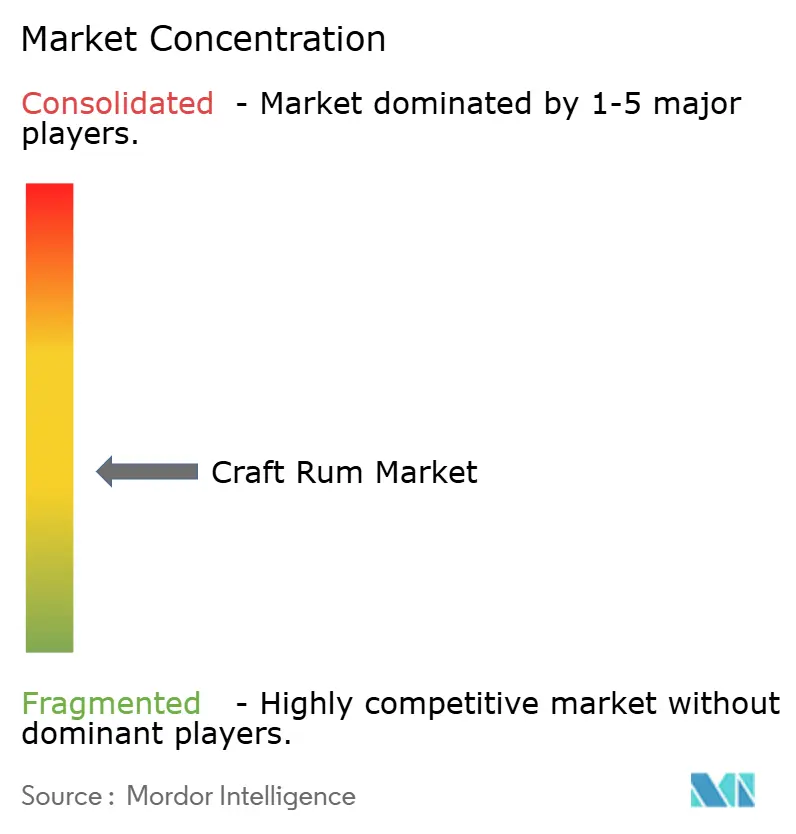
| Market Concentration | Medium |
Major Players
*Disclaimer: Major Players sorted in no particular order Image © Mordor Intelligence. Reuse requires attribution under CC BY 4.0. |
|
Craft Rum Market Analysis by Mordor Intelligence
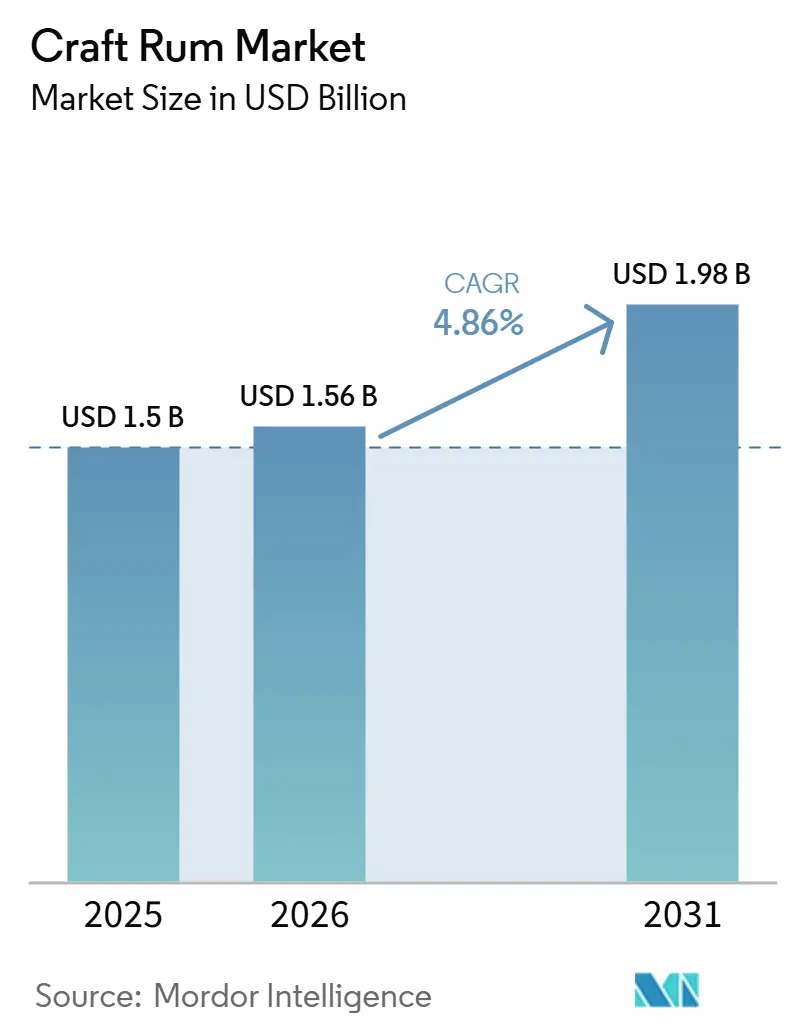
The global craft rum market was valued at USD 1.50 billion in 2025, estimated at USD 1.56 billion in 2026, and projected to reach USD 1.98 billion by 2031, expanding at a CAGR of 4.86% during the 2026–2031 forecast period. The market is experiencing steady growth driven by increasing consumer preference for premium and artisanal alcoholic beverages that emphasize authenticity, craftsmanship, and distinctive flavor profiles. Growing demand for small-batch spirits and botanical-infused variants is encouraging continuous product innovation. In addition, the expansion of independent craft distilleries and rising interest in limited-edition, cask-finished, and single-origin rum varieties continue to diversify product offerings and reinforce the premium positioning of the market.
Key Report Takeaways
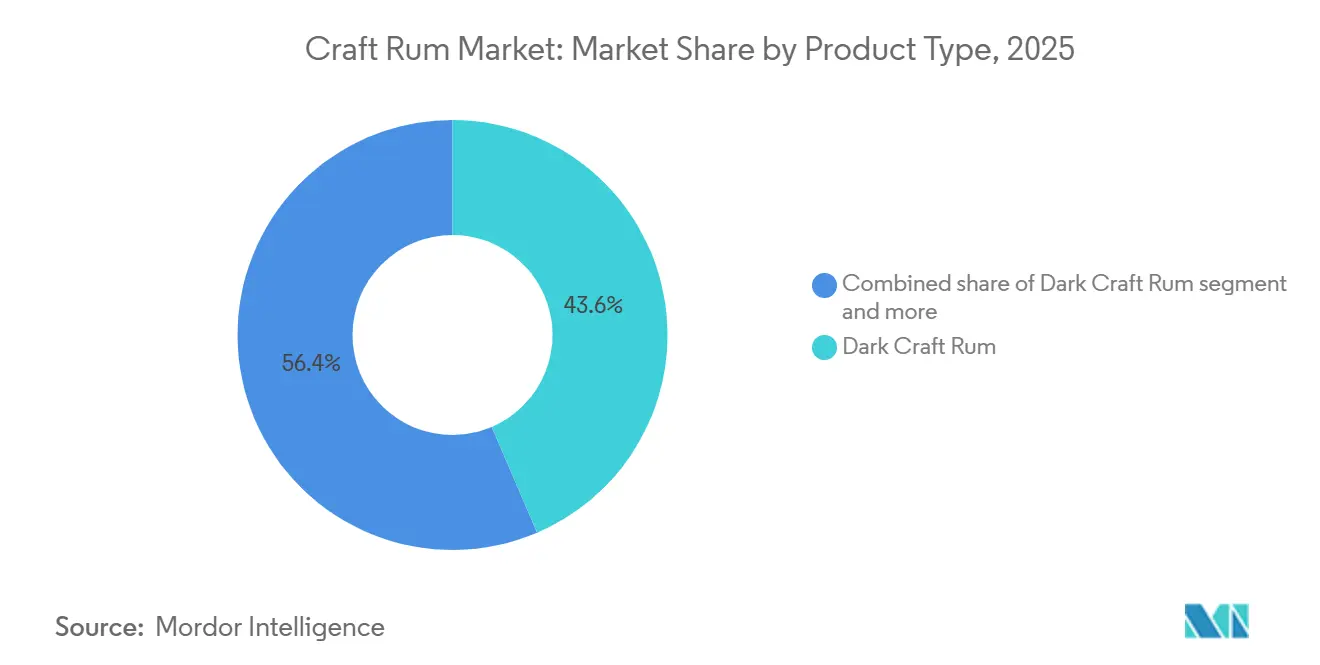
- By product type, dark craft rum held 43.56% of the craft rum market share in 2025, while gold craft rum is forecast to grow at a CAGR of 4.98% through 2031.
- By end user, men accounted for 67.82% of the craft rum market share in 2025, while women are projected to record the highest CAGR of 6.83% through 2031.
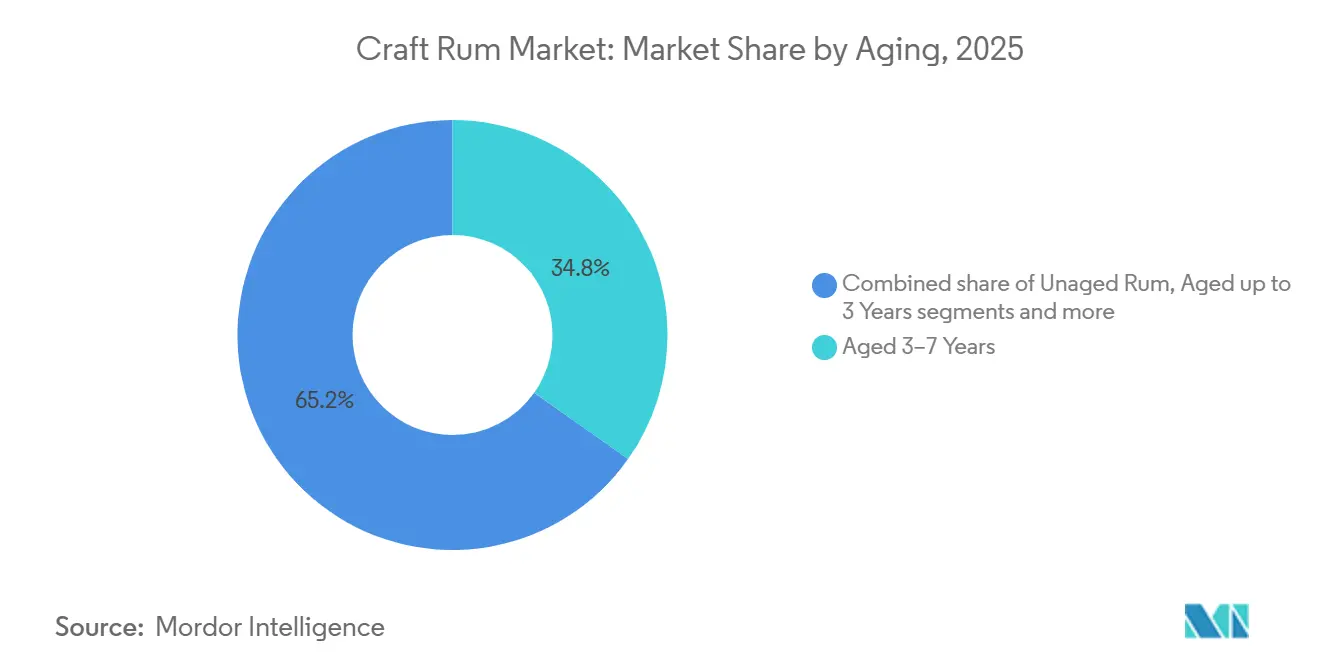
- By aging, the aged 3–7 years segment captured 34.79% of the craft rum market share in 2025, while aged above 7 years is projected to expand at a CAGR of 6.09% through 2031.
- By distribution channel, off-trade held 58.92% of the craft rum market share in 2025, while on-trade is forecast to grow at a CAGR of 5.76% through 2031.
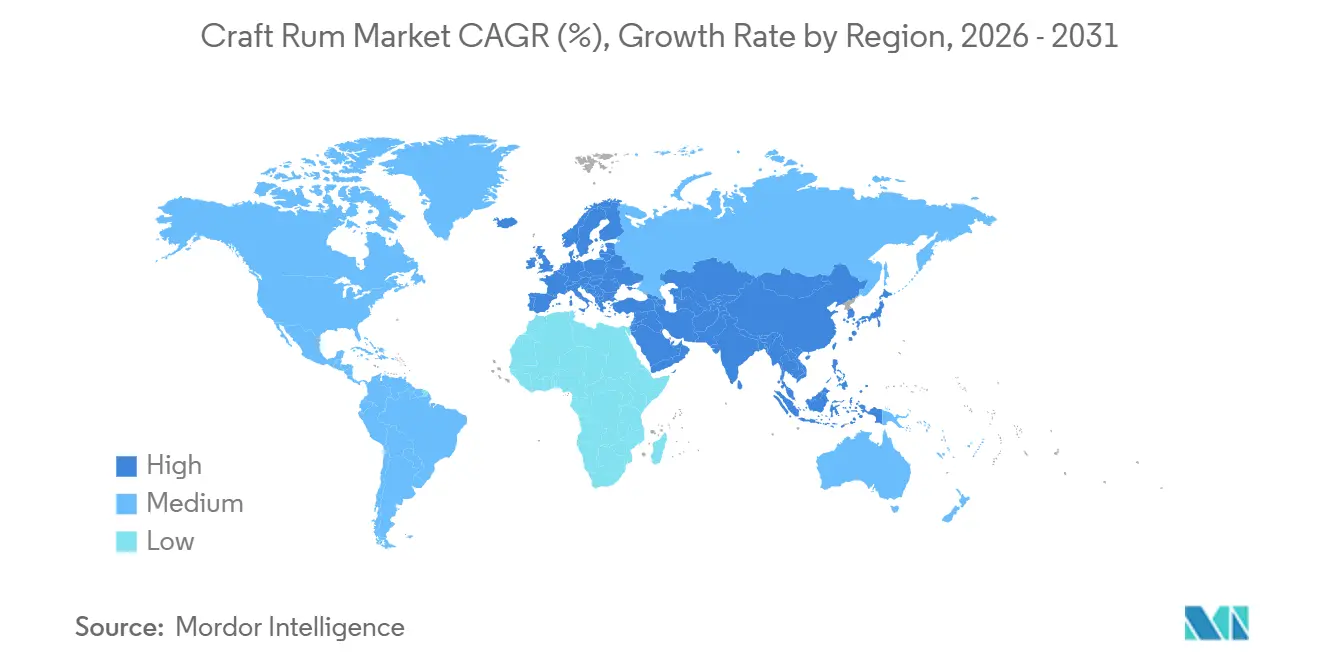
- By geography, North America accounted for 38.76% of the craft rum market share in 2025, while Asia-Pacific is projected to advance at a CAGR of 6.45% through 2031.
Note: Market size and forecast figures in this report are generated using Mordor Intelligence’s proprietary estimation framework, updated with the latest available data and insights as of January 2026.
Global Craft Rum Market Trends and Insights
Drivers Impact Analysis*
| Driver | (~) % Impact on CAGR Forecast | Geographic Relevance | Impact Timeline |
|---|---|---|---|
| Demand for unique flavor profiles and botanical-infused rum variants | +0.9% | Global, with intensity in North America and Western Europe | Medium term (2–4 years) |
| Expansion of craft distilleries and small-batch production facilities | +0.8% | North America, Europe, Asia-Pacific core | Medium term (2–4 years) |
| Increasing popularity of premium cocktail culture and mixology | +0.7% | Global, with fastest adoption in Asia-Pacific urban centers | Short term (≤ 2 years) |
| Rising influence of rum tourism and distillery experiences | +0.6% | Caribbean, North America, Europe | Medium term (2–4 years) |
| Innovation in barrel-aging and cask-finishing techniques | +0.8% | Caribbean, Europe, North America | Medium term (2–4 years) |
| Consumer interest in limited-edition and collectible spirits | +0.5% | North America, Europe, East Asia | Long term (≥ 4 years) |
| Source: Mordor Intelligence | |||
Demand for unique flavor profiles and botanical-infused rum variants
Growing consumer interest in distinctive and premium tasting experiences is driving innovation across the craft rum market, encouraging producers to develop products with complex flavor profiles and natural botanical infusions. Rather than relying on traditional rum expressions, craft distillers are incorporating herbs, spices, citrus peels, tropical fruits, floral ingredients, and other plant-based botanicals during fermentation, distillation, or post-distillation maturation to create differentiated offerings. This focus on flavor innovation enables brands to cater to consumers seeking authenticity, experimentation, and artisanal craftsmanship, while expanding product portfolios with limited-edition and specialty expressions. The continuous introduction of botanical-infused craft rums is strengthening product differentiation, supporting premium positioning, and attracting consumers looking for novel, high-quality spirits.
Expansion of craft distilleries and small-batch production facilities
The expansion of craft distilleries and small-batch production facilities is driving growth in the craft rum market by increasing production capacity, product diversity, and innovation. Independent distillers are investing in artisanal distillation infrastructure that enables greater control over ingredient selection, fermentation, maturation, and quality, resulting in premium handcrafted rum expressions. Small-batch production allows manufacturers to experiment with different sugarcane sources, yeast strains, barrel-aging techniques, and limited-edition releases, creating differentiated products that appeal to consumers seeking authenticity and exclusivity. As more craft distilleries enter the market and expand their operational capabilities, the availability of premium craft rum continues to increase, strengthening market competitiveness and supporting category growth.
Increasing popularity of premium cocktail culture and mixology
The growing popularity of premium cocktail culture and mixology is driving demand for craft rum by increasing consumer appreciation for high-quality spirits with distinctive flavor profiles and artisanal production characteristics. Professional bartenders and mixologists increasingly prefer craft rums, as their diverse aging styles, fermentation methods, and natural flavor complexity allow for the creation of premium cocktails with greater depth and originality. This trend has encouraged producers to develop premium expressions that highlight unique sensory attributes, barrel finishes, and botanical influences, making craft rum a more prominent ingredient in contemporary cocktail development. Rising consumer participation in cocktail experiences, tasting events, and mixology-focused hospitality concepts is further strengthening the visibility and premium positioning of craft rum within the global spirits industry. In May 2025, Wise Monkey Rum launched its Mauritian Rum & Cola Ready-to-Drink (RTD) cocktail, expanding its premium cocktail portfolio to meet the growing demand for convenient, high-quality rum-based cocktail experiences while highlighting the versatility of craft rum.
Rising influence of rum tourism and distillery experiences
The growing popularity of rum tourism and immersive distillery experiences is contributing to the expansion of the craft rum market by strengthening consumer engagement and brand loyalty. Craft distilleries offer guided production tours, barrel-aging demonstrations, and blending workshops that deepen visitor understanding of artisanal rum production. These offerings enhance brand authenticity, encourage premium product purchases, and build consumer connections beyond traditional retail channels. According to UN Comtrade, Italy was the world's largest exporter of rum and distilled fermented sugar-cane products in 2024, with exports valued at approximately USD 224 million [1]Source: UN Comtrade, "Leading exporters of rum and distilled fermented sugar-cane", comtradeplus.un.org. This reflects the growing international appeal of premium rum and supports the development of rum-focused tourism and destination distilleries worldwide.
Restraints Impact Analysis*
| Restraint | (~) % Impact on CAGR Forecast | Geographic Relevance | Impact Timeline |
|---|---|---|---|
| Stringent alcohol production and licensing regulations | -0.9% | Global; most acute in emerging markets and United States state-level jurisdictions | Medium term (2–4 years) |
| Lengthy aging requirements for premium rum varieties | -0.8% | Global; most pronounced for producers entering aged-above-7-years tier | Long term (≥ 4 years) |
| Supply variability of high-quality sugarcane and molasses | -1.0% | Caribbean producers and markets dependent on Cuban/regional molasses | Short to medium term |
| Storage and inventory requirements for barrel-aged products | -0.7% | North America, Europe (small-batch producers) | Long term (≥ 4 years) |
| Source: Mordor Intelligence | |||
Stringent alcohol production and licensing regulations
Stringent alcohol production and licensing regulations restrain the craft rum market by increasing compliance costs and extending the time required to establish and expand production facilities. Craft rum producers must comply with requirements related to distillation permits, excise taxation, product approvals, labeling standards, quality control, storage, distribution, and periodic regulatory inspections. For small and independent distilleries, these regulatory obligations often require substantial financial investment and administrative resources, limiting production scalability and delaying new product introductions. Variations in alcohol regulations across countries further complicate market expansion, making it more difficult for craft rum producers to access new markets and maintain efficient cross-border distribution.
Lengthy aging requirements for premium rum varieties
Lengthy aging requirements for premium rum varieties restrain the growth of the craft rum market by delaying product commercialization and extending the time needed to generate revenue. Premium craft rums often require several years of barrel maturation to develop the desired complexity, aroma, color, and smoothness. During this period, producers must allocate significant storage space, maintain barrel inventories, and invest in long-term quality management while products remain unavailable for sale. Additionally, natural evaporation during aging, commonly known as the angel's share, reduces the final volume of rum, affecting production efficiency and overall yield. These factors increase operational costs and limit the ability of small craft distilleries to expand production or respond quickly to changing market demand, making extended aging a key restraint for the craft rum market.
*Our forecasts treat driver/restraint impacts as directional, not additive. The impact forecasts reflect baseline growth, mix effects, and variable interactions.
Segment Analysis
By Product Type: Dark Rum's Heritage Premium Confronts Gold's Rising Trajectory
Dark Craft Rum held the largest product-type share in 2025 at 43.56%, supported by increasing consumer appreciation for spirits that offer depth, maturity, and craftsmanship through extended barrel aging. The prolonged aging process naturally develops layered aromas and a fuller body, creating a distinctive sensory profile that differentiates dark craft rum from lighter variants. Consumers are increasingly seeking authentic spirits with visible production heritage, traditional distillation practices, and premium maturation techniques, all of which favor dark craft rum. The category also benefits from the growing popularity of small-batch and limited-release expressions, where longer maturation enhances perceived exclusivity and product value. Additionally, the emphasis on provenance, natural ingredient quality, and handcrafted production has positioned dark craft rum as a benchmark for premium artisanal spirits, reinforcing its dominant position within the product landscape.
Gold Craft Rum is the fastest-growing product-type segment, with a CAGR of 4.98% over the 2026–2031 forecast period. Growth is driven by evolving consumer preferences for premium spirits that balance freshness with oak-derived complexity. Its moderate maturation produces a smoother, more approachable taste while preserving the natural sugarcane character, making it increasingly attractive to consumers exploring premium craft rum. Producers are expanding this category through innovative maturation methods, specialty wood finishes, and controlled aging techniques that enhance flavor without overwhelming the spirit's original profile. Rising demand for versatile premium expressions with refined yet accessible taste characteristics has accelerated product innovation in this category, while growing consumer interest in different aging styles and flavor profiles continues to support the long-term growth outlook for gold craft rum.



By End-User: Dominant Male Base Masking the Fastest-Growing Demand Shift
Male consumers accounted for 67.82% of the craft rum end-user share in 2025, driven by a strong preference for premium spirits that emphasize heritage, craftsmanship, and flavor complexity. Consumers within this group demonstrate a greater inclination toward exploring artisanal distillation techniques, extended barrel maturation, and limited-production releases, resulting in sustained demand for high-quality craft rum. Interest in tasting notes, authenticity, production transparency, and traditional rum-making practices has encouraged continued engagement with premium expressions, while growing participation in spirits education, tasting events, and enthusiast communities has further reinforced purchasing frequency. The increasing appreciation for handcrafted beverages with distinctive character and premium positioning continues to support the dominance of male consumers within the craft rum market.
Women represent the fastest-growing end-user segment with a 6.83% CAGR over 2026–2031, driven by evolving preferences for premium alcoholic beverages that combine authenticity, refined taste, and artisanal production values. Increasing interest in craft spirits has encouraged greater exploration of products featuring balanced flavor profiles, natural ingredients, and distinctive production stories. Consumers are also placing greater importance on quality over quantity, seeking beverages that offer unique sensory experiences and premium craftsmanship. This shift has encouraged producers to broaden their premium portfolios with more diverse flavor expressions, sophisticated packaging, and heritage-focused branding, strengthening the participation of women in the craft rum market and supporting sustained growth throughout the forecast period.
By Aging: The 3–7 Year Sweet Spot Anchors Volume While Ultra-Aged Drives Value
The 3–7 years aging segment held the largest share at 34.79% in 2025. This aging range allows the spirit to develop richer aromas, smoother texture, and greater depth while preserving the natural characteristics of the base distillate. Consumers increasingly value premium spirits that offer refined flavor development without excessive oak influence, making this maturation range attractive. Producers also favor this category because it consistently delivers enhanced sensory quality while maintaining product consistency through controlled aging practices. The growing preference for premium spirits with defined aging statements, traditional maturation methods, and distinctive flavor profiles continues to support demand for craft rums aged between 3 and 7 years.
The aged above 7 years segment is the fastest-growing aging category, with a CAGR of 6.09% over 2026–2031. Longer aging enables the development of layered flavor profiles, smoother mouthfeel, and enhanced aromatic richness, appealing to consumers seeking sophisticated, high-quality drinking experiences. Growing interest in heritage-inspired spirits, limited-production aged releases, and time-intensive production methods has encouraged producers to expand their portfolios of long-matured craft rums. The increasing recognition of extended aging as a marker of authenticity and premium quality continues to drive demand for craft rum aged beyond 7 years.
By Distribution Channel: Off-Trade Scale Versus On-Trade Influence
Off-trade channels held a dominant 58.92% distribution share in 2025, driven by consumer preference for a wide assortment of premium and artisanal spirits available through organized retail outlets that enable product comparison and informed purchasing decisions. Retail environments provide access to diverse craft rum portfolios, including limited-production and aged expressions, while knowledgeable staff and detailed product information help consumers evaluate origin, production methods, and flavor characteristics. The availability of premium packaging formats, gift editions, and exclusive releases further supports purchases through off-trade channels. According to the American Craft Spirits Association, the United States craft spirits category exceeded 12.7 million 9-liter cases in retail sales during 2024, highlighting the continued strength of retail-based purchasing and the expanding shelf presence of craft spirits, including craft rum [2]Source: American Craft Spirits Association, "CRAFT SPIRITS DATA PROJECT 2025", americancraftspirits.org.
On-trade channels are the fastest-growing distribution segment, with a 5.76% CAGR over 2026–2031, supported by increasing consumer preference for immersive premium beverage experiences and greater exposure to artisanal spirits in hospitality settings. Consumers are increasingly seeking opportunities to discover new craft rum expressions through guided tastings, curated spirit menus, and bartender-led recommendations, which enhance product awareness and encourage trial of premium offerings. Growing demand for experiential consumption, premium beverage education, and personalized drinking occasions has strengthened sales through hospitality venues, while producers continue to collaborate with premium establishments to showcase craftsmanship, aging techniques, and unique flavor characteristics, accelerating the expansion of the on-trade channel.
Geography Analysis
North America accounted for 38.76% of the global craft rum market in 2025, supported by its well-developed craft distilling ecosystem, strong consumer preference for premium artisanal spirits, and continuous innovation in small-batch rum production. The region benefits from an extensive network of independent distilleries that focus on authentic production methods, barrel-aging expertise, ingredient traceability, and premium-quality offerings. According to the Distilled Spirits Council of the United States (DISCUS), the United States had nearly 2,300 operating distilleries in 2025, reflecting a robust manufacturing base that continues to strengthen product diversity and premium craft spirit availability [3]Source: Distilled Spirits Council of the United States (DISCUS), "AMERICAN SPIRITS EXPORTS 2025", distilledspirits.org. Growing consumer interest in handcrafted spirits, heritage-inspired production techniques, and premium aged rum expressions further reinforces the region's position in the global craft rum market.
Asia-Pacific is the fastest-growing regional market, with a CAGR of 6.45% during 2026–2031, driven by the rapid evolution of premium drinking culture, increasing consumer exposure to international craft spirits, and growing appreciation for artisanal alcoholic beverages. The region is witnessing strong growth in premium spirit education, specialized tasting events, and sophisticated beverage experiences that encourage consumers to explore craft rum. The continued expansion of premium cocktail culture across major metropolitan areas, along with growing demand for authentic, high-quality imported and locally crafted spirits, has accelerated category adoption. Increasing product availability through modern retail channels, specialty beverage outlets, and premium hospitality establishments is also supporting broader consumer access to craft rum and sustaining long-term market expansion across the region.
Europe, South America, and the Middle East and Africa each contribute to the global craft rum market through distinct regional growth dynamics. Europe benefits from a mature premium spirits culture, strong consumer appreciation for artisanal production, and increasing demand for heritage-inspired, aged, and limited-edition rum expressions. South America is supported by its deep-rooted sugarcane cultivation, long-standing rum-making traditions, and a growing emphasis on premiumization, enabling producers to introduce high-quality craft offerings with distinctive regional identities. The Middle East & Africa is gradually emerging as a developing market, driven by the expansion of premium hospitality, luxury tourism, specialty beverage retail, and growing consumer interest in authentic imported craft spirits, creating new opportunities for premium craft rum brands to expand their presence.

Competitive Landscape
The global craft rum market is fragmented, with numerous regional craft distilleries competing alongside established international premium spirits producers. Market participants primarily compete on product authenticity, small-batch production, premium positioning, aging expertise, and brand heritage. Growing consumer preference for artisanal and high-quality spirits has encouraged both established companies and independent distillers to expand their craft rum portfolios, resulting in a highly competitive environment driven by continuous product differentiation and innovation.
Leading companies such as Brown-Forman Corporation, Campari Group, Rémy Cointreau Group, Suntory Holdings Limited, and Foursquare Rum Distillery continue to strengthen their market positions through portfolio expansion, premiumization strategies, and investments in distillation and maturation capabilities. Manufacturers are increasingly focusing on limited-edition releases, single-cask expressions, and premium aged variants, while improving production efficiency through modern fermentation technologies, precision distillation systems, barrel management techniques, and quality-control processes that ensure product consistency without compromising artisanal craftsmanship.
Innovation is a key competitive differentiator in the craft rum market, with producers continuously developing new flavor profiles and premium expressions to meet evolving consumer preferences. Companies are introducing botanical-infused, spice-forward, fruit-infused, cask-finished, and specialty-aged craft rums, while experimenting with diverse wood types, barrel-finishing techniques, and natural ingredient combinations to create distinctive products. Producers are also adopting digital production monitoring, automated quality assurance systems, sustainable distillation technologies, and environmentally responsible packaging solutions to improve operational efficiency, reinforce brand value, and maintain competitiveness in the premium spirits market.
Craft Rum Industry Leaders
-
Diageo PLC
-
Suntory Holdings Limited
-
Rémy Cointreau Group
-
Foursquare Rum Distillery
-
Campari Group (Appleton Estate)
- *Disclaimer: Major Players sorted in no particular order

Recent Industry Developments
- July 2026: Monika Alcobev partnered with Angostura, a globally recognized producer of bitters and one of the Caribbean's most awarded rum portfolios. Under the partnership, Monika Alcobev will lead the import, distribution, and marketing of Angostura's portfolio across key Indian markets.
- May 2026: Kuleana Rum Works partnered with Craft & Art Wine and Spirits, providing Kuleana Rum Works with the national sales infrastructure and route-to-market execution required to meet accelerating demand across the United States.
- April 2026: The Rolling Stones launched Crossfire Hurricane Rum Gold and Reserve, the first Jamaican rum to blend the island's iconic distilleries, developed in collaboration with Ian Burrell and brought to market by beverage brand builder Kite Drinks.


Global Craft Rum Market Report Scope
Craft rum is a premium spirit produced in small batches by independent distilleries. The craft rum market is segmented by product type, end-user, aging, distribution channel, and geography. Based on product type, the market is segmented into white craft rum, gold craft rum, and dark craft rum. Based on end-user, the market is segmented into men and women. Based on aging, the market is segmented into unaged rum, aged up to 3 years, aged 3–7 years, aged above 7 years, and others. Based on distribution channel, the market is segmented into on-trade and off-trade. The off-trade segment is further categorized into specialty/liquor stores and other off-trade channels. Based on geography, the market is segmented into North America, Europe, Asia-Pacific, South America, and Middle East and Africa. The report provides market size and forecasts in both value (USD) and volume (liters) for all the mentioned segments.
| White Craft Rum |
| Gold Craft Rum |
| Dark Craft Rum |
| Men |
| Women |
| Unaged Rum |
| Aged up to 3 Years |
| Aged 3 - 7 Years |
| Aged Above 7 Years |
| Others |
| On-Trade | |
| Off-Trade | Specialty/Liquor Stores |
| Other off-Trade Channels |
| North America | United States |
| Canada | |
| Mexico | |
| Rest of North America | |
| Europe | United Kingdom |
| Germany | |
| France | |
| Italy | |
| Spain | |
| Netherlands | |
| Poland | |
| Belgium | |
| Sweden | |
| Rest of Europe | |
| Asia-Pacific | China |
| Japan | |
| India | |
| Australia | |
| Indonesia | |
| South Korea | |
| Thailand | |
| Singapore | |
| Rest of Asia-Pacific | |
| South America | Brazil |
| Argentina | |
| Colombia | |
| Chile | |
| Peru | |
| Rest of South America | |
| Middle East and Africa | South Africa |
| Saudi Arabia | |
| United Arab Emirates | |
| Nigeria | |
| Egypt | |
| Morocco | |
| Turkey | |
| Rest of Middle East and Africa |
| By Product Type | White Craft Rum | |
| Gold Craft Rum | ||
| Dark Craft Rum | ||
| By End-User | Men | |
| Women | ||
| By Aging | Unaged Rum | |
| Aged up to 3 Years | ||
| Aged 3 - 7 Years | ||
| Aged Above 7 Years | ||
| Others | ||
| By Distribution Channel | On-Trade | |
| Off-Trade | Specialty/Liquor Stores | |
| Other off-Trade Channels | ||
| By Geography | North America | United States |
| Canada | ||
| Mexico | ||
| Rest of North America | ||
| Europe | United Kingdom | |
| Germany | ||
| France | ||
| Italy | ||
| Spain | ||
| Netherlands | ||
| Poland | ||
| Belgium | ||
| Sweden | ||
| Rest of Europe | ||
| Asia-Pacific | China | |
| Japan | ||
| India | ||
| Australia | ||
| Indonesia | ||
| South Korea | ||
| Thailand | ||
| Singapore | ||
| Rest of Asia-Pacific | ||
| South America | Brazil | |
| Argentina | ||
| Colombia | ||
| Chile | ||
| Peru | ||
| Rest of South America | ||
| Middle East and Africa | South Africa | |
| Saudi Arabia | ||
| United Arab Emirates | ||
| Nigeria | ||
| Egypt | ||
| Morocco | ||
| Turkey | ||
| Rest of Middle East and Africa | ||


Key Questions Answered in the Report
What is the current size of the craft rum market?
The craft rum market was valued at USD 1.50 billion in 2025 and stands at USD 1.56 billion in 2026.
What is the forecast growth rate for craft rum through 2031?
The craft rum market is projected to grow at a CAGR of 4.86% from 2026 to 2031 and reach USD 1.98 billion by 2031.
Which product type leads craft rum sales?
Dark craft rum led product demand with a 43.56% share in 2025, supported by consumer preference for aged and full-bodied expressions.
Which craft rum category is growing the fastest?
Gold craft rum is the fastest-growing product category, with a projected CAGR of 4.98% through 2031.
Page last updated on:





