
Court Case Management Software Market Size and Share
Market Overview
| Study Period | 2020 - 2031 |
|---|---|
| Market Size (2026) | USD 2.17 Billion |
| Market Size (2031) | USD 3.63 Billion |
| Growth Rate (2026 - 2031) | 10.84 % |
| Fastest Growing Market | Asia-Pacific |
| Largest Market | North America |
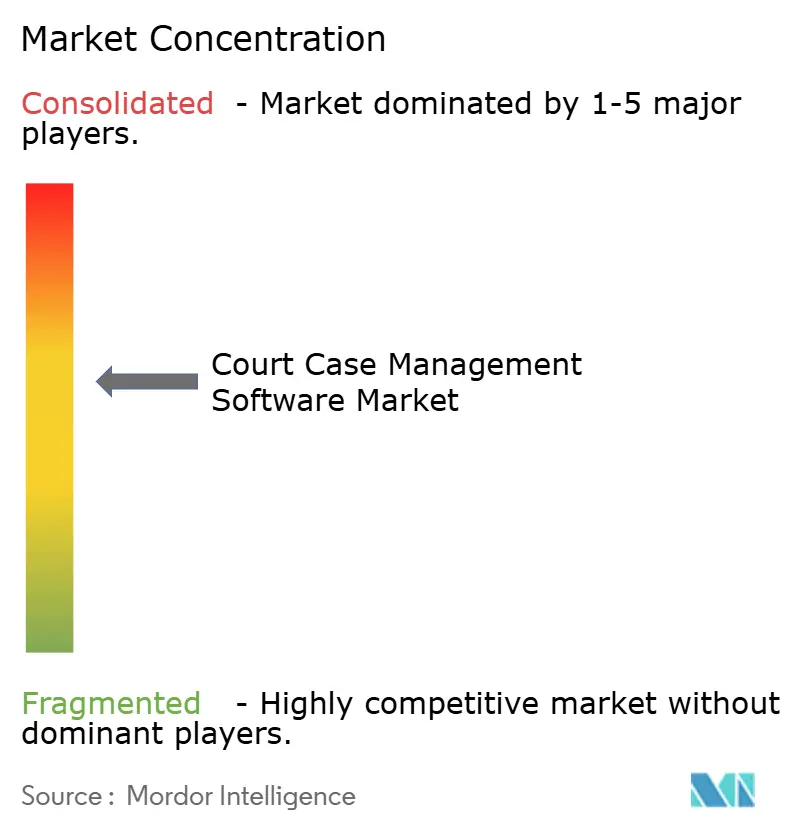
| Market Concentration | Medium |
Major Players *Disclaimer: Major Players sorted in no particular order Image © Mordor Intelligence. Reuse requires attribution under CC BY 4.0. | |
Court Case Management Software Market Analysis by Mordor Intelligence
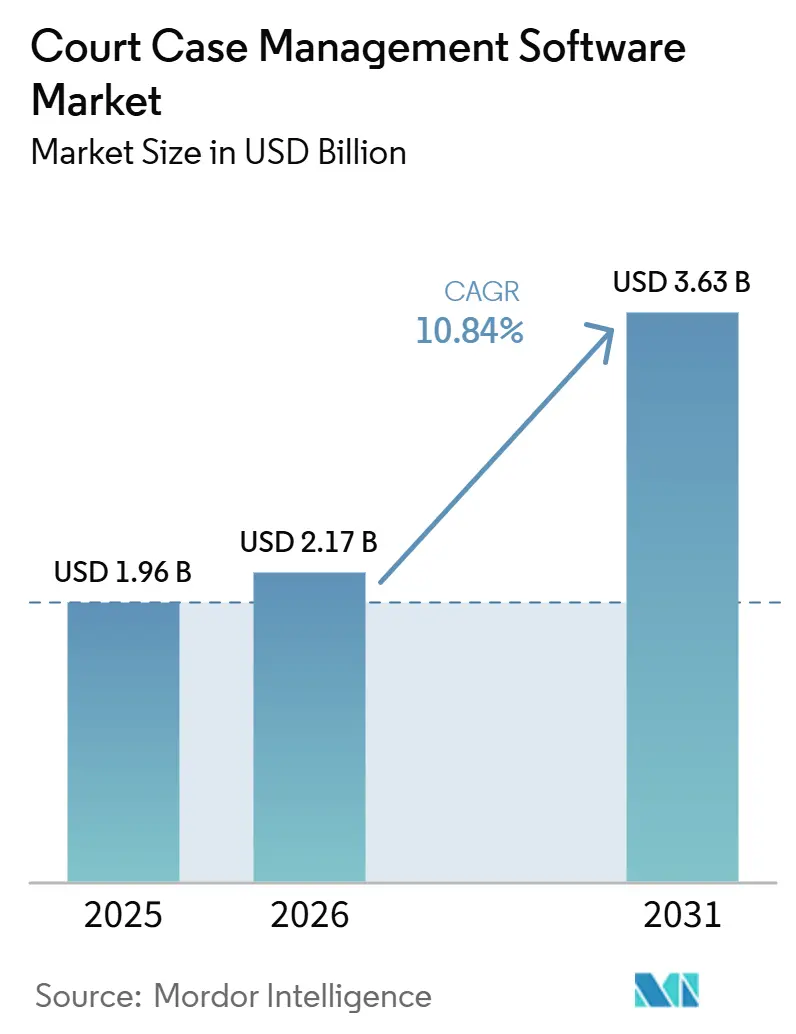
The court case management software market size was USD 1.96 billion in 2025 and USD 2.17 billion in 2026, and is forecast to reach USD 3.63 billion by 2031, growing at a CAGR of 10.84% from 2026 to 2031. Judicial digitalization programs are moving court technology from discretionary spending to a core continuity requirement. In June 2026, the U.S. Judicial Conference approved a USD 700-800 million, 6-year program to replace the CM/ECF system and move federal court case management to a secure cloud environment. Courts are replacing platforms that no longer meet operational and cybersecurity needs, which makes funding decisions harder to reverse once programs begin. Subscription software is changing vendor economics by lowering initial license revenue while supporting recurring revenue over longer contracts. Implementation complexity, data security, and explainability requirements for AI-enabled functions remain important limits on the court case management software market.
Key Report Takeaways
- By deployment mode, cloud-based platforms held 64.73% of the court case management software market share in 2025 and are projected to expand at a 13.26% CAGR through 2031.
- By court type, civil courts held 33.61% of revenue in 2025, while criminal courts are projected to record the highest CAGR of 12.88% through 2031.
- By end user, judicial courts held 46.52% of revenue in 2025, while government justice agencies are expected to expand at a 13.19% CAGR through 2031.
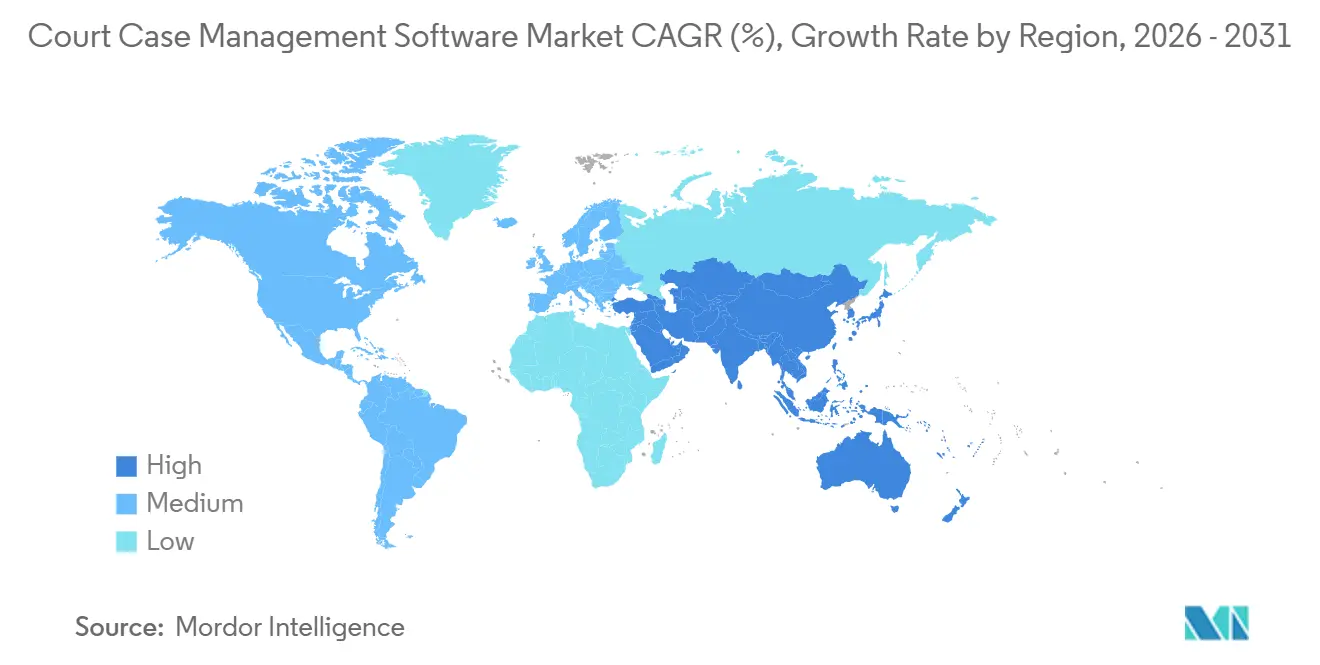
- By geography, North America accounted for 39.67% of revenue in 2025, while Asia-Pacific is projected to advance at a 14.38% CAGR through 2031 in the court case management software market.
Note: Market size and forecast figures in this report are generated using Mordor Intelligence’s proprietary estimation framework, updated with the latest available data and insights as of January 2026.
Market Trends and Insights
Drivers Impact Analysis of Court Case Management Software Market*
| DRIVER | (~) % IMPACT ON CAGR FORECAST | GEOGRAPHIC RELEVANCE | IMPACT TIMELINE |
|---|---|---|---|
| Digitization of Court Records and E-Filing | +2.8% | Global, with advanced gains in North America, Western Europe, and East Asia | Short term (≤ 2 years) |
| Cloud Migration for Scalable Court Operations | +2.1% | North America, Western Europe, Australia | Medium term (2-4 years) |
| Court Backlog Reduction Through Workflow Automation | +1.7% | Global, most acute in South Asia, South America, and Sub-Saharan Africa | Medium term (2-4 years) |
| Demand for Integrated Justice-System Data Exchange | +1.3% | North America, Europe, India | Medium term (2-4 years) |
| AI-Assisted Docket, Document, and Hearing Workflows | +1.0% | North America, Europe, Asia-Pacific | Long term (≥ 4 years) |
| Mobile and Remote Access for Distributed Justice Stakeholders | +0.7% | Global, with rapid uptake in Asia-Pacific and Africa | Short term (≤ 2 years) |
| Source: Mordor Intelligence | |||
Digitization of Court Records and E-Filing
Mandatory e-filing rules issued by the Supreme Court and court administrations are making adoption a statutory requirement rather than a local budget decision. Nigeria’s Federal High Court launched an e-filing platform in Lagos on April 27, 2026, and the Supreme Court activated the National Case Management System in July 2026. France’s digital justice plan set a paperless objective for civil and criminal proceedings, with Portalis deployed to 47 first-wave tribunals from May 2026. These programs extend the market demand for court management software beyond advanced economies into jurisdictions with large caseloads and developing digital infrastructure. A jurisdiction-wide filing standard and document layer can make later replacement of the underlying platform disruptive. This gives vendors a limited period to compete before long-term platform arrangements become established.
Cloud Migration for Scalable Court Operations
Cloud migration is increasingly driven by security and operational resilience rather than server-cost savings. The U.S. judiciary plans to place case management systems for civil and criminal matters in a secure cloud environment by the end of 2027. The court case management software market benefits because cloud platforms can support peak filing volumes without court-owned server expansion. North Carolina completed its statewide transition to an enterprise justice platform across 100 counties in October 2025, demonstrating the viability of a unified statewide migration. Courts in the United States are placing greater weight on cybersecurity, while many Asia-Pacific programs seek scale and cross-agency interoperability. Providers that can meet national data-residency requirements may have an advantage in European and Middle Eastern court case management software market procurements.
Court Backlog Reduction Through Workflow Automation
Court backlogs are increasing the demand for systems that improve scheduling, case processing, and record handling. Brazil’s PROMOJUD program increased judicial productivity by 40% in Ceará between 2021 and 2025, while finalized cases per judge increased from 1,164 to 1,631 per year.[1]Inter-American Development Bank, “Digital Tools Improve the Efficiency of Justice Services in Brazil,” Inter-American Development Bank, iadb.org The program reduced the average time from filing to sentencing from more than 3 years to 16 months and reduced the cost per resolved case by 17%. A nationwide study in Pakistan found that a customized generative AI judicial assistant and training produced 1,848 additional resolved cases per district each year. Courts with substantial backlogs are therefore placing greater value on demonstrated throughput than on feature lists alone when selecting suppliers for the court case management software market. This supports contract models linked to measurable operational outcomes in the court case management software market.
Demand for Integrated Justice-System Data Exchange
Criminal justice workflows increasingly require data to move between police, prosecutors, courts, corrections, and probation services. India launched the One Case One Data initiative in May 2026 to integrate records across district courts, high courts, and the Supreme Court. The eCourts Phase III program also supports an Interoperable Criminal Justice System that connects court functions with related justice agencies. Germany’s XJustiz standard reached version 3.6.2 in April 2026, giving court-system integrations a common data-exchange baseline.[2]XJustiz, “XJustiz Downloads, Version 3.6.2 Effective April 30, 2026,” XJustiz Standards Repository, xjustiz.justiz.de API-based and interoperable designs are becoming routine procurement requirements rather than optional product features. Vendors using proprietary data formats face greater replacement risk in the court case management software market as courts require data portability.
Restraints Impact Analysis of Court Case Management Software Market*
| RESTRAINT | (~) % IMPACT ON CAGR FORECAST | GEOGRAPHIC RELEVANCE | IMPACT TIMELINE |
|---|---|---|---|
| Legacy-System Integration Complexity | -2.0% | North America, Europe, South Asia | Long term (≥ 4 years) |
| Cybersecurity and Judicial Data Confidentiality Risk | -1.5% | Global, most acute in North America and Europe | Medium term (2-4 years) |
| Procurement, Funding, and Implementation Cycles | -1.1% | North America, South America, Middle East and Africa | Long term (≥ 4 years) |
| Explainability and Due-Process Concerns for AI-Enabled Functions | -0.6% | Europe, North America | Long term (≥ 4 years) |
| Source: Mordor Intelligence | |||
Legacy-System Integration Complexity
Many courts operate with case repositories that are 2 or 3 decades old, with data structures that differ by jurisdiction and court type. Tennessee issued its statewide CMS and e-filing vendor award in December 2025 after an RFP issued in July 2025. Washington State had 11 courts live on Enterprise Justice in November 2025 within a rollout planned for 143 courts. Data conversion can slow court case management software market deployments even when program funding is available. Courts must usually migrate complete historical records before the new platform can serve as a trusted source of case information. Data-quality issues often appear only after the implementation work begins.
Cybersecurity and Judicial Data Confidentiality Risk
Courts hold sealed filings, witness-protection records, and protected documents involving minors, which makes their systems attractive targets. The U.S. judiciary strengthened cybersecurity controls in August 2025 after attacks on its case management system. The Judicial Conference later approved the CM/ECF modernization program, including a PACER fee increase from USD 0.10 to USD 0.12 per page from January 2027 to help fund the program.[3]Administrative Office of the U.S. Courts, “Cybersecurity Measures Strengthened in Light of Attacks on Judiciary’s Case Management System,” U.S. Courts, uscourts.gov A breach can speed procurement for cloud-native and security-focused platforms. It can also raise compliance expectations for vendors and make court buyers more cautious during evaluation. These uneven responses make court case management software market revenue timing difficult for providers that depend on large public-sector contracts.
*Our forecasts treat driver/restraint impacts as directional, not additive. The impact forecasts reflect baseline growth, mix effects, and variable interactions.
Court Case Management Software Market Segment Analysis
By Deployment Mode:
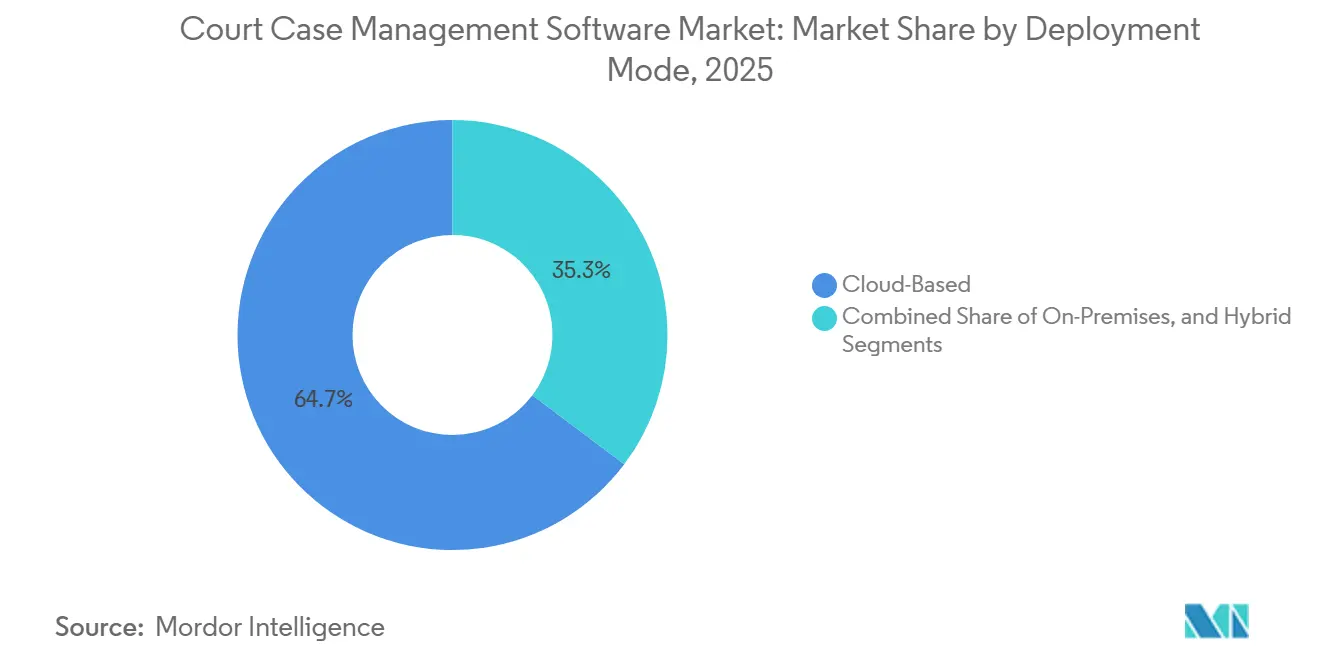
Cloud Platforms Lead Court Technology ModernizationCloud-based deployment held 64.73% of revenue in 2025. The shift reflects a move away from systems maintained on local server infrastructure by individual jurisdictions. SaaS platforms can provide capacity during periods of heavy filing without requiring comparable capital spending on court-owned servers. North Carolina’s statewide migration across 100 counties in October 2025 showed that a unified cloud implementation can work at a large scale. Courts are also using cloud services to support remote access, document management, scheduling, and payment functions.
Cloud-based deployment in the court case management software market is projected to grow at a 13.26% CAGR from 2026 to 2031, the fastest rate among deployment modes. The court case management software market size for cloud systems is supported by government SaaS policies and federal modernization programs. The U.S. plan to replace CM/ECF strengthens demand for secure cloud architectures. On-premises systems remain relevant where data-residency rules require local processing. Hybrid models offer an interim option by retaining sealed records on private infrastructure while moving routine workflow functions to cloud services.



By Court Type:
Criminal Workflows Drive Faster Platform DemandCivil courts held 33.61% of revenue in 2025, making them the largest court-type segment. They handle a broad set of matters, including small claims, commercial disputes, family proceedings, and arbitration-related cases. Civil proceedings have often provided the first setting for e-filing because they generally involve fewer sealed documents and less sensitive evidence than criminal proceedings. France began the first-wave deployment of Portalis to 47 civil tribunals in May 2026.[4]Conseil National des Barreaux, “Point d’Information sur le Projet PORTALIS,” Conseil National des Barreaux, cnb.avocat.fr These deployments continue to create significant modernization activity in Western Europe.
Criminal courts are projected to grow at a 12.88% CAGR from 2026 to 2031. The court management software industry is responding to more complex needs for digital evidence, body-camera material, chain-of-custody records, pretrial supervision, and real-time law-enforcement data exchange. Administrative, family and juvenile, commercial, appellate, and specialized courts each need workflows that general-purpose systems may not fully address. This creates an opening in the court case management software market for modular platforms that combine a core case system with specialist applications. Appellate courts are also adopting document-bundling and AI-assisted brief-summary functions to reduce work associated with large records.
By End User:
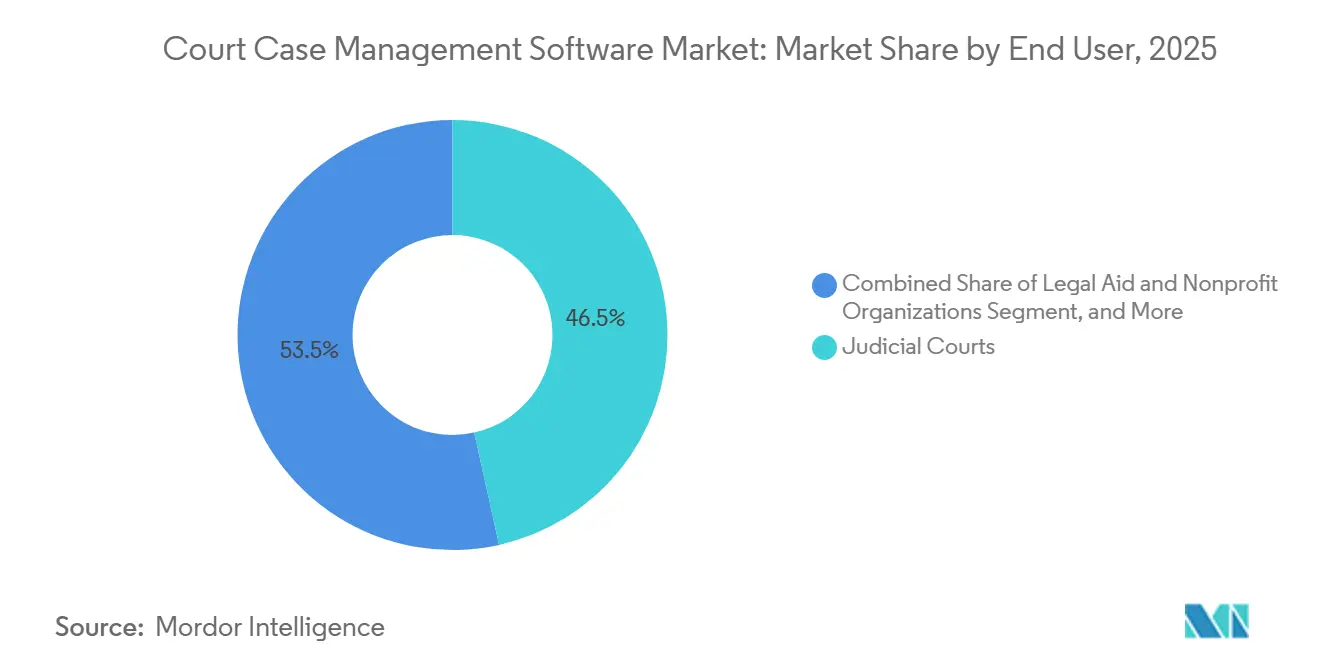
Justice Agencies Extend the Addressable Workflow BaseJudicial courts held 46.52% of revenue in 2025. Judges, registrars, and clerks use these systems for case scheduling, docket management, documents, and hearing administration. Judicial administration is the second-largest end-user group because administrators, budget offices, and IT teams procure and configure platforms. These institutions often lead multiyear consolidation programs across state or national court systems. Their central role gives them substantial influence over the selection and implementation of court management software platforms.
Government justice agencies are projected to expand at a 13.19% CAGR from 2026 to 2031. The court case management software market for this end-user group is growing as prosecutors, public defenders, probation agencies, and justice information bureaus need access to court dockets. India’s eCourts Phase III program includes an Interoperable Criminal Justice System for this purpose.[5]Prime Minister’s Office, India, “Cabinet Approves eCourts Phase III for 4 Years,” Government of India, pmindia.gov.in These agencies have historically used separate case tools, so integration is expanding the platform’s role beyond courtrooms. Secure mobile access and role-based controls are also supporting remote hearings, document review, and case filing.
Geography Analysis
North America Court Case Management Software Market
North America accounted for 39.67% of revenue in 2025. The region has the largest installed base of commercial vendors, mature e-filing systems, and an active pipeline of state and federal projects. The U.S. Judicial Conference approved USD 700-800 million for CM/ECF modernization in June 2026. Georgia launched a statewide court CMS in December 2025, while Tennessee completed its statewide vendor award process in the same month.
APAC Court Case Management Software Market
Asia-Pacific is projected to grow at 14.38% CAGR from 2026 to 2031. India’s eCourts Phase III program received INR 7,210 crore (USD 862 million) for a unified judicial technology platform covering e-filing, virtual hearings, record digitization, and AI-enabled scheduling. The One Case One Data initiative expands this work by seeking synchronized records across court levels. Hong Kong extended its integrated Court Case Management System to civil appeal cases in the High Court in June 2025.[6]Hong Kong Government Information Services, “Judiciary Rolls Out Integrated Court Case Management System for Civil Appeal Cases in High Court,” Hong Kong Government, info.gov.hk Southeast Asian systems remain at an earlier stage, where basic e-filing and case-tracking programs can create early opportunities for the court case management software market.
EMEA and South America Court Case Management Software Market
Europe has mandatory e-filing and digital file requirements that support continued court case management software market replacement activity. Hessen completed electronic court file implementation across courts, prosecutors, and justice administration bodies in January 2026. Germany’s XJustiz framework supports consistent data exchange across its federal states. South America has a strong reference case in Brazil, where PROMOJUD produced measurable productivity gains in Ceará. The Middle East and Africa are earlier in adoption, although Nigeria’s 2026 case management and e-filing launches show rising activity in Sub-Saharan Africa.

Competitive Landscape
The court case management software market is moderately concentrated in North America, where Tyler Technologies, Thomson Reuters, Equivant Data, Journal Technologies, and Catalis are established suppliers. Tyler Technologies has a strong position in U.S. courts and justice software, while specialized vendors compete through court-specific functionality. International competition is more fragmented because national suppliers, IT services firms, and in-house government teams often serve Europe, Asia-Pacific, and African markets, which also include government-developed and donor-supported platforms. This combination gives buyers more alternatives outside the largest commercial procurement markets.
Tyler Technologies reported USD 2.3 billion in revenue in 2025, with SaaS revenue growing 20.6% and annualized recurring revenue reaching USD 2.06 billion. The company also secured a USD 11 million Enterprise Supervision SaaS contract with the Arizona Supreme Court in 2025. This illustrates the move from perpetual licenses to subscription-based court technology contracts. Synergy International Systems is positioning its eCase platform around AI-supported document handling, case analysis, and user interaction. Smaller suppliers are developing positions in prosecutor workflows, drug courts, mental health courts, and other specialized settings.
Platform integration, AI-enabled workflow support, and outcome-focused pricing are becoming more important competitive factors. Vendors need auditable AI functions because due-process and explainability concerns are relevant where technology supports judicial administration. Security standards and data-residency requirements can favor suppliers in the court case management software market that can provide sovereign cloud or private deployment options.
Court Case Management Software Industry Leaders
Tyler Technologies, Inc.
Thomson Reuters Corporation
Equivant Data, Inc.
Journal Technologies, Inc.
Catalis, Inc.
- *Disclaimer: Major Players sorted in no particular order
Court Case Management Software Market Companies Covered in this Report
- Tyler Technologies, Inc.
- Thomson Reuters Corporation
- Equivant Data, Inc.
- Journal Technologies, Inc.
- Catalis, Inc.
- Matrix Pointe Software, LLC
- Daily Journal Corporation
- MicroPact, Inc.
- Microsoft Corporation
- Relativity ODA LLC
- Hyland Software, Inc.
- Welligent, Inc.
- Jayhawk Software, Inc.
- Cenifax Courts, Inc.
- Onit, Inc.
- Mitratech Holdings, Inc.
- Themis Solutions Inc.
- Filevine, Inc.
- Paradigm / Paradigm Corporation
- PracticePanther Legal Software
- MyCase, Inc.
- Actionstep Limited
- Law Qube Technologies Pvt. Ltd.
- Synergy International Systems, Inc.
- Computer Software Innovations India Private Limited

Recent Industry Developments in Court Case Management Software Market
- July 2026: The Supreme Court of Nigeria formally activated the Nigerian Case Management System, enabling electronic case filing, digital record management, and case-tracking capabilities at Africa's apex court. The launch marks Nigeria's entry into cloud-assisted court management and is expected to inform similar initiatives across West African judiciaries as regional legal-technology investment expands.
- June 2026: The Judicial Conference of the United States approved a USD 700-800 million, 6-year modernization program to replace the legacy CM/ECF case management system with a secure, cloud-based platform, partly funded by raising PACER access fees from USD 0.10 to USD 0.12 per page beginning January 1, 2027. The project targets full deployment of new civil and criminal case management systems across district courts by the end of 2027, representing the largest single court management software procurement in the market’s history.
- April 2026: The Federal High Court of Nigeria officially launched its electronic filing platform in the Lagos judicial division, eliminating manual paper-filing processes and integrating digital payment gateways for filing fees. The platform enables 24/7 remote case filing from any internet-connected location and is being rolled out to additional divisions through 2026.
- January 2026: Germany’s state of Hessen achieved full implementation of the electronic court file across all courts, prosecutors, and justice administrative bodies from January 1, 2026, following a multiyear phased rollout. The implementation positions Hessen as a reference jurisdiction for other German states preparing their transitions ahead of the national deadline.


Global Court Case Management Software Market Report Scope
The court case management software market is defined as the market for digital platforms that help courts and justice agencies manage judicial case workflows through electronic case intake, docketing, scheduling, evidence tracking, and document management. These solutions use automation, analytics, and secure collaboration tools to improve operational efficiency, transparency, and access to court services while supporting compliance with legal requirements for confidentiality, data protection, and evidence handling. By replacing manual, paper-based processes with centralized digital systems, court case management software enables faster case resolution, reduces administrative workloads, and supports the development of modern, technology-enabled judicial systems.
The Court Case Management Software Market Report is Segmented by Deployment Mode (Cloud-Based, On-Premises, and Hybrid), Court Type (Civil Courts, Criminal Courts, Administrative Courts, Family and Juvenile Courts, Commercial Courts, Appellate Courts, and Specialized Courts), End User (Judicial Courts, Judicial Administration, Government Justice Agencies, Prosecutor and Public Defenders, Legal Aid and Nonprofit Organizations, and Other End Users), and Geography (North America, South America, Europe, Asia-Pacific, and Middle East and Africa). The Market Forecasts are Provided in Terms of Value (USD).
| Cloud-Based |
| On-Premises |
| Hybrid |
| Civil Courts |
| Criminal Courts |
| Administrative Courts |
| Family and Juvenile Courts |
| Commercial Courts |
| Appellate Courts |
| Specialized Courts |
| Judicial Courts |
| Judicial Administration |
| Government Justice Agencies |
| Prosecutor and Public Defenders |
| Legal Aid and Nonprofit Organizations |
| Other End Users |
| North America | United States | |
| Canada | ||
| Mexico | ||
| South America | Brazil | |
| Argentina | ||
| Rest of South America | ||
| Europe | Germany | |
| United Kingdom | ||
| France | ||
| Italy | ||
| Spain | ||
| Russia | ||
| Rest of Europe | ||
| Asia-Pacific | China | |
| Japan | ||
| India | ||
| South Korea | ||
| Australia | ||
| Southeast Asia | ||
| Rest of Asia-Pacific | ||
| Middle East and Africa | Middle East | Saudi Arabia |
| United Arab Emirates | ||
| Turkey | ||
| Israel | ||
| Rest of Middle East | ||
| Africa | South Africa | |
| Nigeria | ||
| Egypt | ||
| Rest of Africa | ||
| By Deployment Mode | Cloud-Based | ||
| On-Premises | |||
| Hybrid | |||
| By Court Type | Civil Courts | ||
| Criminal Courts | |||
| Administrative Courts | |||
| Family and Juvenile Courts | |||
| Commercial Courts | |||
| Appellate Courts | |||
| Specialized Courts | |||
| By End User | Judicial Courts | ||
| Judicial Administration | |||
| Government Justice Agencies | |||
| Prosecutor and Public Defenders | |||
| Legal Aid and Nonprofit Organizations | |||
| Other End Users | |||
| By Geography | North America | United States | |
| Canada | |||
| Mexico | |||
| South America | Brazil | ||
| Argentina | |||
| Rest of South America | |||
| Europe | Germany | ||
| United Kingdom | |||
| France | |||
| Italy | |||
| Spain | |||
| Russia | |||
| Rest of Europe | |||
| Asia-Pacific | China | ||
| Japan | |||
| India | |||
| South Korea | |||
| Australia | |||
| Southeast Asia | |||
| Rest of Asia-Pacific | |||
| Middle East and Africa | Middle East | Saudi Arabia | |
| United Arab Emirates | |||
| Turkey | |||
| Israel | |||
| Rest of Middle East | |||
| Africa | South Africa | ||
| Nigeria | |||
| Egypt | |||
| Rest of Africa | |||


Key Questions Answered in the Report
What is the size of the court case management software market?
The court case management software market size was USD 1.96 billion in 2025 and USD 2.17 billion in 2026, and is forecast to reach USD 3.63 billion by 2031, growing at a CAGR of 10.84% from 2026 to 2031.
Why are courts adopting cloud-based case management platforms?
Cloud-based deployment held 64.73% share in 2025 because it supports scalable operations, remote access, and stronger security planning.
Which court type is expected to grow fastest through 2031?
Criminal courts are projected to grow at a 12.88% CAGR as they need tools for digital evidence, pretrial processes, and justice-system data exchange.
Which end users are creating new demand for court platforms?
Government justice agencies are expected to grow at a 13.19% CAGR as prosecutors, defenders, probation teams, and courts need connected workflows.
Which region is expected to lead future growth?
Asia-Pacific is projected to grow at a 14.38% CAGR through 2031, supported by major judicial digitalization programs in India and other jurisdictions.
What challenges can slow court technology implementation?
Legacy data migration, cybersecurity requirements, long public procurement cycles, and AI explainability concerns can delay deployment decisions.
Page last updated on:





