
Corporate Insolvency Service Market Size and Share
Market Overview
| Study Period | 2021 - 2032 |
|---|---|
| Market Size (2027) | USD 19.40 Billion |
| Market Size (2032) | USD 25.5 Billion |
| Growth Rate (2027 - 2032) | 5.60 % |
| Fastest Growing Market | Asia-Pacific |
| Largest Market | North America |
| Market Concentration | Low |
Major Players *Disclaimer: Major Players sorted in no particular order Image © Mordor Intelligence. Reuse requires attribution under CC BY 4.0. | |
Corporate Insolvency Service Market Analysis by Mordor Intelligence
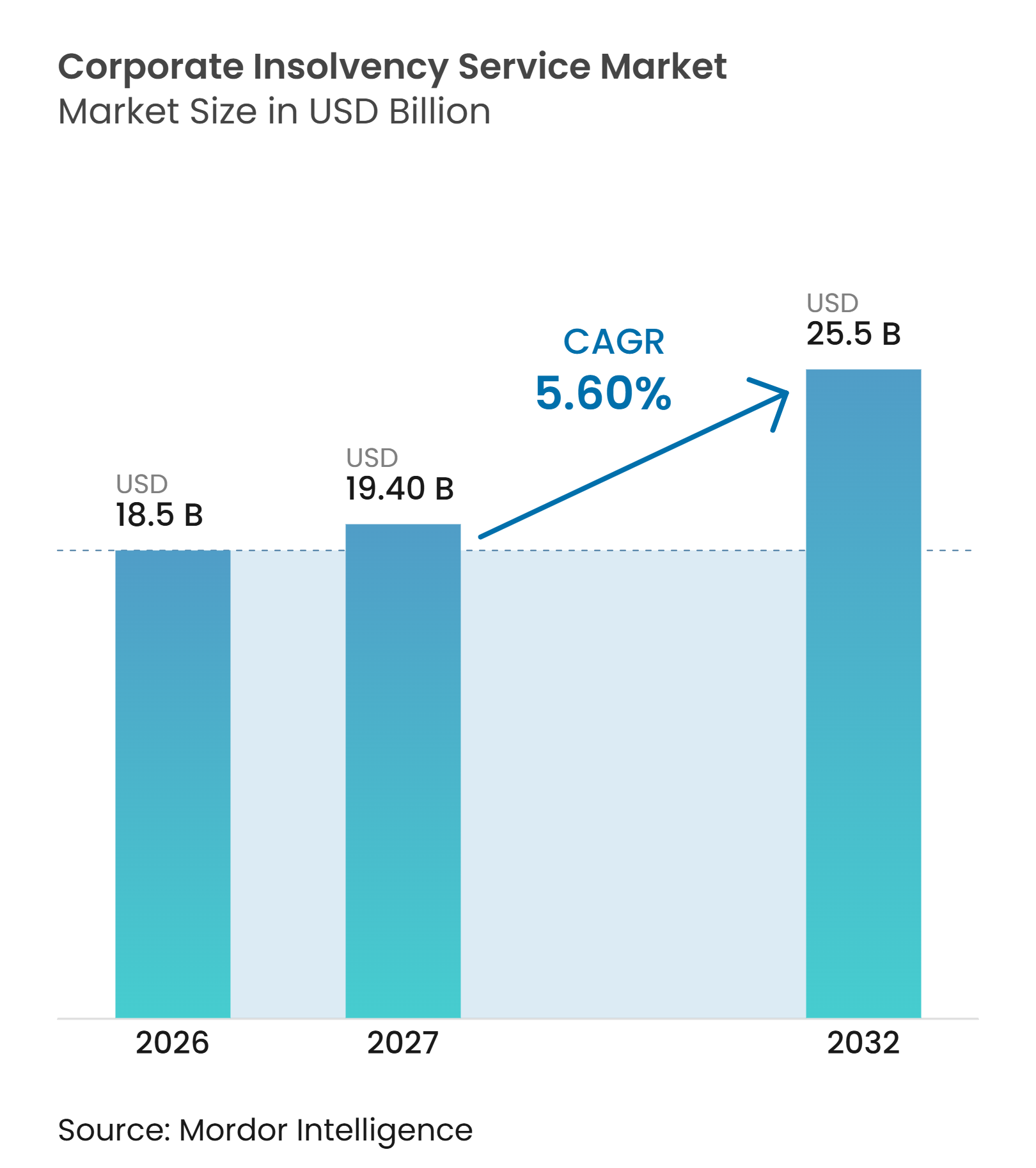
The Corporate Insolvency Service Market size is projected to be USD 18.5 billion in 2026, USD 19.40 billion in 2027, and reach USD 25.5 billion by 2032, growing at a CAGR of 5.60% from 2027 to 2032.
Higher filing activity in several large economies indicates that demand is extending beyond a short-lived disruption. United States business bankruptcy filings reached 27,054 in the 12 months ended September 2026, including 9,986 Chapter 11 reorganization filings, according to the Administrative Office of the United States Courts. France recorded 68,602 insolvency proceedings in 2025, its highest annual total, and this level was 15% above the 2010-2019 pre-pandemic average. Refinancing needs and the continued maturity of leveraged debt support restructuring work, while legal reforms are bringing advisers into cases earlier. Formal processes remain important, but creditors and companies are also using negotiated solutions before a formal filing, which is broadening the corporate insolvency service industry across advisory activities.
Key Report Takeaways
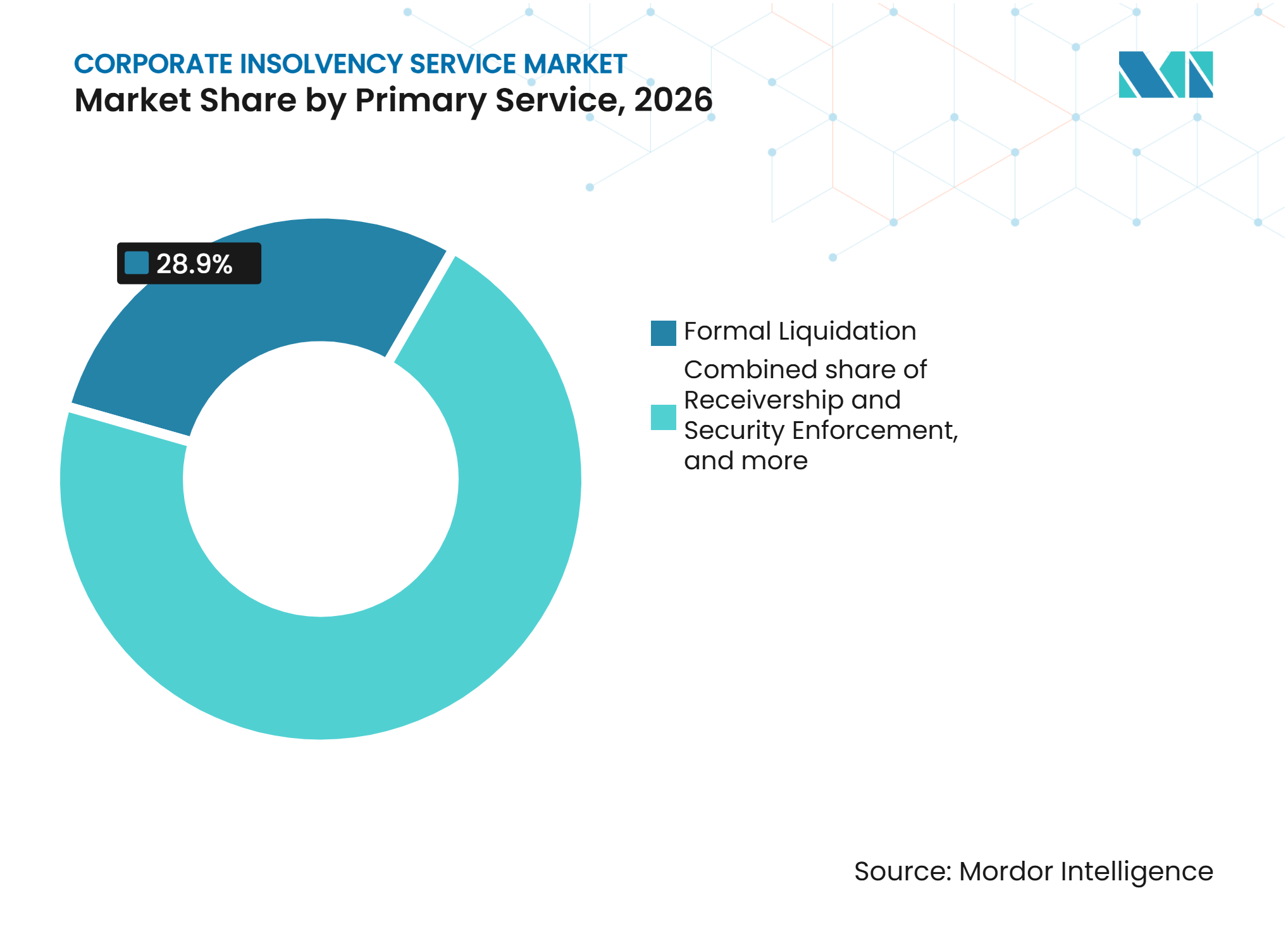
- By primary service, formal liquidation captured 31.8% of the corporate insolvency service market share in 2026, while pre-insolvency and out-of-court restructuring advisory is projected to grow at 8.2% CAGR through 2032.
- By primary fee payer, debtor/company estate captured 42.3% of the corporate insolvency service market share in 2026, while equity sponsors and investors, including private equity, is projected to grow at 7.6% CAGR through 2032.
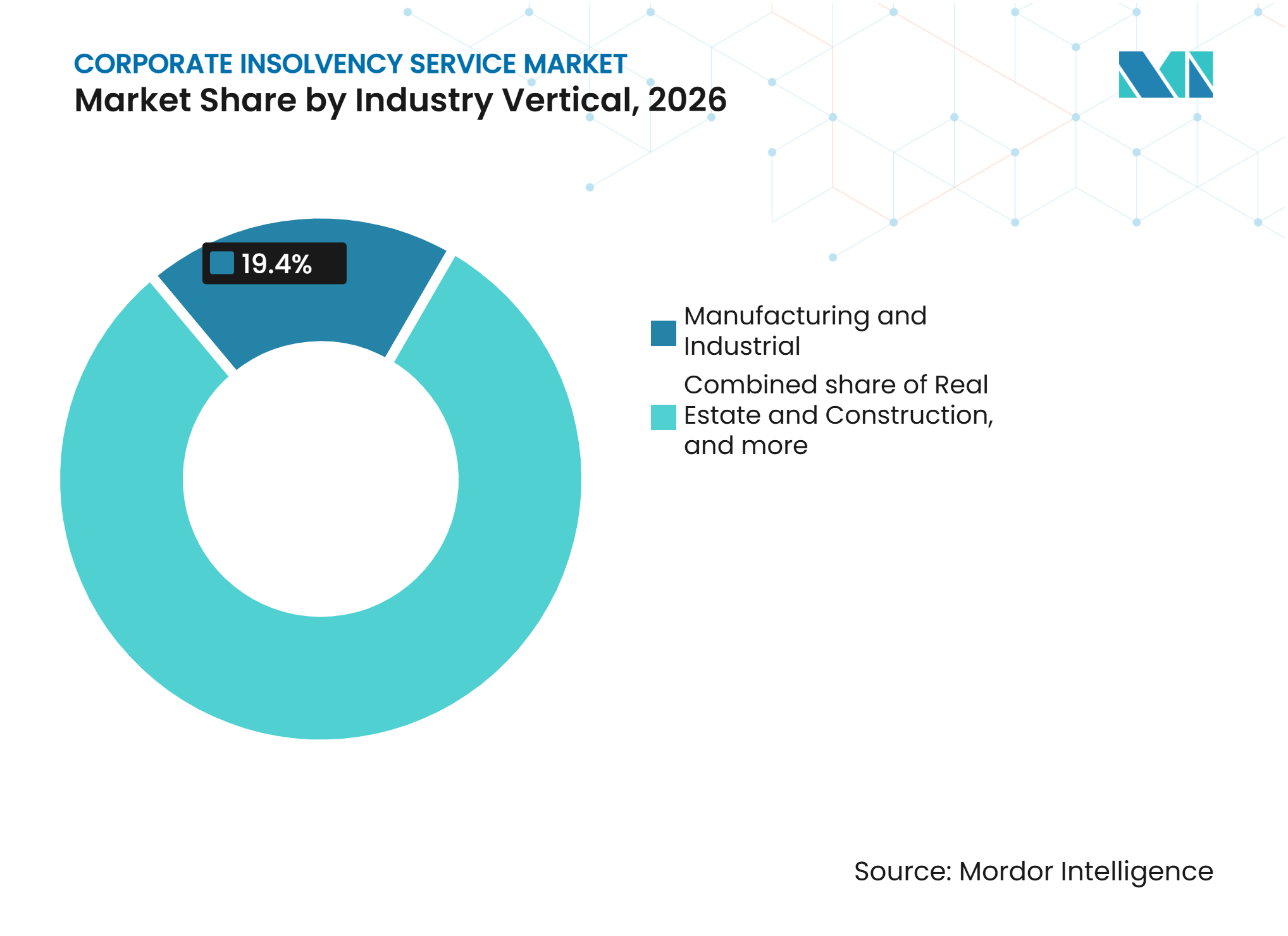
- By industry vertical, manufacturing and industrial captured 19.4% of the corporate insolvency service market size in 2026, while real estate and construction is projected to grow at 7.8% CAGR through 2032.
- By enterprise size, large enterprises captured 42.7% of the corporate insolvency service industry share in 2026, while small enterprises is projected to grow at 6.8% CAGR through 2032.
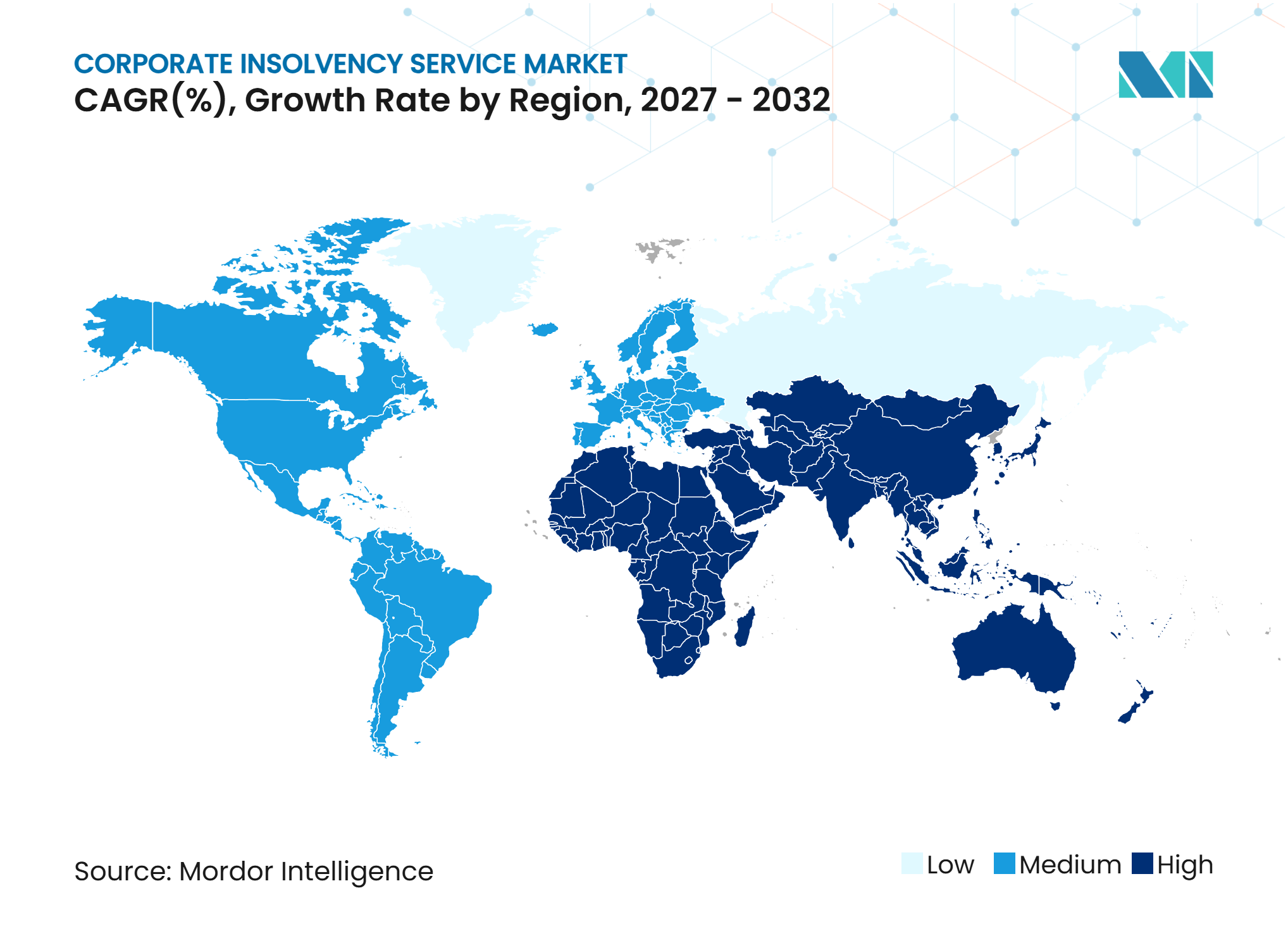
- By geography, North America captured 35.7% of the corporate insolvency service market share in 2026, while Asia-Pacific is projected to grow at 7.5% CAGR through 2032.
Note: Market numbers in this report are based on Mordor Intelligence's proprietary estimation framework, which combines nine months of actuals with Q4 projections for base year 2026.
Market Trends and Insights
Drivers Impact Analysis of Corporate Insolvency Service Market*
| Driver | (~) % Impact on CAGR Forecast | Geographic Relevance | Impact Timeline |
|---|---|---|---|
| Rising Debt-Service Burdens, Refinancing Pressures, and Liquidity Constraints | +1.2% | Global, acute in North America and Western Europe | Short term (≤ 2 years) |
| Increasing Restructuring, Insolvency Filings, and Bankruptcy Proceedings | +1.0% | Global, most visible in North America, Western Europe, and China | Short term (≤ 2 years) |
| Early Distress Detection and Pre-insolvency Restructuring Demand | +0.8% | European Union, United Kingdom, North America, and core Asia-Pacific markets | Medium term (2-4 years) |
| Cross-border Insolvency and Multi-jurisdictional Restructuring Requirements | +0.6% | Global, concentrated in Asia-Pacific, the European Union, and North American corridors | Medium term (2-4 years) |
| Technology-Enabled Case Management, Claims Processing, and Creditor Coordination | +0.7% | Global, with early adoption in the United States, United Kingdom, and India | Medium term (2-4 years) |
| Out-of-court Restructuring, Turnaround Advisory, and Alternative Resolution Mechanisms | +0.9% | North America and Western Europe, with spillover to Asia-Pacific and the Middle East and Africa | Medium term (2-4 years) |
| Source: Mordor Intelligence | |||
Rising Corporate Debt-Service Burdens, Refinancing Pressures, and Liquidity Constraints
The increasing volume of corporate debt requiring refinancing is creating pressure on borrowers to manage interest costs, liquidity, and capital structures. According to the OECD's Global Debt Report 2026, refinancing requirements over the next three years account for 31% of outstanding non-investment-grade corporate bond debt, compared with 24% for investment-grade debt, based on end-2025 figures. Furthermore, 67% of non-investment-grade corporate bond debt maturing between 2026 and 2028 carries an existing interest cost of 6% or less, exposing borrowers to potentially higher refinancing costs[1]. These conditions increase the importance of early liquidity assessments, debt restructuring, covenant negotiations, and creditor coordination. Companies experiencing deteriorating financial positions are therefore more likely to engage corporate insolvency service providers before default, supporting demand for restructuring advisory, turnaround planning, and out-of-court debt resolution.
Increasing Corporate Restructuring, Insolvency Filings, and Bankruptcy Proceedings
The increase in corporate bankruptcy filings across major economies is expanding demand for legal, financial, and operational restructuring services. In the United States, business bankruptcy filings reached 27,054 in the 12 months ended September 2026, representing a 12.5% increase from 24,039 in the previous-year period. Chapter 11 filings also increased by 11.7% to 9,986, compared with 8,937 previously, highlighting the continuing requirement for reorganization plans, creditor negotiations, claims management, and court-supervised restructuring[2]. In the European Union, Eurostat reported a 5.7% quarter-on-quarter increase in seasonally adjusted bankruptcy declarations in Q2 2026, reaching the highest level since Q1 2019. In France, 68,602 corporate insolvency proceedings were opened in 2025, an increase of 3.6% year-on-year and 15% above the 2010–2019 average. Bankruptcies among SMEs, intermediate-sized enterprises, and large enterprises were 68% above their pre-pandemic average. These developments support demand for insolvency practitioners, restructuring advisers, turnaround specialists, and legal professionals across formal insolvency and business reorganization proceedings.
Early Distress Detection, Cross-Border Cases, and Out-of-court Resolution
Regulatory developments in the European Union are strengthening the framework for insolvency prevention, asset recovery, and restructuring proceedings. Directive (EU) 2026/799, adopted on 30 March 2026 and effective from 21 April 2026, harmonises several aspects of insolvency law, including avoidance actions, asset tracing, pre-pack proceedings, directors' duties to request the opening of insolvency proceedings, and creditors' committees. The Directive also establishes requirements for directors to request insolvency proceedings within a period of no more than three months after becoming aware, or reasonably expected to become aware, of insolvency, subject to national implementation. Separately, UNCITRAL adopted its Toolkit and Background Notes on Asset Tracing and Recovery in Insolvency Proceedings on 21 July 2025, providing guidance on identifying, tracing, and recovering assets in insolvency cases[3]. These developments reinforce the importance of early financial distress assessments, pre-pack transactions, cross-border asset recovery, and coordinated creditor negotiations. Consequently, demand for specialist insolvency advisers is likely to expand, particularly among firms requiring multi-jurisdictional legal, financial, and asset-recovery expertise.
Technology-Enabled Case Management and Creditor Coordination
Technology adoption is improving the efficiency of insolvency administration through automated document processing, fraud identification, claims reconciliation, and information management. In India, the Insolvency and Bankruptcy Board of India (IBBI) considered the mandatory adoption of specialised artificial intelligence agents by resolution professionals in October 2025. The proposed applications include identifying fraudulent and undervalued transactions, detecting concealed assets, automating compliance, and forecasting creditor recovery outcomes[4]. These were proposals under consideration rather than an implemented mandatory requirement. Similarly, the United Kingdom Insolvency Service awarded a contract in August 2025 for the productionisation of four generative AI proof-of-concept use cases using retrieval-augmented generation (RAG), alongside the exploration of additional efficiency applications and an external chatbot. These initiatives demonstrate increasing institutional interest in applying AI to insolvency-related workflows. For private advisory firms, similar technologies can support high-volume claims processing, financial analysis, asset tracing, fraud detection, and creditor communication. However, data confidentiality, cybersecurity, accuracy, and regulatory compliance remain important considerations. Technology-enabled delivery can therefore improve operational efficiency, reduce administrative costs, and strengthen service quality across the corporate insolvency service market.
Restraints Impact Analysis of Corporate Insolvency Service Market*
| Restraint | (~) % Impact on CAGR Forecast | Geographic Relevance | Impact Timeline |
|---|---|---|---|
| Shortage of Experienced Insolvency Practitioners, Restructuring Specialists, and Turnaround Professionals | -0.7% | Global, most acute in Asia-Pacific and emerging Middle East and Africa markets | Long term (≥ 4 years) |
| High Professional and Legal Advisory Costs | -0.6% | Global, most restrictive for small and medium-sized enterprises in North America and Western Europe | Short term (≤ 2 years) |
| Fragmented Creditor Structures and Lengthy Negotiation and Resolution Processes | -0.5% | Global, most pronounced in complex cross-border and mid-market mandates | Medium term (2-4 years) |
| Inadequate Financial Transparency, Poor Data Quality, and Legacy-System Constraints | -0.4% | Global, heightened in the Middle East and Africa and South and Southeast Asia | Medium term (2-4 years) |
| Source: Mordor Intelligence | |||
Shortage of Experienced Practitioners and Complex Resolution Processes
Insolvency mandates require professionals with financial, legal, and local regulatory knowledge. Houlihan Lokey reported 57 managing directors in its global financial restructuring group in its March 2025 annual filing, illustrating the scale required to cover large and complex mandates. Capacity is less developed in several emerging markets, where legal reforms are increasing demand for practitioners faster than local talent pipelines can expand. Cross-border cases also often involve fragmented creditor groups, differing national rules, and negotiations that can take substantial time. These conditions make case administration more difficult and can delay recovery or resolution. The corporate insolvency service market therefore faces a supply constraint, especially where a case requires both regional knowledge and coordination across several jurisdictions.
High Advisory Costs and Limited Financial Transparency
Professional, legal, and administrative fees can restrict access to formal insolvency and restructuring services, particularly for small businesses with limited financial resources and low-value estates. Smaller companies may struggle to justify the costs of appointing legal advisers, restructuring specialists, and insolvency practitioners when the expected recovery value is limited. Fragmented accounting records, outdated financial systems, and inadequate reporting can further increase due diligence requirements, delay financial assessments, and complicate creditor negotiations. These challenges may encourage informal business closures or delayed restructuring instead of structured insolvency resolution. Although technology-assisted case management, automated claims processing, and standardised reporting can help reduce administrative costs, affordability and financial transparency will continue to constrain demand among smaller enterprises in the corporate insolvency service market.
*Our forecasts treat driver/restraint impacts as directional, not additive. The impact forecasts reflect baseline growth, mix effects, and variable interactions.
Corporate Insolvency Service Market Segment Analysis
By Primary Service:
Liquidation Leads While Advisory ExpandsFormal Liquidation held 31.8% of the corporate insolvency service market share in 2026, making it the largest primary service category. Mandatory professional requirements in compulsory and creditors’ voluntary liquidations sustain this position across the United Kingdom, Australia, and other common-law jurisdictions. In England and Wales, 1,307 creditors’ voluntary liquidations were recorded in October 2026. This was the lowest monthly number since August 2021, but the procedure remained the dominant insolvency instrument by case count. Formal Administration and Corporate Rescue, Receivership and Security Enforcement, Operational Turnaround, Distressed Mergers and Acquisitions, and supporting professional services address different creditor and company needs.
Pre-insolvency and Out-of-court Restructuring Advisory is projected to grow at 8.2% CAGR through 2032, the highest rate among service lines. The corporate insolvency service market size for this activity is supported by the increasing use of negotiated amendments, extensions, and liability management transactions. Companies can preserve operating value when creditors agree on terms before a formal filing. This approach can also reduce disruption for employees, suppliers, and customers. Regulatory reforms that set clearer director obligations can bring advisers into assignments sooner. The result is a service mix in which formal liquidation remains substantial, while early-stage advisory accounts for a growing part of the client relationship.


By Primary Fee Payer:
Company Estates Remain Central as Sponsor Work GrowsDebtor/Company Estate accounted for 42.3% share in 2026. It is the usual source of payment in liquidations, administrations, and Chapter 11 cases. Secured Lenders and Financial Institutions also generate recurring advisory demand where collateral, financing arrangements, and recovery strategies require independent analysis. Unsecured Creditor or Bondholder Committees may appoint separate advisers in larger cases with competing interests. This structure can create several simultaneous advisory roles within a single restructuring. The corporate insolvency service industry consequently serves a broad set of fee payers rather than only the debtor company.
Equity Sponsors and Investors, including private equity, is projected to grow at 7.6% CAGR through 2032. Private Equity Stakeholder Project reported that private equity-backed companies represented 54% of the 35 largest United States corporate bankruptcies by liabilities in 2025. Sponsors can provide rescue capital through equity injections, loan participations, or conditional commitment letters. These arrangements require advisers to structure transactions, assess creditor rights, and negotiate outcomes. Sponsor involvement can preserve an operating business, but it may also increase the number of parties and priorities that need to be balanced. This fee-payer group therefore creates demand for specialized restructuring advice as distressed portfolio companies seek capital solutions.
By Industry Vertical:
Manufacturing Leads While Property and Construction AccelerateManufacturing and Industrial captured 19.4% share in 2026, the largest position among industry verticals. The segment includes companies exposed to changes in demand, input costs, supply chains, and capital spending. It also contains businesses with asset-heavy operations that may require detailed creditor and asset-recovery work. Banking, Financial Services and Insurance maintains demand through lender, creditor, and financial counterparty assignments. Retail and Consumer Goods, Healthcare and Life Sciences, and Information Technology and Telecommunications each present distinct operating and financing pressures. This breadth means that the corporate insolvency service market does not depend on a single sector for its case flow.
Real Estate and Construction is projected to grow at 7.8% CAGR through 2032. Construction accounted for 17% of recorded United Kingdom insolvencies through October 2026, the highest share of any sector for the fourth consecutive year. The sector often faces cash-flow pressure from delayed projects, fixed-price contracts, changing material costs, and financing constraints. Commercial real estate cases can add complexity where property valuations, senior debt, and tenant conditions must be reviewed together. The segment creates a continuing need for restructuring, administration, and asset-sale expertise. Its expansion is supported by distress in both property-linked borrowers and construction businesses.

By Enterprise Size:
Large Assignments Drive Fees While Small Companies Drive GrowthLarge Enterprises accounted for 42.7% share in 2026. Their matters typically involve higher liabilities, larger creditor groups, and several operating jurisdictions. The United States business filing environment continues to support demand for these complex assignments, including Chapter 11 reorganizations. Mid-Sized Enterprises form an important client base for restructuring boutiques and national networks. These businesses may use out-of-court workouts and liability management transactions where a formal proceeding is not required. Large enterprise mandates retain their value because the financial, operational, and legal issues must often be managed at the same time.
Small Enterprises are projected to grow at 6.8% CAGR through 2032. Construction, retail, and hospitality failures are increasing the potential case volume in this group. Smaller companies may have fewer resources to retain specialized advisers, which makes price and delivery models important. Earlier filing obligations under European Union law can bring some businesses into a formal process sooner. Technology-supported intake, claims processing, and standardized reporting may help service providers manage higher case volumes. The corporate insolvency service industry has an opportunity to serve this group, but it must manage the challenge of smaller fees and weaker records.
Geography Analysis
North America: Institutional Depth Supports the Largest Regional Position
North America held a 35.7% share in 2026. The region benefits from established legal and professional infrastructure, particularly through United States Chapter 11 and Chapter 7 proceedings. U.S. business bankruptcy filings reached 27,054 in the 12 months ended September 2026, an increase of 12.5% year-on-year, maintaining a substantial pipeline of formal insolvency cases. Liability management exercises also remain relevant for borrowers seeking alternatives to court-supervised restructuring. AlixPartners completed its acquisition of Canadian restructuring firm KSV Advisory on 1 June 2026, expanding its Canadian restructuring capabilities. The United States' legal framework, court expertise, and cross-border links with Canada and Mexico continue to support regional demand.
Asia-Pacific: Legal Reform and Real Estate Stress Drive Expansion
Asia-Pacific is projected to grow at 7.5% through 2032, the fastest regional rate. India's Insolvency and Bankruptcy Code Amendment Act received Presidential Assent on 6 April 2026, with specified provisions taking effect on 26 May 2026; certain group and cross-border insolvency provisions were not included in that commencement notification. Vietnam's Law on Recovery and Bankruptcy (No. 142/2025/QH15) came into force on 1 March 2026, introducing a revised business recovery framework. Japan's Early Business Recovery Act was enacted in June 2025 and is scheduled to take effect on 11 December 2026, introducing a majority-vote mechanism for certain out-of-court debt restructurings. These reforms, alongside continuing real estate sector pressures in China, are increasing the need for restructuring and insolvency advisers across Asia-Pacific. India's proposed AI applications for claims reconciliation and fraud detection also indicate growing digitalisation.
Europe, South America, and the Middle East and Africa: Diverse National Conditions Shape Demand
France recorded 68,602 corporate insolvency proceedings in 2025, 3.6% higher year-on-year. The United Kingdom recorded 1,757 company insolvencies in October 2026, while administrations increased 28% month-on-month. Directive (EU) 2026/799 introduces common rules covering selected insolvency processes, including pre-pack proceedings and asset tracing. South America continues to generate restructuring assignments, particularly in Brazil, where 977 judicial recovery proceedings involving 2,466 companies were recorded in 2025. The Middle East and Africa remains less developed, although Saudi Arabia's Bankruptcy Law provides formal restructuring and liquidation procedures, while the UAE has separate insolvency frameworks under ADGM and DIFC. These developments support gradual expansion of professional insolvency and restructuring services across the region.
Competitive Landscape
Market Concentration
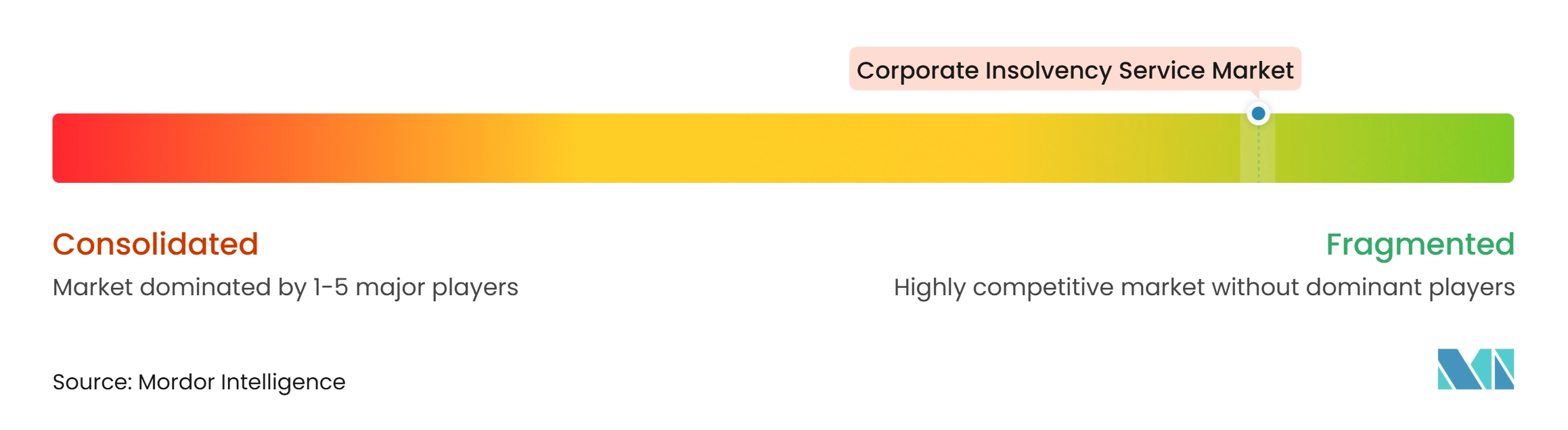
The corporate insolvency service market includes global firms competing for large and cross-border mandates, including Alvarez & Marsal, FTI Consulting, AlixPartners, and Houlihan Lokey. Regional specialists and national networks, including FRP Advisory, Interpath, and Begbies Traynor Group, compete for domestic and mid-market assignments. Competition is shaped by case size, jurisdictional reach, and the ability to assemble multidisciplinary teams. AlixPartners completed its acquisition of Canadian restructuring firm KSV Advisory on 1 June 2026, strengthening its Canadian presence and cross-border restructuring capabilities. Alvarez & Marsal appointed Claudia Lotti and Francesco Leone as Managing Directors and Co-Heads of its Italian Financial and Operational Restructuring practice on 3 July 2026. These developments highlight the importance of geographic coverage and senior expertise in competing for restructuring mandates.
Technology is becoming another area of competition in the corporate insolvency service market. Claims management, fraud detection, and creditor coordination can improve the handling of large and complex case populations. India's Insolvency and Bankruptcy Board has proposed the use of specialised AI agents to support fraud detection, compliance, and recovery-outcome prediction. The United Kingdom Insolvency Service awarded a contract in August 2025 to productionise four generative AI proof-of-concept applications using retrieval-augmented generation and develop an external chatbot. These initiatives demonstrate growing public-sector adoption of AI for operational efficiency. Firms that develop reliable technology platforms may improve service efficiency and make smaller assignments more viable. Data protection, cybersecurity, and legal compliance will remain important adoption considerations.
Cross-border restructuring capability is likely to remain valuable as more jurisdictions adopt or update insolvency frameworks. UNCITRAL adopted its Toolkit and Background Notes on Asset Tracing and Recovery in Insolvency Proceedings in July 2025, supporting practitioners dealing with asset recovery in complex insolvency cases. Houlihan Lokey advised Sino-Ocean on the restructuring of USD 6.3 billion in offshore debt, implemented through a United Kingdom restructuring plan and an inter-conditional Hong Kong scheme of arrangement in 2025. Alvarez & Marsal also launched a Reputation Advisory practice in London in April 2026 to support organisations facing reputational risks during complex restructuring, disputes, and transformation situations. Large firms can leverage international networks for complex assignments, while regional specialists retain advantages in local relationships and domestic procedures. The competitive field therefore combines global capabilities with local execution across the corporate insolvency service market.
Corporate Insolvency Service Industry Leaders
-
FTI Consulting, Inc.
-
Alvarez & Marsal
-
Houlihan Lokey, Inc.
-
Deloitte Touche Tohmatsu Limited
-
PricewaterhouseCoopers International Limited
- *Disclaimer: Major Players sorted in no particular order
Corporate Insolvency Service Market Companies Covered in this Report
- Alvarez & Marsal
- FTI Consulting, Inc.
- Deloitte
- PricewaterhouseCoopers (PwC)
- KPMG
- Ernst & Young (EY)
- Kroll, LLC
- AlixPartners, LLP
- Houlihan Lokey, Inc.
- RSM International
- Grant Thornton
- BDO
- Baker Tilly
- Crowe Global
- Teneo
- FRP Advisory LLP
- Interpath
- Begbies Traynor Group plc
- Lazard Ltd.
- Quantuma Advisory Limited
Recent Industry Developments in Corporate Insolvency Service Market
- September 2026: New Fortress Energy completed a cross-border restructuring, reducing debt from USD 5.7 billion to USD 700 million with United Kingdom and United States court approvals. The case highlights the growing complexity of large energy-sector restructurings.
- July 2026: Alvarez & Marsal expanded its Financial and Operational Restructuring practice in Italy by appointing 2 senior co-heads. The expansion supports its Europe, Middle East, and Africa mid-market growth strategy.
- May 2026: AlixPartners agreed to acquire Canadian restructuring firm KSV Advisory, marking its first investment in Canada. KSV professionals in Toronto and Calgary joined AlixPartners in June 2026.
- April 2026: India’s Insolvency and Bankruptcy Code Amendment Act received Presidential Assent on April 6, 2026, after Lower House approval on March 30, 2026. The Act strengthens creditor rights and introduces group insolvency and cross-border cooperation provisions.
Global Corporate Insolvency Service Market Report Scope
Segmentation Overview
| Formal Administration & Corporate Rescue |
| Formal Liquidation |
| Receivership & Security Enforcement |
| Pre-insolvency & Out-of-court Restructuring Advisory |
| Operational Turnaround & Business-Rescue Consulting |
| Distressed M&A, Asset Realisation & Exit Advisory |
| Other Supporting Professional Services |
| Debtor / Company Estate |
| Secured Lenders & Financial Institutions |
| Unsecured Creditor or Bondholder Committees |
| Equity Sponsors & Investors (including PE) |
| Other (including public bodies where third-party fees arise) |
| Banking, Financial Services and Insurance |
| Manufacturing and Industrial |
| Retail and Consumer Goods |
| Healthcare and Life Sciences |
| IT and Telecommunications |
| Energy and Utilities |
| Real Estate and Construction |
| Transportation and Logistics |
| Media and Entertainment |
| Others |
| Large Enterprises |
| Mid-Sized Enterprises |
| Small Enterprises |
| North America | United States |
| Canada | |
| Mexico | |
| South America | Brazil |
| Argentina | |
| Rest of South America | |
| Europe | United Kingdom |
| Germany | |
| France | |
| Italy | |
| Spain | |
| Rest of Europe | |
| Asia-Pacific | China |
| Japan | |
| India | |
| South Korea | |
| Australia | |
| Indonesia | |
| Thailand | |
| Malaysia | |
| Singapore | |
| Vietnam | |
| Rest of Asia-Pacific | |
| Middle East and Africa | Saudi Arabia |
| United Arab Emirates | |
| Turkey | |
| South Africa | |
| Egypt | |
| Rest of Middle East and Africa |
| By Primary Service | Formal Administration & Corporate Rescue | |
| Formal Liquidation | ||
| Receivership & Security Enforcement | ||
| Pre-insolvency & Out-of-court Restructuring Advisory | ||
| Operational Turnaround & Business-Rescue Consulting | ||
| Distressed M&A, Asset Realisation & Exit Advisory | ||
| Other Supporting Professional Services | ||
| By Primary Fee Payer | Debtor / Company Estate | |
| Secured Lenders & Financial Institutions | ||
| Unsecured Creditor or Bondholder Committees | ||
| Equity Sponsors & Investors (including PE) | ||
| Other (including public bodies where third-party fees arise) | ||
| By Industry Vertical | Banking, Financial Services and Insurance | |
| Manufacturing and Industrial | ||
| Retail and Consumer Goods | ||
| Healthcare and Life Sciences | ||
| IT and Telecommunications | ||
| Energy and Utilities | ||
| Real Estate and Construction | ||
| Transportation and Logistics | ||
| Media and Entertainment | ||
| Others | ||
| By Enterprise Size of the Debtor | Large Enterprises | |
| Mid-Sized Enterprises | ||
| Small Enterprises | ||
| By Geography | North America | United States |
| Canada | ||
| Mexico | ||
| South America | Brazil | |
| Argentina | ||
| Rest of South America | ||
| Europe | United Kingdom | |
| Germany | ||
| France | ||
| Italy | ||
| Spain | ||
| Rest of Europe | ||
| Asia-Pacific | China | |
| Japan | ||
| India | ||
| South Korea | ||
| Australia | ||
| Indonesia | ||
| Thailand | ||
| Malaysia | ||
| Singapore | ||
| Vietnam | ||
| Rest of Asia-Pacific | ||
| Middle East and Africa | Saudi Arabia | |
| United Arab Emirates | ||
| Turkey | ||
| South Africa | ||
| Egypt | ||
| Rest of Middle East and Africa | ||
Key Questions Answered in the Report
What is the projected size of corporate insolvency services?
The sector is expected to rise from USD 18.5 billion in 2026 to USD 25.5 billion by 2032, at a 5.6% CAGR over 2027-2032.
Which service is projected to grow fastest through 2032?
Pre-insolvency and Out-of-court Restructuring Advisory is projected to grow at 8.2% CAGR through 2032.
Which customer group is expected to expand fastest?
Equity Sponsors and Investors, including private equity, is projected to expand at 7.6% CAGR through 2032.
Why is Asia-Pacific expanding faster than other regions?
Asia-Pacific is projected to grow at 7.5% CAGR through 2032, supported by insolvency reform in India, Japan, Vietnam, and Malaysia, alongside real estate stress in China.
Which business sectors are generating the strongest demand for restructuring advice?
Manufacturing and Industrial held a 19.4% share in 2026, while Real Estate and Construction is projected to grow at 7.8% CAGR through 2032.
What is changing in corporate insolvency technology?
Artificial intelligence is being applied to fraud detection, insolvency prediction, claims reconciliation, casework retrieval, and debtor guidance.