
Core Materials Market Size and Share
Market Overview
| Study Period | 2021 - 2031 |
|---|---|
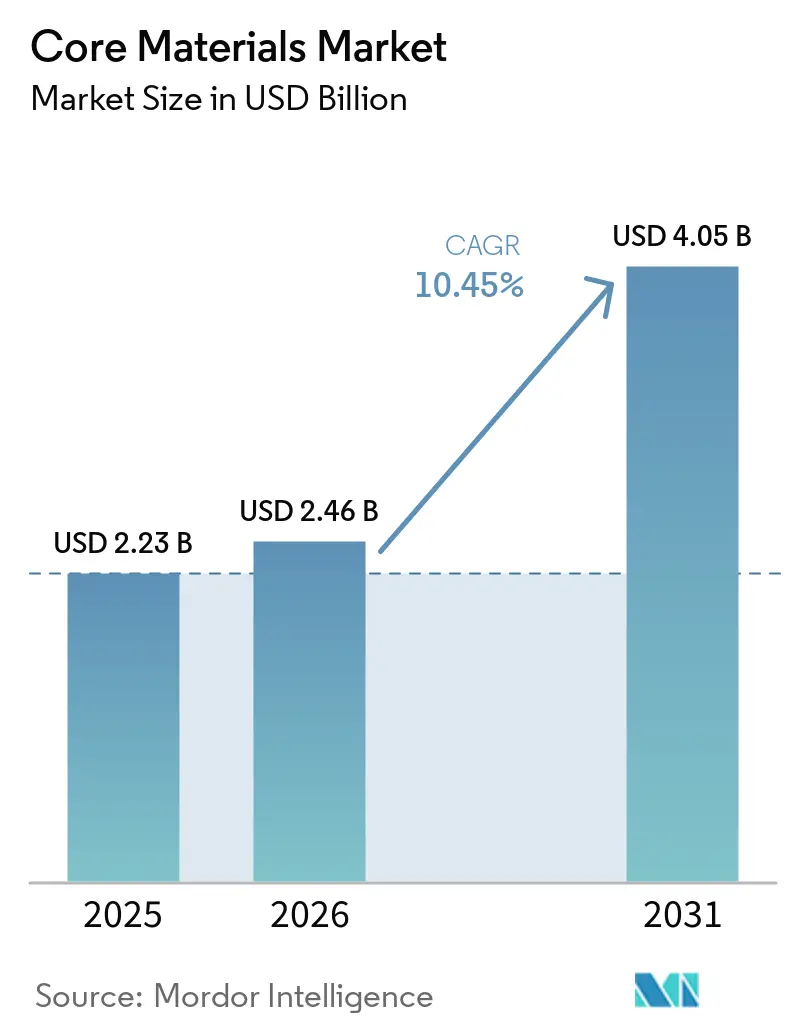
| Market Size (2026) | USD 2.46 Billion |
| Market Size (2031) | USD 4.05 Billion |
| Growth Rate (2026 - 2031) | 10.45 % |
| Fastest Growing Market | Asia-Pacific |
| Largest Market | Asia-Pacific |
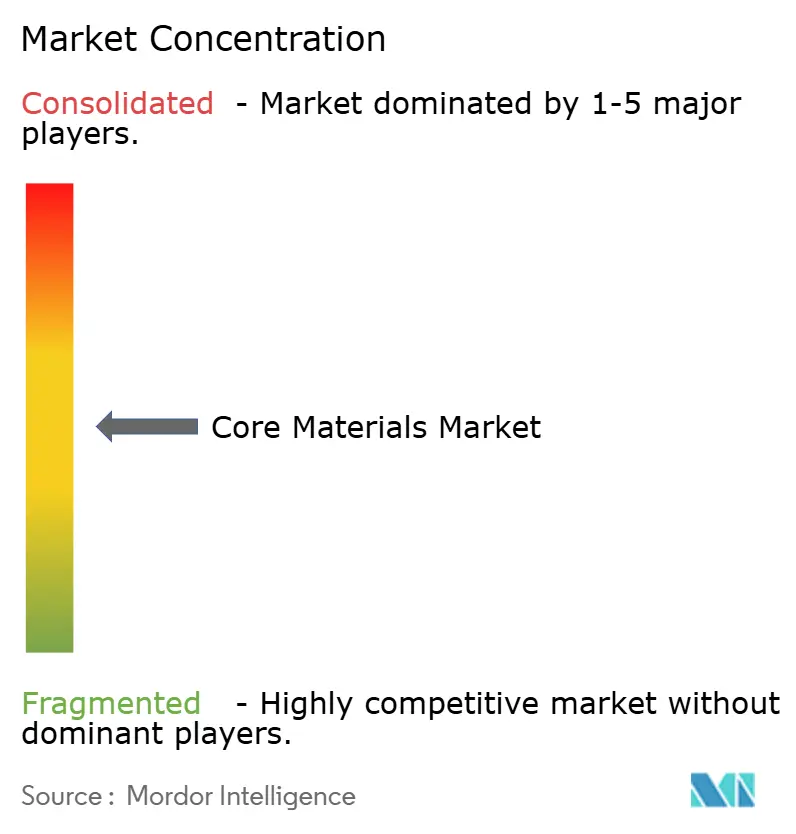
| Market Concentration | Medium |
Major Players *Disclaimer: Major Players sorted in no particular order Image © Mordor Intelligence. Reuse requires attribution under CC BY 4.0. | |
Core Materials Market Analysis by Mordor Intelligence
The Core Materials Market size was valued at USD 2.23 billion in 2025 and is estimated to grow from USD 2.46 billion in 2026 to reach USD 4.05 billion by 2031, at a CAGR of 10.45% during the forecast period (2026-2031). The core materials market is supported by larger wind turbine blades and higher aircraft production, both of which need lightweight structures with reliable stiffness. Manufacturers are moving from solid metal components toward sandwich panels that use a low-density core to manage shear loads and reduce weight. This shift gives suppliers opportunities to provide engineered kits, recycled polyethylene terephthalate foam, and thermoplastic honeycomb instead of standard materials alone. The core materials market also faces pressure from polymer price changes, aerospace qualification costs, and the difficulty of recovering thermoset structures at the end of service life.
Key Report Takeaways
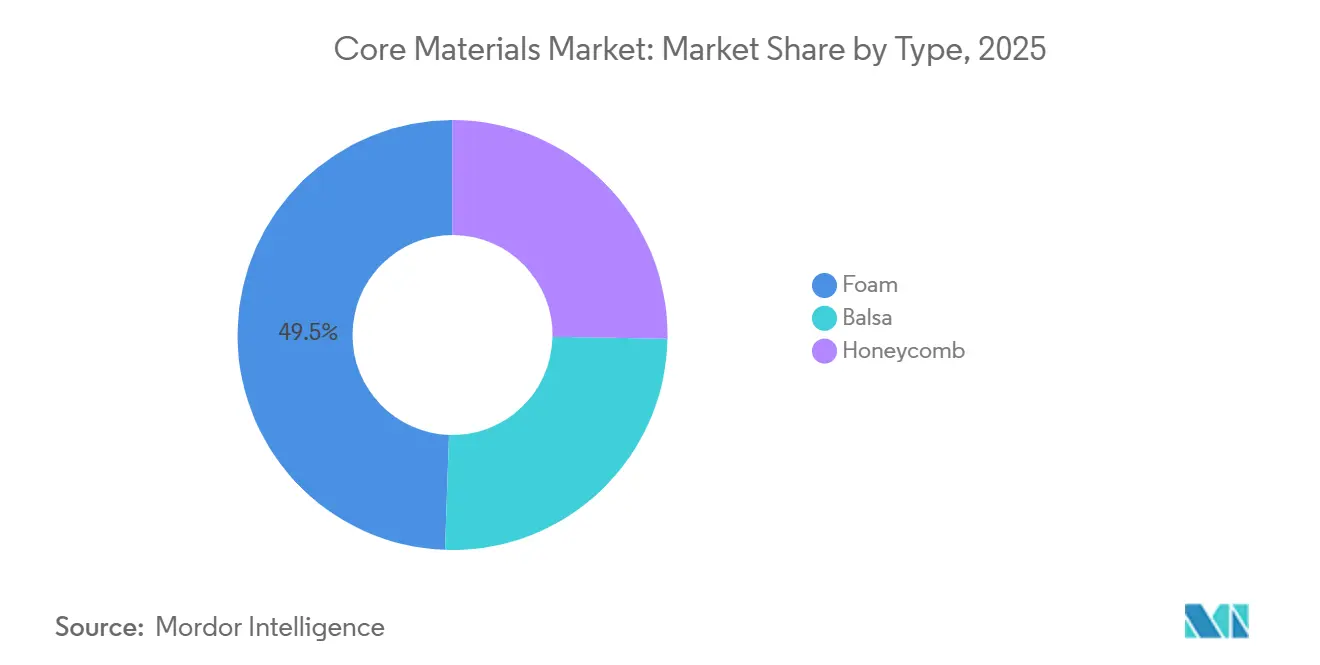
- By type, foam held 49.45% of the core materials market share in 2025, while honeycomb is projected to advance at an 11.74% CAGR through 2031.
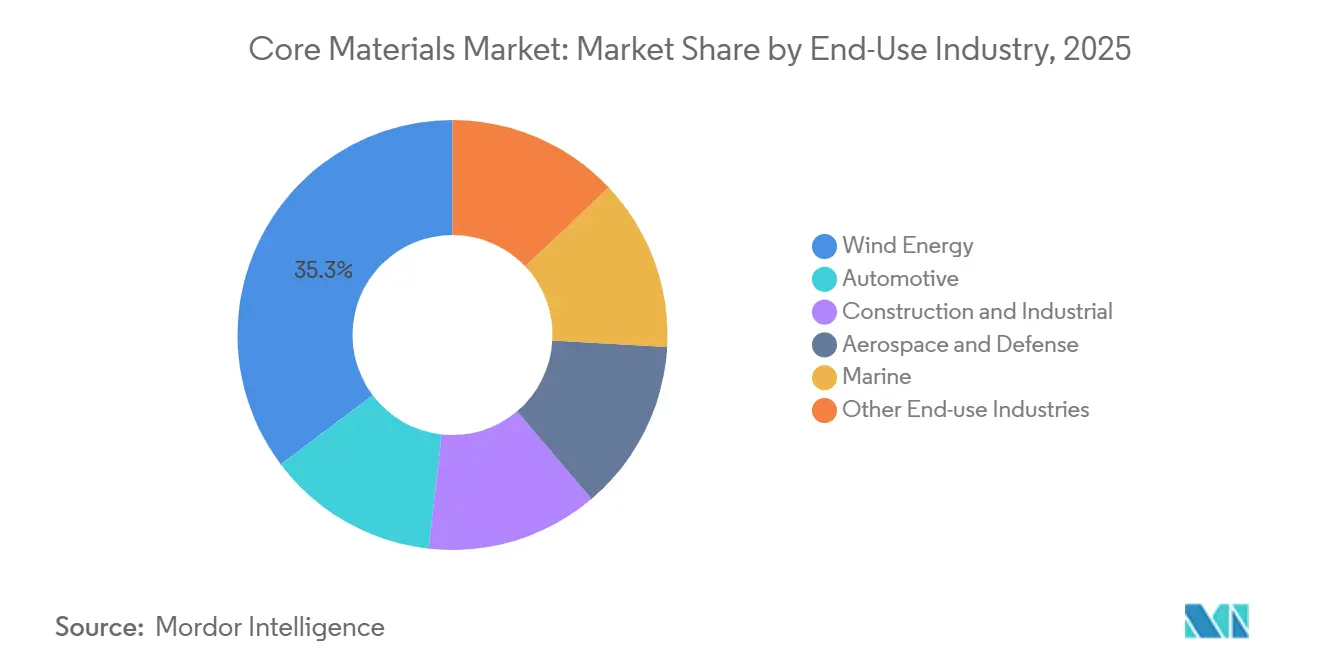
- By end-use industry, wind energy held 35.28% of the core materials market share in 2025 and is projected to advance at a 12.18% CAGR through 2031.
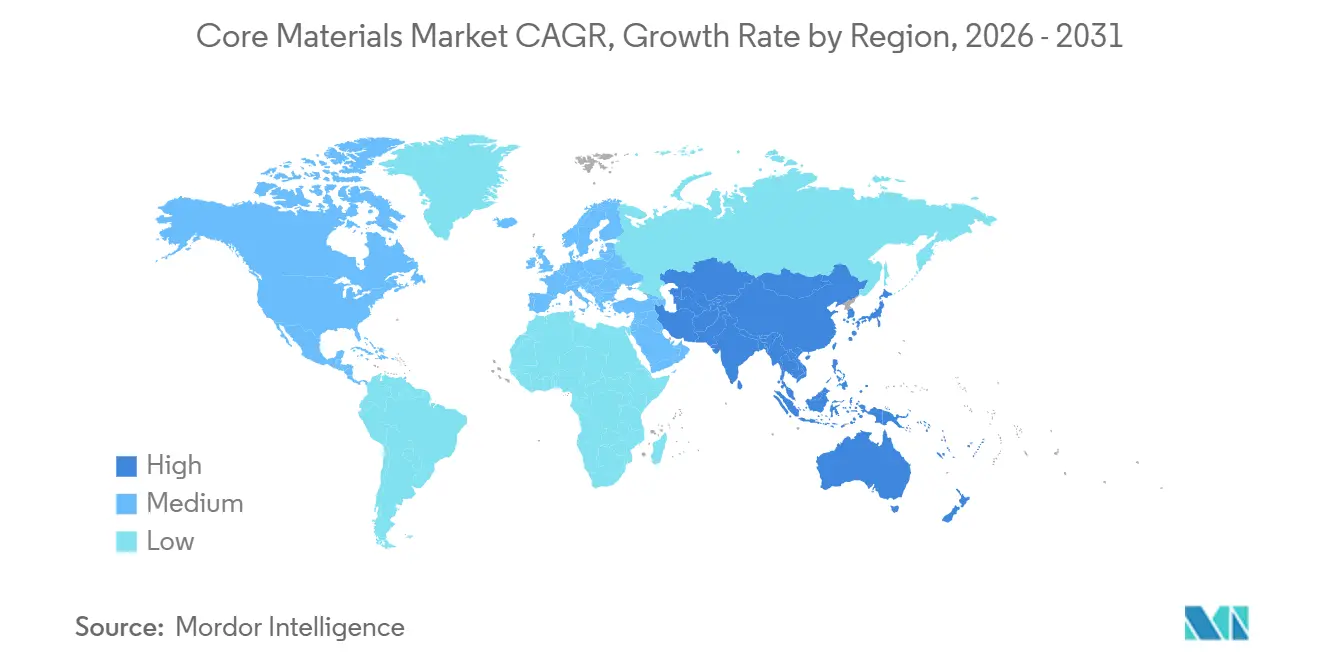
- By geography, Asia-Pacific held 38.12% of the core materials market share in 2025 and is projected to advance at an 11.56% CAGR through 2031.
Note: Market size and forecast figures in this report are generated using Mordor Intelligence’s proprietary estimation framework, updated with the latest available data and insights as of January 2026.
Market Trends and Insights
Drivers Impact Analysis of Core Materials Market*
| Driver | (~) % Impact on CAGR Forecast | Geographic Relevance | Impact Timeline |
|---|---|---|---|
| Lightweighting Requirements Across Composite Structures | +3.2% | Global, with primary concentration in North America, Europe, and APAC | Long term (≥ 4 years) |
| Expansion of Wind Turbine Blade Dimensions | +2.8% | APAC core (China, India); spillover to Europe and North America | Medium term (2–4 years) |
| Aircraft Production and Composite Airframe Penetration | +1.8% | North America & Europe; emerging in APAC (China, Japan) | Medium term (2–4 years) |
| Electrification and Commercial-Transport Weight Reduction | +1.2% | APAC and Europe; early gains in United States, Germany, and South Korea | Long term (≥ 4 years) |
| Recycled PET and Thermoplastic Core Adoption | +0.7% | Europe (Scandinavia, Germany); spill-over to APAC wind hub | Long term (≥ 4 years) |
| Source: Mordor Intelligence | |||
Lightweighting Requirements Across Composite Structures
The core materials market benefits when manufacturers need lighter structures without reducing stiffness or durability. Sandwich structures can reduce structural mass by 30%-50% compared with monolithic laminates that offer equivalent stiffness, which supports their use in larger mobility structures. Composite panels are used in electric vehicle battery enclosures, rail interiors, marine hulls, and aircraft components where weight affects operating efficiency. Research on optimized sandwich cores for unmanned aerial vehicles found improvements in energy absorption and crashworthiness compared with a heavier monolithic design. The performance benefit becomes more relevant as structures become larger, particularly in offshore blades and wide-body aircraft components. Recycled polyethylene terephthalate foam and thermoplastic cores add a circular material option, while retaining the structural function that makes sandwich construction useful.
Expansion of Wind Turbine Blade Dimensions
The core materials market gains demand when turbine blades become longer because larger shells require more stiff, lower-density material. Commercial offshore turbines use blades longer than 115 meters, and future platforms are planned with blade lengths of 120-135 meters. Each additional meter of blade span increases bending loads and raises the need for carefully designed core placement in shells and shear webs. The Gurit 98m reference blade model showed that optimized recycled polyethylene terephthalate core layouts can maintain buckling margins while reducing core mass. Gurit Holding AG announced a CHF 250 million (approximately USD 275–283 million) five-year agreement in January 2026 to supply core material kits using its OptiCore design approach, which placed blade weight reduction and production efficiency at the center of the contract[1]. The agreement shows that wind customers are considering engineered geometry and processing benefits alongside material price.
Aircraft Production and Composite Airframe Penetration
The core materials market receives steady aerospace demand from aircraft production backlogs and the continued use of composite structures. Airbus delivered 793 commercial aircraft in 2025 and reported a year-end backlog of 8,754 aircraft. Boeing reported that its Commercial Airplanes backlog exceeded 6,100 units and was valued at USD 576 billion in the first quarter of 2026. Airbus is targeting 70-75 A320 Family aircraft each month by the end of 2027 and 12 A350 aircraft each month by 2028, while Boeing is moving the 737 program toward 47 aircraft each month in 2026. New core grades must complete extensive testing before use in certified aircraft, which gives established suppliers an advantage. Hexcel Corporation achieved National Center for Advanced Materials Performance (NCAMP) qualification for its HexPly M91 system in July 2026, making data available that can reduce a customer’s qualification work for future programs.
Electrification and Commercial-Transport Weight Reduction
The core materials market is finding additional demand in electric vehicles and commercial transport platforms. A hybrid composite battery housing developed by SABIC achieved a 10%-20% weight reduction and up to 46% lower carbon footprint than an aluminum enclosure, while also reducing production costs by up to 30%. Composite sandwich floors and sidewalls can combine structural support with thermal management and acoustic control. Röchling Automotive has been contracted to supply intrusion protection plates from 2027 for a European original equipment manufacturer platform using continuous-glass-fiber thermoplastic composite sandwich construction. It also broadens the customer base for foam cores beyond suppliers focused on wind and aerospace applications.
Restraints Impact Analysis of Core Materials Market*
| Restraint | (~) % Impact on CAGR Forecast | Geographic Relevance | Impact Timeline |
|---|---|---|---|
| High Qualification and Certification Costs | -1.2% | North America & Europe; limited impact in APAC construction and marine segments | Long term (≥ 4 years) |
| Polymer Precursor and Raw-Material Price Volatility | -0.9% | Global; highest exposure in APAC and Europe foam production hubs | Short term (≤ 2 years) |
| End-of-Life Recycling Constraints for Thermoset Sandwich Structures | -0.6% | Europe (primary); APAC and North America emerging | Long term (≥ 4 years) |
| Source: Mordor Intelligence | |||
High Qualification and Certification Costs
Aerospace core materials can require years of development and substantial testing before they are approved for a certified aircraft. Federal Aviation Administration Advisory Circular 20-107B and European Union Aviation Safety Agency Acceptable Means of Compliance 20-29 use a building-block approach that moves from coupons to full-scale structures[2]. The requirements make it difficult for new suppliers to enter aerospace programs quickly. Shared material databases can reduce duplicated work, but suppliers still need a documented manufacturing process and approval under customer-specific specifications. Aerospace customers also expect recognized quality systems, including AS9100D and National Aerospace and Defense Contractors Accreditation Program accreditation. These requirements can delay the use of newer thermoplastic and bio-based core options even when their performance is suitable.
Polymer Precursor and Raw-Material Price Volatility
Polymer price changes affect foam-core costs and make long-term customer pricing more difficult. Chinese polyvinyl chloride export prices reached historic lows in 2025 amid oversupply and weaker downstream demand. Freight rates on China-to-India routes then increased by more than 60% across 2 months during 2025, which placed pressure on converters and buyers using imported inputs. Polymethacrylimide precursors and polyethylene terephthalate resin feedstocks also move with petrochemical price cycles. Smaller converters often have less ability to manage this exposure than vertically integrated suppliers with plants in several regions. The core materials market may therefore favor large producers when raw-material costs and logistics costs change quickly.
*Our forecasts treat driver/restraint impacts as directional, not additive. The impact forecasts reflect baseline growth, mix effects, and variable interactions.
Core Materials Market Segment Analysis
By Type:
Foam Leads, While Honeycomb Grows FastestFoam accounted for 49.45% of the core materials market revenue in 2025. It serves applications from cost-sensitive marine and construction panels to autoclave-capable polymethacrylimide grades used in aerospace structures. The category includes polyvinyl chloride, polyethylene terephthalate, polyurethane, styrene-acrylonitrile, and polymethacrylimide materials. Polyethylene terephthalate foam is gaining use in wind blades because it offers consistent mechanical properties and can support recycling objectives. ARMACELL stated that its ArmaPET range had converted 5 billion recycled polyethylene terephthalate bottles into structural foam cores during 20 years of commercial production. Balsa remains useful where high compressive strength relative to weight and lower processing cost are important, although traceability and forestry certification add procurement requirements.
Honeycomb is projected to advance at an 11.74% CAGR through 2031. Aerospace cabin panels, floor panels, nacelles, and other lightweight structures support demand for aluminum, aramid-paper, and polymer honeycomb. Hexcel Corporation offers more than 700 HexWeb honeycomb variants and operates a facility in Casablanca, Morocco, that supports aerospace supply chains. Evonik Industries AG presented new ROHACELL in-mold foaming products at the Society for the Advancement of Material and Process Engineering (SAMPE) 2026 for thick-section aerospace and urban air mobility applications. These products can reduce waste by integrating the core during automated manufacturing. EconCore N.V.’s thermoplastic honeycomb technology is also directed at recyclable, fire-safe panels for aircraft interiors, which creates a path away from conventional thermoset aramid solutions.

By End-Use Industry:
Wind Energy Leads Both Share and GrowthWind energy held 35.28% of the core materials market revenue in 2025 and is projected to advance at a 12.18% CAGR through 2031. Longer blades use more core material per turbine because shells and shear webs must handle higher bending loads. Gurit Holding AG’s January 2026 CHF 250 million (approximately USD 275–283 million) supply agreement used OptiCore design kits. This approach links core design with blade weight and manufacturing cycle time. Wind development in China, India, and Southeast Asia gives suppliers a basis to invest in dedicated conversion capacity for the core materials industry.
Aerospace and defense use honeycomb-cored interior panels, nacelles, and control surfaces. Combined Airbus and Boeing backlogs exceeded 15,000 aircraft, which supports multi-year demand for qualified composite material systems. Marine customers use specialty polyvinyl chloride and styrene-acrylonitrile foam in racing hulls and commercial vessel structures. Automotive use is expanding through electric vehicle battery enclosures and protective panels. Construction and industrial applications use mid-range foam grades in wind nacelle covers, modular building panels, and other sandwich structures. These varied applications help the core materials industry balance demand across transport, energy, and industrial projects.
Geography Analysis
APAC Core Materials Market
Asia-Pacific held 38.12% of the core materials market revenue in 2025 and is projected to advance at an 11.56% CAGR through 2031. China’s blade manufacturing base supports demand for foam, balsa, and engineered core kits. India’s wind capacity target of 140 gigawatts by 2030 adds a further source of regional demand. Japan and South Korea support quality-focused applications in marine structures, rail interiors, and aerospace-related manufacturing. Southeast Asian countries are becoming additional demand centers as electric vehicle assembly and renewable infrastructure expand.
APAC, the Americas, Europe and Oceania Core Materials Market
China’s blade manufacturers are establishing facilities in Southeast Asia to serve local projects and supply export markets. This development supports a more integrated regional supply chain for the core materials market. North America and Europe remain important because of their aerospace manufacturing bases and offshore wind programs. Airbus and Boeing production plans support demand for aerospace honeycomb from Tier 1 and Tier 2 suppliers. Europe’s recycling requirements for wind blades support interest in polyethylene terephthalate foam and polypropylene honeycomb alternatives. Ecuador and Papua New Guinea are important supply locations for balsa, even though much of the demand is in other regions.
MEA Core Materials Market
The Middle East and Africa represent a smaller part of the core materials market, but renewable energy projects and aerospace manufacturing are creating targeted opportunities. Saudi Arabia’s wind plans and South Africa’s renewable procurement program can support the use of composite panels in turbine nacelles and civil structures. Morocco has developed an aerospace cluster in the MidParc Free Trade Zone. Hexcel Corporation’s Casablanca facility serves nearby Airbus, Safran, and Bombardier operations and reflects the value of locating close to aerospace customers. The region can benefit from supplier investment that follows aircraft production diversification. Its growth prospects depend on the pace of renewable project execution and aerospace supply-chain expansion.
Competitive Landscape
The core materials market is moderately concentrated, with the top five players including Hexcel Corporation, Gurit Holding AG, 3A Composites GmbH, Diab Group, and ARMACELL. These companies have a stronger position where approval cycles and qualified supply are important. Gurit Holding AG combines balsa sourcing, polyethylene terephthalate foam production, and OptiCore kitting for wind blade customers. Its January 2026 agreement with a leading wind original equipment manufacturer shows how suppliers can compete on engineered performance rather than material price alone. Hexcel Corporation competes in aerospace honeycomb with a broad HexWeb product range and manufacturing near aerospace clusters in Morocco.
Hexcel Corporation’s July 2026 NCAMP qualification for HexPly M91 is a strategic move that can reduce material-data barriers for aerospace customers. Diab Group partnered with CompPair Technologies in 2025 on self-healing Divinycell sandwich panels for aerospace and mobility applications. This development is intended to address microcrack damage without disassembly. Toray Advanced Composites completed the NCAMP qualification in December 2025 for Cetex TC1225 thermoplastic composite materials, which can support future thermoplastic sandwich structures. These moves show the value placed on qualification data, durability, and recyclability. EconCore and EURO-COMPOSITES are also pursuing thermoplastic honeycomb for future aircraft procurement needs.
The core materials market has opportunities in thermoplastic cores for primary aircraft structures, recycled-content foam for construction panels, and hybrid systems that combine foam and honeycomb. Certification timing, rather than material performance alone, limits adoption in the most demanding aerospace applications. Suppliers are also using digital design tools to optimize kit geometry and reduce manufacturing waste. Changzhou Tiansheng New Materials Co., Ltd. and other Chinese producers compete in mid-range foam grades through regional proximity, lower input costs, and improved quality consistency. Their position can place pressure on North American and European producers in non-certified applications. The competitive balance, therefore, differs by end use, with certification strength important in aerospace and cost, logistics, and conversion capabilities more important in standard foam applications.
Core Materials Industry Leaders
-
Hexcel Corporation
-
Gurit Holding AG
-
3A Composites GmbH
-
Diab Group
-
ARMACELL
- *Disclaimer: Major Players sorted in no particular order
Core Materials Market Companies Covered in this Report
- 3A Composites GmbH
- ARMACELL
- Carbon-Core Corp.
- Changzhou Tiansheng New Materials Co., Ltd.
- Diab Group
- EconCore N.V.
- EURO-COMPOSITES
- Evonik Industries AG
- Gurit Holding AG
- Hexcel Corporation
- Lantor BV
- Maricell S.r.l.
- NMG EUROPE SRL
- Plascore, Inc.
- Polyumac USA, LLC
Recent Industry Developments in Core Materials Market
- August 2026: Simmons established a three-way memorandum of understanding with POSCO and KISWIRE to develop a core materials collaboration framework for the bedding industry. The agreement supports the development and integration of advanced core materials in bedding products, expanding applications beyond traditional composites.
- January 2026: Gurit Holding AG announced a CHF 250 million (approximately USD 313 million) five-year supply agreement with a leading wind turbine OEM for core material kits using OptiCore technology. The agreement supports demand for lightweight, performance-oriented core materials in wind turbine blade manufacturing.
Global Core Materials Market Report Scope
Core materials are lightweight structural materials used within composite assemblies to increase stiffness and strength while minimizing overall weight. They form an internal layer between structural skins, helping improve load distribution, dimensional stability, and structural efficiency in applications where weight reduction and mechanical performance are important.
The Core Materials Market is segmented by type, end-use industry, and geography. By type, the market is segmented into foam, balsa, and honeycomb. By end-use industry, the market is segmented into wind energy, aerospace and defense, marine, automotive, construction and industrial, and other end-use industries. The report also covers the market size and forecasts for core materials in 15 countries across major regions. For each segment, the market sizing and forecasts have been done on the basis of value (USD).
Segmentation Overview
| Foam |
| Balsa |
| Honeycomb |
| Wind Energy |
| Aerospace and Defense |
| Marine |
| Automotive |
| Construction and Industrial |
| Other End-use Industries |
| Asia-Pacific | China |
| India | |
| Japan | |
| South Korea | |
| ASEAN Countries | |
| Rest of Asia-Pacific | |
| North America | United States |
| Canada | |
| Mexico | |
| Europe | Germany |
| United Kingdom | |
| France | |
| Italy | |
| NORDIC Countries | |
| Rest of Europe | |
| South America | Brazil |
| Argentina | |
| Rest of South America | |
| Middle East and Africa | Saudi Arabia |
| South Africa | |
| Rest of Middle East and Africa |
| By Type | Foam | |
| Balsa | ||
| Honeycomb | ||
| By End-Use Industry | Wind Energy | |
| Aerospace and Defense | ||
| Marine | ||
| Automotive | ||
| Construction and Industrial | ||
| Other End-use Industries | ||
| By Geography | Asia-Pacific | China |
| India | ||
| Japan | ||
| South Korea | ||
| ASEAN Countries | ||
| Rest of Asia-Pacific | ||
| North America | United States | |
| Canada | ||
| Mexico | ||
| Europe | Germany | |
| United Kingdom | ||
| France | ||
| Italy | ||
| NORDIC Countries | ||
| Rest of Europe | ||
| South America | Brazil | |
| Argentina | ||
| Rest of South America | ||
| Middle East and Africa | Saudi Arabia | |
| South Africa | ||
| Rest of Middle East and Africa | ||
Key Questions Answered in the Report
What is the size of the core materials market?
The core materials market stands at USD 2.46 billion in 2026 and is projected to reach USD 4.05 billion by 2031.
What is driving demand for core materials?
Larger wind turbine blades, aerospace production, and lighter transport structures support demand for foam and honeycomb cores.
Which type held the largest share in 2025?
Foam held 49.45% of revenue in 2025 because it serves applications ranging from marine panels to aerospace structures.
Which type is projected to grow fastest through 2031?
Honeycomb is projected to advance at an 11.74% CAGR through 2031, supported by aerospace interiors and recyclable thermoplastic formats.