
Connected Worker Platforms Market Size and Share
Market Overview
| Study Period | 2020 - 2031 |
|---|---|
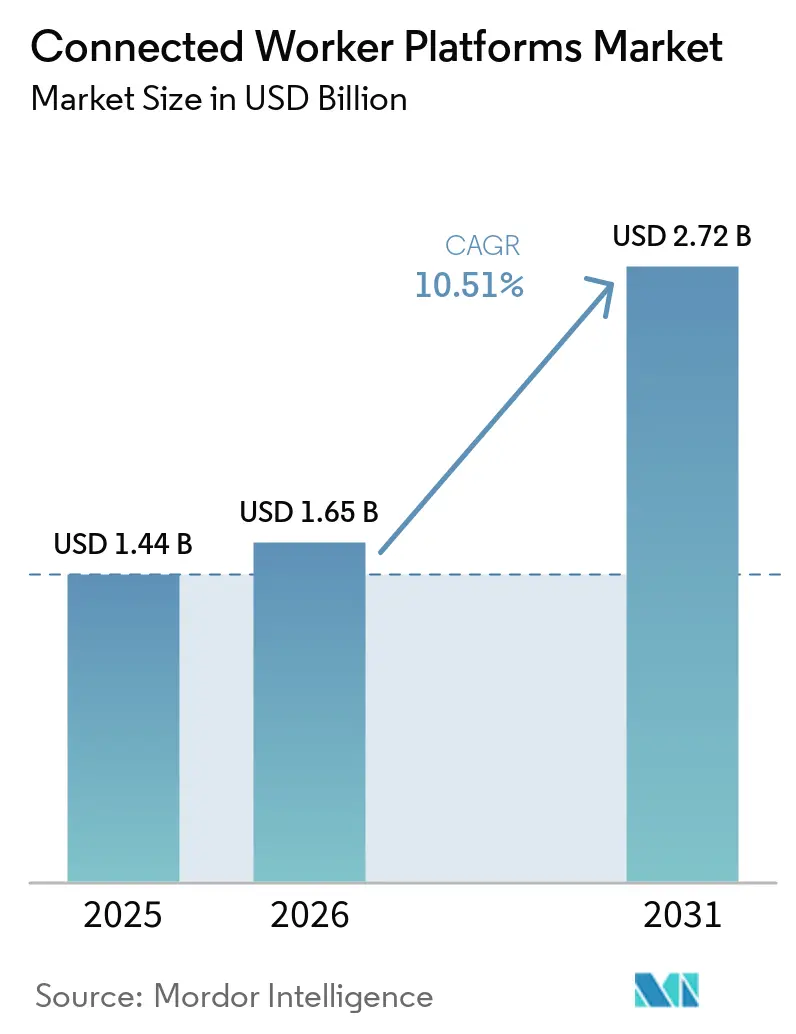
| Market Size (2026) | USD 1.65 Billion |
| Market Size (2031) | USD 2.72 Billion |
| Growth Rate (2026 - 2031) | 10.51 % |
| Fastest Growing Market | Middle East |
| Largest Market | North America |
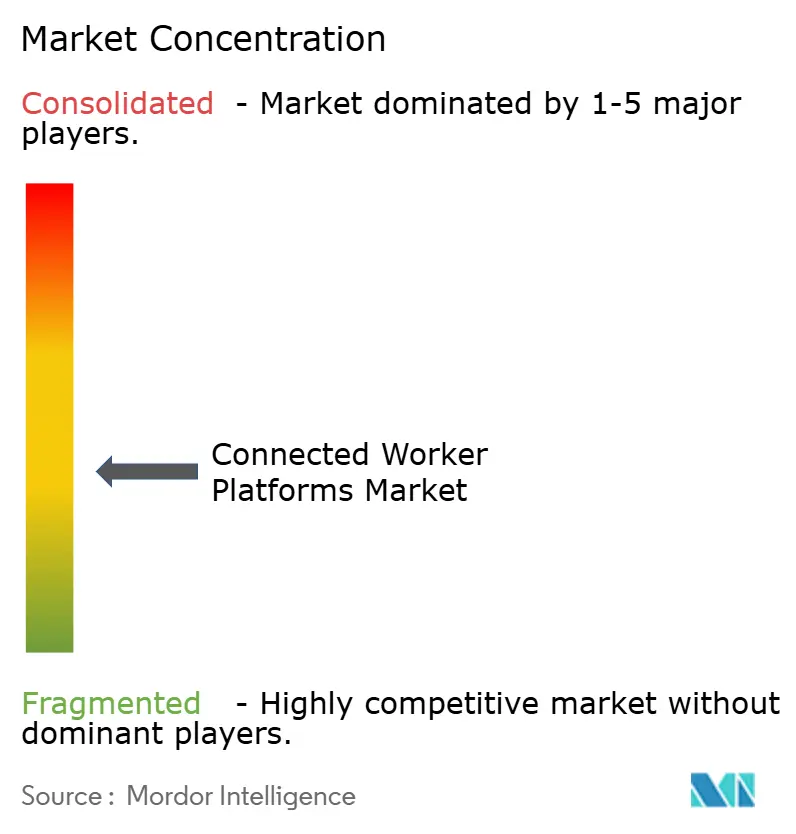
| Market Concentration | Medium |
Major Players *Disclaimer: Major Players sorted in no particular order Image © Mordor Intelligence. Reuse requires attribution under CC BY 4.0. | |
Connected Worker Platforms Market Analysis by Mordor Intelligence
The connected worker platforms market size is projected to be USD 1.44 billion in 2025, USD 1.65 billion in 2026, and reach USD 2.72 billion by 2031, growing at a CAGR of 10.51% from 2026 to 2031. The connected worker market combines devices, software, and services that bring digital work instructions, communications, safety information, and operational data to frontline teams. Industrial digital programs, persistent skill shortages, and stronger requirements for safety records are moving purchases beyond limited pilots. Buyers are increasingly seeking platforms that fit into daily shift routines and connect with existing operational systems. Software subscriptions are becoming more important because they support recurring updates, analytics, and broader deployment across sites. This shift gives vendors opportunities to expand within existing accounts, although integration work and worker acceptance continue to shape adoption decisions.
Key Report Takeaways
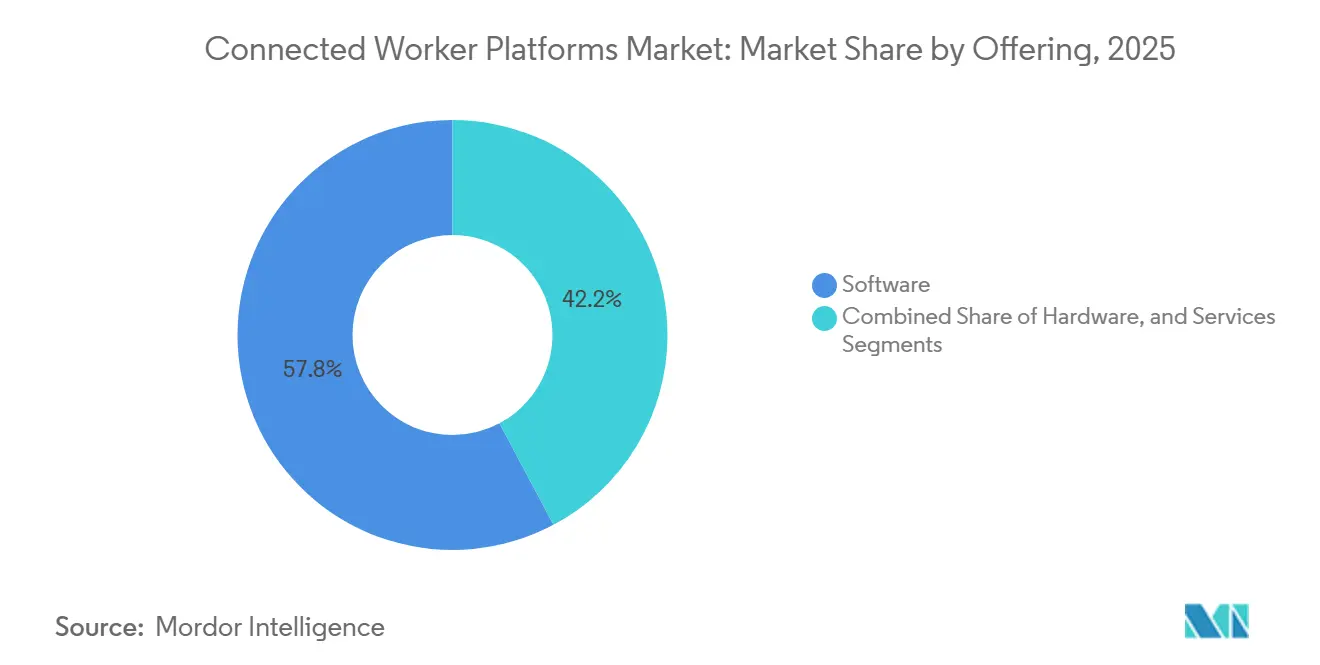
- By offering, software held 57.78% of the connected worker platforms market share in 2025 and is projected to expand at a 12.63% CAGR through 2031.
- By deployment, cloud-based solutions held 63.59% of the connected worker platforms market share in 2025 and are projected to expand at a 13.02% CAGR through 2031.
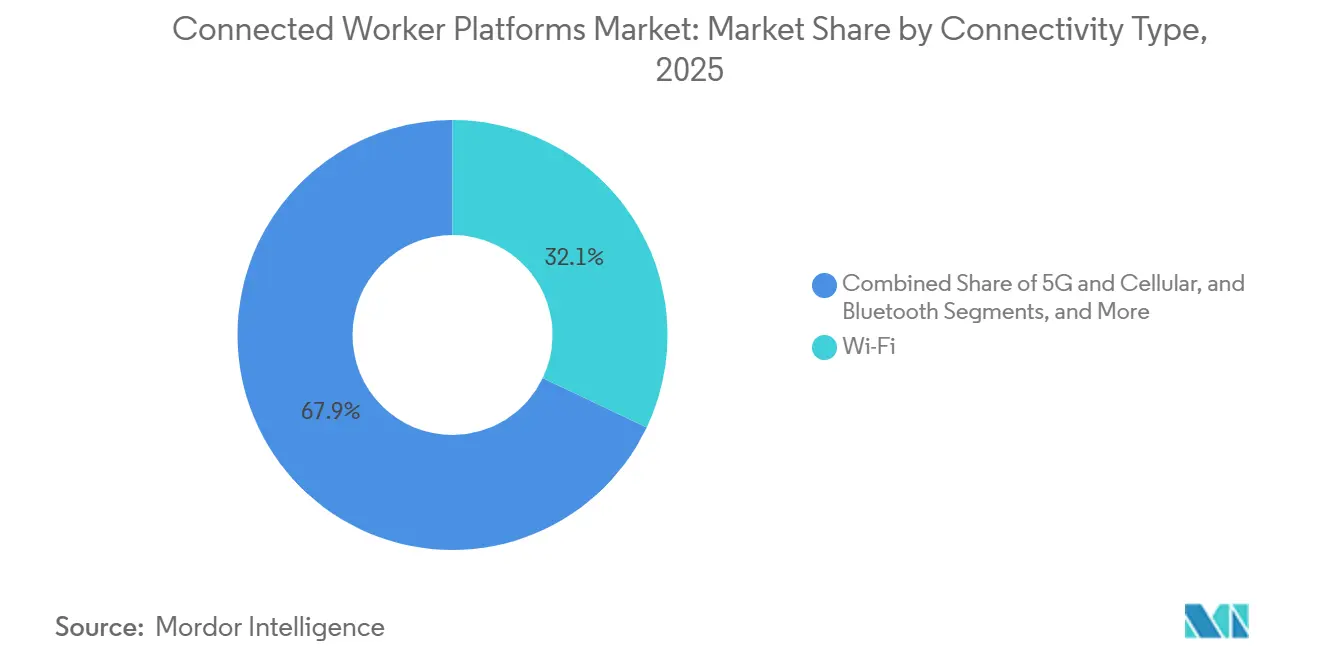
- By connectivity type, Wi-Fi held 32.07% of revenue in 2025, while 5G and cellular are projected to expand at a 12.36% CAGR through 2031.
- By application, task management and productivity optimization held 22.21% of revenue in 2025, while remote assistance and collaboration are projected to expand at a 13.14% CAGR through 2031 in the connected worker platforms market.
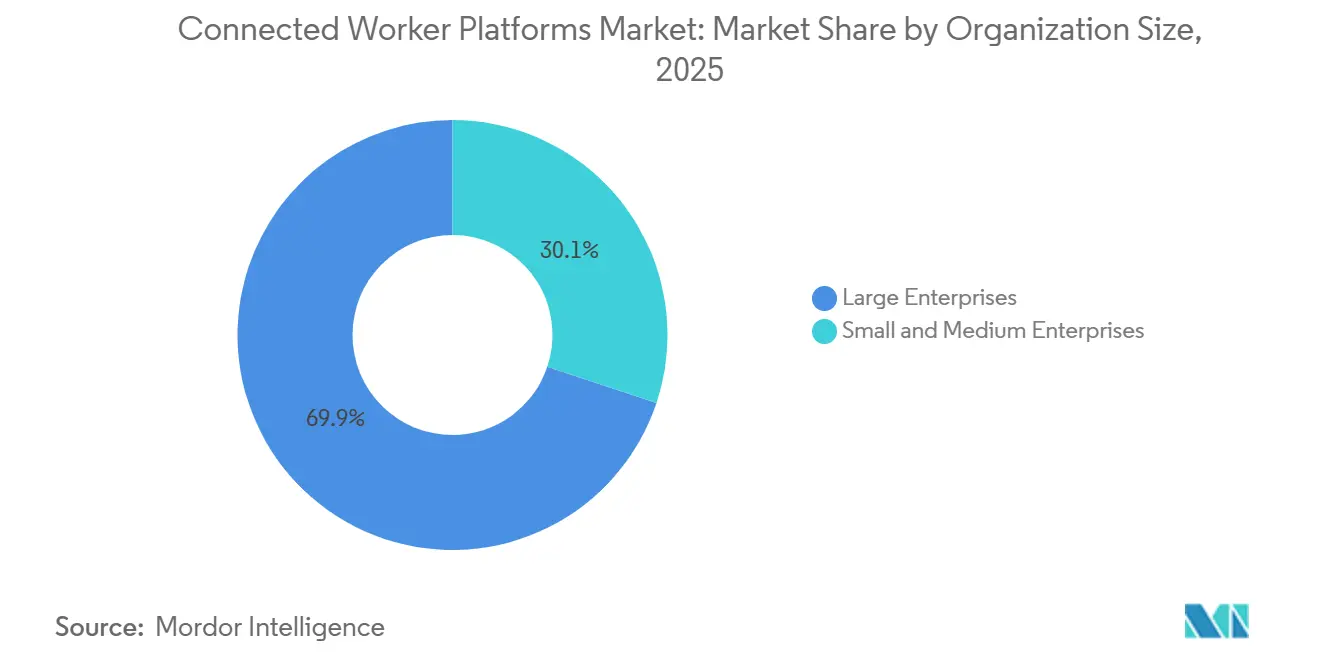
- By organization size, large enterprises held 69.87% of revenue in 2025, while small and medium enterprises are projected to expand at a 12.36% CAGR through 2031.
- By end-user industry, manufacturing accounted for 36.12% of revenue in the connected worker platforms market in 2025, while retail and warehousing are projected to expand at a 13.06% CAGR through 2031.
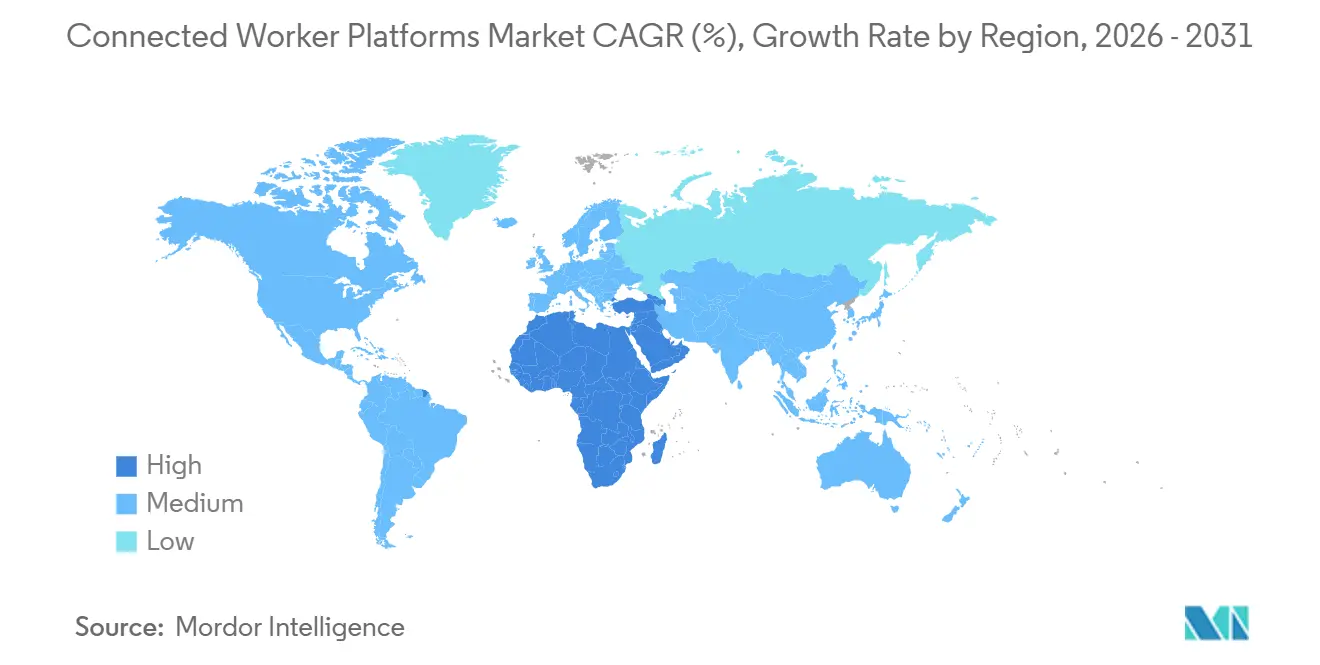
- By geography, North America held 36.62% of revenue in 2025, while the Middle East is projected to expand at a 14.27% CAGR through 2031 in the connected worker platforms market.
Note: Market size and forecast figures in this report are generated using Mordor Intelligence’s proprietary estimation framework, updated with the latest available data and insights as of January 2026.
Market Trends and Insights
Drivers Impact Analysis of Connected Worker Platforms Market*
| DRIVER | (~) % IMPACT ON CAGR FORECAST | GEOGRAPHIC RELEVANCE | IMPACT TIMELINE |
|---|---|---|---|
| Industrial Digital Transformation and Industry 4.0 Adoption | +2.8% | Global, with advanced clusters in North America, Europe, and Asia-Pacific | Medium term (2-4 years) |
| Worker Safety and Compliance Digitization | +1.9% | Global, with elevated relevance in North America and Europe | Short term (≤ 2 years) |
| Skilled-Labor Shortages and Faster Time-to-Proficiency Requirements | +1.5% | North America, Europe, and Japan, with spillover across Asia-Pacific | Long term (≥ 4 years) |
| 5G, Industrial IoT, and Edge-Computing Convergence | +1.3% | Asia-Pacific and the Middle East lead private 5G projects, followed by North America | Medium term (2-4 years) |
| AI-Based Hazard Detection and Predictive Work Guidance | +0.9% | Global, with acceleration in oil and gas, mining, and construction | Short term (≤ 2 years) |
| Digital Capture of Tribal Knowledge Before Workforce Retirement | +0.5% | Mature industrial economies, including Japan, Germany, and North America | Long term (≥ 4 years) |
| Source: Mordor Intelligence | |||
Industrial Digital Transformation and Industry 4.0 Adoption
Manufacturers are moving from separate digital pilots toward programs that link production, maintenance, quality, and workforce processes. This transition supports the connected worker platforms market because frontline applications supply the information needed to make broader digital systems useful in daily operations. The Manufacturing Leadership Council reported in 2026 that smart factory investment had become a competitiveness priority rather than a limited innovation activity.[1] Rockwell Automation reported that 87% of German manufacturers considered digital transformation essential in 2026, and respondents allocated 29% of operating budgets to industrial technology. This investment gives the connected worker platforms market a place in wider plans for data collection and production improvement. The operational data created through usage, work instructions, and exception reporting can support analytics and production improvement programs.
Worker Safety and Compliance Digitization
Safety and compliance requirements are giving frontline digitization a more immediate business case in many industrial settings. The Occupational Safety and Health Administration required covered establishments to electronically submit 2025 injury and illness data by March 2, 2026. OSHA listed a maximum penalty of USD 16,131 for a serious violation in 2026, increasing the value of reliable compliance records and timely corrective action. May 19, 2026, update deadline for safety data sheets under the Hazard Communication Standard also increased the need for controlled document management and training records.[2] Connected worker applications can consolidate field observations, checklists, alerts, and training confirmations into a single audit trail. This gives the connected worker platforms market a compliance-led route to adoption where productivity projects have not yet received approval.
Skilled-Labor Shortages and Faster Time-to-Proficiency Requirements
Manufacturing employers are managing a shortage of experienced workers while also needing to prepare new employees more quickly. The National Association of Manufacturers expected 3.8 million manufacturing positions to open by 2033, with nearly 1.9 million potentially unfilled. The same organization reported average manufacturing compensation above USD 102,000 in 2025, making delayed proficiency and turnover financially significant. Digital instructions and remote expert support can record procedures that otherwise remain with experienced personnel. They can also guide new employees through defined steps and make deviations visible to supervisors. The connected worker platforms market benefits when employers treat onboarding, skills management, and knowledge retention as connected operating requirements.
5G, Industrial IoT, and Edge-Computing Convergence
Private wireless networks and on-site computing are expanding the technical settings where connected worker tools can operate reliably. Nokia reported in 2025 that 87% of surveyed industrial enterprises using on-premises edge with private wireless achieved return on investment within 1 year. The same study found that 71% had deployed connected worker tools as part of their edge programs. These networks can support live video, geofencing, alarms, and augmented guidance in locations where Wi-Fi is unreliable. Schneider Electric stated that 5G is expected to become a standard industrial wireless option by 2030. The connected worker platforms market can therefore serve sites such as large yards, process plants, and mines with stronger cellular and edge support.
Restraints Impact Analysis of Connected Worker Platforms Market*
| RESTRAINT | (~) % IMPACT ON CAGR FORECAST | GEOGRAPHIC RELEVANCE | IMPACT TIMELINE |
|---|---|---|---|
| High Upfront Implementation and Integration Costs | -1.6% | Global, with greater impact in small and medium enterprise-heavy South America and Africa | Short term (≤ 2 years) |
| Worker Privacy, Labor Relations, and Acceptance Risks | -0.9% | North America and Europe, where labor regulation and unionization are strong | Medium term (2-4 years) |
| Legacy-System Interoperability Gaps | -0.7% | Global, with particular pressure in older facilities in Europe and South America | Long term (≥ 4 years) |
| Battery, Durability, and Connectivity Limitations in Harsh Sites | -0.4% | Global mining, oil and gas, and construction sites, with elevated relevance in the Middle East and Africa | Medium term (2-4 years) |
| Source: Mordor Intelligence | |||
High Upfront Implementation and Integration Costs
Implementation costs remain a major obstacle, particularly for mid-sized plants that lack dedicated industrial technology teams. Many sites use enterprise resource planning and manufacturing execution systems that were built before current application programming interfaces became common. Connecting these systems to work orders, asset records, and safety files can require tailored middleware and specialized services. Innovapptive reported that its deployment at an Indorama Ventures facility generated more than USD 12 million in EBITDA gains, while illustrating the scale of operational change needed for a full deployment. Pilot results can also be difficult to extend across departments because information technology, operations technology, and human resources teams must align. This friction limits the connected worker market among buyers who cannot absorb the project cost and governance work.
Worker Privacy, Labor Relations, and Acceptance Risks
Wearable devices and software that record employee activity can create privacy and labor concerns in unionized workplaces. The US Government Accountability Office stated in 2025 that digital surveillance may affect workers and employers, including workers’ exercise of rights under labor laws.[3] California labor proposals in 2025 also demonstrated closer public attention to algorithmic workplace monitoring. Organizations may need consent processes, data-use limits, and joint labor-management arrangements before deployment. These requirements can lengthen procurement and legal review cycles. The connected worker market will benefit when providers separate individual data from supervisory analytics and explain how data is used.
*Our forecasts treat driver/restraint impacts as directional, not additive. The impact forecasts reflect baseline growth, mix effects, and variable interactions.
Connected Worker Platforms Market Segment Analysis
By Offering:
Software Leads Revenue and Subscription DemandSoftware accounted for 57.78% of revenue in the connected worker sector in 2025. This position reflected the shift from hardware-centered purchases toward workflow, analytics, and skills-management subscriptions. Software gives vendors recurring revenue, feature updates, and broader adoption across customer sites. It also lets customers add use cases without replacing the physical devices frontline workers use. The software segment is projected to expand at a 12.63% CAGR through 2031, supported by AI-enabled tools for skills analysis, guided work, and predictive compliance activities.
Hardware remains necessary because many workers use rugged displays, scanners, wearables, and tablets in demanding environments. Its contribution to customer value declines when a platform is sold under a multiyear software agreement. Services are gaining relevance as buyers need support with integration, workforce change, and operational governance. Providers increasingly package these activities as managed support rather than one-time implementation assignments. Augmentir launched its Industrial AI Agent Studio in April 2025, enabling manufacturers to create AI agents within frontline workflows and supporting premium software subscriptions.

By Deployment:
Cloud Platforms Reshape Delivery EconomicsCloud-based deployment accounted for 63.59% of revenue in the connected worker sector in 2025. The model avoids on-site server investment and lets suppliers deliver updates without local information technology intervention. It also makes it easier to extend analytics and collaboration functions across a distributed facility network. These benefits have made cloud platforms the standard option for many new deployments. Cloud-based solutions are projected to expand at a 13.02% CAGR through 2031 as organizations become more comfortable with cloud tools.
Hybrid configurations offer a middle route for enterprises with uneven technology maturity or strict data controls. They can keep selected operational technology data within the facility while sending training, collaboration, and analytical data to cloud services. Kuehne+Nagel completed the global rollout of its cloud-native contract logistics platform at more than 1,000 sites in April 2026. The deployment showed that complex multisite operations can transition to shared digital platforms at scale. On-premises models still matter in defense, critical infrastructure, and regulated pharmaceutical settings, but their addressable opportunity is narrower.
By Connectivity Type:
Wi-Fi Retains Scale as 5G and Cellular AdvanceWi-Fi accounted for 32.07% of revenue in 2025. Its installed base in factories and warehouses makes it the practical default for many workflow, scanning, and training applications. Existing networks also reduce the initial investment needed to introduce a platform. Wi-Fi remains well-suited to indoor settings, with stable coverage and established access management. 5G and cellular are projected to expand at a 12.36% CAGR through 2031, reflecting demand for dependable, lower-latency connectivity across complex sites.
Private wireless networks are useful in large outdoor yards, multistory plants, and sites where worker movement crosses coverage boundaries. They can support real-time video, augmented-reality guidance, and safety-critical communications where patchy coverage would otherwise limit use. Nokia found that 94% of industrial enterprises deploying on-premise edge technology did so alongside private wireless networks. Bluetooth remains important for short-range wearables, tagged assets, and proximity alerts. Zebra launched the WS501-R in April 2026 with UHF RFID, NFC, barcode scanning, and voice-directed picking functions.[4]
By Application:
Task Management Holds the Lead While Remote Support GrowsTask management and productivity optimization accounted for 22.21% of the connected worker platforms market size in 2025. Manufacturers use guided instructions, shift handovers, and standardized checklists to link work to measurable operational outcomes. These applications can begin with limited integration and reduce procedural errors soon after deployment. They are often the first use case at sites that later add safety, maintenance, or training tools. Remote assistance and collaboration are projected to grow at a 13.14% CAGR through 2031, as specialists can support dispersed assets without repeated travel.
Augmented reality-supported collaboration is valuable in oil and gas, utilities, and aerospace maintenance, where specialists cannot remain at every location. PTC reported that a Harpak-ULMA customer completed a complex tool rebuild in 8 hours, rather than the standard 40 hours, using its Vuforia solution.[5] Safety and compliance applications remain central because electronic records and incident workflows support inspection readiness. Training, predictive maintenance, and asset management provide durable use cases as AI functions improve. Sensor-detected issues can trigger work orders and instructions for frontline teams, allowing the connected worker platforms market to extend beyond stand-alone digital work instructions.
By Organization Size:
Large Enterprises Lead While Small and Medium Enterprises ExpandLarge enterprises accounted for 69.87% of revenue in 2025. Their leadership reflects their capacity to fund multisite deployments and manage integrations with established enterprise systems. They also tend to have existing relationships with automation, device, and software suppliers. These factors reduce the practical risk of deploying a platform across multiple facilities. Small and medium enterprises are projected to expand at a 12.36% CAGR through 2031 as cloud delivery and configuration tools lower technical requirements.
Smaller manufacturers face the same workforce shortages and knowledge retention challenges as larger corporations, but with fewer training and technology resources. No-code and low-code tools can make guided-work applications manageable for operations teams. Tulip secured USD 120 million in Series D funding in January 2026 and reported that its platform supported 60,000 frontline workers at 1,000 customer sites in 45 countries as of 2025. This shows that standardized applications can reach a broad base of facilities. As vendor packages become easier to deploy, the connected worker industry can address more mid-market operations.
By End-User Industry:
Manufacturing Anchors Demand as Retail and Warehousing AccelerateManufacturing held 36.12% of revenue in 2025. The sector combines repetitive tasks, complex procedures, safety obligations, and an aging skilled workforce. Digital work instructions can improve process consistency while preserving operational knowledge for newer employees. These benefits make manufacturing the reference sector for many vendor sales efforts. Retail and warehousing are projected to expand at a 13.06% CAGR through 2031 as e-commerce fulfillment and seasonal hiring raise the need for fast onboarding.
Honeywell announced 2 AI innovations for frontline workforce performance in retail and logistics in October 2025, including the CT70 handheld computer with RAIN RFID functions. Oil and gas and mining remain high-value uses because safety monitoring and permit-to-work processes can provide compliance value. Healthcare and pharmaceutical manufacturing also need controlled documentation and standardized procedure enforcement. The US Food and Drug Administration’s electronic record rules under 21 CFR Part 11 support the importance of reliable digital audit trails in these settings. Construction and utilities use these platforms for inspection and maintenance across dispersed locations, broadening demand beyond manufacturing.
Geography Analysis
North America Connected Worker Platforms Market
North America held 36.62% of revenue in 2025. The region’s large manufacturing base, mature cloud environment, and safety compliance requirements supported its leading position. The US Bureau of Labor Statistics reported 495,000 manufacturing job openings in January 2026. This shortage reinforces demand for tools that guide new personnel and retain process knowledge. The connected worker platforms market also benefits from Mexico’s nearshoring manufacturing growth as automotive and electronics producers standardize operations across regional supply chains.
Europe and APAC Connected Worker Platforms Market
Europe remained the second-largest regional opportunity, with Germany as its industrial anchor. German manufacturers placed a high value on digital transformation and industrial technology spending in 2026. The European Union’s occupational safety and health framework requires employers to manage work-related risks and provide appropriate information and training. Asia-Pacific offers the connected worker platforms market a significant opportunity because China, Japan, South Korea, and Australia combine industrial activity with smart-factory investment. Japan’s aging workforce and Australia’s remote mining operations make knowledge capture and offline-capable tools particularly relevant.
MEA and South America Connected Worker Platforms Market
The Middle East is projected to expand at a 14.27% CAGR through 2031, the fastest rate among geographic segments. Saudi Arabia’s Vision 2030 and the United Arab Emirates’ industrial programs are promoting technology adoption. The United Arab Emirates launched its National Industrial Transformation Track in February 2026 with the World Economic Forum to accelerate Industry 4.0 adoption at 100 industrial companies.[6] Africa and South America remain earlier-stage markets, but the connected worker platforms market can find focused demand at asset-intensive sites in Brazil, Argentina, Nigeria, and South Africa.
Competitive Landscape
The connected worker platforms market is moderately fragmented, with industrial automation companies and software-focused providers competing for enterprise accounts. Honeywell, Siemens, Zebra Technologies, PTC, and Microsoft bring device portfolios, installed customer bases, and enterprise relationships. Augmentir, Tulip, Poka, and MaintainX compete with configurable platforms and faster product cycles. Incumbents can link frontline tools to established industrial systems, while software providers often emphasize rapid configuration and cloud delivery. These different strengths keep the connected worker platforms market tied to the customer’s technology environment and implementation needs.
Autodesk entered into a definitive agreement in May 2026 to acquire MaintainX for USD 3.6 billion in cash. The move showed that broader design and construction software suppliers view frontline execution as a capability worth adding through acquisition. Librestream deployed Onsight NOW at Hill Air Force Base in May 2026 under a US Air Force Sustainment Center SBIR Phase II contract. Honeywell launched Safety Suite 2.0 in June 2026 with analytics, forecasting, and centralized compliance dashboards. These actions show that competition is moving beyond device management toward workflow intelligence and safety analytics.
No-code configuration matters in the mid-market, where long deployment cycles and high professional services needs can hinder adoption. Workerbase introduced AI-supported shop-floor application generation in 2025, allowing operations teams to create workflow applications from natural-language descriptions. AVEVA and Amazon Web Services announced a multiyear collaboration in May 2026 to develop industrial intelligence in the cloud. The connected worker platforms market will favor providers that combine usable frontline applications with trusted integrations.
Connected Worker Platforms Industry Leaders
-
Honeywell International Inc.
-
Siemens AG
-
Zebra Technologies Corporation
-
PTC Inc.
-
Microsoft Corporation
- *Disclaimer: Major Players sorted in no particular order
Connected Worker Platforms Market Companies Covered in this Report
- Honeywell International Inc.
- Siemens AG
- Zebra Technologies Corporation
- PTC Inc.
- Microsoft Corporation
- Augmentir, Inc.
- Tulip Interfaces Inc.
- Innovapptive Inc.
- Librestream Technologies Inc.
- Poka Inc.
- RealWear, Inc.
- RedZone, Inc.
- SymphonyAI
- Parsable, Inc.
- QAD Inc.
- Workerbase GmbH
- Zaptic Limited
- Dozuki
- MaintainX, Inc.
- SafetyCulture Pty Ltd
Recent Industry Developments in Connected Worker Platforms Market
- August 2026: SafetyCulture, a global operations platform with more than 2 million frontline users across 80,000 organizations, rebranded as Mitti, repositioning from a safety-focused application into a comprehensive frontline operations system encompassing AI-powered computer vision monitoring, compliance, and an integrated insurance product tied to operational performance data. The rebrand signals the company's ambition to consolidate the fragmented point-solution landscape into a single platform for frontline work measurement and improvement.
- June 2026: Librestream Technologies deployed its Onsight NOW remote collaboration platform at Hill Air Force Base under a US Air Force Sustainment Center SBIR Phase II contract, with plans to scale to 1,000 users across the Air Force Sustainment Center through a Phase III production contract. The deployment, integrated with Microsoft Azure GovCloud, establishes a defense-grade connected-worker reference architecture that positions Librestream for broader government and regulated industrial verticals.
- June 2026: Honeywell launched Safety Suite 2.0, an enhanced version of its portable gas detection software platform providing historical data analytics, trend forecasting, and centralized compliance dashboards for safety leaders in refineries, chemical plants, utilities, and first-responder operations. The update expands Honeywell's connected worker safety footprint beyond device management into proactive safety analytics.
- May 2026: Autodesk announced a definitive agreement to acquire MaintainX, the leading AI-powered computerized maintenance management and enterprise asset management platform, in an all-cash transaction valued at USD 3.6 billion. MaintainX was projected to exceed USD 135 million in annualized recurring revenue in calendar year 2026, representing growth of more than 50% and positioning it as one of the largest MandA transactions in the connected worker software category to date.
Global Connected Worker Platforms Market Report Scope
The Connected Worker Platforms Market includes digital solutions that connect frontline and field workers with enterprise systems, operational data, and collaboration tools through mobile devices, wearables, and cloud-based applications. These platforms support real-time communication, task management, workflow guidance, data capture, knowledge sharing, and performance monitoring across industrial and service operations. Organizations use connected worker platforms to improve workforce productivity, enhance operational visibility, reduce downtime, strengthen safety compliance, and support digital transformation initiatives across manufacturing, energy, utilities, logistics, and field service environments.
The Connected Worker Platforms Market Report is Segmented by Offering (Hardware, Software, and Services), Deployment (Cloud-Based, Hybrid, and On-Premises), Connectivity Type (Wi-Fi, 5G and Cellular, Bluetooth, RFID and NFC, and Other Connectivity Types), Application (Remote Assistance and Collaboration, Workforce Safety and Compliance, Training and Skill Development, Task Management and Productivity Optimization, Predictive and Preventive Maintenance, Inventory and Asset Management, and Other Applications), Organization Size (Large Enterprises, and Small and Medium Enterprises), End-User Industry (Manufacturing, Mining, Oil and Gas, Construction, Healthcare and Pharmaceuticals, Utilities and Energy, Retail and Warehousing, and Other End-user Industries), and Geography (North America, South America, Europe, Asia-Pacific, Middle East, and Africa). The Market Forecasts are Provided in Terms of Value (USD).
Segmentation Overview
| Hardware |
| Software |
| Services |
| Cloud-Based |
| Hybrid |
| On-Premises |
| Wi-Fi |
| 5G and Cellular |
| Bluetooth |
| RFID and NFC |
| Other Connectivity Types |
| Remote Assistance and Collaboration |
| Workforce Safety and Compliance |
| Training and Skill Development |
| Task Management and Productivity Optimization |
| Predictive and Preventive Maintenance |
| Inventory and Asset Management |
| Other Applications |
| Large Enterprises |
| Small and Medium Enterprises |
| Manufacturing |
| Mining |
| Oil and Gas |
| Construction |
| Healthcare and Pharmaceuticals |
| Utilities and Energy |
| Retail and Warehousing |
| Other End-user Industries |
| North America | United States |
| Canada | |
| Mexico | |
| South America | Brazil |
| Argentina | |
| Rest of South America | |
| Europe | Germany |
| United Kingdom | |
| France | |
| Italy | |
| Spain | |
| Russia | |
| Rest of Europe | |
| Asia-Pacific | China |
| India | |
| Japan | |
| South Korea | |
| Australia | |
| Rest of Asia-Pacific | |
| Middle East | Saudi Arabia |
| United Arab Emirates | |
| Turkey | |
| Rest of Middle East | |
| Africa | South Africa |
| Nigeria | |
| Rest of Africa |
| By Offering | Hardware | |
| Software | ||
| Services | ||
| By Deployment | Cloud-Based | |
| Hybrid | ||
| On-Premises | ||
| By Connectivity Type | Wi-Fi | |
| 5G and Cellular | ||
| Bluetooth | ||
| RFID and NFC | ||
| Other Connectivity Types | ||
| By Application | Remote Assistance and Collaboration | |
| Workforce Safety and Compliance | ||
| Training and Skill Development | ||
| Task Management and Productivity Optimization | ||
| Predictive and Preventive Maintenance | ||
| Inventory and Asset Management | ||
| Other Applications | ||
| By Organization Size | Large Enterprises | |
| Small and Medium Enterprises | ||
| By End-User Industry | Manufacturing | |
| Mining | ||
| Oil and Gas | ||
| Construction | ||
| Healthcare and Pharmaceuticals | ||
| Utilities and Energy | ||
| Retail and Warehousing | ||
| Other End-user Industries | ||
| By Geography | North America | United States |
| Canada | ||
| Mexico | ||
| South America | Brazil | |
| Argentina | ||
| Rest of South America | ||
| Europe | Germany | |
| United Kingdom | ||
| France | ||
| Italy | ||
| Spain | ||
| Russia | ||
| Rest of Europe | ||
| Asia-Pacific | China | |
| India | ||
| Japan | ||
| South Korea | ||
| Australia | ||
| Rest of Asia-Pacific | ||
| Middle East | Saudi Arabia | |
| United Arab Emirates | ||
| Turkey | ||
| Rest of Middle East | ||
| Africa | South Africa | |
| Nigeria | ||
| Rest of Africa | ||
Key Questions Answered in the Report
What is the connected worker platforms market size?
The connected worker platforms market size is projected to be USD 1.44 billion in 2025, USD 1.65 billion in 2026, and reach USD 2.72 billion by 2031, growing at a CAGR of 10.51% from 2026 to 2031.
What is driving adoption of connected worker platforms?
Industrial digitization, safety recordkeeping, workforce shortages, and the need for faster training are supporting adoption.
Which connected worker offering has the largest share?
Software held the largest share at 57.78% in 2025 and is projected to expand at a 12.63% CAGR through 2031.
Why are cloud-based connected worker solutions growing?
Cloud delivery supports lower infrastructure costs, centralized updates, and wider access to analytics across sites.
Which end-user sector leads demand for connected worker tools?
Manufacturing led with 36.12% of revenue in 2025 because it needs consistent procedures, workforce knowledge retention, and safety compliance.
What are the main barriers to connected worker adoption?
Integration costs, legacy systems, worker privacy concerns, and device constraints at harsh sites can delay wider deployment.