
Conductive Carbon Dispersions Market Size and Share
Market Overview
| Study Period | 2021 - 2031 |
|---|---|
| Market Size (2026) | USD 1.42 Billion |
| Market Size (2031) | USD 2.41 Billion |
| Growth Rate (2026 - 2031) | 11.23 % |
| Fastest Growing Market | Asia-Pacific |
| Largest Market | Asia-Pacific |
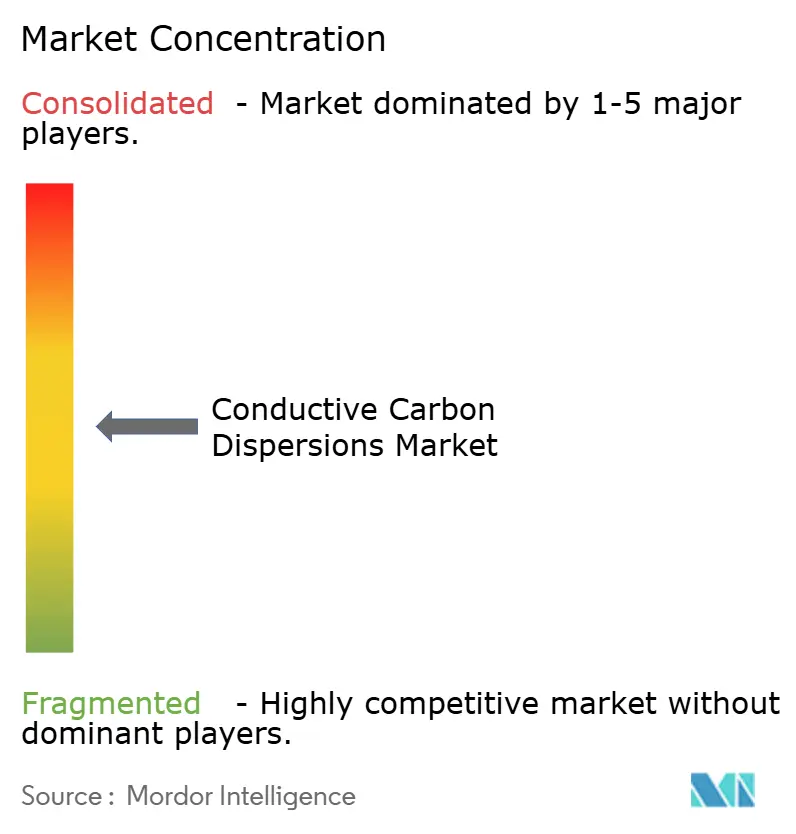
| Market Concentration | Medium |
Major Players *Disclaimer: Major Players sorted in no particular order Image © Mordor Intelligence. Reuse requires attribution under CC BY 4.0. | |
Conductive Carbon Dispersions Market Analysis by Mordor Intelligence
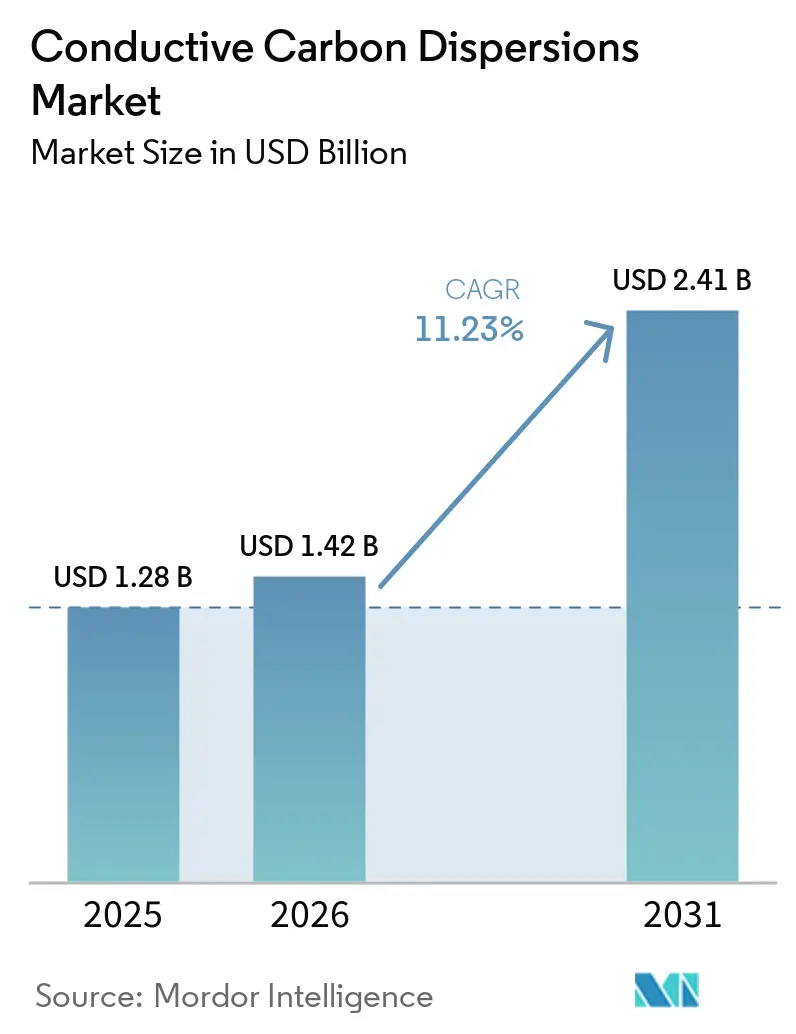
The conductive carbon dispersions market size is estimated at USD 1.28 billion in 2025 and is estimated to grow from USD 1.42 billion in 2026 to USD 2.40 billion by 2031, at a CAGR of 11.23% during the forecast period (2026-2031). Rising battery cell output is increasing demand for electrode-ready materials that can be fed into slot-die coating lines without a separate dry-blending stage. Pre-dispersed products help manufacturers reduce mixing variation and limit electrode defects at large production sites. This operational benefit supports demand for liquid formulations and favors suppliers that can deliver consistent quality at scale. Battery chemistry changes are also shifting demand, as silicon-rich anodes and high-nickel cathodes require stronger conductive networks. Production consistency remains a key requirement for suppliers serving the conductive carbon dispersions market. Suppliers are responding with water-based products, high-solids concentrates, regional capacity, and technical support to assist customers through qualification processes.
Key Report Takeaways
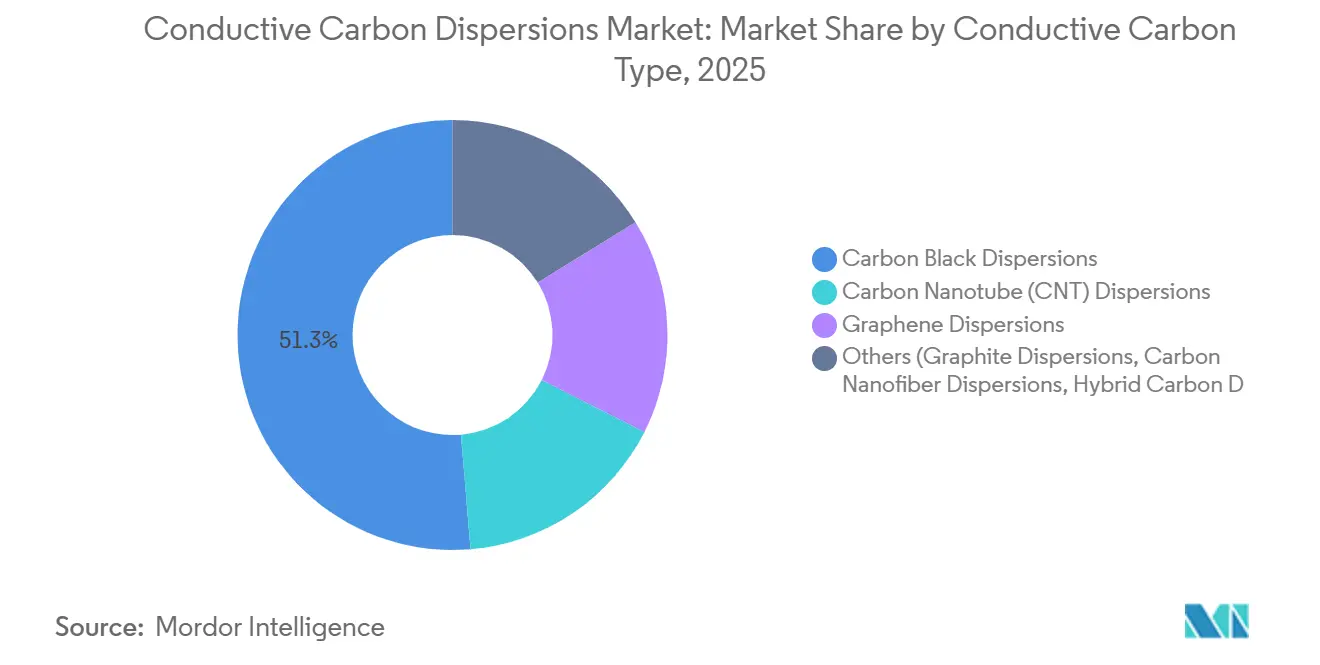
- By conductive carbon type, carbon black held 51.34% of the conductive carbon dispersions market share in 2025, while CNT dispersions are forecast to grow at a 13.45% CAGR through 2031.
- By dispersion medium, water-based products accounted for 58.06% of the conductive carbon dispersions market share in 2025 and are expected to expand at an 11.86% CAGR through 2031.
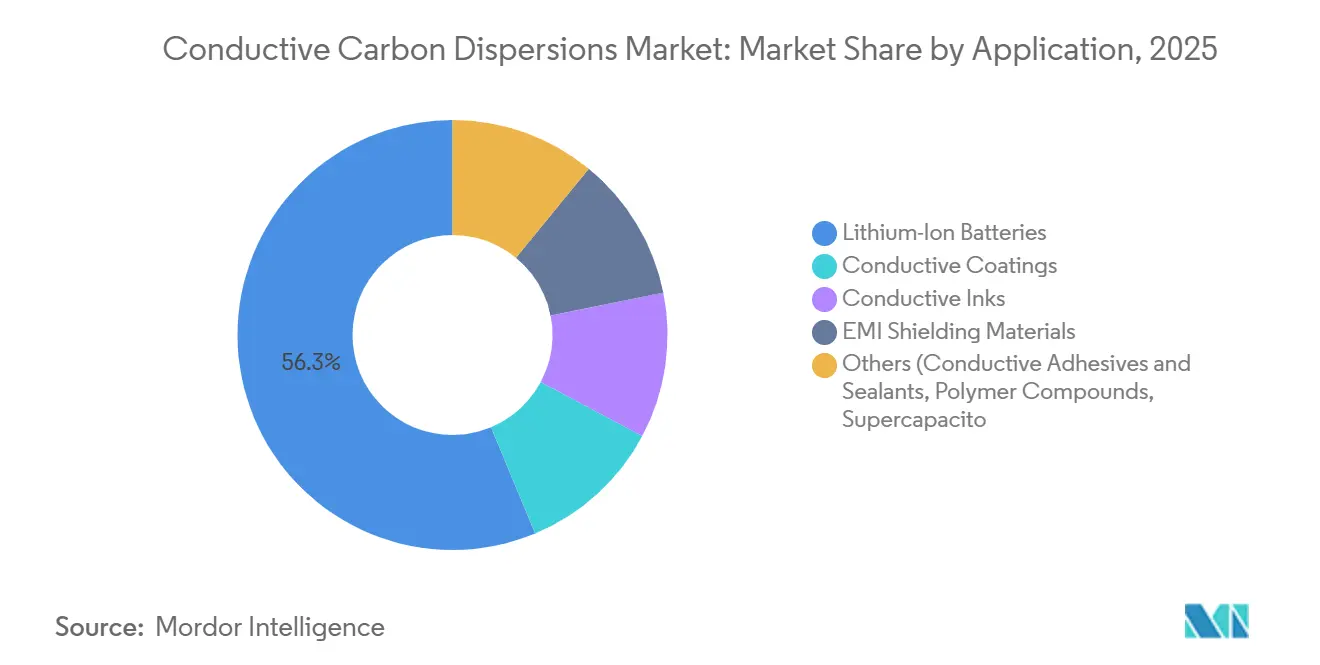
- By application, lithium-ion batteries commanded 56.28% of the conductive carbon dispersions market share in 2025 and are forecast to advance at a 12.66% CAGR through 2031.
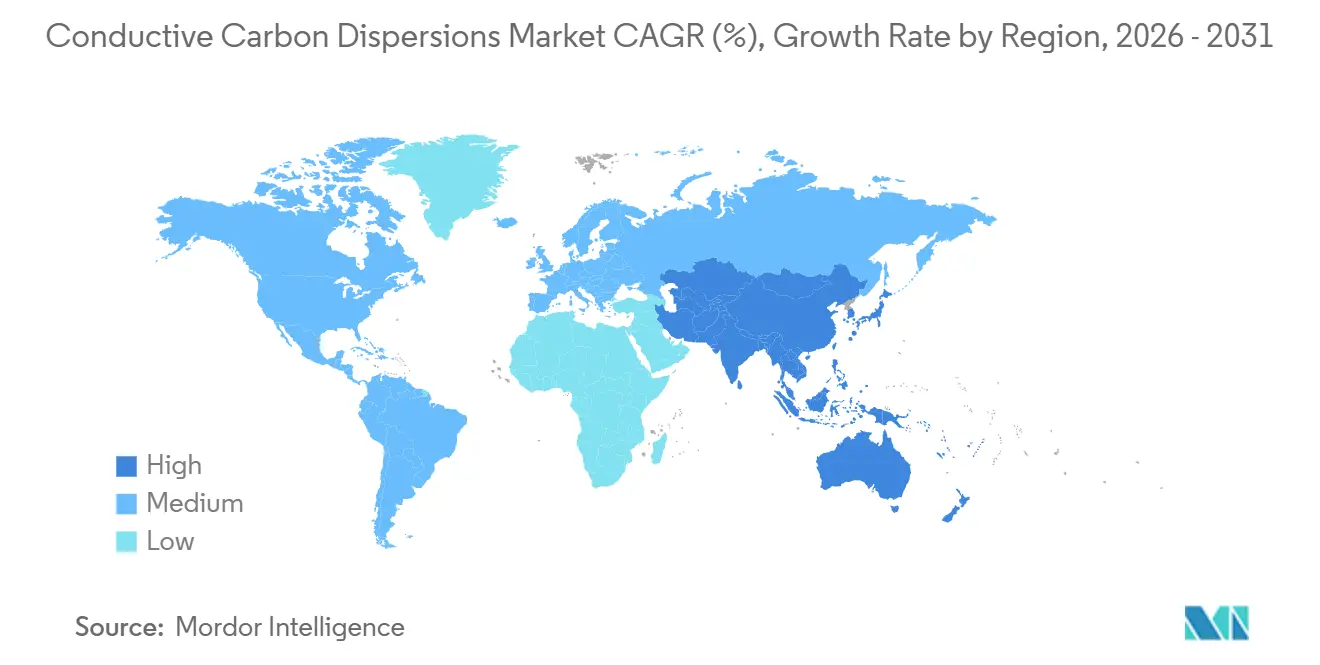
- By geography, Asia-Pacific accounted for 33.94% of the conductive carbon dispersions market share in 2025 and is projected to grow at a 12.17% CAGR through 2031.
Note: Market size and forecast figures in this report are generated using Mordor Intelligence’s proprietary estimation framework, updated with the latest available data and insights as of January 2026.
Market Trends and Insights
Drivers Impact Analysis of Conductive Carbon Dispersions Market*
| Drivers | (~) % Impact on CAGR Forecast | Geographic Relevance | Impact Timeline |
|---|---|---|---|
| EV and Grid Battery Electrode Expansion | +4.2% | Global, concentrated in China, the EU, and North America | Short term (≤ 2 years) |
| Higher Energy Density Through Lower Conductive-Additive Loading | +1.8% | Global, with the highest traction in Asia-Pacific premium cell lines | Medium term (2-4 years) |
| Silicon-Rich Anode and High-Nickel Cathode Adoption | +2.5% | Asia-Pacific, North America, and Europe | Medium term (2-4 years) |
| Water-Based and High-Solids Slurry Processing | +1.5% | EU, China, and North America | Short term (≤ 2 years) |
| Localized Battery Supply Chains and Qualification Support | +1.2% | North America and the EU | Medium term (2-4 years) |
| Pre-Dispersed Formulations That Reduce Mixing and Handling Risk | +1.1% | Global, strongest in large-format prismatic cell manufacturing | Short term (≤ 2 years) |
| Source: Mordor Intelligence | |||
EV and Grid Battery Electrode Expansion
Global EV battery deployment reached 1.2 TWh in 2025, rising nearly 30% from 2024 and more than sevenfold from 2020. Each additional TWh of cell output requires more electrode slurry and more conductive material at the cathode and anode production steps. The International Energy Agency reported that lithium iron phosphate (LFP) accounted for more than 55% of global EV batteries deployed in 2025 and more than 90% of stationary battery storage installations. LFP has lower conductivity than nickel manganese cobalt (NMC) and generally requires higher additive loading per unit of electrode area, supporting demand for carbon black dispersions as battery makers scale electrode production. The conductive carbon dispersions market also benefits from rising demand for stationary storage, where LFP remains the dominant chemistry. Cabot Corporation stated that lithium-ion battery demand is expected to grow through the end of the decade, supporting longer-term investment across the conductive carbon dispersions market[1].
Silicon-Rich Anode and High-Nickel Cathode Adoption
Silicon-rich anodes require more durable conductive networks than conventional graphite anodes because silicon expands by nearly 300% during lithiation. Flexible, high-aspect-ratio materials such as SWCNTs help preserve electrical pathways through this expansion. A study examining a carbon black (CB)-to-SWCNT mass ratio of 70:30 found that the resulting network supported 700 µm coatings without cracking or delamination. High-nickel NMC811 and NCA90 cathodes also require improved electron pathways at lower additive loadings. These performance requirements create an opportunity for suppliers that can provide qualified CNT and hybrid dispersion systems for advanced electrode designs.
Water-Based and High-Solids Slurry Processing
The shift toward water-based electrode processing is increasing demand for aqueous conductive carbon products. A 2025 Nature Communications study found that kosmotropic aqueous processing for Ni-rich cathodes reduced manufacturing costs by 23% and eliminated the conventional NMP solvent-recovery loop, resulting in a 95% reduction in associated capital costs. High-solids binder-CNT composite systems with more than 77 wt% solids reduced solvent use by 30% and supported more uniform conductive networks in thick electrodes. The conductive carbon dispersions market benefits when customers redesign slurry systems to achieve regulatory compliance, reduce solvent use, and improve coating efficiency.
Pre-Dispersed Formulation Reducing Mixing and Handling Risk
Ready-to-use liquid dispersions address the difficulty of deagglomerating dry carbon powders at gigafactory throughput. High-shear mixing of CNT powder can create batch variation, and even limited agglomeration can reduce electrode uniformity. OCSiAl states that its TUBALL BATT H2O and TUBALL BATT NMP products provide conductivity at SWCNT loadings as low as 0.02 wt% and reach more than 80% solids in cathode-grade concentrates. Lower additive loading can offset part of the higher per-kilogram cost of liquid dispersion. Cabot reported strong fiscal 2025 growth in conductive additive blends with major battery producers. OCSiAl also reported that its Chinese licensed partners targeted a combined TUBALL BATT dispersion capacity of 52,000 tons per year by end of 2025.
Restraints Impact Analysis of Conductive Carbon Dispersions Market*
| Restraints | (~) % Impact on CAGR Forecast | Geographic Relevance | Impact Timeline |
|---|---|---|---|
| High CNT and Graphene Cost Versus Carbon Black | -0.6% | Global, most acute in price-sensitive markets, including ASEAN and South America | Long term (≥ 4 years) |
| CNT Agglomeration and Dispersion Stability Risk | -0.3% | Global, most significant in waterborne formulations for Ni-rich cathodes | Medium term (2-4 years) |
| Long Cell-Qualification and Change-Control Cycles | -0.4% | Global, most pronounced in automotive-grade LIB cells | Long term (≥ 4 years) |
| Regional Concentration of Battery and Conductive-Carbon Capacity | -0.2% | Asia-Pacific supply risk for Europe and North America | Medium term (2-4 years) |
| Source: Mordor Intelligence | |||
High CNT and Graphene Cost Versus Carbon Black
The price difference between CNT or graphene dispersions and carbon black dispersions remains a major barrier in high-volume EV cell programs. This cost-performance balance is particularly challenging in LFP cathode applications, where buyers focus closely on total electrode cost. An IOPscience conference proceedings report noted global industrial MWCNT output of 25,000 tons per year in 2024, largely from fluidized-bed and floating-catalyst CVD methods. SWCNT production remains lower than that of MWCNTs, supporting its premium pricing in high-value cell formats. CNT and graphene dispersion pricing is 5-15× that of carbon black at equivalent loading levels. NanoXplore launched xGnP D-500HP in fiscal Q3 2026 as a direct alternative to specialty carbon black, but graphene pricing remains above the cost threshold for LFP cells. Carbon black dispersions are therefore expected to remain relevant in price-sensitive markets, while CNT and graphene products are targeted at performance-driven applications.
CNT Agglomeration and Dispersion Stability Risk
CNT agglomeration can reduce the conductivity advantage that nanotubes offer in electrode slurry. Strong van der Waals interactions encourage bundling in aqueous and NMP-based systems. An IOPscience conference proceedings report documented agglomerate diameters of 2-20 µm in cathode electrode cross-sections, linked to poorer electronic conductivity compared to well-dispersed networks. Polymer dispersants can reduce re-aggregation and internal resistance but must remain electrochemically inactive across the battery's operating voltage range, necessitating a test before entering a qualified cell. Water-based products also face hydrolysis, pH drift, microbial contamination, shelf-life certification, and cold-chain requirements that solvent-based systems do not, extending development and qualification timelines in the conductive carbon dispersions market.
*Our forecasts treat driver/restraint impacts as directional, not additive. The impact forecasts reflect baseline growth, mix effects, and variable interactions.
Conductive Carbon Dispersions Market Segment Analysis
By Conductive Carbon Type:
Carbon Black Dominates Demand While CNTs Address Premium ApplicationsCarbon black dispersions held 51.34% of the conductive carbon dispersions market share in 2025. This position reflects formulation maturity, established supply networks, and cost competitiveness in LFP cathode slurry. LFP represented more than 55% of global EV batteries deployed in 2025. Its lower conductivity requires higher conductive-additive loading, which favors carbon black formulations. This material type is well established among battery manufacturers and is supported by existing supply chains. CNT dispersions are forecast to expand at a 13.45% CAGR through 2031, driven by the need for high-aspect-ratio networks in silicon anodes and high-nickel cathodes. Industrial CNT output reached 25,000 tons per year globally in 2024, primarily from MWCNT production.
China's T/CAQI 423-2025 standard, published in April 2025, establishes technical specifications for CNT-composite conductive pastes used in lithium-ion batteries[2]. This qualification benchmark favors larger suppliers that can demonstrate consistent product quality, making production controls and documented consistency important commercial factors. Graphene dispersions and CNT-graphene hybrids remain at an earlier stage of commercialization, though they can combine sheet-like and wire-like conductive networks. A 2026 study reported that a holey graphene-carbon quantum dot composite, at a 2 wt% loading in LFP, delivered 159 mAh/g at 0.1C and maintained capacity at 3C. NanoXplore stated that its xGnP D-500HP product has a production capacity of 4,000 tons per year. Graphite, carbon nanofiber, and hybrid systems continue to serve specialty applications such as supercapacitor electrodes and conductive adhesives. Hybrid CNT and carbon black systems allow suppliers to address performance requirements that no single carbon form meets as effectively. The market is moving toward multi-carbon formulations for demanding electrode programs.

By Dispersion Medium:
Water-Based Products Scale as Alternatives to NMP SystemsWater-based dispersions accounted for 58.06% of the conductive carbon dispersions market share in 2025 and are forecast to grow at an 11.86% CAGR through 2031. Economic and policy factors are driving a shift away from NMP systems across the battery manufacturing industry. Graphite and silicon anode slurries have long been processed using aqueous methods, but water-based cathode processes are more difficult to manage. Ni-rich cathodes can react with water during slurry preparation through lithium and hydrogen exchange, requiring careful formulation control. Solvent-based dispersions continue to serve high-nickel cathode lines where waterborne challenges remain unresolved. Bio-based and other specialty carrier systems have a smaller role in conductive coatings where water and NMP create material-compatibility trade-offs. Research on advanced dispersants, kosmotropic aqueous solutions, and waterborne PVDF systems is narrowing this gap.
The shift to water-based processing changes how suppliers formulate products for shipment and storage. Greater stability is required, increasing the importance of high-solids aqueous concentrates that customers dilute at the point of use. OCSiAl reported that its TUBALL BATT H2O dispersions are supplied to battery-cell manufacturers in China through licensed partners, demonstrating that water-based SWCNT concentrates can be distributed through a scaled partner network. Binder-CNT systems with more than 77 wt% solids reduced solvent use by 30% and improved coating uniformity in thick electrodes. European NMP restrictions and China's solvent-emission standards support water-based certification as a commercial requirement. Suppliers that can maintain stability at high solids content are better positioned to meet these requirements.
By Application:
Lithium-Ion Batteries Remain the Core Application While Specialty Uses Broaden DemandLithium-ion batteries accounted for 56.28% of the conductive carbon dispersions market share in 2025 and are expected to grow at a 12.66% CAGR through 2031. Global EV battery deployment reached 1.2 TWh in 2025, while the International Energy Agency projected deployment of nearly 3 TWh by 2030 in its Stated Policies Scenario. Each TWh of production requires conductive networks on both the cathode and anode surfaces, making battery cells the primary outlet for carbon black, carbon nanotubes (CNTs), and hybrid dispersions. Conductive coatings represent the next major application area, using carbon black and CNT products to provide antistatic and electromagnetic functions in films, plastics, and specialty papers. Conductive inks use mainly graphene and CNT formulations in RFID tags, flexible circuits, and photovoltaic interconnects. EMI shielding materials use CNT and graphene dispersions as lightweight alternatives to metallic shielding in electronics and battery-management-system housings.
The other category includes conductive adhesives and sealants, polymer compounds, supercapacitors, and fuel cells. These end uses have distinct performance requirements and allow smaller specialists to serve niche applications, creating demand outside the battery-cell customer base. Cabot Corporation's fiscal 2025 10-K stated that 4 customers accounted for 50% of its battery-materials segment revenue, illustrating the customer concentration in battery-material supply chains. Battery customers require demanding qualification processes, which can create pricing advantages for approved suppliers but also expose them to reformulation cycles. Suppliers serving coatings, inks, shielding, and battery applications can reduce revenue risk when individual battery programs change.
Geography Analysis
APAC Conductive Carbon Dispersions Market
Asia-Pacific accounted for 33.94% of the conductive carbon dispersions market share in 2025 and is forecast to grow at a 12.17% CAGR through 2031. China hosted more than 80% of global lithium-ion battery manufacturing capacity in 2025, giving local dispersion suppliers close access to electrode production and qualification activity. OCSiAl reported that its licensed Chinese partners targeted a combined TUBALL BATT capacity of 52,000 tons per year by the end of 2025. The conductive carbon dispersions market in this region benefits from the proximity of raw materials, dispersion, and battery-cell operations, as well as from the ability of cell makers to work with suppliers during product qualification and process adjustments. Japan and South Korea are adding demand for high-nickel cathode and silicon-anode platforms, which in turn drive demand for CNT products that can maintain conductive pathways at lower loadings. The region's MWCNT synthesis capacity and carbon black output also provide cost and logistics advantages for local suppliers.
APAC, North America and Europe Conductive Carbon Dispersions Market
India and ASEAN together form an emerging demand base, as domestic battery manufacturing policies and investments encourage regional cell production. This demand is at an earlier stage of development than in the established markets of China, Japan, and South Korea. Regional production is expected to create demand for local technical support as electrode programs progress through qualification. New plants seeking to shorten material supply routes for regular electrode production can benefit the conductive carbon dispersions market. In the West, North America and Europe are the leading battery geographies as new gigafactory projects expand local production. Local-content conditions in public battery programs can create an advantage for regional conductive-material suppliers. European NMP restrictions favor low-emission and water-based dispersion supply chains. OCSiAl's planned Luxembourg SWCNT facility aims to establish regional synthesis capacity for European customers and can help address the supply risk created by the concentration of CNT production in Asia.
MEA and South America Conductive Carbon Dispersions Market
South America, the Middle-East, and Africa remain smaller markets but have longer-term relevance for conductive carbon suppliers. Brazil leads South American demand through EV fiscal incentives and a developing battery technology ecosystem, though electrode-grade dispersion demand in the region remains import-dependent through much of the forecast period, keeping logistics and supply continuity important for regional buyers. Argentina's lithium resources provide a future basis for battery-material investment once midstream processing expands. Saudi Arabia is investing in energy storage manufacturing and chemicals under Vision 2030, creating a longer-term demand signal for functional materials. South Africa's plans for lithium, manganese, and cobalt processing provide a materials base for future battery manufacturing. Commercial cell production in these regions remains a longer-term prospect, and the conductive carbon dispersions market size outside the major battery centers will depend on the pace at which local material processing develops into cell manufacturing.
Competitive Landscape
The conductive carbon dispersions market is moderately fragmented. CNT dispersions are concentrated among OCSiAl, LG Chem, Jiangsu Cnano Technology, and a limited group of Asian producers. Carbon black dispersions are more fragmented, with large chemical companies and specialty formulators competing on cost, logistics, and formulation support. Product qualification and CNT synthesis scale create meaningful barriers to entry in premium CNT applications. Supplier selection also depends on rheology profiles, batch consistency, and technical support at the electrode level. These capabilities support longer supply agreements compared to a product-specification-only approach. As a result, competitive conditions vary across the major material categories within the conductive carbon dispersions market.
OCSiAl announced plans for a USD 300 million SWCNT facility in Luxembourg. NanoXplore commissioned a dry-exfoliation manufacturing module in fiscal Q3 2026. Birla Carbon presented its Nanocyl portfolio, including Aquacyl aqueous MWCNT dispersions, at NanoTech 2026 in Tokyo. These developments reflect a focus on production scale, processing technology, and water-based electrode materials. Water-based SWCNT dispersions for silicon-anode applications have limited qualified supply, which can support higher margins for suppliers meeting quality and certification requirements. Automotive battery programs require ISO 9001, ISO 14001, and IATF 16949 credentials from material suppliers, reinforcing the importance of technical service and documented quality systems.
Dry-electrode processing presents a challenge for suppliers focused exclusively on liquid dispersions. CNT technologies compatible with dry-electrode production may reduce demand for some liquid products if dry processing scales faster than expected. However, liquid slurry production remains widely used and supports established coating operations. The pace at which manufacturers adopt different coating processes will continue to shape demand in the conductive carbon dispersions market. Large suppliers are developing product formats compatible with both liquid and dry-electrode processes. Competitive outcomes will depend on customer qualification, process economics, and the ability to deliver consistent conductive networks at production scale. Carbon black suppliers retain an advantage in cost-sensitive applications, while CNT and graphene suppliers compete where energy density and high-rate performance are priorities.
Conductive Carbon Dispersions Industry Leaders
-
Cabot Corporation
-
OCSiAl
-
LG Chem
-
Birla Carbon
-
artience Co., Ltd.
- *Disclaimer: Major Players sorted in no particular order
Conductive Carbon Dispersions Market Companies Covered in this Report
- Arkema
- artience Co., Ltd.
- Birla Carbon
- Cabot Corporation
- CHASM
- Denka Company Limited
- Haydale Plc
- Imerys
- Jiangsu Cnano Technology Co., Ltd
- LG Chem
- Mitsubishi Chemical Corporation
- Nanocyl SA
- NanoXplore Inc.
- OCSiAl
- Resonac Holdings Corporation
- TORAY INDUSTRIES, INC.
Recent Industry Developments in Conductive Carbon Dispersions Market
- January 2026: Birla Carbon showcased its Nanocyl-branded MWCNT portfolio, including Aquacyl aqueous CNT dispersions and Orgacyl N-Methyl-2-pyrrolidone (NMP)-based solvent dispersions, at NanoTech 2026 in Tokyo. The presentation highlighted Birla Carbon's strategy to expand water-based conductive solutions for EV battery applications through the Nanocyl platform, with a focus on the aqueous dispersion segment.
- July 2025: Cabot Corporation launched LITX 95F, a conductive carbon developed for energy storage system (ESS) lithium-ion batteries, targeting residential, commercial, and industrial ESS designs. The company reported a 20% increase in total battery materials contribution margin in fiscal 2025, driven by growth in conductive additive blends with major global battery producers.
Global Conductive Carbon Dispersions Market Report Scope
Conductive carbon dispersions are stable liquid mixtures in which carbon particles, such as carbon black, carbon nanotubes, or graphene, are uniformly suspended in a liquid medium. They are used to impart electrical conductivity, anti-static properties, or thermal management capabilities to coatings, inks, plastics, and battery electrodes.
The conductive carbon dispersions market is segmented by conductive carbon type, dispersion medium, application, and geography. By conductive carbon type, the market is segmented into carbon black dispersions, carbon nanotube (CNT) dispersions, graphene dispersions, and others (graphite dispersions, carbon nanofiber dispersions, hybrid carbon dispersions). By dispersion medium, the market is segmented into water-based, solvent-based, and others (bio-based systems, specialty carrier systems). By application, the market is segmented into lithium-ion batteries, conductive coatings, conductive inks, EMI shielding materials, and others (conductive adhesives and sealants, polymer compounds, supercapacitors and fuel cells). The report also covers market size and forecasts for conductive carbon dispersions across 15 countries in major regions. The market sizes and forecasts are provided in terms of value (USD).
Segmentation Overview
| Carbon Black Dispersions |
| Carbon Nanotube (CNT) Dispersions |
| Graphene Dispersions |
| Others (Graphite Dispersions, Carbon Nanofiber Dispersions, Hybrid Carbon Dispersions) |
| Water-Based |
| Solvent-Based |
| Others (Bio-Based Systems, Specialty Carrier Systems) |
| Lithium-Ion Batteries |
| Conductive Coatings |
| Conductive Inks |
| EMI Shielding Materials |
| Others (Conductive Adhesives and Sealants, Polymer Compounds, Supercapacitors and Fuel Cells) |
| Asia-Pacific | China |
| India | |
| Japan | |
| South Korea | |
| ASEAN Countries | |
| Rest of Asia-Pacific | |
| North America | United States |
| Canada | |
| Mexico | |
| Europe | Germany |
| United Kingdom | |
| France | |
| Italy | |
| NORDIC Countries | |
| Rest of Europe | |
| South America | Brazil |
| Argentina | |
| Rest of South America | |
| Middle-East and Africa | Saudi Arabia |
| South Africa | |
| Rest of Middle-East and Africa |
| By Conductive Carbon Type | Carbon Black Dispersions | |
| Carbon Nanotube (CNT) Dispersions | ||
| Graphene Dispersions | ||
| Others (Graphite Dispersions, Carbon Nanofiber Dispersions, Hybrid Carbon Dispersions) | ||
| By Dispersion Medium | Water-Based | |
| Solvent-Based | ||
| Others (Bio-Based Systems, Specialty Carrier Systems) | ||
| By Application | Lithium-Ion Batteries | |
| Conductive Coatings | ||
| Conductive Inks | ||
| EMI Shielding Materials | ||
| Others (Conductive Adhesives and Sealants, Polymer Compounds, Supercapacitors and Fuel Cells) | ||
| By Geography | Asia-Pacific | China |
| India | ||
| Japan | ||
| South Korea | ||
| ASEAN Countries | ||
| Rest of Asia-Pacific | ||
| North America | United States | |
| Canada | ||
| Mexico | ||
| Europe | Germany | |
| United Kingdom | ||
| France | ||
| Italy | ||
| NORDIC Countries | ||
| Rest of Europe | ||
| South America | Brazil | |
| Argentina | ||
| Rest of South America | ||
| Middle-East and Africa | Saudi Arabia | |
| South Africa | ||
| Rest of Middle-East and Africa | ||
Key Questions Answered in the Report
What is current market size of Conductive Carbon Dispersions Market?
The conductive carbon dispersions market size is estimated at USD 1.28 billion in 2025 and is estimated to grow from USD 1.42 billion in 2026 to USD 2.41 billion by 2031, at a CAGR of 11.23% during the forecast period (2026-2031).
Which conductive carbon type leads demand?
Carbon black dispersions accounted for 51.34% of revenue in 2025 due to their cost position and established role in LFP cathode formulations. CNT products are expanding more rapidly in areas where high-aspect-ratio networks are needed.
Why are CNT dispersions growing faster than carbon black products?
CNT dispersions are forecast to grow at a 13.45% CAGR through 2031 because they form durable networks at low loading in silicon-anode and high-nickel cathode designs. Their performance is important in thicker electrodes.
Why are water-based dispersion systems important?
Water-based products accounted for 58.06% of revenue in 2025 and are projected to grow at an 11.86% CAGR as manufacturers seek to reduce N-Methyl-2-pyrrolidone (NMP) use and improve slurry efficiency. High-solids systems can reduce solvent use.