
Condensing Commercial Boiler Market Size and Share
Market Overview
| Study Period | 2021 - 2032 |
|---|---|
| Market Size (2027) | USD 3.28 Billion |
| Market Size (2032) | USD 4.29 Billion |
| Growth Rate (2027 - 2032) | 5.52 % |
| Fastest Growing Market | Asia-Pacific |
| Largest Market | North America |
| Market Concentration | Medium |
Major Players *Disclaimer: Major Players sorted in no particular order Image © Mordor Intelligence. Reuse requires attribution under CC BY 4.0. | |
Condensing Commercial Boiler Market Analysis by Mordor Intelligence
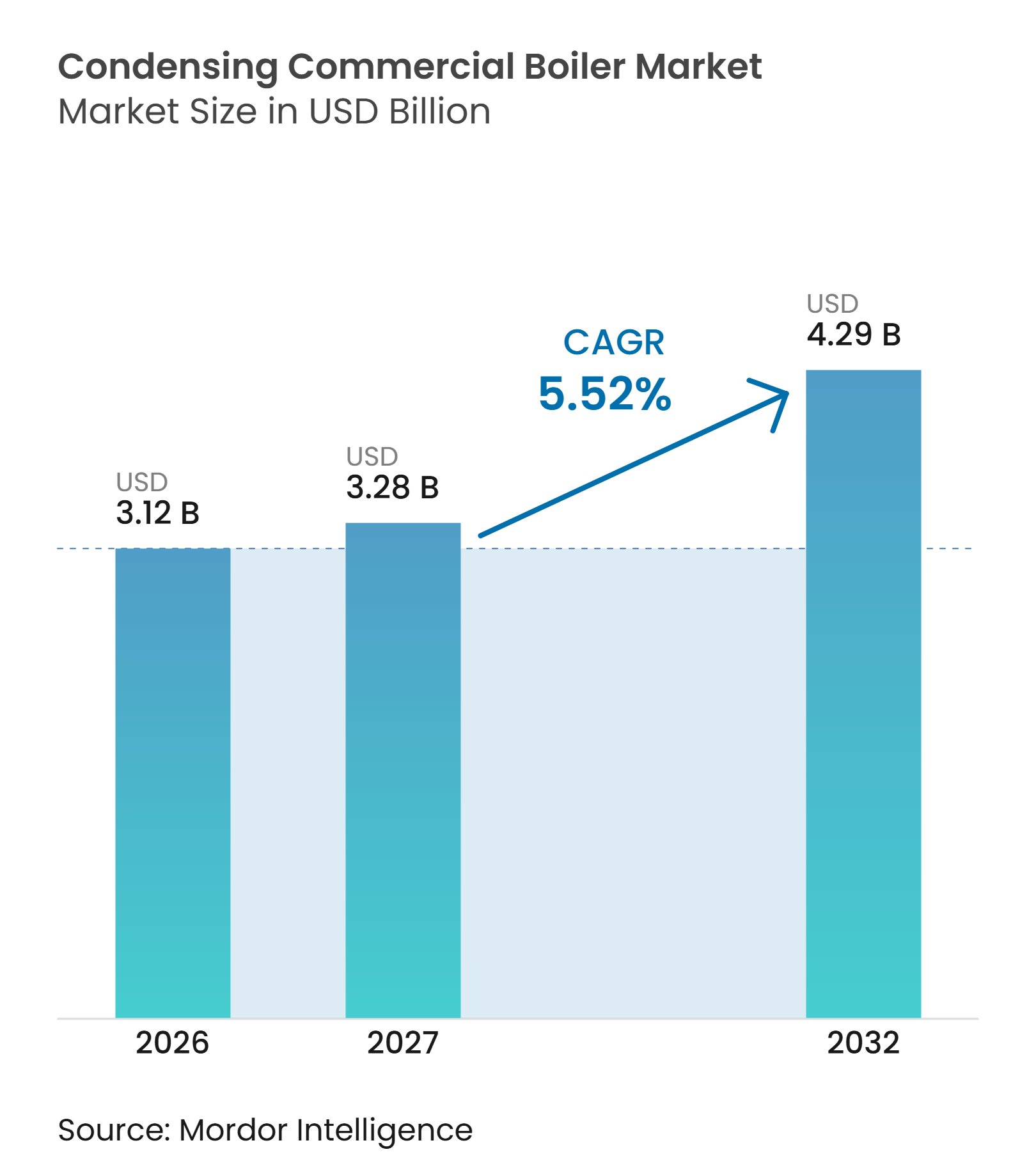
The Condensing Commercial Boiler Market size is valued at USD 3.12 billion in 2026 and is forecast to reach USD 4.29 billion by 2032, expanding at a CAGR of 5.52% over 2027-2032. Tighter efficiency rules, the replacement of aging commercial heating equipment, and demand from healthcare, hospitality, and educational facilities support adoption. Regulatory changes also widen the scope of retrofit work because boilers perform best when paired with lower-temperature distribution systems and suitable controls. Manufacturers are responding with modular units, digital monitoring, and fuel-flexible designs that can reduce operating costs or improve resilience for facility operators. Competition therefore depends not only on boiler performance, but also on local service capacity, commissioning support, the availability of replacement parts, and the ability to integrate equipment with building controls across a property's heating plant.
Key Report Takeaways
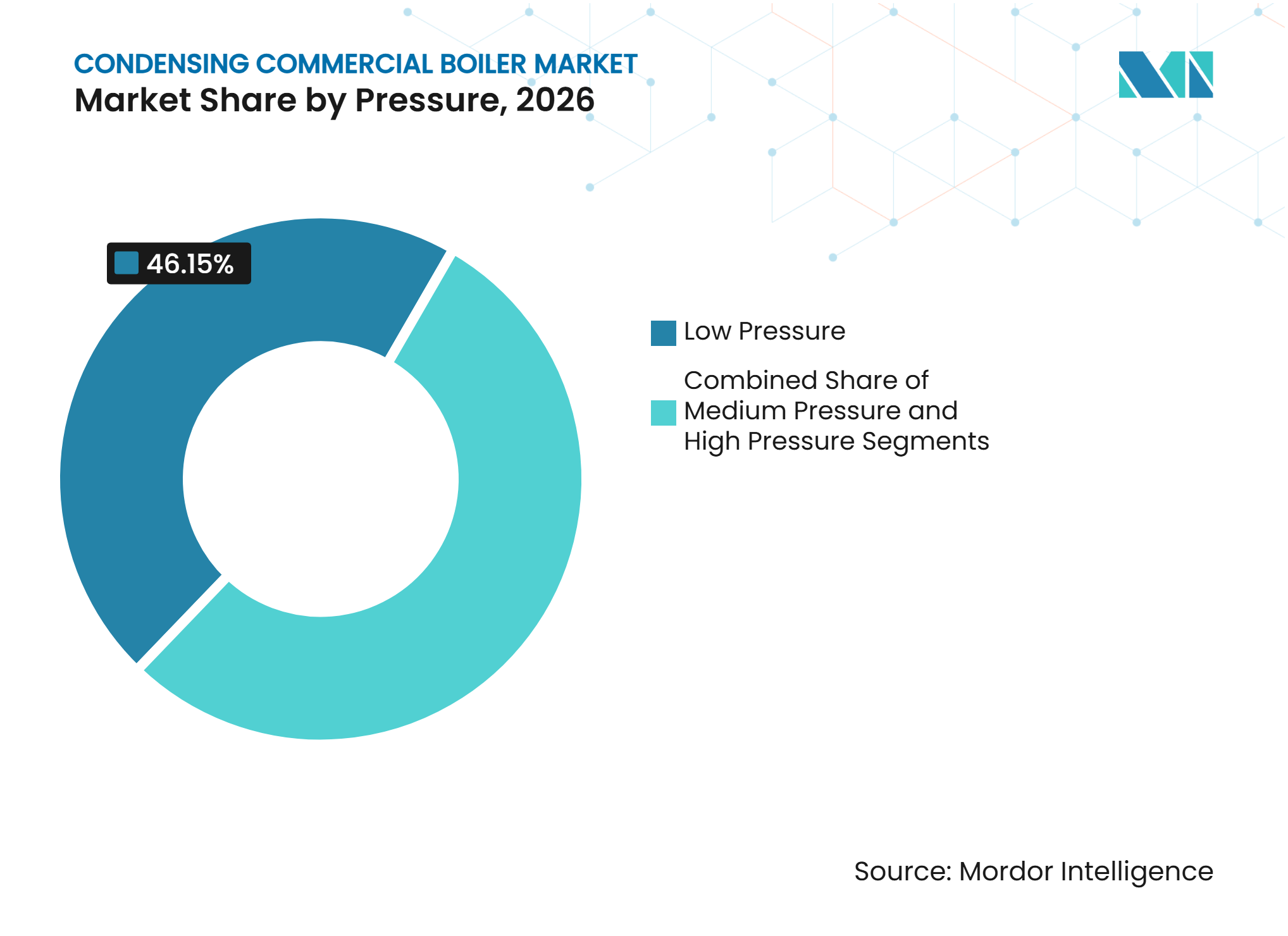
- By pressure, low-pressure systems held 46.15% of the condensing commercial boiler market in 2026 and are projected to record the highest CAGR of 5.87% through 2032.
- By stage and configuration, single-stage units held 55.18% revenue share in 2026, while multistage formats are projected to expand at a 5.92% CAGR through 2032.
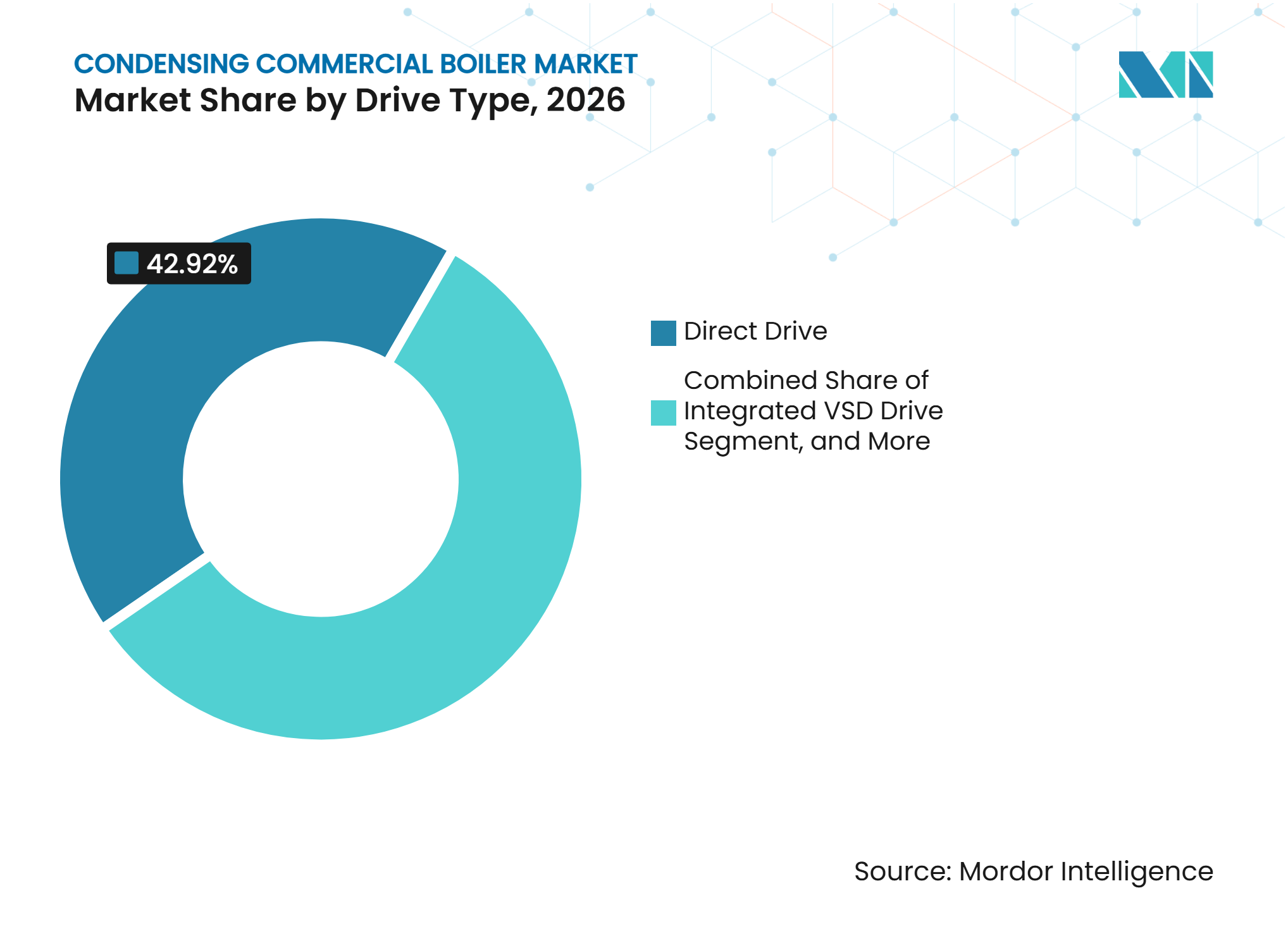
- By drive type, direct-drive systems held 42.92% revenue share in 2026, while integrated VSD drive systems are projected to expand at a 6.11% CAGR through 2032.
- By end-use industry, HVAC and commercial buildings accounted for 41.08% of the condensing commercial boiler market in 2026, while water and wastewater treatment is projected to expand at a 6.42% CAGR through 2032.
- By geography, North America held a 34.29% revenue share of the condensing commercial boiler market in 2026, while Asia-Pacific is projected to expand at a 6.23% CAGR through 2032.
Note: Market numbers in this report are based on Mordor Intelligence's proprietary estimation framework, which combines nine months of actuals with Q4 projections for base year 2026.
Market Trends and Insights
Drivers Impact Analysis of Condensing Commercial Boiler Market*
| Driver | (~) % Impact on CAGR Forecast | Geographic Relevance | Impact Timeline |
|---|---|---|---|
| Rising Commercial Building Replacement Demand | +1.4% | Global, concentrated in North America and Europe | Medium term (2-4 years) |
| Tightening Energy Efficiency and NOx Standards | +1.0% | North America and the EU, with spillover to Asia-Pacific | Short term (≤ 2 years) |
| High Energy Savings From Latent Heat Recovery | +0.8% | Global | Medium term (2-4 years) |
| Growth of Modular Cascade Systems in Space-Constrained Buildings | +0.6% | North America and Europe | Medium term (2-4 years) |
| Digital Boiler Controls and Predictive Maintenance | +0.4% | Global, with early gains in North America and Asia-Pacific industrial hubs | Long term (≥ 4 years) |
| Mission-Critical Heating Resilience Requirements | +0.3% | North America, Europe, and the Middle East | Long term (≥ 4 years) |
| Source: Mordor Intelligence | |||
Rising Commercial Building Replacement Demand
Replacement activity remains central to demand because many commercial and institutional facilities operate older heating equipment. Educational facilities, hospitals, municipal buildings, and hotels often replace boilers within planned capital programs rather than waiting for new construction. U.S. educational facility construction reached USD 138.1 billion in 2025, creating a continuing base for equipment specifications that meet energy codes and sustainability requirements. The U.S. Department of Energy Federal Energy Management Program requires 96% or higher combustion efficiency for certain large gas-fired hot-water boilers purchased for federal facilities. It also requires ENERGY STAR certification for covered commercial units rated from 300,000 to 2,500,000 Btu/hr. These procurement requirements influence specifications beyond federal projects and favor condensing equipment in the Condensing commercial boiler market.
The effect is strongest where building owners have established replacement budgets and technical staff. Schools, healthcare facilities, and municipal properties can assess lifecycle operating costs across many sites, which improves the case for higher-efficiency equipment. These buyers also need heating systems that can remain in service for long periods with predictable maintenance arrangements. New construction still matters, but it does not provide the same stable demand base in mature commercial property markets. A large installed base of legacy boilers therefore gives manufacturers and contractors recurring retrofit opportunities. The Condensing commercial boiler market benefits when replacement planning is tied to building upgrades, code compliance, and long-term facility operations.
Tightening Energy Efficiency and NOx Standards
Energy efficiency rules and air-quality requirements are changing how buyers evaluate gas-fired heating equipment. The U.S. Department of Energy delayed enforcement of commercial water-heating standards until October 6, 2027, but the underlying minimum thermal efficiency requirements remain in place. These requirements set a 95%-96% performance threshold for covered gas-fired commercial water-heating equipment. High-efficiency condensing systems are positioned to meet those requirements when installed and operated under suitable conditions. Federal procurement requirements also reinforce the same direction for public facilities. The Condensing commercial boiler market is therefore shaped by compliance decisions as well as equipment replacement needs.
California air-quality policy adds another consideration for new installations. The South Coast Air Quality Management District sets limits for NOx emissions through rules that affect boilers and water heaters. Buyers in other U.S. jurisdictions are also responding to low-NOx equipment requirements through product selection and system design. In Europe, Ecodesign requirements establish minimum seasonal space-heating efficiency thresholds for relevant products. These compliance factors increase the value of engineered systems that combine efficient combustion, appropriate controls, and emissions management. They also make regulatory knowledge an important part of the supplier offering in the Condensing commercial boiler market.
High Energy Savings From Latent Heat Recovery
Condensing boilers recover heat from water vapor in flue gas that conventional boilers normally release through the vent. This recovery occurs when return-water temperature falls below the relevant flue-gas dew point, which is near 55°C for many systems. Research on a deep-condensing waste-heat recovery system at the Baoneng Heating Plant found that the approach can recover additional thermal energy from boiler flue gas. The operating result depends on the entire hydronic system, not only the boiler itself. Return-water temperature, load profile, control settings, and heat-exchanger design all influence realized efficiency. These factors create an equipment and service opportunity within the Condensing commercial boiler market.
The U.S. National Renewable Energy Laboratory documentation for condensing gas boilers notes that lower entering-water temperatures support higher efficiency performance. Systems with return temperatures near 27°C can operate closer to their peak condensing range, while systems with 60°C returns capture a smaller share of the available benefit. Many retrofits therefore require changes to distribution temperatures, controls, or terminal equipment before the full efficiency advantage is available. Manufacturers can support this work through design guidance, sensor-based controls, and commissioning services. Performance-based maintenance contracts can also address poor operating conditions after installation. The Condensing commercial boiler market gains value when buyers assess boiler performance as part of the broader heating system.
Growth of Modular Cascade Systems in Space-Constrained Buildings
Modular cascade systems use several smaller boilers linked through a common hydronic arrangement and sequenced by controls. This arrangement allows capacity to be added while retaining part-load operation and service continuity. Riello introduced the Array V2.5 in March 2026 with input capacity from 800 MBH to 4,000 MBH and up to 320:1 cascade turndown across an eight-boiler configuration. The format is relevant to retrofit projects where large equipment cannot be moved through existing access routes. It can also reduce the need for major structural changes in mechanical rooms. These practical constraints support modular solutions in the Condensing commercial boiler market.
Ideal Commercial Boilers introduced a cascade configurator for the Imax Xtra 2 in 2026 to simplify system selection and site assembly. Standardized packages help contractors manage shorter installation windows and limited specialist availability. A Baxi project at Highlees Primary School replaced cast-iron boilers with a Remeha Gas 120 Ace cascade system and reported efficiency improvement over the displaced equipment.[1] Such projects show why schools and other occupied facilities value shorter shutdown periods. Modular designs also provide redundancy because individual units can be serviced while other units remain active. This supports adoption where reliability and space use are both procurement priorities.
Restraints Impact Analysis of Condensing Commercial Boiler Market*
| Restraint | (~) % Impact on CAGR Forecast | Geographic Relevance | Impact Timeline |
|---|---|---|---|
| High Retrofit Cost for Condensate Drainage and Venting | -0.8% | Global, acute in older North American and European building stock | Short term (≤ 2 years) |
| Heat-Pump Substitution in Low-Temperature Heating Projects | -0.6% | Europe and progressive U.S. states | Medium term (2-4 years) |
| Dependence on Low Return-Water Temperatures | -0.2% | Global | Long term (≥ 4 years) |
| Shortage of Commissioning and Hydronic-Controls Specialists | -0.2% | North America and Europe | Medium term (2-4 years) |
| Source: Mordor Intelligence | |||
High Retrofit Cost for Condensate Drainage and Venting
Condensing equipment requires drainage and venting arrangements that can handle acidic condensate. The condensate can have a pH from 3 to 5, so systems may need neutralization equipment and corrosion-resistant materials. Existing commercial installations often use venting that is unsuitable for a condensing replacement. Building owners may also need to alter vent routes, provide drainage slope, and fit piping within occupied multistory properties. These requirements increase project complexity and can defer voluntary replacement by smaller operators. The Condensing commercial boiler market therefore faces a practical retrofit barrier even when equipment efficiency is attractive.
The U.S. Department of Energy indicates that efficient large commercial gas-fired hot-water systems can remain cost-effective with capital premiums up to USD 95,651 in its lifecycle-cost analysis. However, smaller building owners may not conduct the engineering review needed to assess that lifecycle case. Older properties can also have aging piping, higher distribution temperatures, and controls that do not support accurate boiler sequencing. These conditions raise installation costs and can limit achievable condensing performance. Larger institutional owners are better able to manage these changes through capital programs and technical teams. This difference can widen adoption between large facility portfolios and smaller commercial accounts.
Heat-Pump Substitution in Low-Temperature Heating Projects
Heat pumps compete most directly with condensing boilers in projects that use low-temperature hydronic distribution. Offices, schools, and light commercial properties can be suitable for heat pumps when supply temperatures remain below 55°C. The International Energy Agency found that low-temperature industrial heat can be electrified in some cases, but energy costs remain an important constraint in markets with a wide electricity-to-gas price gap. This cost relationship influences the timing of electrification decisions. It also means that boiler replacement and heat-pump adoption do not follow a uniform pattern across locations. The Condensing commercial boiler market retains a role where gas systems remain cost-effective or where retrofit conditions constrain electrification.
CIBSE reporting on non-domestic buildings identifies capital cost, retrofit complexity, and the electricity-to-gas price gap as barriers to wider heat-pump deployment.[2] Some building owners continue to select condensing boilers even where support programs are available because project risk remains high. This does not remove the substitution risk, particularly in policy-led decarbonization programs. It encourages boiler suppliers to offer hybrid architectures, compatible controls, and products that can accommodate future fuel changes. Manufacturers with both boiler and heat-pump capabilities can address different project pathways. The resulting competition limits some near-term demand but also encourages broader heating-system strategies.
*Our forecasts treat driver/restraint impacts as directional, not additive. The impact forecasts reflect baseline growth, mix effects, and variable interactions.
Condensing Commercial Boiler Market Segment Analysis
By Pressure, Low-Pressure Systems Anchor Commercial Applications
Low-pressure systems held 46.15% of the Condensing commercial boiler market share in 2026 and are projected to expand at a 5.87% CAGR through 2032. Their position reflects broad use in commercial HVAC systems, hospitals, schools, hotels, and office properties. These applications typically have variable heating loads and can operate with return-water temperatures that support condensing performance. Low-pressure steam systems usually operate below 15 psi, while commercial hot-water systems operate below the higher pressures used for process steam. This makes the equipment suitable for space heating and service-water applications rather than heavy industrial duties. The Condensing commercial boiler industry relies heavily on these building applications because they create repeat demand from a large installed base.
Federal procurement rules reinforce this segment in public-sector projects. The U.S. Department of Energy Federal Energy Management Program specifies high combustion efficiency for relevant large gas-fired hot-water boilers. These requirements favor equipment that can meet performance benchmarks in schools, hospitals, and government buildings. Medium-pressure systems serve food processing, district heating, and certain light industrial operations with higher process-steam needs. High-pressure equipment remains important for cogeneration and heavy industrial steam, where boiler selection depends more on output requirements and process conditions. The Condensing commercial boiler market size for low-pressure applications benefits when retrofit designers lower system temperatures to improve operating efficiency. This design approach can make later substitution with high-temperature equipment less attractive.



By Stage and Configuration, Multistage Formats Lead Future Expansion
Single-stage units held 55.18% of revenue in 2026 because they meet the needs of many standard commercial heating projects. They are widely used where building owners value simple system integration, moderate turndown, and lower initial project complexity. Mid-size commercial retrofits often favor these units because commissioning is more straightforward than for more advanced arrangements. Single-stage products also support replacement projects with limited budgets and short shutdown windows. Their established installed base gives them a continuing role across the Condensing commercial boiler market. Cost, installer familiarity, and the existing hydronic layout remain important selection criteria.
Multistage formats are projected to expand at a 5.92% CAGR through 2032 as operators seek stronger part-load performance. Multiple condensing stages can improve heat extraction when controls and return-water temperature are properly managed. This change supports the Condensing commercial boiler market, where building operators are seeking lower fuel use without sacrificing heating reliability. Experimental research on deep-condensing systems reported that advanced heat-exchanger arrangements can achieve high thermal efficiency under favorable operating conditions. High-speed turbo configurations use premix combustion and compact heat-transfer designs for projects with space and emissions constraints. Integrally geared formats serve specialized process applications that need precise combustion management across a broad load range. Research on industrial boiler control identifies potential efficiency and emissions benefits from continuously optimized burner operation.[3] These configurations are more specialized, but they expand the technology choices available to contractors and facility managers.
By Drive Type, Variable-Speed Technology Redefines Combustion Efficiency
Direct-drive systems held a 42.92% revenue share in 2026, reflecting their mechanical simplicity and lower upfront cost. They remain common where heating loads are stable, and buyers do not require advanced fan modulation. Direct-drive equipment can suit standard commercial installations with routine maintenance practices and limited control-system integration. Its established position reflects the practical needs of many replacement projects. Belt-drive arrangements retain a role in older sites where physical constraints or legacy infrastructure complicate a direct replacement. However, belt maintenance and energy loss can make these systems less attractive in new projects.
Integrated VSD drive systems are projected to expand at a 6.11% CAGR through 2032, which is the fastest rate within this segmentation. A variable-speed drive allows combustion-air fans to adjust with boiler load and helps maintain the required air-to-fuel ratio. This can reduce fan energy use at partial load and support stable low-NOx operation. Advanced drives can gain traction as building automation becomes more common in institutional and industrial facilities. This supports the Condensing commercial boiler market as operators prioritize measured efficiency and responsive controls. Magnetic-bearing technology represents a smaller premium category for facilities where uptime is critical. A 2026 review of boiler intelligence found that sensor data and optimization tools can improve maintenance decisions, although practical application depends on data quality and sustained system management. Hospitals, data centers, and pharmaceutical facilities may value these features because unplanned heating interruptions can disrupt operations.

By End-Use Industry, HVAC Leads While Water Treatment Accelerates
HVAC and commercial buildings accounted for 41.08% of end-use demand in 2026, making this the largest end-use group. The group includes offices, hospitals, hotels, universities, and mixed-use properties. Equipment replacement is usually driven by age, energy costs, emissions requirements, and facility capital planning. These buyers often need flexible output to manage changes in occupancy and weather. They also place value on reliable service support because boiler downtime affects building operations. The Condensing commercial boiler market is closely linked to this end-use group because it provides a broad base of retrofit projects.
Water and wastewater treatment is projected to expand at a 6.42% CAGR through 2032. Municipal utilities use process heat for digestion, sludge handling, biological treatment, and other plant operations. This gives the Condensing commercial boiler market a route into public infrastructure projects that prioritize reliable energy use and automated operation. Mining and cement users require high-temperature steam for production processes, which limits the role of condensing configurations in primary heating. Steel, chemicals, and petrochemicals can use condensing equipment for heat recovery or auxiliary heating rather than core process loads. Food and beverage plants may use it in pasteurization, sanitation, and clean-in-place circuits where efficient thermal supply is valuable. Pulp and paper, construction, power generation, and other industries add project-based demand across the Condensing commercial boiler industry.
Geography Analysis
North America
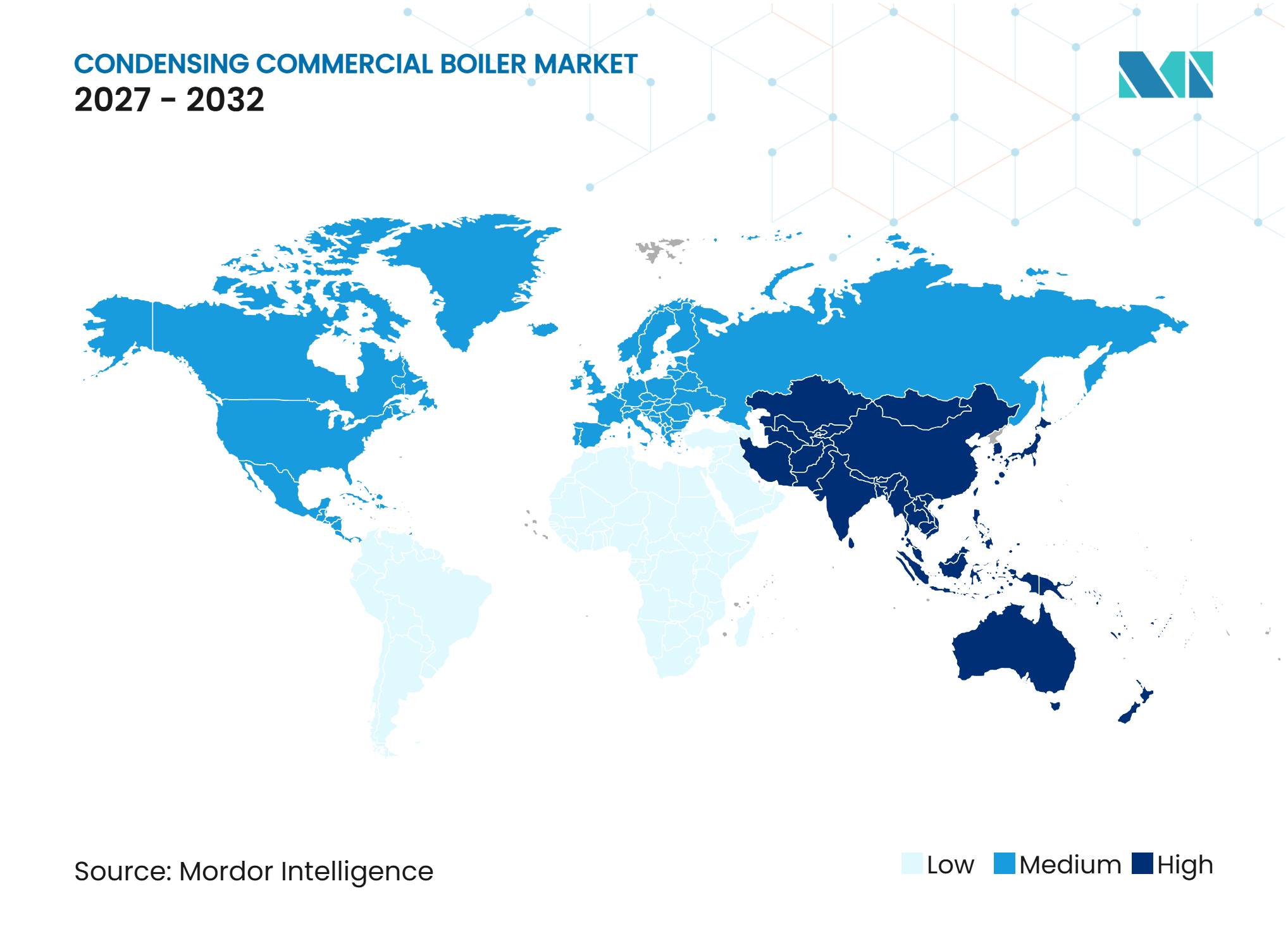
North America held 34.29% of the Condensing commercial boiler market share in 2026. The Condensing commercial boiler market in the region is supported by a large commercial and institutional building base, so replacement and retrofit work supports demand more consistently than new construction. Federal efficiency benchmarks, ENERGY STAR requirements, and state building standards shape equipment selection in the United States. New York Local Law 97 adds a carbon-performance consideration for large buildings, while California air-quality rules affect combustion equipment choices. A.O. Smith reported 13% year-over-year boiler sales expansion in North America during the third quarter of 2026 and raised its full-year growth outlook to 10%-12%. Canada’s carbon-pricing framework supports efficiency investment in commercial portfolios where natural gas remains the main heating fuel. Mexico adds demand through hospitality, healthcare, and food-processing investment, although its commercial heating base remains smaller than the United States and Canada.
Asia-Pacific
Asia-Pacific is projected to expand at a 6.23% CAGR through 2032, giving it the strongest regional rate in the Condensing commercial boiler market. China’s coal-to-gas and coal-to-electricity programs support modernization of district-heating systems in northern cities. India’s Energy Conservation Building Code sets energy-performance requirements for eligible commercial buildings and increases attention to HVAC efficiency.[4] Southeast Asian manufacturing expansion supports demand from food processing, textiles, and light industrial sites. Japan and South Korea are more replacement-oriented markets where aging equipment and emissions requirements sustain upgrades. KD Navien introduced a subscription-based boiler service model in South Korea in 2025, showing how service and uptime are becoming part of supplier differentiation. These conditions give the region a mix of industrial capacity growth, building investment, and technology-led replacement demand.
Europe, South America, and the Middle East and Africa
Europe remains a major revenue area because commercial and residential buildings require ongoing renovation. The Energy Performance of Buildings Directive requires member states to improve building energy performance and supports renovation of commercial and public stock. Germany, the United Kingdom, France, and Italy maintain substantial commercial replacement activity, although heating-policy changes can affect investment timing. BDR Thermea completed the acquisition of G.I. Holding in July 2026, adding commercial HVAC brands and capabilities to its portfolio. In the United Kingdom, the Public Sector Decarbonization Scheme and complex heat-pump retrofits influence the near-term mix of heating choices. South America is building demand in hospitality, healthcare, and food processing, with buyers generally favoring mid-range systems. In the Middle East and Africa, Saudi Arabia and the United Arab Emirates support demand through commercial infrastructure, healthcare facilities, industrial parks, and government procurement requirements. These mixed regions provide project-led opportunities rather than the broad installed-base replacement profile seen in North America and Europe.
Competitive Landscape
Market Concentration
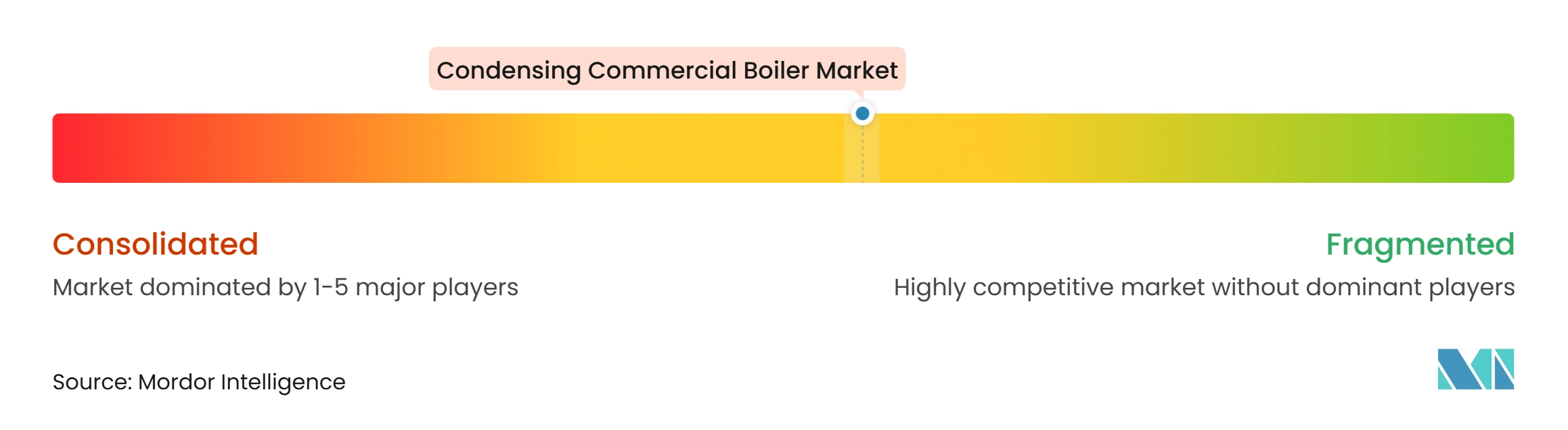
The Condensing commercial boiler market is moderately consolidated at the global platform level but fragmented by region and application. Viessmann, now part of Carrier Global, BDR Thermea Group, Vaillant Group, and Ariston Holding hold established positions through installed bases, dealer networks, and aftermarket support. Their portfolios increasingly combine boilers with digital controls, heat pumps, and connected services. BDR Thermea completed its full acquisition of G.I. Holding in July 2026, adding the CLINT, KTK, and NOVAIR brands to its commercial HVAC offering. The transaction strengthened its ability to serve customers seeking integrated building systems. This type of portfolio expansion gives major suppliers a wider response to electrification and retrofit demand.
Ariston Holding completed the acquisition of Riello Group in July 2026 for EUR 370 million (USD 418 million) in the supplied material. The transaction added a major burner and boiler specialist to Ariston’s thermal-system portfolio. Miura’s acquisition of Cleaver-Brooks has also led to a technical information-sharing center in Milwaukee focused on alternative heat energy and boiler-water treatment. These moves show that scale is being pursued through adjacent technologies, service capability, and regional reach rather than equipment volumes alone. Smaller regional manufacturers can remain relevant in specific applications, but compliance engineering and product development require sustained investment. This encourages further consolidation where suppliers need to meet efficiency and emissions requirements across multiple jurisdictions.
Connected service platforms are another competitive tool in the Condensing commercial boiler market. Cleaver-Brooks launched myBoilerRoom in February 2025, combining performance tracking, diagnostics, and remote optimization through its Prometha monitoring system. Miura introduced Connect Lite in November 2025 to extend remote monitoring to smaller boiler rooms at a lower hardware cost. These products can help suppliers maintain customer contact after the equipment sale and identify service needs before failures occur. Hydrogen-ready designs, customized water-treatment systems, and predictive service contracts remain areas of competition. Compliance with DOE procurement criteria and European Ecodesign requirements can favor suppliers with dedicated engineering resources. Regional specialists continue to compete through application knowledge, local service coverage, and replacement-project responsiveness.
Condensing Commercial Boiler Industry Leaders
-
Bosch Thermotechnology
-
Vaillant Group
-
Cleaver-Brooks
-
AERCO International, Inc.
-
Babcock & Wilcox Enterprises, Inc.
- *Disclaimer: Major Players sorted in no particular order
Condensing Commercial Boiler Market Companies Covered in this Report
- Bosch Thermotechnology
- Viessmann Group
- Vaillant Group
- A.O. Smith Corporation
- BDR Thermea Group B.V.
- Miura Co., Ltd.
- Cleaver-Brooks
- AERCO International, Inc.
- The Fulton Companies
- Babcock & Wilcox Enterprises, Inc.
- Ariston Holding N.V.
- Ferroli S.p.A.
- De Dietrich Thermique
- KD Navien Co., Ltd.
- Rinnai Corporation
- Bradford White Corporation
- Weil-McLain
- Burnham Holdings, Inc.
- Hurst Boiler & Welding Co, Inc.
- Thermax Limited
- Riello S.p.A.
- Parker Boiler Co.
Recent Industry Developments in Condensing Commercial Boiler Market
- October 2026: Cleaver-Brooks and R.F. MacDonald Co. completed their partnership agreement, integrating R.F. MacDonald's sales and service operations in California and Nevada into Cleaver-Brooks' national commercial boiler distribution network, expanding service capabilities in a state under strict NOx compliance enforcement.
- July 2026: BDR Thermea Group completed the full acquisition of Italy’s G.I. Holding, a commercial HVAC specialist with CLINT, KTK, NOVAIR, and MONTAIR brands, adding 300 employees and manufacturing facilities in Latisana, Ronchis, and Rivignano, in support of its Strategy 2030 integrated building solutions ambition.
- July 2026: Ariston Holding completed the acquisition of Riello Group, a major Italian burner and boiler specialist, for EUR 370 million (USD 418 million) in the supplied material, consolidating 2 of Italy’s established thermal-system brands and significantly expanding Ariston’s commercial heating and industrial burner portfolio.
- July 2026: The Ninth Circuit upheld SCAQMD Rule 1146.2’s zero-NOx standard for new appliance installations in new construction, establishing a binding legal precedent that Clean Air Act-based emissions regulations for boilers and heaters are not preempted by federal energy efficiency statutes under EPCA, a ruling with direct implications for boiler specification across 35 U.S. jurisdictions that have adopted similar standards.
Global Condensing Commercial Boiler Market Report Scope
The condensing commercial boiler refers to closed-vessel heating systems designed for commercial and institutional applications. These boilers utilize advanced heat-exchanger technology to capture latent heat from exhaust flue gases, converting water vapor into liquid condensate to achieve superior thermal efficiency and reduced greenhouse gas emissions.
The Condensing Commercial Boiler Market Report is Segmented by Pressure (High Pressure, Medium Pressure, and Low Pressure), Stage/Configuration (Single-Stage, Multistage, High-Speed Turbo, and Integrally Geared), Drive Type (Direct Drive, Belt Drive, Integrated VSD Drive, and Magnetic-Bearing Drive), End-use Industry (Mining, Cement, Pulp and Paper, Construction, Steel, Chemicals and Petrochemicals, Power Generation, Water and Wastewater Treatment, Food and Beverage, HVAC and Commercial Buildings, and Other End-use Industries), and Geography (North America, South America, Europe, Asia-Pacific, Middle East, and Africa). The Market Forecasts are Provided in Terms of Value (USD).
Segmentation Overview
| High Pressure |
| Medium Pressure |
| Low Pressure |
| Single-Stage |
| Multistage |
| High-Speed Turbo |
| Integrally Geared |
| Direct Drive |
| Belt Drive |
| Integrated VSD Drive |
| Magnetic-Bearing Drive |
| Mining |
| Cement |
| Pulp and Paper |
| Steel |
| Chemicals and Petrochemicals |
| Power Generation |
| Water and Wastewater Treatment |
| HVAC and Commercial Buildings |
| Other End-use Industries |
| North America | United States |
| Canada | |
| Mexico | |
| South America | Brazil |
| Argentina | |
| Rest of South America | |
| Europe | Germany |
| United Kingdom | |
| France | |
| Italy | |
| Russia | |
| Rest of Europe | |
| Asia-Pacific | China |
| Japan | |
| India | |
| South Korea | |
| ASEAN | |
| Rest of Asia-Pacific | |
| Middle East | Saudi Arabia |
| United Arab Emirates | |
| Turkey | |
| Rest of Middle East | |
| Africa | South Africa |
| Nigeria | |
| Rest of Africa |
| By Pressure | High Pressure | |
| Medium Pressure | ||
| Low Pressure | ||
| By Stage/Configuration | Single-Stage | |
| Multistage | ||
| High-Speed Turbo | ||
| Integrally Geared | ||
| By Drive Type | Direct Drive | |
| Belt Drive | ||
| Integrated VSD Drive | ||
| Magnetic-Bearing Drive | ||
| By End-use Industry | Mining | |
| Cement | ||
| Pulp and Paper | ||
| Steel | ||
| Chemicals and Petrochemicals | ||
| Power Generation | ||
| Water and Wastewater Treatment | ||
| HVAC and Commercial Buildings | ||
| Other End-use Industries | ||
| ByGeography | North America | United States |
| Canada | ||
| Mexico | ||
| South America | Brazil | |
| Argentina | ||
| Rest of South America | ||
| Europe | Germany | |
| United Kingdom | ||
| France | ||
| Italy | ||
| Russia | ||
| Rest of Europe | ||
| Asia-Pacific | China | |
| Japan | ||
| India | ||
| South Korea | ||
| ASEAN | ||
| Rest of Asia-Pacific | ||
| Middle East | Saudi Arabia | |
| United Arab Emirates | ||
| Turkey | ||
| Rest of Middle East | ||
| Africa | South Africa | |
| Nigeria | ||
| Rest of Africa | ||
Key Questions Answered in the Report
What is the 2026 size of the condensing commercial boiler sector?
The sector is valued at USD 3.12 billion in 2026 and is projected to reach USD 4.29 billion by 2032 at a 5.52% CAGR.
What is driving demand for condensing commercial boilers?
Replacement of aging equipment, tighter efficiency rules, NOx requirements, and institutional retrofit programs are the key factors.
Which pressure category leads commercial boiler demand?
Low-pressure systems held 46.15% share in 2026 and are projected to expand at a 5.87% CAGR through 2032.
Which end-use application is expanding fastest?
Water and wastewater treatment is projected to expand at a 6.42% CAGR through 2032, supported by process-heating needs in municipal facilities.
Which region has the strongest forecast for condensing commercial boilers?
Asia-Pacific is projected to expand at a 6.23% CAGR through 2032, supported by industrial growth and replacement demand.
How are suppliers differentiating their commercial boiler offerings?
Suppliers are adding modular systems, connected monitoring, predictive maintenance, hybrid heating options, and broader HVAC portfolios.