
Condensation Reagents Market Size and Share
Market Overview
| Study Period | 2021 - 2031 |
|---|---|
| Market Size (2026) | USD 1.27 Billion |
| Market Size (2031) | USD 1.71 Billion |
| Growth Rate (2026 - 2031) | 6.13 % |
| Fastest Growing Market | Asia-Pacific |
| Largest Market | North America |
| Market Concentration | Medium |
Major Players *Disclaimer: Major Players sorted in no particular order Image © Mordor Intelligence. Reuse requires attribution under CC BY 4.0. | |
Condensation Reagents Market Analysis by Mordor Intelligence
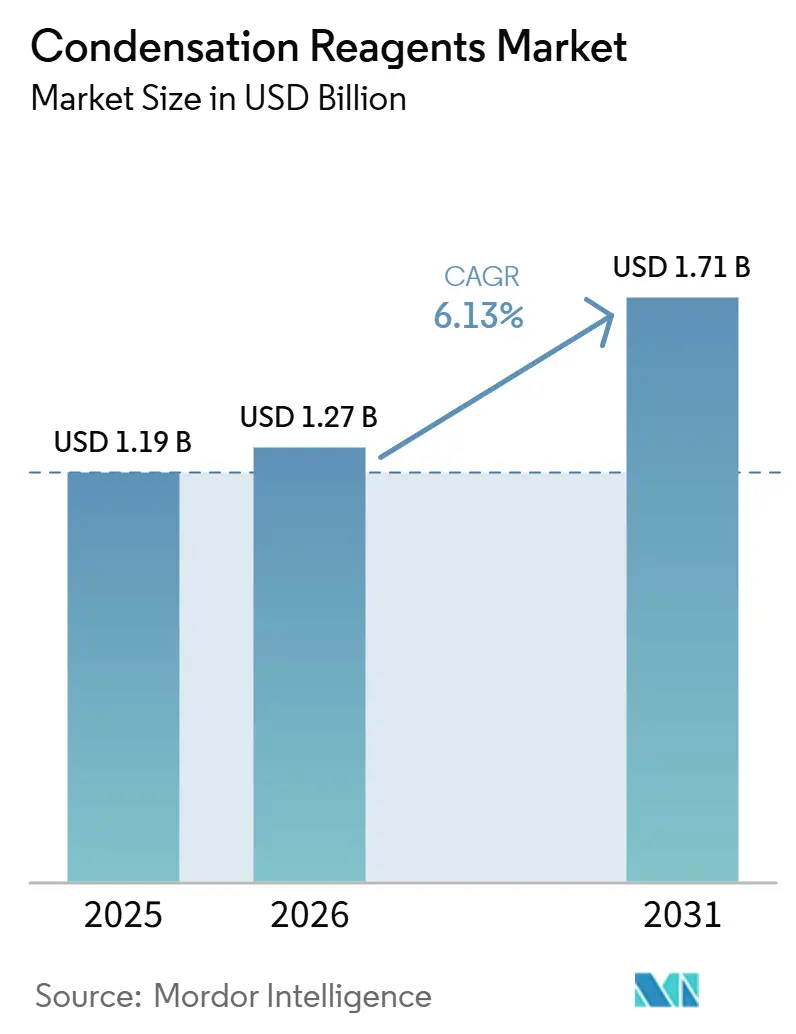
The Condensation Reagents Market size was valued at USD 1.19 billion in 2025 and is estimated to grow from USD 1.27 billion in 2026 to reach USD 1.71 billion by 2031, at a CAGR of 6.13% during the forecast period (2026-2031). The condensation reagents market is driven by the rapid commercial-scale-up of glucagon-like peptide-1 (GLP-1) receptor agonists, which require long peptide sequences and multiple high-purity coupling steps, thereby increasing reagent demand with each additional amino acid. Commercial peptide manufacturing depends on reliable peptide bond formation, making these reagents central to pharmaceutical supply chains, expanding peptide capacity. Safety concerns around legacy hydroxybenzotriazole (HOBt)-based systems are reshaping the market, as manufacturers shift toward alternative chemistries that address transport and handling concerns while supporting premium pricing. Automation provides additional support, as high-throughput and continuous synthesis lines favor validated powders and ready-to-dose solutions compatible with controlled dispensing systems. The primary near-term pressures on the market include raw material inflation, Asia-linked supply risks, and the capital required to transition away from older reagent systems that no longer meet evolving safety standards.
Key Report Takeaways
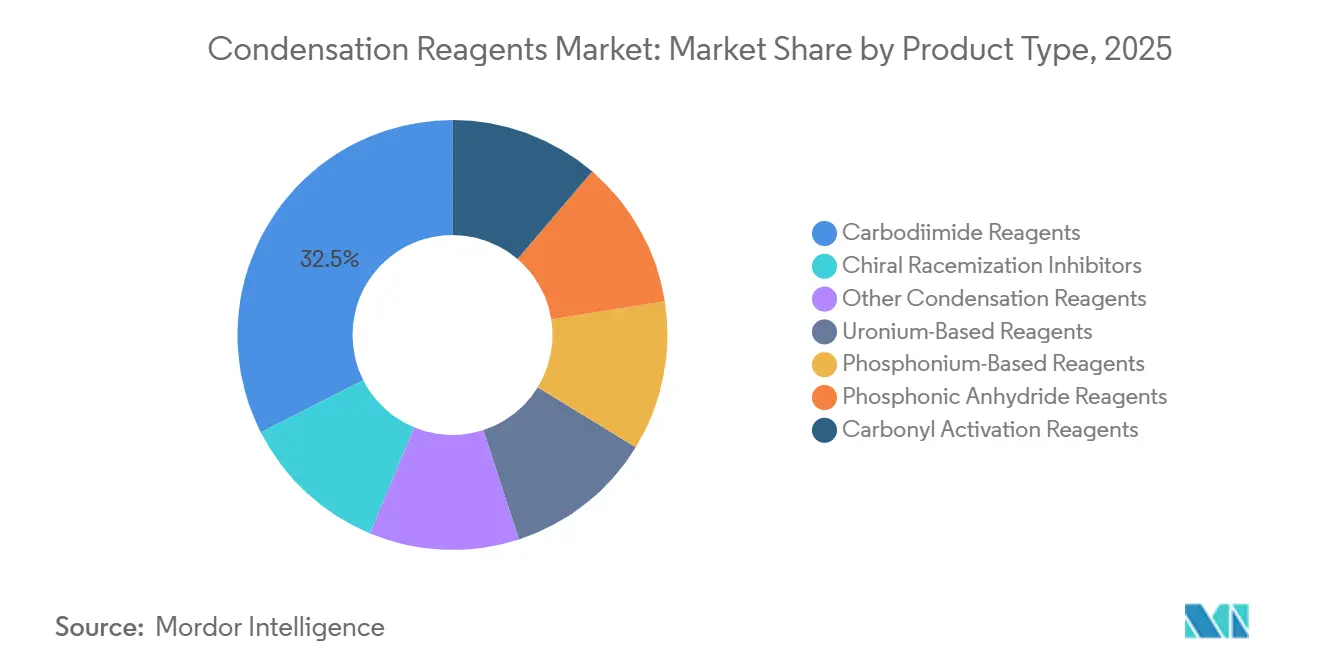
- By product type, carbodiimide reagents held 32.48% of the condensation reagents market share in 2025, while phosphonic anhydride reagents are forecast to expand at a 7.23% CAGR through 2031.
- By physical form, powder accounted for 58.71% of the value in 2025, while solution form is projected to record the fastest growth at a 6.84% CAGR through 2031.
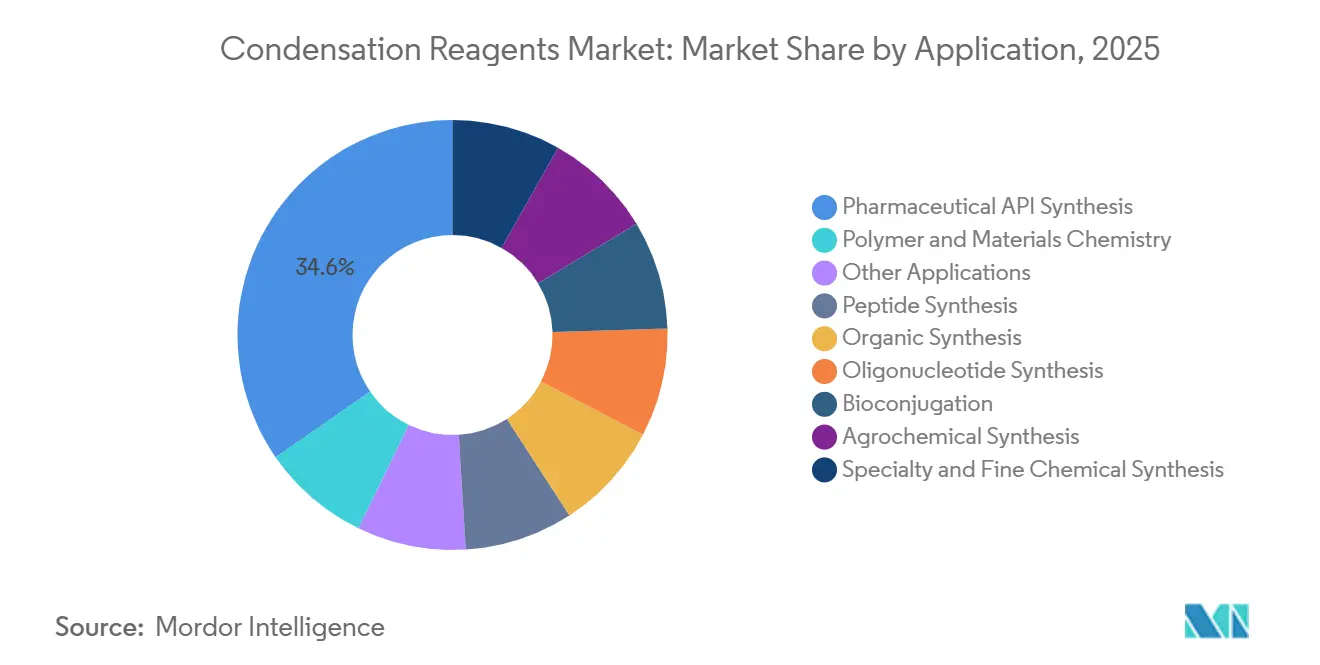
- By application, pharmaceutical API Synthesis accounted for 34.62% of the condensation reagents market in 2025, while peptide synthesis is forecast to grow at a 7.22% CAGR through 2031.
- By geography, North America accounted for 41.27% of the value in 2025, while the Asia-Pacific is forecast to grow at a 7.35% CAGR through 2031.
Note: Market size and forecast figures in this report are generated using Mordor Intelligence’s proprietary estimation framework, updated with the latest available data and insights as of January 2026.
Global Condensation Reagents Market Trends and Insights
Drivers Impact Analysis*
| Drivers | (~) % Impact on CAGR Forecast | Geographic Relevance | Impact Timeline |
|---|---|---|---|
| Rising Demand for Peptide-Based Therapeutics | +2.1% | Global, with concentrated effect in North America and Europe | Short term (≤ 2 years) |
| Increasing Pharmaceutical API Synthesis and Drug Development Activity | +1.4% | Global, pronounced in North America and APAC | Medium term (2-4 years) |
| Growing Adoption of High-Throughput and Automated Synthesis Platforms | +0.9% | North America, Europe, APAC core | Medium term (2-4 years) |
| Expansion of Contract Development and Manufacturing Organizations | +0.8% | Global, with the largest capacity additions in Europe and APAC | Long term (≥ 4 years) |
| Rising Demand for Specialty and Fine Chemical Synthesis | +0.5% | Global, with the fastest pull in APAC and Latin America | Medium term (2-4 years) |
| Source: Mordor Intelligence | |||
Rising Demand for Peptide-Based Therapeutics
The approval and commercial scale-up of Glucagon-like peptide-1 (GLP-1) receptor agonists has created a strong base for the condensation reagents market. Bachem invested CHF 332.6 million (~USD 411.67 million) in 2025 and opened Building K in Bubendorf in April 2026 for industrial-scale peptide and oligonucleotide API manufacturing. The company also planned capital expenditure (CAPEX) of more than CHF 400 million (~USD 495.10 million) for 2026, indicating continued expansion of peptide capacity rather than a one-time investment. Reagent demand rises sharply as peptide chains become longer, because each additional coupling cycle increases consumption per unit of output. This dynamic makes GLP-1 manufacturing a key near-term demand driver in the condensation reagents market.
Increasing Pharmaceutical API Synthesis and Drug Development Activity
The condensation reagents market is also benefiting from the broader outsourcing of API manufacturing to CDMOs, which are purchasing larger, more standardized reagent volumes. CordenPharma committed more than EUR 1 billion (~USD 1.14 billion) to its peptide platform through 2027, including a greenfield facility in Muttenz with more than 5,000 L of SPPS reactor capacity and a Colorado expansion planned to push the site beyond 42,000 L by 2028. This shift broadens the end-user base, as procurement moves away from branded drug developers and toward specialist manufacturers running standardized commercial workflows. API quality requirements under ICH Q11 and Q7 also raise documentation standards for reagent suppliers, strengthening certified suppliers and reducing the viability of lower-specification offerings. The result is a demand profile that is larger, more repeatable, and more quality-sensitive than earlier research-driven purchasing patterns.
Growing Adoption of High-Throughput and Automated Synthesis
Automated SPPS and continuous flow systems are changing how condensation reagents are supplied and consumed. Facilities running automated workflows prefer inputs with stable performance, narrow specifications, and dispensing formats that reduce manual handling. A 2026 Green Chemistry paper showed that resonant acoustic mixing enabled solvent-less amide coupling in SPPS and validated a 10-fold scale-up with lower reagent use and better process mass intensity. This supports the condensation reagents market by favoring validated lots, predictable shelf life, and supply partners capable of meeting GMP-grade expectations. Solution formats are gaining ground faster than powders in more automated environments.
Expansion of CDMOs and Specialty Chemical Manufacturing
The condensation reagents market is also supported by applications beyond core pharmaceutical demand, particularly in specialty and fine chemical synthesis. Research published by Bentham Science in 2026 highlighted T3P-mediated heterocyclic ring formation as an active area, extending the relevance of phosphonic anhydrides beyond peptide manufacturing. India is adding another layer of support, as its bulk drug PLI scheme had commissioned 38 greenfield projects across 28 critical products by December 2025. Actual investment reached INR 48,140 million (~USD 498.55 million), indicating that domestic capacity build-out had moved from planning to execution[1]Press Information Bureau of India, “APIs Imports from China,” PIB Government of India, pib.gov.in . As more complex molecules move into local production, demand for specialty synthesis inputs is expected to remain firm across pharmaceutical and adjacent chemical applications.
Restraints Impact Analysis*
| Restraints | (~) % Impact on CAGR Forecast | Geographic Relevance | Impact Timeline |
|---|---|---|---|
| High Cost of Advanced Condensation Reagents | -1% | Global, most acute in price-sensitive APAC and Latin America | Medium term (2-4 years) |
| Safety and Handling Challenges with Legacy Reagent Chemistries | -0.8% | Global, with the strongest regulatory pressure in North America and the EU | Short term (≤ 2 years) |
| Availability of Alternative Coupling Approaches | -0.5% | Global, with emerging impact concentrated in North America and Europe, R&D settings | Long term (≥ 4 years) |
| Source: Mordor Intelligence | |||
High Cost of Advanced Condensation Reagents
Advanced coupling agents remain costly, limiting the expansion of the condensation reagents market into price-sensitive applications. A 2025 Springer paper on liraglutide synthesis described TBEC as a safer and greener substitute for DIC, while noting that the newer route carried a higher unit cost than conventional DIC and Oxyma combinations. That cost gap is less significant for high-volume GLP-1 producers, as they can spread premium reagent costs across large commercial batches. However, it is a more significant constraint for smaller biotechs, academic groups, and generic Active Pharmaceutical Ingredient (API) users operating under tighter budget constraints. This divide suppresses mid-market demand even as premium pharmaceutical demand remains strong.
Safety and Handling Challenges
Legacy systems based on HOBt and HOAt continue to create safety and handling pressure for the condensation reagents market. Veranova stated in a 2025 white paper that HOBt's classification as an explosive material had restricted its availability and accelerated the shift toward safer OxymaPure-based replacements such as COMU and PyOxim. The American Chemical Society (ACS) Green Chemistry Institute Pharmaceutical Roundtable also identifies safety concerns in peptide synthesis tied to these reagent families, which keep attention on storage, transport, and process design. The common DIC and OxymaPure combination can also generate trace amounts of HCN during amide coupling, complicating approvals for larger-scale manufacturing[2]ACS Green Chemistry Institute Pharmaceutical Roundtable, “Peptide Synthesis Safety Topics,” ACS GCIPR Reagent Guides, reagents.acsgcipr.org . These issues increase the capital and compliance burden for new capacity additions and favor suppliers that support safer operating conditions.
*Our forecasts treat driver/restraint impacts as directional, not additive. The impact forecasts reflect baseline growth, mix effects, and variable interactions.
Segment Analysis
By Product Type: Phosphonic Anhydride Disrupts a Carbodiimide-Anchored Market
Carbodiimide reagents held 32.48% of the condensation reagents market share in 2025, maintaining their position as the largest product group due to cost efficiency and broad synthetic utility. DIC, DCC, and EDC remain deeply embedded in standard solid-phase peptide synthesis (SPPS) and solution-phase workflows across research, clinical, and commercial settings. Their installed base remains large because many users value familiar handling, broad substrate compatibility, and lower cost compared to newer systems. Uronium-based reagents also retain a meaningful role in demanding sequences where fast coupling and racemization control are important.
Phosphonic anhydride reagents are forecast to grow at a 7.23% CAGR through 2031, making them the fastest-growing product group in the condensation reagents market. Propylphosphonic anhydride (T3P) has gained ground because it generates water-soluble byproducts, simplifies workup, and supports greener process design at scale. Organic Letters reported in 2026 that Cyclover-assisted liquid-phase peptide synthesis (LPPS) using T3P demonstrated commercial relevance under mild conditions with strong isolated yields. Chiral racemization inhibitors and carbonyl activation reagents remain smaller categories, but they serve growing needs in stereoselective pharmaceutical synthesis, oligonucleotide assembly, and bioconjugation workflows.



By Physical Form: Solution Form Gains on Automation Trends
Powder reagents accounted for 58.71% of the market value in 2025, maintaining their position as the largest physical form in the condensation reagents market. This is supported by strong shelf life under controlled storage conditions, simpler shipping practices, and compatibility with manual weighing in research and clinical-scale settings. Powder also suits operations with smaller batch sizes and non-continuous reagent use. A broad supplier base further supports the category, as buyers can source standard powder grades from several established vendors.
Solution form is projected to grow at a 6.84% CAGR through 2031, making it the fastest-growing format in the condensation reagents market. Ready-to-dose liquids reduce operator exposure, lower weighing error risk, and are more compatible with automated dispensing equipment than solid charging steps. Green Chemistry highlighted T3P as a solution product supplied at 50% concentration in several solvents, which aligns with the shift toward more controlled dosing systems. ACS Sustainable Chemistry and Engineering also showed in 2026 that MP-LPPS protocols using TBDC salts and OxymaPure improved atom economy and eliminated chlorinated solvents, reinforcing the case for solution-based sustainable process design.
By Application: Peptide Synthesis Accelerates Past the Pharma API Baseline
Pharmaceutical API synthesis accounted for 34.62% of the condensation reagents market in 2025, making it the largest application area. This reflects the central role of amide bond formation in both classical small-molecule routes and more complex peptide manufacturing. API production requirements also demand close control over reagent-linked impurities, underscoring the need for certified suppliers with stable documentation.
Peptide synthesis is forecast to expand at a 7.22% CAGR through 2031, making it the fastest-growing application in the condensation reagents market. This growth reflects sustained additions to SPPS and LPPS capacity, particularly for long therapeutic peptides. Oligonucleotide synthesis provides additional support, as H-phosphonate routes depend on activating systems that include carbodiimide and related condensation chemistries. Organic synthesis, agrochemical synthesis, and specialty chemical applications provide a steadier baseline, helping balance demand concentration in pharmaceutical applications.
Geography Analysis
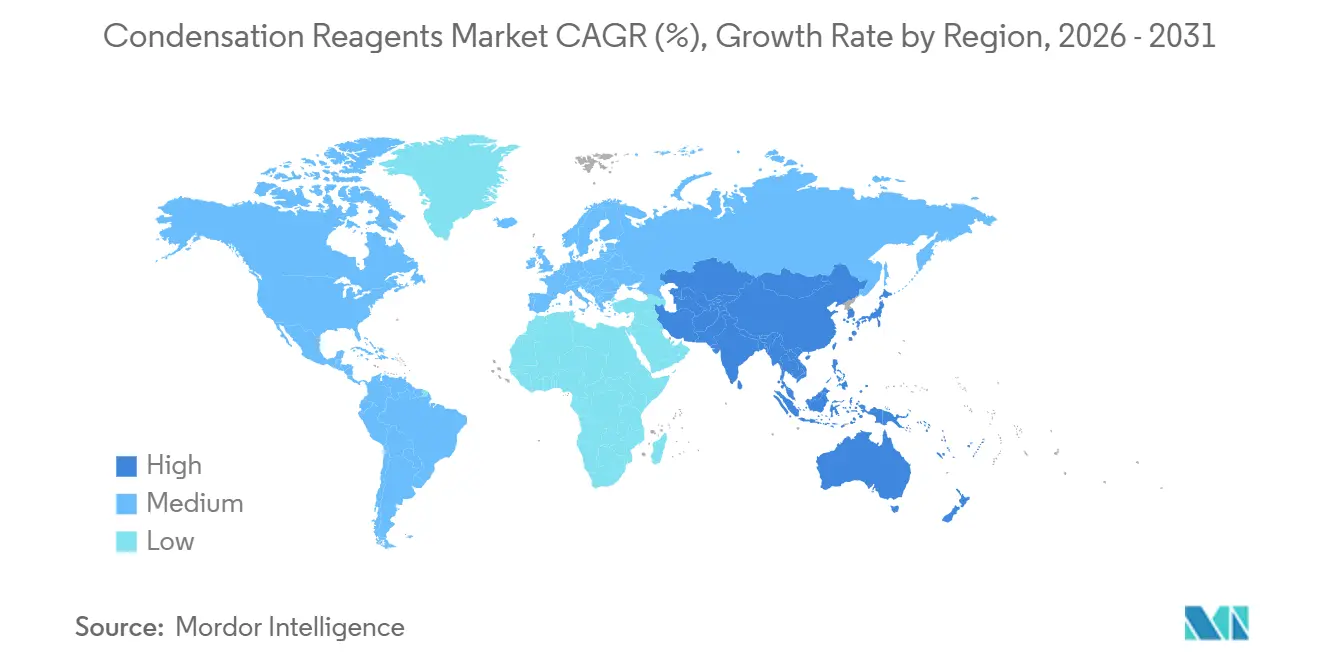
North America held 41.27% of the condensation reagents market share in 2025, making it the largest regional contributor. The region benefits from a dense cluster of innovator drug companies, a large base of contract development and manufacturing organizations (CDMOs), and research institutions that consume reagents from early development through commercial production. The United States remains the core demand center, while Canada contributes through its biotech activity and research capacity. In March 2026, CordenPharma and BioMed Realty expanded a peptide development laboratory in Boulder, adjacent to an existing large-scale peptide manufacturing site, indicating that North American peptide infrastructure continues to expand.
Asia-Pacific is projected to grow at a 7.35% CAGR through 2031, making it the fastest-growing geography in the condensation reagents market. India represents a significant part of that growth, supported by the government's bulk drug production-linked incentive (PLI) scheme, which commissioned 38 projects across 28 critical products by December 2025. The same program established 56,800 t per annum of domestic capacity, supporting a broader local base for API-oriented synthesis inputs. Regional momentum is further driven by ongoing manufacturing expansion across China, Japan, and South Korea, keeping Asia-Pacific relevant for both demand growth and supply positioning. Japan remains a technically demanding market where high compliance expectations support demand for premium reagent grades.
Europe remains a sizeable and technically demanding part of the condensation reagents market, with Germany, France, and the United Kingdom representing the largest national markets in the region. Germany benefits from a strong base in fine and specialty chemicals, which supports domestic production capabilities and specialist reagent supply. Switzerland is also notable, as Bachem is expanding its industrial peptide and oligonucleotide infrastructure there, with planned capital expenditure of more than CHF 400 million (~USD 495.10 million) for 2026. The Rest of the World remains smaller in absolute size, but early pharmaceutical development in parts of South America and the Middle-East is creating a modest base for future demand.

Competitive Landscape
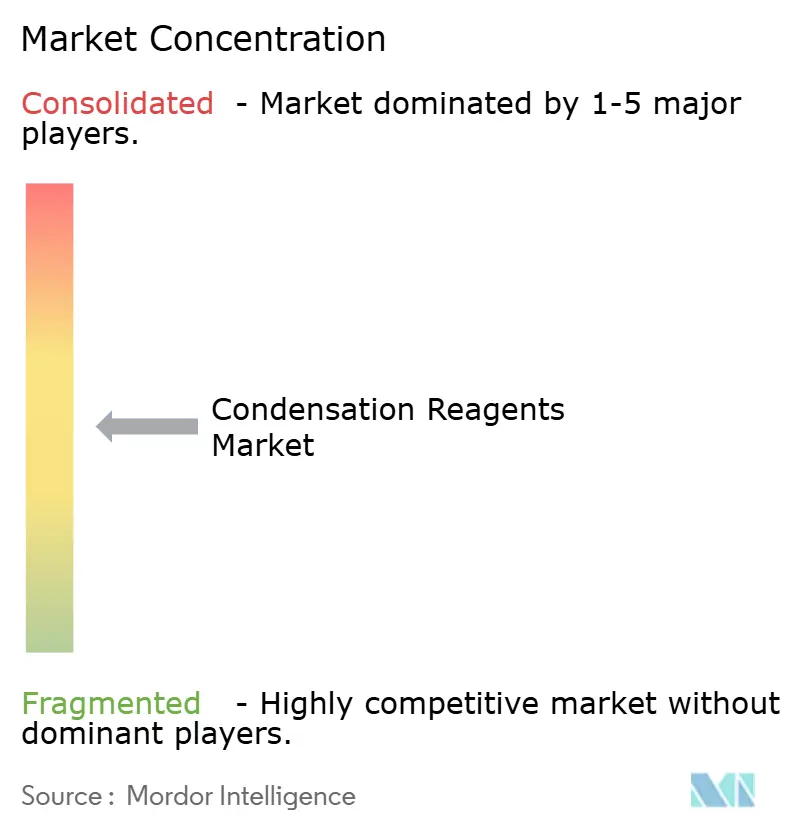
The condensation reagents market is moderately fragmented. Merck KGaA through MilliporeSigma, Thermo Fisher Scientific, and IRIS Biotech GmbH hold visible positions based on brand strength, broad portfolios, and established distribution reach. A second tier of regional specialists, including GL Biochem, Suzhou Highfine Biotech, and Enamine, compete primarily on pricing and narrower catalog depth. For pharmaceutical applications, buyers place greater weight on technical performance, supply reliability, and the quality of regulatory documentation than on price alone. Merck also benefits from its peptide coupling reagent selection guide, which influences buying decisions and reinforces its standing among research and production customers.
Strategic activity in the condensation reagents market is increasingly focused on aligning with peptide manufacturing capacity rather than on catalog expansion. Bachem opened Building K in April 2026 for industrial-scale peptide and oligonucleotide API manufacturing, strengthening its position in high-growth therapeutic modalities. Bachem also outlined USD 250 million in U.S. capacity investments for 2026-2030 in its January 2026 investor presentation, indicating that companies are linking future growth to larger production footprints. CordenPharma expanded its Boulder laboratory in March 2026, connecting peptide development capabilities more closely to nearby manufacturing scale. These moves indicate that scale, process control, and integration with peptide output are becoming more important competitive factors.
Opportunity remains in safer, greener reagent systems, as no supplier has clearly established dominance in the GMP-ready, HOBt-free segment of the condensation reagents market. Veranova's 2025 paper on peptide coupling reagents highlighted that safer alternatives such as COMU and PyOxim are gaining attention as long-term replacements for more hazardous legacy systems. Peer-reviewed work on TBEC, TBDC, and T3P further indicates that innovation is moving toward lower-risk and more sustainable process chemistry. Pricing pressure from Asian fine chemical producers on more commoditized reagent lines is also prompting established suppliers to defend margins through compliance support, application guidance, and validated quality systems.
Condensation Reagents Industry Leaders
Merck KGaA
Thermo Fisher Scientific Inc.
GL Biochem (Shanghai) Ltd.
CordenPharma
Bachem Inc.
- *Disclaimer: Major Players sorted in no particular order

Recent Industry Developments
- April 2026: Bachem inaugurated Building K in Bubendorf to expand large-scale production of active pharmaceutical ingredients (APIs), with the facility designed for industrial-scale peptide and oligonucleotide API manufacturing.
- March 2026: CordenPharma and BioMed Realty expanded CordenPharma's peptide development laboratory at Flatiron Park in Boulder, Colorado, adjacent to the company's existing large-scale peptide manufacturing facility. This expansion strengthened the CDMO's integrated peptide-to-injectable development capabilities in North America.


Global Condensation Reagents Market Report Scope
Condensation reagents are chemical substances that facilitate reactions in which two molecules combine to form one larger molecule, typically accompanied by the loss of a small byproduct such as water, alcohol, or HCl. By activating reacting groups in situ, these reagents enable rapid and efficient bond formation.
The condensation reagents market is segmented by product type, physical form, application, and geography. By product type, the market is segmented into carbodiimide reagents, uronium-based reagents, phosphonium-based reagents, phosphonic anhydride reagents, carbonyl activation reagents, chiral racemization inhibitors, and other condensation reagents. By physical form, the market is segmented into powder, solution, and other forms. By application, the market is segmented into peptide synthesis, pharmaceutical api synthesis, organic synthesis, oligonucleotide synthesis, bioconjugation, agrochemical synthesis, specialty and fine chemical synthesis, polymer and materials chemistry, and other applications. The report also covers market size and forecasts for condensation reagents across 11 countries in major regions. The market sizes and forecasts are provided in terms of value (USD).
| Carbodiimide Reagents |
| Uronium-Based Reagents |
| Phosphonium-Based Reagents |
| Phosphonic Anhydride Reagents |
| Carbonyl Activation Reagents |
| Chiral Racemization Inhibitors |
| Other Condensation Reagents |
| Powder |
| Solution |
| Other Forms |
| Peptide Synthesis |
| Pharmaceutical API Synthesis |
| Organic Synthesis |
| Oligonucleotide Synthesis |
| Bioconjugation |
| Agrochemical Synthesis |
| Specialty and Fine Chemical Synthesis |
| Polymer and Materials Chemistry |
| Other Applications |
| Asia-Pacific | China |
| India | |
| Japan | |
| South Korea | |
| Rest of Asia-Pacific | |
| North America | United States |
| Canada | |
| Europe | Germany |
| United Kingdom | |
| France | |
| Italy | |
| Russia | |
| Rest of Europe | |
| Rest of the World | South America |
| Middle-East and Africa |
| By Product Type | Carbodiimide Reagents | |
| Uronium-Based Reagents | ||
| Phosphonium-Based Reagents | ||
| Phosphonic Anhydride Reagents | ||
| Carbonyl Activation Reagents | ||
| Chiral Racemization Inhibitors | ||
| Other Condensation Reagents | ||
| By Physical Form | Powder | |
| Solution | ||
| Other Forms | ||
| By Application | Peptide Synthesis | |
| Pharmaceutical API Synthesis | ||
| Organic Synthesis | ||
| Oligonucleotide Synthesis | ||
| Bioconjugation | ||
| Agrochemical Synthesis | ||
| Specialty and Fine Chemical Synthesis | ||
| Polymer and Materials Chemistry | ||
| Other Applications | ||
| By Geography | Asia-Pacific | China |
| India | ||
| Japan | ||
| South Korea | ||
| Rest of Asia-Pacific | ||
| North America | United States | |
| Canada | ||
| Europe | Germany | |
| United Kingdom | ||
| France | ||
| Italy | ||
| Russia | ||
| Rest of Europe | ||
| Rest of the World | South America | |
| Middle-East and Africa | ||


Key Questions Answered in the Report
What is current market size of Condensation Reagents Market?
The Condensation Reagents Market size was valued at USD 1.19 billion in 2025 and is estimated to grow from USD 1.27 billion in 2026 to reach USD 1.71 billion by 2031, at a CAGR of 6.13% during the forecast period (2026-2031).
Which product group leads sales today?
Carbodiimide reagents led product demand with a 32.48% share in 2025 because they remain cost-efficient and widely used across standard synthesis workflows.
Which product category is growing the fastest?
Phosphonic anhydride reagents are forecast to grow at a 7.23% CAGR through 2031, supported by propylphosphonic anhydride (T3P)-based green chemistry and easier process workup.
Why are peptide drugs so important for reagent demand?
Glucagon-Like Peptide-1 (GLP-1) and other peptide therapeutics require multiple coupling cycles, so longer peptide chains increase reagent consumption and support sustained purchasing by peptide manufacturers.
Page last updated on:





