
Computational Imaging Systems For Industrial Inspection Market Size and Share
Market Overview
| Study Period | 2020 - 2031 |
|---|---|
| Market Size (2026) | USD 1.11 Billion |
| Market Size (2031) | USD 2.06 Billion |
| Growth Rate (2026 - 2031) | 13.23 % |
| Fastest Growing Market | Asia-Pacific |
| Largest Market | Asia-Pacific |
| Market Concentration | Medium |
Major Players *Disclaimer: Major Players sorted in no particular order Image © Mordor Intelligence. Reuse requires attribution under CC BY 4.0. | |
Computational Imaging Systems For Industrial Inspection Market Analysis by Mordor Intelligence
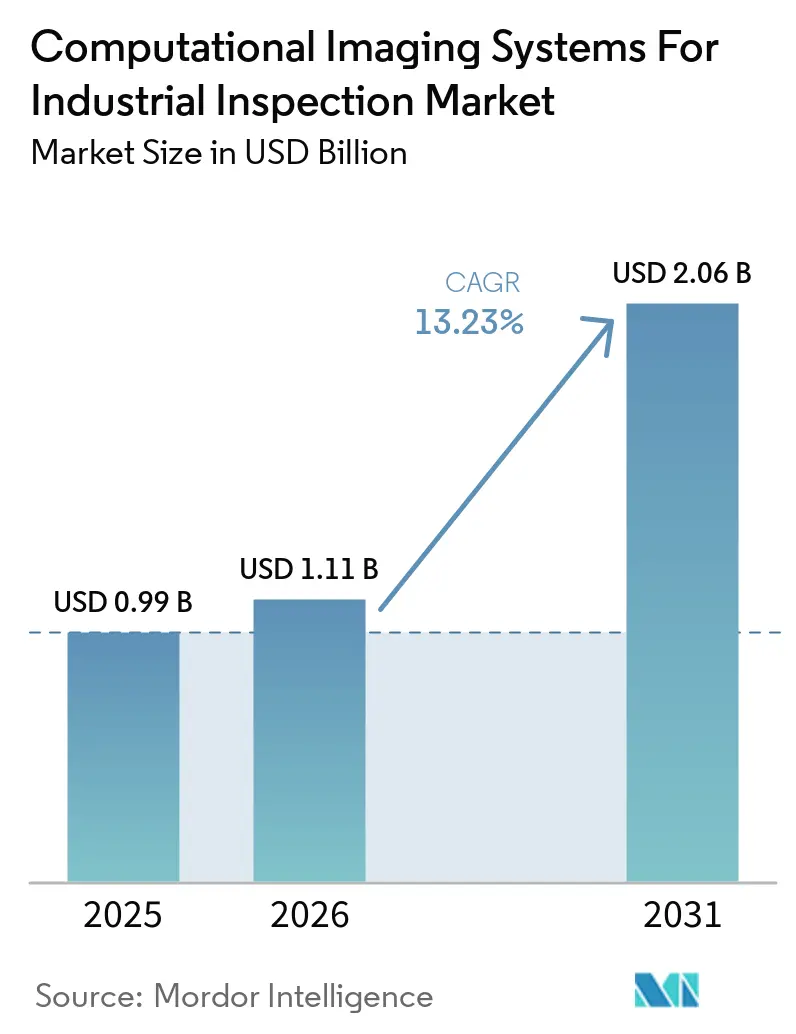
The Computational imaging systems for industrial inspection market size is projected to expand from USD 0.99 billion in 2025 and USD 1.11 billion in 2026 to USD 2.06 billion by 2031, registering a CAGR of 13.23% between 2026 to 2031. Demand is moving from rule-based machine vision toward imaging platforms that combine physics-based methods with algorithms. These systems let manufacturers assess material composition, subsurface geometry, and process deviations from one inline platform. Factory automation is making periodic sampling less practical as production lines require continuous verification. Digital Product Passport requirements in Europe also increase the value of machine-generated production records. Suppliers are responding with embedded AI, edge processing, software platforms, and broader inspection coverage.
Key Report Takeaways
- By imaging modality, Computational 2D and 3D Machine Vision held 34.18% of the Computational imaging systems for industrial inspection market share in 2025, while Coded-Aperture, Compressive and Lensless Imaging is projected to expand at a 13.78% CAGR through 2031.
- By offering, Imaging Hardware held 42.63% of the market share in 2025, while Imaging Software is projected to expand at a 13.69% CAGR through 2031.
- By inspection dimension, Three-Dimensional Inspection held 48.21% of the market share in 2025, while Four-Dimensional and Time-Resolved Inspection is projected to expand at a 14.11% CAGR through 2031.
- By inspection type, Surface Defect Inspection held 30.47% of the market share in 2025, while Structural Integrity and Failure Analysis is projected to expand at a 13.94% CAGR through 2031.
- By end-user industry, Automotive and Electric Vehicles held 24.36% of the market share in 2025, while Semiconductor and Electronics is projected to expand at a 13.86% CAGR through 2031.
- By deployment, Inline and In-Process Systems held 55.12% of the market share in 2025, while Remote and Cloud-Connected Inspection Systems are projected to expand at a 13.92% CAGR through 2031.
- By geography, Asia-Pacific held 38.29% of the Computational imaging systems for industrial inspection market share in 2025 and is projected to expand at a 14.14% CAGR through 2031.
Note: Market size and forecast figures in this report are generated using Mordor Intelligence’s proprietary estimation framework, updated with the latest available data and insights as of January 2026.
Market Trends and Insights
Drivers Impact Analysis of Computational Imaging Systems For Industrial Inspection Market*
| Driver | (~) % Impact on CAGR Forecast | Geographic Relevance | Impact Timeline |
|---|---|---|---|
| Industry 4.0 Adoption and Factory Automation | +3.2% | Global, concentrated in North America, Europe, and Asia-Pacific | Medium term (2-4 years) |
| Rising Demand for Non-Destructive Quality Assurance | +2.6% | Global, with early gains in Asia-Pacific and North America | Short term (≤ 2 years) |
| Semiconductor, Electric Vehicle and Additive Manufacturing Complexity | +2.3% | Asia-Pacific core, with spillover to North America and Europe | Short term (≤ 2 years) |
| Integration of Artificial Intelligence and Edge Computing | +2.1% | Global, with fastest adoption in North America and East Asia | Medium term (2-4 years) |
| Digital Product Passports and Traceability Requirements | +1.4% | Europe-led, with spillover to North American and Asia-Pacific export manufacturers | Short term (≤ 2 years) |
| Shift Toward Inline Multimodal Inspection | +1.1% | Global, with early traction in automotive and semiconductor hubs | Long term (≥ 4 years) |
| Source: Mordor Intelligence | |||
Industry 4.0 Adoption and Factory Automation
Every additional robot on a production line creates a corresponding need for dimensional verification, alignment checks, and defect detection. The International Federation of Robotics reported that the global stock of operating industrial robots reached 4.28 million units in 2024. This total represented a 10% year-over-year increase, while annual installations exceeded 500,000 units for the third consecutive year. Asia accounted for 70% of newly deployed robots in 2023, compared with 17% in Europe and 10% in the Americas.[1] Robot-dense plants produce inspection volumes that exceed human capacity and make complete inline verification necessary. VDMA data cited in Basler AG’s recent results showed a year-over-year increase in German image-processing-component order intake through the middle of the year. The computational imaging systems for industrial inspection market benefits when machine builders include inspection capability within wider automation procurement packages.
Rising Demand for Non-Destructive Quality Assurance
EV batteries, aerospace composites, and advanced semiconductor packages require inspection methods that reveal internal conditions without destroying parts. Destructive testing cannot support full verification at production volumes because it consumes the component being assessed. Fraunhofer EZRT demonstrated its RoboCT system for large-format battery systems with voxel resolution down to 30 µm. The system uses computed laminography to identify electrode misalignment and foreign objects without opening battery cells.[2] Innometry shipped inline CT equipment for 46-series cylindrical EV batteries to a mass-production facility in August 2026. This deployment confirms that automotive throughput and non-destructive testing resolution must coexist in the same production platform. The Computational imaging systems for industrial inspection market therefore gains from supply agreements linked to new battery formats and manufacturing lines.
Semiconductor, Electric Vehicle and Additive Manufacturing Complexity
Advanced semiconductor packaging, EV power systems, and additive manufacturing create inspection problems that single legacy imaging modes cannot fully address. Their production processes require spatial, thermal, structural, and material information at increasingly tight tolerances. ASML’s Computational Guided Inspection at Micron Technology improved defective die capture rates by up to 4.3 times on memory devices. The result showed how machine-learning-directed e-beam sampling can improve yield decisions in high-volume manufacturing. Luster Vision Technology stated in its 2025 annual report that computational imaging supports high-resolution imaging under complex conditions without high-end equipment.[3] The Computational imaging systems for industrial inspection market is becoming more software-led as inspection algorithms increasingly influence leading-edge fab purchasing decisions.
Integration of Artificial Intelligence and Edge Computing
AI inference at the sensor removes latency that once prevented automated quality loops from operating at line speed. Cognex launched the In-Sight 3900, using Qualcomm Dragonwing technology to deliver high-resolution imaging and substantially faster processing. Cognex also introduced the In-Sight 6900 on NVIDIA Jetson, providing high AI processing performance. Its transformer-based classifiers can operate with a limited set of training images, shortening model preparation for facilities with constrained data resources. Research published in Machine Vision and Applications reported strong mean average precision and real-time processing performance for YOLO-HCS. This supports edge AI deployment for production-speed connector terminal inspection and expands access to high-mix manufacturing settings.
Restraints Impact Analysis of Computational Imaging Systems For Industrial Inspection Market*
| Restraint | (~) % Impact on CAGR Forecast | Geographic Relevance | Impact Timeline |
|---|---|---|---|
| High Capital Expenditure and Integration Complexity | -2.8% | Global, most acute in South America, Middle East and Africa, and smaller European markets | Long term (≥ 4 years) |
| Shortage of Computational Imaging and Metrology Expertise | -1.9% | Global, most severe in Asia-Pacific second-tier cities and emerging markets | Medium term (2-4 years) |
| Data Governance, Cybersecurity and Intellectual Property Risks | -1.4% | North America and Europe core, expanding globally with cloud-connected deployment | Medium term (2-4 years) |
| Calibration, Explainability and Validation Constraints for AI Inspection | -1.1% | Global, most pronounced in regulated industries, including pharmaceuticals and aerospace | Long term (≥ 4 years) |
| Source: Mordor Intelligence | |||
High Capital Expenditure and Integration Complexity
The initial investment remains a major constraint for mid-market manufacturers operating in industries with limited margins. An integrated inline CT or hyperspectral installation requires hardware, reconstruction software, AI inference, communication interfaces, and integration services. This can create a multimillion-dollar commitment before the first production sample is inspected. Existing manufacturing execution systems, programmable logic controllers, and enterprise resource planning platforms often lack compatible data protocols. Custom middleware can extend qualification periods by 6 to 12 months. Manufacturers must also redesign workflows, retrain operators, and manage production downtime during cutover. These conditions limit brownfield penetration in the Computational imaging systems for industrial inspection market and reduce repeat orders among smaller facilities.
Shortage of Computational Imaging and Metrology Expertise
Large manufacturers can face technical staffing limits even when capital is available for a new inspection platform. Effective deployment requires expertise in photonics, signal processing, machine learning, optical calibration, industrial metrology, and the relevant production process. University programs have only recently begun to address this combination of skills. The shortage is particularly evident in Asia-Pacific second-tier cities and South American and African industrial clusters. A 2025 review identified real-time implementation and model generalization as key unresolved issues in AI-based industrial visual inspection. The gap increases reliance on vendor field-service teams for commissioning and validation. It also raises the total cost of ownership beyond the original equipment purchase price.
*Our forecasts treat driver/restraint impacts as directional, not additive. The impact forecasts reflect baseline growth, mix effects, and variable interactions.
Computational Imaging Systems For Industrial Inspection Market Segment Analysis
By Imaging Modality:
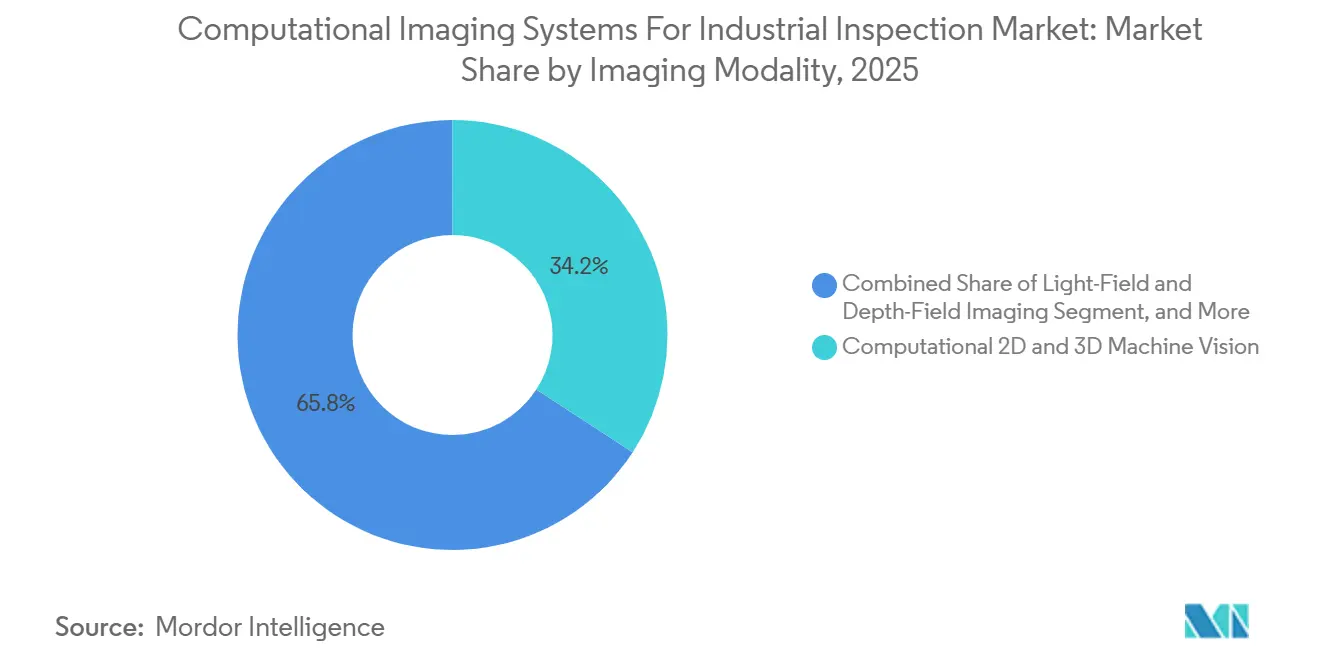
2D and 3D Machine Vision Anchors a Diverse Modality SpectrumComputational 2D and 3D Machine Vision held 34.18% of the Computational imaging systems for industrial inspection market share in 2025. Its lead reflected established use in automotive assembly, electronics packaging, and food-processing lines. Coded-Aperture, Compressive, and Lensless Imaging is projected to expand at a 13.78% CAGR through 2031. The modality produces 3D spatial maps and multispectral data with compact hardware that has no moving parts. This design suits constrained inline stations in semiconductor and additive manufacturing facilities.
Computational X-Ray Radiography and Computed Tomography support EV battery and aerospace composite inspection. Computational Hyperspectral and Multispectral Imaging is used for pharmaceutical blending verification and food contamination detection. Computational Infrared and Thermal Imaging serves turbine and pipework assessments in energy and utilities. Computational OCT and Interferometric Imaging addresses nanometer-scale measurement in optics and medical-device production. Nature Computational Science introduced HorusEye, a self-supervised model trained on more than 100 million X-ray tomography images that generalizes across imaging modalities. The finding points to shared pre-trained models, while multimodal tender requirements increasingly favor vendors that can combine spectral, spatial, and temporal data.

By Offering:
Software Momentum Challenges Hardware’s Structural LeadImaging Hardware commanded 42.63% of the Computational imaging systems for industrial inspection market size in 2025. Camera-resolution upgrades and multispectral detector releases continued to support hardware demand. Imaging Software is projected to expand at a 13.69% CAGR through 2031. Cognex made its OneVision cloud-to-edge environment generally available in May 2026. The beta program had more than 100 customers, including Essity, Schneider Electric, and 3M.
Integrated Computational Imaging Systems appeal to users without internal systems-integration capabilities. Services include installation, calibration, and application development, and they track deployment complexity. Hardware specifications are converging in several applications, which creates pricing pressure for camera-focused vendors. Managed software platforms can create switching costs through application configuration and model ownership. Five-year ownership costs are increasingly shaped by licensing and integration work rather than the initial hardware purchase. The computational imaging systems for the industrial inspection industry are consequently shifting procurement toward total-system value and recurring software revenue.
By Inspection Dimension:
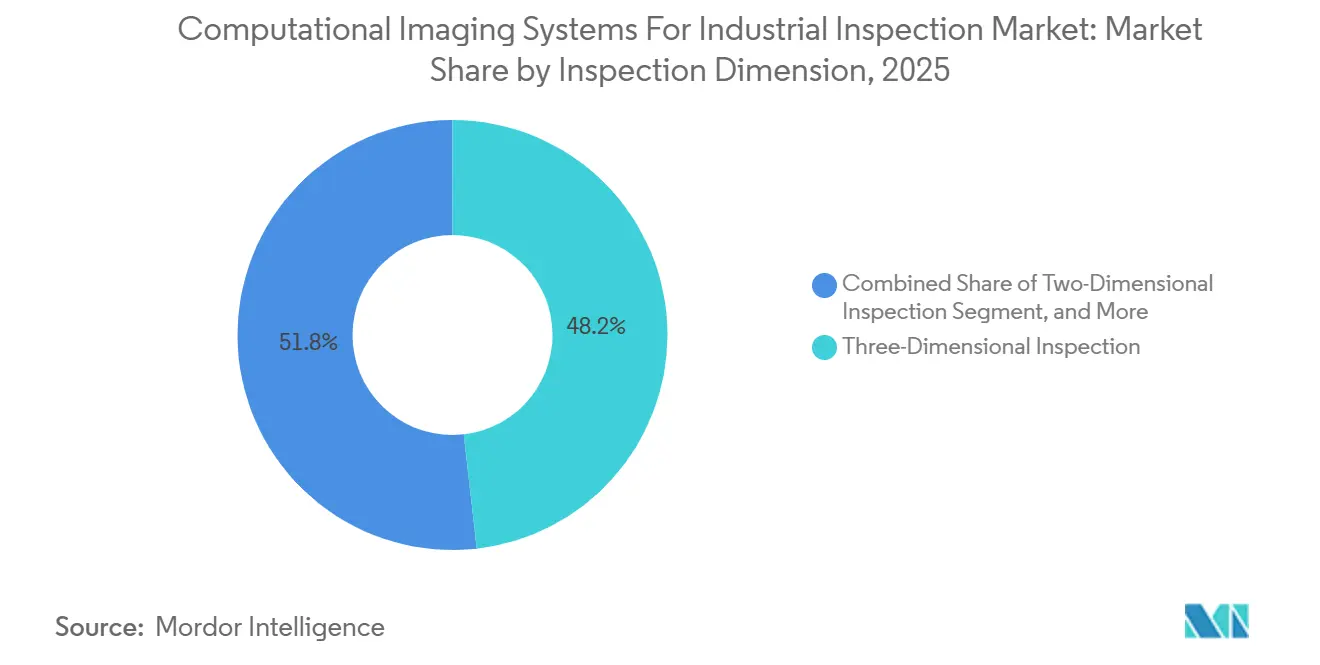
Three-Dimensional Systems Define the Production StandardThree-Dimensional Inspection held 48.21% of the Computational imaging systems for industrial inspection market share in 2025. It is widely used for automotive body-in-white verification, wafer bonding, and geometric assessment in additive manufacturing. These tasks require depth information that 2D systems cannot reliably provide. Teledyne e2v introduced the Perciva 5D camera in March 2026 with pixel-aligned depth maps from a single CMOS sensor. The camera uses Angular Sensitive Pixel technology, an onboard neural processing unit, and less than 5 W of power.
Two-Dimensional Inspection remains relevant for label verification, cosmetic grading, and optical character recognition. These applications emphasize cycle time and unit cost over depth measurement. Four-Dimensional and Time-Resolved Inspection is projected to expand at a 14.11% CAGR through 2031. It captures molten-pool behavior, solder reflow, and crack propagation under cyclic load. This process-state information provides inputs that static inspection cannot deliver. The transition from 3D to 4D makes inspection a real-time process-control input and deepens links with manufacturing execution systems and digital twins.
By Inspection Type:
Surface Defect Detection Leads, Structural Analysis Gains GroundSurface Defect Inspection held 30.47% of the Computational imaging systems for industrial inspection market share in 2025. It is deployed across automotive panels, consumer-electronics enclosures, rolled metal sheets, and printed circuit board assembly lines. AI.SEE surface inspection at thyssenkrupp Automotive Body Solutions reached 99% defect sensitivity for cosmetic flaws at production takt. The result set a performance reference for tier-1 automotive surface inspection. Internal Defect Inspection is expanding in battery cells and aerospace composites where voids and electrode misalignment affect safety outcomes.
Dimensional Inspection and Metrology serves precision machining and semiconductor lithography at micrometer tolerances. Structural Integrity and Failure Analysis is projected to expand at a 13.94% CAGR through 2031. Energy, aerospace, and infrastructure operators are applying these systems to predictive maintenance as well as production quality. Material Composition and Contamination Inspection uses hyperspectral and X-ray fluorescence methods in food safety and tablet verification. Vendors are pursuing platforms that combine surface, internal, compositional, and structural analysis. Achieving that objective requires sensor-fusion capability that remains under active development.
By End-User Industry:
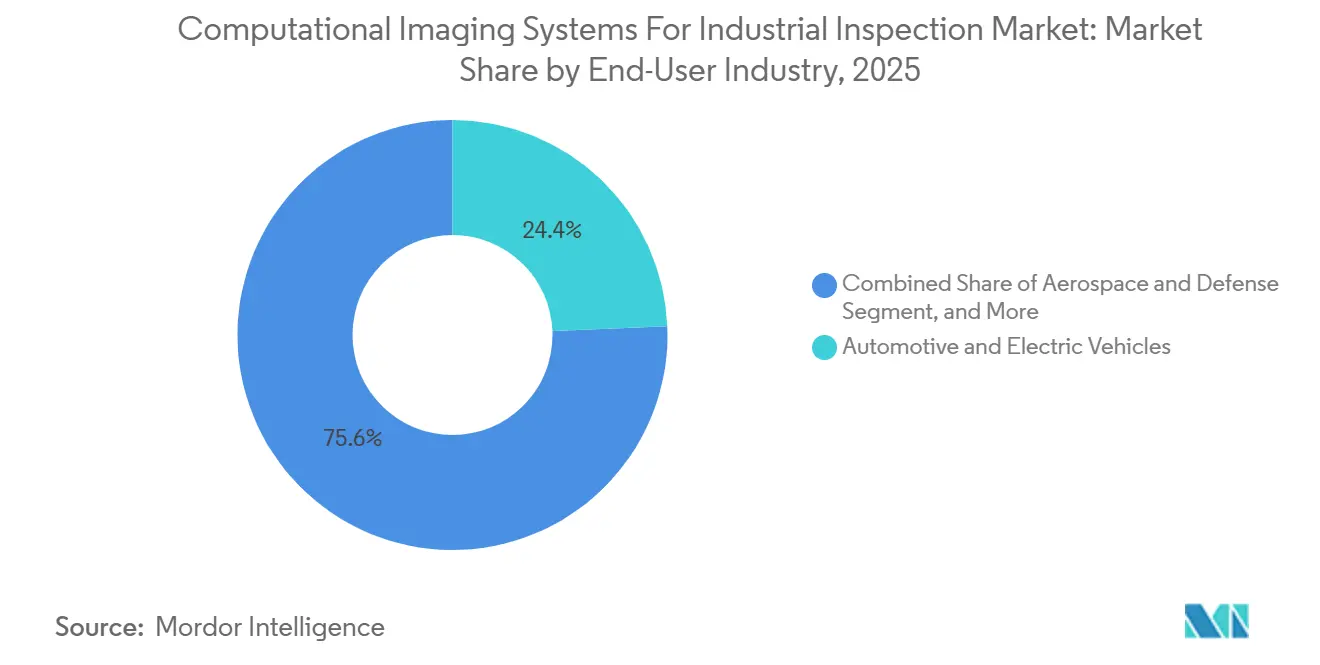
Automotive and EV Anchor Volume, Semiconductor Drives GrowthAutomotive and Electric Vehicles held 24.36% of the Computational imaging systems for industrial inspection market share in 2025. The segment combines established body-in-white and weld-seam inspection with battery-cell X-ray and power-electronics thermal assessment. Semiconductor and Electronics is projected to expand at a 13.86% CAGR through 2031. ASML’s work with Micron showed a defective die capture improvement of up to 4.3 times using machine-learning-guided e-beam inspection. This yield-related outcome supports investment at advanced process nodes.
Aerospace and Defense uses X-ray CT, structured light, and infrared thermography for composite airworthiness work under AS9100 frameworks. Pharmaceutical and Medical Devices require validated systems with calibration records and audit-ready documentation under ISO 13485. Food and Beverage uses hyperspectral and near-infrared imaging for species verification and contamination detection. Additive Manufacturing requires thermal-gradient and build-accuracy monitoring during production. Energy and Utilities, Industrial Machinery and General Manufacturing, and Mining, Recycling and Materials Processing select modalities according to material, throughput, and safety requirements. This broad range of needs helps preserve a fragmented supplier structure rather than concentrating the market around a few platforms.
By Deployment:
Inline Systems Dominate, Cloud-Connected Mode AcceleratesInline and In-Process Systems accounted for 55.12% of the Computational imaging systems for industrial inspection market size in 2025. They reject defective parts before downstream processes add further value and cost. Offline and Laboratory Systems remain necessary for process development and failure analysis. These applications can tolerate dwell times that production lines cannot accept. Portable and Field-Deployable Systems address assets that cannot be brought to the instrument. Pipeline integrity, aerospace structural health monitoring, and civil infrastructure assessment are examples of such work.
Remote and Cloud-Connected Inspection Systems are projected to expand at a 13.92% CAGR through 2031. Manufacturers use them to centralize model training, version control, and performance monitoring across distributed facilities. Cognex OneVision supports centrally trained models that execute locally on In-Sight 3900 and 6900 systems. This architecture lets a central engineering team govern quality across multiple sites without disrupting local production. Cloud-connected deployments also provide suppliers with a subscription-based revenue model. The Computational imaging systems for industrial inspection market is therefore moving beyond one-time equipment sales toward ongoing software services.
Geography Analysis
APAC Computational Imaging Systems for Industrial Inspection Market
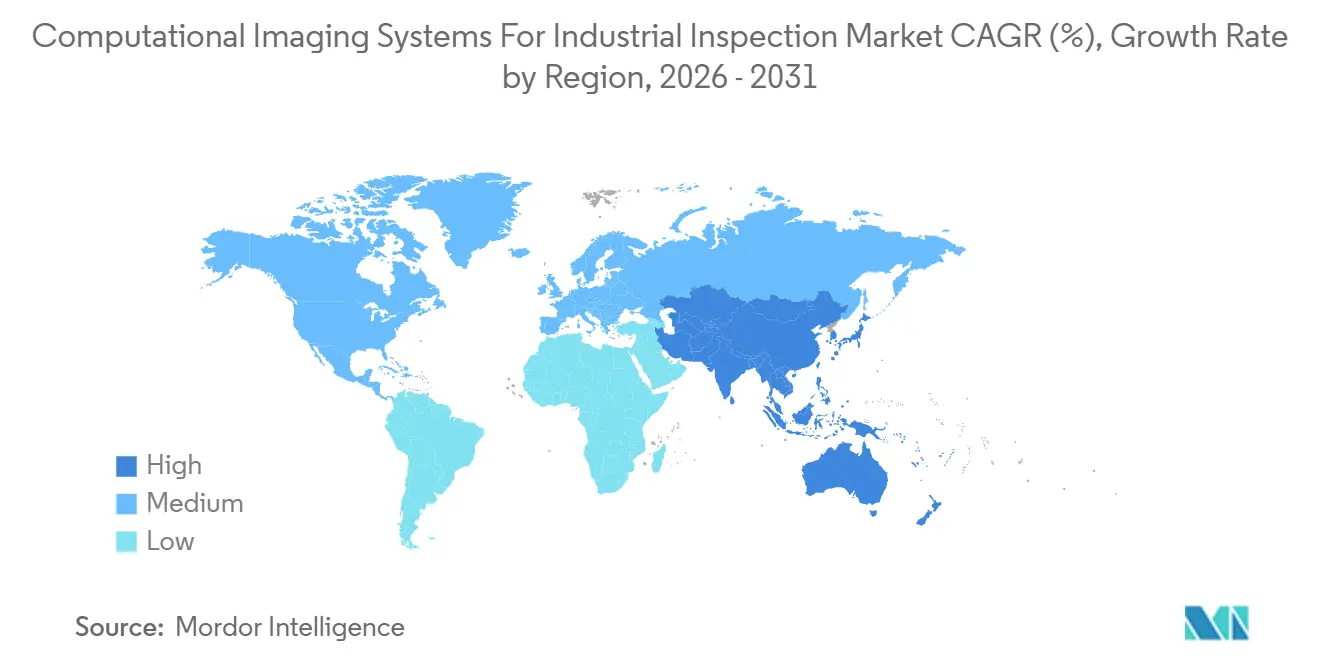
Asia-Pacific held 38.29% of the Computational imaging systems for industrial inspection market share in 2025 and is projected to expand at a 14.14% CAGR through 2031. EV battery capacity, front-end semiconductor investment, advanced packaging, and consumer-electronics production support demand across China, South Korea, Japan, and India. Luster Vision Technology’s 2025 annual report described computational imaging as a means of achieving high-resolution images in complex conditions without high-end equipment. This capability supports domestic development in wafer metrology, lithography alignment, and advanced packaging inspection. Innometry’s August 2026 shipment for 46-series batteries also showed that South Korea is an application-led product-development center. India is developing as a secondary cluster as fab investment and EV component manufacturing attract multinational machine builders.
North America and Europe Computational Imaging Systems for Industrial Inspection Market
North America and Europe are mature regions with demanding specifications and higher average selling prices. North America draws demand from semiconductor capital equipment, aerospace and defense non-destructive testing, and battery gigafactory inspection. Cognex reported broad-based outperformance in the first quarter of 2026 alongside its AI vision platform launches. German image-processing-component manufacturers recorded a 25% increase in order intake through June 2026, according to VDMA data cited by Basler. Europe’s Digital Product Passport Registry launched in July 2026 under Regulation (EU) 2026/1778. The February 18, 2027, deadline for large batteries strengthens the case for traceable inspection data.
MEA and South America Computational Imaging Systems for Industrial Inspection Market
South America, the Middle East and Africa are in earlier adoption phases. Mining, oil and gas infrastructure, and multinational manufacturing supply chains are the main demand bases. Brazil leads South American demand through automotive assembly and agrifood inspection. Saudi Arabia and the UAE use portable systems for pipeline integrity and utilities monitoring. South Africa has the region’s most developed mining-related non-destructive testing needs, while Nigeria remains an early-stage oil and gas inspection opportunity. Local integration shortages and high ownership costs make vendor-managed cloud-connected service models more viable than capital-intensive on-premise systems in these geographies.
Competitive Landscape
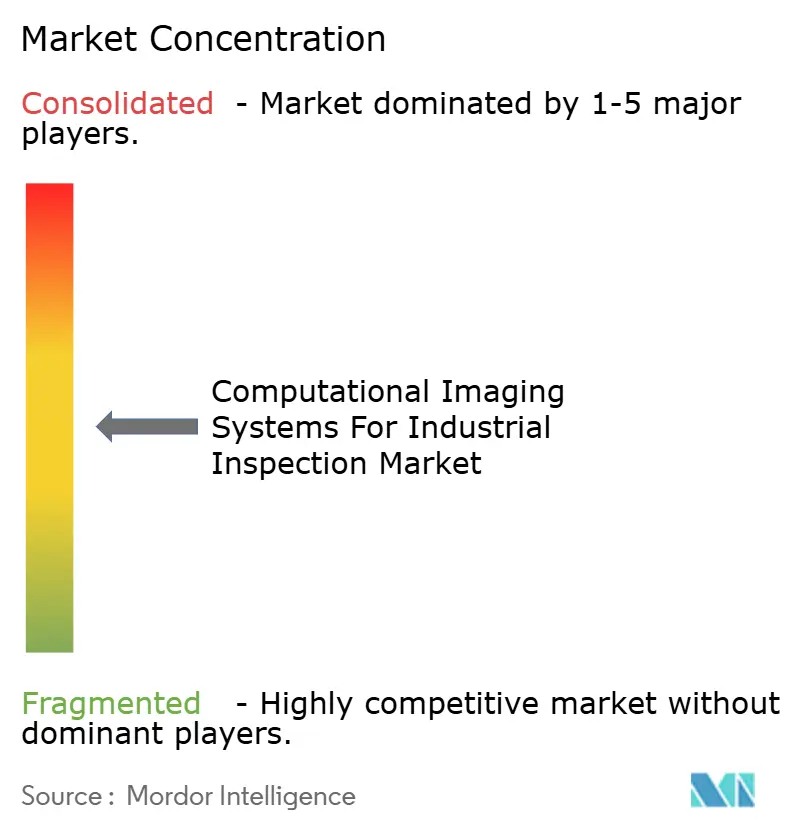
The Computational imaging systems for industrial inspection market is moderately concentrated at the platform level and fragmented across specialized modalities. Keyence and Cognex have broad 2D and 3D machine-vision portfolios and established customer relationships. SICK and Basler maintain strong European manufacturing networks and camera hardware positions. Basler reported substantial revenue growth in the first half of 2026, supported by strong year-over-year performance. The company achieved a healthy EBIT margin, driven by AI hardware production, EV battery manufacturing, and logistics automation.
Cognex embedded proprietary AI acceleration in its In-Sight 3900 and 6900 platforms during 2026. COGNEX It also expanded its cloud-to-edge ecosystem through OneVision’s general availability in May 2026. and LMI Technologies focuses on vertically integrated system offerings. Headwall Photonics, Specim Spectral Imaging, and Cubert GmbH address hyperspectral niches. Adaptix works in coded-aperture imaging, while DIGISENS targets photon-counting CT. Teledyne e2v added the Perciva 5D camera in March 2026 for compact ambient-light 3D inspection.
No dominant platform currently combines AI-enabled hyperspectral analysis and inline CT in a unified multimodal inspection system. This leaves room for integrators developing sensor-fusion middleware. Cloud-connected deployments also lack a purpose-built cybersecurity architecture for defense and pharmaceutical data-sovereignty requirements. The technical skills gap is creating interest in vendor-managed inspection-as-a-service models with per-part billing and vendor ownership of AI models. Early-stage entrants are testing this approach in semiconductor and pharmaceutical settings. ISO 13485 and AS9100 qualification needs raise entry barriers for suppliers without documented validation methods. The competitive landscape therefore remains consistent with specialist providers retaining meaningful positions alongside broader platform vendors.
Computational Imaging Systems For Industrial Inspection Industry Leaders
-
Cognex Corporation
-
Keyence Corporation
-
OMRON Corporation
-
SICK AG
-
Teledyne DALSA, Inc.
- *Disclaimer: Major Players sorted in no particular order
Computational Imaging Systems For Industrial Inspection Market Companies Covered in this Report
- Adaptix Ltd.
- Allied Vision Technologies GmbH
- Basler AG
- Baumer Holding AG
- Cognex Corporation
- Cubert GmbH
- Datalogic S.p.A.
- DIGISENS SAS
- Headwall Photonics, Inc.
- IDS Imaging Development Systems GmbH
- ISRA VISION GmbH
- KA Imaging Inc.
- Keyence Corporation
- LMI Technologies Inc.
- MDA - Multiphysics Diagnostic Automation
- OMRON Corporation
- Photon etc. Inc.
- SICK AG
- Specim Spectral Imaging Ltd.
- STEMMER IMAGING AG
- Teledyne DALSA, Inc.
- VISIONx Inc.
Recent Industry Developments in Computational Imaging Systems For Industrial Inspection Market
- August 2026: Innometry shipped the first inline CT and X-ray inspection systems for 46-series cylindrical EV battery mass production, following a supply contract secured in February 2026, the first reported use of inline CT for this battery format at commercial production throughput, inspecting electrode alignment and detecting foreign materials inside cells.
- July 2026: The European Commission launched the Digital Product Passport Registry under Commission Implementing Regulation (EU) 2026/1778, with the first enforcement deadline for large batteries on February 18, 2027, creating a binding traceability requirement mandating machine-generated inspection data for covered product groups.
- May 2026: Cognex Corporation announced general availability of OneVision, its cloud-to-edge AI development environment, after a beta phase with over 100 customers including Essity, Schneider Electric, and 3M, enabling centralized AI model training with local edge deployment across multi-site production networks.
- July 2026: Cognex launched the In-Sight 3900 Vision System on Qualcomm Dragonwing platforms, delivering 25-megapixel resolution at 4 times the predecessor’s processing speed in a PC-free, embedded configuration suited to high-speed production-line inspection without external computing infrastructure.
Global Computational Imaging Systems For Industrial Inspection Market Report Scope
Computational Imaging Systems for Industrial Inspection Market refers to advanced imaging solutions that combine specialized optics, sensors, illumination, and algorithmic processing (including AI/deep learning) to extract geometric, material, and defect information beyond the capabilities of conventional cameras.
The Computational Imaging Systems for Industrial Inspection Market Report is Segmented by Imaging Modality (Computational 2D and 3D Machine Vision, Computational X-Ray Radiography and Computed Tomography, Computational Hyperspectral and Multispectral Imaging, Computational Infrared and Thermal Imaging, Computational OCT and Interferometric Imaging, Light-Field and Depth-Field Imaging, Coded-Aperture, Compressive and Lensless Imaging, Computational Microscopy and Holographic Imaging, and Other Computational Imaging Modalities), Offering (Hardware, Software, Integrated Systems, Services), Inspection Dimension (2D, 3D, 4D), Inspection Type (Surface Defect Inspection, Internal Defect Inspection, Dimensional Inspection and Metrology, Material Composition and Contamination Inspection, and Structural Integrity and Failure Analysis), End-User Industry (Automotive and Electric Vehicles, Aerospace and Defense, Semiconductor and Electronics, Additive Manufacturing, Food and Beverage, Pharmaceutical and Medical Devices, Energy and Utilities, Industrial Machinery and General Manufacturing, Mining, Recycling and Materials Processing, and Other End-User Industries), Deployment (Inline and In-Process Systems, Offline and Laboratory Systems, Portable and Field-Deployable Systems, and Remote and Cloud-Connected Inspection Systems), and Geography (North America, South America, Europe, Asia-Pacific, and Middle East and Africa). Market Forecasts are Provided in Terms of Value (USD).
Segmentation Overview
| Computational 2D and 3D Machine Vision |
| Computational X-Ray Radiography and Computed Tomography |
| Computational Hyperspectral and Multispectral Imaging |
| Computational Infrared and Thermal Imaging |
| Computational OCT and Interferometric Imaging |
| Light-Field and Depth-Field Imaging |
| Coded-Aperture, Compressive and Lensless Imaging |
| Computational Microscopy and Holographic Imaging |
| Other Computational Imaging Modalities |
| Imaging Hardware |
| Imaging Software |
| Integrated Computational Imaging Systems |
| Services |
| Two-Dimensional Inspection |
| Three-Dimensional Inspection |
| Four-Dimensional / Time-Resolved Inspection |
| Surface Defect Inspection |
| Internal Defect Inspection |
| Dimensional Inspection and Metrology |
| Material Composition and Contamination Inspection |
| Structural Integrity and Failure Analysis |
| Automotive and Electric Vehicles |
| Aerospace and Defense |
| Semiconductor and Electronics |
| Additive Manufacturing |
| Food and Beverage |
| Pharmaceutical and Medical Devices |
| Energy and Utilities |
| Industrial Machinery and General Manufacturing |
| Mining, Recycling and Materials Processing |
| Other End-User Industries |
| Inline and In-Process Systems |
| Offline and Laboratory Systems |
| Portable and Field-Deployable Systems |
| Remote and Cloud-Connected Inspection Systems |
| North America | United States | |
| Canada | ||
| Mexico | ||
| South America | Brazil | |
| Argentina | ||
| Rest of South America | ||
| Europe | Germany | |
| United Kingdom | ||
| France | ||
| Italy | ||
| Spain | ||
| Rest of Europe | ||
| Asia-Pacific | China | |
| Japan | ||
| India | ||
| South Korea | ||
| ASEAN | ||
| Rest of Asia-Pacific | ||
| Middle East and Africa | Middle East | Saudi Arabia |
| United Arab Emirates | ||
| Turkey | ||
| Rest of the Middle East | ||
| Africa | South Africa | |
| Nigeria | ||
| Rest of Africa | ||
| By Imaging Modality | Computational 2D and 3D Machine Vision | ||
| Computational X-Ray Radiography and Computed Tomography | |||
| Computational Hyperspectral and Multispectral Imaging | |||
| Computational Infrared and Thermal Imaging | |||
| Computational OCT and Interferometric Imaging | |||
| Light-Field and Depth-Field Imaging | |||
| Coded-Aperture, Compressive and Lensless Imaging | |||
| Computational Microscopy and Holographic Imaging | |||
| Other Computational Imaging Modalities | |||
| By Offering | Imaging Hardware | ||
| Imaging Software | |||
| Integrated Computational Imaging Systems | |||
| Services | |||
| By Inspection Dimension | Two-Dimensional Inspection | ||
| Three-Dimensional Inspection | |||
| Four-Dimensional / Time-Resolved Inspection | |||
| By Inspection Type | Surface Defect Inspection | ||
| Internal Defect Inspection | |||
| Dimensional Inspection and Metrology | |||
| Material Composition and Contamination Inspection | |||
| Structural Integrity and Failure Analysis | |||
| By End-User Industry | Automotive and Electric Vehicles | ||
| Aerospace and Defense | |||
| Semiconductor and Electronics | |||
| Additive Manufacturing | |||
| Food and Beverage | |||
| Pharmaceutical and Medical Devices | |||
| Energy and Utilities | |||
| Industrial Machinery and General Manufacturing | |||
| Mining, Recycling and Materials Processing | |||
| Other End-User Industries | |||
| By Deployment | Inline and In-Process Systems | ||
| Offline and Laboratory Systems | |||
| Portable and Field-Deployable Systems | |||
| Remote and Cloud-Connected Inspection Systems | |||
| By Geography | North America | United States | |
| Canada | |||
| Mexico | |||
| South America | Brazil | ||
| Argentina | |||
| Rest of South America | |||
| Europe | Germany | ||
| United Kingdom | |||
| France | |||
| Italy | |||
| Spain | |||
| Rest of Europe | |||
| Asia-Pacific | China | ||
| Japan | |||
| India | |||
| South Korea | |||
| ASEAN | |||
| Rest of Asia-Pacific | |||
| Middle East and Africa | Middle East | Saudi Arabia | |
| United Arab Emirates | |||
| Turkey | |||
| Rest of the Middle East | |||
| Africa | South Africa | ||
| Nigeria | |||
| Rest of Africa | |||
Key Questions Answered in the Report
What is the size of the computational imaging systems for industrial inspection market?
The Computational imaging systems for industrial inspection market size is USD 1.11 billion in 2026. It is projected to reach USD 2.06 billion by 2031, registering a CAGR of 13.23% between 2026 and 2031.
Which imaging modality leads demand?
Computational 2D and 3D Machine Vision led with a 34.18% share in 2025. The Computational imaging systems for industrial inspection market uses this modality across automotive assembly, electronics packaging, and food-processing lines.
Which offering is expanding fastest?
Imaging Software is projected to expand at a 13.69% CAGR through 2031. In the Computational imaging systems for industrial inspection market, centralized model governance and recurring software use support this direction.
Why are EV batteries important for inspection systems?
Battery production needs non-destructive checks for electrode alignment and foreign materials at production throughput. The Computational imaging systems for industrial inspection market supports these checks with CT and X-ray approaches that do not open the cell.
Which region leads demand?
Asia-Pacific held 38.29% share in 2025 and is projected to expand at a 14.14% CAGR through 2031. The Computational imaging systems for industrial inspection market benefits from regional battery, semiconductor, and consumer-electronics production.
What deployment approach has the largest share?
Inline and In-Process Systems accounted for 55.12% in 2025 because they identify defects before further processing adds cost. The Computational imaging systems for industrial inspection market also uses portable systems where assets cannot reach the instrument.