
Compressed Earth Block Machine Market Size and Share
Market Overview
| Study Period | 2021 - 2031 |
|---|---|
| Market Size (2026) | USD 2.53 Billion |
| Market Size (2031) | USD 3.25 Billion |
| Growth Rate (2026 - 2031) | 5.09 % |
| Fastest Growing Market | Asia-Pacific |
| Largest Market | Asia-Pacific |
| Market Concentration | Low |
Major Players *Disclaimer: Major Players sorted in no particular order Image © Mordor Intelligence. Reuse requires attribution under CC BY 4.0. | |
Compressed Earth Block Machine Market Analysis by Mordor Intelligence
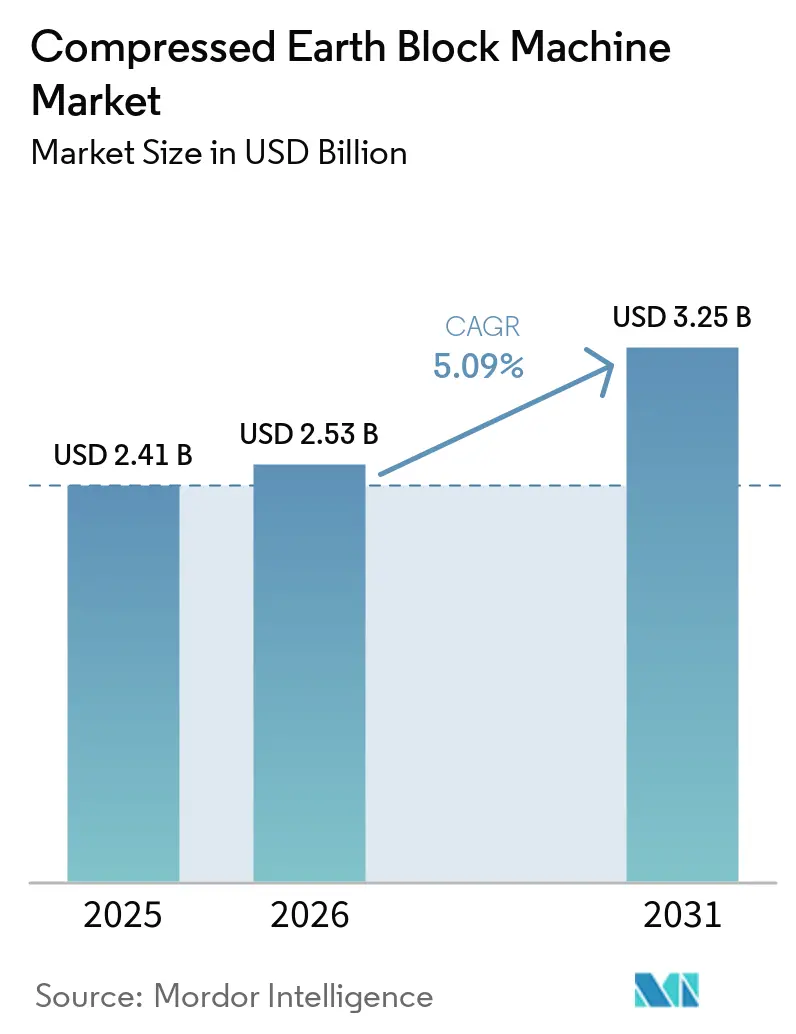
The Compressed Earth Block Machine Market size was valued at USD 2.41 billion in 2025 and is estimated to grow from USD 2.53 billion in 2026 to reach USD 3.25 billion by 2031, at a CAGR of 5.09% during the forecast period (2026-2031). The compressed earth block machine market is supported by construction procurement that gives greater weight to embodied carbon alongside cost. Compressed stabilized earth blocks can emit up to 35 kg CO₂/m³, compared with 150-180 kg CO₂/m³ for fired bricks, which makes suitable machinery relevant to low-carbon building programs. Demand is also shaped by rural housing programs, where producing blocks near the construction site can reduce dependence on transport and conventional masonry supply chains. Manufacturers compete through service coverage, soil compatibility knowledge, equipment reliability, and recognition under public or green-building programs. The compressed earth block machine market also faces uneven code acceptance, which can limit financeable projects despite Germany’s Deutsches Institut für Normung (DIN) 18940 and DIN 18945 standards.
Key Report Takeaways
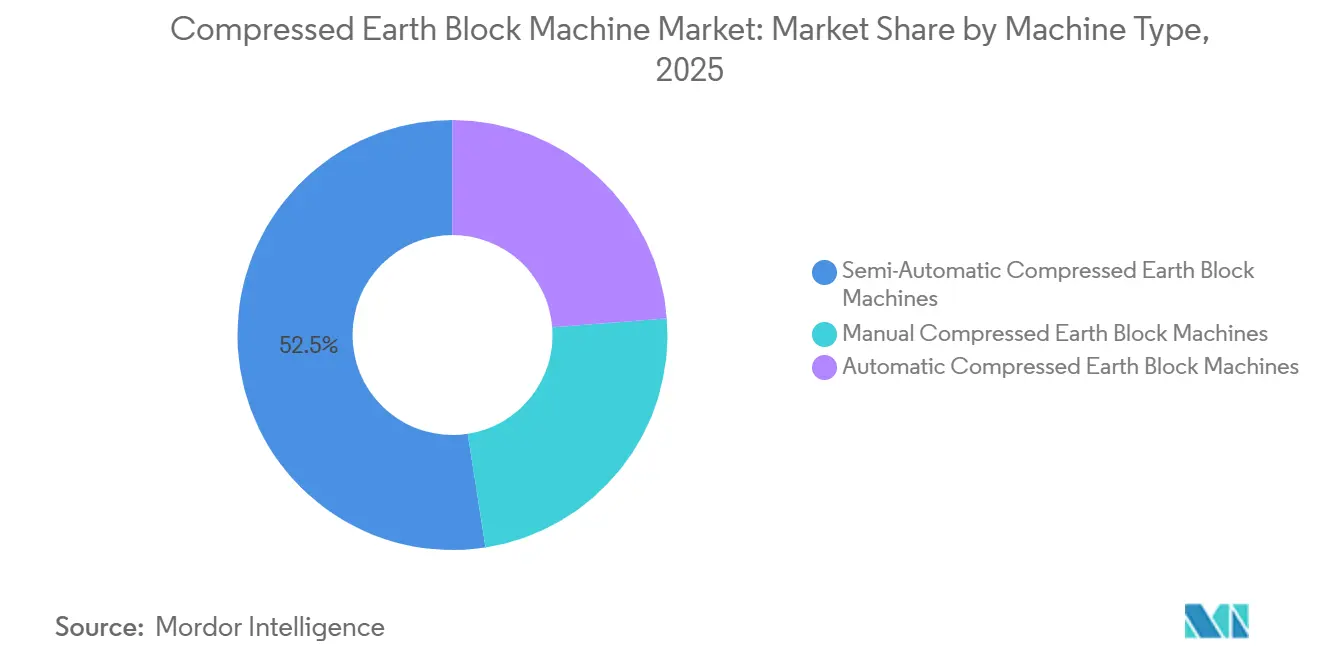
- By machine type, semi-automatic compressed earth block machines held 52.45% of the compressed earth block machine market share in 2025, while automatic compressed earth block machines are projected to advance at a 5.82% CAGR through 2031.
- By capacity, medium capacity, 1,000-5,000 blocks per day held 44.18% of the compressed earth block machine market share in 2025, while large-capacity machines are projected to advance at a 6.45% CAGR through 2031.
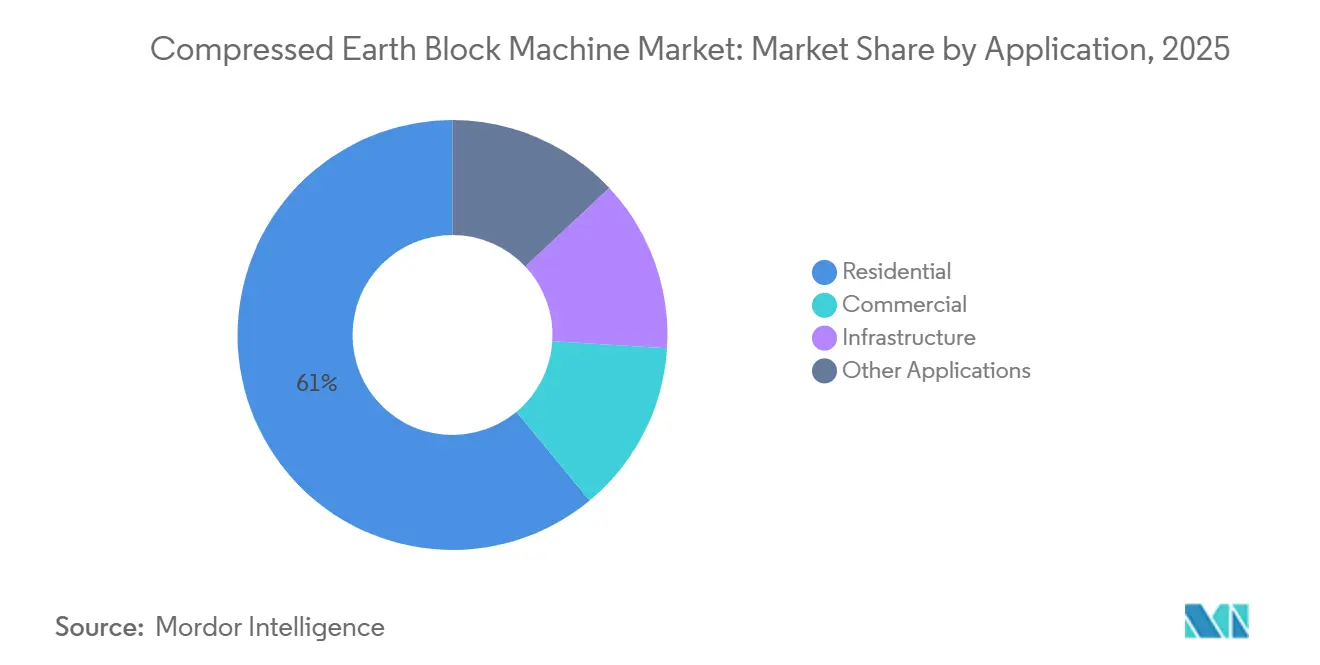
- By application, residential held 61.03% of the compressed earth block machine market share in 2025, while infrastructure is projected to advance at a 6.73% CAGR through 2031.
- By geography, Asia-Pacific held 38.12% of the compressed earth block machine market share in 2025 and is projected to advance at a 6.13% CAGR through 2031.
Note: Market size and forecast figures in this report are generated using Mordor Intelligence’s proprietary estimation framework, updated with the latest available data and insights as of January 2026.
Global Compressed Earth Block Machine Market Trends and Insights
Drivers Impact Analysis*
| Driver | (~) % Impact on CAGR Forecast | Geographic Relevance | Impact Timeline |
|---|---|---|---|
| Adoption of Low-Carbon and Locally Sourced Construction Materials | +1.4% | Global, concentrated in APAC and MEA | Long term (≥ 4 years) |
| Affordable Housing and Decentralized Building Programs | +1.2% | Global, highest intensity in South Asia and Sub-Saharan Africa | Medium term (2–4 years) |
| Automation Reducing Labor Intensity and Improving Block Consistency | +0.9% | Global, with early gains in Southeast Asia and Latin America | Medium term (2–4 years) |
| Green-Building Certification and Energy-Efficiency Requirements | +0.7% | North America, Europe, and major APAC cities | Long term (≥ 4 years) |
| Off-Grid and Remote-Site Production Enabled by Diesel and Mobile Machines | +0.5% | MEA core, with spillover to Remote APAC and South America | Short term (≤ 2 years) |
| Source: Mordor Intelligence | |||
Adoption of Low-Carbon and Locally Sourced Construction Materials
Construction decarbonization targets are bringing compressed stabilized earth block technology into broader procurement discussions. Research in Ethiopia found that compressed stabilized earth blocks can reduce cement use by more than 50% compared with hollow concrete blocks and avoid up to 2 metric tons of CO₂ per 100 m² of wall area. Production using local soil can also reduce exposure to cement price changes and material delivery delays in Sub-Saharan Africa and South Asia. Germany’s standards permit earth blocks in load-bearing structures up to 5 stories, expanding the range of building designs that can use the material. The March 2024 update to DIN 18945 aligned requirements for testing and labeling, giving procurement teams a reference point when specifying earth blocks. These conditions support equipment purchases where buyers need consistent production of locally sourced walling materials.
Affordable Housing and Decentralized Building Programs
Affordable housing programs can create repeat demand for equipment rather than isolated commercial orders. India approved Pradhan Mantri Awaas Yojana-Grameen (PMAY-G) Phase 2 in August 2024 with a budget of INR 3.06 trillion (approximately USD 36.6 billion) to build 20 million additional rural homes through 2028-29. The proposed USD 500 million Sustainable Housing Integrated Efficient Living and Disaster-Resilience loan was intended to support climate-adaptive and thermally resilient housing under the same rural program. In Africa, the Africa Urban Forum in September 2024 brought support from the African Development Bank and the World Bank to affordable housing efforts[1]“Towards a Sustainable Housing Solution for Africa,” UN-Habitat, unhabitat.org. The compressed earth block machine market benefits where dispersed rural projects make delivery of premade blocks expensive. On-site block production is particularly suited to programs that operate across many smaller communities.
Green-Building Certification and Energy-Efficiency Requirements
Green-building certification can give developers a defined route for considering compressed earth blocks in material selection. The International Finance Corporation’s Excellence in Design for Greater Efficiencies (EDGE) framework lists compressed earth blocks as an eligible alternative material[2]“Green Buildings,” International Finance Corporation, ifc.org. EDGE Home Prescriptive Certification under EDGE Version 3.1 continued to list the material after the May 2025 update. This recognition is relevant to projects seeking credits for material choices and energy performance. It can favor machinery that produces blocks with predictable quality and documentation. The compressed earth block machine market, therefore, has an opportunity in developments where certification requirements affect procurement. The effect is strongest where developers have the capacity to use certification in project planning.
Off-Grid and Remote-Site Production Enabled by Diesel and Mobile Machines
Diesel and generator-powered machines can support block production where grid access is unreliable. Hydraform has designed its systems for use in more than 70 countries and describes operations using 20% cement-to-soil ratios. The Netherlands Organisation for Applied Scientific Research (TNO) found in March 2025 that, for Kenyan sites more than 250 km from a stone quarry, compressed earth block options had the lowest combined cost and climate-change impact among the walling systems assessed. Interlocking blocks can also reduce mortar needs at the building site. This matters for schools, clinics, and community buildings in remote locations. The compressed earth block machine market gains where site access limits the use of stationary electric equipment. In these cases, mobility can matter more than maximum daily throughput.
Restraints Impact Analysis*
| Restraint | (~) % Impact on CAGR Forecast | Geographic Relevance | Impact Timeline |
|---|---|---|---|
| Inconsistent Building-Code Acceptance and Certification Requirements | -1.1% | Global, most acute in Sub-Saharan Africa and Southeast Asia | Long term (≥ 4 years) |
| Limited Availability of Suitable Soil and Higher Site-Testing Requirements | -0.6% | APAC, South America, and MEA peri-urban zones | Medium term (2–4 years) |
| Operator-Skill, Curing-Control, and Local-Service Constraints | -0.4% | Global, highest in remote MEA and Pacific Island markets | Short term (≤ 2 years) |
| Source: Mordor Intelligence | |||
Inconsistent Building-Code Acceptance and Certification Requirements
Inconsistent code acceptance remains a structural constraint on the compressed earth block machine market. Germany, Gujarat and Tamil Nadu in India, and Iran have formal approvals for compressed earth block construction, although the terms can differ by building height, occupancy, and seismic zone. Without codified structural standards, projects can struggle to obtain mortgages or development finance under standard conditions. That restriction can keep demand concentrated in cash-financed or grant-funded construction. DIN 18940 and the March 2024 revision of DIN 18945 offer credible reference points for load-bearing earth masonry. Their incorporation into German regional building ordinances were not planned before 2027. Wider adoption of comparable standards would determine access to larger financeable programs.
Limited Availability of Suitable Soil and Higher Site-Testing Requirements
Suitable soil is not available at every construction site. Structurally adequate blocks generally require a clay content of 15%-30%, along with suitable particle distribution and plasticity. TNO found that cement content was a primary driver of cost and environmental impact in Kenyan block production. Soil variability can raise stabilizer requirements to 10%, reducing both cost and carbon benefits. Peri-urban sites can have disturbed soil, contamination, or rubble that requires geotechnical testing before production. Large public programs can spread those preparation costs across many homes. Smaller contractors and cooperatives may find testing harder to finance, limiting demand for the semi-automatic equipment that dominates the installed base.
*Our forecasts treat driver/restraint impacts as directional, not additive. The impact forecasts reflect baseline growth, mix effects, and variable interactions.
Segment Analysis
By Machine Type: Semi-Automatic Compressed Earth Block Machines Lead While Automatic Compressed Earth Block Machines Gain Ground
Semi-automatic compressed earth block machines held 52.45% of the compressed earth block machine market share in 2025. Their position reflects accessible controls, consistent compression output, and pricing suited to mid-tier contractors in developing economies. These machines generally require 2-5 operators. They are used in medium-capacity block yards producing 1,000-5,000 blocks per day. That range aligns with many rural housing program tenders. Automatic compressed earth block machines are projected to advance at a 5.82% CAGR through 2031. Larger block-yard operators, public agencies, and infrastructure contractors support this demand.
Automated presses can provide the dimensional tolerance needed for projects with tighter quality requirements. Research from ETH Zurich showed that presses using additively manufactured molds can create interlocking block geometries for corbeled dome structures without mortar or formwork. This extends machine use beyond rectangular walling applications. Manual compressed earth block machines remain relevant in community self-build projects and remote locations. Habitat for Humanity’s Kenya project used a hand press designed by Oskam VF for African soil types and local operator needs in 2025. The May 2025 EDGE Version 3.1 update also supported the use of compressed earth blocks in certified residential projects. The compressed earth block machine industry includes manual, semi-automatic, and automatic systems because each addresses different operating conditions.



By Capacity: Medium Capacity, 1,000-5,000 Blocks per Day Leads, While Large Capacity, above 5,000 Blocks per Day Expand
Medium capacity, 1,000-5,000 blocks per day, held 44.18% of the market share in 2025. It balances capital accessibility with output suitable for organized construction programs. A medium-capacity machine can supply a typical 2-3 room rural home in a 3–4-day production cycle. This makes it suitable for decentralized programs in India, Kenya, and Indonesia. Large capacity, above 5,000 blocks per day, is projected to advance at a 6.45% CAGR through 2031. Their uptake follows the scaling of government-backed block yards in Africa and South Asia.
Hydraform’s M10 system can produce up to 6,000 interlocking blocks in an 8-hour shift. Such systems are intended for national housing programs that require sustained output. As block yards move beyond pilot production, some operators replace smaller equipment with higher-throughput systems. Small-capacity machines, producing up to 1,000 blocks per day, still serve nongovernmental organization projects, disaster reconstruction, and community cooperatives. A 2024 study found that blocks using 6% cement stabilization could meet the compressive-strength requirement above 2 MPa for low-rise structures. This indicates that higher production capacity does not necessarily reduce structural adequacy. The compressed earth block machine industry continues to require equipment across several output ranges.
By Application: Residential Leads, While Infrastructure Expands
The residential segment held 61.03% of the market share in 2025. The segment is supported by self-build and cooperative housing models across Asia and Africa. Compressed earth block systems match the need for local materials and decentralized production. In Kerala, architect-led residential projects used compressed stabilized earth block jali walls from 2024. This reflected acceptance of the material in housing, where affordability and design are both relevant. The infrastructure segment is projected to advance at a 6.73% CAGR through 2031. Schools, clinics, community halls, and retaining structures are the main uses identified for this segment.
Grüne Helme used soil-stabilized blocks for a junior secondary school in Yarawadu, Sierra Leone, in August 2024 and a health station in Durukoro in November 2024. These projects show how mobile equipment can be used across institutional construction sites. Commercial applications include retail, light industrial, tourism, and hospitality projects. The 2025 Jalmanjar Farmhouse in Ahmedabad and Saguna Baug Pond Houses in Maharashtra used 9-inch compressed stabilized earth block load-bearing walls. Their geographic distribution generally follows residential construction activity. The compressed earth block machine market is, therefore, anchored by housing, while institutional projects add a faster-growing use case.
Geography Analysis
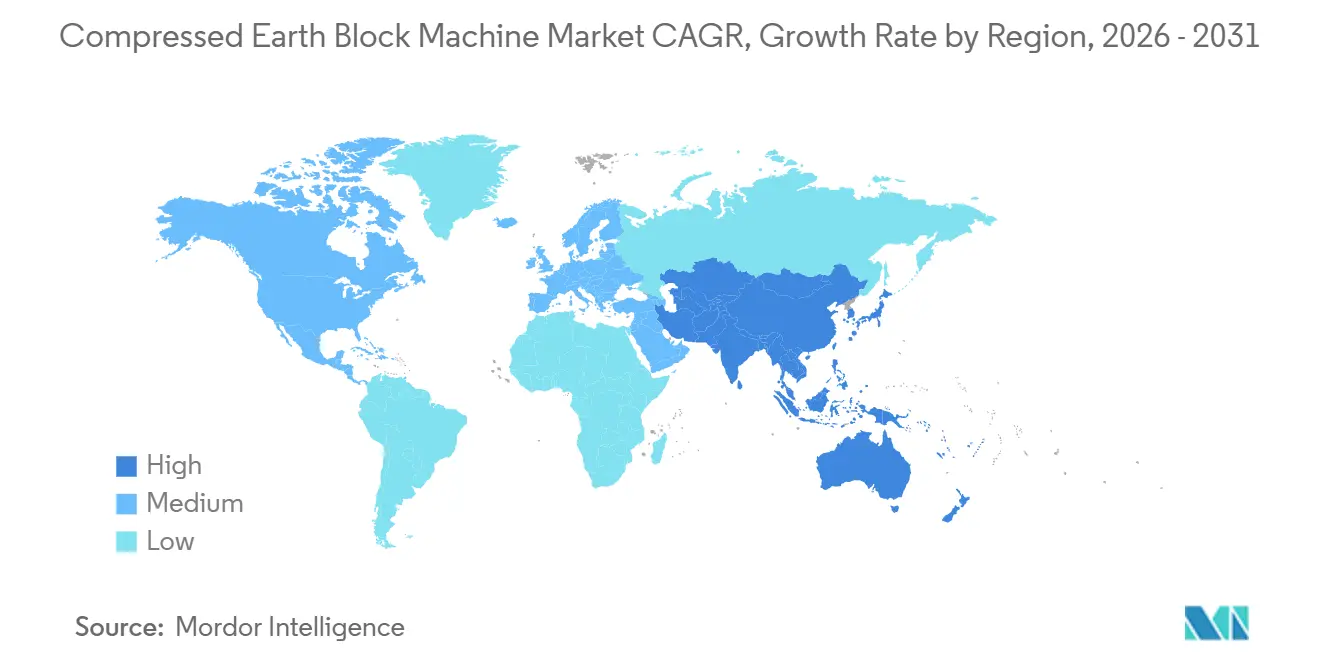
Asia-Pacific held 38.12% of the compressed earth block machine market share in 2025 and is projected to advance at a 6.13% CAGR through 2031. India is a demand center because PMAY-G Phase 2 targets 20 million rural homes between 2024-25 and 2028-29. Its machine producers in Coimbatore, Gujarat, and Rajasthan supply domestic buyers and export markets in Africa and the Middle East. China has a large base of hydraulic block-making equipment manufacturers that also offer compatible models. Japan and South Korea support demand for higher-specification automatic equipment in green-building and disaster-resilient construction. Indonesia and Vietnam are emerging demand centers as urbanization and rural housing programs develop.
The Middle East and Africa represent a long-term opportunity within the compressed earth block machine market. Sub-Saharan Africa’s housing shortage supports demand for decentralized and lower-cost production methods. Hydraform has machines in national housing programs in South Africa, Nigeria, Ghana, Kenya, and Mozambique. TNO’s 2025 Kenya analysis favored interlocking compressed earth blocks for remote sites located more than 250 km from stone quarries. Kuwait-based research examined carbon-fiber-reinforced-polymer-strengthened compressed earth block walls using local soils in 2025. Saudi Arabia’s Vision 2030 housing goals and South Africa’s subsidized-housing pipeline are relevant demand catalysts for suppliers with established service coverage.
North America and Europe demand higher-specification equipment for green building, experimental housing, and reconstruction. Advanced Earthen Construction Technologies offers automated systems priced from USD 59,000 to USD 149,000. Germany’s DIN 18940 and DIN 18945 improved the outlook for load-bearing earth-block masonry. Bauhaus Earth is exploring the scaled use of earth blocks in European industrialized construction. South America has more modest activity through social housing and bioclimatic construction research. An Ecuador study reported compressive strengths up to 3.3 MPa with local soils and cement stabilizers.

Competitive Landscape
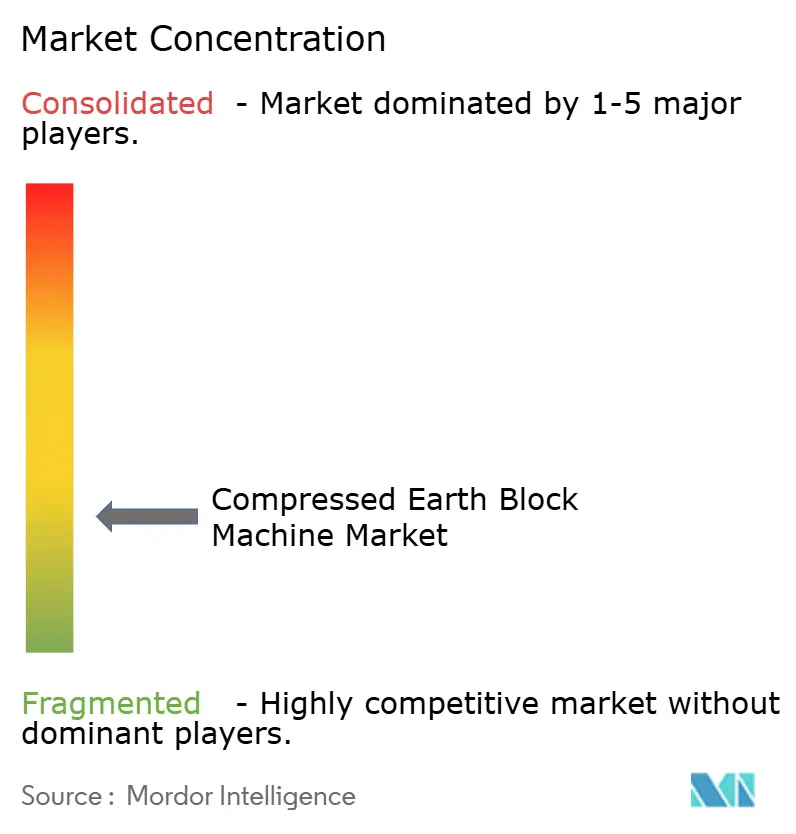
The compressed earth block machine market is highly fragmented, with the top five players including Hydraform, Advanced Earthen Construction Technologies, Dwell Earth, Makiga Engineering Services Limited, and PMSA. Hydraform has built a strong presence in sub-Saharan Africa through training and post-sale skills transfer. Advanced Earthen Construction Technologies and Dwell Earth supply North American and nongovernmental organization-supported international projects. Makiga Engineering Services Limited has a recognized position in East Africa, where compressed earth blocks are commonly called Makiga bricks in Kenya. TARA MACHINES & TECH SERVICES PVT. LTD. and Auroville Earth Institute support India’s technology-transfer ecosystem. Auroville Earth Institute’s government approvals provide a form of regulatory legitimacy in Gujarat, Tamil Nadu, and Iran.
Competition in the premium part of the compressed earth block machine market centers on precision, after-sales support, and compatibility with EDGE and Leadership in Energy and Environmental Design (LEED) Version 5 requirements. Suppliers serving buyers focus more on pricing, mobile configurations, and equipment that can use a broad range of local soils. Solar-electric machines remain an early opportunity for grid-connected or solar-powered block yards. Integrated soil-testing and mix-optimization kits could reduce a barrier for smaller contractors. Contractors building 5-50 homes in peri-urban Vietnam, Indonesia, and the Philippines have limited equipment tailored to their cost and productivity needs. The compressed earth block machine market also has room for products that address this middle segment.
Dwell Earth’s use of the Advanced Earthen Construction Technologies BP714 and the earlier Vermeer collaboration showed how partnerships can broaden distribution and strengthen credibility. Manufacturing rights for the BP714 were later transferred to Midwest Engineering Works, changing the North American partnership structure. Bauhaus Earth’s patent activity and compressed stabilized earth block research place greater emphasis on certifiable product performance. The EDGE Version 3.1 framework also continued to recognize compressed earth blocks as eligible materials. These developments can favor suppliers that link equipment specifications with testing and certification needs. The compressed earth block machine industry remains defined by specialist suppliers and regional service models. The balance of competition remains consistent with a moderately fragmented supplier base.
Compressed Earth Block Machine Industry Leaders
Hydraform
Advanced Earthen Construction Technologies
Dwell Earth
Makiga Engineering Services Limited
PMSA
- *Disclaimer: Major Players sorted in no particular order

Recent Industry Developments
- August 2026: Open Source Ecology demonstrated an automated hydraulic compressed earth block press capable of producing up to six blocks per minute. The higher production rate supports demand for an automated compressed earth block machine for on-site, low-energy construction and localized block manufacturing.
- June 2026: Hydraform officially launched the M9 Diesel Block and Brickmaking Machine, a compact diesel-powered system capable of producing up to 600 interlocking soil-cement blocks per 9-hour shift. The launch expanded Hydraform’s entry-level machinery portfolio and supported demand for mobile, lower-capital compressed earth block machines among small-scale housing contractors and remote-site operators.


Global Compressed Earth Block Machine Market Report Scope
Compressed earth block machines are equipment used to form building blocks by compacting prepared earth or soil-based mixtures under controlled pressure. They support the production of uniform blocks while enabling efficient use of locally available materials in construction.
The Compressed Earth Block Machine Market is segmented by machine type, capacity, application, and geography. By machine type, the market is segmented into manual compressed earth block machines, semi-automatic compressed earth block machines, and automatic compressed earth block machines. By capacity, the market is segmented into small capacity, up to 1,000 blocks per day, medium capacity, 1,000-5,000 blocks per day, and large capacity, above 5,000 blocks per day. By application, the market is segmented into residential, commercial, infrastructure, and other applications. The report also covers the market size and forecasts for compressed earth block machines in 15 countries across major regions. For each segment, the market sizing and forecasts have been done on the basis of value (USD).
| Manual Compressed Earth Block Machines |
| Semi-Automatic Compressed Earth Block Machines |
| Automatic Compressed Earth Block Machines |
| Small Capacity, Up to 1,000 Blocks per Day |
| Medium Capacity, 1,000-5,000 Blocks per Day |
| Large Capacity, Above 5,000 Blocks per Day |
| Residential |
| Commercial |
| Infrastructure |
| Other Applications |
| Asia-Pacific | China |
| India | |
| Japan | |
| South Korea | |
| ASEAN Countries | |
| Rest of Asia-Pacific | |
| North America | United States |
| Canada | |
| Mexico | |
| Europe | Germany |
| United Kingdom | |
| France | |
| Italy | |
| NORDIC Countries | |
| Rest of Europe | |
| South America | Brazil |
| Argentina | |
| Rest of South America | |
| Middle East and Africa | Saudi Arabia |
| South Africa | |
| Rest of Middle East and Africa |
| By Machine Type | Manual Compressed Earth Block Machines | |
| Semi-Automatic Compressed Earth Block Machines | ||
| Automatic Compressed Earth Block Machines | ||
| By Capacity | Small Capacity, Up to 1,000 Blocks per Day | |
| Medium Capacity, 1,000-5,000 Blocks per Day | ||
| Large Capacity, Above 5,000 Blocks per Day | ||
| By Application | Residential | |
| Commercial | ||
| Infrastructure | ||
| Other Applications | ||
| By Geography | Asia-Pacific | China |
| India | ||
| Japan | ||
| South Korea | ||
| ASEAN Countries | ||
| Rest of Asia-Pacific | ||
| North America | United States | |
| Canada | ||
| Mexico | ||
| Europe | Germany | |
| United Kingdom | ||
| France | ||
| Italy | ||
| NORDIC Countries | ||
| Rest of Europe | ||
| South America | Brazil | |
| Argentina | ||
| Rest of South America | ||
| Middle East and Africa | Saudi Arabia | |
| South Africa | ||
| Rest of Middle East and Africa | ||


Key Questions Answered in the Report
What is the size of the compressed earth block machine market?
The compressed earth block machine market stands at USD 2.53 billion in 2026 and is projected to reach USD 3.25 billion by 2031.
What factors are supporting demand for compressed earth block machines?
Low-carbon construction, rural housing programs, certification pathways, and remote-site production need support to meet demand.
Which machine type held the largest share in 2025?
Semi-automatic compressed earth block machines held 52.45% of the market share in 2025.
Which capacity is projected to grow fastest through 2031?
Large Capacity, above 5,000 blocks per day, is projected to advance at a 6.45% CAGR through 2031.
Page last updated on:


 Your data is secure and never sold or shared.


