
Community Management Services Market Size and Share
Market Overview
| Study Period | 2020 - 2031 |
|---|---|
| Market Size (2026) | USD 7.49 Billion |
| Market Size (2031) | USD 11.73 Billion |
| Growth Rate (2026 - 2031) | 9.39 % |
| Fastest Growing Market | Asia-Pacific |
| Largest Market | North America |
| Market Concentration | Medium |
Major Players *Disclaimer: Major Players sorted in no particular order Image © Mordor Intelligence. Reuse requires attribution under CC BY 4.0. | |
Community Management Services Market Analysis by Mordor Intelligence
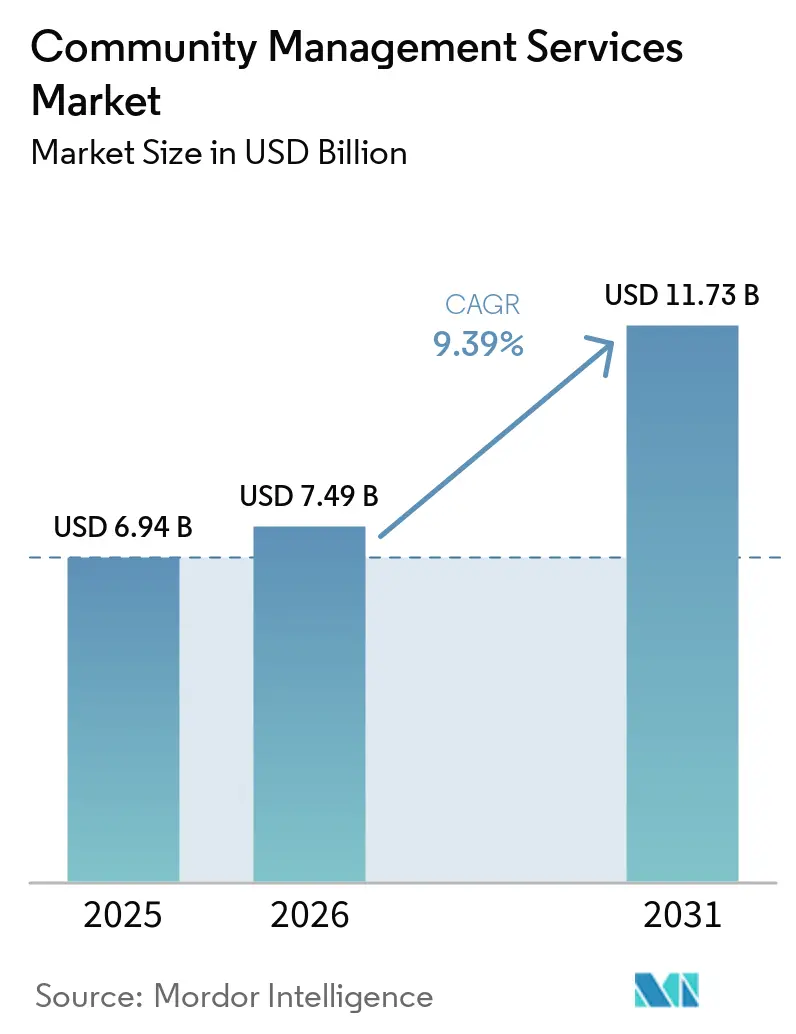
The community management services market size is projected to expand from USD 6.94 billion in 2025 to USD 7.49 billion in 2026, and to USD 11.73 billion by 2031, registering a CAGR of 9.39% between 2026 and 2031. Demand is moving toward owned customer and member environments as organizations seek durable ways to collect consented behavioral signals and support peer interaction. Regulatory requirements are also making moderation, privacy controls, and governance more important in platform selection. AI tools are changing service delivery by automating routine moderation, onboarding, content routing, and member recognition. The community management services market is therefore becoming more closely tied to customer retention, advocacy, and customer success operations. Providers that combine community operations with analytics and enterprise workflow integration are likely to have stronger opportunities as buyers reduce reliance on stand-alone tools.
Key Report Takeaways
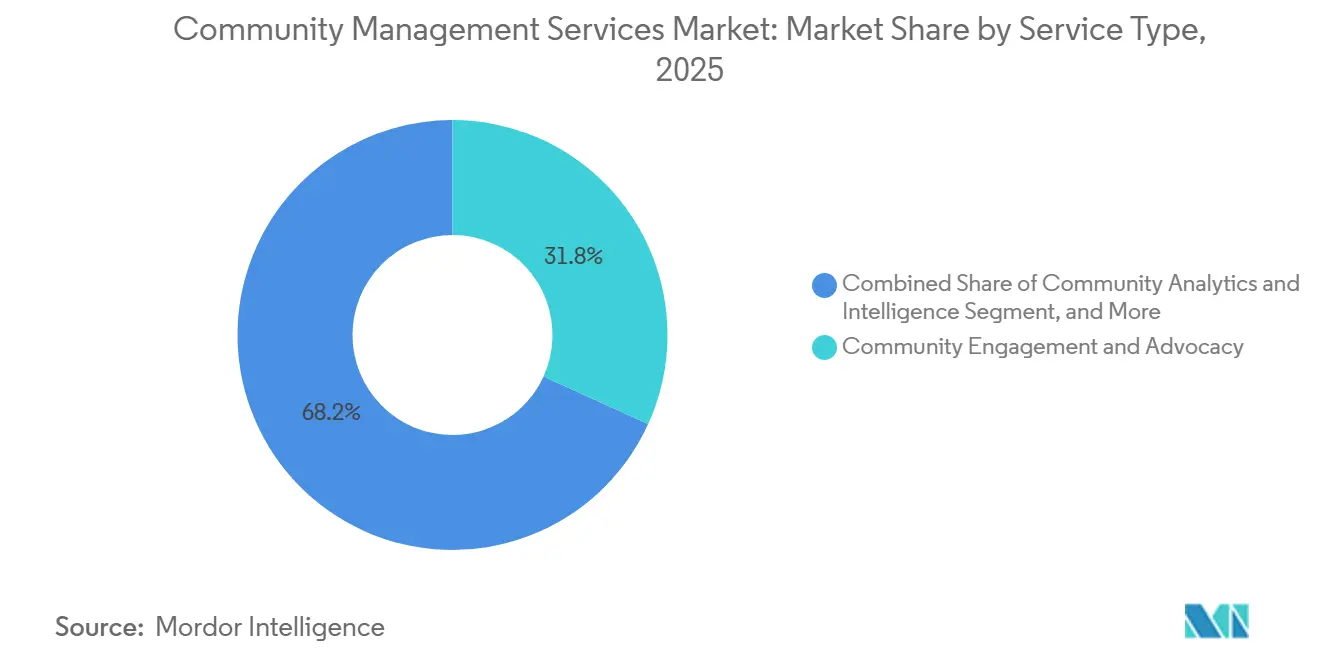
- By service type, community engagement and advocacy held 31.80% of the community management services market share in 2025, while community analytics and intelligence is projected to expand at a CAGR of 9.95% through 2031.
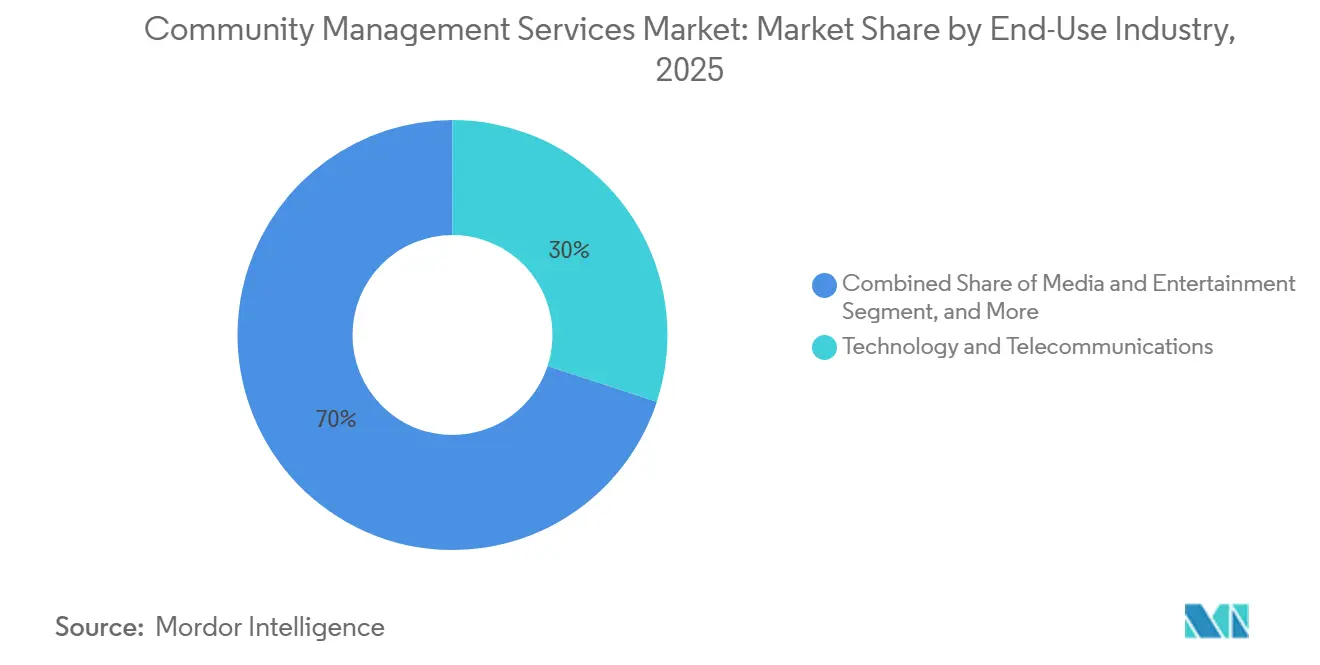
- By end-use industry, technology and telecommunications accounted for 30.02% of the community management services market share in 2025, while healthcare and life sciences are projected to expand at a CAGR of 9.81% through 2031.
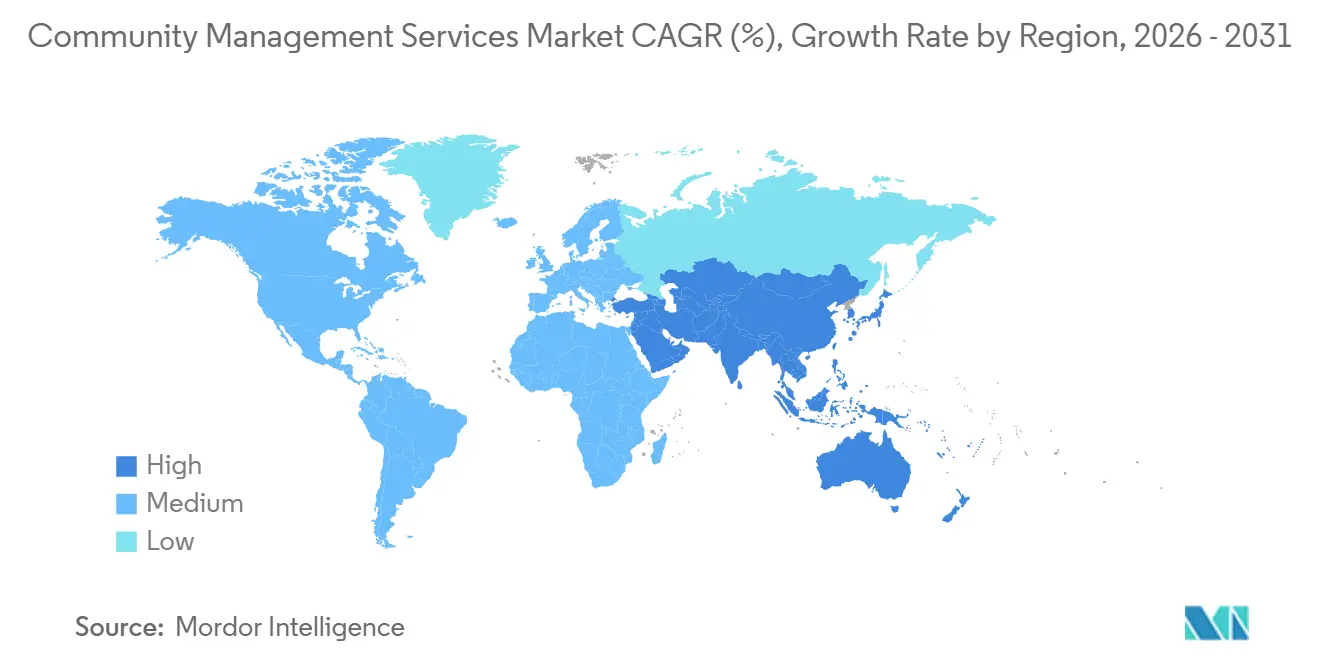
- By geography, North America accounted for 38.13% of the community management services market in 2025, while Asia-Pacific is projected to expand at a 10.06% CAGR through 2031.
Note: Market size and forecast figures in this report are generated using Mordor Intelligence’s proprietary estimation framework, updated with the latest available data and insights as of January 2026.
Market Trends and Insights
Drivers Impact Analysis of Community Management Services Market*
| Driver | (~) % Impact on CAGR Forecast | Geographic Relevance | Impact Timeline |
|---|---|---|---|
| Shift Toward Owned Customer and Member Communities | +2.8% | Global, concentrated in North America and Europe | Medium term (2-4 years) |
| AI-Assisted Personalization and Workflow Automation | +2.3% | Global, with early deployment in North America and Asia-Pacific | Short term (≤ 2 years) |
| Need for Always-On Moderation and Trust and Safety | +1.2% | Global, with regulatory acceleration in Europe and Asia-Pacific | Short term (≤ 2 years) |
| Demand for Measurable Advocacy and Peer Support Programs | +1.0% | North America and Europe, with spillover to Asia-Pacific | Medium term (2-4 years) |
| Zero-Click Discovery and First-Party Community Data | +0.6% | Global, with strong relevance in US and European digital markets | Short term (≤ 2 years) |
| Community Analytics for Private-Signal Attribution | +0.4% | North America and Europe | Medium term (2-4 years) |
| Source: Mordor Intelligence | |||
Digital Shift Toward Owned Customer and Member Communities
Organizations are placing more value on the communities that they operate and govern directly. For the community management services market, these environments can retain member interactions, preferences, support history, and consent records within a controlled setting that is easier to govern than scattered third-party channels. This matters when paid acquisition becomes more expensive, and organizations need more repeatable engagement channels with clearer ownership of member data. Community programs can also provide members with a place to exchange practical knowledge, find relevant answers, and assess product value before making purchase or renewal decisions. Circle reported that 69% of surveyed community builders planned to place community at the center of their 2026 strategy, while 48% expected prospective buyers to engage with a community before purchase.[1] The community management services market benefits when organizations connect these environments with customer data, advocacy programs, measurable retention objectives, and clear internal accountability for member outcomes.
AI-Assisted Community Personalization and Workflow Automation
AI is being adopted as an operating capability rather than a separate feature in the community management services market. It can identify routine violations, route questions, support new members onboarding, and highlight useful content for different member groups. Khoros introduced Aurora AI in April 2026 with Answer Assist, AI Moderation, and a Community Orchestrator for lifecycle actions, and stated that its platform supports more than 4,000 enterprise communities and 1.8 billion annual site visits. Gainsight stated that its Community Moderation Agent automates the handling of clear-cut violations and escalates complex cases, reducing community managers’ moderation time by half. Each moderated interaction, resolved question, and flagged item can improve the quality of future workflow decisions. Larger platforms may therefore gain an advantage from having more active communities and more labeled operational data.
Rising Need for Always-On Moderation and Trust and Safety Coverage
Trust and safety requirements are making continuous moderation a core service need. The Digital Services Act requires very large online platforms and search engines to assess systemic risks, apply transparency requirements, and undergo independent audits. The European Commission may impose fines of up to 6% of worldwide annual turnover for noncompliance with the Digital Services Act. Organizations are consequently evaluating governance architecture alongside standard community features. AI-assisted review can process clear cases quickly, while human teams focus on difficult decisions and appeals. This combination supports the community management services market because regulated buyers need ongoing operational coverage rather than periodic content review.
Demand for Measurable Customer Advocacy and Peer-Level Support Programs
Community leaders are under pressure to show how participation affects retention, customer expansion, and support outcomes. This need favors platforms that connect community activity to customer relationship management systems. Gainsight’s May 2026 Agentic Stack announcement included a partnership with Salesforce to place community and expansion signals within Salesforce Agentforce MCP workflows. Salesforce stated that Agentforce for Partner Community handled more than 19,000 requests in its first 3 months, averaged 1,400 conversations each week, and reached 120,000 monthly Partner Community users. These examples show that peer support can be measured when communities are connected to enterprise systems. The community management services market is supported when buyers treat engagement signals as part of operational and commercial reporting.
Restraints Impact Analysis of Community Management Services Market*
| Restraint | (~) % Impact on CAGR Forecast | Geographic Relevance | Impact Timeline |
|---|---|---|---|
| Data Privacy, Consent, and Cross-Border Compliance Complexity | -1.8% | Europe, North America, and Asia-Pacific | Long term (≥ 4 years) |
| Sustaining Member Participation and Content Quality at Scale | -1.2% | Global | Long term (≥ 4 years) |
| Synthetic Members, AI Spam, and Coordinated Inauthentic Behavior | -0.7% | Global, especially social-media-adjacent communities | Medium term (2-4 years) |
| Fragmented Advocacy, CRM, and Community Technology Stacks | -0.5% | North America and Europe | Medium term (2-4 years) |
| Source: Mordor Intelligence | |||
Data Privacy, Consent, and Cross-Border Compliance Complexity
Community operators often collect behavioral and interaction data from members in several jurisdictions. The European Data Protection Board’s 2025 guidance states that AI-supported content moderation under the Digital Services Act involves the processing of personal data and requires a lawful basis under the General Data Protection Regulation.[2] A consent model that works in one jurisdiction may not meet requirements in another, particularly where an organization processes sensitive engagement information or uses automated review. Organizations may need data separation, tailored notices, revised retention rules, and documented escalation processes, which add cost and implementation time. Smaller providers can find it difficult to maintain the legal and technical resources required for this work. The community management services market can therefore favor a limited group of providers with established privacy, compliance, and operational capabilities.
Difficulty Sustaining Member Participation and Content Quality at Scale
Member attention is fragmented across many digital channels, which can reduce participation in owned communities. The Community Roundtable identified harder engagement and scarcer attention as defining themes in its 2026 State of Community Management research. Large communities also need editorial planning, reliable moderation, relevant programming, and clear member value to sustain useful contributions over time. Passive members can inflate membership totals without improving engagement, peer support, or the outcomes used to justify a program. AI can assist with content discovery and tagging, but it cannot replace program design or trusted human facilitation. This constraint may limit the community management services market when buyers cannot demonstrate sustained participation or a clear return on community investment.
*Our forecasts treat driver/restraint impacts as directional, not additive. The impact forecasts reflect baseline growth, mix effects, and variable interactions.
Community Management Services Market Segment Analysis
By Service Type:
Analytics Growth Builds on Engagement LeadershipCommunity Engagement and Advocacy held 31.80% share in 2025. Within the community management services market, the segment supports ambassador programs, peer support groups, customer forums, and structured advocacy efforts. Organizations continue to invest in these programs because they can bring customers into product discussions and support activities. Engagement data becomes more useful when it is available in customer relationship management workflows. Gainsight’s 2026 partnership with Salesforce places community expansion signals within Salesforce Agentforce MCP workflows. This connection can extend the value of community activity beyond informal feedback. Community Operations and Moderation remain necessary because governance and response quality affect member trust. Community Technology and Platform Services also retain demand as buyers assess security, scalability, integrations, and administrative controls.
Community Analytics and Intelligence is projected to expand at a CAGR of 9.95% from 2026 to 2031. The community management services market size for this service type is supported by the increasing need to interpret behavioral signals from owned channels. In the community management services market, analytics teams need to identify recurring questions, content gaps, member cohorts, contribution patterns, and signals that indicate changing support or renewal needs. This function is increasingly important when conventional attribution methods provide incomplete visibility into private sharing and community discussions. BrightEdge stated in July 2026 that social platform and community content appeared in 19.5 million Google AI Overview answers and influenced 77% of AI-assisted search responses, according to its research. Community Training and Enablement is the smallest service type, but it has relevance where formal knowledge transfer supports member retention and professional development. The community management services industry also relies on training services when organizations need internal teams to establish governance, content processes, and member engagement practices.

By End-Use Industry:
Healthcare Momentum Follows Technology LeadershipTechnology and Telecommunications held 30.02% share in 2025. Within the community management services market, software vendors have long used customer forums and user groups to support adoption and peer-to-peer problem solving. These communities can reduce pressure on support teams while making product knowledge easier to find. Salesforce’s Summer ’26 release introduced Experience Cloud updates with AI-powered self-service and agentic engagement capabilities. This development reinforces the role of community functions within enterprise software environments. Media and Entertainment, Retail and E-Commerce, and BFSI form a further demand group. Retail communities are increasingly linked to loyalty, re-engagement, and personalized commerce experiences.
Healthcare and Life Sciences are projected to expand at a CAGR of 9.81% from 2026 to 2031. Patient networks, clinician peer learning, and digital engagement programs for life sciences teams support the community management services market size in this end-use segment. The community management services market also has a role in helping healthcare organizations organize member interactions while applying appropriate moderation and data governance. Health Union stated in June 2026 that it operates more than 125 condition-specific communities reaching more than 50 million patients and 9.5 million healthcare professionals. Its 2027 innovation suite includes AI-personalized patient experience tools and uses a 3.8-million-prescriber first-party data network. ON24 reported that life sciences service webinars outperformed other verticals in engagement growth in its 2025 benchmarks.[3] Education, professional associations, and nonprofits also provide resilient demand because they need owned environments for member engagement, renewals, learning, and content distribution.
Geography Analysis
North America Community Management Services Market
North America accounted for 38.13% share in 2025. The community management services market in the region has a high concentration of business-to-business software providers, professional associations, and healthcare networks. The United States accounts for much of this demand because community platforms are frequently integrated with customer relationship management and service workflows. Salesforce reported that its Partner Community reached 120,000 monthly active users and handled more than 19,000 partner requests in the first 3 months after Agentforce integration. Canada and Mexico provide adjacent opportunities as technology and media organizations adopt more formal community programs.
Europe and South America Community Management Services Market
Europe has mature community adoption in the United Kingdom, Germany, and the Nordic countries. The region also faces procurement changes as organizations adjust their data practices to comply with privacy and platform regulations. The European Data Protection Board’s 2025 guidance is particularly relevant to providers using AI-assisted moderation. France, Spain, Italy, and Benelux show demand in retail and professional services communities, while Russia’s participation remains constrained by conditions affecting cross-border data flows. South America remains an emerging region, with Brazil driving adoption through e-commerce growth and a more professional creator community.
APAC and MEA Community Management Services Market
Asia-Pacific is projected to expand at a CAGR of 10.06% from 2026 to 2031. The community management services market is supported by large digital user populations and expanding creator and small-business communities in India, Southeast Asia, and China. Research from the Indian School of Business found that India’s creator population increased from 960,000 in 2020 to 4.12 million in 2025, and 66% of active creators were outside metropolitan areas. China requires content compliance for user-generated interactions, while Japan, South Korea, Southeast Asia, Australia, and New Zealand offer business-to-business, live-commerce, peer review, and governance-led use cases. The Middle East and Africa provide longer-term opportunities, conditional on local partnerships, multilingual moderation, connectivity, and pricing suited to emerging-market buyers.
Competitive Landscape
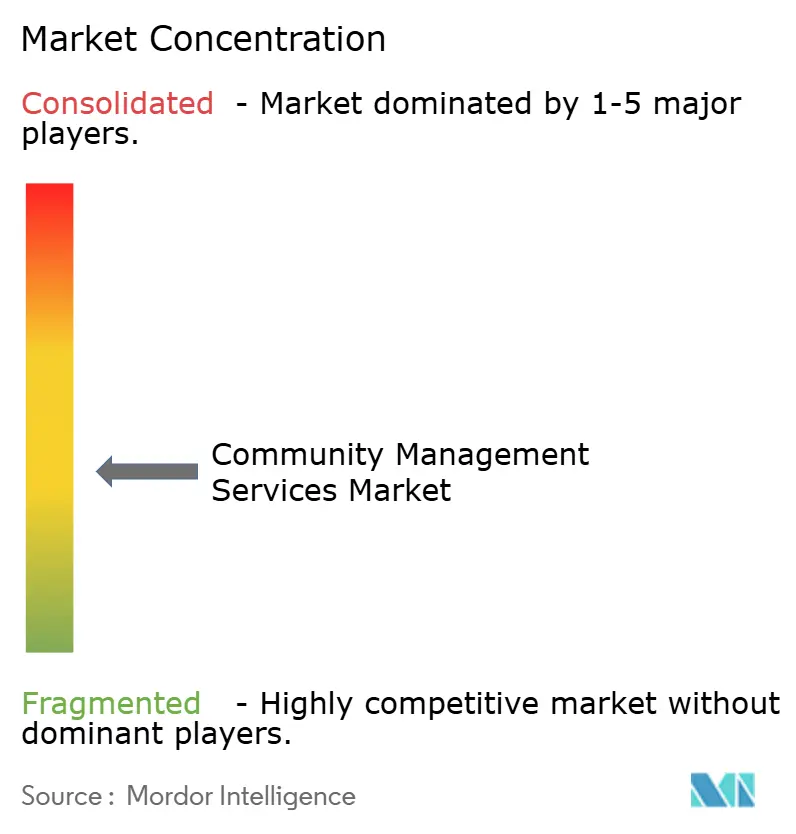
The community management services market is moderately fragmented, and no provider holds a decisive position across all service types and end-use sectors. Specialist providers include Khoros, Higher Logic, Gainsight, Circle, and Bettermode. Broader enterprise platforms include Salesforce, Microsoft, Sprinklr, and Verint Systems. These providers compete through community functionality, workflow integration, security controls, and service coverage. Buyers choose between specialist platforms with deep community tools and broader suites that combine community management with customer experience or productivity capabilities.
Within the community management services market, acquisition activity has focused on building more complete customer retention stacks. Gainsight acquired Skilljar in February 2025 to combine learning, customer education, product experience, and community data.[4] Gainsight also completed acquisitions of Erica Kuhl Consulting and ModerateKit in April 2025 and formed a business unit for customer community, learning, and in-app experience. It's May 2026, Agentic Stack added an Agent Studio, a Community Developer Studio, and an integration with Salesforce. These moves place community activity within a larger retention and customer operations framework.
AI-native product development is another major competitive factor in the community management services market. IgniteTech launched Khoros Aurora AI in April 2026 with AI moderation, answer support, and lifecycle orchestration. IgniteTech also launched Khoros Iris AI across 187 languages, while Sprinklr’s Spring ’26 release added explainable AI agents, DRP 2.0 compliance controls, and a unified marketplace. The market concentration score is 3 out of 10 because no top-player combined-share data is available and the supplier base remains broadly fragmented across specialist and enterprise platforms.
Community Management Services Industry Leaders
-
Khoros, LLC
-
Higher Logic, LLC
-
Sprinklr, Inc.
-
ModSquad, Inc.
-
Hivebrite (Kit United SAS)
- *Disclaimer: Major Players sorted in no particular order
Community Management Services Market Companies Covered in this Report
- Khoros, LLC
- Higher Logic, LLC
- Hivebrite (Kit United SAS)
- ModSquad, Inc.
- Viafoura Inc.
- CircleCo, Inc.
- Civilized Discourse Construction Kit, Inc.
- Bettermode Inc.
- Sprinklr, Inc.
- Gainsight, Inc.
- Verint Systems Inc.
- Personify, Inc.
- Influitive Corporation
- Bevy Labs, Inc.
- Zendesk, Inc.
- Mighty Software, Inc.
- Salesforce, Inc.
- Microsoft Corporation
Recent Industry Developments in Community Management Services Market
- July 2026: BrightEdge published research covering approximately 300 million monthly searches, finding that social platform and community content appeared as a source in 19.5 million Google AI Overview answers and influenced 77% of AI-assisted search responses, establishing community content as a critical discovery surface for AI search and creating new demand for community signal monitoring and management among enterprise brands.
- June 2026: Health Union launched its 2027 innovation suite on June 25, 2026, introducing AI-personalized patient experience tools, including a Prior Authorization Appeal Support module, an adaptive multimedia experience called My Journ.ai, and a 360° Community Connect advertising layer, coordinating media delivery across 50 million patients and 3.8 million prescribers through community behavioral signals, positioning its 125+ health communities as a first-party data network for life sciences brands.
- June 2026: Circle launched Circle Eclipse 2026, introducing Circle AI as an AI partner for building and operating digital communities, Circle Discover as a creator business marketplace, and Circle Studios as a full-service partnership program for top community creators. Beta rollout of Circle AI and a redesigned inbox began on June 16, with full customer access expected by August 2026.
- June 2026: Salesforce released its Summer ’26 platform update, delivering multi-agent orchestration, Slack-first workflows, and Experience Cloud community updates, including AI-powered self-service and agentic engagement capabilities, to all enterprise customers from June 15, 2026, marking a significant expansion of community platform capability within its agentic enterprise architecture.
Global Community Management Services Market Report Scope
The Community Management Services Market refers to the industry that provides professional services for the administration, engagement, governance, and optimization of online and offline communities on behalf of organizations. These services are designed to foster meaningful interactions among members, strengthen brand loyalty, improve customer experiences, facilitate knowledge sharing, and ensure healthy, inclusive, and compliant community environments. Community management services combine operational expertise, engagement strategies, analytics, and technology support to help organizations build sustainable communities that contribute to customer retention, advocacy, innovation, and business growth.
The Community Management Services Market Report is Segmented by Service Type (Community Operations and Moderation, Community Engagement and Advocacy, Community Analytics and Intelligence, Community Technology and Platform Services, and Community Training and Enablement), End-Use Industry (Technology and Telecommunications, Media and Entertainment, Retail and E-commerce, BFSI, Education, Healthcare and Life Sciences, Professional Associations and Nonprofits, and Other End-Use Industries), and Geography (North America, South America, Europe, Asia-Pacific, Middle East, and Africa). The Market Forecasts are Provided in Terms of Value (USD).
Segmentation Overview
| Community Operations and Moderation |
| Community Engagement and Advocacy |
| Community Analytics and Intelligence |
| Community Technology and Platform Services |
| Community Training and Enablement |
| Technology and Telecommunications |
| Media and Entertainment |
| Retail and E-commerce |
| BFSI |
| Education |
| Healthcare and Life Sciences |
| Professional Associations and Nonprofits |
| Other End-use Industries |
| North America | United States |
| Canada | |
| Mexico | |
| South America | Brazil |
| Argentina | |
| Chile | |
| Colombia | |
| Rest of South America | |
| Europe | Germany |
| United Kingdom | |
| France | |
| Italy | |
| Spain | |
| Nordics | |
| Benelux | |
| Russia | |
| Rest of Europe | |
| Asia-Pacific | China |
| Japan | |
| India | |
| South Korea | |
| Australia and New Zealand | |
| Southeast Asia | |
| Rest of Asia-Pacific | |
| Middle East | United Arab Emirates |
| Saudi Arabia | |
| Turkey | |
| Israel | |
| Qatar | |
| Rest of Middle East | |
| Africa | South Africa |
| Egypt | |
| Nigeria | |
| Kenya | |
| Rest of Africa |
| By Service Type | Community Operations and Moderation | |
| Community Engagement and Advocacy | ||
| Community Analytics and Intelligence | ||
| Community Technology and Platform Services | ||
| Community Training and Enablement | ||
| By End-use Industry | Technology and Telecommunications | |
| Media and Entertainment | ||
| Retail and E-commerce | ||
| BFSI | ||
| Education | ||
| Healthcare and Life Sciences | ||
| Professional Associations and Nonprofits | ||
| Other End-use Industries | ||
| By Geography | North America | United States |
| Canada | ||
| Mexico | ||
| South America | Brazil | |
| Argentina | ||
| Chile | ||
| Colombia | ||
| Rest of South America | ||
| Europe | Germany | |
| United Kingdom | ||
| France | ||
| Italy | ||
| Spain | ||
| Nordics | ||
| Benelux | ||
| Russia | ||
| Rest of Europe | ||
| Asia-Pacific | China | |
| Japan | ||
| India | ||
| South Korea | ||
| Australia and New Zealand | ||
| Southeast Asia | ||
| Rest of Asia-Pacific | ||
| Middle East | United Arab Emirates | |
| Saudi Arabia | ||
| Turkey | ||
| Israel | ||
| Qatar | ||
| Rest of Middle East | ||
| Africa | South Africa | |
| Egypt | ||
| Nigeria | ||
| Kenya | ||
| Rest of Africa | ||
Key Questions Answered in the Report
What is the community management services market size?
It is USD 7.49 billion in 2026 and is projected to reach USD 11.73 billion by 2031, at a CAGR of 9.39%. Growth reflects demand for owned member environments, AI-enabled workflows, stronger governance, and measurable customer engagement.
Which service type leads community management services?
Community Engagement and Advocacy led with 31.80% share in 2025. Demand is supported by customer forums, ambassador programs, structured peer support, and advocacy workflows that can contribute to retention and customer success activities.
Which service type is projected to grow fastest?
Community Analytics and Intelligence is projected to expand at a CAGR of 9.95% through 2031. Organizations are seeking better visibility into owned-channel behavior, recurring member needs, private community interactions, and the commercial value of engagement data.
Which end-use sector has the strongest growth outlook?
Healthcare and Life Sciences is projected to expand at a CAGR of 9.81% through 2031. Patient communities, healthcare professional engagement programs, peer learning, and controlled digital information exchange support demand for specialized services and governance.
Which region has the largest share of community management services?
North America held 38.13% share in 2025. Enterprise software vendors, professional associations, and healthcare networks support this position through established customer success operations and mature use of community platforms.
Why are AI capabilities important for community platforms?
AI can automate moderation, onboarding, content routing, and routine support. This allows human teams to focus on complex member needs, appeals, governance decisions, escalation processes, program quality, the development of trusted member relationships, and the sensitive cases where context, accountability, and professional judgment remain necessary for responsible, transparent, consistent, and well-documented community operations across large and diverse member groups.