
Community Growth Services Market Size and Share
Market Overview
| Study Period | 2020 - 2031 |
|---|---|
| Market Size (2026) | USD 2.46 Billion |
| Market Size (2031) | USD 5.22 Billion |
| Growth Rate (2026 - 2031) | 16.17 % |
| Fastest Growing Market | Asia-Pacific |
| Largest Market | North America |
| Market Concentration | Low |
Major Players *Disclaimer: Major Players sorted in no particular order Image © Mordor Intelligence. Reuse requires attribution under CC BY 4.0. | |
Community Growth Services Market Analysis by Mordor Intelligence
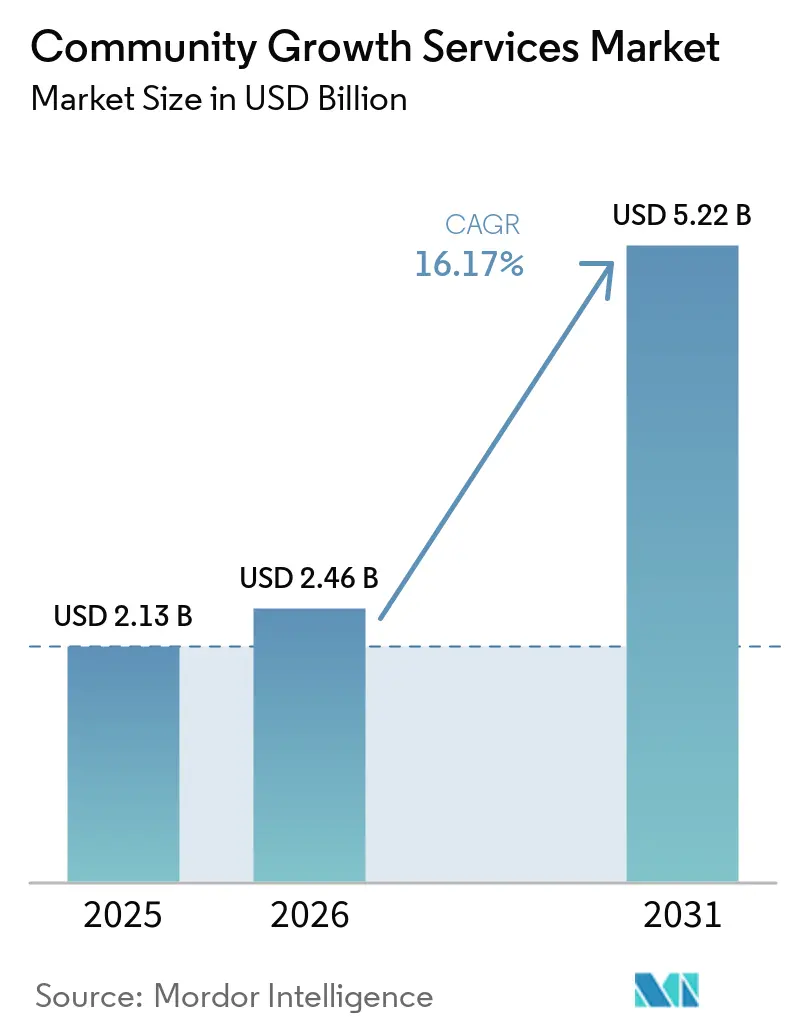
The community growth services market size is projected to expand from USD 2.13 billion in 2025 to USD 2.46 billion in 2026, and to USD 5.22 billion by 2031, registering a CAGR of 16.17% between 2026 and 2031. Enterprise buyers increasingly treat owned communities as infrastructure for retention and revenue, rather than as discretionary marketing programs. This change supports multi-year service contracts and dedicated operations roles across software, media, healthcare, and professional services. Lower organic reach on third-party platforms, higher customer acquisition costs, and the need for reliable first-party data for AI tools are shifting work from short campaigns to ongoing operations. The community growth services market is also shaped by stricter review of return on investment, moderation costs from synthetic content, and gaps between community activity and commercial systems.
Key Report Takeaways
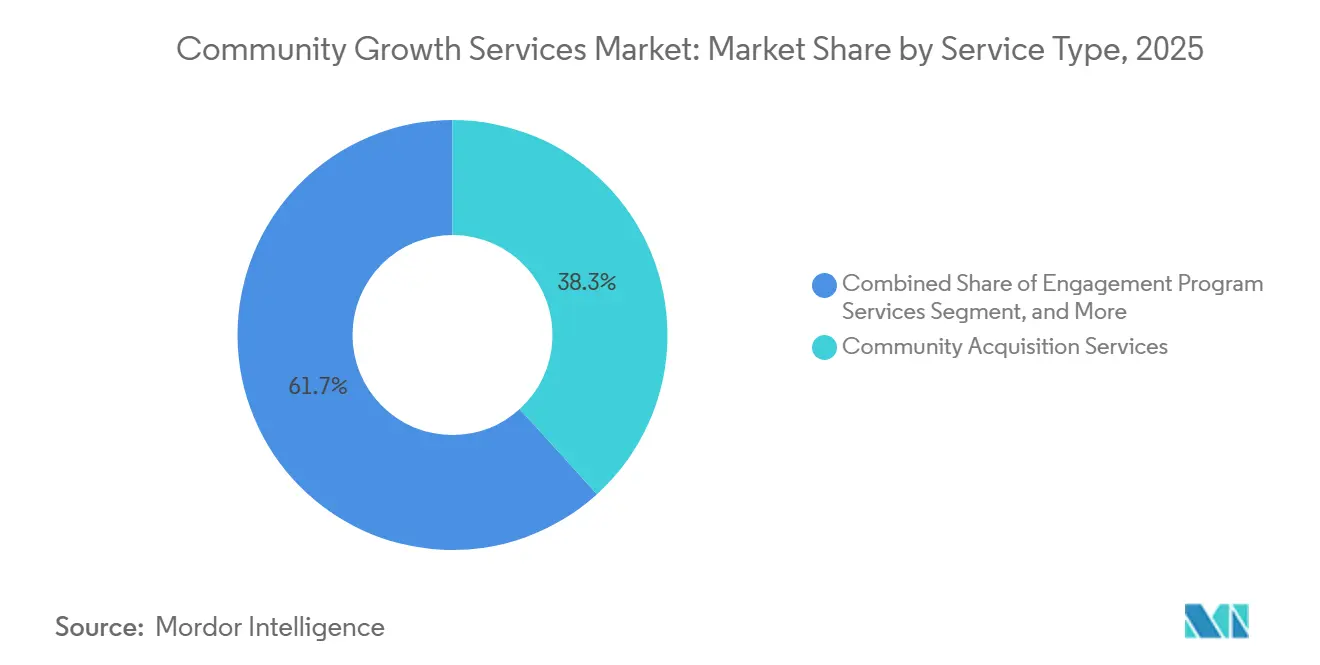
- By service type, community acquisition services held 38.27% of the community growth services market share in 2025, while employee advocacy programs are projected to expand at a 17.28% CAGR through 2031.
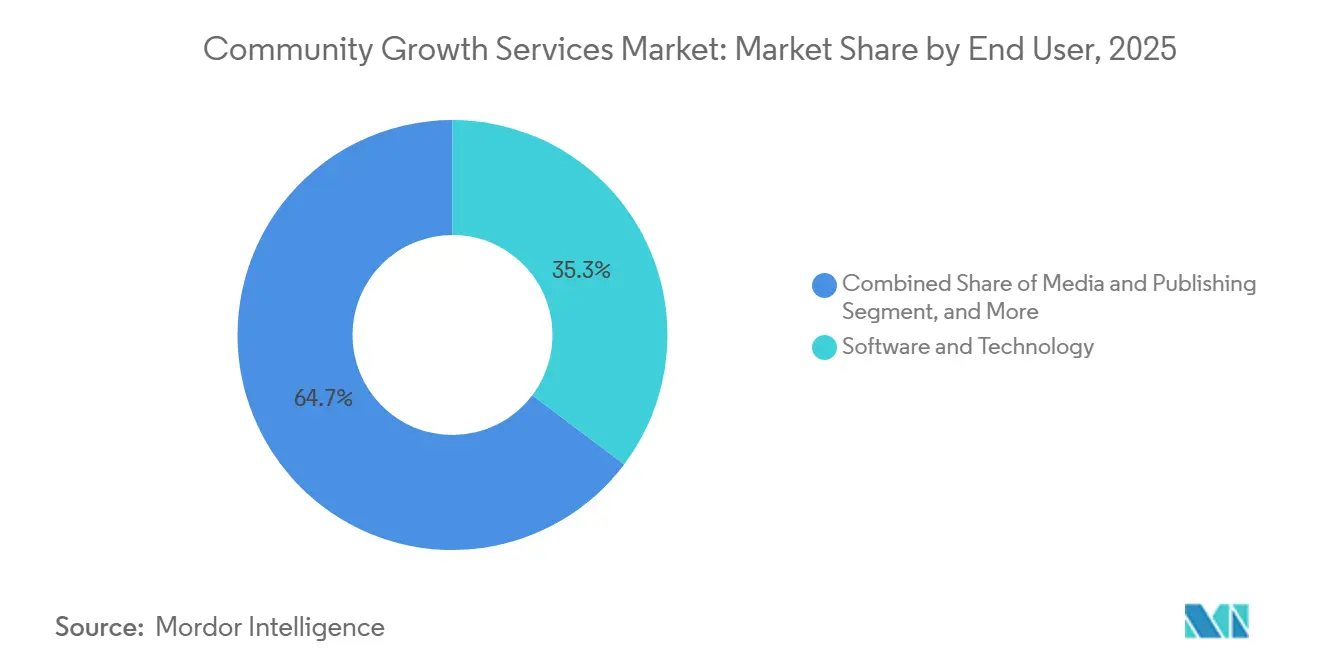
- By end user, software and technology accounted for 35.28% of revenue in 2025, while art and culture is projected to record the highest CAGR at 16.74% through 2031.
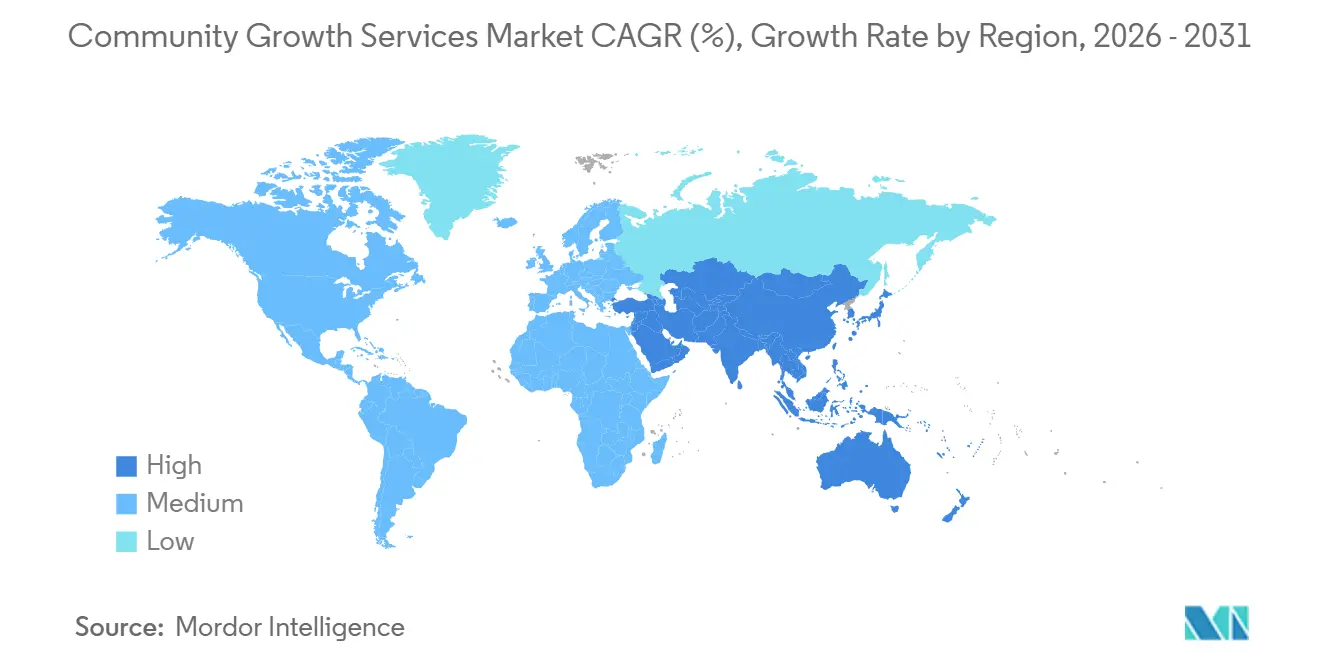
- By geography, North America held 48.04% of revenue in 2025, while Asia-Pacific is projected to expand at a CAGR of 17.04% through 2031.
Note: Market size and forecast figures in this report are generated using Mordor Intelligence’s proprietary estimation framework, updated with the latest available data and insights as of January 2026.
Market Trends and Insights
Drivers Impact Analysis of Community Growth Services Market*
| Driver | (~) % Impact on CAGR Forecast | Geographic Relevance | Impact Timeline |
|---|---|---|---|
| Rising Enterprise Focus on Retention-Led Growth | +3.8% | Global, concentrated in North America and Europe | Medium term (2-4 years) |
| Growing Preference for Peer Support and Case Deflection | +3.1% | Global, strongest in North America and Asia-Pacific core | Short term (≤ 2 years) |
| AI-Enabled Personalization and Community Operations | +2.6% | North America and Europe, with spillover to Asia-Pacific | Medium term (2-4 years) |
| Expansion of Hybrid Events and Always-On Member Experiences | +2.0% | Global, including North America, Europe, and Asia-Pacific core | Medium term (2-4 years) |
| Owned Communities as a Hedge Against Zero-Click Discovery and Algorithm Volatility | +1.6% | Global, stronger in North America and Europe | Long term (≥ 4 years) |
| First-Party Interaction Data for AI-Led Go-to-Market Systems | +1.2% | North America and Europe, with early gains in Asia-Pacific | Long term (≥ 4 years) |
| Source: Mordor Intelligence | |||
Rising Enterprise Focus on Retention-Led Growth
Retention has become a central growth metric for many software and technology companies, creating sustained demand for community specialists who can connect program activity to customer outcomes. A community gives customers a place to learn from peers, resolve issues, and build closer ties to a vendor’s products without relying solely on formal support channels. Gainsight reported that highly active members who contributed peer-to-peer solutions were less likely to churn than customers who did not participate.[1] This pattern can make a community harder to replace because customer relationships, practical knowledge, and user confidence accumulate over time within a vendor-led environment. Zoom and Cognite used Gainsight Customer Communities and Skilljar to link peer access with structured learning, which strengthened the use of education and support during renewal decisions. The community growth services market, therefore, rewards providers that build retention measures into program design, align them with customer success teams, establish a common account of what member activity means, and report results before annual contract reviews, making the community program easier to position as part of the customer relationship instead of a separate communications activity.
Growing Preference for Peer Support and Case Deflection
Peer support can protect community budgets by reducing the volume of cases sent to formal support teams and making the resulting savings easier to discuss with finance leaders. Salesforce stated that peer-to-peer forums can deflect 20%-28% of support tickets when they operate at scale. Higher Logic’s method measures direct savings through accepted answers and average ticket cost, while also considering the value of content page views that may prevent future cases. This approach gives finance teams a clearer way to assess a program that creates value across support, customer success, and product teams, rather than within a single department. FeverBee reported that a structured moderation and friction program increased the retrieval of community content by organizational AI systems by 55%. The community growth services market has room for providers that combine support savings with well-governed knowledge, clearer content structures, and evidence that can improve internal AI outputs, because the value depends on maintaining accurate answers, making useful content easy to find, and applying moderation practices that limit low-quality material before it affects the knowledge base as it develops through member participation and formal content review.
AI-Enabled Personalization and Community Operations
AI tools are reducing repetitive work in large enterprise communities while retaining a role for human judgment in situations involving trust, nuanced member needs, and complex decisions. Khoros introduced Aurora AI in April 2026 with a Community Language Model and Answer Assist for unanswered posts. Khoros stated that 30% of questions in enterprise communities had historically gone unresolved, highlighting the operational gap that such tools seek to address across large knowledge bases. After IgniteTech acquired Khoros in May 2025, internal ticket resolution rose from 5% to 60%, and platform downtime fell by 97%. Bevy also added AI-led member matching through its acquisition of Intros AI, which had facilitated more than 1 million introductions across 1,000 communities. These changes allow community teams to focus more of their time on member relationships, program strategy, and complex moderation decisions, while routine work is handled more consistently, changing the provider role from performing every operational task to setting rules, reviewing exceptions, improving content quality, and ensuring that automated responses remain relevant to a community’s context and align with the service objectives agreed by the provider and client.
Expansion of Hybrid Events and Always-On Member Experiences
Community events now extend beyond annual meetings to include in-person, virtual, and asynchronous activities throughout the year, giving members more regular ways to participate. This format requires ongoing content planning, moderation, event coordination, and performance tracking, rather than a short cycle focused on a single event. The Community Marketing Promotion Association found that organizations combining events with always-on communities achieved stronger member contribution and advocacy outcomes than organizations using event-only formats. Momentive Software launched Momentive Community in July 2026 to support continuous participation between annual events for associations and nonprofits. The platform is designed for the 37,000 organizations that Momentive supports across 30 countries and includes subcommunities by chapter and career stage. The community growth services market benefits as buyers need support for continuous member experiences, coordinated local participation, and year-round delivery rather than event-specific work, requiring providers to connect member communications, event follow-up, and local group management into a single operating model that does not lose momentum once a scheduled event ends and members return to their usual working routines.
Restraints Impact Analysis of Community Growth Services Market*
| Restraint | (~) % Impact on CAGR Forecast | Geographic Relevance | Impact Timeline |
|---|---|---|---|
| Proving Community ROI Under Flat Marketing Budgets | -2.4% | Global, pronounced in Europe and South America | Short term (≤ 2 years) |
| Data Privacy, Compliance, and Brand Safety Burdens | -1.9% | Europe, United Kingdom, with global spillover | Medium term (2-4 years) |
| Higher Moderation Cost From Online Safety Rules and Synthetic Abuse Risk | -1.3% | Europe, United Kingdom, and North America | Short term (≤ 2 years) |
| Fragmented Tool Stacks and Attribution Blind Spots | -0.8% | Global, primarily North America and Europe | Medium term (2-4 years) |
| Source: Mordor Intelligence | |||
Proving Community ROI Under Flat Marketing Budgets
Community programs compete for funding with channels that offer direct and familiar performance measures, particularly when marketing budgets are flat. Their value can appear across support deflection, retention, advocacy, product feedback, and search visibility, which makes a single attribution model difficult for many organizations to establish. Higher Logic explains that direct ticket savings can be measured by accepted answers and the average ticket cost, while indirect savings require program-specific activity assumptions. Community networks often produce their strongest results after members and content reach sufficient scale, which can conflict with short budget cycles and quarterly planning expectations. Providers can reduce this issue by defining metrics, baselines, ownership, and attribution logic before inviting members into a program. The community growth services market remains exposed when providers present measurement as a later reporting task instead of a core service component that guides operational decisions, since without an agreed starting point and regular reporting process, teams can struggle to explain whether changes in participation, support activity, or retention are linked to the service program and whether reported results can be used in future budget decisions.
Data Privacy, Compliance, and Brand Safety Burdens
The European Union Digital Services Act has been in force since February 2024 and sets out obligations regarding transparency, user rights, content governance, and systemic risks for online platforms. The United Kingdom’s Online Safety Act introduces requirements on child protection, age-appropriate design, and content governance for services accessible to United Kingdom users.[2] These rules require multinational providers to adapt legal and technical processes by jurisdiction, increasing delivery costs and making standardized global programs more difficult to manage. IFTAS found that 1 in 5 moderators reported trauma or exhaustion in its 2025 assessment, which indicates the human burden that can accompany growing volumes of harmful or synthetic content. Providers with established compliance procedures, escalation paths, and AI-supported moderation can use these capabilities to meet buyer requirements with more consistent controls. The community growth services market faces a continuing constraint, as smaller providers cannot maintain comparable compliance and trust-and-safety capacity, with the burden most evident when a provider must respond to incidents, document its actions, maintain consistent standards across communities operating in multiple jurisdictions, and adapt established processes to local requirements.
*Our forecasts treat driver/restraint impacts as directional, not additive. The impact forecasts reflect baseline growth, mix effects, and variable interactions.
Community Growth Services Market Segment Analysis
By Service Type:
Acquisition Services Lead While Advocacy Programs ExpandCommunity Acquisition Services accounted for 38.27% of revenue in 2025 within the community growth services market. The leading position reflects the need to establish a member base before engagement, moderation, and advocacy services can deliver results. Acquisition programs cover onboarding journeys, member value propositions, and early activation triggers. Enterprises often seek external specialists because these activities require dedicated community planning that general marketing agencies may not provide.
Employee Advocacy Programs are projected to expand at a 17.28% CAGR within Engagement Program Services between 2026 and 2031. DSMN8 reported that 68% of advocates shared 3 or more times each week in 2026, an increase of 13 percentage points from the prior year. Sprinklr stated that L’Oréal’s advocacy program generated more than 33 million organic impressions and a 4x return on investment across 18 months with more than 900 ambassadors.[3] Moderation and Trust Services are gaining relevance as synthetic content and larger communities require more specialized oversight. Community Events and Experience Services are also extending beyond annual meetings, which supports ongoing work across event design, platform administration, and logistics. Across these services, the community growth services industry is moving toward continuous managed delivery that can support longer contracts and higher service value in the community growth services market.

By End User:
Software and Technology Leads Demand While Art and Culture ExpandsSoftware and Technology accounted for 35.28% of revenue in 2025, giving it the largest share of the community growth services market by end-user demand. SaaS companies use communities to improve product adoption, shorten time to value, and reduce support costs through peer assistance. This vendor mix reflects the depth of platform and service capabilities that software buyers in the community growth services market seek.
Art and culture are projected to expand at a CAGR of 16.74% between 2026 and 2031. Cultural institutions are building paid digital membership communities that enable them to generate income outside algorithm-controlled distribution channels, and that require acquisition and engagement services suited to values-led, noncommercial member relationships. Professional Associations and Membership Organizations remain a stable source of demand as association management vendors add community functions to retain members between events. Momentive Software supports more than 37,000 organizations across 30 countries and facilitates more than USD 13 billion raised each year through its platform, while Media and Publishing organizations use community services to encourage recurring subscriptions as zero-click search reduces organic traffic. Healthcare, Life Sciences, and Financial Services are adopting more cautiously because regulated and privacy-sensitive interactions can slow deployment. The community growth services industry, therefore, includes both high-volume software demand and carefully governed programs in regulated sectors.
Geography Analysis
North America Community Growth Services Market
North America held 48.04% of the community growth services market share in 2025. The region has a large concentration of SaaS businesses, enterprise buyers, and community platform vendors. Their proximity has supported shared professional practices, tools, and procurement approaches. The United States remains the main contributor, with Gainsight, Higher Logic, Bevy, Khoros, and Influitive serving buyers from growth-stage SaaS companies to Fortune 500 enterprises, while Canada is adding demand through its financial technology and SaaS sectors.
Europe and South America Community Growth Services Market
Europe is the second-largest regional market, led by the United Kingdom, Germany, France, and the Nordic countries. The Digital Services Act has affected community governance, moderation, and data handling requirements across Europe. Germany and the Nordic countries show demand for professional associations and B2B programs that support knowledge exchange and peer validation. France’s software ecosystem is increasing community investment as organizations recognize community operations as a distinct business function within the community growth services market. South American demand is centered on Brazil, followed by Argentina and Colombia, where digital transformation is creating early enterprise programs in the community growth services market.
APAC and MEA Community Growth Services Market
Asia-Pacific is projected to expand at a CAGR of 17.04% between 2026 and 2031, making it the fastest-growing region. India and Southeast Asia are increasing SaaS adoption, while professional association networks are expanding across the community growth services market in the region. SaaS companies in the region are building community programs that serve both local users and global customer bases. Regional differences in customer expectations and program maturity create demand for service models that can adapt to local market operating conditions. India benefits from SaaS startups and IT services firms serving global customers, while South Korea and Singapore are early adopters of enterprise platforms. The Middle East and Africa remain at earlier stages, with the UAE, Saudi Arabia, and South Africa acting as key demand centers under national digital transformation programs.
Competitive Landscape
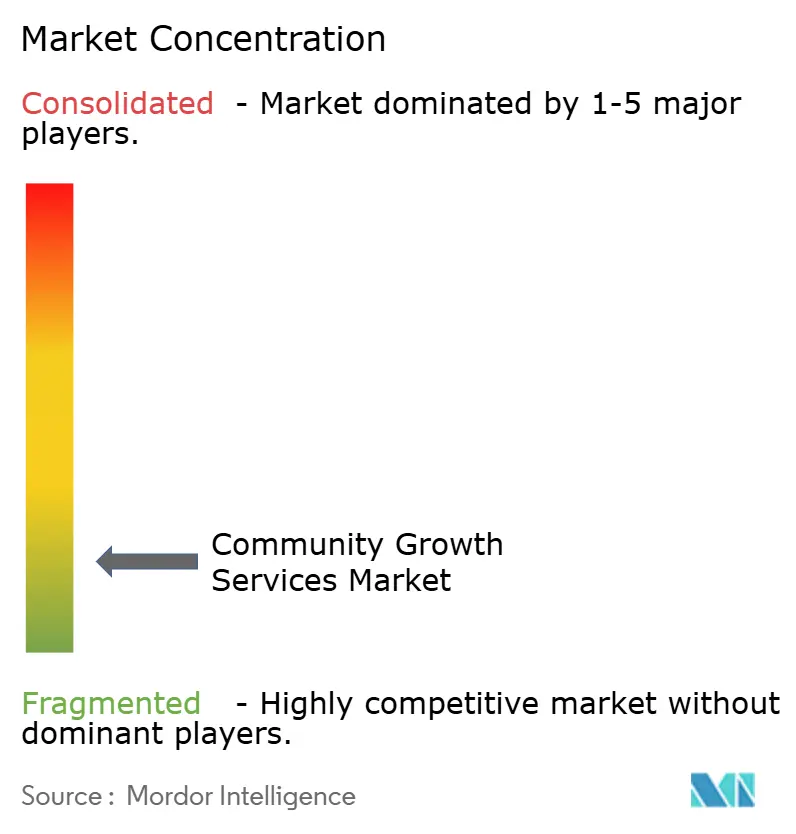
The community growth services market is fragmented because providers compete across distinct service areas rather than through a single dominant model. FeverBee and The Community Roundtable provide strategy and program design for enterprise clients, while Khoros, Gainsight, and Higher Logic combine software licenses with professional services in full-stack engagements. Influitive specializes in customer marketing and reference program management within the community growth services market. Bettermode, Disciple Media, and Zapnito provide white-label community systems for specific vertical needs.
Acquisitions in 2025 and 2026 show a preference for integrated community intelligence platforms over point solutions. Zoom announced an agreement in July 2026 to acquire Common Room, bringing buyer intelligence from community, product, and engagement signals into its Revenue Accelerator offering.[4] Bevy acquired Intros AI in July 2025 and added AI-led member matching across forums, events, and user groups. IgniteTech acquired Khoros in May 2025, followed by the launch of Aurora AI in April 2026. These moves indicate that community data is increasingly viewed as an input to sales and customer workflows, rather than merely as an engagement record in the community growth services market.
Higher Logic introduced Vanilla MCP in May 2026, enabling users to connect live community data to AI tools via the Model Context Protocol. Gainsight launched Developer Studio in May 2026 to help nontechnical teams customize community experiences with AI-assisted development. Khoros also introduced a Community Language Model and a 3-tier AI moderation approach through Aurora AI. Smaller providers can still compete in the market where vertical designs, multilingual operations, moderation services, or cross-channel attribution are more important than broad platform functions. The community growth services market offers room for these focused providers because buyer requirements differ widely by use case and geography.
Community Growth Services Industry Leaders
-
Higher Logic, LLC
-
Khoros, LLC
-
Gainsight, Inc.
-
Salesforce, Inc.
-
Sprinklr Inc.
- *Disclaimer: Major Players sorted in no particular order
Community Growth Services Market Companies Covered in this Report
- FeverBee Limited
- Bevy Labs, Inc.
- CMX Media, Inc.
- Commsor, Inc.
- Orbit Marketing Inc.
- Common Room, Inc.
- Higher Logic, LLC
- Khoros, LLC
- Hivebrite SAS
- Gainsight, Inc.
- Discourse Hosting, Inc.
- Bettermode Inc.
- Mighty Networks, Inc.
- Mobilize Networks, Inc.
- Influitive Corporation
- Zapnito Ltd.
- Disciple Media Ltd.
- Standing On Giants Ltd
- The Community Roundtable LLC
- Clocktower Advisors LLC
Recent Industry Developments in Community Growth Services Market
- July 2026: Zoom Communications Inc. announced a definitive agreement to acquire Common Room, an AI-native GTM intelligence platform used by teams at Atlassian, Anthropic, Autodesk, Notion, Okta, and Snowflake. The acquisition extends Zoom's Revenue Accelerator by adding person-level buyer intelligence derived from community, product, and engagement signals, repositioning community data as a first-party input to enterprise sales workflows rather than a downstream marketing output. Financial terms were not disclosed.
- July 2026: Momentive Software launched Momentive Community, an AI-native online community platform for associations and nonprofits. It addresses the member engagement gap between annual events for the 37,000 organizations it serves across 30 countries. The platform includes an AI Community Assistant, nested subcommunities, and 2-way AMS data sync. General availability is scheduled for August 2026.
- May 2026: Higher Logic launched Higher Logic Vanilla MCP on May 26, 2026. It enables customers to connect their community platform directly to AI tools including ChatGPT, Claude, and Cursor through the Model Context Protocol. The capability makes live community data, including sentiment, product feedback, and advocacy signals, queryable by AI systems. It is provided free to existing Higher Logic Vanilla customers.
- May 2026: Gainsight launched Developer Studio for Customer Communities and a new Gainsight Customer Communities and Skilljar integration on May 21, 2026. The release created a unified retention platform that combines community access with structured learning. Cognite and Zoom reported stronger self-service case deflection and community engagement after deploying the integrated experience.
Global Community Growth Services Market Report Scope
The Community Growth Services Market refers to the industry that provides specialized services to build, expand, engage, and sustain communities around brands, organizations, products, platforms, and shared interests. These services help organizations attract new members, foster meaningful interactions, improve member retention, strengthen trust and loyalty, and create vibrant communities that support business growth, customer advocacy, and long-term engagement. Community growth services combine strategic planning, content development, moderation, analytics, event management, and engagement initiatives to cultivate active and valuable communities across digital and physical channels.
The Community Growth Services Market Report is Segmented by Service Type (Community Acquisition Services, Engagement Program Services, Moderation and Trust Services, and Community Events and Experience Services), End User (Software and Technology, Media and Publishing, Professional Associations and Membership Organizations, Consumer Brands and Retail, Financial Services, Healthcare and Life Sciences, Education, and Other End Users), and Geography (North America, South America, Europe, Asia-Pacific, Middle East, and Africa). The Market Forecasts are Provided in Terms of Value (USD).
Segmentation Overview
| Community Acquisition Services |
| Engagement Program Services |
| Moderation and Trust Services |
| Community Events and Experience Services |
| Software and Technology |
| Media and Publishing |
| Professional Associations and Membership Organizations |
| Consumer Brands and Retail |
| Financial Services |
| Healthcare and Life Sciences |
| Education |
| Other End Users |
| North America | United States |
| Canada | |
| Mexico | |
| South America | Brazil |
| Argentina | |
| Colombia | |
| Chile | |
| Rest of South America | |
| Europe | Germany |
| United Kingdom | |
| France | |
| Italy | |
| Spain | |
| Russia | |
| Netherlands | |
| Nordics | |
| Rest of Europe | |
| Asia-Pacific | China |
| Japan | |
| India | |
| South Korea | |
| Australia | |
| Singapore | |
| Indonesia | |
| Rest of Asia-Pacific | |
| Middle East | Saudi Arabia |
| United Arab Emirates | |
| Turkey | |
| Israel | |
| Rest of Middle East | |
| Africa | South Africa |
| Nigeria | |
| Kenya | |
| Egypt | |
| Rest of Africa |
| By Service Type | Community Acquisition Services | |
| Engagement Program Services | ||
| Moderation and Trust Services | ||
| Community Events and Experience Services | ||
| By End User | Software and Technology | |
| Media and Publishing | ||
| Professional Associations and Membership Organizations | ||
| Consumer Brands and Retail | ||
| Financial Services | ||
| Healthcare and Life Sciences | ||
| Education | ||
| Other End Users | ||
| By Geography | North America | United States |
| Canada | ||
| Mexico | ||
| South America | Brazil | |
| Argentina | ||
| Colombia | ||
| Chile | ||
| Rest of South America | ||
| Europe | Germany | |
| United Kingdom | ||
| France | ||
| Italy | ||
| Spain | ||
| Russia | ||
| Netherlands | ||
| Nordics | ||
| Rest of Europe | ||
| Asia-Pacific | China | |
| Japan | ||
| India | ||
| South Korea | ||
| Australia | ||
| Singapore | ||
| Indonesia | ||
| Rest of Asia-Pacific | ||
| Middle East | Saudi Arabia | |
| United Arab Emirates | ||
| Turkey | ||
| Israel | ||
| Rest of Middle East | ||
| Africa | South Africa | |
| Nigeria | ||
| Kenya | ||
| Egypt | ||
| Rest of Africa | ||
Key Questions Answered in the Report
What is the community growth services market size?
The community growth services market is projected to be USD 2.46 billion in 2026 and USD 5.22 billion by 2031, at a CAGR of 16.17%.
What services are included in community growth programs?
The scope includes community acquisition, engagement programs, moderation and trust services, and community events and experience services. These services support the full member journey, from initial enrollment through ongoing participation.
Why do software companies use community growth services?
Software companies use communities to support product adoption, customer learning, peer support, and renewal retention. Software and Technology held 35.28% of revenue in 2025, reflecting its reliance on these operating goals.
Which region is expanding fastest for community services?
Asia-Pacific is projected to record the highest regional CAGR at 17.04% between 2026 and 2031. Growth is supported by rising SaaS adoption and expanding professional networks across India and Southeast Asia.
How can community programs reduce support costs?
Peer-to-peer forums can deflect 20%-28% of support ticket volume at scale, according to Salesforce. Accepted answers and accessible content can reduce the number of cases directed to formal support teams.
How is AI changing community operations?
AI supports unanswered-post responses, member matching, content retrieval, and moderation, allowing teams to focus on member relationships and complex decisions. It also requires providers to maintain clear rules and human review for sensitive situations.