
Commercial Food Dehydrators Market Size and Share
Market Overview
| Study Period | 2021 - 2031 |
|---|---|
| Market Size (2026) | USD 804.32 Million |
| Market Size (2031) | USD 998.76 Million |
| Growth Rate (2026 - 2031) | 5.67 % |
| Fastest Growing Market | Asia-Pacific |
| Largest Market | North America |
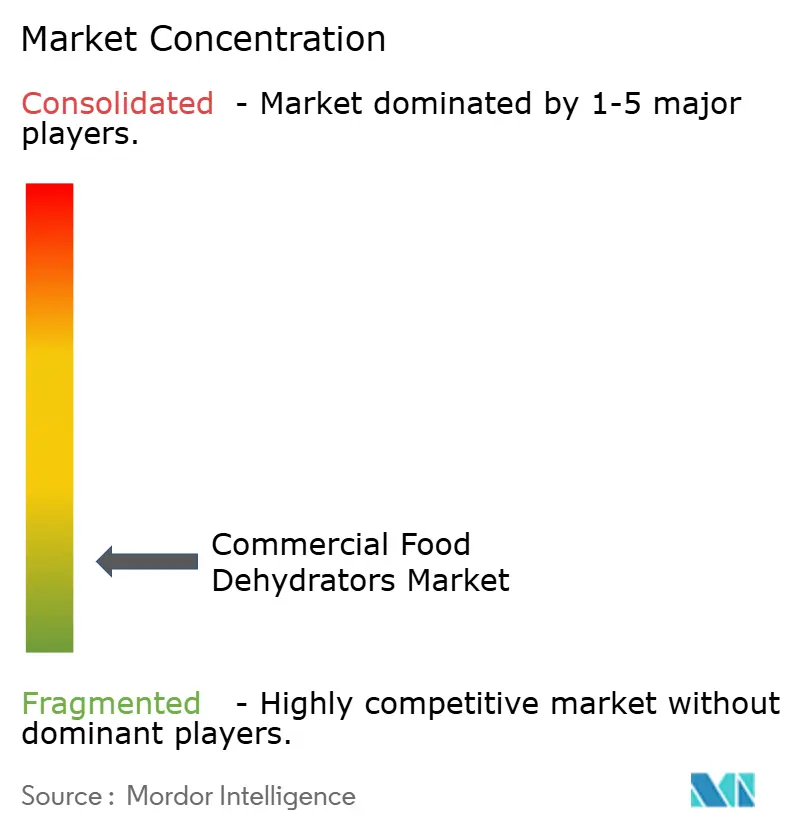
| Market Concentration | Low |
Major Players *Disclaimer: Major Players sorted in no particular order Image © Mordor Intelligence. Reuse requires attribution under CC BY 4.0. | |
Commercial Food Dehydrators Market Analysis by Mordor Intelligence
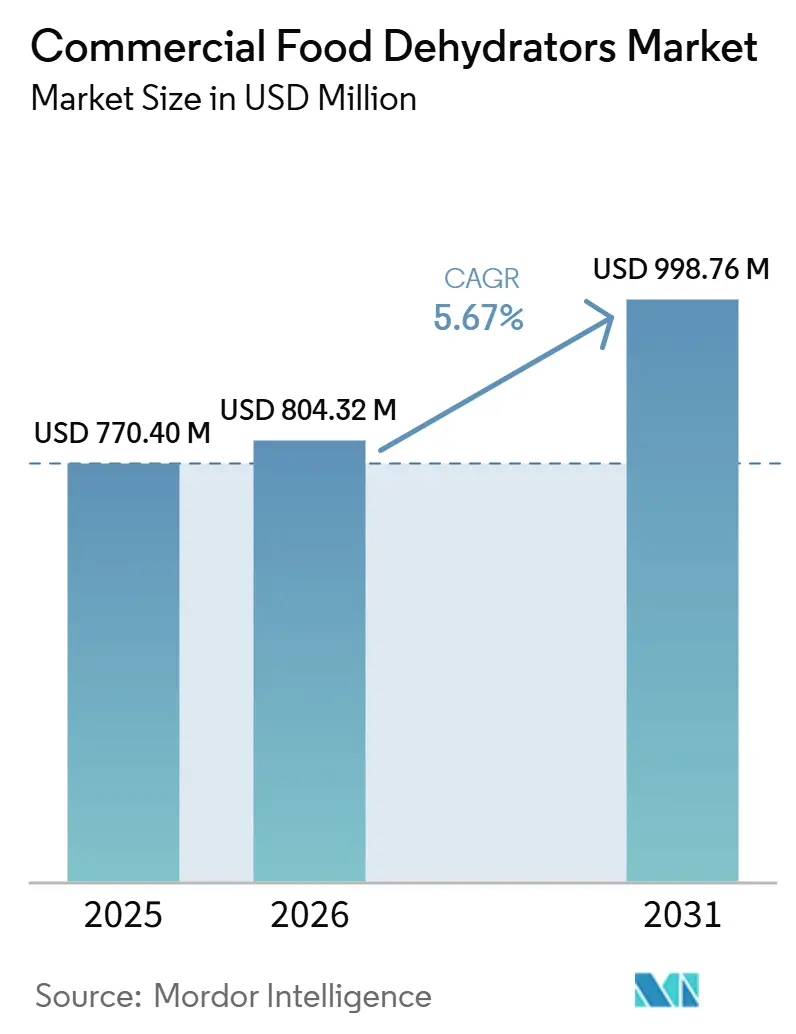
The Commercial Food Dehydrators Market size is projected to expand from USD 770.40 million in 2025 to USD 804.32 million in 2026, and to USD 998.76 million by 2031, registering a CAGR of 5.67% between 2026 and 2031. Food processors are placing greater value on shelf-stable production as they seek to reduce losses and use seasonal crops more effectively. The Food and Agriculture Organization reported that 13.00% of food was lost between harvest and retail, which supports investment in preservation capacity across different production scales. The United Nations Environment Programme reported that more than 1 billion metric tons of food was wasted globally in 2022, strengthening the case for value-added processing near production areas[1]Source: United Nations Environment Programme, “UNEP Food Waste Index Report 2024,” United Nations Environment Programme, unep.org. Buyers are also considering energy use, process records, and product consistency when selecting equipment. These requirements favor suppliers that can combine drying equipment with practical controls, service, and process support throughout the Commercial Food Dehydrators Market.
Key Report Takeaways
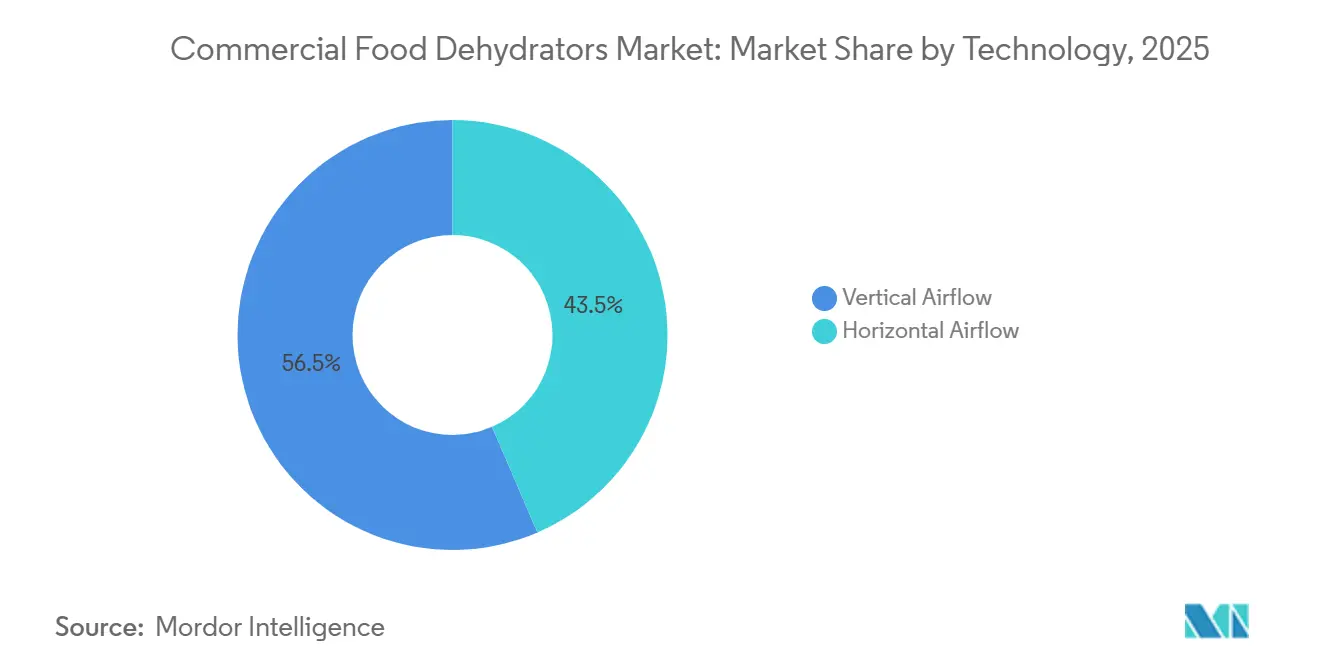
- By technology, Vertical Airflow held 56.47% of the commercial food dehydrators market share in 2025, while Horizontal Airflow is projected to record the highest CAGR of 6.84% through 2031.
- By product configuration, Tray and Cabinet Dehydrators accounted for 45.68% of the commercial food dehydrators sector in 2025, while Continuous Dehydrators are forecast to grow at 7.11% CAGR through 2031.
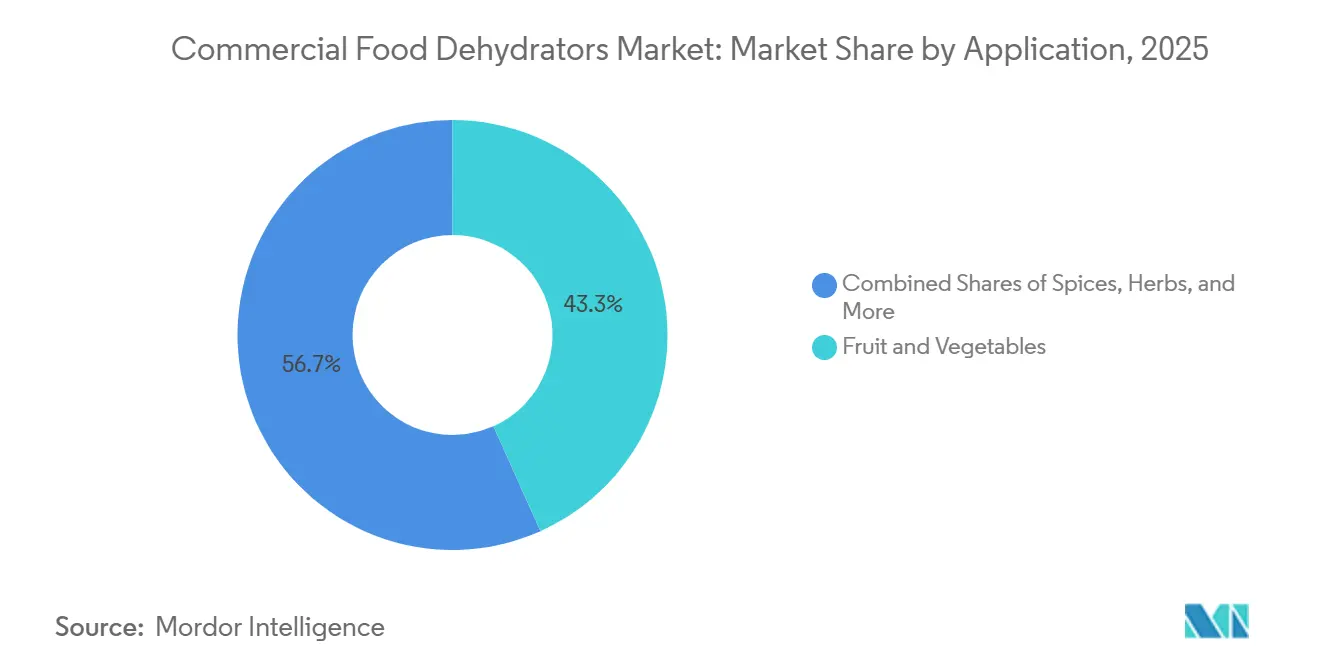
- By application, Fruits and Vegetables held 43.29% of the commercial food dehydrators sector in 2025, while Herbs, Spices, and Seasonings are projected to expand at 6.78% CAGR through 2031.
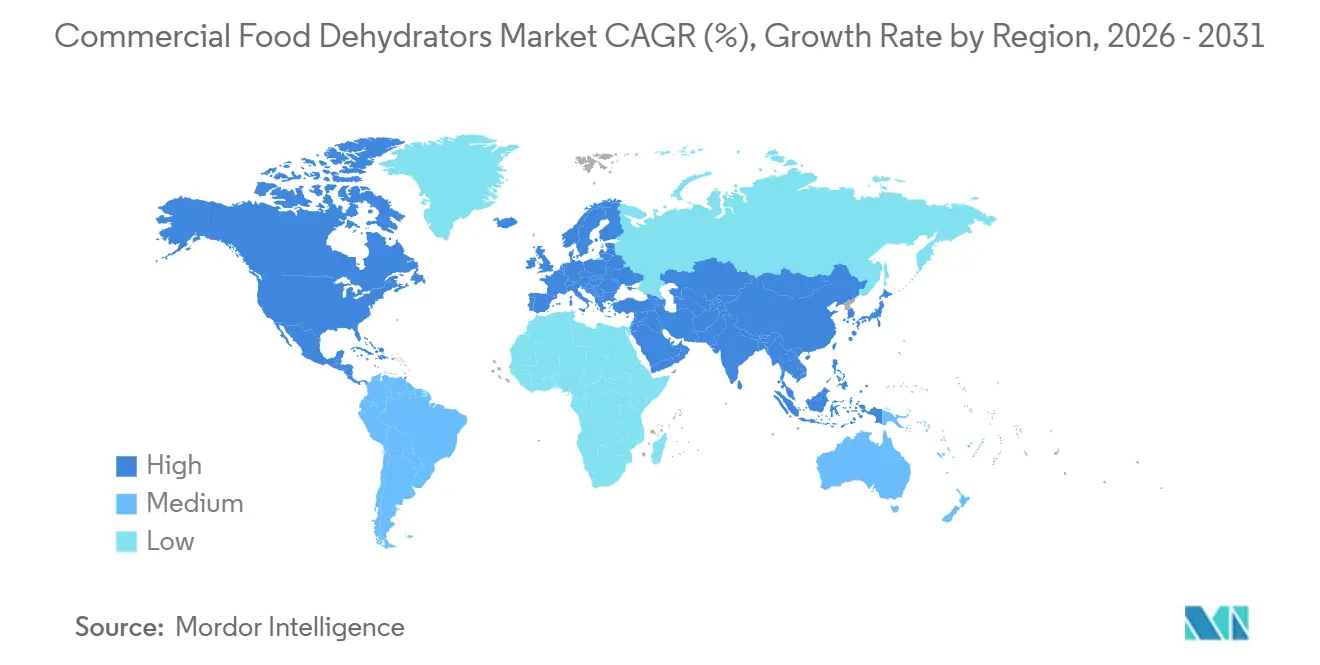
- By geography, North America accounted for 38.27% of the commercial food dehydrators sector in 2025, while Asia-Pacific is forecast to grow at 6.57% CAGR through 2031.
Note: Market size and forecast figures in this report are generated using Mordor Intelligence’s proprietary estimation framework, updated with the latest available data and insights as of January 2026.
Market Trends and Insights
Drivers Impact Analysis of Commercial Food Dehydrators Market*
| Driver | (~) % Impact on CAGR Forecasts | Geographic Relevance | Impact Timeline |
|---|---|---|---|
| Increasing Demand for Shelf-Stable and Minimally Processed Food Products | +1.5% | Global | Medium term (2–4 years) |
| Growing Focus on Reducing Food Waste Through Value-Added Processing | +1.0% | APAC core, spill-over to MEA and South America | Long term (≥ 4 years) |
| Expansion of Small and Medium-Sized Food Processing Enterprises | +0.8% | APAC and South America | Medium term (2–4 years) |
| Rising Adoption of Energy-Efficient Drying Technologies | +0.7% | Global, led by EU and North America | Short term (≤ 2 years) |
| Growing Demand for Dried Food Ingredients, Healthy Snacks, and Pet Treats | +1.2% | North America and EU | Medium term (2–4 years) |
| Increasing Need for Low Water Activity Products to Meet Export Standards | +0.5% | South America and APAC exporters | Long term (≥ 4 years) |
| Source: Mordor Intelligence | |||
Shelf-Stable and Minimally Processed Food Demand Repositions Dehydration as a Strategic Input
Commercial Food Dehydrators Market demand is increasingly connected to formulation plans rather than simple capacity replacement. Ready-meal manufacturers and ingredient suppliers are reducing preservative use and need reliable methods to create stable ingredients with predictable storage performance. This requirement is especially relevant in North America and Western Europe, where buyers place greater emphasis on clean-label products and consistent finished-product quality. The FAO estimate that 13.00% of food was lost between harvest and retail gives processors a clear economic reason to preserve more usable output[2]Source: Food and Agriculture Organization of the United Nations, “The State of Food and Agriculture 2024,” FAO, fao.org. Equipment is therefore assessed against water activity targets, moisture uniformity, documented repeatability, and the ability to support different ingredient formats without unnecessary process changes. Suppliers with stronger process control can gain an advantage over manufacturers of basic tray dryers because their systems can better support a processor’s quality requirements.
Food Waste Reduction Through Value-Added Processing Creates Durable Demand in Agricultural Surplus Regions
The Commercial Food Dehydrators Market benefits from policy and business efforts to reduce post-harvest waste. UNEP documented more than 1 billion metric tons of food waste worldwide in 2022, which has increased attention on processing that can stabilize perishable produce. Dehydration provides processors with a practical route to convert seasonal fruits and vegetables into products with longer shelf life, saleable formats, and less exposure to immediate price pressure. Seasonal surpluses of mangoes, tomatoes, and chilies can create repeat demand for cabinet and tray units in Asia-Pacific and South America, particularly where local processors serve institutional buyers or export channels. Chile’s INIA ran a 2025 technology diffusion program in Curacaví for small-scale dehydrated vegetable operations, with support from CORFO and the Chilean Fruit Exporters Association. This pattern can make batch equipment less exposed to uneven utilization than lines that require consistent high throughput, while allowing processors to respond to crop volumes as they arise.
Energy-Efficient Drying Technologies Lower the Operating Break-Even for Commercial Operators
Energy costs remain a major operating consideration in the Commercial Food Dehydrators Market, particularly for smaller processors with limited ability to absorb high utility costs. Heat pump systems recover latent heat from moisture-laden exhaust air and can reduce energy use by 40.00% to 60.00% compared with conventional resistance heating. A 2025 study in Energies found that temperature-responsive microwave pulsing achieved an energy efficiency ratio of 0.41 across different power levels\. The result was more than 10.00% higher than time-based control alternatives in that assessment, which indicates that controls can affect operating efficiency as well as equipment design. Nyle Systems introduced the FD60, FD24, and 200-Series heat pump dehydrators in 2026 for operators that need commercial throughput with lower energy use. These developments make efficiency a more important factor in equipment selection and may improve the operating case for mid-scale installations.
Dried Ingredients, Healthy Snacks, and Pet Treats Anchor Repeat Equipment Procurement
Dried spices and herbs, health-oriented snacks, and pet treats support demand across several customer groups in the Commercial Food Dehydrators Market. The dehydrated pet food market is valued at USD 5.50 billion in 2026 and is projected to grow at 11.08% CAGR through 2031. This demand supports purchases of low-temperature belt and cabinet systems that help preserve protein quality and provide repeatable outcomes for premium product lines. Health snack manufacturers use modular tray and cabinet equipment for dried fruit, activated nuts, and functional snack products, which can be introduced in smaller production runs. These applications have distinct procurement cycles, which can reduce exposure to any one food category and broaden the equipment customer base. Their growth also gives equipment suppliers opportunities to tailor systems for particular ingredients, production volumes, and processing requirements.
Restraints Impact Analysis of Commercial Food Dehydrators Market*
| Restraint | (~) % Impact on CAGR Forecasts | Geographic Relevance | Impact Timeline |
|---|---|---|---|
| Growing Competition from Alternative Food Preservation Technologies | -1.5% | North America and EU | Medium term (2–4 years) |
| High Capital Investment and Process Integration Costs | -0.8% | APAC and MEA emerging markets | Short term (≤ 2 years) |
| Variability in Drying Performance Across Different Product Types | -0.6% | Global | Medium term (2–4 years) |
| Limited Availability of Technical Support in Emerging Food Processing Regions | -0.5% | MEA and South America | Long term (≥ 4 years) |
| Source: Mordor Intelligence | |||
Freeze-Drying and Vacuum Technologies Apply Competitive Pressure on Premium Dehydration Applications
Alternative preservation systems constrain part of the Commercial Food Dehydrators Market in premium applications. Freeze-drying is gaining attention for snack ingredients and functional foods where nutrient retention is important, and product pricing can support a more costly process. GEA launched its RAY® Plus freeze dryer series in November 2024 with improved energy efficiency, hygienic design, and flexible throughput. EnWave’s Radiant Energy Vacuum technology offers flavor, color, and bioactive retention for many snack formats with shorter cycles than lyophilization. The pressure is strongest in North America and Europe, where premium positioning can support higher capital spending, and brands can differentiate their products through processing claims. Conventional dehydrator suppliers need to demonstrate value in operating cost, capacity, validated performance, and their ability to meet the practical needs of larger production runs.
High Capital Investment and Integration Complexity Constrain Market Entry for Smaller Processors
Continuous belt and tunnel systems can be difficult for smaller processors to purchase and integrate. Costs increase when drying equipment is linked with blanching, slicing, and quality-sorting machinery, since each upstream process must operate at compatible capacity and quality levels. Export customers may also require documented controls and validation before approving a supplier, which can extend project timelines and add commissioning work. UNEP reported that post-harvest losses in sub-Saharan Africa exceeded 45.00% of harvested output, but the initial capital requirement remains a barrier to wider commercial adoption. Some demand in MEA and South America is therefore met by lower-cost equipment that does not serve industrial processing needs. Financing and leasing can reduce this constraint, but their coverage remains limited relative to the available agricultural base and the number of processors that could benefit from Commercial Food Dehydrators Market equipment.
*Our forecasts treat driver/restraint impacts as directional, not additive. The impact forecasts reflect baseline growth, mix effects, and variable interactions.
Commercial Food Dehydrators Market Segment Analysis
By Technology:
Horizontal Airflow Systems Gain Ground in Continuous Production EnvironmentsVertical Airflow held 56.47% of the commercial food dehydrators market share in 2025. Its position reflects broad use in tray and cabinet systems for meat, fruit, and vegetable processors, where batch flexibility remains important. Bottom-mounted heating and vertically rising air keep the equipment relatively simple for small and medium-sized operators that need familiar operating procedures. The established installation base also creates recurring replacement demand and gives operators access to a large body of practical operating experience.
Horizontal Airflow is projected to grow at 6.84% CAGR from 2026 to 2031, ahead of the overall Commercial Food Dehydrators Market size growth rate. Rear-mounted fan systems can remove moisture more evenly across tray layers and reduce the need for tray rotation, which can make batch handling more straightforward. A 2025 study reported that hybrid drum dryers using infrared and conventional horizontal heating reduced drying time and energy use for medicinal herbs. Research published by the Institute of Food Technologists also described how digital control systems can improve energy efficiency and product consistency. These capabilities support the use of horizontal systems in more controlled production environments and make them relevant to processors seeking more uniform results.


By Product Configuration:
Continuous Dehydrators Lead Industrial Capacity ExpansionTray and Cabinet Dehydrators accounted for 45.68% of the commercial food dehydrators sector in 2025. Within the Commercial Food Dehydrators Market, they serve small herb processors, mid-sized jerky manufacturers, and other users with varied product requirements and changing product schedules. Lower purchase costs and simpler installation help maintain their relevance for companies that do not require a dedicated continuous line. Their flexibility also allows processors to handle different products without committing to a single format or specialized throughput requirement.
Continuous Dehydrators are forecast to grow at 7.11% CAGR through 2031. This portion of the Commercial Food Dehydrators Market serves large fruit, vegetable, and pet treat producers that use belt and tunnel systems to maintain production without batch interruptions and to support more stable daily output. KRONEN presented the K1040H horizontal centrifuge drying system at Fruit Logistica 2026 for integration into continuous fresh-cut lines. Nyle’s 100-Series and 200-Series units, launched in June 2026, offer wet-product batch capacities of 2,400.00 to 9,600.00 lbs and 4,800.00 to 19,200.00 lbs, respectively. Specialized Dehydrators continue to serve botanical and nutraceutical applications, where lower unit volumes can still support higher equipment value and differentiated process requirements.
By Application:
Herb and Spice Processors Drive the Fastest-Growing Demand CorridorFruits and Vegetables held 43.29% of the commercial food dehydrators sector in 2025. This application anchors the Commercial Food Dehydrators Market because processors need to preserve high-perishability produce during recurring seasonal supply cycles and convert crops into products with longer selling periods. Value-added processing is relevant across North America, Europe, and Asia-Pacific, where processors can use drying to manage seasonal volumes. Meat and Seafood is the second-largest application and requires documented process control for dried protein products and customer assurance requirements.
Herbs, Spices, and Seasonings are projected to grow at 6.78% CAGR through 2031. This demand corridor broadens the Commercial Food Dehydrators Market beyond its traditional fruit and vegetable base. Ready-to-Eat Meals are an emerging source of demand for continuous and specialized equipment because shelf-stable ingredients can reduce cold-chain needs and simplify ingredient storage. Other Applications include pet treats and dried dairy products. Pet food premiumization supports low-temperature belt and tray systems that protect sensitive ingredients and provide a suitable option for protein-focused product lines. The range of applications gives suppliers opportunities to serve both ingredient processors and finished-food manufacturers.

Geography Analysis
North America and Europe Commercial Food Dehydrators Market
North America accounted for 38.27% of the commercial food dehydrators sector in 2025. The region is the largest part of the Commercial Food Dehydrators Market because the United States has the largest installation base for jerky, dried snacks, pet treats, and specialty food ingredients. Food safety requirements for low-moisture ready-to-eat food and dried meat products support investment in precise, documented drying equipment. Canada and Mexico add demand from specialty food processors and agricultural exporters. Europe is led by Germany, the Netherlands, and France, where fresh-cut and food ingredient processors support demand for continuous systems.
APAC Commercial Food Dehydrators Market
Asia-Pacific is forecast to grow at 6.57% CAGR through 2031, making it the fastest-growing regional part of the commercial food dehydrators market size. China and India benefit from strong agricultural output, food processing investment, and export activity. India’s food processing industry generated export revenue of INR 334.18 billion, equivalent to USD 3.99 billion, in 2024-25, supporting demand in mango, chili, and herb processing corridors. Guangdong IKE Industrial displayed the WRH-100T Cabinet Food Dryer and DF300 Heat Pump Drying Room to European buyers at INTERPACK 2026. The appearance of Chinese suppliers at the event showed their growing focus on international commercial buyers.
The Americas and MEA Commercial Food Dehydrators Market
South America is led by Brazil and Argentina, where tropical fruit, soybean, and spice exports support value-added processing. The region provides a developing opportunity for the Commercial Food Dehydrators Market as processors seek more stable outlets for agricultural output. EnWave granted a royalty-bearing license in Mexico for a 120.00 kW REV machine to expand dried fruit and ingredient production, with U.S. expansion planned for 2027. Chile’s 2025 INIA and CORFO program supports smaller dehydrated vegetable processors in Curacaví[3]Source: Instituto de Investigaciones Agropecuarias, “De la Parcela al Mercado: Mujeres Productoras Innovan con Hortalizas y Frutas Deshidratadas en Curacaví,” Instituto de Investigaciones Agropecuarias, inia.cl. Middle East and Africa holds the smallest current share, but food security programs and food exports create medium-term demand. GEA received a EUR 140.00 million to EUR 170.00 million mandate in September 2025 to build an integrated dairy facility in Algeria, equivalent to USD 154.00 million to USD 187.00 million

Competitive Landscape
The Commercial Food Dehydrators Market has competitive tiers that serve different customer needs. JBT Marel and GEA Group compete at the industrial level through integrated lines that can combine blanching, cooking, drying, and packaging. JBT completed its USD 4.27 billion acquisition of Marel in January 2025, creating JBT Marel Corporation BUSINESSWIRE.COM. Bühler acquired Endeco GmbH and Endeco Protein and Food in June 2026 to strengthen its plant protein and industrial food technology capabilities. Its Solis multi-pass pet food dryer adds to its drying solutions for pet food and alternative protein producers.
Regional specialists such as Excalibur, Weston Brands, and Guangdong IKE Industrial compete in application niches and price ranges that larger suppliers do not always serve efficiently. Their presence keeps the Commercial Food Dehydrators Market open to equipment designs suited to smaller facilities and more specific product requirements. EnWave uses a royalty-based licensing approach for REV technology rather than relying only on equipment ownership. The company signed more than 11 new license and evaluation agreements during 2025 and 2026, extending its presence among premium snack, herb, and ingredient processors. This model gives processors access to a different drying technology while limiting their equipment development burden.
Suppliers have opportunities in modular heat pump systems for urban specialty food processors, connected monitoring for export documentation, and expansion in MEA and South America. Nyle Systems, EnWave, and IKE introduced or promoted new equipment in 2026 for mid-scale users. ISO 22000 and HACCP requirements influence purchasing decisions for suppliers serving large retailers and export customers. Patent activity in continuous conveyor drying and sensor-integrated chamber controls can make it harder for mid-sized challengers to compete without licensing or acquisitions. The Commercial Food Dehydrators Market remains moderately fragmented because regional specialists and global equipment groups continue to address different price and application requirements, while buyers choose equipment according to capacity, process needs, and available support.
Commercial Food Dehydrators Industry Leaders
Excalibur Dehydrator
LEM Products Holding LLC
National Presto Industries, Inc.
Nesco Holdings, Inc.
Hamilton Beach Brands Holding Company
- *Disclaimer: Major Players sorted in no particular order
Commercial Food Dehydrators Market Companies Covered in this Report
- Excalibur Dehydrator
- Nesco Holdings, Inc.
- Weston Brands LLC
- LEM Products Holding LLC
- Tribest Corporation
- Hamilton Beach Brands Holding Company
- National Presto Industries, Inc.
- Koolatron Corporation
- Aroma Housewares Company
- COSORI
- Magic Mill
- Harvest Right
- STX International, Inc.
- Vitality4Life Pty Limited
- JBT Marel
- GEA Group AG
- Bühler AG
- Hosokawa Micron Group
- EnWave Corporation
- Guangdong IKE Industrial Co., Ltd.
- The Legacy Companies
- Avantco Equipment
- Waring Commercial
- Kihara Works Co., Ltd.

Recent Industry Developments in Commercial Food Dehydrators Market
- May 2026: EnWave Corporation signed a Technology Evaluation and License Option Agreement with a leading global packaged food company with over USD 20.00 billion in annual revenues, commencing commercial-scale evaluation of REV™ dehydration technology across multiple food categories, with an option to negotiate royalty-bearing licenses upon successful evaluation.
- May 2026: Guangdong IKE Industrial exhibited the WRH-100T Cabinet Food Dryer, DF300 Heat Pump Drying Room, and all-in-one compact freeze dryers at INTERPACK 2026 in Düsseldorf, targeting European commercial food processors with energy-efficient heat pump drying solutions
- February 2026: GEA Group AG opened a EUR 80.00 million, equivalent to USD 83.60 million, pharmaceutical freeze-drying technology center in Elsdorf, Germany, marking a major capital commitment to scaling lyophilization capacity and broadening competitive alternatives to conventional commercial dehydrators.


Global Commercial Food Dehydrators Market Report Scope
| Vertical Airflow |
| Horizontal Airflow |
| Tray and Cabinet Dehydrators |
| Continuous Dehydrators |
| Specialized Dehydrators |
| Fruits and Vegetables |
| Meat and Seafood |
| Herbs, Spices, and Seasonings |
| Ready-to-Eat Meals |
| Other Application |
| North America | United States |
| Canada | |
| Mexico | |
| Rest of North America | |
| Europe | Germany |
| United Kingdom | |
| France | |
| Italy | |
| Spain | |
| Netherlands | |
| Rest of Europe | |
| Asia-Pacific | China |
| India | |
| Japan | |
| Australia | |
| Rest of Asia-Pacific | |
| South America | Brazil |
| Argentina | |
| Rest of South America | |
| Middle East and Africa | Saudi Arabia |
| South Africa | |
| Rest of Middle East and Africa |
| Technology | Vertical Airflow | |
| Horizontal Airflow | ||
| Product Configuration | Tray and Cabinet Dehydrators | |
| Continuous Dehydrators | ||
| Specialized Dehydrators | ||
| Application | Fruits and Vegetables | |
| Meat and Seafood | ||
| Herbs, Spices, and Seasonings | ||
| Ready-to-Eat Meals | ||
| Other Application | ||
| By Geography | North America | United States |
| Canada | ||
| Mexico | ||
| Rest of North America | ||
| Europe | Germany | |
| United Kingdom | ||
| France | ||
| Italy | ||
| Spain | ||
| Netherlands | ||
| Rest of Europe | ||
| Asia-Pacific | China | |
| India | ||
| Japan | ||
| Australia | ||
| Rest of Asia-Pacific | ||
| South America | Brazil | |
| Argentina | ||
| Rest of South America | ||
| Middle East and Africa | Saudi Arabia | |
| South Africa | ||
| Rest of Middle East and Africa | ||


Key Questions Answered in the Report
What is the 2026 value of commercial food dehydrators?
The Commercial Food Dehydrators Market is valued at USD 804.32 million in 2026 and is forecast to reach USD 998.76 million by 2031 at a CAGR of 5.67%.
Which technology leads commercial food dehydrator sales?
Vertical Airflow led with 56.47% share in 2025, while Horizontal Airflow is forecast to grow faster at 6.84% CAGR through 2031.
Which commercial dehydrator configuration is growing fastest?
Continuous Dehydrators are forecast to grow at 7.11% CAGR through 2031 in the Commercial Food Dehydrators Market, supported by high-throughput food and pet treat production.
What application creates the largest equipment demand?
Fruits and Vegetables held 43.29% share in 2025 because processors need to preserve perishable produce during seasonal supply cycles.
Page last updated on:





