
Commercial Cleaning Products Market Size and Share
Market Overview
| Study Period | 2022 - 2032 |
|---|---|
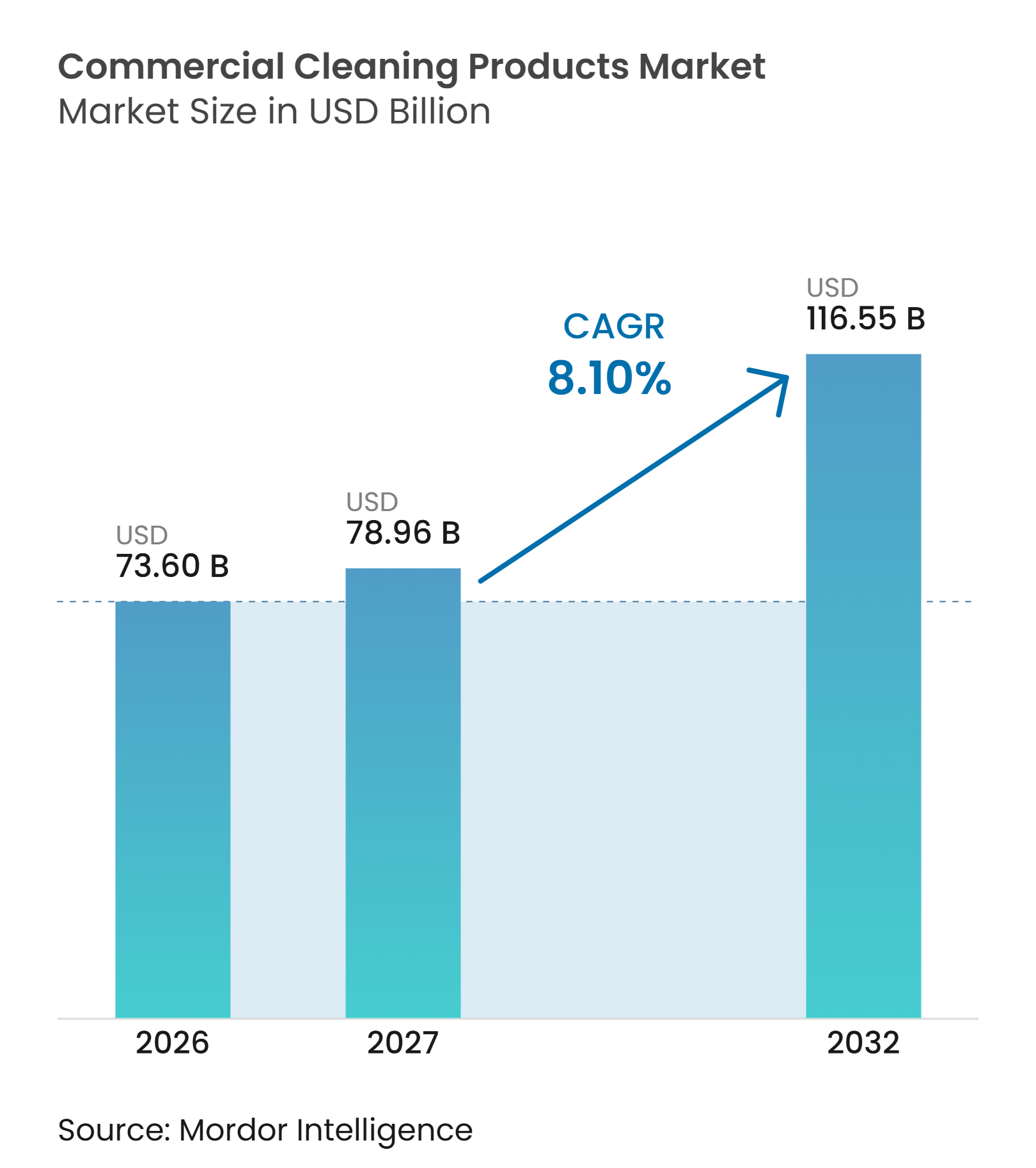
| Market Size (2027) | USD 78.96 Billion |
| Market Size (2032) | USD 116.55 Billion |
| Growth Rate (2027 - 2032) | 8.10 % |
| Fastest Growing Market | Asia-Pacific |
| Largest Market | North America |
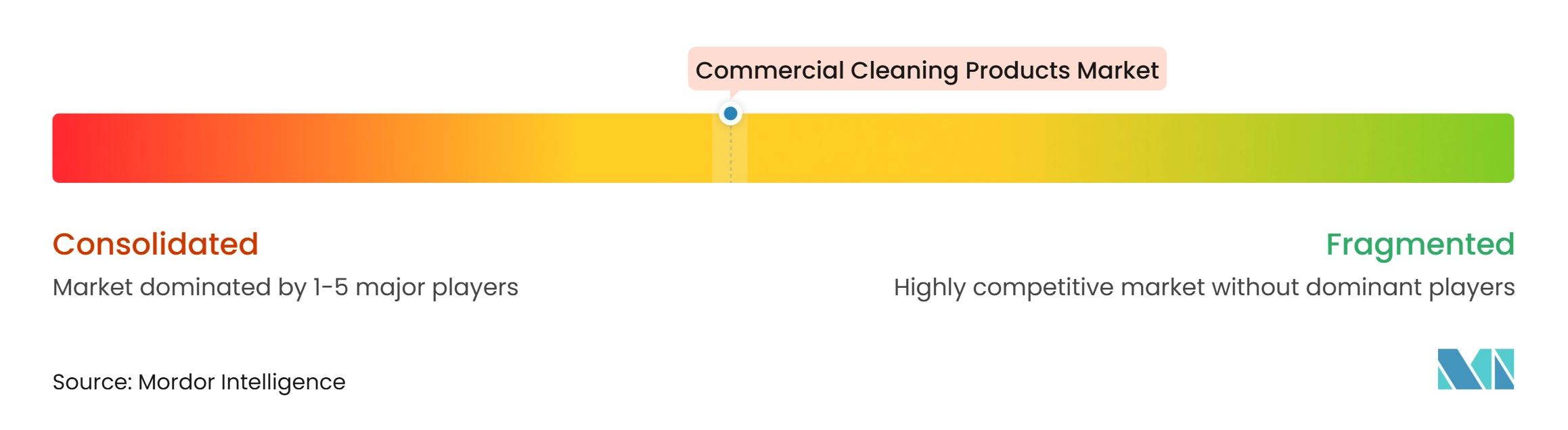
| Market Concentration | Medium |
Major Players *Disclaimer: Major Players sorted in no particular order Image © Mordor Intelligence. Reuse requires attribution under CC BY 4.0. | |
Commercial Cleaning Products Market Analysis by Mordor Intelligence
The Commercial cleaning products market size is projected to be USD 73.6 billion in 2026, USD 79.6 billion in 2027, and reach USD 116.6 billion by 2032, growing at a CAGR of 8.1% from 2027 to 2032. Hygiene requirements established during the pandemic continue to influence purchasing decisions in healthcare, hospitality, education, and commercial real estate. Return-to-office policies are supporting spending on cleaning supplies in shared workplaces, while travel activity is increasing demand from hotels and food-service venues. Labor shortages are encouraging facilities to choose concentrated and multipurpose products that help smaller teams maintain cleaning standards. Regulatory requirements and procurement policies are also directing product development toward formulations with clearer environmental credentials.
Key Report Takeaways
-
By category, conventional products held 86.12% of the commercial cleaning products market share in 2026, while organic and natural products are forecast to grow at a 9.83% CAGR through 2032.
-
By product type, laundry care products accounted for 34.12% of the commercial cleaning products market size in 2026, while surface cleaners are projected to expand at a 9.62% CAGR through 2032.
-
By form, liquid products held a 47.27% revenue share in 2026, while wipes are expected to grow at a 7.02% CAGR through 2032.
-
By distribution channel, wholesale and corporate procurement represented 71.45% of sales in 2026, while retail is forecast to grow at a 9.56% CAGR through 2032.
-
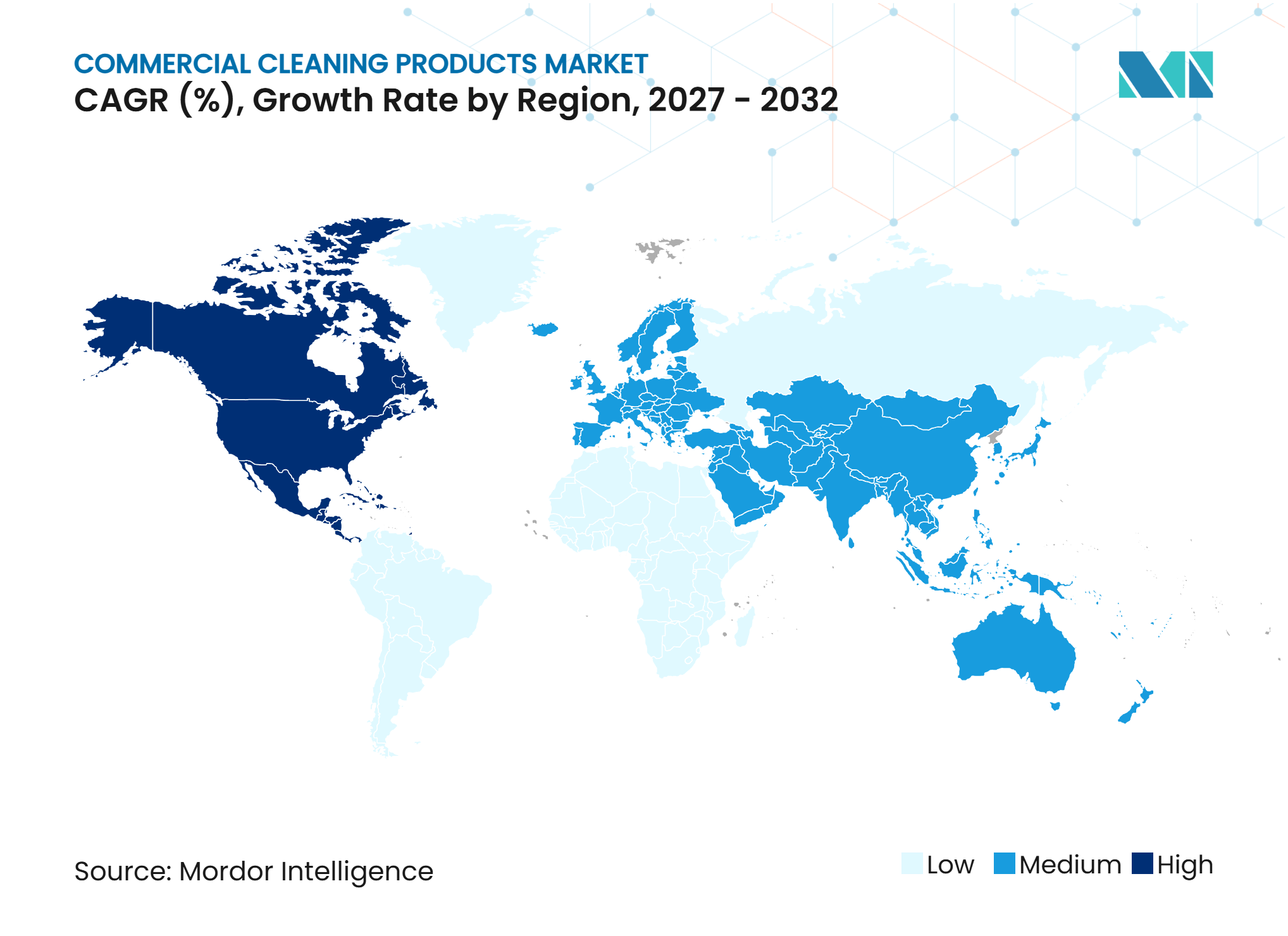
By geography, North America held 31.66% of revenue in 2026, while Asia-Pacific is projected to grow at a 9.45% CAGR through 2032.
Note: Market numbers in this report are based on Mordor Intelligence's proprietary estimation framework, which combines nine months of actuals with Q4 projections for base year 2026.
Market Trends and Insights
Drivers Impact Analysis of Commercial Cleaning Products Market*
| Driver | (~) % Impact on CAGR Forecast | Geographic Relevance | Impact Timeline |
|---|---|---|---|
| Rising Demand for Workplace Hygiene and Sanitation | +2.1% | Global | Short term (≤ 2 years) |
| Increasing Awareness of Infection Prevention Practices | +1.3% | Global, with North America and Asia-Pacific leading | Medium term (2-4 years) |
| Growing Demand from Healthcare and Hospitality Sectors | +1.6% | Global, highest in North America and Asia-Pacific | Medium term (2-4 years) |
| Increasing Adoption of Sustainable Cleaning Products | +1.1% | North America and Europe, with spillover to Asia-Pacific | Long term (≥ 4 years) |
| Rising Outsourcing of Professional Cleaning Services | +0.7% | North America, Europe, and Asia-Pacific | Medium term (2-4 years) |
| Increasing Adoption of Automated Cleaning Technologies | +0.5% | North America and Europe | Long term (≥ 4 years) |
| Source: Mordor Intelligence | |||
Rising Demand for Workplace Hygiene and Sanitation
The commercial cleaning products market is benefiting from renewed demand in occupied office buildings. Office locations were the only commercial end-user group that recorded year-over-year volume growth in Q2 2025, at 2%, according to ISSA[1]. Employers are investing in shared-workspace hygiene to support employee expectations and occupancy requirements. Surface cleaners and hand hygiene products are especially relevant in common areas, lobbies, and shared amenities. Understaffed facility teams are also likely to prefer multipurpose and concentrated products because these formulations can simplify daily routines. This preference supports spending on higher-performance products even when cleaning schedules become more regular.
Growing Demand from Healthcare and Hospitality Sectors
Healthcare facilities purchase cleaning chemicals as part of infection-control and patient-safety procedures. Ecolab serves acute-care hospitals, long-term care facilities, and lodging operators with surface-cleaning, warewashing, and laundry solutions[2]. This demand is less discretionary than spending in many other facility categories because cleaning performance is linked to operating standards. Hotels are also increasing consumption of laundry and housekeeping products as business and leisure travel recover. Reckitt reported continued demand for Dettol antiseptic and home-cleaning offerings during 2025. The commercial cleaning products market therefore has a durable base in facilities where hygiene performance affects service quality and regulatory compliance.
Increasing Adoption of Sustainable Cleaning Products
Sustainability is becoming more important in facility procurement and product design. Corporate environmental reporting is making the ingredients, packaging, and disposal profile of cleaning supplies more visible to buyers. Reckitt introduced a 100% plant-derived Dettol antiseptic liquid in China, which it expected to generate GBP 60 million, or USD 76 million, in its first year. This example shows that reformulated products can create additional demand rather than only replace existing products. Green Seal and EPA Safer Choice credentials can also support a supplier's position in institutional procurement processes. The Commercial cleaning products market can benefit when buyers treat environmental certifications as part of their supplier-selection requirements.
Increasing Adoption of Automated Cleaning Technologies
Automated cleaning equipment is changing how facilities use chemicals and manage daily cleaning work. Aramark reported in 2025 that it operated around 70 autonomous floor-cleaning units across hospitals, schools, universities, businesses, and entertainment venues. The fleet maintained around 50 million square feet annually, and certain newer units could clean nearly 40,000 square feet per hour. SoftBank Robotics America launched a platform in 2025 for managing mixed fleets of autonomous cleaning robots. Automated systems can improve dosing consistency and reduce wasted chemical use. This supports demand for concentrated formulations that are compatible with robot-operated floor-care equipment.
Restraints Impact Analysis of Commercial Cleaning Products Market*
| Restraint | (~) % Impact on CAGR Forecast | Geographic Relevance | Impact Timeline |
|---|---|---|---|
| High Costs of Commercial Cleaning Products | -1.1% | Global, most acute in SME-dominated markets | Short term (≤ 2 years) |
| Availability of Low-Cost Alternative Cleaning Products | -0.8% | Asia-Pacific, South America, Middle East and Africa | Medium term (2-4 years) |
| Stringent Regulations on Chemical Ingredients | -0.5% | North America and Europe | Long term (≥ 4 years) |
| Health Risks Associated with Chemical Exposure | -0.3% | Global | Long term (≥ 4 years) |
| Source: Mordor Intelligence | |||
High Costs of Commercial Cleaning Products
High costs of commercial cleaning products can limit purchases by smaller facilities. Buyers without large multi-year contracts have less ability to negotiate prices with major suppliers. ISSA reported volume erosion across most cleaning categories in Q1 and Q2 2025 while prices remained stable. This pattern suggests that some buyers are reducing quantities instead of moving quickly between brands. Bio-based ingredients, enzyme-enhanced formulations, and certified products can also require higher input and packaging costs. Hospitality and food-service operators may rationalize purchases during difficult trading periods because they face concurrent labor and food-cost pressure.
Stringent Regulations on Chemical Ingredients
Stricter requirements for chemical ingredients can increase the cost and time needed to develop new cleaning products. Producers are adjusting formulations in response to rules on biodegradability, ingredient disclosure, and PFAS. Diversey introduced the TASKI Jontec Care range in 2025 with new-generation polymer chemistry that replaced fluorinated leveling agents. The change shows how compliance factors can require redesign work even for established product categories. EPA Safer Choice certification is also becoming relevant in some institutional bid processes in the United States. Smaller suppliers with limited research resources can face a heavier compliance burden, while suppliers that complete reformulation can strengthen their position.
*Our forecasts treat driver/restraint impacts as directional, not additive. The impact forecasts reflect baseline growth, mix effects, and variable interactions.
Commercial Cleaning Products Market Segment Analysis
By Product Type:
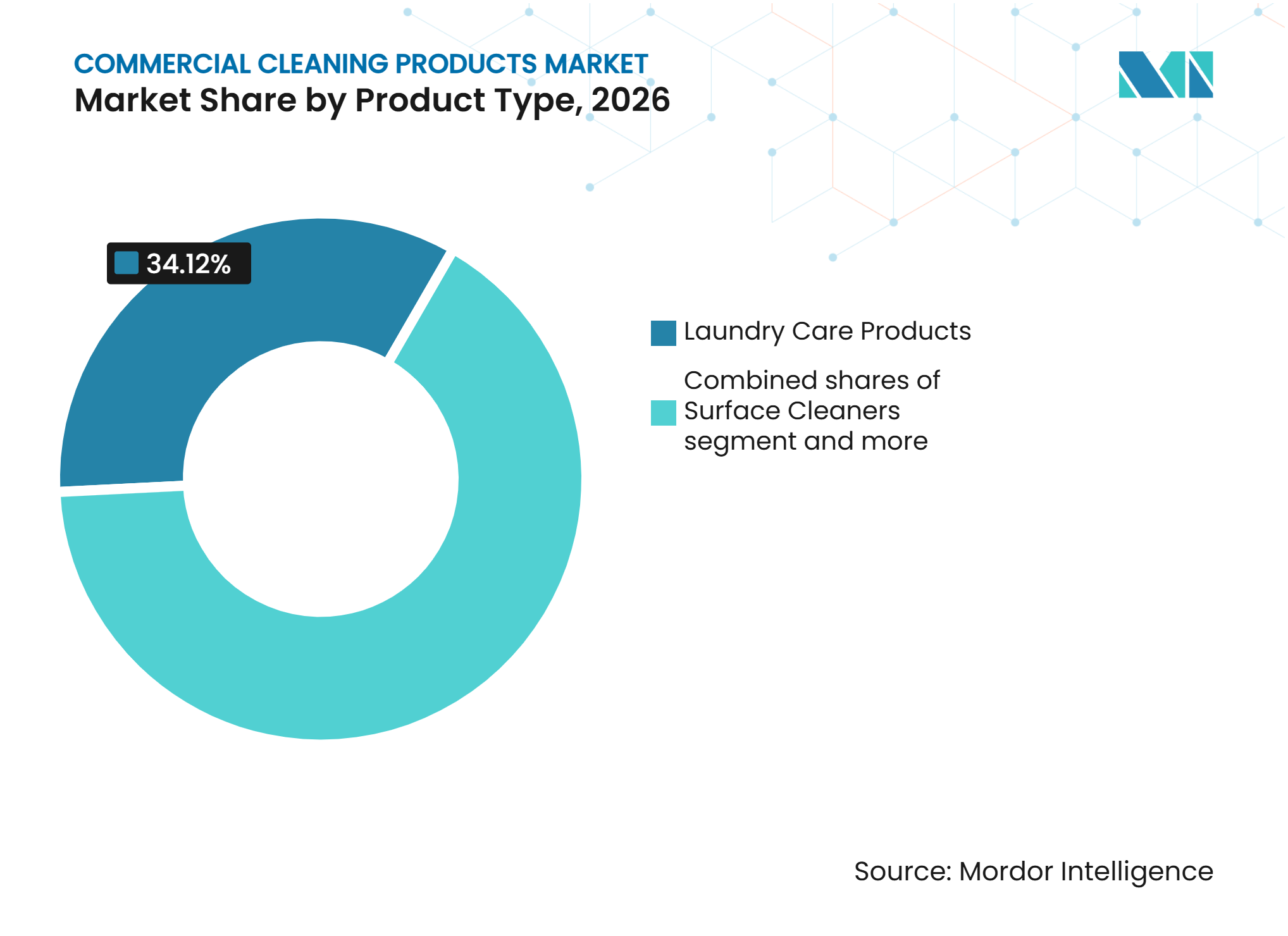
Laundry Care Provides Scale and Surface Cleaners Lead GrowthLaundry care products accounted for 34.12% of the Commercial cleaning products market size in 2026. Hospitals, hotels, and industrial laundries use detergents, bleaches, and sour neutralizers regularly because linen processing remains central to their daily service operations. The category benefits from high linen volumes, repeat wash cycles, and the operational need for consistent wash results across multiple sites. Surface cleaners are projected to grow at a 9.62% CAGR through 2032. Demand is tied to hygiene requirements in offices, retail locations, airports, shared facilities, and other high-traffic environments.
Spartan Chemical launched Clothesline Fresh Xtreme Hard Water Conditioner 28 and Low Foam Detergent 29 in October 2025 for hospitality, healthcare, and food-service laundry operations. Diversey introduced IntelliDish CONTROL in October 2025, combining chemical dispensing with cloud-based monitoring for food-service and hospitality dishwashing. Such systems can help operators track wash performance, manage chemical use, and document hygiene procedures across several locations. Floor cleaners are also adapting to autonomous equipment through concentrated, robot-compatible formulations. Toilet, bathroom, glass, and metal cleaners retain essential roles where hygiene and appearance standards are closely monitored.



By Category:
Conventional Products Retain Scale While Natural Products Gain GroundConventional products held 86.12% of the commercial cleaning products market share in 2026. Their position reflects established institutional buying practices that favor repeatable performance, predictable shelf life, and manageable unit costs across large, recurring orders. These formulations remain common in multi-year supply arrangements for hospitals, hotels, schools, and other facilities that require stable supply and familiar operating procedures. Organic and natural products are forecast to grow at a 9.83% CAGR through 2032, ahead of the overall rate. The Commercial cleaning products market size for this category is supported by healthcare, education, and hospitality buyers facing environmental purchasing requirements.
Reckitt's 100% plant-derived Dettol antiseptic liquid illustrates how reformulated products can support a revenue opportunity. The product was expected to generate GBP 60 million, or USD 76 million, in its first year in China. Institutional contracts can create more formal switching incentives than household purchases when they include certification, ingredient, packaging, or waste-reduction requirements. This can favor suppliers able to demonstrate that product changes preserve cleaning performance and fit existing facility procedures. Conventional products are still likely to provide the commercial base for suppliers, while natural products offer room for differentiated product development.
By Form:
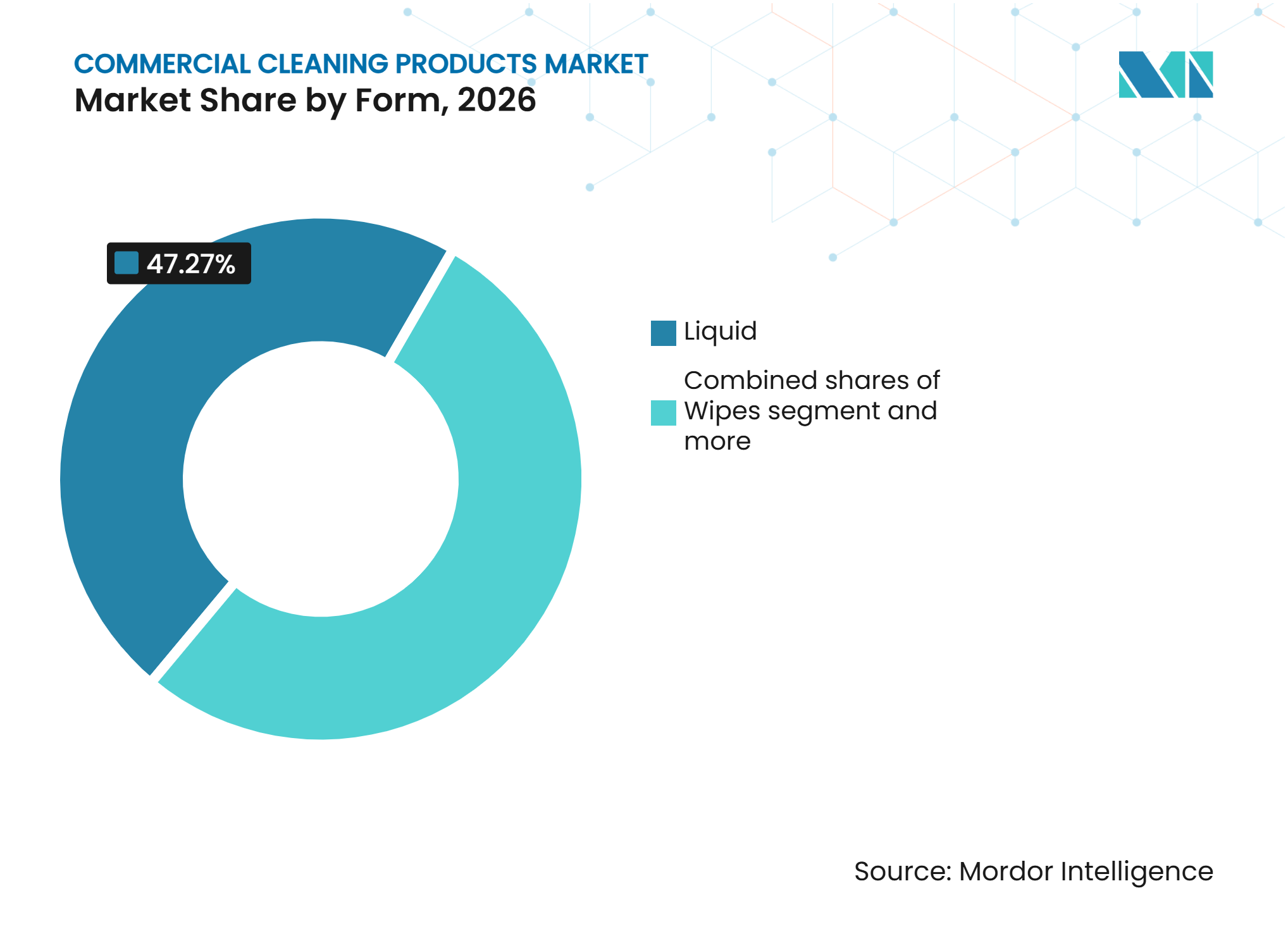
Liquids Lead Institutional Use While Wipes ExpandLiquid products held 47.27% of the commercial cleaning products market share in 2026. Controlled dosing and compatibility with dispensing systems support their use across institutional sites where staff need consistent dilution and application procedures. Concentrates also provide a practical dilution ratio for bulk purchasers and can reduce the storage burden of transporting ready-to-use products. Wipes are projected to grow at a 7.02% CAGR through 2032. Their growth is linked to the need for convenient cleaning in healthcare settings, schools, grocery stores, offices, and specialized electronic environments.
Powder products continue to serve large-volume laundry uses where dry handling remains practical and established equipment supports their use. Gel and cream products are suited to focused toilet and bathroom applications, where adherence to vertical surfaces can be important. Tablets and aerosol formats can reduce packaging or simplify dosing in dishwashing and surface-cleaning tasks. The Commercial cleaning products market is also seeing interest in lint-free and dry wipes for sensitive equipment. Format choices increasingly reflect the equipment, storage capacity, labor availability, handling needs, and waste targets of the facility.

By Distribution Channel:
Wholesale Retains Control While Retail Broadens AccessWholesale and corporate procurement channels accounted for 71.45% of sales in 2026. Hospital systems, hotel groups, and professional facility-management firms commonly purchase through competitive contracts lasting 1 to 3 years. Such agreements specify products, formats, service requirements, delivery expectations, and dispensing arrangements for several locations. Retail is forecast to grow at a 9.56% CAGR through 2032. Online and store-based channels give independent restaurants, smaller hotels, and office operators access to institutional products in smaller order sizes.
Ecolab expanded its Scientific Clean line to more than 180 Home Depot stores in Canada in November 2025. The line had expanded from 20 to more than 45 products during 2 years of its U.S. Home Depot partnership. Retail and digital channels offer product comparisons, transparent pricing, and more flexible ordering that smaller buyers increasingly expect. This channel expansion can help branded suppliers serve businesses that do not qualify for large corporate contracts. It also brings professional cleaning products closer to operators that combine business purchasing with household shopping trips.
Geography Analysis
North America
North America held 31.66% of the commercial cleaning products market share in 2026. The United States has a dense base of healthcare networks, corporate real estate, hotels, food-service establishments, and supermarkets that require recurring cleaning supplies. ISSA found that the office end-user segment recorded 2% year-over-year volume growth in Q2 2025. This activity supports demand for products used in shared workspaces. EPA Safer Choice is also becoming a relevant compliance factor in some institutional procurement processes. The region is seeing greater use of automated cleaning equipment in hospitals, campuses, and commercial facilities. Aramark's robot program shows how dosing precision and equipment compatibility can become part of cleaning-chemical selection.
Asia-Pacific
Asia-Pacific is forecast to grow at a 9.45% CAGR through 2032, the fastest pace among geographic segments. The commercial cleaning products market size in the region is supported by commercial construction in China, hospitality formalization in India, and investment in manufacturing and food-processing sites in Southeast Asia. Demand centers on surface, floor, and laundry products used in high-traffic public and commercial facilities. India is also supported by organized retail and quick-service restaurant expansion. Food-service and pharmaceutical operators face higher hygiene expectations, which favors documented product performance. Pudu Robotics launched the CC1 Pro autonomous cleaning robot in 2025 for hospitals, airports, and large commercial spaces. The system can cover 5,000 to 8,000 square meters per operation, supporting demand for compatible cleaning formulations.
Europe, South America, and the Middle East and Africa
Europe remains a major institutional demand center, with Germany, the United Kingdom, France, and the Netherlands providing established customer bases. Germany's household and professional care-products sector reached EUR 23.9 billion, or USD 25.8 billion, in domestic revenue in 2025, according to IKW [3]. Reckitt launched Finish Ultimate Plus in Germany with Cycle Sync tablet technology, increasing the product's shelf-space presence from 40% to 70%. South America has demand from food-service and agricultural-export infrastructure, although inflation and currency changes can restrain budgets. The Middle East and Africa are growing from a smaller base through hospitality and healthcare investment in Saudi Arabia, the UAE, and Egypt. Diversey opened a European headquarters and research center in the Netherlands in 2025, which supports its regional innovation and distribution work.
Competitive Landscape
Market Concentration
Ecolab, Diversey, Reckitt, Clorox, Kimberly-Clark Professional, GOJO Industries, and S.C. Johnson Professional compete through product performance, dispensing systems, service capability, and established customer relationships. Large institutional suppliers benefit from multi-year contracts and equipment that can make switching more difficult for buyers. Clorox reported that cleaning products represented 44% of consolidated net sales in fiscal 2025, according to the United States Securities and Exchange Commission. Its Health and Wellness segment reported 9% full-year revenue growth.
Companies are using sustainability, digital monitoring, and channel reach to strengthen their positions. Diversey's TASKI Jontec Care range replaced fluorinated leveling agents with new polymer chemistry. Diversey also launched IntelliDish CONTROL to provide chemical dispensing and cloud monitoring for dishwashing operations. Kimberly-Clark Professional launched Onvation SmartFit in 2025, using sensors to provide dispenser-level data and janitorial scheduling alerts. These moves focus on operational value as well as chemical-product sales.
Ecolab agreed to acquire Ovivo's electronics ultrapure-water business for USD 1.8 billion in 2025. The transaction extends Ecolab's water-management technology platform while its institutional cleaning operations continue to serve hospitality, healthcare, and food-service customers. The Commercial cleaning products market also has openings among mid-sized operators that need professional products but lack the purchasing scale for premium contracts. Specialized cleaning for data centers and advanced manufacturing remains relevant for suppliers with appropriate surface-care capabilities. Certifications, product safety documentation, and dispensing technology are likely to remain important competitive tools.
Commercial Cleaning Products Industry Leaders
-
The Procter & Gamble Company
-
Unilever PLC
-
Reckitt Benckiser Group plc
-
The Clorox Company
-
Kao Corporation
- *Disclaimer: Major Players sorted in no particular order
Commercial Cleaning Products Market Companies Covered in this Report
- Kimberly-Clark Corporation
- The Procter & Gamble Company
- Unilever PLC
- Reckitt Benckiser Group plc
- The Clorox Company
- S. C. Johnson & Son, Inc.
- Kao Corporation
- Ecolab Inc.
- Solenis LLC (Diversey)
- McBride plc
- Werner & Mertz GmbH
- 3M Company
- GOJO Industries, Inc.
- Spartan Chemical Company, Inc.
- Zep Inc.
- Betco Corporation
- Buckeye International, Inc.
- Hillyard, Inc.
- PDI, Inc.
- Arrow Solutions
Recent Industry Developments in Commercial Cleaning Products Market
- May 2026: Diamond Chemical acquired Nyco Products Company, expanding its commercial and institutional cleaning portfolio. The acquisition strengthened its presence across commercial laundry, dishwashing, housekeeping, floor care, sanitizing and industrial cleaning chemicals.
- April 2026: P&G Professional introduced Mr. Clean PRO, a commercial cleaning product range for floors and high-touch surfaces. The launch included all-purpose floor cleaner, degreasing floor cleaner, commercial all-surface cleaner and commercial deep cleaner with bleach, targeting restaurants, offices and retail facilities.
- February 2026: EnvirOx launched OxiGenesis Hyper-Concentrate, a concentrated cleaner-disinfectant designed to address up to 99% of facility cleaning and disinfection needs through four dilution levels. The launch expanded its professional surface-cleaning and disinfection portfolio.
Global Commercial Cleaning Products Market Report Scope
The commercial cleaning products market comprises the manufacturing, distribution, and sale of cleaning and hygiene solutions used in commercial, institutional, and industrial facilities to maintain cleanliness and sanitation. The commercial cleaning products report is segmented by product type (laundry care products, surface cleaners, dishwashing products, toilet/bathroom cleaners, floor cleaners, glass and metal cleaners, and other product types), category (conventional and organic/natural), form (liquid, powder, gel and cream, wipes, tablets, and aerosol), distribution channel (wholesale/corporate procurement and retail), and geography (North America, Europe, Asia-Pacific, South America, and the Middle East and Africa). The market forecasts are provided in terms of value (USD).
Segmentation Overview
| Laundry Care Products |
| Surface Cleaners |
| Dishwashing Products |
| Toilet/Bathroom Cleaners |
| Floor Cleaners |
| Glass and Metal Cleaners |
| Other Product Types |
| Conventional |
| Organic/Natural |
| Liquid |
| Powder |
| Gel and Cream |
| Wipes |
| Tablets and Aerosol |
| Wholesale/Corporate Procurement | |
| Retail | Supermarkets and Hypermarkets |
| Convenience/Grocery Stores | |
| Online Retail | |
| Other Distribution Channels |
| North America | United States |
| Canada | |
| Mexico | |
| Rest of North America | |
| Europe | Germany |
| United Kingdom | |
| Italy | |
| France | |
| Spain | |
| Netherlands | |
| Poland | |
| Belgium | |
| Sweden | |
| Rest of Europe | |
| Asia-Pacific | China |
| India | |
| Japan | |
| Australia | |
| Indonesia | |
| South Korea | |
| Thailand | |
| Singapore | |
| Rest of Asia-Pacific | |
| South America | Brazil |
| Argentina | |
| Colombia | |
| Chile | |
| Peru | |
| Rest of South America | |
| Middle East and Africa | South Africa |
| Saudi Arabia | |
| United Arab Emirates | |
| Nigeria | |
| Egypt | |
| Morocco | |
| Turkey | |
| Rest of Middle East and Africa |
| By Product Type | Laundry Care Products | |
| Surface Cleaners | ||
| Dishwashing Products | ||
| Toilet/Bathroom Cleaners | ||
| Floor Cleaners | ||
| Glass and Metal Cleaners | ||
| Other Product Types | ||
| By Category | Conventional | |
| Organic/Natural | ||
| By Form | Liquid | |
| Powder | ||
| Gel and Cream | ||
| Wipes | ||
| Tablets and Aerosol | ||
| By Distribution Channel | Wholesale/Corporate Procurement | |
| Retail | Supermarkets and Hypermarkets | |
| Convenience/Grocery Stores | ||
| Online Retail | ||
| Other Distribution Channels | ||
| By Geography | North America | United States |
| Canada | ||
| Mexico | ||
| Rest of North America | ||
| Europe | Germany | |
| United Kingdom | ||
| Italy | ||
| France | ||
| Spain | ||
| Netherlands | ||
| Poland | ||
| Belgium | ||
| Sweden | ||
| Rest of Europe | ||
| Asia-Pacific | China | |
| India | ||
| Japan | ||
| Australia | ||
| Indonesia | ||
| South Korea | ||
| Thailand | ||
| Singapore | ||
| Rest of Asia-Pacific | ||
| South America | Brazil | |
| Argentina | ||
| Colombia | ||
| Chile | ||
| Peru | ||
| Rest of South America | ||
| Middle East and Africa | South Africa | |
| Saudi Arabia | ||
| United Arab Emirates | ||
| Nigeria | ||
| Egypt | ||
| Morocco | ||
| Turkey | ||
| Rest of Middle East and Africa | ||
Key Questions Answered in the Report
What is the projected value of commercial cleaning products in 2032?
The sector is forecast to reach USD 116.6 billion by 2032, rising from USD 73.6 billion in 2026 at an 8.1% CAGR.
Which product category has the strongest growth outlook?
Surface cleaners are forecast to grow at a 9.62% CAGR through 2032, supported by demand in high-traffic workplaces and commercial facilities.
Why are sustainable cleaning products becoming more important?
Buyers increasingly evaluate certifications, ingredients, packaging, and environmental performance when selecting institutional suppliers.
Which region has the fastest projected expansion?
Asia-Pacific is projected to grow at a 9.45% CAGR through 2032, supported by commercial infrastructure, hospitality, and formalized hygiene standards.