
Commercial Banking Market Size and Share
Market Overview
| Study Period | 2021 - 2032 |
|---|---|
| Market Size (2027) | USD 1.9 Trillion |
| Market Size (2032) | USD 2.40 Trillion |
| Growth Rate (2027 - 2032) | 4.80 % |
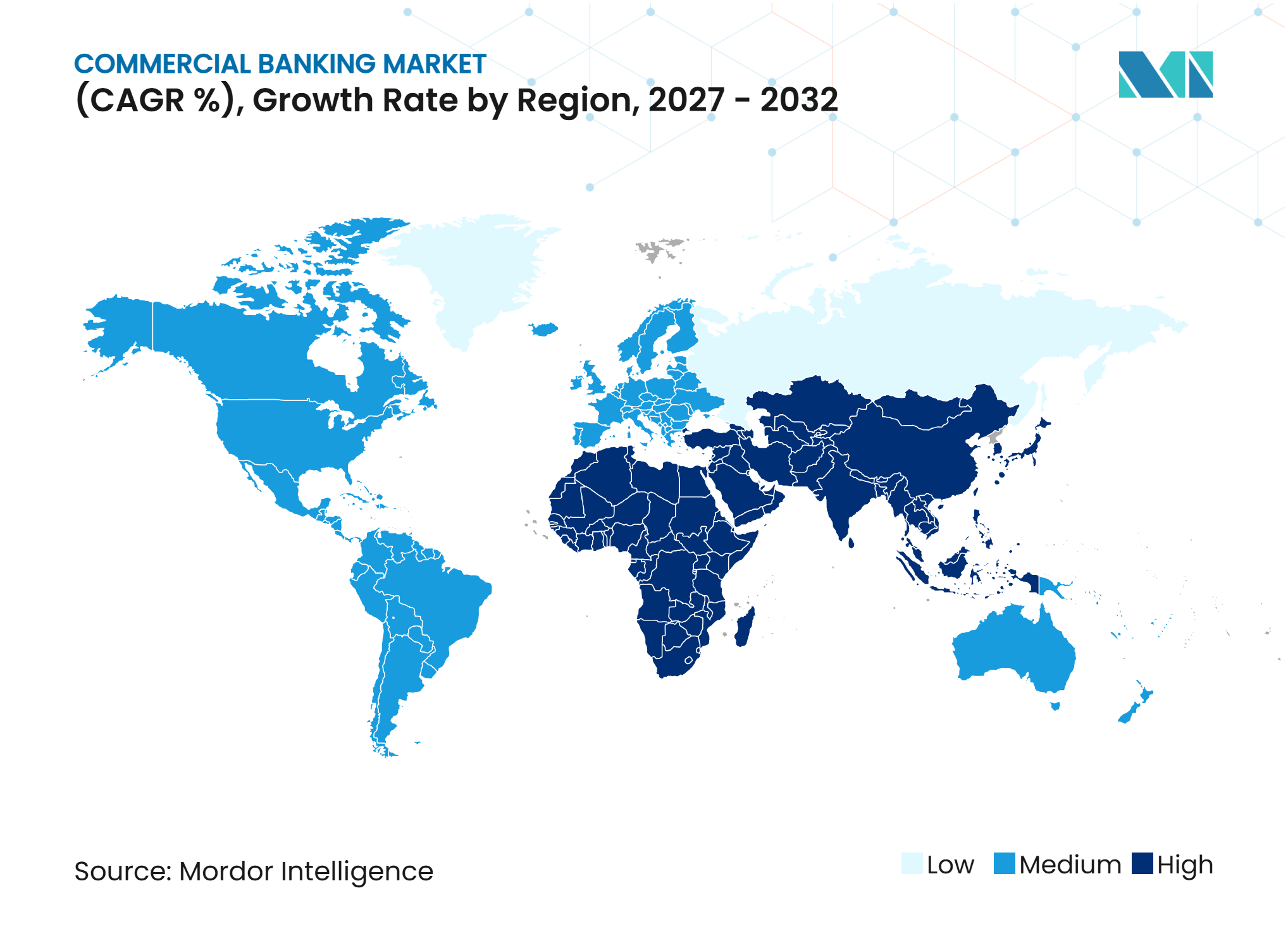
| Fastest Growing Market | Middle East and Africa |
| Largest Market | Asia-Pacific |
| Market Concentration | Medium |
Major Players *Disclaimer: Major Players sorted in no particular order Image © Mordor Intelligence. Reuse requires attribution under CC BY 4.0. | |
Commercial Banking Market Analysis by Mordor Intelligence
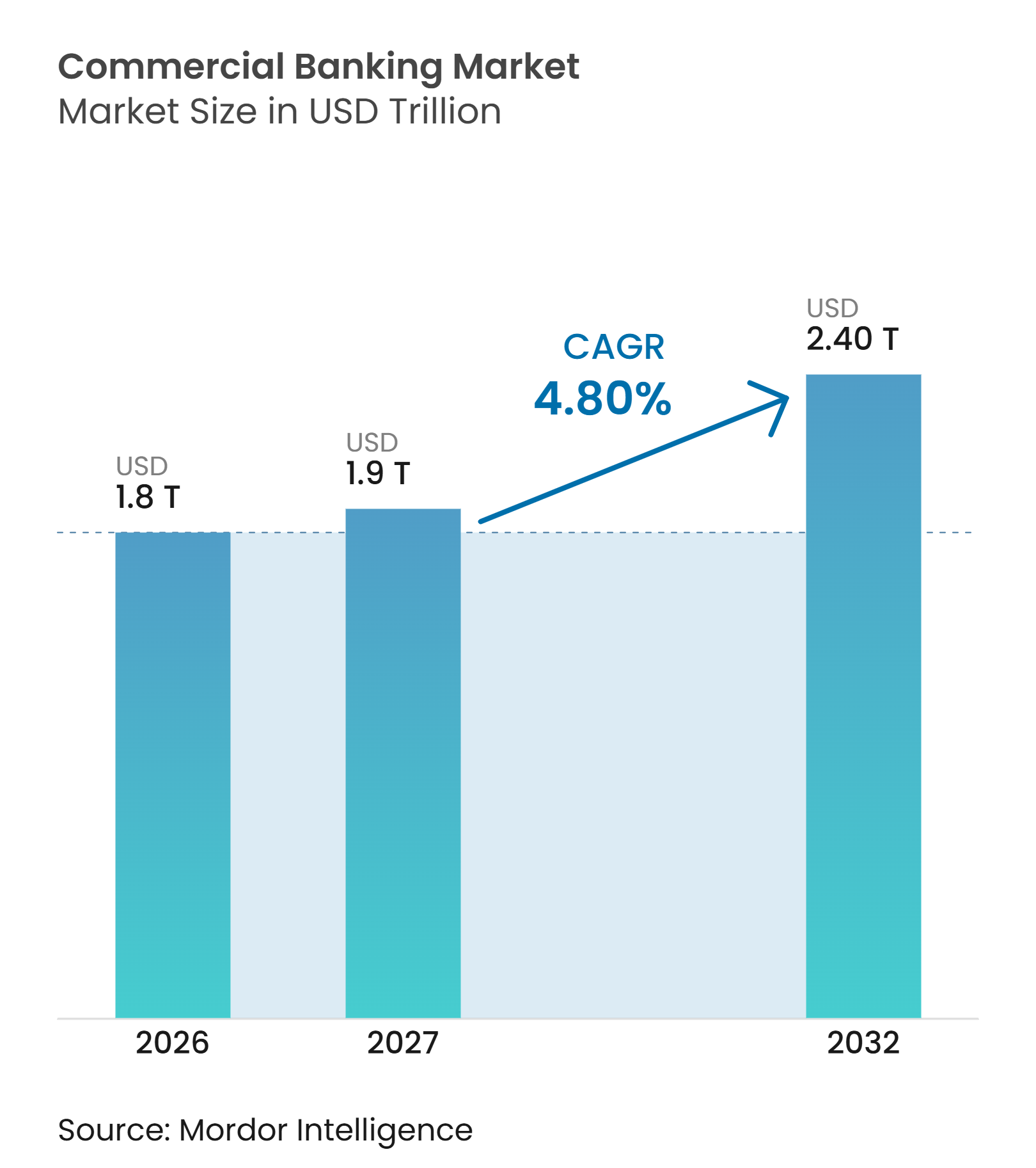
The commercial banking market size is projected to expand from USD 1.8 trillion in 2026 to USD 2.4 trillion by 2032, registering a CAGR of 4.8% between 2027 and 2032. The commercial banking industry is moving beyond an earnings model centered on net interest income, as banks expand transaction services, treasury products, advisory, and wealth-related fees for clients that expect more support from their primary banking relationship. Payment modernization, including ISO 20022 migration, is making corporate payment services more important to client retention, operating efficiency, reconciliation quality, and the timely movement of funds across domestic and international accounts. Supply-chain changes are also shifting demand toward trade finance, working-capital tools, cross-border cash management, foreign-exchange support, and services that help clients handle payments to suppliers and collections from customers. Banks that connect lending with payment data and cash-flow visibility can deepen corporate relationships, raise fee income, improve internal risk assessment, and create a more complete view of each client’s operating needs. The commercial banking market remains demanding because fintech firms, private-credit providers, and established banks are all pursuing profitable corporate relationships, while the commercial banking industry increasingly rewards reliable technology, strong controls, and practical client service.
Key Report Takeaways
- By product family, Commercial Lending held 41.7% of the commercial banking market share in 2026, while Transaction Banking and Cash Management is forecast to grow at a 6.2% CAGR through 2032.
- By customer segment, Large Corporations and Multinationals held 38.2% of the commercial banking market size in 2026, while Medium Enterprises is forecast to grow at a 5.9% CAGR through 2032.
- By industry vertical, Construction and Real Estate accounted for 22.4% of the commercial banking market size in 2026, while Information and Communication Technology is forecast to grow at a 7.1% CAGR through 2032.
- By revenue stream, Net Interest Income accounted for 61.8% of the commercial banking market share in 2026, while Non-Interest Income is forecast to grow at a 6.4% CAGR through 2032.
- By institution type, Global Banks held 48.1% of the commercial banking market share in 2026, while Regional Banks are forecast to grow at a 5.5% CAGR through 2032.
- By geography, Asia-Pacific held 42.5% of the commercial banking market size in 2026, while Middle East and Africa is forecast to grow at a 6.8% CAGR through 2032.
Note: Market numbers in this report are based on Mordor Intelligence's proprietary estimation framework, which combines nine months of actuals with Q4 projections for base year 2026.
Market Trends and Insights
Drivers Impact Analysis of Commercial Banking Market*
| Driver | (~) % Impact on CAGR Forecast | Geographic Relevance | Impact Timeline |
|---|---|---|---|
| Expansion of SME, Mid-Market and Corporate Lending Demand | +1.2% | Global, with highest intensity in Asia-Pacific and Middle East and Africa | Medium term (2-4 years) |
| Growth in International Trade Finance and Cross-Border Banking | +0.8% | Global, with strongest activity across Asia-Pacific, Middle East and Africa, and South America corridors | Medium term (2-4 years) |
| Digital Transaction Banking and Corporate Cash Management Adoption | +1.0% | Global, with Asia-Pacific and North America leading deployment | Short term (≤ 2 years) |
| AI-Enabled Credit Assessment, Fraud Detection and Process Automation | +0.7% | North America and Europe are early adopters, while Asia-Pacific is scaling | Medium term (2-4 years) |
| Embedded Banking Through Enterprise Software Platforms | +0.4% | North America is primary, with Europe and Asia-Pacific following | Long term (≥ 4 years) |
| Integrated Corporate Treasury and Liquidity Management Demand | +0.3% | Global, with multinational and mid-market corporates as primary users | Long term (≥ 4 years) |
| Source: Mordor Intelligence | |||
Expansion of SME, Mid-Market, and Corporate Lending Demand
SME borrowing is increasingly tied to recurring working-capital needs rather than occasional financing events. Major-bank lending to United Kingdom SMEs rose 8% year over year to USD 5.4 billion in the second quarter of 2025, while gross lending to small businesses rose 28%[1]. This activity supports the commercial banking market because credit relationships can lead to deposits, payments, cash-management, and foreign-exchange services. Agricultural Bank of China said it would raise loans to private-sector firms beyond USD 1.0 trillion by the end of 2025[2]. The direction of lending shows that large banks are placing greater emphasis on commercially oriented borrowers alongside traditional public-sector relationships. Mid-market clients remain attractive when banks can use timely cash-flow information to make credit assessment faster and more consistent.
Growth in International Trade Finance and Cross-Border Banking
The commercial banking market benefits when companies need financing, payment support, and risk management across more than one jurisdiction. Open-account trading has reduced reliance on traditional letters of credit, which has increased demand for approved-payables programs, supply-chain finance, and receivables purchasing. Tariff changes during 2025 raised the value of tailored structures supported by export credit agencies for companies managing cross-border risk. Nearshoring has created new trade corridors and changed where banks need correspondent relationships and regulatory approvals. Standard Chartered has positioned its intra-Asia and Asia-to-Africa network around these commercial connections, including activity linked to manufacturing investment in Southeast Asia[3]. Banks with an operating presence across several corridors are better placed to serve clients that need local payments, trade financing, and treasury support together.
Increasing Adoption of Digital Transaction Banking and Corporate Cash Management
Digital transaction banking is becoming central to primary corporate banking relationships because it supports daily payment, liquidity, and reconciliation activity. The commercial banking market can gain recurring fee income when payment tools are integrated with clients’ operating systems and used across business units. Corporate clients are placing greater weight on platform usability, application-programming-interface connectivity, and timely account information when selecting an operating bank. ISO 20022 adoption supports richer payment data and can improve reconciliation and compliance workflows for corporate treasury teams. PNC integrated its embedded-banking platform with Oracle Fusion Cloud ERP in July 2025, allowing clients to initiate payments, approve transactions, and reconcile accounts inside the ERP environment[4]. This approach makes payments infrastructure harder to replace and expands the role of the bank beyond credit provision.
AI-Enabled Credit Assessment, Fraud Detection, Process Automation, and Embedded Banking
AI-enabled credit assessment can reduce manual work in commercial lending, but broad production deployment remains limited. The gap between pilot programs and scaled use is important because early adopters can build more consistent information flows across lending, fraud controls, onboarding, and client servicing. Embedded banking gives this capability a direct route into enterprise software, where payment data and workflow events are already available. Truist introduced its One View Connect pilot in October 2025 for NetSuite, Sage Intacct, Workday, and Microsoft Dynamics 365 Business Central, with real-time payments and reconciliation features for wholesale clients. Banks that combine automation with integrated treasury tools can serve smaller commercial clients without relying on the same level of manual effort. This model also raises the importance of reliable data controls, client consent, and fraud monitoring.
Restraints Impact Analysis of Commercial Banking Market*
| Restraint | (~) % Impact on CAGR Forecast | Geographic Relevance | Impact Timeline |
|---|---|---|---|
| Capital, Liquidity, and Regulatory Compliance Requirements | -1.2% | Global, with European banks most affected by a +2.5% MRC impact under Basel III | Medium term (2-4 years) |
| Deposit Competition and Corporate Deposit Funding Costs | -0.8% | North America and Europe, with pressure intensifying in Asia-Pacific | Short term (≤ 2 years) |
| Deteriorating Corporate Credit Quality and Commercial Loan Default Risks | -0.6% | North America commercial real estate and global private-credit exposure | Short term (≤ 2 years) |
| Legacy Core-Banking Infrastructure and Technology Modernization Costs | -0.5% | Global, with community and mid-tier banks most exposed | Long term (≥ 4 years) |
| Source: Mordor Intelligence | |||
Capital, Liquidity, and Regulatory Compliance Requirements
Capital and liquidity rules can limit the pace at which banks expand balance sheets and reallocate funds toward growth initiatives. By the end of September 2025, revised credit-risk and operational-risk standards, along with the output floor, were in effect in around 80% of Basel Committee member jurisdictions. The Basel Committee reported that European banks faced a 2.5% minimum-required-capital increase under full phase-in, compared with 0.9% for banks in the Americas. These obligations can shift investment toward capital planning and compliance systems instead of lending and product modernization. Basel III, CRR3, anti-money-laundering requirements, and the European Union’s Digital Operational Resilience Act shape how institutions allocate technology and control budgets. The commercial banking market faces a larger burden at mid-tier institutions when compliance costs are spread across a smaller revenue base.
Deposit Competition, Credit Quality, and Legacy Infrastructure Costs
Corporate clients have raised their expectations for deposit yields, digital access, and immediate liquidity information, which puts pressure on funding costs. Institutions with similar products can find it difficult to protect margins when direct banks and fintech providers offer competitive returns and simpler digital experiences. Commercial real estate lending requires close portfolio monitoring because weakening borrower performance can increase default risk and restrict new lending capacity. Legacy core platforms also reduce flexibility because maintenance spending competes with investment in fraud controls, payment modernization, and client-facing tools. This combination is most challenging for domestic and community banks that lack the scale of global institutions and the operating model of newer digital competitors. The commercial banking market therefore rewards banks that can modernize carefully while preserving service continuity and risk discipline.
*Our forecasts treat driver/restraint impacts as directional, not additive. The impact forecasts reflect baseline growth, mix effects, and variable interactions.
Commercial Banking Market Segment Analysis
By Product Family:
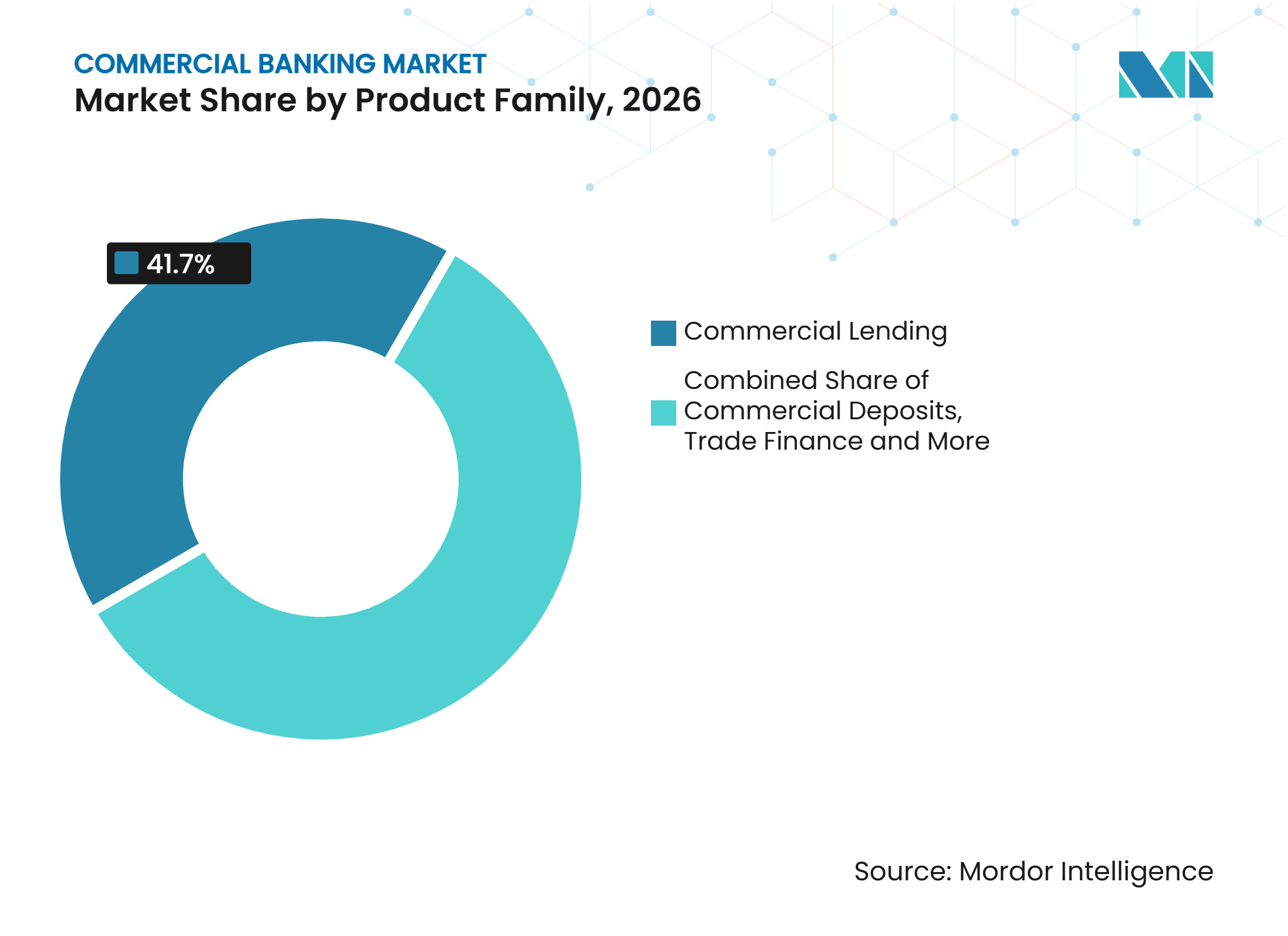
Transaction Banking Expands Its Role in Revenue MixCommercial Lending held 41.7% of revenue in 2026, making it the largest product family in the commercial banking market. Its position is supported by demand for working capital, project credit, commercial mortgages, and sector-specific financing. Corporate borrowers value lenders that understand the timing of receipts, supplier payments, payroll, and inventory needs. Private-credit providers are increasing competition in working-capital and supply-chain financing, which places pressure on traditional loan origination. Transaction Banking and Cash Management is projected to grow at a 6.2% CAGR through 2032 as companies seek real-time liquidity oversight and payment connectivity.
Commercial Deposits and Account Services remain important because they provide operating balances and a foundation for daily banking relationships. These services also give banks a clearer view of routine client activity when customers use them as their primary operating account. Trade Finance and Guarantees are adapting as firms use more open-account structures and seek receivables and supply-chain tools. Treasury and Markets Services support foreign exchange, hedging, and liquidity planning for clients exposed to multiple currencies. Banks with strong payment platforms can use these services to build cross-sell revenue without relying solely on lending volume.



By Customer Segment:
Mid-Market Banking Gains Structural RelevanceLarge Corporations and Multinationals held 38.2% of commercial banking revenue in 2026. Their needs span multicurrency payments, complex credit, trade services, and treasury management, which supports large bank relationships. These clients often value consistent service across markets because their treasury teams manage subsidiaries, suppliers, and customers in several locations. Medium Enterprises are forecast to grow at a 5.9% CAGR through 2032 as digital underwriting reduces the operational cost of serving more clients. Growth in this cohort benefits when banks can combine financing with clear cash-flow data and straightforward digital service.
Micro and Small Enterprises can gain access through bank-fintech arrangements that support mobile-first origination and payment tools. This approach is relevant in ASEAN markets where smaller firms may have limited interaction with traditional branch networks. Financial Institutions are also becoming more important clients for banks offering cross-border financing, settlement, and liquidity services. Standard Chartered reported that financial-institution clients accounted for 51% of its Corporate and Investment Banking income, supporting a dedicated financial-sponsor coverage team. Government and public-sector clients continue to provide stable deposits, though margins in that segment can remain constrained. Client coverage is therefore becoming more tailored to the operating needs and risk profile of each customer group.
By Industry Vertical:
ICT Lending Grows Alongside Real Estate ExposureConstruction and Real Estate held 22.4% of commercial banking revenue in 2026. The segment continues to require project finance, development credit, and commercial mortgages, but its credit quality needs close review. Changes in occupancy, refinancing conditions, and asset values can affect borrower performance and lending appetite. Information and Communication Technology is projected to grow at a 7.1% CAGR through 2032, supported by financing demand for data centers, semiconductor capacity, and cloud infrastructure.
China Construction Bank reported a technology-sector loan balance of USD 722 billion by mid-2025, up 16.8% from the start of the year. Manufacturing and industrial borrowers remain a stable lending base in Asia-Pacific because industrial policy supports investment and production. Energy, utilities, health care, agriculture, transport, and professional services bring distinct cash-flow patterns and risk profiles. Banks are responding with sector-specific products that combine lending with working-capital analytics and payment services. This approach can improve product relevance without treating diverse borrowers as a single credit category.
By Revenue Stream:
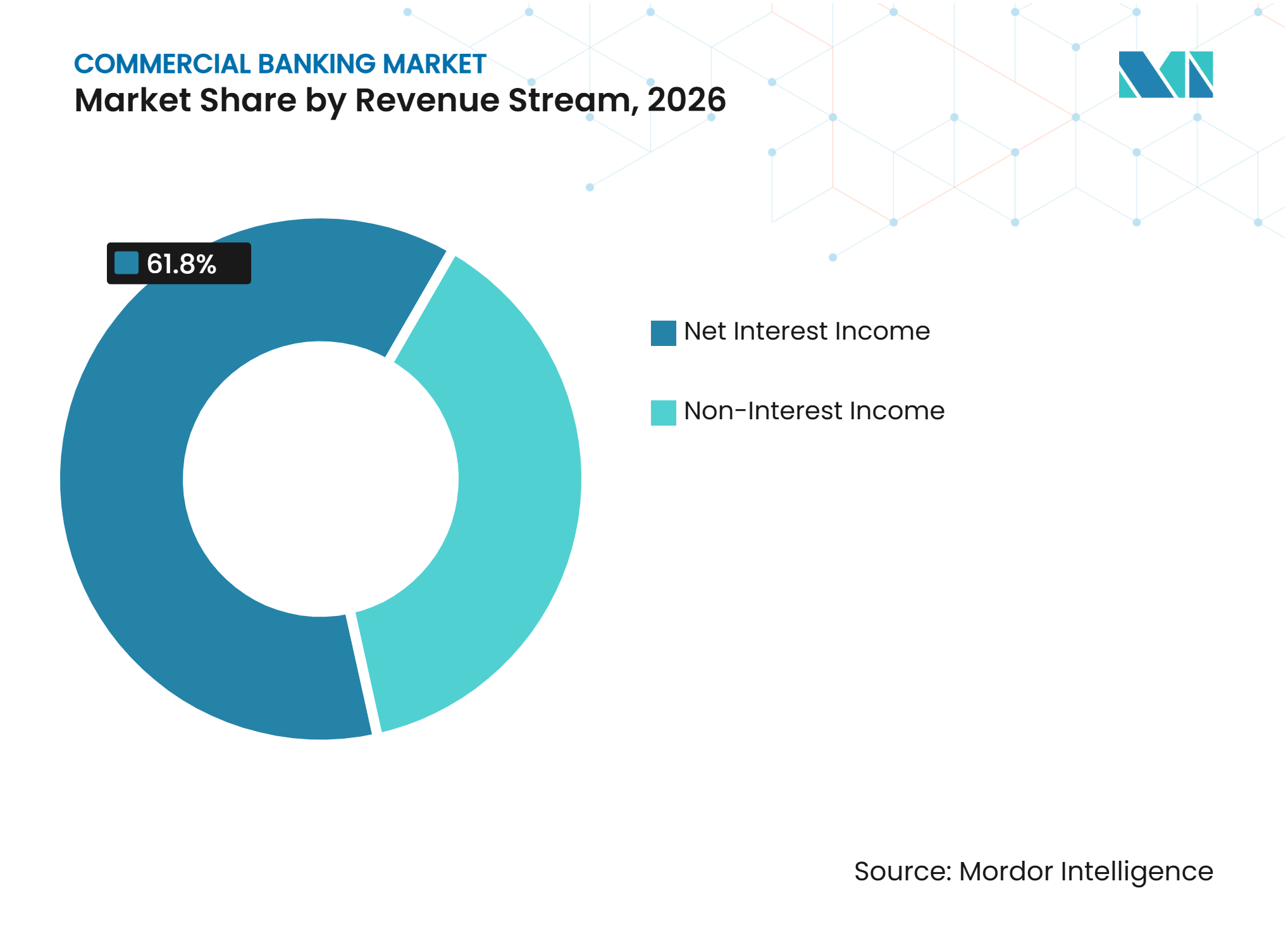
Fee Income Becomes More ImportantNet Interest Income accounted for 61.8% of revenue in 2026, keeping it as the largest revenue stream in the commercial banking market. Pressure on lending spreads has led many institutions to place greater emphasis on service fees and market-related income. China’s major banks reported net interest margins between 1.42% and 1.51% in the first half of 2025, which supported a stronger focus on wealth management, investment banking, and transaction banking. This shift changes product priorities because daily operating services can create recurring income that is less dependent on lending spreads.
Non-Interest Income is forecast to grow at a 6.4% CAGR through 2032. The category includes fee and commission income from trade services, advisory work, wealth management, and treasury products. Bank of China reported that its non-interest income rose 26% year over year to USD 16 billion in the first half of 2025. U.S. banks also recorded a USD 8.5 billion year-over-year increase in non-interest income in the third quarter of 2025, largely from trading revenue. These results show why banks are investing in advisory, payment, and liquidity services. They also reinforce the value of products that remain useful throughout a client’s normal business cycle.

By Institution Type:
Global Scale Meets Regional AgilityGlobal Banks held 48.1% of revenue in 2026. Their broad networks support multinational treasury services, cross-border trade finance, and multicurrency settlement. Large institutions can also originate complex transactions across jurisdictions where they have established operations and compliance capability. Their scale is particularly relevant when clients need coordinated service across subsidiaries and trading partners. Regional Banks are forecast to grow at a 5.5% CAGR through 2032 by using local relationships, faster decisions, and focused digital investment.
Domestic and Community Banks face a more difficult path because older infrastructure can be expensive to maintain. The commercial banking industry is also seeing digital banks expand commercial deposit and SME service capabilities in selected Asian markets. Digital competitors can appeal to smaller businesses with clear onboarding processes and immediate account access. Community institutions can respond by focusing on local knowledge, specialized credit, and practical service integration. Their ability to compete depends on choosing modernization priorities that improve client experience without creating unsustainable costs.
Geography Analysis
Asia-Pacific: Scale, State Capital, and Digital Infrastructure Support Leadership
Asia-Pacific held 42.5% of regional revenue in 2026. China’s large state-owned banks provide significant lending capacity, while India and Southeast Asia add credit demand, digital adoption, and a broad base for SME and mid-market relationships. ICBC reported sci-tech loans of USD 841 billion at the end of 2025, with green loans exceeding USD 939 billion. JPMorgan increased its Asia-Pacific corporate banking hiring target by 20% in 2025 and planned a further 20% increase in 2026, reflecting demand related to intra-Asia trade and digital services.
Middle East and Africa: Diversification and Digital Payments Drive Growth
Middle East and Africa is forecast to grow at a 6.8% CAGR through 2032. GCC diversification programs, formalization of financial services, and cross-border trade create demand for transaction banking and corporate lending. In the UAE, stronger trade flows and more commodity merchants supported trade-loan volumes and fee income during 2025, while digital payment infrastructure is creating a wider base for formal business payments and bank-led treasury services. Standard Chartered received approval to open a commercial banking office in Morocco in June 2025, focused on agro-industrial, automotive, and renewable-energy clients. This market offers room for banks that can pair trade corridors with local compliance and mobile payment infrastructure.
Regional Diversity Sustains Multi-Market Banking Depth
North America has advanced corporate lending and expanding non-interest income, with U.S. banks recording a USD 8.5 billion year-over-year increase in non-interest income in the third quarter of 2025. Europe faces tighter capital requirements, and the Basel Committee estimated a 2.5% minimum-required-capital effect for European banks under full phase-in. South America remains shaped by commodity trade, foreign-exchange services, and the uneven pace of lending recovery across countries. Mexico is attracting commercial credit interest as nearshoring changes trade flows and manufacturing investment patterns. Banking performance across these regions depends on how banks balance capital rules, trade opportunities, payment innovation, and local credit conditions.
Competitive Landscape
Market Concentration
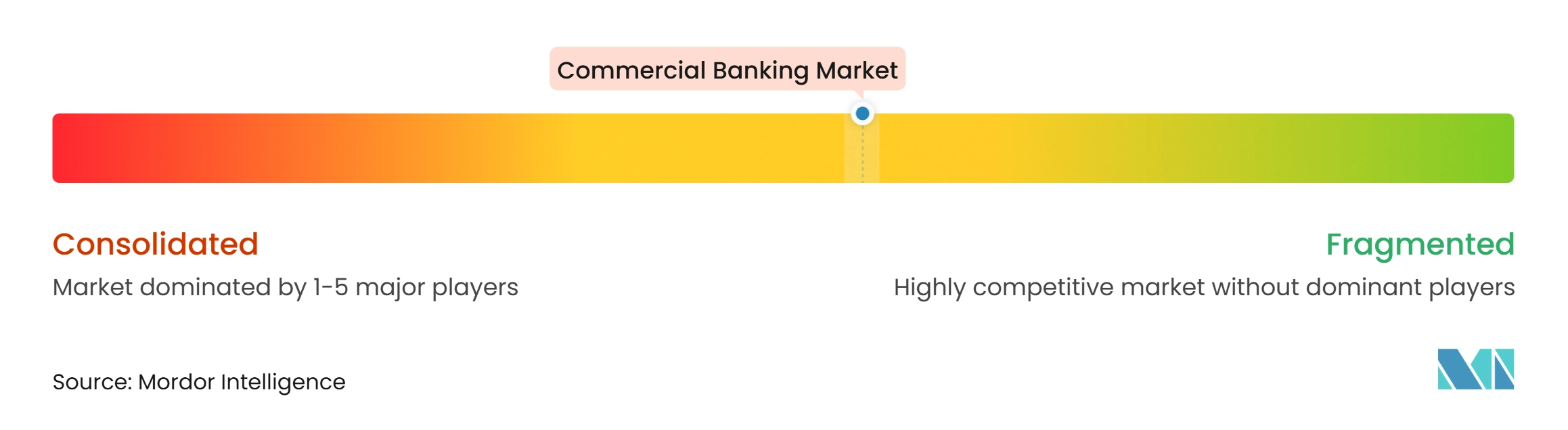
The commercial banking market has a two-tier structure. Large Chinese state-owned banks and global universal banks have balance-sheet scale, established corporate coverage, and the operational capacity to support large cross-border clients. Competition is more fragmented below this group, where regional banks, digital entrants, and specialist providers compete for specific client needs and local relationships. Margin pressure is encouraging these banks to direct more lending and services toward technology, green finance, and private-sector companies.
Technology investment is a key competitive tool in the commercial banking market. SWIFT and more than 30 financial institutions, including JPMorgan, HSBC, Deutsche Bank, MUFG, BNP Paribas, and Santander, began work on a shared-ledger initiative for cross-border settlement in September 2025. The project aims to improve settlement processes, reduce payment friction, and give participating banks a common framework for handling cross-border payment information. Barclays deployed more than 500 software engineers to develop proprietary prime-brokerage margin infrastructure in 2025. PNC’s Oracle integration and Truist’s ERP banking pilot show that banks are also competing through direct links to corporate finance workflows and make the commercial banking market more dependent on practical technology execution than on product range alone.
White-space demand remains in mid-market treasury management, embedded banking for health care and logistics, and trade links across Africa and Southeast Asia. Fintech-backed platforms and private-credit funds increase competitive pressure on traditional loan originators, particularly when clients seek quick decisions or specialized working-capital products. Established banks are responding by connecting payment technology, risk controls, relationship management, and sector coverage more closely. The commercial banking market is fragmented below the largest institutions, creating opportunities for banks that offer relevant local expertise, usable digital tools, reliable daily service, and compliance controls that support client trust.
Commercial Banking Industry Leaders
-
Industrial and Commercial Bank of China Limited
-
JPMorgan Chase & Co.
-
Bank of America Corporation
-
HSBC Holdings plc
-
BNP Paribas S.A.
- *Disclaimer: Major Players sorted in no particular order
Commercial Banking Market Companies Covered in this Report
- Industrial and Commercial Bank of China Limited
- Agricultural Bank of China Limited
- China Construction Bank Corporation
- Bank of China Limited
- JPMorgan Chase & Co.
- Bank of America Corporation
- HSBC Holdings plc
- BNP Paribas S.A.
- Crédit Agricole S.A.
- Mitsubishi UFJ Financial Group, Inc.
- Citigroup Inc.
- Wells Fargo & Company
- Banco Santander, S.A.
- Barclays PLC
- Sumitomo Mitsui Financial Group, Inc.
- Mizuho Financial Group, Inc.
- Deutsche Bank AG
- Standard Chartered PLC
- DBS Group Holdings
Recent Industry Developments in Commercial Banking Market
- September 2026: HSBC launched HSBCnio, a digital banking solution combining transaction banking services and AI tools for corporate and institutional clients. Features include cash-balance monitoring, payment tracking, trade-loan arrangements, and foreign-exchange services.
- August 2026: Standard Chartered and HSBC completed the first live interbank tokenized-deposit transaction on SWIFT’s blockchain-based ledger, demonstrating interoperability between their tokenized-deposit infrastructures.
- June 2026: Bank of America announced plans to launch a cross-border real-time payments solution for corporate, commercial, and financial-institution clients through SWIFT and CashPro. The planned service includes real-time tracking and full-principal delivery.
- June 2025: PNC Bank integrated its PINACLE Connect embedded banking platform with Oracle Fusion Cloud ERP. The integration allows Oracle Cloud ERP clients to initiate payments, approve transactions, and reconcile accounts within the ERP environment.
Global Commercial Banking Market Report Scope
The commercial banking market comprises banks that provide financial services to businesses and individuals, including deposits, loans, payments, cash management, and trade finance.
The Commercial Banking Market is Segmented by Product Family (Lending, Deposits, Transaction Banking, and More), Customer Segment (SMEs, Large Corporations, and More), Industry Vertical (Manufacturing, Construction, Energy, ICT, Healthcare, and More), Revenue Stream (NII, Non-Interest Income), Institution Type (Global, Regional, Community Banks), and Geography. Forecasts are Provided in Terms of Value (USD).
Segmentation Overview
| Commercial Lending |
| Commercial Deposits & Account Services |
| Transaction Banking & Cash Management |
| Trade Finance & Guarantees |
| Treasury & Markets Services for Commercial Clients |
| Micro and Small Enterprises |
| Medium Enterprises |
| Large Corporations and Multinationals |
| Financial Institutions |
| Government, Public Sector and Non-Profits |
| Manufacturing and Industrial |
| Construction and Real Estate |
| Energy and Utilities |
| Transportation and Logistics |
| Wholesale and Retail Trade |
| Information and Communication Technology |
| Healthcare and Life Sciences |
| Agriculture, Forestry and Food Processing |
| Professional and Business Services |
| Public Administration and Education |
| Other Industries |
| Net Interest Income | |
| Non-Interest Income | Fee and Commission Income |
| Foreign Exchange and Treasury Income | |
| Other Banking and Service Income |
| Global Banks |
| Regional Banks |
| Domestic and Community Banks |
| North America | United States |
| Canada | |
| Mexico | |
| South America | Brazil |
| Argentina | |
| Rest of South America | |
| Europe | United Kingdom |
| Germany | |
| France | |
| Italy | |
| Spain | |
| Rest of Europe | |
| Asia-Pacific | China |
| Japan | |
| India | |
| South Korea | |
| Australia | |
| Indonesia | |
| Thailand | |
| Malaysia | |
| Singapore | |
| Vietnam | |
| Rest of Asia-Pacific | |
| Middle East and Africa | Saudi Arabia |
| United Arab Emirates | |
| Turkey | |
| South Africa | |
| Egypt | |
| Rest of Middle East and Africa |
| By Product Family | Commercial Lending | |
| Commercial Deposits & Account Services | ||
| Transaction Banking & Cash Management | ||
| Trade Finance & Guarantees | ||
| Treasury & Markets Services for Commercial Clients | ||
| By Customer Segment | Micro and Small Enterprises | |
| Medium Enterprises | ||
| Large Corporations and Multinationals | ||
| Financial Institutions | ||
| Government, Public Sector and Non-Profits | ||
| By Industry Vertical | Manufacturing and Industrial | |
| Construction and Real Estate | ||
| Energy and Utilities | ||
| Transportation and Logistics | ||
| Wholesale and Retail Trade | ||
| Information and Communication Technology | ||
| Healthcare and Life Sciences | ||
| Agriculture, Forestry and Food Processing | ||
| Professional and Business Services | ||
| Public Administration and Education | ||
| Other Industries | ||
| By Revenue Stream | Net Interest Income | |
| Non-Interest Income | Fee and Commission Income | |
| Foreign Exchange and Treasury Income | ||
| Other Banking and Service Income | ||
| By Institution Type | Global Banks | |
| Regional Banks | ||
| Domestic and Community Banks | ||
| By Geography | North America | United States |
| Canada | ||
| Mexico | ||
| South America | Brazil | |
| Argentina | ||
| Rest of South America | ||
| Europe | United Kingdom | |
| Germany | ||
| France | ||
| Italy | ||
| Spain | ||
| Rest of Europe | ||
| Asia-Pacific | China | |
| Japan | ||
| India | ||
| South Korea | ||
| Australia | ||
| Indonesia | ||
| Thailand | ||
| Malaysia | ||
| Singapore | ||
| Vietnam | ||
| Rest of Asia-Pacific | ||
| Middle East and Africa | Saudi Arabia | |
| United Arab Emirates | ||
| Turkey | ||
| South Africa | ||
| Egypt | ||
| Rest of Middle East and Africa | ||
Key Questions Answered in the Report
What is the commercial banking market size?
The commercial banking market is projected to increase from USD 1.8 trillion in 2026 to USD 2.4 trillion by 2032, at a 4.8% CAGR.
Which commercial banking product is growing fastest?
Transaction Banking and Cash Management is forecast to grow at a 6.2% CAGR through 2032 as corporate clients need payment, liquidity, and reconciliation tools.
Which customer group presents the strongest growth opportunity?
Medium Enterprises is forecast to expand at a 5.9% CAGR through 2032, supported by digital underwriting and integrated cash-flow tools.
Which industry vertical is growing fast for commercial banks?
Information and Communication Technology is forecast to grow at a 7.1% CAGR through 2032, supported by demand for data-center, semiconductor, and cloud financing.
Which region leads to commercial banking revenue?
Asia-Pacific held 42.5% of revenue in 2026, supported by China’s state-owned banks and growing digital banking activity across South and Southeast Asia.
Why are banks investing in embedded banking?
ERP integrations can bring payments, account information, approvals, and reconciliation into corporate workflows, which can strengthen the operating relationship.