
Commerce Experience Services Market Size and Share
Market Overview
| Study Period | 2020 - 2031 |
|---|---|
| Market Size (2026) | USD 20.55 Billion |
| Market Size (2031) | USD 37.10 Billion |
| Growth Rate (2026 - 2031) | 12.54 % |
| Fastest Growing Market | Asia-Pacific |
| Largest Market | North America |
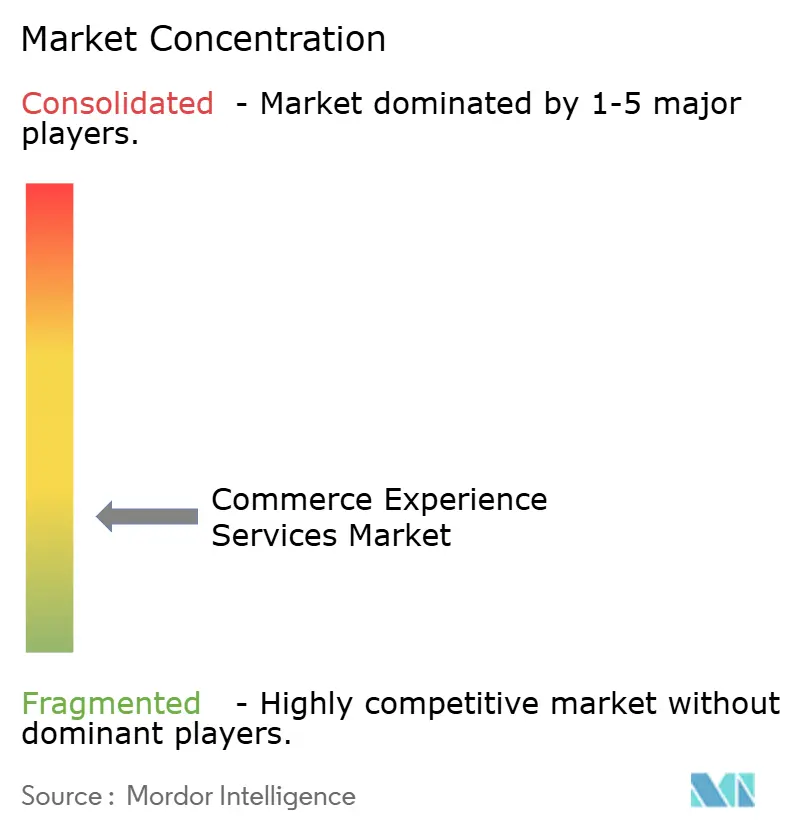
| Market Concentration | Low |
Major Players *Disclaimer: Major Players sorted in no particular order Image © Mordor Intelligence. Reuse requires attribution under CC BY 4.0. | |
Commerce Experience Services Market Analysis by Mordor Intelligence
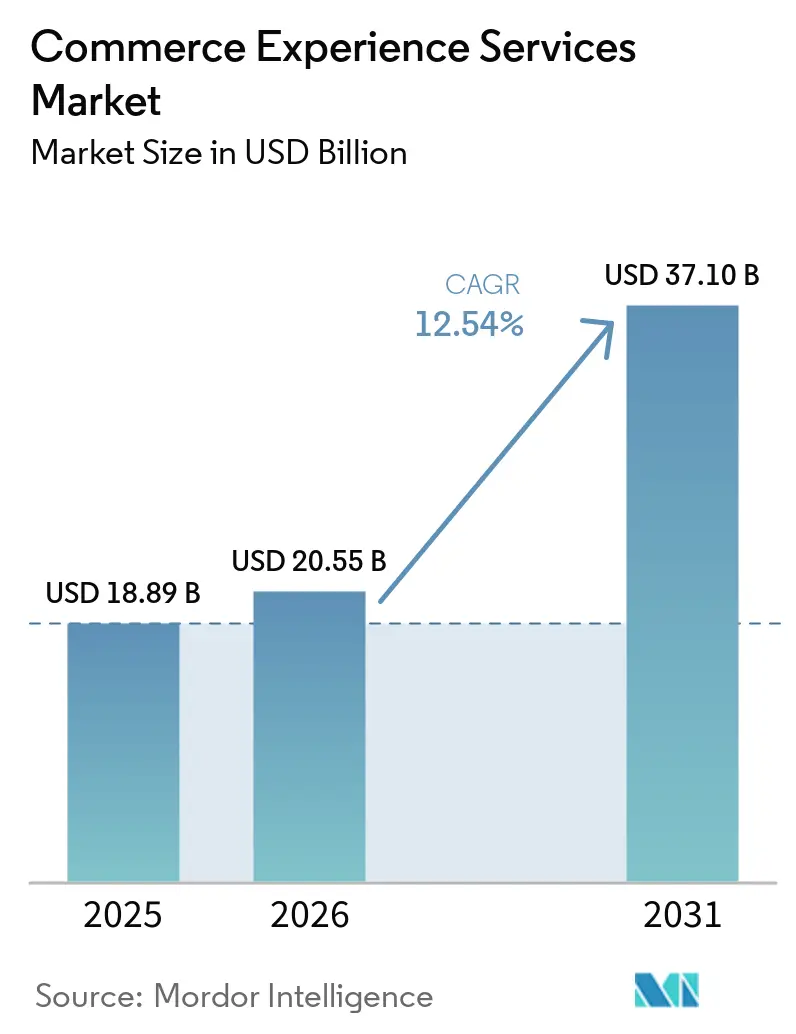
The commerce experience services market size is projected to be USD 18.89 billion in 2025, USD 20.55 billion in 2026, and reach USD 37.10 billion by 2031, growing at a CAGR of 12.54% from 2026 to 2031. The market is expanding because enterprise digital spending is shifting toward customer-facing experience programs rather than internal process automation. AI-native commerce platforms, higher buyer expectations, and the rising cost of digital customer acquisition are driving strong demand for strategy, implementation, and optimization services. The commerce experience services market is also changing as platform vendors build more native capabilities into their stacks, reducing simple implementation work and increasing the value of specialized delivery, vertical expertise, and cross-platform integration. This is creating more room for providers that can handle complex modernization programs, recurring optimization work, and regulated use cases across multiple industries. Growth remains supported by long-term digital commerce investment, even as privacy rules and talent shortages continue to extend project timelines in some regions.
Key Report Takeaways
- By service, platform implementation and integration held 39.78% of the commerce experience services market share in 2025, while commerce operations and optimization are projected to expand at a 13.72% CAGR through 2031.
- By organization size, large enterprises accounted for 63.17% of the commerce experience services market in 2025, while small and medium enterprises are projected to grow at a 12.34% CAGR through 2031.
- By industry vertical, retail and e-commerce accounted for 29.51% of the commerce experience services market in 2025, while healthcare and life sciences are projected to grow at a 13.86% CAGR through 2031.
- By geography, North America held 38.32% of the commerce experience services market share in 2025, while Asia-Pacific is projected to record the highest CAGR of 14.21% through 2031.
Note: Market size and forecast figures in this report are generated using Mordor Intelligence’s proprietary estimation framework, updated with the latest available data and insights as of January 2026.
Market Trends and Insights
Drivers Impact Analysis of Commerce Experience Services Market*
| Driver | (~) Impact on CAGR Forecast | Geographic Relevance | Impact Timeline |
|---|---|---|---|
| Growing Adoption of AI and Generative AI in Commerce Personalization and Content Creation | +3.5% | Global, with stronger impact in North America and Europe | Medium term (2-4 years) |
| Rising Demand for Hyper-Personalized Shopping Experiences Across Channels | +2.5% | Global, with Asia-Pacific and North America as key contributors | Medium term (2-4 years) |
| Accelerating Shift Toward Digital-First Consumer Engagement Strategies | +2.0% | Global | Short term (≤ 2 years) |
| Expansion of Omnichannel Retail Infrastructure Driving Unified Experience Investments | +1.8% | North America and Europe, with spillover into APAC | Medium term (2-4 years) |
| Increasing Mobile Commerce Penetration Fueling UX Optimization Demand | +1.5% | Asia-Pacific-led, with spillover into South America and the Middle East | Short term (≤ 2 years) |
| Surge In Direct-To-Consumer Brand Models Prioritizing Digital Experience Differentiation | +1.2% | North America and Europe | Short term (≤ 2 years) |
| Source: Mordor Intelligence | |||
Growing Adoption of AI and Generative AI in Commerce Personalization and Content Creation
AI-led commerce execution is moving from pilot programs into live enterprise use, driving increased demand across consulting, implementation, and ongoing optimization in the commerce experience services market. Salesforce announced its planned acquisition of Cimulate in March 2026 to strengthen AI-powered product discovery and conversational shopping in Agentforce Commerce, underscoring how deeply AI is entering commerce workflows. Commercetools reported in November 2025 that 88% of enterprises planned to modernize commerce platforms within 12 months and that 97% of enterprise decision-makers believed AI would reshape commerce, which keeps migration and integration pipelines active in the commerce experience services market. Salesforce also reported that many organizations had already deployed AI for analytics or automation, while only 12% had deployed fully autonomous AI systems, which leaves a large second phase of deeper service work still open. As AI capabilities move closer to real-time catalog, pricing, and customer journey decisions, service providers that can translate platform capability into operating models are gaining a stronger position in the commerce experience services market.
Rising Demand for Hyper-Personalized Shopping Experiences Across Channels
Personalization is no longer limited to campaign management, and it now depends on connected data, content, and decisioning across every customer touchpoint in the commerce experience services market. Adobe announced the general availability of AI agents across the Adobe Experience Cloud in September 2025, covering site optimization, audience creation, journey orchestration, experimentation, and content optimization, underscoring how central personalization has become to platform roadmaps.[1] Bloomreach launched Loomi AI for Shopify in April 2026, enabling merchants to activate AI-powered search, recommendations, and marketing personalization without coding or IT support, lowering the barrier to broader adoption. FEVAD reported that 31% of French online shoppers used generative AI during their purchase journeys in 2025, confirming that customer behavior is already pushing brands to improve the customer experience. The commerce experience services market benefits because many enterprises still need outside support to connect customer data, redesign journeys, and operationalize personalization across web, mobile, loyalty, and support channels.
Accelerating Shift Toward Digital-First Consumer Engagement Strategies
Digital-first engagement is now more closely tied to budget allocation, widening the addressable scope of the commerce experience services market. Enterprise modernization plans are increasingly built around customer acquisition efficiency, owned-channel performance, and stronger retention, which pushes experience work higher on executive agendas in the commerce experience services market. Adobe, Salesforce, and Bloomreach all expanded AI-led commerce capabilities during 2025 and 2026, which shows that digital engagement is being treated as a core operating layer rather than a peripheral marketing function. This creates different demand patterns by region, mature markets focus on modernization, while high-growth markets focus on faster deployment of new digital engagement models. Providers with global delivery capacity are benefiting because they can support both replacement programs and greenfield implementations inside the commerce experience services market.
Expansion of Omnichannel Retail Infrastructure Driving Unified Experience Investments
Retailers continue to invest in unified experiences because customer journeys now move across storefronts, mobile apps, social channels, fulfillment layers, and service touchpoints in the commerce experience services market. Manhattan Associates found in 2025 that only 17% of surveyed North American specialty retailers considered their unified commerce capabilities mature, while 38% were actively advancing unification initiatives. Commercetools reported that enterprises moving to modern platforms experienced higher satisfaction and faster time-to-value than those remaining on legacy systems, which supports continued re-platforming and integration demand. Salesforce also expanded its headless storefront tooling with PWA Kit 3.16 in February 2026, further underscoring the need for design, localization, SEO, and performance work across channels. As omnichannel infrastructure becomes more modular, the commerce experience services market is shifting further toward multi-year delivery models instead of one-time implementation work.
Restraints Impact Analysis of Commerce Experience Services Market*
| Restraint | (~) % Impact on CAGR Forecast | Geographic Relevance | Impact Timeline |
|---|---|---|---|
| Stringent Data Privacy Regulations Constraining Personalization Capabilities | -1.8% | Europe and North America, with growing spillover into APAC | Medium term (2-4 years) |
| High Implementation and Integration Costs Limiting Adoption Among Small and Medium Enterprises | -1.5% | Global, with stronger impact in emerging markets | Short term (≤ 2 years) |
| Complexity of Managing Consistent Experiences Across Multiple Digital Touchpoints | -1.0% | Global, especially among large multi-brand enterprises | Medium term (2-4 years) |
| Shortage of Skilled Digital Experience and Commerce Technology Professionals | -0.8% | Global, with sharper impact in North America and Western Europe | Long term (≥ 4 years) |
| Source: Mordor Intelligence | |||
Stringent Data Privacy Regulations Constraining Personalization Capabilities
Privacy and AI governance rules are increasing delivery complexity in the commerce experience services market, especially for European deployments. JIPITEC explained in 2025 that recommendation engines in e-commerce must address both GDPR requirements and AI Act obligations, including transparency, documentation, human oversight, and automated decision-making provisions. The European Parliament also noted that the AI Act and GDPR create overlapping assessments and compliance steps that differ in scope and procedure, which adds uncertainty for companies deploying personalization systems.[2] For service providers, this means that European projects require more privacy-by-design work, more documentation, and more review cycles than similar programs in less-regulated markets. The result is a slower rollout, higher delivery cost, and lower standardization across the commerce experience services market.
High Implementation and Integration Costs Limiting Adoption Among Small and Medium Enterprises
Cost remains a practical barrier in the commerce experience services market, especially for small and medium enterprises that want modern capabilities but lack full internal technical teams. Commercetools stated in November 2025 that enterprise-grade migrations have historically taken 12-18 months, and even with better tooling, the investment threshold remains significant for organizations without deep platform expertise. Salesforce introduced its Agentic B2C Developer Toolkit in April 2026, featuring 40+ pre-built agent skills to reduce implementation effort, but it does not eliminate integration complexity for smaller clients. This keeps adoption uneven across the commerce experience services market because many smaller companies still need scoped packages, phased deployment, and subscription-led optimization instead of broad transformation projects. Providers that cannot adapt their pricing and delivery model for smaller accounts may miss a meaningful part of future demand in the commerce experience services market.
*Our forecasts treat driver/restraint impacts as directional, not additive. The impact forecasts reflect baseline growth, mix effects, and variable interactions.
Commerce Experience Services Market Segment Analysis
By Service:
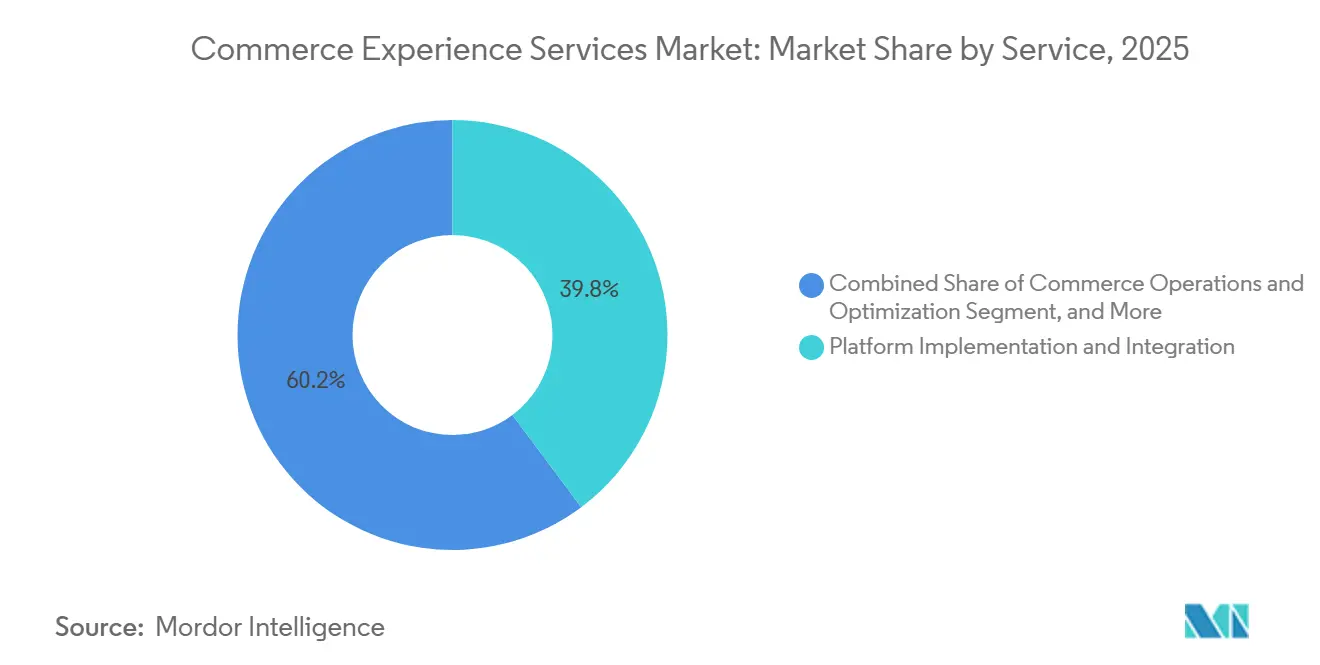
Platform Implementation Leads As Optimization Builds MomentumPlatform implementation and integration accounted for 39.78% of the market in 2025, making it the largest service line in the commerce experience services market. That lead reflected the volume of active re-platforming, stack modernization, and API-led integration work underway across enterprise and upper mid-market accounts. Commercetools reported that many recent movers were exiting SAP Commerce Cloud and Salesforce Commerce Cloud in favor of more composable and AI-ready architectures, which supports steady implementation demand. Commerce operations and optimization are projected to grow at a 13.72% CAGR through 2031, indicating that the commerce experience services market is moving beyond one-time deployment into recurring performance management.
Commerce strategy and experience consulting continue to shape upstream demand because clients need clearer roadmaps for AI readiness, personalization design, and cross-channel orchestration in the commerce experience services market. Experience design and front-end development also remain important because modern storefronts now depend on headless frameworks, faster localization, stronger SEO, and better mobile performance. Salesforce expanded this front-end scope with PWA Kit 3.16 in February 2026, adding updates around localization, SEO, and performance that extend development work in new builds and migration programs. Together, consulting, design, implementation, and optimization form a connected delivery cycle that supports longer contracts and more durable client relationships across the commerce experience services industry.

By Organization Size:
Large Enterprises Anchor Demand While SMEs Gain SpeedLarge enterprises held a 63.17% share in 2025, keeping them at the center of revenue generation in the commerce experience services market. Their spending base remains higher because they run broader channel portfolios, larger data environments, and more complex commerce and experience stacks across regions and brands. Shopify reported in 2025 that Bloomreach was already supporting personalization for more than 1,400 global brands, which shows how widely enterprise-grade experience tools are being adopted across established retail accounts. This concentration among large clients continues to support large-scale transformation, migration, and managed optimization work in the commerce experience services market.
Small and medium enterprises are projected to expand at a 12.34% CAGR through 2031, making them the fastest-growing segment in the commerce experience services market. Bloomreach's April 2026 launch of Loomi AI for Shopify shows why this part of the market is growing, because merchants can access personalization across search, recommendations, and campaigns without a heavy technical setup. Salesforce's April 2026 developer toolkit points in the same direction, with pre-built agent skills that reduce effort for development teams and shorten onboarding for headless commerce projects. The growth pattern remains distinct from that of large enterprises, as SMEs typically focus on owned-channel performance, loyalty infrastructure, and conversion improvements rather than broad enterprise-wide reinvention across the commerce experience services industry.
By Industry Vertical:
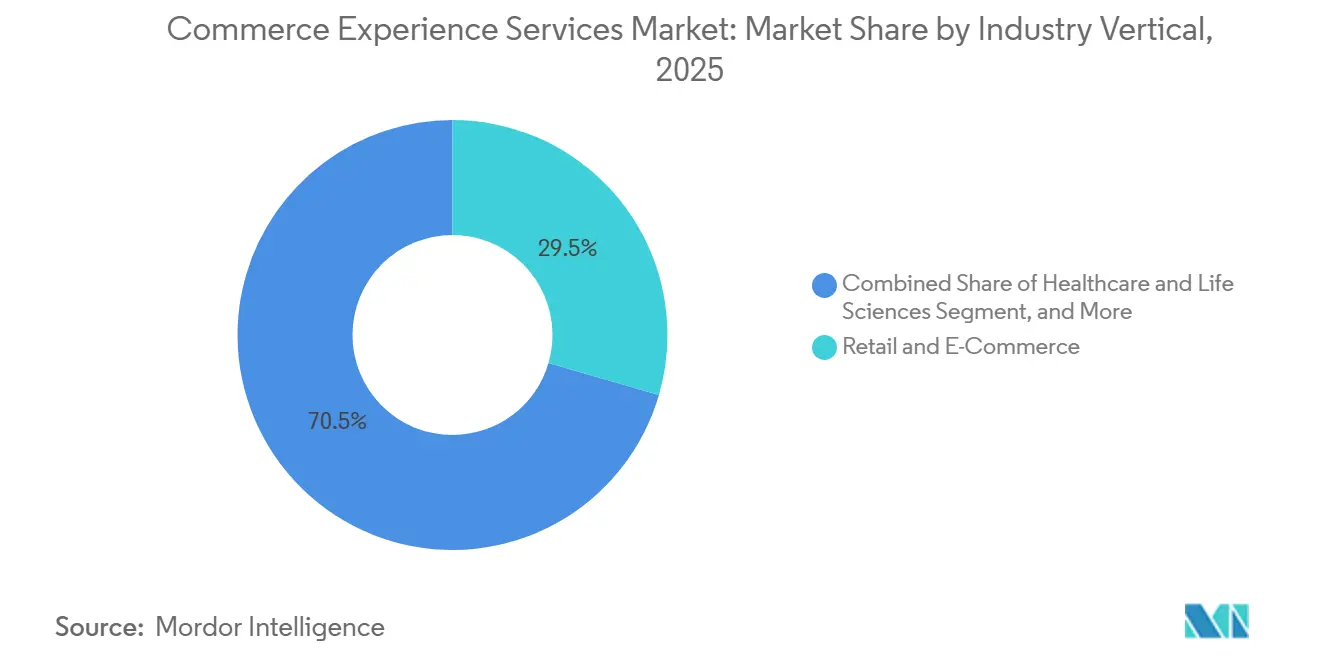
Retail Holds Scale While Healthcare Broadens DemandRetail and e-commerce accounted for 29.51% of the market in 2025, making this vertical the largest contributor to the commerce experience services market. Demand remained high as merchants continued to modernize platforms, enhance personalization, and connect omnichannel operations across storefronts, content, and checkout. Adobe reported that mobile devices accounted for 59% of global ecommerce revenue in 2025, which reinforced the need for mobile-centered UX, performance tuning, and checkout optimization. FEVAD also reported that France's e-commerce sector reached EUR 196.4 billion (USD 207 billion) in 2025, with 3.2 billion transactions, underscoring the scale of digital commerce activity retailers must support.
Healthcare and life sciences are projected to expand at a 13.86% CAGR through 2031, making it the fastest-growing vertical in the commerce experience services market. Growth in this vertical is coming from digital pharmacy, telehealth, connected patient engagement, and the need for compliant personalization and data handling. That gives healthcare programs a different delivery profile, because platform work often has to connect experience layers with regulated data systems and service workflows. Media and entertainment, travel and hospitality, consumer goods, and other sectors, including BFSI, education, automotive, and IT and telecom, also contribute meaningfully to the commerce experience services market, but healthcare is broadening the scope of what commerce-led experience delivery now includes.
Geography Analysis
North America Commerce Experience Services Market
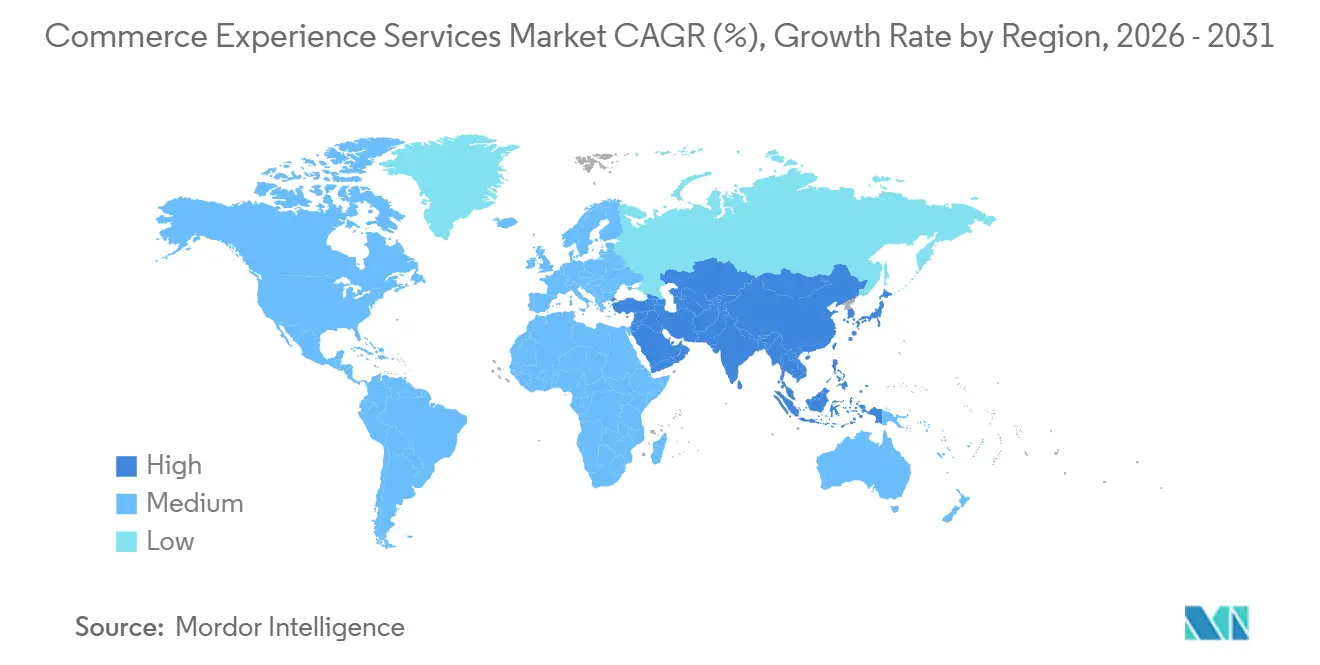
North America held a 38.32% share in 2025, making it the largest regional contributor to the commerce experience services market. The region benefits from large enterprise technology budgets, a mature platform ecosystem, and a deep base of implementation and optimization partners. Salesforce expanded B2C Commerce functionality in May 2026 with a generally available Visual Merchandising Workspace and broader payment configuration options, which support further downstream demand for customization and deployment work.[3] The United States continues to support strong service demand because brands are shifting investment toward owned-channel performance, loyalty, and experience optimization amid rising acquisition costs. Canada and Mexico are also contributing more actively as cross-border retail digitization and unified commerce programs expand across North America.
APAC Commerce Experience Services Market
Asia-Pacific is projected to grow at a 14.21% CAGR through 2031, making it the fastest-growing geography in the commerce experience services market. Growth in the region is supported by large mobile-first customer bases, rising digital transaction intensity, and faster adoption of new commerce formats. This creates strong demand for storefront redesign, mobile checkout optimization, localized journey orchestration, and performance-led operations support in the commerce experience services market. The delivery pattern also differs from mature markets because many programs in Asia-Pacific are still scaling quickly rather than replacing large legacy estates. That gives providers with modular service models and faster implementation methods a stronger opportunity to expand in the commerce experience services market.
EMEA and South America Commerce Experience Services Market
Europe, South America, the Middle East, and Africa form a diverse group of markets with different starting points but growing demand for digital commerce experience work. FEVAD reported that France recorded EUR 196.4 billion (USD 207 billion) in e-commerce sales and 3.2 billion transactions in 2025, while 31% of French online shoppers used generative AI during purchase journeys, highlighting the pace of change in customer behavior. The European Parliament's 2025 analysis of the AI Act also shows that projects in Europe require more compliance work on transparency, oversight, and documentation. In South America, the Middle East, and Africa, service demand is being shaped more by mobile-first adoption, expanding payment infrastructure, and early-stage digital transformation, which gives the commerce experience services market a broader long-term runway beyond the largest established regions.
Competitive Landscape
The commerce experience services market is fragmented. Large platform vendors such as Salesforce, Adobe, and Oracle compete for major enterprise accounts with broad suites that span commerce, content, data, and personalization. At the same time, focused specialists such as Bloomreach and Commercetools are gaining ground by offering stronger AI readiness, open architecture, and more flexible deployment models in the commerce experience services market. Commercetools said it had surpassed a USD 100 billion GMV run rate in Q1 2026 while continuing to support open standards such as Model Context Protocol and Agentic Commerce Protocol, which shows the scale that ecosystem-first models can achieve. This leaves the commerce experience services market with strong platform power at the top, but no similar consolidation across the services layer.
Competitive differentiation is now centered on AI depth, data architecture, and ecosystem breadth in the commerce experience services market. Adobe introduced CX Enterprise in April 2026, with support for open standards such as MCP and Agent2Agent, and interoperability with major cloud and AI partners, raising the bar for enterprise-grade orchestration.[4] Bloomreach announced Loomi Connect in January 2026, extending product discovery intelligence to ChatGPT and other conversational AI platforms via the Model Context Protocol. Salesforce also announced support for Google's Universal Commerce Protocol in 2026, which helps merchants surface products inside AI-assisted discovery environments and reflects a broader shift in channel strategy.
These moves are changing where value is created inside the commerce experience services market. Simple integration work is becoming easier to compress, while demand is rising for providers that can manage orchestration, data flow, AI governance, and continuous optimization. The strongest whitespace remains in regulated sectors, conversational commerce infrastructure, and more complex B2B experience environments where platform capability alone is not enough. That is why the commerce experience services market still offers room for specialists with vertical expertise, proprietary methods, and stronger execution across multi-platform client estates.
Commerce Experience Services Industry Leaders
-
Salesforce, Inc.
-
Adobe Inc.
-
SAP SE
-
Oracle Corporation
-
Shopify Inc.
- *Disclaimer: Major Players sorted in no particular order
Commerce Experience Services Market Companies Covered in this Report
- Salesforce, Inc.
- Adobe Inc.
- SAP SE
- Oracle Corporation
- Shopify Inc.
- Commercetools GmbH
- Bloomreach, Inc.
- Coveo Solutions Inc.
- Contentsquare SAS
- Algolia, Inc.
- Nosto Solutions Oy
- Salsify, Inc.
- BigCommerce Holdings, Inc.
- Optimizely AB
- Insider Growth Management Platform A.S.
- Amplience Limited
- Elastic Path Software Inc.
- VTEX
- Akeneo SAS
- Cloudinary Ltd.
Recent Industry Developments in Commerce Experience Services Market
- May 2026: Bloomreach announced the general availability of its Loomi Marketing Agent, the second autonomous agent on its Loomi AI platform, automating audience segmentation, campaign orchestration, and retention workflows for over 1,400 global brands. The agent includes built-in GDPR compliance controls and granular access management, positioning it for enterprise deployments with strict data governance requirements.
- May 2026: Salesforce announced support for Google's Universal Commerce Protocol, an open standard designed for the agentic commerce era. The integration enables Agentforce Commerce merchants to surface products natively within Google AI Mode in Search and the Gemini app, directly extending brand reach into AI-assisted discovery channels and shifting the competitive importance of SEO toward AI-surface visibility.
- May 2026: Salesforce released its B2C Commerce May 2026 update, introducing the generally available Visual Merchandising Workspace, smarter catalog management tools with AI-assisted product data completeness filters, frictionless checkout options, and a new developer toolkit, incremental enhancements supporting the broader Agentforce Commerce rollout.
- April 2026: Adobe launched CX Enterprise at Adobe Summit 2026, repositioning Adobe Experience Cloud as an AI-first, agent-based platform. New capabilities include the Commerce MCP Server, enabling real-time AI agent access to catalog, cart, pricing, inventory, and order management data; the CX Enterprise Coworker orchestration layer; and a Commerce Developer Agent for automated legacy code migration. Over 1,770 customers are already entitled to use the credit-based AI agent offering.
Global Commerce Experience Services Market Report Scope
The Commerce Experience Services Market comprises professional and managed services that help organizations design, implement, optimize, and manage digital commerce experiences across online and omnichannel customer touchpoints. These services enable businesses to enhance customer engagement, improve conversion rates, streamline commerce operations, and deliver personalized shopping experiences by integrating commerce platforms, customer data, content, and digital technologies.
The Commerce Experience Services Market Report is Segmented by Service (Commerce Strategy and Experience Consulting, Experience Design and Front-End Development, Platform Implementation and Integration, and Commerce Operations and Optimization), Organization Size (Large Enterprises, and Small and Medium Enterprises), Industry Vertical (Retail and E-commerce, Media and Entertainment, Healthcare and Life Sciences, Travel and Hospitality, Consumer Goods, and Other Industry Verticals), and Geography (North America, South America, Europe, Asia-Pacific, Middle East, and Africa). The Market Forecasts are Provided in Terms of Value (USD).
Segmentation Overview
| Commerce Strategy and Experience Consulting |
| Experience Design and Front-End Development |
| Platform Implementation and Integration |
| Commerce Operations and Optimization |
| Large Enterprises |
| Small and Medium Enterprises |
| Retail and E-commerce |
| Media and Entertainment |
| Healthcare and Life Sciences |
| Travel and Hospitality |
| Consumer Goods |
| Other Industry Verticals |
| North America | United States |
| Canada | |
| Mexico | |
| South America | Brazil |
| Argentina | |
| Chile | |
| Rest of South America | |
| Europe | Germany |
| United Kingdom | |
| France | |
| Italy | |
| Spain | |
| Rest of Europe | |
| Asia-Pacific | China |
| Japan | |
| India | |
| South Korea | |
| Australia | |
| Rest of Asia-Pacific | |
| Middle East | Saudi Arabia |
| United Arab Emirates | |
| Qatar | |
| Rest of Middle East | |
| Africa | South Africa |
| Egypt | |
| Nigeria | |
| Rest of Africa |
| By Service | Commerce Strategy and Experience Consulting | |
| Experience Design and Front-End Development | ||
| Platform Implementation and Integration | ||
| Commerce Operations and Optimization | ||
| By Organization Size | Large Enterprises | |
| Small and Medium Enterprises | ||
| By Industry Verticals | Retail and E-commerce | |
| Media and Entertainment | ||
| Healthcare and Life Sciences | ||
| Travel and Hospitality | ||
| Consumer Goods | ||
| Other Industry Verticals | ||
| By Geography | North America | United States |
| Canada | ||
| Mexico | ||
| South America | Brazil | |
| Argentina | ||
| Chile | ||
| Rest of South America | ||
| Europe | Germany | |
| United Kingdom | ||
| France | ||
| Italy | ||
| Spain | ||
| Rest of Europe | ||
| Asia-Pacific | China | |
| Japan | ||
| India | ||
| South Korea | ||
| Australia | ||
| Rest of Asia-Pacific | ||
| Middle East | Saudi Arabia | |
| United Arab Emirates | ||
| Qatar | ||
| Rest of Middle East | ||
| Africa | South Africa | |
| Egypt | ||
| Nigeria | ||
| Rest of Africa | ||
Key Questions Answered in the Report
What is the current and forecast value of the commerce experience services space?
The commerce experience services market size stands at USD 20.55 billion in 2026 and is forecast to reach USD 37.10 billion by 2031, rising at a 12.54% CAGR.
Which service category leads spending today?
Platform implementation and integration led with 39.78% share in 2025, reflecting the scale of ongoing re-platforming and modernization programs.
Which service category is expanding the fastest through 2031?
Commerce operations and optimization is projected to grow at 13.72% CAGR, showing the shift from one-time deployments to continuous improvement models.
Why are enterprises increasing spending on commerce experience programs?
Spending is being driven by AI-enabled personalization, omnichannel unification, digital-first engagement, and the need to improve conversion and retention across owned channels.
Which customer group is creating the largest revenue base?
Large enterprises held 63.17% share in 2025 because they operate more complex channel, data, and platform environments that require larger service engagements.
Which region offers the strongest growth outlook?
Asia-Pacific is projected to record the highest CAGR at 14.21% through 2031, while North America remains the largest regional contributor with 38.32% share in 2025.