
Collateral Management Services Market Size and Share
Market Overview
| Study Period | 2021 - 2032 |
|---|---|
| Market Size (2027) | USD 2.5 Billion |
| Market Size (2032) | USD 3.80 Billion |
| Growth Rate (2027 - 2032) | 3.80 % |
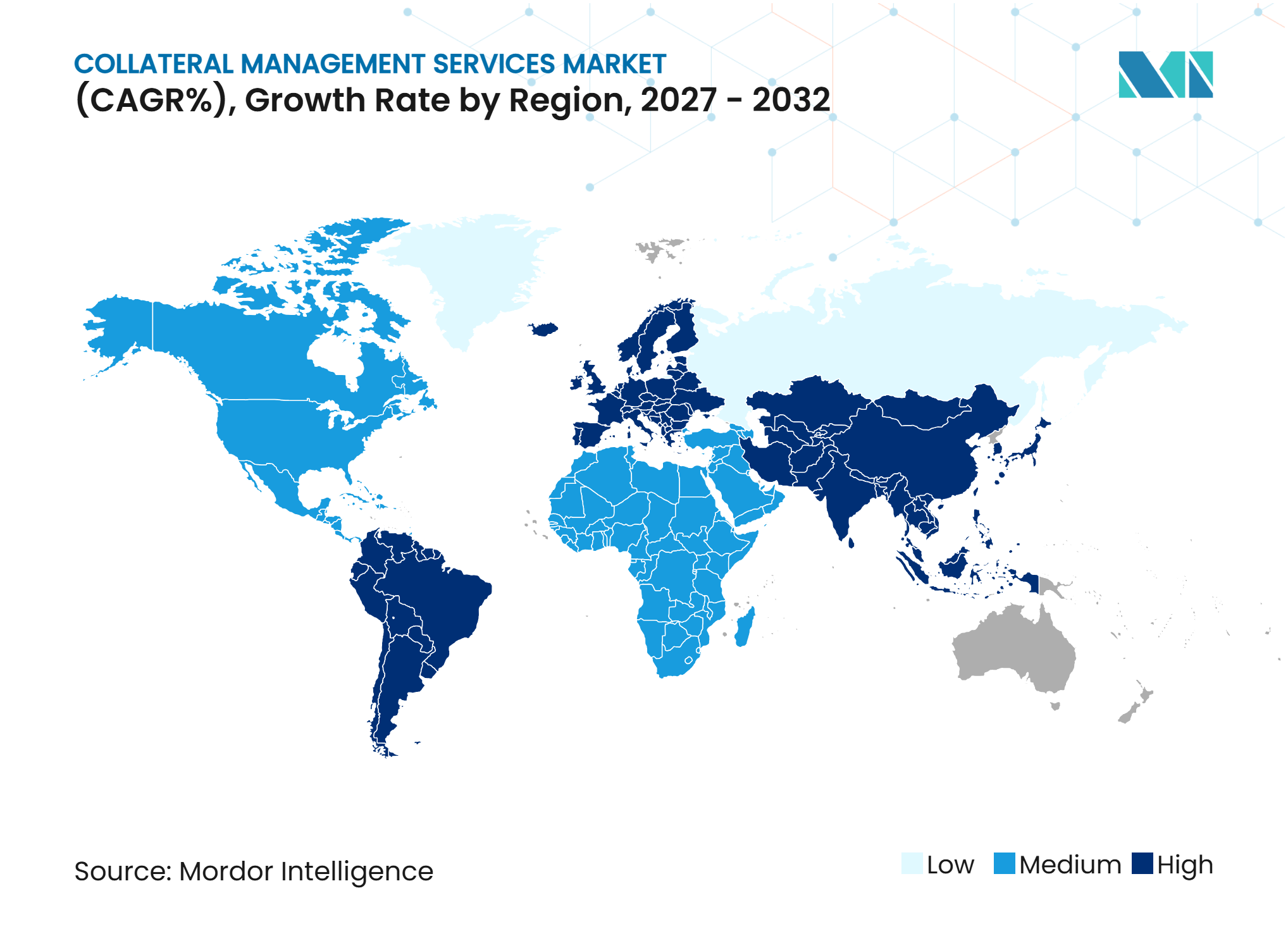
| Fastest Growing Market | Asia-Pacific |
| Largest Market | North America |
| Market Concentration | Medium |
Major Players *Disclaimer: Major Players sorted in no particular order Image © Mordor Intelligence. Reuse requires attribution under CC BY 4.0. | |
Collateral Management Services Market Analysis by Mordor Intelligence
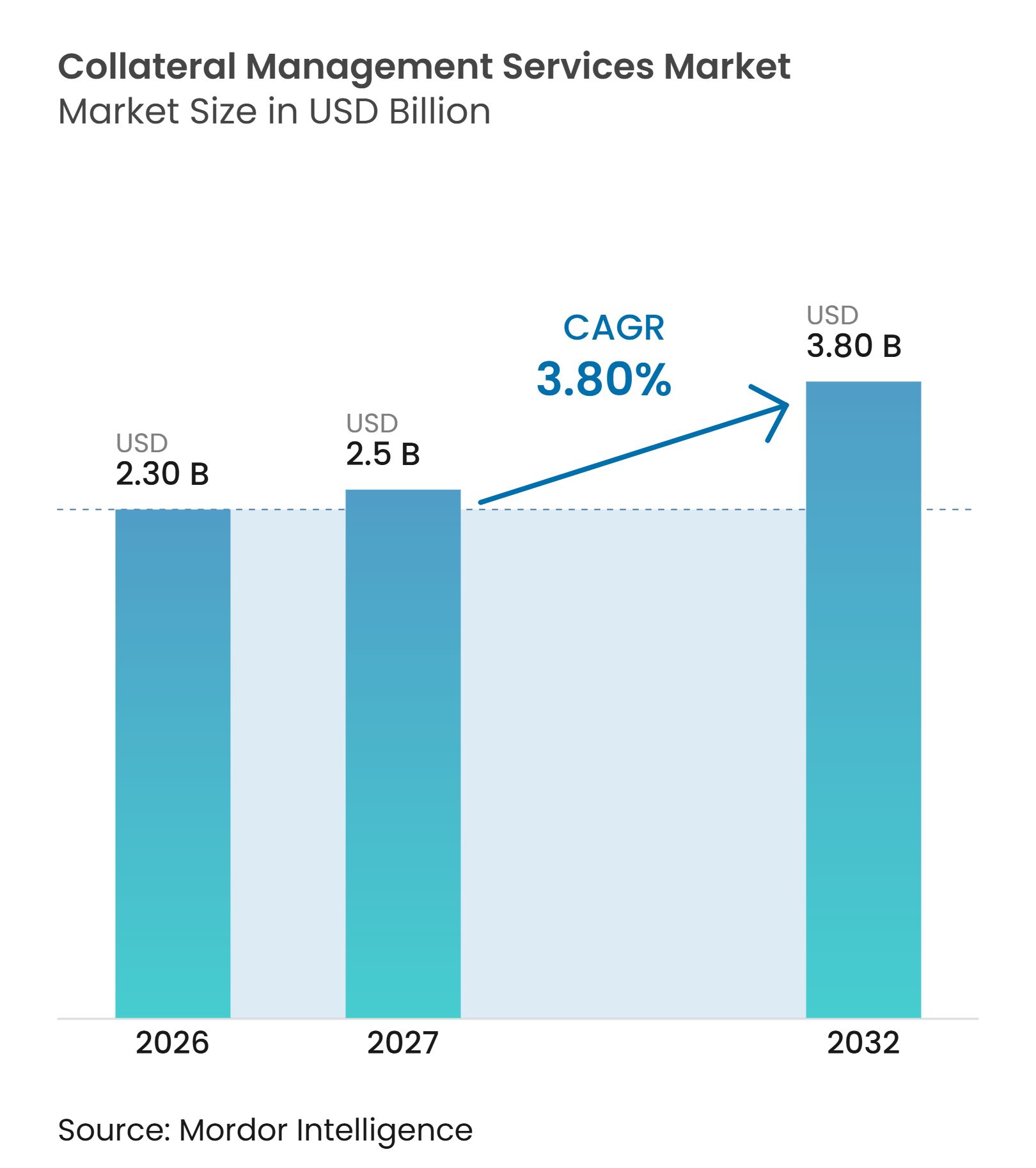
The Collateral Management Services Market size is projected to be USD 2.30 billion in 2026, USD 2.5 billion in 2027, and reach USD 3.80 billion by 2032, growing at a CAGR of 3.80% from 2027 to 2032.
Growth reflects the expanding need to move, value, and substitute collateral across cleared and uncleared exposures. Regulatory margin requirements continue to increase the number of institutions that need reliable custody, eligibility, and reporting processes. Providers are responding by joining settlement infrastructure with allocation tools and real-time data capabilities. The Collateral management services industry also benefits as asset managers and other buy-side firms seek outsourced operating models rather than building specialist functions internally.
Key Report Takeaways
- By service type, Collateral Mobilization, Settlement and Custody Coordination Services held 34.2% of the Collateral management services market share in 2026, while Collateral Optimization and Allocation Services is forecast to expand at an 11.2% CAGR through 2032.
- By transaction and exposure type, Repo and Reverse Repo Transactions accounted for 32.9% of the Collateral management services market size in 2026, while Uncleared OTC Derivatives Margin is projected to grow at a 10.4% CAGR through 2032.
- By end user, Banks and Broker-Dealers held 48.6% of the Collateral management services market share in 2026, while Asset Managers and Investment Funds are expected to record a 10.8% CAGR through 2032.
- By geography, North America held 42.1% of the Collateral management services market share in 2026, while Asia-Pacific is projected to advance at an 11.5% CAGR through 2032.
Note: Market numbers in this report are based on Mordor Intelligence's proprietary estimation framework, which combines nine months of actuals with Q4 projections for base year 2026.
Market Trends and Insights
Drivers Impact Analysis of Collateral Management Services Market*
| Driver | (~) % Impact on CAGR Forecast | Geographic Relevance | Impact Timeline |
|---|---|---|---|
| Expansion of Collateral Requirements Across Cleared and Uncleared Derivatives | +2.2% | Global, most acute in North America and Europe | Long term (≥ 4 years) |
| Increasing Demand for Collateral Optimization and Mobilization Services | +1.6% | North America, Europe, Asia-Pacific core | Medium term (2-4 years) |
| Rising Adoption of Outsourced and Third-Party Collateral Management Services | +1.4% | Global, early gains in Asia-Pacific and Middle East | Medium term (2-4 years) |
| Growing Complexity of Cross-Border Collateral and Securities Financing Operations | +1.0% | Asia-Pacific and Europe, with spillover to the Middle East and Africa | Long term (≥ 4 years) |
| Increasing Need for Real-Time Collateral Visibility and Automated Margin Processing | +0.8% | North America and Europe, with Asia-Pacific accelerating | Short term (≤ 2 years) |
| Emergence of Tokenized Collateral and Digital Collateral Management Infrastructure | +1.2% | Global, with pioneer activity in the United States, United Kingdom, and Europe | Long term (≥ 4 years) |
| Source: Mordor Intelligence | |||
Expansion of Collateral Requirements Across Cleared and Uncleared Derivatives
Mandatory clearing and bilateral margining are widening the operating burden for firms with derivatives exposures. The Collateral management services market responds when these obligations create recurring needs for controls, asset selection, and verified settlement. Mexico's UMR Phase 2 took effect in September 2025 and extended margin requirements to development banks and corporates under amended Banco de México rules[1]. The change adds institutions that need custody, eligibility review, and movement of initial and variation margin. The Collateral management services industry gains demand when margin must be segregated and recorded, even without comparable growth in the underlying derivatives volume. EMIR Refit requirements and the United Kingdom rules on non-centrally cleared derivatives also require traceable workflows and approved approaches for margin management[2]. These compliance obligations make integrated workflows more important for firms operating across several rulebooks.
Increasing Demand for Collateral Optimization and Mobilization Services
Funding costs and balance-sheet constraints are raising the value of placing the right asset against the right obligation. The Collateral management services market is therefore moving beyond basic settlement processing toward allocation, substitution, and inventory-aware decisions. Euroclear and Transact Street Solutions launched a joint Collateral Optimization Service in November 2025 that combines settlement infrastructure with an algorithmic allocation engine. This model supports venue-neutral allocation across different pools and can reduce operational gaps between custody and optimization teams. Cross-border portfolios make the case stronger because eligibility schedules, settlement venues, and funding costs differ by jurisdiction. Firms that retain fragmented processes can face slower substitution and less clear intraday visibility.
Rising Adoption of Outsourced and Third-Party Collateral Management Services
Outsourcing is gaining ground because smaller and mid-sized firms often lack the people and systems needed to manage direct clearing and margin obligations. Citco reported that the value of margin movements in its middle-office operations increased, while collateral margin volumes rose another 10% quarter-on-quarter in the first quarter of 2025[3]. Outsourced providers can apply common eligibility schedules, agreement terms, and reporting processes across multiple clients. This pooling model can lower the cost of maintaining specialist control functions for an individual fund. SmartStream and Finastra announced a 2025 partnership focused on collateral management in the Middle East and Asia-Pacific[4]. The Collateral management services market has room to expand as new clearing participants seek operational support without building a full internal platform.
Real-Time Visibility, Cross-Border Operations, and Tokenized Collateral Infrastructure
Cross-border securities financing requires timely data on asset location, eligibility, haircuts, and settlement status. This need is making real-time visibility and automated margin processing central features of the Collateral management services market. DTCC introduced a digital collateral management platform in April 2025 to support real-time movement of tokenized assets across previously separate networks. The CFTC then opened a September 2025 initiative on tokenized collateral and stablecoins, seeking input on the use of tokenized non-cash assets as derivatives margin. ISDA has also set out work on legal frameworks and interoperability for tokenized collateral in standard derivatives documentation. These developments can reduce transfer delays, but they also increase the need for strong controls over legal ownership, operational interoperability, and eligibility rules.
Restraints Impact Analysis of Collateral Management Services Market*
| Restraint | (~) % Impact on CAGR Forecast | Geographic Relevance | Impact Timeline |
|---|---|---|---|
| High Integration Costs Associated with Legacy Collateral Management Systems | -1.2% | Global, most acute in North America and Europe | Medium term (2-4 years) |
| Limited Availability of Eligible High-Quality Collateral Assets | -0.8% | Global, more acute in Asia-Pacific and Middle East and Africa | Long term (≥ 4 years) |
| Fragmented Regulatory, Legal, and Collateral Eligibility Requirements Across Jurisdictions | -0.6% | Cross-border, Asia-Pacific core with spillover to Middle East and Africa | Long term (≥ 4 years) |
| Data Standardization and Interoperability Challenges Across Market Participants | -0.5% | Global | Medium term (2-4 years) |
| Source: Mordor Intelligence | |||
High Integration Costs Associated with Legacy Collateral Management Systems
Legacy systems can limit adoption because they were designed for separate products, static data, and end-of-day processing. The Collateral management services market can be slowed when a client's core records cannot support connected and timely workflows. Firms must spend on connectors, data reconciliation, historical agreement review, and redesigned workflows before they can use modern application programming interfaces. CloudMargin noted in 2025 that resilient collateral operations require modern technology stacks and stronger access to current data during market stress. Industry adoption of common data models shows how standardized records can shorten onboarding and reduce repeated integration work. However, migration remains difficult where a firm has years of customized processes and inconsistent data definitions. The restraint is most material when a firm needs real-time optimization but cannot replace the underlying system without disrupting daily operations.
Limited Eligible Collateral and Fragmented Requirements Across Jurisdictions
The Collateral management services market depends on the availability of assets that satisfy counterparty, central counterparty, and regulatory requirements. Liquidity rules and central clearing can concentrate demand in high-quality liquid assets, while segregated initial margin can reduce the inventory available for other uses. Requirements also differ by country, which means that an asset accepted in one location may not be acceptable in another. This creates additional work in legal review, bilateral documentation, haircuts, and custody arrangements. The resulting friction increases the value of services that can assess eligibility and substitute assets quickly. It can also delay cross-border expansion for providers and clients that do not have access to a broad network of custodians and settlement venues.
*Our forecasts treat driver/restraint impacts as directional, not additive. The impact forecasts reflect baseline growth, mix effects, and variable interactions.
Collateral Management Services Market Segment Analysis
By Service Type:
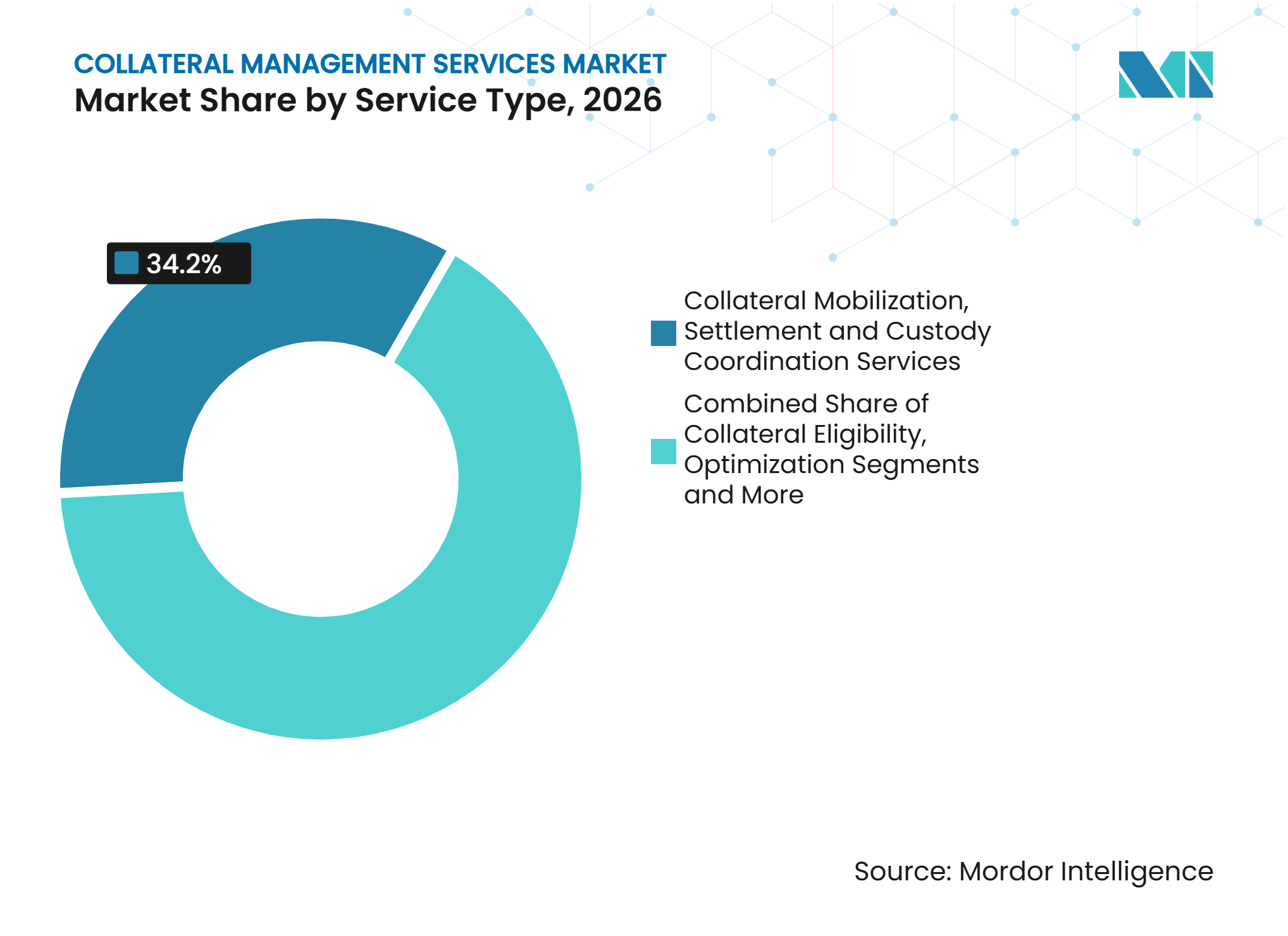
Optimization Becomes More Important Alongside SettlementCollateral Mobilization, Settlement and Custody Coordination Services held 34.2% of revenue in 2026, giving the category the largest position in the Collateral management services market. Settlement remains essential because each cleared derivative, bilateral margin call, and repo transaction requires reliable asset delivery and receipt. For the Collateral management services market, this creates an operating base that does not depend on a single product cycle. Custody coordination also remains important where securities must move across accounts, agents, and depositories. These activities give providers a recurring operational role across the collateral lifecycle. Providers also need dependable exception management when an asset fails eligibility checks or a settlement instruction changes.
Collateral Optimization and Allocation Services is expected to grow at an 11.2% CAGR through 2032, the fastest rate among service types. The Collateral management services market size for this category is supported by clients that need to compare eligible assets, funding costs, and obligations across venues. Euroclear and Transcend's 2025 service illustrates the shift toward a model that combines settlement reach with allocation capability. Margin and exposure management, eligibility and inventory management, and reconciliation services remain necessary inputs to both settlement and optimization. Consulting and systems integration services also benefit as institutions replace older platforms and redesign controls. The mix of service demand shows why workflow continuity remains as important as analytical capability.



By Transaction and Exposure Type:
Repo Supports Volume While OTC Margin Supports GrowthRepo and Reverse Repo Transactions accounted for 32.9% of revenue in 2026, the largest transaction category within the Collateral management services market. The category draws on frequent secured funding transactions and established triparty operating models. Europe's outstanding repo market reached USD 16.07 trillion in December 2025, following 24.6% year-on-year growth. In the United States, the Office of Financial Research measured USD 12.6 trillion in daily repo exposures in the third quarter of 2025.
Uncleared OTC Derivatives Margin is forecast to grow at a 10.4% CAGR through 2032. These positions require review of credit support annex terms, eligible collateral schedules, valuations, dispute handling, and margin transfer processes. Those requirements can create higher service intensity than standardized repo processing. Cleared derivatives margin and secured lending provide additional demand as clearing obligations and securities financing activity expand. Securities lending also needs accurate asset availability and return management, which keeps collateral operations connected to the broader financing workflow. This combination limits reliance on a single transaction source and supports a diversified provider revenue base.
By End User:
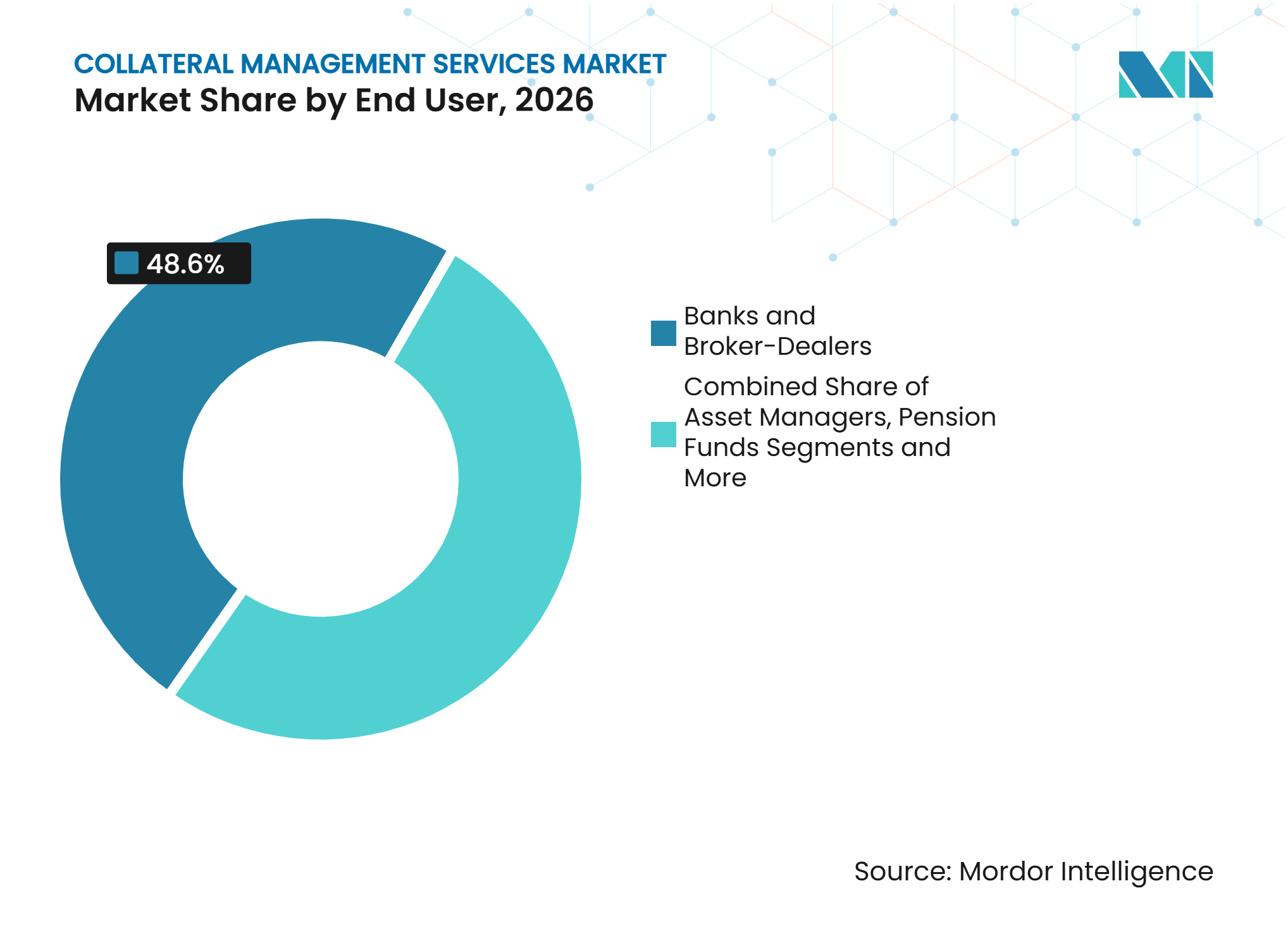
Banks Provide Scale While Asset Managers Add DemandBanks and Broker-Dealers held 48.6% of revenue in 2026, reflecting their roles as primary counterparties, clearing members, and triparty agents. Their broad balance-sheet activity gives them a continuing need for collateral inventory, valuation, substitution, and settlement support. The Collateral management services industry remains closely tied to these institutions because they connect many market participants to clearing and custody infrastructure. Their scale also supports investment in integrated platforms rather than stand-alone applications. They also help establish operational standards that other participants must connect with when they enter clearing or triparty arrangements.
Asset Managers and Investment Funds are projected to expand at a 10.8% CAGR through 2032. The segment includes hedge funds that need stronger operational capacity as clearing and margin obligations reach further into buy-side activity. Pension funds and insurers also manage collateral when interest-rate derivatives are used for liability-driven investment strategies. The Bank of England awarded VERMEG a USD 4.4 billion (GBP 3.5 million) contract in 2025 to upgrade its Securities and Collateral Management Settlement System. Central counterparties, public institutions, corporates, and other financial firms add smaller but growing sources of demand as their collateral processes become more formalized. This breadth makes end-user requirements diverse, ranging from high-volume processing to managed operations and implementation support.

Geography Analysis
North America
North America held 42.1% of the Collateral management services market share in 2026. The United States has a large repo and derivatives clearing base, and the Office of Financial Research recorded USD 12.6 trillion in average daily U.S. repo exposures during the third quarter of 2025. The same assessment identified USD 4.4 trillion in centrally cleared activity, USD 3.1 trillion through BNY's triparty platform, and USD 5.0 trillion in non-centrally cleared bilateral activity. SEC Treasury repo clearing requirements are increasing the need for buy-side firms to establish direct or sponsored clearing arrangements. Canada is also strengthening its market structure through the Canadian Collateral Management Service operated by TMX Group and Clearstream.
Asia-Pacific
Asia-Pacific is projected to record an 11.5% CAGR through 2032, the fastest rate among regions. The Collateral management services market size in the region is supported by infrastructure investment in Japan, South Korea, Singapore, Indonesia, India, and China. Singapore, Japan, and Australia have more mature collateral frameworks, while other markets are still expanding repo and central clearing capabilities. IDClear activated bilateral repo processing on VERMEG's Megara platform in January 2025, supporting Indonesia's domestic money-market infrastructure. Cross-border arrangements such as Bond Connect and Swap Connect are also making it easier to link domestic Chinese pools with international activity. The Collateral management services market can gain as these connections create a need to manage eligibility and settlement across different local infrastructures.
Europe, Middle East and Africa, and South America
Europe's repo market stood at USD 16.07 trillion in December 2025 after expanding 24.6% year on year. Euronext Clearing expanded its triparty model through relationships with Euroclear, Clearstream, and BNY, increasing the available routes for collateral selection, substitution, settlement, and reporting. ISO 20022 requirements under the Eurosystem Collateral Management System are influencing interoperability in European central bank collateral operations. The Middle East and Africa are developing from a smaller base, with the SmartStream and Finastra partnership aimed at regional firms. South America is also adding demand through new margin obligations in Mexico and the ongoing development of institutional derivatives activity.
Competitive Landscape
Market Concentration
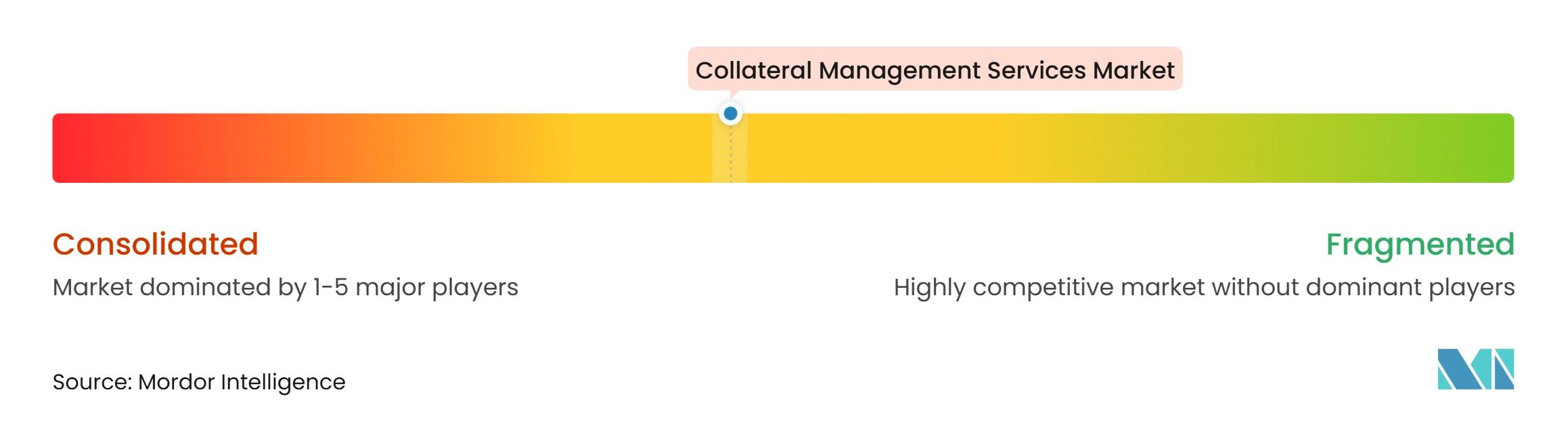
The Collateral management services market is moderately concentrated among global custodians and international central securities depositories. BNY, J.P. Morgan, Euroclear, Clearstream, and State Street have broad positions because they combine custody reach, settlement connectivity, balance-sheet capacity, and client relationships. BNY reported USD 59.4 trillion in assets under custody and USD 7.8 trillion in its liquidity pool in 2026, supporting its role in cleared and uncleared collateral workflows. The Collateral management services market also includes specialist technology suppliers such as CloudMargin, OpenGamma, Cassini Systems, and Transcend Street Solutions. Full-platform vendors, including VERMEG, Murex, SmartStream, Broadridge, and Finastra, compete through workflow coverage, interoperability, and speed of implementation.
Providers are increasingly seeking to connect custody, triparty agency, and optimization in one operating environment. Euronext and BNY announced a June 2026 collaboration that designates BNY as a triparty agent for Euronext Clearing and connects clients to BNY's Global Collateral Platform. Euroclear and Transcend launched their joint optimization service in November 2025, combining Collateral Highway with algorithmic allocation capability. DTCC's 2025 digital collateral platform is another strategic move that brings tokenized assets into a real-time management model.
Competition is less concentrated in analytics, margin calculation, and workflow tools than in custody and settlement. The Collateral management services market gives specialized suppliers room to compete where a client requires a defined analytical or operational capability. Smaller firms can compete by addressing a defined gap, including pre-trade funding analysis, post-trade margin optimization, or integration with existing systems. Euroclear and Digital Asset started Phase 1 of a tokenized collateral mobility initiative for the Canton Global Collateral Network in February 2025. This work shows where established infrastructure providers are extending their capabilities, while newer vendors seek a position in data and automation layers. The competitive outcome will depend on whether providers can deliver interoperable services without forcing clients to replace every legacy system.
Collateral Management Services Industry Leaders
-
BNY
-
J.P. Morgan
-
Euroclear
-
State Street Corporation
-
Clearstream
- *Disclaimer: Major Players sorted in no particular order
Collateral Management Services Market Companies Covered in this Report
- BNY
- J.P. Morgan
- Euroclear
- State Street Corporation
- Clearstream
- Broadridge Financial Solutions, Inc.
- BNP Paribas
- Société Générale
- Pirum Systems Limited
- Murex S.A.S.
- FIS
- SmartStream Technologies Ltd.
- VERMEG
- CloudMargin
- OpenGamma
- Transcend Street Solutions
- Cassini Systems
- Brown Brothers Harriman
- Finastra
- Hazeltree
Recent Industry Developments in Collateral Management Services Market
- October 2026: Clearstream introduced open connectivity for integrating third-party collateral solutions with its triparty platform, including Transcend’s optimization technology, enabling enhanced collateral optimization, inventory management, and analytics.
- June 2026: Euronext appointed BNY as triparty agent for Euronext Clearing, connecting members to BNY’s Global Collateral Platform and USD 7.8 trillion liquidity pool to manage cleared and uncleared exposures, supporting pan-European repo clearing expansion.
- May 2026: DTCC partnered with Chainlink to integrate its Runtime Environment and data standards into the Collateral AppChain, enabling automated collateral eligibility, valuation, margining, optimization, and settlement, with a planned Q4 2026 launch.
- May 2026: Euroclear and MUFG: MUFG adopted Euroclear’s Collateral Optimization Service, combining Euroclear’s infrastructure with Transcend’s technology to optimize collateral allocation, reduce funding costs, and improve capital efficiency.
- January 2026: DTCC received SEC approval to launch its Agent Clearing Service (ACS) Triparty Service through FICC, using BNY’s Global Collateral infrastructure to support cleared triparty repo transactions, improve margin efficiency, and expand access to central clearing ahead of the US Treasury clearing mandate.
Global Collateral Management Services Market Report Scope
The Collateral Management Services Market comprises services and solutions that help financial institutions, banks, asset managers and corporates manage, monitor, allocate, optimise and mobilise collateral assets to secure financial transactions, meet regulatory margin requirements, mitigate counterparty credit risk and improve liquidity efficiency.
The Collateral Management Services Report is Segmented by Service Type (Margin Management, Collateral Eligibility, Optimization, Mobilization, Reconciliation, Consulting), Transaction Type (Cleared Derivatives, Uncleared OTC, Repo, Securities Lending, Secured Lending), End User (Banks, Asset Managers, Pension Funds, Corporates, Central Banks, CCPs, Others), and Geography. Market Forecasts are Provided in Terms of Value (USD).
Segmentation Overview
| Margin and Exposure Management Services |
| Collateral Eligibility, Valuation and Inventory Management Services |
| Collateral Optimization and Allocation Services |
| Collateral Mobilization, Settlement and Custody Coordination Services |
| Reconciliation, Dispute Management and Reporting Services |
| Consulting, Implementation and Systems Integration Services |
| Cleared Derivatives Margin |
| Uncleared OTC Derivatives Margin |
| Repo and Reverse Repo Transactions |
| Securities Lending and Borrowing |
| Secured Lending and Other Bilateral Exposures |
| Banks and Broker-Dealers |
| Asset Managers and Investment Funds (including Hedge Funds) |
| Pension Funds and Insurance Companies |
| Non-Financial Corporates |
| Central Banks and Public-Sector Institutions |
| Central Counterparties (CCPs) |
| Other Financial Institutions |
| North America | United States |
| Canada | |
| Mexico | |
| South America | Brazil |
| Argentina | |
| Rest of South America | |
| Europe | United Kingdom |
| Germany | |
| France | |
| Italy | |
| Spain | |
| Rest of Europe | |
| Asia-Pacific | China |
| Japan | |
| India | |
| South Korea | |
| Australia | |
| Indonesia | |
| Thailand | |
| Malaysia | |
| Singapore | |
| Vietnam | |
| Rest of Asia-Pacific | |
| Middle East and Africa | Saudi Arabia |
| United Arab Emirates | |
| Turkey | |
| South Africa | |
| Egypt | |
| Rest of Middle East and Africa |
| By Service Type | Margin and Exposure Management Services | |
| Collateral Eligibility, Valuation and Inventory Management Services | ||
| Collateral Optimization and Allocation Services | ||
| Collateral Mobilization, Settlement and Custody Coordination Services | ||
| Reconciliation, Dispute Management and Reporting Services | ||
| Consulting, Implementation and Systems Integration Services | ||
| By Transaction and Exposure Type | Cleared Derivatives Margin | |
| Uncleared OTC Derivatives Margin | ||
| Repo and Reverse Repo Transactions | ||
| Securities Lending and Borrowing | ||
| Secured Lending and Other Bilateral Exposures | ||
| By End User | Banks and Broker-Dealers | |
| Asset Managers and Investment Funds (including Hedge Funds) | ||
| Pension Funds and Insurance Companies | ||
| Non-Financial Corporates | ||
| Central Banks and Public-Sector Institutions | ||
| Central Counterparties (CCPs) | ||
| Other Financial Institutions | ||
| By Geography | North America | United States |
| Canada | ||
| Mexico | ||
| South America | Brazil | |
| Argentina | ||
| Rest of South America | ||
| Europe | United Kingdom | |
| Germany | ||
| France | ||
| Italy | ||
| Spain | ||
| Rest of Europe | ||
| Asia-Pacific | China | |
| Japan | ||
| India | ||
| South Korea | ||
| Australia | ||
| Indonesia | ||
| Thailand | ||
| Malaysia | ||
| Singapore | ||
| Vietnam | ||
| Rest of Asia-Pacific | ||
| Middle East and Africa | Saudi Arabia | |
| United Arab Emirates | ||
| Turkey | ||
| South Africa | ||
| Egypt | ||
| Rest of Middle East and Africa | ||
Key Questions Answered in the Report
What is the projected value of collateral management services by 2032?
The sector is projected to reach USD 3.8 billion by 2032. Growth from USD 2.5 billion in 2027 represents an 8.6% CAGR through 2032 and reflects more extensive margin, settlement, optimization, and reporting requirements.
Which service type leads collateral management services revenue?
Collateral Mobilization, Settlement and Custody Coordination Services leads with 34.2% revenue share in 2026. It remains essential because collateral must be delivered, received, and recorded accurately across every major transaction workflow.
Which transaction type is growing fastest in collateral management services?
Uncleared OTC Derivatives Margin is projected to grow at a 10.4% CAGR through 2032. Its growth is supported by complex credit support agreements, eligibility schedules, valuations, and dispute-resolution processes that require specialized operating support.
Why are asset managers adopting outsourced collateral workflows?
Expanded clearing and margin obligations are increasing the need for specialist operational capacity. Asset Managers and Investment Funds are forecast to grow at a 10.8% CAGR as more buy-side firms need systems and controls that they may not operate internally.
Which region is expected to grow fastest for collateral management services?
Asia-Pacific is projected to grow at an 11.5% CAGR through 2032 as securities financing infrastructure expands. Development spans mature markets such as Japan and Singapore as well as countries that are extending repo and clearing capabilities.
How is tokenization affecting collateral operations?
Platforms from DTCC and Euroclear are developing real-time tokenized collateral capabilities. The CFTC and ISDA are addressing regulatory, legal, and documentation considerations that will shape how tokenized assets can be used as derivatives collateral.