
Cocoa Butter Market Size and Share
Market Overview
| Study Period | 2021 - 2031 |
|---|---|
| Market Size (2026) | USD 11.71 Billion |
| Market Size (2031) | USD 13.84 Billion |
| Growth Rate (2026 - 2031) | 3.40 % |
| Fastest Growing Market | Asia-Pacific |
| Largest Market | Europe |
| Market Concentration | Medium |
Major Players
*Disclaimer: Major Players sorted in no particular order Image © Mordor Intelligence. Reuse requires attribution under CC BY 4.0. |
|
Cocoa Butter Market Analysis by Mordor Intelligence
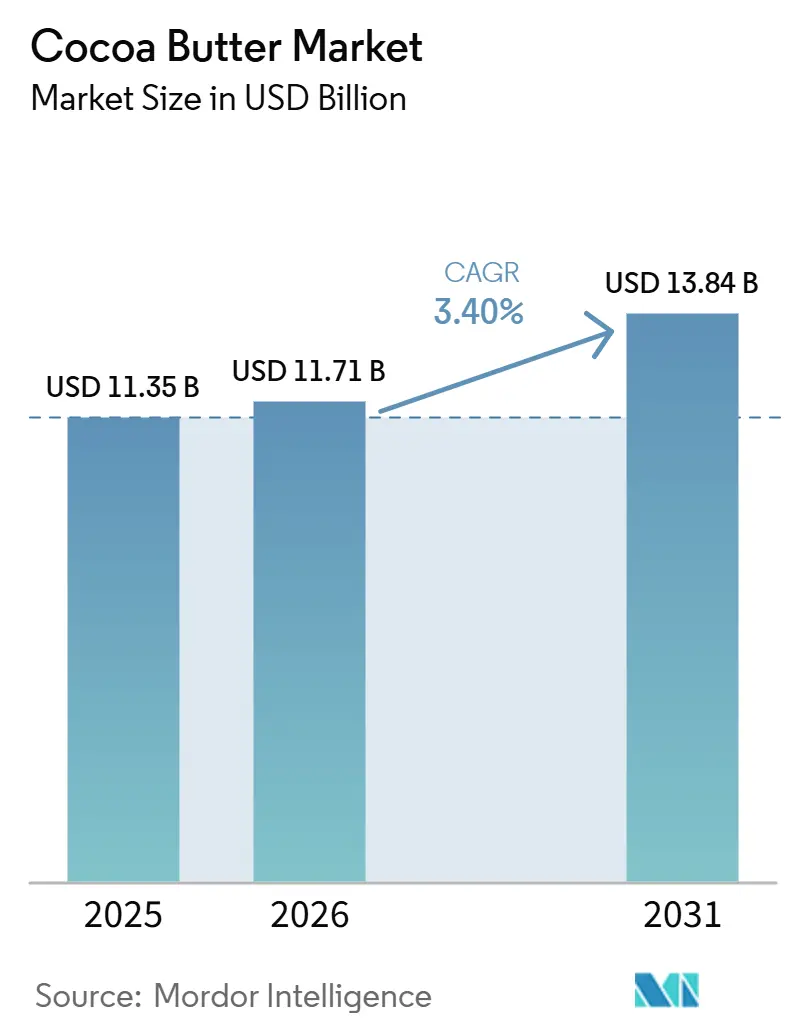
The cocoa butter market size is expected to grow from USD 11.35 billion in 2025 to USD 11.71 billion in 2026 and is forecast to reach USD 13.84 billion by 2031 at a 3.40% CAGR over 2026-2031. The cocoa butter market is experiencing steady growth, driven by its established role across food and beverage, cosmetics and personal care, and pharmaceutical applications. While chocolate and confectionery remain the primary end-use segments, cocoa butter is increasingly used in premium bakery products, dairy formulations, clean-label foods, skincare products, and pharmaceutical excipients due to its unique melting characteristics, texture, and emollient properties. Growing consumer preference for premium chocolate, natural ingredients, and sustainably sourced products continues to influence purchasing decisions, prompting manufacturers to invest in certified sourcing, product quality, and processing improvements. At the same time, evolving sustainability regulations, climate-related supply challenges in cocoa-producing regions, and ongoing investments in cocoa processing capacity are reshaping global supply chains and competitive dynamics.
Key Report Takeaways
- By product type, deodorized cocoa butter held 52.35% of the cocoa butter market share in 2025, while semi-deodorized cocoa butter is forecast to record a 4.65% CAGR from 2026 to 2031.
- By nature, conventional cocoa butter accounted for 86.43% of the cocoa butter market share in 2025, while organic cocoa butter is forecast to grow at a 5.03% CAGR from 2026 to 2031.
- By application, food and beverages represented 67.46% of demand in 2025, while cosmetics and personal care is forecast to expand at a 4.24% CAGR from 2026 to 2031.
- By geography, Europe held 38.75% of global revenue in 2025, while Asia-Pacific is forecast to advance at a 4.85% CAGR from 2026 to 2031.
Note: Market size and forecast figures in this report are generated using Mordor Intelligence’s proprietary estimation framework, updated with the latest available data and insights as of January 2026.
Market Trends and Insights
Drivers Impact Analysis of Cocoa Butter Market*
| Driver | (~) % Impact on CAGR Forecast | Geographic Relevance | Impact Timeline |
|---|---|---|---|
| Rising demand for premium and artisanal chocolate products | +0.9% | Global, led by Europe, North America, and Asia-Pacific urban centers | Medium term (2–4 years) |
| Growing preference for natural and plant-based ingredients | +0.7% | Global, with accelerated adoption in North America and Europe | Medium term (2–4 years) |
| Increasing innovation in premium chocolate and confectionery formulations | +0.5% | Europe, North America | Short term (≤ 2 years) |
| Technological advancements in cocoa processing | +0.3% | Global, particularly Asia-Pacific origin-processing hubs | Long term (≥ 4 years) |
| Expansion of sustainable and certified cocoa supply chains | +0.4% | Europe, North America; spill-over to West Africa | Medium term (2–4 years) |
| Expanding use in cosmetics and personal care formulations | +0.5% | Global; highest penetration in North America and Asia-Pacific | Medium term (2–4 years) |
| Source: Mordor Intelligence | |||
Rising demand for premium and artisanal chocolate products
Rising consumer demand for premium and artisanal chocolate products is driving the cocoa butter market, as these products rely on cocoa butter to deliver smooth texture, glossy appearance, clean snap, and desirable melting characteristics. Premium chocolate formulations typically contain higher cocoa content and are less likely to substitute cocoa butter with vegetable fat alternatives, supporting sustained demand. According to the National Confectioners Association (NCA), 99.8% of United States households purchased confectionery in 2025, reflecting the broad consumer base that underpins continued product innovation and premiumization in the chocolate industry[1]Source: National Confectioners Association, "NCA Sweet Insights STATE OF TREATING 2025", candyusa.com. As manufacturers expand their portfolios of premium, single-origin, and artisanal chocolate products to meet evolving consumer preferences, demand for high-quality cocoa butter continues to grow.
Growing preference for natural and plant-based ingredients
Growing consumer preference for natural and plant-based ingredients is driving demand for cocoa butter across food, cosmetics, and personal care applications. As a naturally derived vegetable fat, cocoa butter is widely used in clean-label chocolate formulations, plant-based confectionery, and personal care products due to its functional and sensory properties. Manufacturers are increasingly incorporating cocoa butter into formulations to meet consumer demand for recognizable, minimally processed ingredients while reducing reliance on synthetic alternatives. According to the 2025 International Food Information Council (IFIC) Food & Health Survey, 41% of United States consumers look for "natural" label claims when shopping for foods and beverages[2]Source: International Food Information Council, "2025 IFIC Food & Health Survey", ific.org. The survey also found that 30% of consumers actively look for "organic" labels and 30% seek out "non-GMO" claims, reflecting the growing preference for naturally positioned and minimally processed ingredients in food products[3]Source: International Food Information Council, "2025 IFIC Food & Health Survey", ific.org.
Increasing innovation in premium chocolate and confectionery formulations
Growing innovation in premium chocolate and confectionery formulations is driving demand for cocoa butter, as manufacturers focus on improving product quality, texture, flavor, and sensory appeal. Cocoa butter remains an essential ingredient in premium chocolate due to its unique crystallization behavior, smooth mouthfeel, glossy appearance, and clean snap, making it difficult to replace in high-quality formulations. Chocolate manufacturers are also introducing single-origin, high-cocoa-content, filled, and functional chocolate products that require consistent cocoa butter quality and specialized processing characteristics. Continued product innovation and premiumization across the confectionery market are encouraging manufacturers to invest in high-quality cocoa butter and differentiated ingredient solutions to meet evolving consumer preferences.
Technological advancements in cocoa processing
Technological advancements in cocoa processing are supporting the growth of the cocoa butter market by improving extraction efficiency, product consistency, and processing yields. Manufacturers are increasingly adopting advanced pressing, filtration, deodorization, and quality control technologies to produce cocoa butter with greater purity, stable functional properties, and consistent sensory characteristics for food, cosmetics, and pharmaceutical applications. Modern processing techniques also enable greater product customization, allowing manufacturers to offer cocoa butter with specific flavor profiles and performance attributes tailored to diverse end-use requirements. Continued investments in processing technology are helping producers improve operational efficiency, maximize raw material utilization, and meet the evolving quality and sustainability expectations of global customers.
Restraints Impact Analysis of Cocoa Butter Market*
| Restraint | (~) % Impact on CAGR Forecast | Geographic Relevance | Impact Timeline |
|---|---|---|---|
| Cocoa bean and cocoa butter price volatility | −0.6% | Global, most acute in import-dependent markets: India, Southeast Asia, Middle East | Short term (≤ 2 years) |
| Climate change, crop diseases, and aging cocoa trees affecting supply | −0.5% | West Africa (Côte d'Ivoire, Ghana); spill-over to global buyers | Long term (≥ 4 years) |
| Availability of cocoa butter equivalents (CBEs) and substitutes | −0.4% | Global; highest adoption in price-sensitive Asia-Pacific and Latin American markets | Medium term (2–4 years) |
| Limited geographic concentration of cocoa production | −0.3% | Global supply chain; most relevant for European processors | Long term (≥ 4 years) |
| Source: Mordor Intelligence | |||
Cocoa bean and cocoa butter price volatility
Volatility in cocoa bean and cocoa butter prices is a major restraint on the cocoa butter market, creating cost uncertainty for processors, chocolate manufacturers, and downstream industries. Fluctuating raw material prices make it difficult for manufacturers to forecast production costs, establish stable pricing strategies, and plan long-term investments. Sudden increases in cocoa prices can compress profit margins and prompt manufacturers to reformulate products, reduce package sizes, delay product launches, or optimize ingredient usage to manage production costs. Price instability also increases financial risk throughout the value chain, particularly for small and medium-sized manufacturers with limited purchasing power and hedging capabilities.
Climate change, crop diseases, and aging cocoa trees affecting supply
Climate change, crop diseases, and aging cocoa tree plantations continue to constrain the cocoa butter market by reducing the long-term productivity and resilience of global cocoa cultivation. Cocoa production is highly dependent on suitable growing conditions, making it vulnerable to rising temperatures, shifting rainfall patterns, prolonged droughts, and other extreme weather events. Diseases, pests, and aging plantations can lower yields and reduce bean quality, while the slow replacement of older trees limits production recovery. These structural challenges reduce long-term cocoa productivity and the availability of high-quality cocoa beans, limiting the industry's ability to meet growing demand for cocoa butter.
*Our forecasts treat driver/restraint impacts as directional, not additive. The impact forecasts reflect baseline growth, mix effects, and variable interactions.
Cocoa Butter Market Segment Analysis
By Product Type:
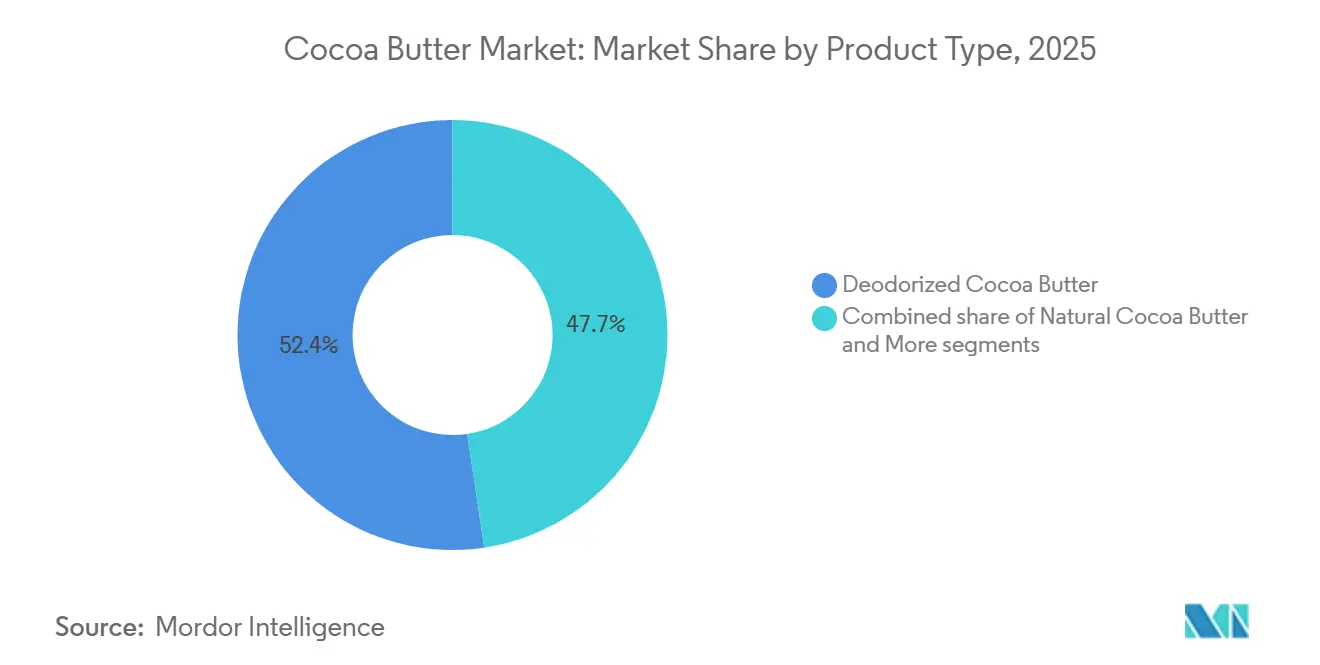
Semi-Deodorized Gains Ground as Deodorized Narrows Processing PreferencesDeodorized cocoa butter accounted for 52.35% of the global cocoa butter market in 2025, making it the largest product type. Its dominance is driven by widespread use in food and beverage applications, particularly chocolate, confectionery, bakery products, and dairy formulations. Its neutral flavor and aroma enable manufacturers to achieve consistent taste profiles while maintaining the desirable melting characteristics and texture of cocoa butter. The product is also preferred in large-scale industrial food processing, where formulation consistency and versatility are essential.
Semi-deodorized cocoa butter is projected to register the fastest growth, expanding at a CAGR of 4.65% during the forecast period. Growth is supported by increasing demand for premium chocolate, artisanal confectionery, and high-quality personal care products. It provides a balance between retaining some of the natural cocoa aroma and offering greater formulation flexibility than natural cocoa butter. Rising consumer preference for premium, minimally processed ingredients and continued product innovation across food and cosmetics are expected to further drive demand for this product type.



By Nature:
Organic Outpaces ConventionalConventional cocoa butter accounted for 86.43% of the global cocoa butter market in 2025, making it the dominant segment by nature. This dominance is attributed to the widespread availability of conventionally cultivated cocoa beans, well-established global supply chains, and lower production costs compared to organic alternatives. Conventional cocoa butter remains the preferred choice across food and beverage, cosmetics, and pharmaceutical applications due to its consistent supply, broad availability, and cost competitiveness.
Organic cocoa butter is projected to register the fastest growth, expanding at a CAGR of 5.03% during the forecast period. This growth is driven by increasing consumer demand for organic, clean-label, and sustainably sourced products across the food, cosmetics, and personal care industries. Rising adoption of certified organic ingredients by manufacturers, coupled with growing investments in traceable and sustainable cocoa supply chains, is expected to further support demand for organic cocoa butter over the forecast period.
By Application:
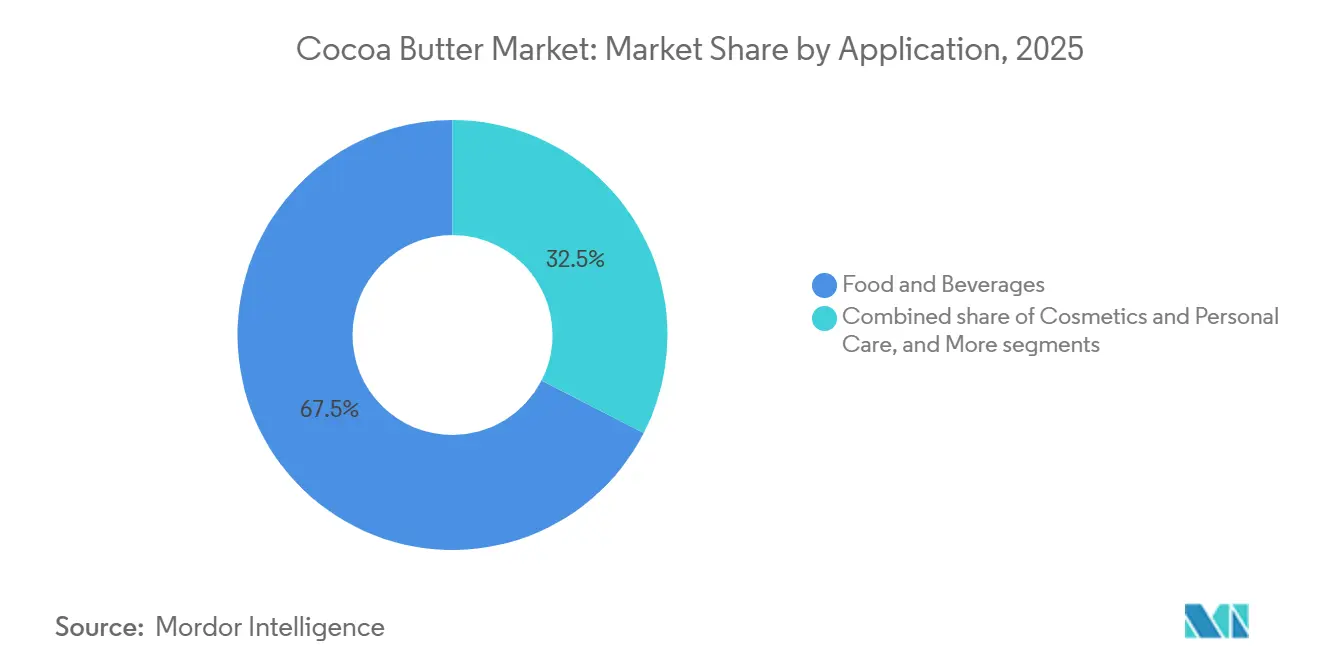
Cosmetics Outpaces Food as Cross-Sector Demand Broadens the Ingredient BaseFood and beverages accounted for 67.46% of the global cocoa butter market in 2025, making it the largest application segment, with confectionery as the dominant sub-segment. Cocoa butter is an essential ingredient in chocolate and confectionery products due to its unique melting profile, smooth texture, glossy appearance, and clean snap. It is also widely used in bakery products, dairy and frozen desserts, and functional foods and beverages, where it enhances product quality, stability, and sensory characteristics. Growing consumption of premium chocolate and clean-label food products continues to support demand across this segment.
Cosmetics and personal care is projected to register the fastest growth, at a CAGR of 4.24% during the forecast period. Cocoa butter is increasingly incorporated into skincare, lip care, and body care products due to its natural emollient properties, moisturizing benefits, and compatibility with clean-label and plant-based formulations. Rising consumer preference for naturally derived ingredients, along with continued innovation in premium personal care products, is expected to drive cocoa butter adoption across the cosmetics industry.
Geography Analysis
Europe Cocoa Butter Market
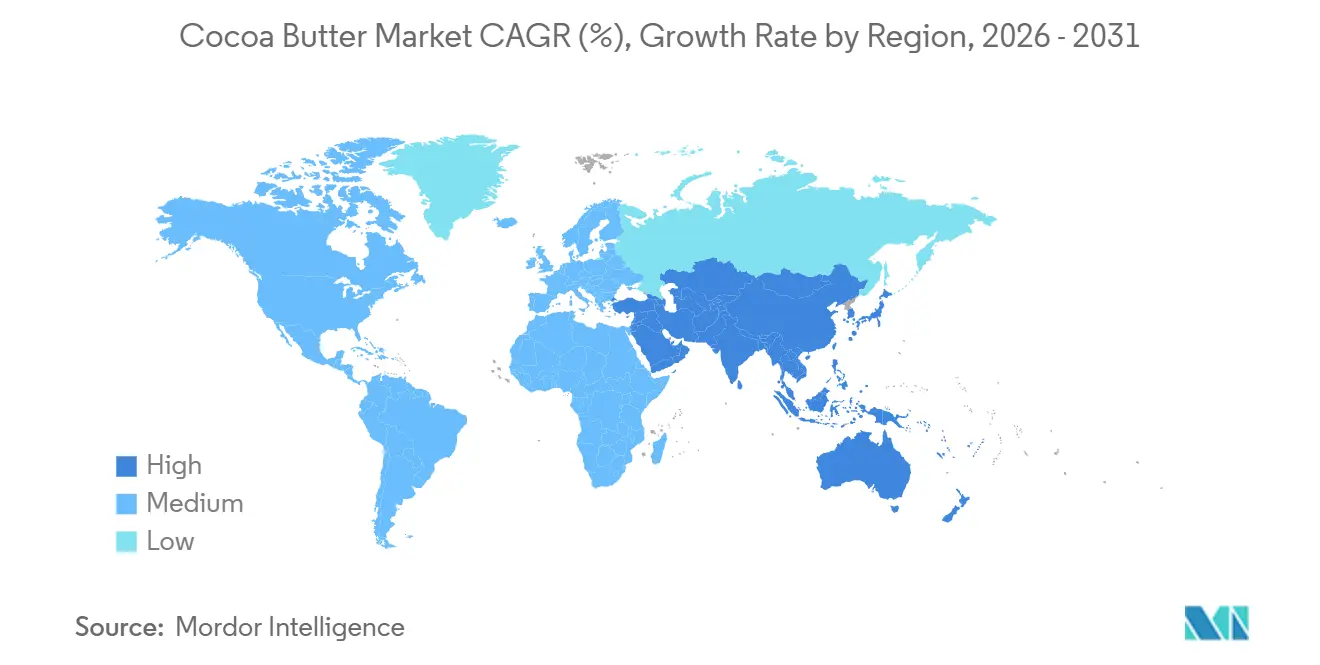
Europe accounted for 38.75% of the global cocoa butter market in 2025, making it the largest regional market. The region's position is supported by its well-established cocoa processing industry, a strong presence of major chocolate and confectionery manufacturers, and high consumer demand for premium chocolate products. Europe also has a mature cosmetics and personal care sector, where cocoa butter is widely used in skincare and beauty formulations. Growing emphasis on sustainably sourced and certified cocoa ingredients continues to influence procurement strategies and product development across the region.
APAC Cocoa Butter Market
Asia-Pacific is projected to register the fastest growth, expanding at a CAGR of 4.85% during the forecast period. Rising disposable incomes, increasing consumption of premium chocolate and confectionery products, and the rapid expansion of the food processing industry are driving market growth across the region. Demand is also supported by the growing cosmetics and personal care industry, where manufacturers are increasingly incorporating natural and plant-based ingredients into product formulations. Continued investments in cocoa processing capacity and expanding retail availability of premium chocolate products are expected to further accelerate regional growth.
South America and MEA Cocoa Butter Market
South America and the Middle East and Africa are emerging as important regions in the global cocoa butter market, driven by their strategic role in cocoa production and processing. Countries across these regions are strengthening domestic cocoa processing capabilities to increase value addition and reduce reliance on raw bean exports, while growing food manufacturing and personal care industries are supporting local demand. Rising investments in sustainable cocoa production, certified sourcing, and processing infrastructure are expected to enhance the regions' position in the global cocoa butter supply chain over the coming years.

Competitive Landscape
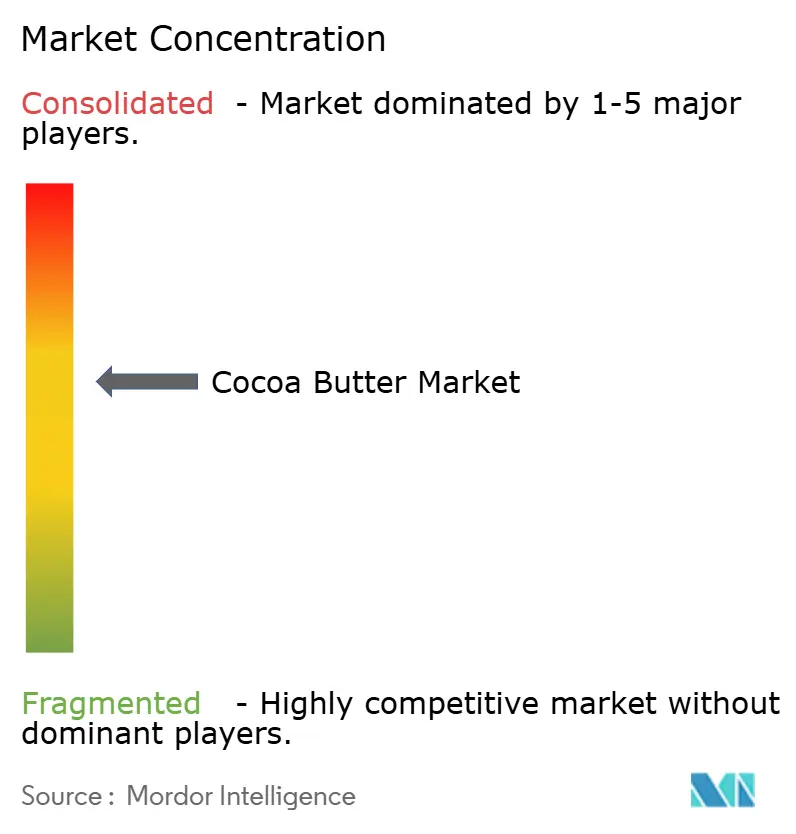
The cocoa butter market is moderately consolidated, with a handful of multinational cocoa processors accounting for a significant share of global production, while numerous regional processors and specialty manufacturers serve niche application requirements. Competition is primarily based on processing capacity, product quality, sourcing capabilities, sustainability certifications, and long-term supply relationships with food, cosmetics, and pharmaceutical manufacturers. The market is also characterized by strong vertical integration, with leading companies managing operations across cocoa sourcing, processing, and value-added ingredient production.
Major players, including Barry Callebaut AG, Cargill, Incorporated, Olam Group Limited (through ofi), ECOM Agroindustrial Corp. Limited, and Guan Chong Berhad, continue to strengthen their market positions through investments in processing capacity, sustainable sourcing initiatives, and product portfolio expansion. Companies are increasingly focusing on improving operational efficiency, enhancing traceability across cocoa supply chains, and expanding their portfolios of certified and specialty cocoa ingredients to address evolving customer requirements. Strategic investments in processing technologies and origin-based sourcing networks are also helping manufacturers improve supply reliability and product differentiation.
Regional cocoa processors and specialty manufacturers are expanding their presence by focusing on certified, organic, and application-specific cocoa butter products for premium food, cosmetics, and pharmaceutical applications. Growing investments in cocoa processing facilities within producing countries are increasing local value addition and strengthening supply chain resilience. As sustainability standards, traceability requirements, and demand for premium cocoa ingredients continue to evolve, manufacturers with strong sourcing networks, quality assurance capabilities, and specialized processing expertise are expected to gain a competitive advantage in the global cocoa butter market.
Cocoa Butter Industry Leaders
-
Barry Callebaut AG
-
Cargill, Incorporated
-
Olam Group Limited
-
ECOM Agroindustrial Corp. Limited
-
Guan Chong Berhad
- *Disclaimer: Major Players sorted in no particular order
Cocoa Butter Market Companies Covered in this Report
- Barry Callebaut AG
- Cargill, Incorporated
- Olam Group Limited
- ECOM Agroindustrial Corp. Limited
- Fuji Oil Holdings Inc.
- Guan Chong Berhad
- JB Foods Limited
- Blommer Chocolate Company
- Puratos Group
- Natra S.A.
- Nederland S.A.
- Touton
- Cocoa Processing Company PLC
- Indcre S.A.
- Moner Cocoa SA
- ALTINMARKA
- United Cocoa Processor, Inc.
- PRONATEC AG
- Plot Ghana
- Kocoatrait

Recent Industry Developments in Cocoa Butter Market
- February 2026: Barry Callebaut inaugurated its Global Innovation Center in Singapore, bringing together advanced research, pilot-scale production, and application development capabilities to accelerate innovation in cocoa and chocolate ingredients for food manufacturers.
- February 2025: Through its subsidiary GCB Cocoa Singapore Pte Ltd, Guan Chong Berhad acquired a 25% stake in Transcao Côte d'Ivoire, a cocoa processing company, to strengthen its cocoa processing capabilities in West Africa. The investment supports the company's strategy to expand cocoa ingredient production, including cocoa butter, while supporting Côte d'Ivoire's efforts to increase domestic cocoa processing capacity.
- February 2025: Johnvents secured USD 40.5 million in funding from British International Investment (BII) to expand its cocoa processing facility in Ondo State, Nigeria. The investment will increase the plant's processing capacity to 30,000 metric tons per year, boosting production of cocoa butter and cocoa powder while supporting greater adoption of Rainforest Alliance-certified cocoa.


Global Cocoa Butter Market Report Scope
The cocoa butter market comprises cocoa-derived fat extracted from cocoa beans. It is widely used across the food and beverage, cosmetics and personal care, and pharmaceutical industries due to its functional, sensory, and emollient properties. Market growth is supported by increasing demand for premium chocolate products, natural ingredients, and sustainably sourced cocoa derivatives. The market is segmented by product type into natural cocoa butter, deodorized cocoa butter, and semi-deodorized cocoa butter. Based on nature, the market is classified into conventional cocoa butter and organic cocoa butter. By application, the market is segmented into food and beverages, cosmetics and personal care, and pharmaceuticals and nutraceuticals. The report also analyzes the market across North America, Europe, Asia-Pacific, South America, and the Middle East and Africa.
| Natural Cocoa Butter |
| Deodorized Cocoa Butter |
| Semi-Deodorized Cocoa Butter |
| Conventional Cocoa Butter |
| Organic Cocoa Butter |
| Food and Beverages | Confectionery |
| Bakery Products | |
| Dairy and Frozen Desserts | |
| Functional Foods and Beverages | |
| Others | |
| Cosmetics and Personal Care | |
| Pharmaceuticals and Nutraceuticals |
| North America | United States |
| Canada | |
| Mexico | |
| Rest of North America | |
| Europe | Germany |
| United Kingdom | |
| Italy | |
| France | |
| Spain | |
| Netherlands | |
| Poland | |
| Belgium | |
| Sweden | |
| Rest of Europe | |
| Asia-Pacific | China |
| India | |
| Japan | |
| Australia | |
| Indonesia | |
| South Korea | |
| Thailand | |
| Singapore | |
| Rest of Asia-Pacific | |
| South America | Brazil |
| Argentina | |
| Colombia | |
| Chile | |
| Peru | |
| Rest of South America | |
| Middle East and Africa | South Africa |
| Saudi Arabia | |
| United Arab Emirates | |
| Nigeria | |
| Egypt | |
| Morocco | |
| Turkey | |
| Rest of Middle East and Africa |
| By Product Type | Natural Cocoa Butter | |
| Deodorized Cocoa Butter | ||
| Semi-Deodorized Cocoa Butter | ||
| By Nature | Conventional Cocoa Butter | |
| Organic Cocoa Butter | ||
| By Application | Food and Beverages | Confectionery |
| Bakery Products | ||
| Dairy and Frozen Desserts | ||
| Functional Foods and Beverages | ||
| Others | ||
| Cosmetics and Personal Care | ||
| Pharmaceuticals and Nutraceuticals | ||
| By Geography | North America | United States |
| Canada | ||
| Mexico | ||
| Rest of North America | ||
| Europe | Germany | |
| United Kingdom | ||
| Italy | ||
| France | ||
| Spain | ||
| Netherlands | ||
| Poland | ||
| Belgium | ||
| Sweden | ||
| Rest of Europe | ||
| Asia-Pacific | China | |
| India | ||
| Japan | ||
| Australia | ||
| Indonesia | ||
| South Korea | ||
| Thailand | ||
| Singapore | ||
| Rest of Asia-Pacific | ||
| South America | Brazil | |
| Argentina | ||
| Colombia | ||
| Chile | ||
| Peru | ||
| Rest of South America | ||
| Middle East and Africa | South Africa | |
| Saudi Arabia | ||
| United Arab Emirates | ||
| Nigeria | ||
| Egypt | ||
| Morocco | ||
| Turkey | ||
| Rest of Middle East and Africa | ||


Key Questions Answered in the Report
What is the projected value of the cocoa butter sector by 2031?
The Cocoa butter market is forecast to reach USD 13.84 billion by 2031, from USD 11.71 billion in 2026, at a 3.40% CAGR, as premium food, personal care, and specialty pharmaceutical applications support demand.
Which cocoa butter product type is growing the fastest?
The Cocoa butter market's semi-deodorized cocoa butter segment is forecast to grow at a 4.65% CAGR from 2026 to 2031, supported by premium chocolate and personal care applications.
Which application accounts for the greatest cocoa butter demand?
Food and beverages held 67.46% of demand in 2025, with confectionery remaining the dominant application.
Which region leads global cocoa butter demand?
Europe held 38.75% of revenue in 2025, supported by its cocoa-processing base and premium confectionery sector.
Page last updated on:





