
CO2 Capture Solvents and Solid Sorbents Market Size and Share
Market Overview
| Study Period | 2021 - 2031 |
|---|---|
| Market Size (2026) | USD 0.71 Billion |
| Market Size (2031) | USD 1.25 Billion |
| Growth Rate (2026 - 2031) | 11.91 % |
| Fastest Growing Market | Asia-Pacific |
| Largest Market | North America |
| Market Concentration | Medium |
Major Players *Disclaimer: Major Players sorted in no particular order Image © Mordor Intelligence. Reuse requires attribution under CC BY 4.0. | |
CO2 Capture Solvents and Solid Sorbents Market Analysis by Mordor Intelligence
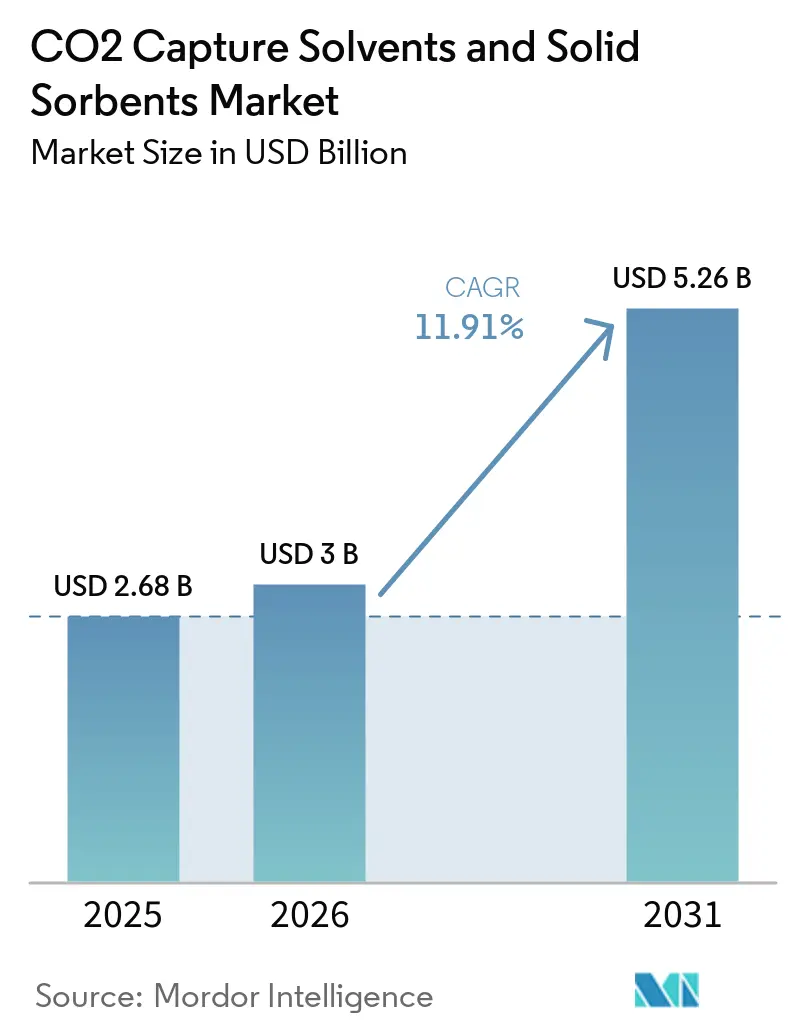
The CO2 Capture Solvents And Solid Sorbents Market size was valued at USD 0.64 billion in 2025 and is estimated to grow from USD 0.71 billion in 2026 to reach USD 1.25 billion by 2031, at a CAGR of 11.91% during the forecast period (2026-2031). Carbon prices, tax incentives, and emissions requirements are making capture projects more viable at power, cement, hydrogen, and ammonia facilities. The CO₂ capture solvents and solid sorbents market is also benefiting from projects that pair capture equipment with transport and storage capacity rather than treating capture as an isolated investment. Demand is expanding for proven liquid amine systems, while solid sorbents are moving into commercial applications where lower regeneration energy or modular equipment can improve site economics. Blue hydrogen and low-carbon ammonia projects are creating long-duration demand for capture materials because their reforming processes generate concentrated CO₂ streams. However, project schedules remain dependent on injection permits, pipeline access, storage capacity, and long-term liability rules.
Key Report Takeaways
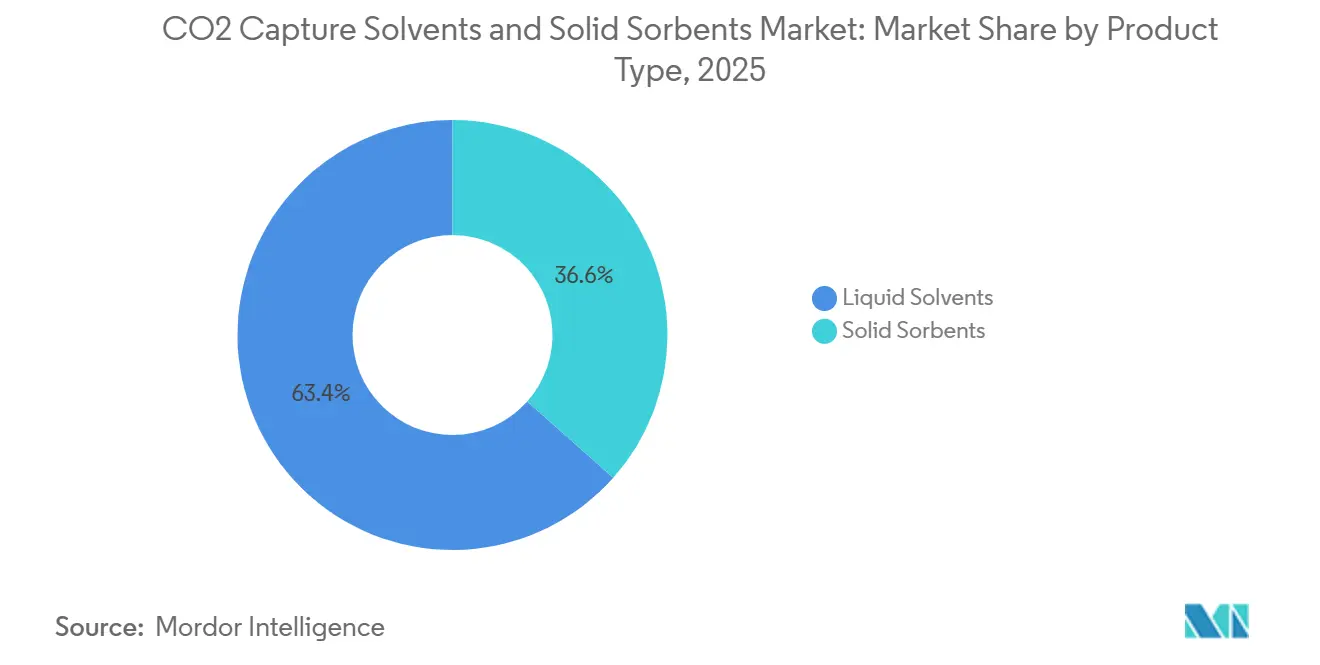
- By product type, liquid solvents held 63.44% of the CO₂ capture solvents and solid sorbents market share in 2025, while solid sorbents are projected to grow at a 13.42% CAGR through 2031.
- By capture route, post-combustion capture accounted for 57.82% of the CO₂ capture solvents and solid sorbents market share in 2025, while direct air capture is forecast to expand at a 12.05% CAGR through 2031.
- By process, absorption held 61.37% of the CO₂ capture solvents and solid sorbents market share in 2025, while adsorption is forecast to grow at a 12.51% CAGR through 2031.
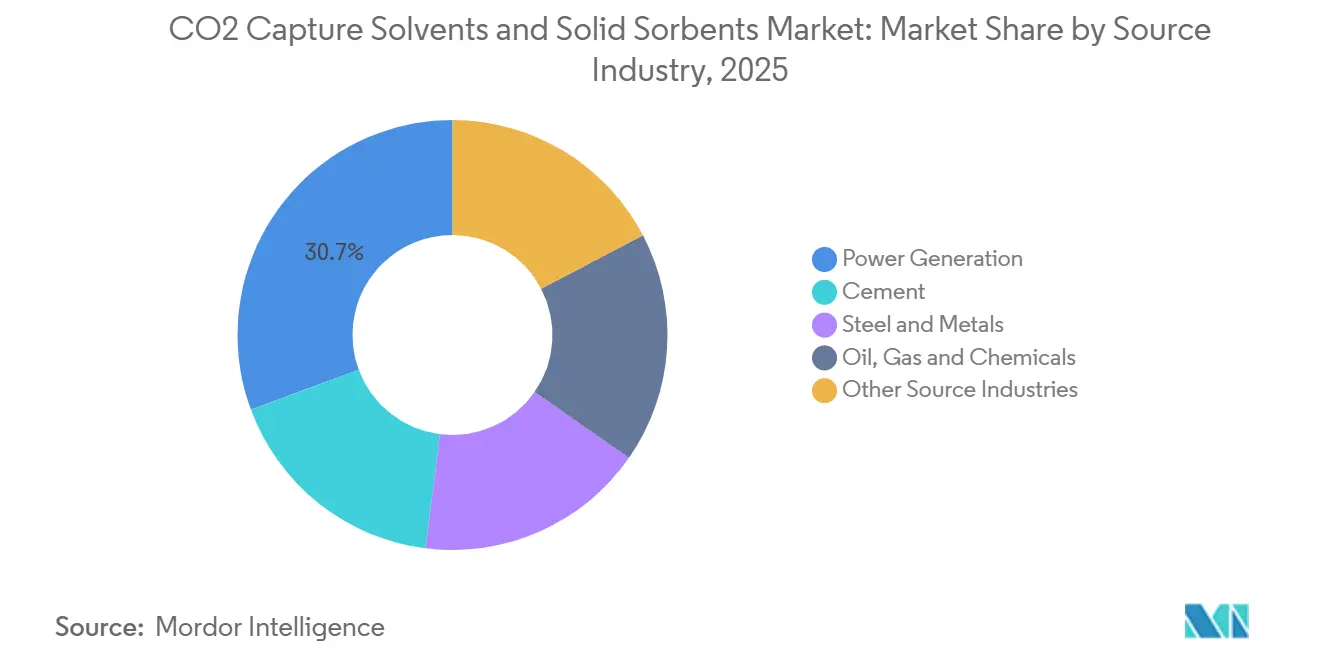
- By source industry, power generation held 30.65% of the CO₂ capture solvents and solid sorbents market share in 2025, while cement is forecast to grow at a 13.27% CAGR through 2031.
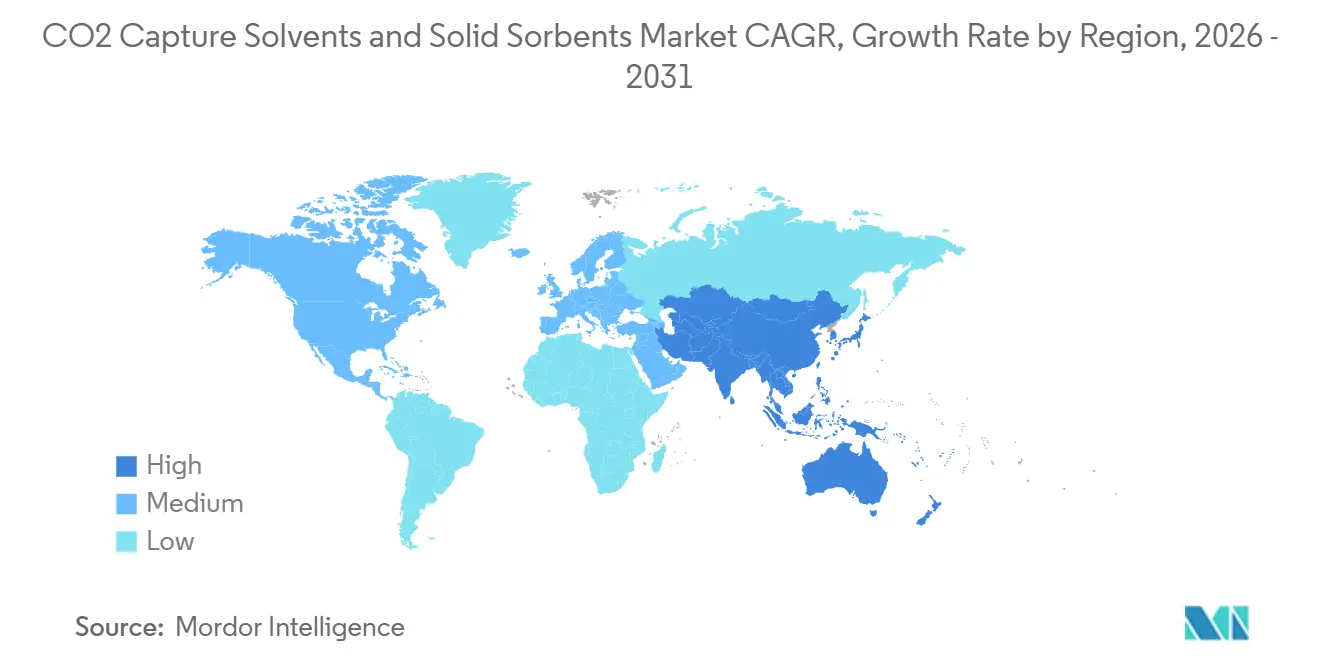
- By geography, North America held 36.21% of the CO₂ capture solvents and solid sorbents market share in 2025, while Asia-Pacific is forecast to grow at a 13.16% CAGR through 2031.
Note: Market size and forecast figures in this report are generated using Mordor Intelligence’s proprietary estimation framework, updated with the latest available data and insights as of January 2026.
Market Trends and Insights
Drivers Impact Analysis of CO2 Capture Solvents and Solid Sorbents Market*
| Driver | (~) % Impact on CAGR Forecast | Geographic Relevance | Impact Timeline |
|---|---|---|---|
| Carbon-Price and Tax-Credit Support for Capture Economics | +2.5% | North America, Europe (Global spillover) | Short-term (≤ 2 years) |
| Industrial Net-Zero Commitments and Emissions-Reduction Mandates | +2.8% | Global | Medium-term (2–4 years) |
| Blue Hydrogen and Low-Carbon Ammonia Project Buildout | +1.8% | North America, Asia-Pacific, Australia | Medium-term (2–4 years) |
| Retrofit Demand From Hard-to-Abate Industrial Assets | +1.5% | Europe, North America, Asia-Pacific | Short-term (≤ 2 years) |
| Carbon Capture Contracts Moving From Pilot to Infrastructure-Backed Procurement | +1.2% | North America, Europe | Medium-term (2–4 years) |
| Modular and Lower-Energy Capture Materials Reaching Commercial Deployment | +1.6% | Global | Medium-term (2–4 years) |
| Source: Mordor Intelligence | |||
Carbon-Price and Tax-Credit Support for Capture Economics
The CO₂ capture solvents and solid sorbents market is receiving a clearer commercial signal from tax credits and carbon-pricing systems. The Internal Revenue Service confirmed a 1.4639 inflation adjustment factor for the Section 45Q credit in May 2026. The resulting 2026 credit for secure geological storage was USD 29.28 per metric ton of CO₂. Direct air capture facilities qualify for a USD 36 per metric ton base credit under the One Big Beautiful Bill Act. These incentives improve the expected return on capture equipment and bring solvent and sorbent selection forward during front-end engineering work. EU Emissions Trading System (ETS) compliance conditions also require eligible installations to maintain energy audits and carbon-neutrality plans, which reduce the scope for delayed action.
Industrial Net-Zero Commitments and Emissions-Reduction Mandates
Corporate emissions targets are increasingly tied to loan conditions, investor expectations, and offtake agreements. The CO₂ capture solvents and solid sorbents market, therefore, serves projects that need verifiable emissions reductions instead of voluntary statements. EU Phase 4 rules link free allocation to carbon-neutrality plans for installations that do not meet performance requirements. The LeadIT tracker identified more than 175 CCUS projects in the cement sector as of 2025. ISO 14064 accounting practices and the Carbon Border Adjustment Mechanism add pressure for credible carbon-content data. This environment supports the CO₂ capture solvents and solid sorbents market at cement, steel, and refining facilities, where capture can document emissions reductions.
Blue Hydrogen and Low-Carbon Ammonia Project Buildout
Blue hydrogen and low-carbon ammonia plants are major procurement opportunities for the CO₂ capture solvents and solid sorbents market. CF Industries, JERA, and Mitsui announced the Blue Point Complex in Louisiana in April 2025. The USD 4 billion facility is designed to produce 1.4 million metric tons of low-carbon ammonia each year and capture 2.3 million metric tons of CO₂ annually. Samsung E&A broke ground on the Wabash Low-Carbon Ammonia Project in Indiana in January 2026. The USD 2.6 billion facility is designed to capture 1.67 million metric tons of CO₂ each year. Autothermal reforming streams typically have CO₂ concentrations above 15% by volume, which favors liquid amine capture and can support CO₂ capture solvents and solid sorbents market demand over the operating life of the plant.
Retrofit Demand from Hard-to-Abate Industrial Assets
Cement and steel retrofits are becoming more important to the CO₂ capture solvents and solid sorbents market. Heidelberg Materials’ Brevik plant in Norway captures 0.4 million metric tons of CO₂ annually as the first full-scale industrial cement CCS facility. Heidelberg’s Edmonton project is planned for commissioning in late 2026 and is designed to capture 1 million metric tons of CO₂ annually from 1.4 million metric tons of cement production. A January 2026 Department of Energy and CEMEX study developed Class 3 estimates for a commercial non-aqueous solvent system at a cement plant rated at 2.4 million metric tons of CO₂ annually[1]U.S. Department of Energy, “Carbon Capture Plant Front-End Engineering Design Study for Cement Manufacturing,” OSTI, osti.gov. Steel blast-furnace gases and refinery hydrogen purge streams also require technology choices that reflect their distinct impurity profiles and CO₂ concentrations.
Restraints Impact Analysis of CO2 Capture Solvents and Solid Sorbents Market*
| Restraint | (~) % Impact on CAGR Forecast | Geographic Relevance | Impact Timeline |
|---|---|---|---|
| Solvent Regeneration Energy Penalty | -2.3% | Global | Short-term (≤ 2 years) |
| Degradation, Corrosion, Emissions, and Waste-Handling Costs | -1.8% | Global | Medium-term (2–4 years) |
| CO₂ Transport, Storage Permitting, and Long-Term Liability Delays | -1.4% | North America, Europe | Short-term (≤ 2 years) |
| Site-Specific Flue-Gas Impurities and Retrofit Space Constraints | -1.0% | Asia-Pacific, Europe | Medium-term (2–4 years) |
| Source: Mordor Intelligence | |||
Solvent Regeneration Energy Penalty
Thermal regeneration remains a material operating constraint for the CO₂ capture solvents and solid sorbents market. Commercial amine systems typically require 3.0 to 3.5 GJ of reboiler duty per metric ton of captured CO₂. Blended solvents, including including 2-amino-2-methyl-1-propanol (AMP) and piperazine CESAR1, have reduced reboiler duty by 20% to 25% against monoethanolamine in pilot work and validated modeling. Even optimized systems can reduce host-plant efficiency by 5% to 15%, depending on CO₂ concentration and heat integration. Facilities without low-cost waste heat or nearby renewable electricity face a more difficult investment case. This limitation increases interest in adsorption and other lower-energy regeneration approaches.
Degradation, Corrosion, Emissions, and Waste-Handling Costs
Amine degradation and corrosion add operating costs throughout the life of capture plants. A 2025 study found that dissolved metals in amine solvents can accelerate oxidative degradation. Heat-stable salt formation and corrosion can therefore reinforce each other as operating hours increase. Nitrosamines and nitramines formed through reactions between amines and NOₓ require additional management under EU emissions rules. Waste solvent may also require regulated handling when it contains metals such as chromium, arsenic, or selenium. These requirements improve the case for solid sorbents where temperature-swing adsorption is suitable and thermal energy is available.
*Our forecasts treat driver/restraint impacts as directional, not additive. The impact forecasts reflect baseline growth, mix effects, and variable interactions.
CO2 Capture Solvents and Solid Sorbents Market Segment Analysis
By Product Type:
Liquid Solvents Retain the Installed Base While Solid Sorbents AdvanceLiquid solvents held 63.44% of the CO₂ capture solvents and solid sorbents market revenue in 2025. Their position reflects long operating experience with absorber-stripper systems at power plants and industrial facilities. Monoethanolamine and blended amines remain the main solvents used in operating post-combustion plants. Physical solvents such as Selexol and Rectisol serve pre-combustion capture and natural-gas sweetening applications. Ionic liquids, water-lean solvents, and enzymatic systems remain at earlier commercial stages. Liquid systems are particularly relevant where high-volume, steady CO₂ streams support conventional equipment layouts. The product segment remains central to the CO₂ capture solvents and solid sorbents industry because many planned projects use established absorption configurations. Its continued role also reflects the availability of process licenses and engineering experience for large sites.
Solid sorbents are forecast to expand at a 13.42% CAGR from 2026 to 2031. Supported amines, zeolites, activated carbon, and metal-organic frameworks (MOF) offer different operating characteristics from liquid systems. Kobe Steel, Atomis, and Nagase completed Japan’s first industrial-scale MOF-based CO₂ capture demonstration at 30 kg per day in November 2025. The partners are examining metric-ton-scale testing during fiscal 2026. IDEX and Nuada announced an industrial-scale MOF vacuum-adsorption unit in France in July 2026 with the capacity to capture up to 10,000 metric tons of biogenic CO₂ each year. These projects show that solid materials are being tested in operating industrial settings rather than only in laboratory programs. Their opportunity is strongest in applications where a compact system or lower regeneration energy is important.


By Capture Route:
Post-Combustion Capture Leads While Direct Air Capture ExpandsPost-combustion capture accounted for 57.82% of the CO₂ capture solvents and solid sorbents market share in 2025. It is widely used for coal and gas power plants, cement kilns, and industrial boilers. Liquid amine systems are the usual choice for many new and retrofit applications in these settings. Pre-combustion capture remains important in hydrogen production and integrated gasification. Selexol and Rectisol benefit from high-pressure, high-concentration feed streams in those processes. The Catch4Climate oxy-fuel cement plant in Germany produced its first clinker in May 2026 and completed its first oxygen campaign in June 2026. The route mix allows the CO₂ capture solvents and solid sorbents market to address both established flue-gas treatment and newer industrial designs.
Direct air capture is projected to grow at a 12.05% CAGR from 2026 to 2031. 1PointFive’s STRATOS project in West Texas is designed to capture 500,000 metric tons of CO₂ per year using liquid solvent technology. The facility is progressing through start-up, with underground injection expected in 2026. Climeworks plans to begin construction on its Generation 3 solid-sorbent technology in Louisiana during 2026 as part of the Project Cypress Hub. Climeworks targets capture costs of USD 250 to USD 350 per metric ton and a 50% energy reduction per module relative to current systems. Direct air capture supports both solid sorbent and liquid solvent systems. It therefore broadens the CO₂ capture solvents and solid sorbents market demand across the two main product groups.
By Process:
Absorption Leads Current Revenue While Adsorption Gains GroundAbsorption held 61.37% of the CO₂ capture solvents and solid sorbents market revenue in 2025. The process is established in liquid amine columns used at point-source capture plants. It supports deployments at waste-to-energy plants, cement sites, power facilities, and hydrogen projects. The installed base has built a strong foundation for absorption equipment, solvent supply, and operating knowledge. Temperature-swing adsorption is particularly suited to direct air capture because atmospheric CO₂ concentrations are near 420 ppm. Climeworks uses structured sorbent materials in modular contactors that cycle through adsorption and desorption. Its regeneration temperature is 80 to 100 °C.
Adsorption is forecast to grow at a 12.51% CAGR from 2026 to 2031. Temperature-swing adsorption supports direct air capture, while vacuum-swing adsorption has a growing role in industrial retrofits. A 2026 study reported that a Zr-MOF pressure-swing system with selective purge recirculation achieved CO₂ and nitrogen selectivity of 89. The study also reported a working CO₂ capacity of 1.96 mmol/g at 0.15 bar and 298 K. These results support the technical case for adsorption materials at scale. Vacuum-swing and electrochemical systems are still early in commercialization. They are gaining interest in biogas upgrading and smaller industrial sites where a liquid solvent system is less suitable.
By Source Industry:
Power Generation Leads While Cement AcceleratesPower generation held 30.65% of the CO₂ capture solvents and solid sorbents market revenue in 2025. Large coal and gas plants have historically concentrated post-combustion capture investment. Their long operating lives can support capital-intensive retrofit decisions. Cement is projected to grow at a 13.27% CAGR from 2026 to 2031. Around 60% of cement CO₂ emissions come from limestone calcination rather than combustion. Capture is therefore a key option for the emissions that fuel switching cannot remove. The CO₂ capture solvents and solid sorbents market size for cement applications is supported by projects that move from design work toward construction and operation. This combination makes cement an important source of future material demand.
Heidelberg Materials’ Edmonton project is planned to capture 1 million metric tons of CO₂ annually from 1.4 million metric tons of cement production. The planned capture capacity is more than twice that of the Brevik facility. A Department of Energy and CEMEX study assessed a non-aqueous solvent capture system rated at 2.4 million metric tons of CO₂ annually at a commercial cement plant. Steel and metals are another growing field because blast-furnace off-gas contains 20% to 25% CO₂. Oil, gas, and chemicals continue to procure capture equipment for hydrogen purification and natural-gas sweetening. Hydrogen, ammonia, waste-to-energy, pulp and paper, and maritime activities are also entering the demand base. Policy requirements and offtake structures are extending capture procurement beyond the legacy industrial categories.

Geography Analysis
North America CO2 Capture Solvents and Solid Sorbents Market
North America held 36.21% of the CO₂ capture solvents and solid sorbents market revenue in 2025. The United States combines Section 45Q incentives with federal financing for projects in ammonia, hydrogen, power, and industry. The Department of Energy provided USD 1.5 billion in Energy Dominance Financing for the Wabash Low-Carbon Ammonia project. Canada is advancing carbon-pricing and large-emitter frameworks, while Heidelberg Materials is planning its Edmonton project for late 2026. Mexico remains a smaller contributor, with activity linked to natural-gas processing and refinery applications. North American opportunity also depends on storage infrastructure because capture projects need injection capacity to become financeable.
APAC CO2 Capture Solvents and Solid Sorbents Market
Asia-Pacific is forecast to grow at a 13.16% CAGR from 2026 to 2031. Japan is advancing domestic CCS demonstrations and international low-carbon ammonia supply chains. Mitsubishi Heavy Industries was awarded the basic design contract for Japan’s largest CO₂ capture plant at Hokkaido Electric Power’s Tomato-Atsuma Power Station in July 2025. South Korea’s Korea Carbon Capture, Utilization and Storage (K-CCUS) roadmap focuses on deployment at steel, power, and petrochemical facilities. China’s projects are concentrated at coal power and steel sites. Japan and South Korea are supporting the CO₂ capture solvents and solid sorbents market demand for amine systems used to retrofit aging heavy-industrial assets. The Kobe Steel, Atomis, and Nagase project also shows regional interest in localizing next-generation sorbent development.
EMEA and South America CO2 Capture Solvents and Solid Sorbents Market
In Europe, Norway’s Longship program reached operational milestones in June 2025, including the Brevik cement CCS plant and Twence’s waste-to-energy carbon-capture project using SLB technology. Holcim’s Carbon2Business project in Germany targets 1.2 million metric tons of CO₂ capture each year, while its GO4ZERO project in Belgium is designed for 1.1 million metric tons annually by 2029. Germany’s Kohlendioxid-Speicherungsgesetz (KSpTG) took effect in November 2025 and enables offshore CO₂ export. South America remains at an early stage, although Brazil’s pre-salt oil and gas operations provide a natural-gas sweetening base. The Middle-East and Africa are gaining relevance through blue ammonia export plans directed toward Asian energy markets.

Competitive Landscape
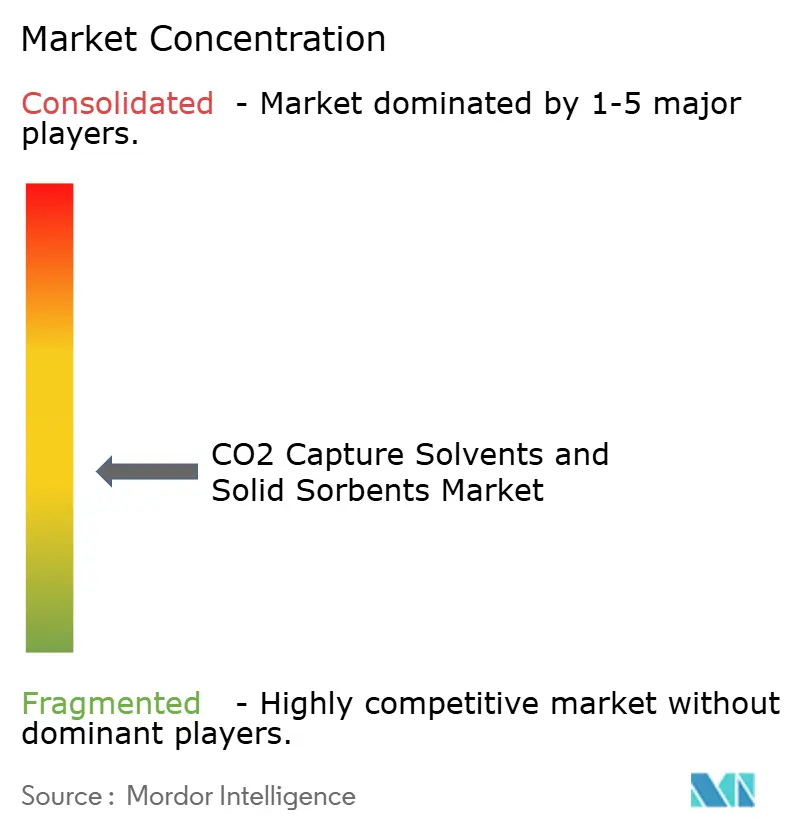
The CO₂ capture solvents and solid sorbents market is moderately concentrated, with the top five players including MITSUBISHI HEAVY INDUSTRIES, LTD., BASF, Shell plc, Fluor Corporation, and Honeywell International Inc. Incumbents defend their positions through solvent improvements and integration with engineering, procurement, and construction capabilities. Specialized solid-sorbent and modular-capture firms compete where operating cost, energy use, or retrofit complexity matters most. The market structure supports liquid amine systems at large facilities and creates room for alternatives at smaller or difficult sites. Supply risks for amine precursors, high-purity zeolites, and MOF synthesis routes can increase operating costs as procurement volume rises. These conditions favor suppliers that can demonstrate dependable materials, equipment performance, and site-specific operating support.
SLB combines Aker Carbon Capture process knowledge with SLB’s engineering capacity. It operates or delivers more than 30 projects worldwide. In July 2026, Uniper selected SLB as the preferred technology licensor for the proposed Connah’s Quay Low Carbon Power project in the United Kingdom[2]SLB, “Uniper Selects SLB Carbon Capture Technology for UK Power Project,” SLB Newsroom, slb.com. The project would use its amine-based Big Catch system in a proposed mega-scale gas-fired power deployment. Mitsubishi Heavy Industries has a significant presence in Asia and Europe through its Advanced KM CDR Process. It was selected with Worley in December 2025 to provide a full-scale capture facility at Heidelberg Materials’ Padeswood Cement Works in the United Kingdom. These awards show the value of established process technology in the CO₂ capture solvents and solid sorbents market projects.
Carbon Clean Solutions, Svante Technologies, and Climeworks are pursuing modular equipment, solid materials, and lower total ownership costs. Their opportunity is strongest for high-concentration streams, direct air capture, and sites below the efficient scale for conventional amine plants. Kobe Steel, Atomis, and Nagase validated MOF capture at 30 kg per day and are assessing larger testing in 2026. Patent activity in MOF synthesis, structured contactors, and electrochemical regeneration increased after the 2025 Nobel Prize in Chemistry recognized MOF science. Operators also evaluate partners on environmental management and permitting experience because emissions control and waste solvent handling affect project execution. The CO₂ capture solvents and solid sorbents market remains competitive between established licensors and specialized material developers. Technology providers that pair effective capture with practical operating requirements are better positioned for complex industrial projects.
CO2 Capture Solvents and Solid Sorbents Industry Leaders
MITSUBISHI HEAVY INDUSTRIES, LTD.
BASF
Shell plc
Fluor Corporation
Honeywell International Inc
- *Disclaimer: Major Players sorted in no particular order
CO2 Capture Solvents and Solid Sorbents Market Companies Covered in this Report
- Air Liquide
- Air Products and Chemicals, Inc.
- BASF
- Carbon Clean Solutions Limited
- Climeworks
- Fluor Corporation
- Honeywell International Inc
- JGC HOLDINGS CORPORATION
- KBR, Inc.
- Linde PLC
- MITSUBISHI HEAVY INDUSTRIES, LTD.
- Shell plc
- SLB
- Svante Technologies Inc.
- Technip Energies N.V.

Recent Industry Developments in CO2 Capture Solvents and Solid Sorbents Market
- July 2026: SLB was selected as the preferred carbon capture technology licensor for Uniper's proposed Connah's Quay Low Carbon Power project in Deeside, UK, using its amine-based Big Catch system. This would represent the company's first carbon capture deployment in large-scale gas-fired power generation, aiming to capture at least 95% of CO₂ emissions, with operations potentially starting by 2030.
- December 2025: MITSUBISHI HEAVY INDUSTRIES, LTD., Worley, and Heidelberg Materials were selected to deliver a full-scale carbon capture facility at Heidelberg Materials UK's Padeswood Cement Works. The project features MITSUBISHI HEAVY INDUSTRIES, LTD.'s capture technology, Worley and Heidelberg Materials's engineering, procurement, and construction management (EPCM) delivery, and targets an annual CO₂ reduction of 800,000 metric tons.


Global CO2 Capture Solvents and Solid Sorbents Market Report Scope
CO₂ capture solvents and solid sorbents are specialized materials used to separate and capture carbon dioxide from industrial emissions and atmospheric air. They play a critical role in carbon capture, utilization, and storage (CCUS) systems by improving CO₂ capture efficiency, reducing greenhouse gas emissions, and supporting industrial decarbonization.
The CO₂ Capture Solvents and Solid Sorbents Market is segmented by product type, capture route, process, source industry, and geography. By product type, the market is segmented into liquid solvents (amines, physical solvents, and others, including ionic liquids, water-lean and enzymatic solvents) and solid sorbents (supported amines, zeolites, activated carbon, and others, including metal-organic frameworks (MOFs), alkali sorbents, and metal-oxide sorbents). By capture route, the market is segmented into post-combustion capture, pre-combustion capture, direct air capture (DAC), and other capture routes (including BECCS and oxy-fuel capture). By process, the market is segmented into absorption, adsorption, temperature swing adsorption (TSA), vacuum swing adsorption (VSA), and other processes (including TVSA, moisture-swing, and electrochemical regeneration). By source industry, the market is segmented into power generation, cement, steel and metals, oil, gas and chemicals, and other source industries (including hydrogen and ammonia, waste-to-energy, pulp and paper, and maritime). The report also covers the market size and forecasts for CO₂ capture solvents and solid sorbents in 15 countries across major regions. For each segment, the market sizing and forecasts have been done on the basis of value (USD).
| Liquid Solvents | Amines |
| Physical Solvents | |
| Others (Ionic Liquids, Water-Lean and Enzymatic Solvents) | |
| Solid Sorbents | Supported Amines |
| Zeolites | |
| Activated Carbon | |
| Others (MOFs, Alkali and Metal-Oxide Sorbents) |
| Post-Combustion Capture |
| Pre-Combustion Capture |
| Direct Air Capture (DAC) |
| Other Capture Routes (BECCS, Oxy-Fuel Capture) |
| Absorption |
| Adsorption |
| Temperature Swing Adsorption (TSA) |
| Vacuum Swing Adsorption (VSA) |
| Other Processes (TVSA, Moisture-Swing, Electrochemical Regeneration) |
| Power Generation |
| Cement |
| Steel and Metals |
| Oil, Gas and Chemicals |
| Other Source Industries (Hydrogen and Ammonia, Waste-to-Energy, Pulp and Paper, Maritime) |
| Asia-Pacific | China |
| India | |
| Japan | |
| South Korea | |
| ASEAN Countries | |
| Rest of Asia-Pacific | |
| North America | United States |
| Canada | |
| Mexico | |
| Europe | Germany |
| United Kingdom | |
| France | |
| Italy | |
| NORDIC Countries | |
| Rest of Europe | |
| South America | Brazil |
| Argentina | |
| Rest of South America | |
| Middle-East and Africa | Saudi Arabia |
| South Africa | |
| Rest of Middle-East and Africa |
| By Product Type | Liquid Solvents | Amines |
| Physical Solvents | ||
| Others (Ionic Liquids, Water-Lean and Enzymatic Solvents) | ||
| Solid Sorbents | Supported Amines | |
| Zeolites | ||
| Activated Carbon | ||
| Others (MOFs, Alkali and Metal-Oxide Sorbents) | ||
| By Capture Route | Post-Combustion Capture | |
| Pre-Combustion Capture | ||
| Direct Air Capture (DAC) | ||
| Other Capture Routes (BECCS, Oxy-Fuel Capture) | ||
| By Process | Absorption | |
| Adsorption | ||
| Temperature Swing Adsorption (TSA) | ||
| Vacuum Swing Adsorption (VSA) | ||
| Other Processes (TVSA, Moisture-Swing, Electrochemical Regeneration) | ||
| By Source Industry | Power Generation | |
| Cement | ||
| Steel and Metals | ||
| Oil, Gas and Chemicals | ||
| Other Source Industries (Hydrogen and Ammonia, Waste-to-Energy, Pulp and Paper, Maritime) | ||
| By Geography | Asia-Pacific | China |
| India | ||
| Japan | ||
| South Korea | ||
| ASEAN Countries | ||
| Rest of Asia-Pacific | ||
| North America | United States | |
| Canada | ||
| Mexico | ||
| Europe | Germany | |
| United Kingdom | ||
| France | ||
| Italy | ||
| NORDIC Countries | ||
| Rest of Europe | ||
| South America | Brazil | |
| Argentina | ||
| Rest of South America | ||
| Middle-East and Africa | Saudi Arabia | |
| South Africa | ||
| Rest of Middle-East and Africa | ||


Key Questions Answered in the Report
What is the size of the CO₂ capture solvents and solid sorbents market?
The CO2 Capture Solvents And Solid Sorbents Market size was valued at USD 0.64 billion in 2025 and is estimated to grow from USD 0.71 billion in 2026 to reach USD 1.25 billion by 2031, at a CAGR of 11.91% during the forecast period (2026-2031).
Which product type led demand in 2025?
Liquid solvents led with 63.44% revenue share in 2025 because amine-based absorption systems have a substantial operating base.
Which capture route is expected to grow fastest through 2031?
Direct air capture is projected to grow at a 12.05% CAGR through 2031, supporting both solid sorbents and liquid-solvent systems.
Why is cement an important source industry for carbon capture deployment?
Cement is forecast to grow at a 13.27% CAGR through 2031, because around 60% of its CO₂ emissions arise from limestone calcination, which fuel switching cannot remove.
Page last updated on:


 Your data is secure and never sold or shared.


