
Closed-Loop Wallets Market Size and Share
Market Overview
| Study Period | 2020 - 2031 |
|---|---|
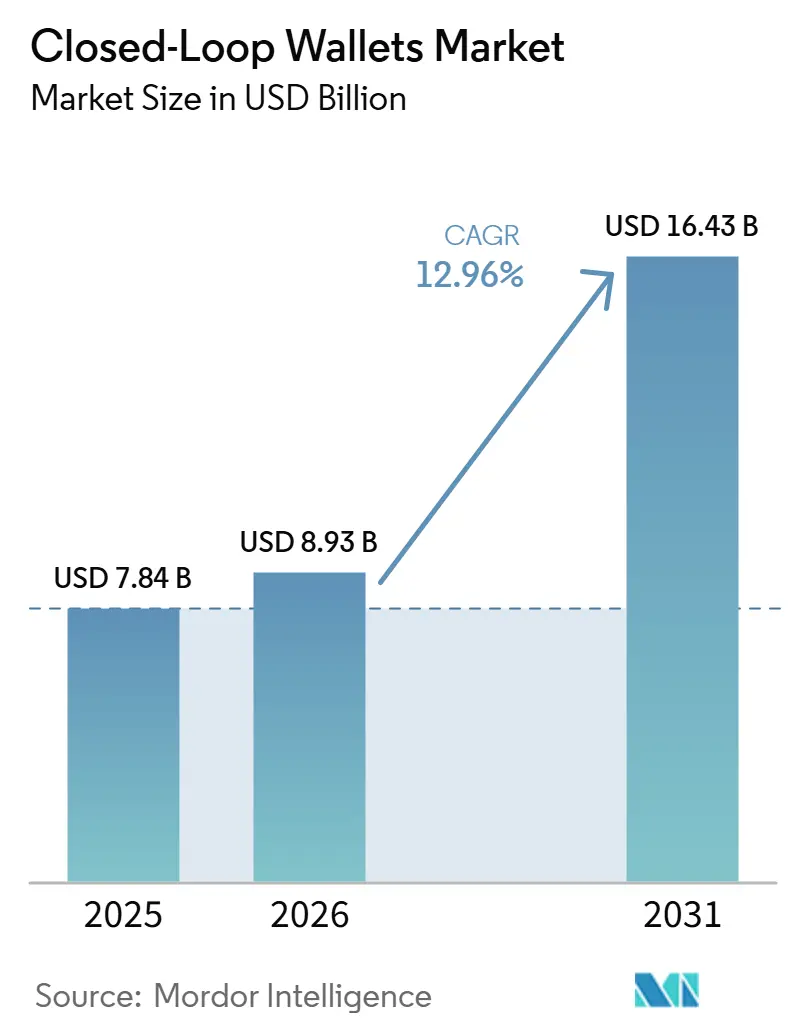
| Market Size (2026) | USD 8.93 Billion |
| Market Size (2031) | USD 16.43 Billion |
| Growth Rate (2026 - 2031) | 12.96 % |
| Fastest Growing Market | Asia-Pacific |
| Largest Market | North America |
| Market Concentration | Medium |
Major Players *Disclaimer: Major Players sorted in no particular order Image © Mordor Intelligence. Reuse requires attribution under CC BY 4.0. | |
Closed-Loop Wallets Market Analysis by Mordor Intelligence
The closed-loop wallet total value is projected to expand from USD 7.84 billion in 2025 and USD 8.93 billion in 2026 to USD 16.43 billion by 2031, registering a CAGR of 12.96% between 2026 to 2031. Digital gifting, loyalty programs, and merchant demand for controlled acceptance are widening the use of closed-loop balances beyond retail. Proprietary payment networks can retain customer spending within a defined ecosystem and give operators more direct visibility into transaction behavior. This is supporting adoption by transit agencies, healthcare benefit administrators, universities, and corporate reward programs. Providers are focusing on digital distribution, reload incentives, and program controls as branded balances become part of customer retention strategies. The closed-loop wallets market also faces pressure from fraud, fragmented acceptance, and lower breakage income as redemption becomes more effective.
Key Report Takeaways
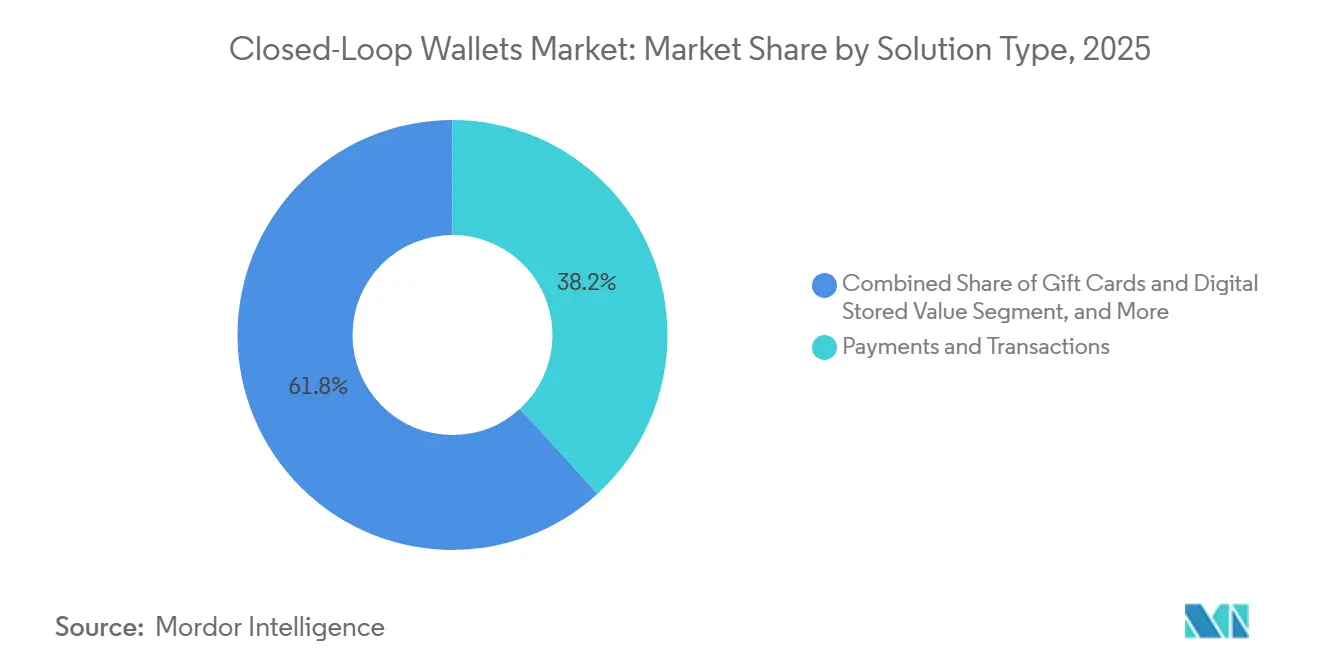
- By solution type, payments and transactions accounted for 38.21% of the closed-loop wallet market share in 2025, while membership and subscription management is projected to expand at a 13.18% CAGR through 2031.
- By funding model, prepaid wallets held 55.83% of the closed-loop wallet revenue share in 2025, while rewards-linked wallets are projected to expand at a 14.16% CAGR through 2031.
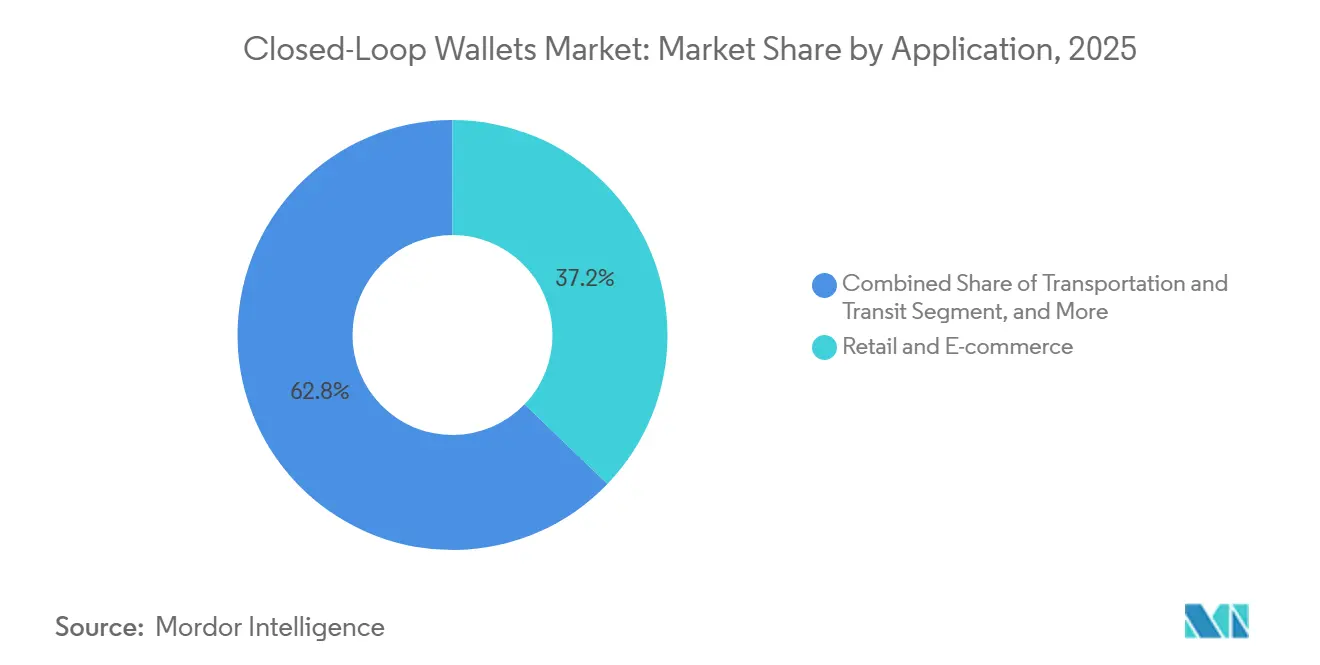
- By application, retail and e-commerce accounted for 37.19% of the closed-loop wallet total value in 2025, while healthcare is projected to expand at a 13.67% CAGR through 2031.
- By end-user, individual customers accounted for 64.28% of the closed-loop wallet total value in 2025, while businesses and enterprises are projected to expand at a 15.24% CAGR through 2031.
- By geography, North America held 36.51% of the closed-loop wallets market share in 2025, while Asia-Pacific is projected to expand at a 13.73% CAGR through 2031.
Note: Market size and forecast figures in this report are generated using Mordor Intelligence’s proprietary estimation framework, updated with the latest available data and insights as of January 2026.
Global Closed-Loop Wallets Market Trends and Insights
Drivers Impact Analysis*
| Driver | (~) % Impact on CAGR Forecast | Geographic Relevance | Impact Timeline |
|---|---|---|---|
| Expansion of Digital Gifting and Stored-Value Commerce | +3.2% | Global, strongest in North America and Asia-Pacific | Short term (≤ 2 years) |
| Growth of Branded Loyalty and Rewards Ecosystems | +2.8% | Global, North America and Western Europe lead | Medium term (2-4 years) |
| Demand for Controlled Payment Acceptance and Lower Intermediary Fees | +2.3% | North America and Europe, growing in Asia-Pacific | Medium term (2-4 years) |
| Growth of Digital and Mobile-First Prepaid Experiences | +1.9% | Asia-Pacific, with expansion into North America and Middle East and Africa | Short term (≤ 2 years) |
| Real-Time Program-Level Spending Intelligence | +1.5% | North America and Europe | Medium term (2-4 years) |
| Offline Authorization for Transit, Campus, Events, and Low-Connectivity Environments | +1.0% | Global, especially transit-intensive urban centers | Long term (≥ 4 years) |
| Source: Mordor Intelligence | |||
Expansion of Digital Gifting and Stored-Value Commerce
Digital gift cards are replacing some physical card purchases and are making stored-value products available through more customer touchpoints. InComm Payments reported that gift card recipients who went online when a card was unavailable in stores increased 20% year over year, while self-use digital purchases increased 7.5% year over year. This pattern shows that online demand is not limited to seasonal gifting. Blackhawk Network stated in April 2026 that brands using its unified balance model retained tens of millions of dollars that otherwise would have been paid as cash refunds.[1] The company also reported that 90% of funds loaded to the platform were spent within 30 days and 95% within 60 days. In the closed-loop wallets market, converting refunds into a merchant balance can reduce the friction between a refund event and a later purchase.
Growth of Branded Loyalty and Rewards Ecosystems
Branded loyalty programs use stored balances, member data, and reward incentives within the same customer relationship. Starbucks announced its redesigned Starbucks Rewards program in January 2026, with Green, Gold, and Reserve tiers for 35.5 million 90-day active members in the United States. The program includes accelerated Star earnings for digital Starbucks Card reloads. This design can encourage customers to maintain a prepaid balance rather than use a card network for each purchase. It can also give the operator a clearer record of repeat activity and reward use. The closed-loop wallets market benefits when loyalty systems support both routine customer engagement and prepaid payment behavior.
Demand for Controlled Payment Acceptance and Lower Intermediary Fees
Employers and fleet operators use closed-loop programs when a defined acceptance network can improve spending control. WEX launched a fleet card in January 2026 that combines fueling and public electric-vehicle charging in a single proprietary account. The card is accepted at more than 90% of US gas stations and 175,000 public charging ports. Such programs can consolidate invoices and make category-based purchase controls easier to apply. InComm Payments states that its HSA card can identify eligible expenses through merchant category code detection. The closed-loop wallets market is therefore supported by use cases where compliance, audit records, and controlled purchases matter alongside payment cost.
Growth of Digital and Mobile-First Prepaid Experiences
Mobile credentials are reducing the dependence on physical cards in campus and institutional payment programs. Georgia Tech completed its transition to a digital BuzzCard by June 2026, allowing students to use Apple Wallet, Google Wallet, or Samsung Wallet for dining, retail, printing, and access. The University of South Carolina launched Mobile CarolinaCard for the Fall 2026 semester. These conversions allow institutions to bring their enrolled populations onto a single credential system at the time of rollout. They also simplify access to closed-loop balances within the services that an institution already operates. The closed-loop wallets market can gain from this model because universities, employers, and transit organizations already manage identities at scale.
Restraints Impact Analysis*
| Restraint | (~) % Impact on CAGR Forecast | Geographic Relevance | Impact Timeline |
|---|---|---|---|
| Limited Acceptance and Customer Liquidity Constraints | -1.8% | Global, most acute in emerging markets | Medium term (2-4 years) |
| Fraud, Account Takeover, and Gift Card Scam Exposure | -1.5% | North America, Europe, and growing in Asia-Pacific | Short term (≤ 2 years) |
| Stored-Value Liability, Breakage Volatility, and Reconciliation Burden | -1.2% | North America and Europe | Long term (≥ 4 years) |
| Regulatory Perimeter Expansion as Networks Scale Beyond a Limited Use Case | -0.9% | Europe, North America, and Asia-Pacific | Long term (≥ 4 years) |
| Source: Mordor Intelligence | |||
Limited Acceptance and Customer Liquidity Constraints
Closed-loop balances are useful only within the merchant or program network that issued them. This creates a tradeoff between program-specific benefits and the broad spending choice available through open-loop payment methods. A recipient may hold a gift card for a retailer they rarely visit, which can lead to delayed redemption or an unused balance. Customers can also accumulate balances across separate brands that do not offer a common redemption route. Starbucks introduced connections with Delta SkyMiles and Marriott Bonvoy in its March 2026 Rewards redesign, giving some members a wider set of loyalty links. Most programs in the closed-loop wallets market lack this type of partner network, so limited acceptance remains a customer consideration.
Fraud, Account Takeover, and Gift Card Scam Exposure
Gift card programs can be exposed to fraud because many issuing flows require limited identity verification. The Michigan Attorney General charged 2 individuals in March 2025 in an alleged gift card scam involving Metro Detroit Meijer stores, and authorities seized more than 3,000 altered cards during a 2-day operation.[2] Palo Alto Networks Unit 42 documented the Jingle Thief campaign, in which phishing and smishing were used to compromise enterprise gift card issuance systems. Fraud can damage customer confidence and increase monitoring, replacement, and reconciliation costs for issuers. It can also make retailers more cautious about distributing high-value cards. These risks require the closed-loop wallets market to invest in activation controls, account security, and prompt detection of suspicious activity.
*Our forecasts treat driver/restraint impacts as directional, not additive. The impact forecasts reflect baseline growth, mix effects, and variable interactions.
Segment Analysis
By Solution Type: Payments Infrastructure Leads While Subscription Management Accelerates
Payments and Transactions held 38.21% of the closed-loop wallets market in 2025. The closed-loop wallets market segment provides the transaction layer used for loyalty redemption, gift card issuance, subscription billing, and employee benefit disbursement. Its position reflects the use of proprietary payment rails by major retail programs. Those systems can provide brands with direct records of wallet activity and reduce their dependence on bank card networks. Loyalty, Rewards, and Customer Engagement, Gift Cards, and Digital Stored Value form the next major solution groups. They are supported by seasonal gifting, enterprise rewards programs, and the shift toward digital eGift distribution, as reported by InComm Payments. Employee Benefits and Incentives support corporate demand as employers replace some check-based awards with programmatic prepaid delivery. Other Solutions include government disbursement and transit-specific balance products. These uses provide steady demand where defined spending rules are required.
Membership and Subscription Management is projected to expand at a 13.18% CAGR from 2026 to 2031. Reload incentives can shift a one-time recipient into a customer who maintains a recurring stored balance. Starbucks has linked faster Starbucks earnings to digital card reloads, creating an incentive at the point of adding funds. This can improve the value generated by each activated wallet without requiring equivalent acquisition spending. Operators can also use balance information to send a relevant reload prompt before a purchase is declined. That approach is more immediate than broad periodic notifications. The closed-loop wallets industry is using these functions to make stored value part of a continuing service relationship. The result is a closer link between membership activity, payment use, and reward delivery. Subscription-oriented tools also give operators a regular channel for service communication. They can coordinate balances, benefits, and renewal prompts within the same program.

By Funding Model: Prepaid Wallets Lead While Rewards-Linked Wallets Expand
Prepaid Wallets held 55.83% of the closed-loop wallets market in 2025. This closed-loop wallet market model is widely used because it does not require credit underwriting, and funds are available immediately after loading. It is also suited to transit wallets, campus meal plans, and corporate expense cards. In these settings, the operator can apply spending rules without the added complexity of credit-based reconciliation. The funding model gives issuers visibility into loaded balances and their use within the program network. Postpaid and Credit-Based Wallets represent a smaller share and are relevant to benefit programs where spending can be advanced against later enrollment credits. Other Funding Models include employer payroll-deduction wallets and government disbursement programs. These institutional programs can be driven more by operating requirements than by consumer price sensitivity.
Rewards-Linked Wallets are projected to expand at a 14.16% CAGR from 2026 to 2031. Merchant-funded rewards can increase program value without requiring an equivalent increase in operator-funded rewards. This approach allows partners to support redemption offers that guide customers to selected categories. Blackhawk Network expanded its relationship with Mastercard in January 2026 to introduce Drive and Grocery prepaid rewards cards. The cards focus on fuel, electric vehicle charging, and grocery purchases. Category-specific funding can direct rewards toward frequent purchases while involving merchants in the cost of redemption. This makes rewards-linked programs relevant to smaller operators that cannot independently fund large reward offers. The closed-loop wallets market can use this model to connect payment controls with partner-funded customer incentives. It can also make reward funding more flexible across merchant categories. Clear redemption rules remain important to maintain customer understanding.
By Application: Retail and E-Commerce Lead While Healthcare Expands
Retail and E-commerce held 37.19% of the closed-loop wallets market in 2025. Branded gift cards at mass merchandise, grocery, and specialty retailers continue to support this closed-loop wallets market application. The online availability of gift cards is expanding the routes through which customers can purchase and send stored value. Transportation and Transit, Consumer Goods and Electronics, and Banking and Financial Services also account for meaningful usage. Transit systems are adopting account-based ticketing that can record travel activity and support fare caps. Indianapolis Public Transportation Corporation launched MyKey+ in June 2026 through Masabi’s Justride platform. The deployment extended account-based fare collection across a 6-state EZFare regional network. These applications use closed-loop design to link a defined service network with a dedicated payment account.
Healthcare is projected to expand at a 13.67% CAGR through 2031. FSA and HSA accounts use merchant category code validation to limit spending to eligible merchants and expenses. The Internal Revenue Service set the 2026 FSA contribution limit at USD 3,400. This limit defines the annual amount that may be loaded to eligible healthcare wallet accounts. InComm Healthcare launched a digital wellness rewards delivery platform for Medicare Advantage and Medicaid health plan members in June 2026. Automated eligibility checks can reduce administrative work for employers and employees. The Centers for Medicare and Medicaid Services reported that US out-of-pocket healthcare spending increased 5.9% in 2024 to USD 556.6 billion. The application also includes Hospitality, Telecom, Automotive, and Entertainment and Leisure, where operators use a defined payment environment to support repeat engagement. Healthcare issuers can differentiate their programs through simple eligibility and reward delivery. The model is most useful where payment controls align with an existing benefit rule.
By End-User: Individual Customers Lead While Enterprise Demand Builds
Individual Customers accounted for 64.28% of the closed-loop wallets market in 2025. Consumer gifting, transit fares, campus dining accounts, and loyalty balances support the scale of this end-user group. These closed-loop wallet market programs have long been the core of branded stored-value use. Convenience, reward accumulation, and routine loading can encourage repeat use across familiar merchants. Institutional Users include transit authorities, healthcare systems, and educational institutions. They provide a stable base of demand because their programs often link payments with access, benefits, or service eligibility. Masabi’s deployment at IndyGo demonstrates how account-based fare systems can extend fare protections to both cash-paying customers and digital users. This can widen program use without making access dependent on a customer’s preferred payment method.
Businesses and Enterprises are projected to expand at a 15.24% CAGR from 2026 to 2031. Employers are converting incentive payments, employee recognition awards, sales rewards, clinical trial participant payments, and research compensation into digital prepaid delivery. Digital wallet delivery can be faster and can support clearer audit records than paper-based processes. InComm Payments and Zip US announced a partnership in May 2026 to integrate installment options into gift card purchases in the Zip app. The Federal Reserve reported that 15% of US consumers used buy now, pay later services in 2024, compared with 10% in 2021. For corporate program designers, installment options can increase the perceived value of a gift card without a matching increase in the stated award amount. The closed-loop wallets industry is responding to enterprise demand for payment delivery that combines speed, controls, and practical reporting. Enterprise users also value the ability to set program-specific spending limits. These needs favor providers with flexible administration tools.
Geography Analysis
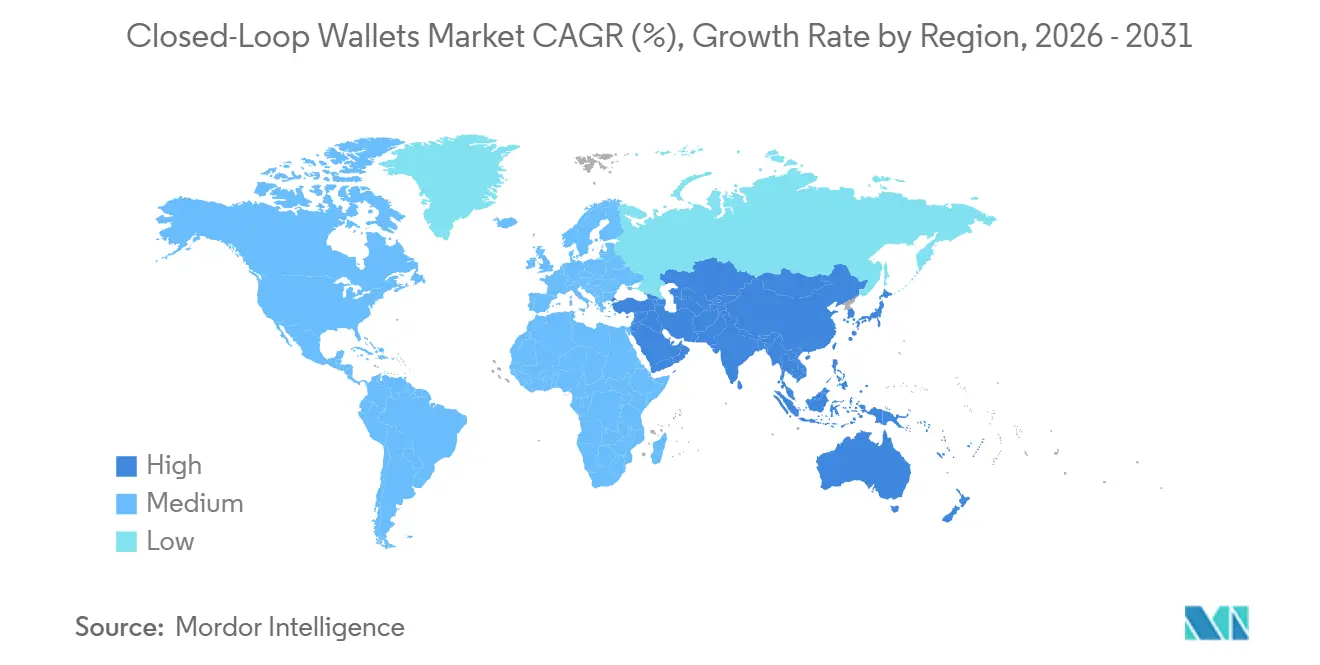
North America held 36.51% of regional revenue in 2025. The region has a mature branded loyalty and gift card environment, as well as extensive corporate prepaid infrastructure. Starbucks reported 35.5 million 90-day active US Rewards members in January 2026. Its card reload incentives show how large consumer programs link loyalty benefits to stored balances. Canada has established retail gift card and corporate incentive activities. Mexico is projected to expand at a 9.88% CAGR through 2031, supported by digital payment adoption and a young mobile-first population. South America is in an earlier stage of program deployment, with Brazil supported by fintech and QR-code payment infrastructure. Argentina and the rest of South America have less developed institutional wallet programs.
The closed-loop wallets market in Europe has a different mix of retail gift card, corporate incentive, and transit payment activity. The United Kingdom, Germany, and France support the region’s established retail and corporate wallet volumes. Spain and Italy are expanding contactless transit infrastructure that can support account-based fare products. HID Global and Sharry introduced digital wallet student IDs at H-FARM College in Italy in April 2026. HID Global reported that 70% of students activated their credentials within 3 minutes of receiving the notification. The Middle East and Africa are at an earlier stage of development. Saudi Arabia’s digital payment goals and the United Arab Emirates’ stored-value facility licensing framework provide an entry setting for international platforms. South Africa’s mobile money infrastructure can support employer benefits and retail prepaid programs.
Asia-Pacific is projected to expand at a 13.73% CAGR through 2031. Smartphone use, digital payment policies, and gifting habits are widening opportunities for brand-specific stored value. India is an important national market because the Reserve Bank of India’s December 2024 update allowed full-KYC prepaid payment instrument holders to link their wallets to third-party UPI applications.[3] This can extend wallet utility while retaining merchant-level controls. Japan’s Suica and PASMO systems show the role of transit cards across rail, bus, retail, and vending acceptance. China combines brand-specific stored balances with super-app environments. South Korea and Australia are seeing increased use of retail gift cards and campus wallets. The closed-loop wallet total value across the region is supported by digital access and broad acceptance of mobile credentials.
Competitive Landscape
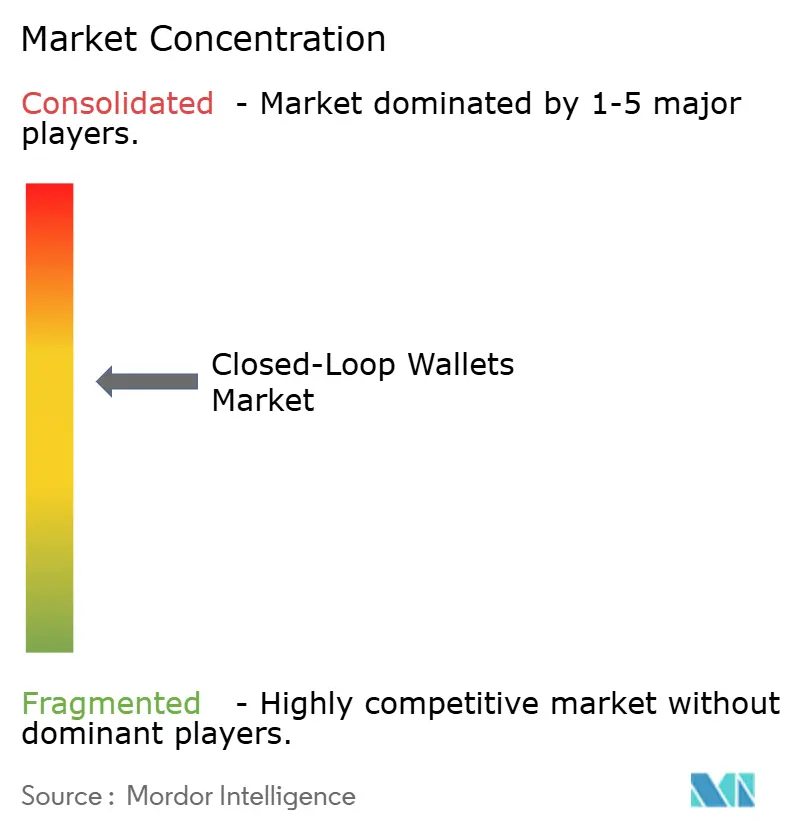
The closed-loop wallets market is moderately concentrated at the platform and infrastructure level. Blackhawk Network and InComm Payments have large distribution networks and long-standing relationships with brands and retailers. InComm Payments states that it loads more than USD 65 billion onto prepaid card products annually for private-label partners and connects to 525,000 in-store and online locations across more than 40 countries. This coverage can be difficult for new distribution platforms to replicate. At the brand program level, the field is more fragmented because many retailers, hospitality groups, and healthcare operators run separate wallet programs. Starbucks operates a large consumer loyalty wallet, while smaller operators may use white-label systems. The closed-loop wallets market, therefore, combines concentrated distribution infrastructure with many independent branded programs.
Blackhawk Network introduced its Stored Value Platform and Digital Wallet API in April 2026. The product is designed to consolidate gift cards, refunds, promotional credits, and loyalty rewards into a single balance. WEX expanded its fleet offering in January 2026 by combining fueling and public electric-vehicle charging into a single proprietary account.[4] InComm Payments and Zip US added installment payment options for gift card purchases in May 2026. These moves show that providers are competing by offering account aggregation, broader payment options, and flexible purchase methods. Providers also compete on program controls, access to distribution, and their ability to support digital issuance. Stronger personalization tools can help operators send a reload offer when a balance is near depletion.
Opportunities remain in cross-border corporate incentive programs, payroll-deduction wallets in emerging economies, and healthcare products that combine FSA, HSA, and over-the-counter benefit functions. Each opportunity requires clear treatment of program controls and regulatory obligations. The main providers are seeking to make stored value useful across more payment occasions without losing the defined acceptance benefits that distinguish a closed-loop account.
Closed-Loop Wallets Industry Leaders
-
Blackhawk Network Holdings, Inc.
-
InComm Payments, LLC
-
Fiserv, Inc.
-
Pine Labs Private Limited
-
Starbucks Corporation
- *Disclaimer: Major Players sorted in no particular order
Recent Industry Developments
- June 2026: nComm Healthcare unveiled a digital delivery platform for wellness rewards targeting Medicare Advantage and Medicaid health plan members, extending closed-loop payment controls into government-funded healthcare benefit administration and signaling growing public-sector demand for compliant prepaid wallet infrastructure at scale.
- June 2026: Indianapolis Public Transportation Corporation launched MyKey+, powered by Masabi's Justride platform, delivering account-based fare collection with automatic fare capping across a 6-state EZFare regional network spanning Indiana, Ohio, Kentucky, Michigan, West Virginia, and Pennsylvania, one of the most geographically expansive regional transit closed-loop deployments in the United States.
- May 2026: InComm Payments and Zip US announced a partnership to integrate buy-now-pay-later installment mechanics into the gift card purchase flow within the Zip app, addressing growing consumer demand for flexible payment options, with 15% of US consumers using BNPL in 2024, per Federal Reserve data.
- April 2026: Blackhawk Network launched a comprehensive Stored Value Platform and Digital Wallet API, enabling brands to aggregate gift cards, refunds, promotional credits, and loyalty rewards into a single consumer-facing balance, shifting stored value from a payment mechanism to a behavioral retention and incremental revenue platform.
Global Closed-Loop Wallets Market Report Scope
The Closed-Loop Wallets Market refers to the industry focused on digital payment wallets that can only be used within a specific merchant, brand, organization, or predefined network. Unlike open-loop wallets that support transactions across multiple merchants and payment networks, closed-loop wallets are designed to facilitate payments, store value, manage loyalty rewards, gift cards, memberships, subscriptions, and other customer engagement functions exclusively within the issuing entity's ecosystem. These wallets enable businesses to strengthen customer retention, enhance user experience, improve payment efficiency, and gain greater control over transaction data and customer relationships.
The Closed-Loop Wallets Market Report is Segmented by Solution Type (Payments and Transactions, Loyalty, Rewards, and Customer Engagement, Gift Cards and Digital Stored Value, Membership and Subscription Management, Employee Benefits and Incentives, and Other Solutions), Funding Model (Prepaid Wallets, Rewards-Linked Wallets, Postpaid/Credit-Based Wallets, and Other Funding Models), Application (Retail and E-commerce, Transportation and Transit, Consumer Goods and Electronics, Automotive, Entertainment and Leisure, Banking and Financial Services, Healthcare, Hospitality, Telecom, and Other Applications), End-User (Individual Customers, Businesses and Enterprises, and Institutional Users), and Geography (North America, South America, Europe, Asia-Pacific, and Middle East and Africa). The Market Forecasts are Provided in Terms of Value (USD).
| Payments and Transactions |
| Loyalty, Rewards, and Customer Engagement |
| Gift Cards and Digital Stored Value |
| Membership and Subscription Management |
| Employee Benefits and Incentives |
| Other Solutions |
| Prepaid Wallets |
| Rewards-Linked Wallets |
| Postpaid / Credit-Based Wallets |
| Other Funding Models |
| Retail and E-commerce |
| Transportation and Transit |
| Consumer Goods and Electronics |
| Automotive |
| Entertainment and Leisure |
| Banking and Financial Services |
| Healthcare |
| Hospitality |
| Telecom |
| Other Applications |
| Individual Customers |
| Businesses and Enterprises |
| Institutional Users |
| North America | United States |
| Canada | |
| Mexico | |
| South America | Brazil |
| Argentina | |
| Rest of South America | |
| Europe | United Kingdom |
| Germany | |
| France | |
| Italy | |
| Spain | |
| Rest of Europe | |
| Asia-Pacific | China |
| India | |
| Japan | |
| South Korea | |
| Australia | |
| Rest of Asia-Pacific | |
| Middle East and Africa | United Arab Emirates |
| Saudi Arabia | |
| South Africa | |
| Rest of Middle East and Africa |
| By Solution Type | Payments and Transactions | |
| Loyalty, Rewards, and Customer Engagement | ||
| Gift Cards and Digital Stored Value | ||
| Membership and Subscription Management | ||
| Employee Benefits and Incentives | ||
| Other Solutions | ||
| By Funding Model | Prepaid Wallets | |
| Rewards-Linked Wallets | ||
| Postpaid / Credit-Based Wallets | ||
| Other Funding Models | ||
| By Application | Retail and E-commerce | |
| Transportation and Transit | ||
| Consumer Goods and Electronics | ||
| Automotive | ||
| Entertainment and Leisure | ||
| Banking and Financial Services | ||
| Healthcare | ||
| Hospitality | ||
| Telecom | ||
| Other Applications | ||
| By End-User | Individual Customers | |
| Businesses and Enterprises | ||
| Institutional Users | ||
| By Geography | North America | United States |
| Canada | ||
| Mexico | ||
| South America | Brazil | |
| Argentina | ||
| Rest of South America | ||
| Europe | United Kingdom | |
| Germany | ||
| France | ||
| Italy | ||
| Spain | ||
| Rest of Europe | ||
| Asia-Pacific | China | |
| India | ||
| Japan | ||
| South Korea | ||
| Australia | ||
| Rest of Asia-Pacific | ||
| Middle East and Africa | United Arab Emirates | |
| Saudi Arabia | ||
| South Africa | ||
| Rest of Middle East and Africa | ||
Key Questions Answered in the Report
What is the closed-loop wallets market size?
The closed-loop wallets market size is projected to be USD 8.93 billion in 2026 and USD 16.43 billion by 2031, at a 12.96% CAGR. Digital gifting, loyalty programs, controlled merchant acceptance, and institutional wallet use support demand.
What is a closed-loop wallet?
It is a stored-value account used within a defined merchant, institution, or service network. It can link payments to loyalty rewards, access rights, or spending rules.
Which solution type leads closed-loop wallet use?
Payments and Transactions led with a 38.21% share in 2025. It supports gift cards, loyalty redemption, subscription billing, and benefit disbursement.
Which funding model has the largest share?
Prepaid Wallets held 55.83% of the total in 2025. They are widely used for transit, campus, corporate expense, and consumer stored-value programs.
Which application is projected to expand fastest?
Healthcare is projected to expand at a 13.67% CAGR through 2031. FSA and HSA programs support this use through eligibility rules and defined merchant acceptance.
Which region is expected to expand fastest?
Asia-Pacific is projected to expand at a 13.73% CAGR through 2031. Smartphone use, payment policy, and gifting practices support regional adoption.