
Clinical Rollators Market Size and Share
Market Overview
| Study Period | 2020 - 2031 |
|---|---|
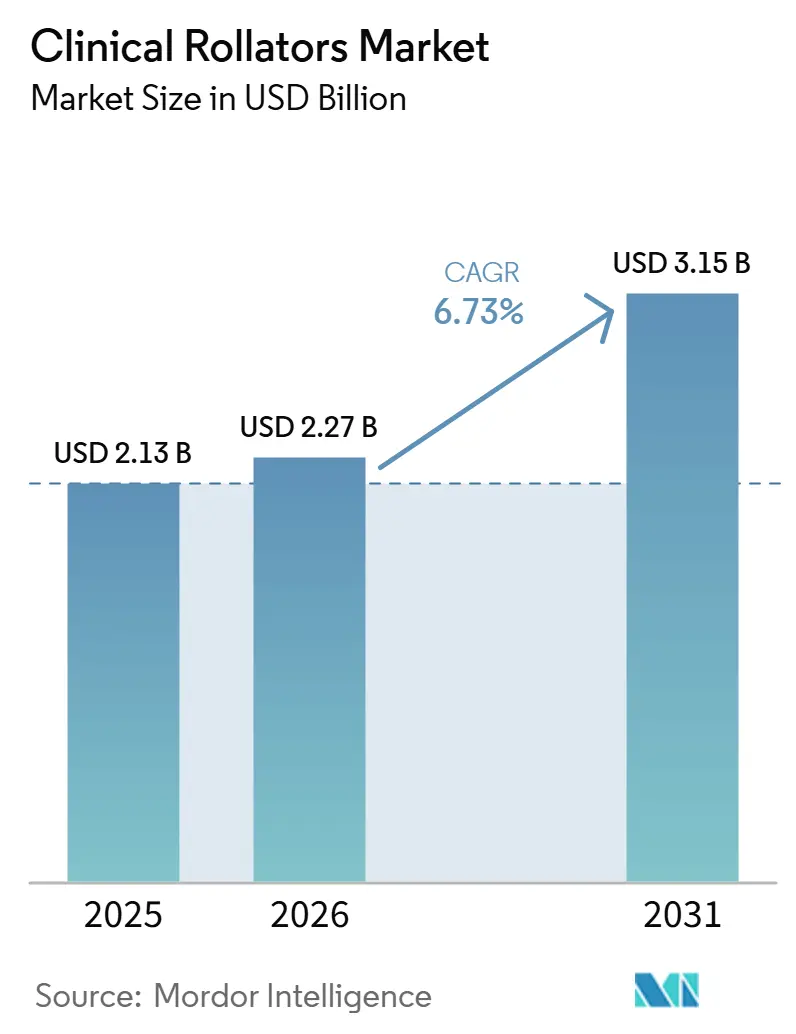
| Market Size (2026) | USD 2.27 Billion |
| Market Size (2031) | USD 3.15 Billion |
| Growth Rate (2026 - 2031) | 6.73 % |
| Fastest Growing Market | Asia-Pacific |
| Largest Market | North America |
| Market Concentration | Medium |
Major Players
*Disclaimer: Major Players sorted in no particular order Image © Mordor Intelligence. Reuse requires attribution under CC BY 4.0. |
|
Clinical Rollators Market Analysis by Mordor Intelligence
The Clinical Rollators Market size is projected to be USD 2.13 billion in 2025, USD 2.27 billion in 2026, and reach USD 3.15 billion by 2031, growing at a CAGR of 6.73% from 2026 to 2031.
Demand is linked to population aging in high-income economies, where rollator prescriptions respond to documented mobility limitations rather than discretionary spending. The United Nations Department of Economic and Social Affairs reported that people aged 65 years and above represented more than 10% of the global population in 2024, while Japan, Italy, and Germany each had shares above 28%[1]United Nations Department of Economic and Social Affairs. "World Population Prospects 2024." UN.org, 2024. https://population.un.org/wpp/. Community-based care policies are moving more rehabilitation activity into homes, which changes demand toward lighter and more maneuverable devices. Established suppliers are expanding distribution reach and rehabilitation portfolios, while smart and specialty products remain areas where clinical requirements and reimbursement pathways are still developing. The clinical rollators market also faces uneven reimbursement in emerging economies, where demographic need has not consistently translated into adoption.
Key Report Takeaways
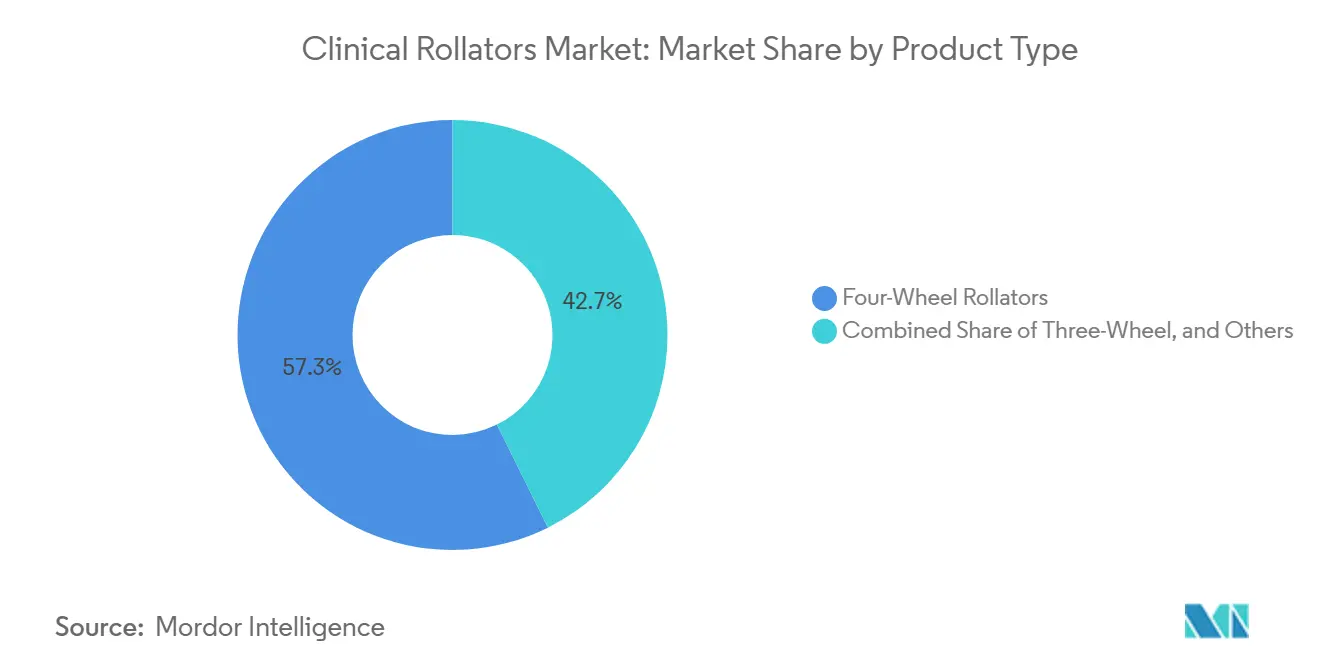
- By product type, Four-Wheel Rollators held 57.32% of the clinical rollators market share in 2025, while Lightweight Rollators are forecast to grow at an 8.50% CAGR through 2031.
- By material, Aluminum accounted for 64.17% of the clinical rollators market size in 2025, while Carbon Fiber and Composite Materials are projected to advance at a 10.50% CAGR through 2031.
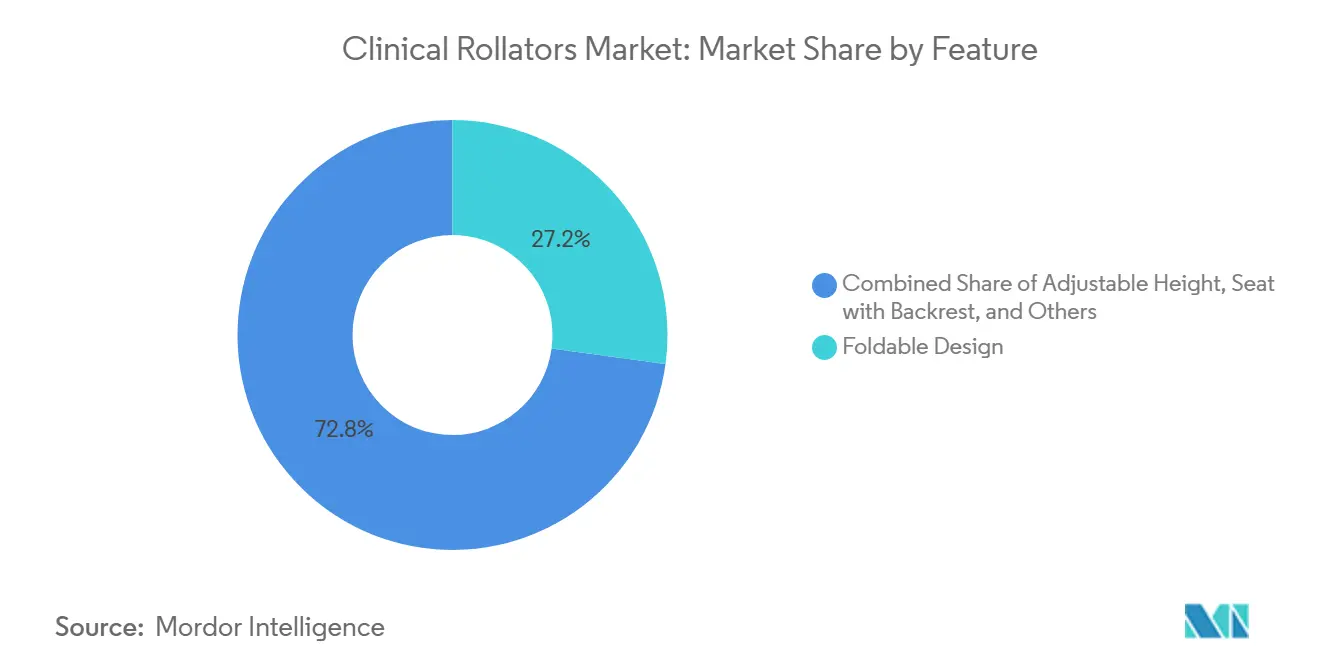
- By feature, Foldable Design captured 27.16% of the clinical rollators market share in 2025, while Smart Connectivity and Fall Detection are expected to grow at an 11.73% CAGR through 2031.
- By application, Indoor Mobility Assistance held 33.56% of the clinical rollators market in 2025, while Neurological and Balance Rehabilitation is forecast to expand at an 8.94% CAGR through 2031.
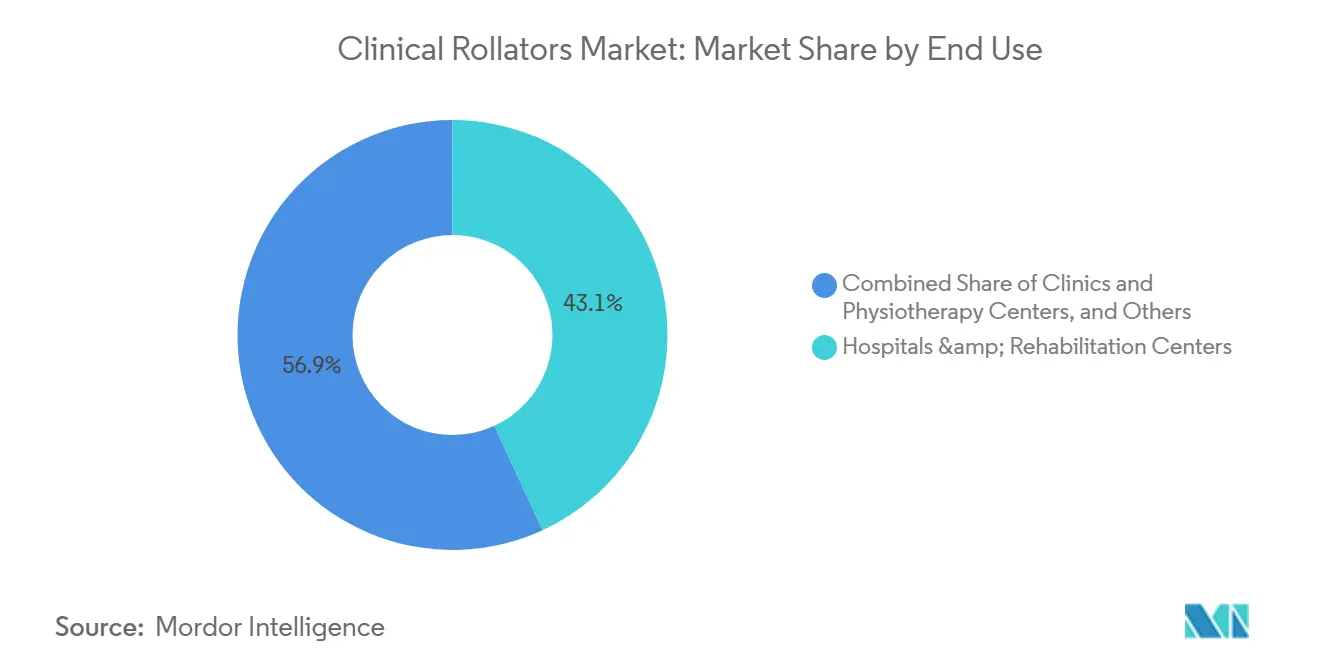
- By end user, Hospitals and Rehabilitation Centers accounted for 43.12% of the clinical rollators market in 2025, while Home Care and Aging-in-Place are forecast to grow at an 8.39% CAGR through 2031.
- By distribution channel, Hospital Pharmacies and Institutional Procurement held 37.13% of the clinical rollators market in 2025, while Online Stores and Direct-to-Consumer channels are projected to grow at a 10.21% CAGR through 2031.
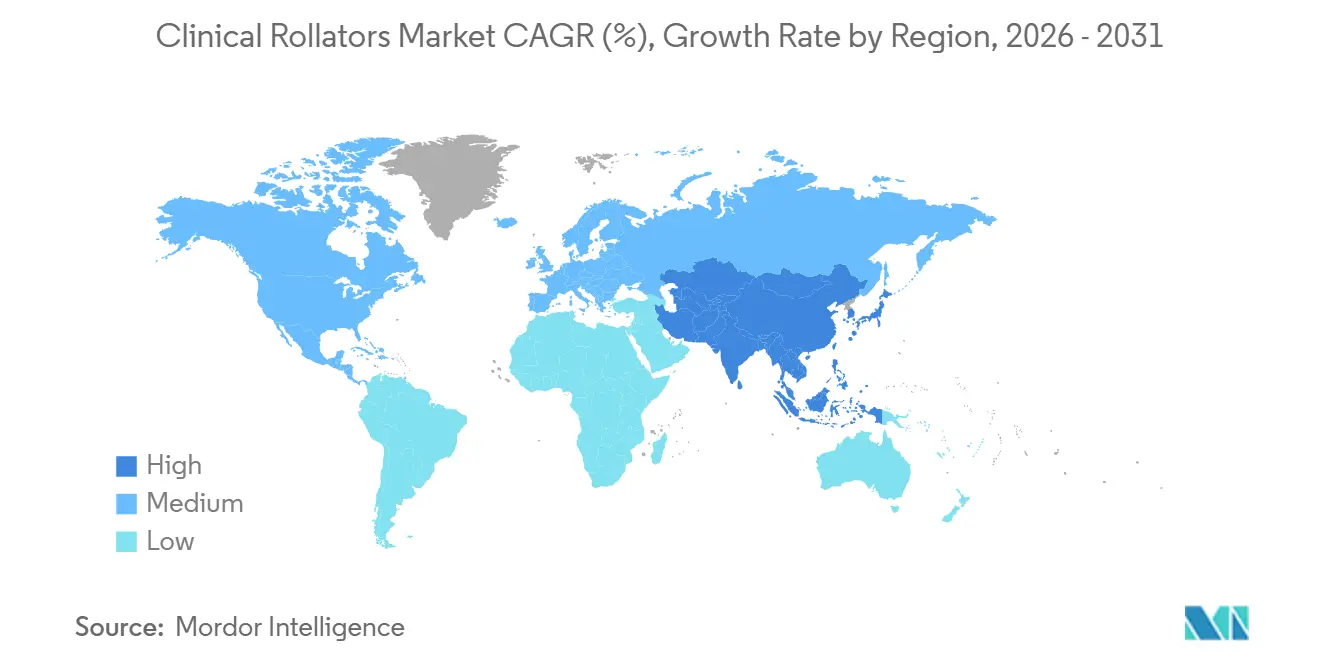
- By geography, North America held 40.44% of the clinical rollators market in 2025, while Asia-Pacific is projected to grow at a 9.34% CAGR through 2031.
Note: Market size and forecast figures in this report are generated using Mordor Intelligence’s proprietary estimation framework, updated with the latest available data and insights as of January 2026.
Market Trends and Insights
Drivers Impact Analysis of Clinical Rollators Market*
| Driver | (~) % Impact on CAGR Forecast | Geographic Relevance | Impact Timeline |
|---|---|---|---|
| Aging Population and Super-Aged Society Expansion | +1.45% | Global, concentrated in Japan, Germany, Italy, and South Korea | Short term (≤ 2 years) |
| Expansion of Home-Based Rehabilitation and Aging-in-Place Care | +1.25% | North America, Western Europe, and Japan | Medium term (2-4 years) |
| Rising Burden of Musculoskeletal and Neurological Mobility Disorders | +1.10% | Global, with the highest burden in high-income North America and Central Southern Latin America | Long term (≥ 4 years) |
| Reimbursement and Fall-Prevention Program Support | +0.95% | North America, Germany, and Japan | Short term (≤ 2 years) |
| Clinical Demand for Lightweight, Ergonomic, and Smart Rollators | +0.85% | North America, Western Europe, and select Asia-Pacific markets | Medium term (2-4 years) |
| Institutional Procurement Shift Toward Discharge-Ready Mobility Kits | +0.70% | North America, Europe, and Australia | Medium term (2-4 years) |
| Source: Mordor Intelligence | |||
Aging Population and Super-Aged Society Expansion
Mobility limitations commonly emerge after age 75, and this age group is growing faster than other population groups in many countries. The United Nations Department of Economic and Social Affairs recorded a population aged 65 years and above of more than 28% in Japan, Italy, and Germany. It also found that South Korea's elderly dependency ratio doubled between 2010 and 2025. These demographics support the recurring need for walking aids across the clinical rollators market in hospital, rehabilitation, and home settings. Users who receive a rollator in their late 70s may require a replacement in later life as their condition or daily needs change. Germany's statutory insurer replacement intervals of 3 to 5 years help create a continuing base of replacement demand alongside new prescriptions.
Expansion of Home-Based Rehabilitation and Aging-in-Place Care
The shift from institutional care to home-based care is broadening the clinical rollators market beyond hospital discharge use. Medicare Part B covers rollators as durable medical equipment under code E0143, and beneficiaries paid 20.00% coinsurance after the USD 257.00 annual Part B deductible in 2025, according to the Centers for Medicare & Medicaid Services[2]Source: V. Sanyod, K. Saelim, K. Chaarmat, and S. Kuankid, “IoT-Based Smart Walking Assistant for Fall Detection in the Elderly,” International Journal of Online and Biomedical Engineering, online-journals.org. Germany's statutory health insurers provide EUR 60.00 to EUR 100.00 equipment subsidies for basic rollators when medical necessity requirements are met. Home users often prioritize foldability, low frame weight, and maneuverability in apartments. Institutional buyers usually prioritize durability and standardized specifications for repeated use. This difference supports separate product positions for consumer-oriented and institutional channels.
Rising Burden of Musculoskeletal and Neurological Mobility Disorders
The growing burden of musculoskeletal and neurological conditions converts demographic need into clinical demand for mobility assistance. A 2025 study in Frontiers in Public Health found 1.69 billion musculoskeletal disorder cases globally, which represented a 95% increase from 1990. The same study projected 2.16 billion cases by 2035 and an increase in disability-adjusted life years from 161.88 million to 203.00 million. High-income North America had the highest age-standardized prevalence rate at 27.62 per 100,000 in the study. A 2024 systematic review in the Journal of Translational Medicine reported that neurological disorders accounted for 23.60% of total disease burden in rehabilitation contexts. These conditions affect balance, gait initiation, and postural control, which are functions addressed within the clinical rollators market by four-wheel and specialty rollators.
Reimbursement and Fall-Prevention Program Support
Reimbursement and fall-prevention programs can reduce the direct cost of clinically necessary mobility aids. Medicare coverage gives eligible users a recognized route to obtain a rollator through durable medical equipment suppliers. Germany's statutory insurance framework also creates access for basic models that meet medical necessity criteria. Japan's long-term care insurance framework supports assistive device access for people aged 65 years and above. These systems give clinical rollators market suppliers clearer routes to healthcare and community-care channels. Coverage requirements also keep attention on minimum device safety, documentation, and approved supplier status.
Restraints Impact Analysis of Clinical Rollators Market*
| Restraint | (~) % Impact on CAGR Forecast | Geographic Relevance | Impact Timeline |
|---|---|---|---|
| Inconsistent Reimbursement and Competitive Pricing Pressure | -1.30% | Global, most pronounced in South America, Southeast Asia, and the Middle East and Africa | Short term (≤ 2 years) |
| High Cost of Advanced Lightweight and Smart Models | -1.05% | Global, concentrated in Asia-Pacific and South American emerging markets | Medium term (2-4 years) |
| China-Centric Component Supply and Tariff Exposure | -0.80% | North America and Europe | Short term (≤ 2 years) |
| Infection-Control, Storage, and Maneuverability Constraints in Clinical Settings | -0.55% | North America and Europe | Medium term (2-4 years) |
| Source: Mordor Intelligence | |||
Inconsistent Reimbursement and Competitive Pricing Pressure
Rollator reimbursement eligibility differs across countries and sometimes across regional programs within the same country. This variation creates uncertainty around the pricing floor for suppliers and can limit investment in advanced models. The Centers for Medicare & Medicaid Services requires prior authorization for rollators under code E0143, while the 2025 Part B deductible was USD 257.00, and coinsurance was 20.00%. These procedures can delay acquisition even for eligible users. Outside North America and Northern Europe, coverage is often unavailable or limited to entry-level specifications. This places pressure on selling prices for mid-tier products and complicates channel planning in the clinical rollators market.
High Cost of Advanced Lightweight and Smart Models
Smart rollators with sensors, emergency calls, and navigation functions have cost structures that many reimbursement schedules do not cover. The April 2026 Frontiers in Digital Health study identified cost as a major limiting factor for smart rollator adoption. Healthcare professionals in that study also noted training needs and software maintenance complexity. Premium carbon fiber models are positioned above standard Medicare-approved rollators, creating a material affordability gap for many users. Import tariffs can further increase procurement costs for advanced-material devices in emerging economies. As a result, clinical rollators market adoption of smart and lightweight formats remains concentrated in higher-income consumer and institutional settings.
*Our forecasts treat driver/restraint impacts as directional, not additive. The impact forecasts reflect baseline growth, mix effects, and variable interactions.
Clinical Rollators Market Segment Analysis
By Product Type:
Four-Wheel Formats Lead While Lightweight Designs Gain GroundFour-wheel rollators accounted for 57.32% of clinical rollators market share in 2025. Their position reflects seated rest capability, bilateral loop-handle brakes, and storage baskets. Clinical discharge protocols and occupational therapist specifications commonly require these functions for patients with balance limitations. Group purchasing organization contracts further standardize four-wheel formats across hospital networks. This gives large manufacturers a stable institutional base. Three-wheel rollators remain useful for users needing tighter indoor turning radii, although their lower stability limits use in some clinical situations.
Lightweight rollators are forecast to grow at an 8.50% CAGR through 2031. Carbon fiber and magnesium alloy engineering reduce carrying weight for users who need to fold or transport devices in the clinical rollators market. TOPRO's Pegasus carbon rollator weighs 6.10 kg and is manufactured in Norway to Scandinavian quality standards. VOCIC's Z35 PackGo Rollator Walker uses a magnesium alloy frame and weighs 5.70 kg in its travel-ready configuration. Alerta Medical offers a powered device that combines a rollator, a wheelchair, and rehabilitation functions. EN ISO 11199-2 certification remains increasingly relevant because many European institutional tenders require evidence of compliance.



By Material:
Aluminum Retains the Largest Role as Carbon Fiber Gains InterestAluminum held 64.17% of revenue in 2025, giving it the leading revenue share by material. Its position rests on a balance of cost, weight, supply availability, and compliance with standard load and corrosion requirements. Hospital procurement managers often treat aluminum as the baseline for clinical adequacy. Supplier qualification frameworks are also established around this material. Steel retains a role in entry-level and price-sensitive settings. Its greater frame weight can limit acceptance in home-care situations where users must manage the device independently.
Carbon fiber and composite materials are forecast to grow at a 10.50% CAGR through 2031. Rollz International's Rollz Air carbon rollator weighs 4.70 kg and supports users weighing up to 175 kg. Bischoff & Bischoff developed the 6.00 kg ALEVO CARBON with Porsche Design Studio for users seeking both medical support and a premium product. Magnesium alloy offers a second route to lower device weight at a lower material cost than carbon fiber. These alternatives create pressure on the clinical rollators market aluminum suppliers to improve frame weight and design. The clinical rollators industry is therefore seeing material competition extend beyond simple durability and price.
By Feature:
Foldability Leads Demand While Connected Safety Features Grow FastestFoldable design held 27.16% of revenue in 2025. Home-care users and ambulatory clinic patients often need devices that fit into vehicles and small living spaces. Adjustable height and seats with backrests are widely treated as basic clinical functions. Correct adjustment helps users maintain posture and may support fall-risk reduction. Storage baskets and trays are important when users carry personal items without caregiver assistance. TOPRO's Troja Neuro uses a reversed braking mechanism for Parkinson's patients whose reflex responses differ from a standard push-to-brake action.
Smart connectivity and fall detection are forecast to grow at an 11.73% CAGR through 2031. A May 2025 study in the International Journal of Online and Biomedical Engineering tested an Internet of Things walking assistant with motion sensors, physiological monitoring, and LoRa or Wi-Fi connectivity. The system reported high precision in fall detection and physiological anomaly identification among elderly test users[3]Source: V. Sanyod, K. Saelim, K. Chaarmat, and S. Kuankid, “IoT-Based Smart Walking Assistant for Fall Detection in the Elderly,” International Journal of Online and Biomedical Engineering, online-journals.org. Drive Medical's WalkWise by Drive is a modular activity-monitoring attachment that can add smart functions to existing rollators and walkers. The 2026 AktiMuW study found that users aged 67 to 95 preferred haptic navigation and hazard warnings over visual alerts. This preference shows how clinical rollators market product design must account for visual limitations alongside mobility issues.
By Application:
Indoor Mobility Generates the Largest Volume While Neurorehabilitation ExpandsIndoor mobility assistance accounted for 33.56% of revenue in 2025. Daily home use is a major source of demand because many rollator-dependent users move through kitchens, bathrooms, and narrow hallways. Outdoor mobility assistance complements this need with wider wheels and weather-resistant construction. Trionic Sverige AB's Walker 14er has 36.00 cm wheels and supports users weighing up to 150 kg. The company designed it for terrain, including cobblestones and forest paths. Post-surgical recovery also produces recurring short-duration demand after orthopedic procedures such as hip and knee replacements.
Neurological and balance rehabilitation is forecast to grow at an 8.94% CAGR through 2031. The 2025 Frontiers in Public Health analysis identified osteoarthritis as the musculoskeletal disorder with the strongest prevalence increase since 1990. The disorder's burden is concentrated among people aged 70 years and above and is projected to continue rising through 2035. Drive DeVilbiss Healthcare acquired De Oro Devices' NexStride product line in June 2025. NexStride can attach to a rollator or walker and provides visual laser-line and auditory metronome cues for Parkinson's disease and other neuroambulatory conditions. The device extends a standard walking aid into a tool for structured neurological rehabilitation within the clinical rollators market.
By End User:
Institutions Hold the Largest Share While Home Care Grows FasterHospitals and rehabilitation centers held 43.12% of revenue in 2025. Institutional procurement includes group purchasing organization agreements, hospital pharmacy dispensing, and standardized discharge kits. Clinics and physiotherapy centers represent a related channel tied to outpatient musculoskeletal and neurological rehabilitation caseloads. Long-term care facilities provide a stable demand through resident fall-prevention protocols and daily assisted-mobility needs. Occupational therapy centers, community sports rehabilitation settings, and veteran-care facilities are included among other end users. These institutional settings favor clinical rollators market suppliers that can meet volume, service, and compliance requirements.
Home care and aging-in-place are forecast to grow at an 8.39% CAGR through 2031. Medicare durable medical equipment coverage, European statutory insurance, and Japan's Kaigo Hoken long-term care insurance support access for community-dwelling seniors. Home users often retain a rollator for 3 to 5 years while using it in different domestic environments. Hospital discharge devices can be returned and reprocessed after shorter periods. This difference supports demand for durable, foldable, and visually differentiated consumer models. Suppliers with consumer brands and direct fulfillment capabilities can address this demand without replacing institutional channels.
By Distribution Channel:
Institutional Supply Chains Lead While Direct Sales ExpandHospital pharmacies and institutional procurement accounted for 37.13% of revenue in 2025. Long-term supply agreements between manufacturers and hospital networks are frequently managed through group purchasing organization intermediaries. These intermediaries aggregate purchasing across many facilities and influence product selection. Retail pharmacies are important in Europe, where insurer pathways can direct prescriptions through pharmacy dispensaries. Germany's Sanitätshäuser combine fitting support with insurance processing. Specialty medical stores add a trial-based setting where product assessments and occupational therapist referrals affect decisions.
Online stores and direct-to-consumer channels are forecast to grow at a 10.21% CAGR through 2031. Medicare-enrolled durable medical equipment suppliers are increasingly available through retail e-commerce marketplaces. This can shorten the time between prescription and fulfillment for covered purchases. Drive Medical operates drivemedicalathome.com as a direct-to-consumer channel alongside institutional business. The approach gives the company an opportunity to build brand recognition beyond price-led group purchasing contracts. Product reviews, lifestyle positioning, and consumer outreach play a larger role in this channel than in standardized bid processes.
Geography Analysis
North America Clinical Rollators Market
North America held 40.44% of revenue in 2025. Medicare's durable medical equipment pathway, a dense approved-supplier network, and high prevalence of mobility-limiting conditions support regional demand. The 2025 Frontiers in Public Health study reported that high-income North America had the highest age-standardized musculoskeletal disorder prevalence at 27.62 per 100,000. The United States is the leading contributor to regional revenue because Medicare provides a recognized coverage route for eligible users. In 2025, the Part B deductible was USD 257.00 and the beneficiary coinsurance requirement was 20.00%. E-commerce platforms are widening access for rural and semi-urban seniors who have historically depended on local medical supply stores.
Europe Clinical Rollators Market
Europe is the second-largest regional area in the clinical rollators market, with Germany, the United Kingdom, France, Italy, Norway, and Sweden as important countries. Germany's statutory Krankenkassen provide EUR 60.00 to EUR 100.00 subsidies for basic rollators when users meet medical necessity requirements. Scandinavian manufacturers use ISO-certified and TÜV-audited products with multiyear warranties to maintain premium positions in institutional channels. TOPRO, Trionic Sverige AB, Eurovema Mobility AB, and byACRE are part of this regional manufacturing base. In 2026, Uplivin's Glide 2-in-1 Rollator and Wheelchair entered United Kingdom retail and healthcare channels through Able2 distribution. Spain, Italy, and France offer further potential as healthcare budgets improve and older populations grow.
APAC, MEA and South America Clinical Rollators Market
Asia-Pacific is forecast to expand at a 9.34% CAGR through 2031, the fastest rate among regional segments. Japan, China, and South Korea are the principal demand centers, while India and Australia represent secondary growth areas. Japan's Kaigo Hoken insurance system supports assistive-device access for citizens aged 65 years and above. South Korea's elderly dependency ratio doubled between 2010 and 2025, as reported by the United Nations Department of Economic and Social Affairs. India is linked more closely to urbanization and hospital infrastructure investment than reimbursement reform. The Middle East and Africa is supported by GCC medical-device imports and private health spending, while Brazil and Argentina lead demand in South America for standard aluminum formats that fit basic reimbursement criteria.

Competitive Landscape
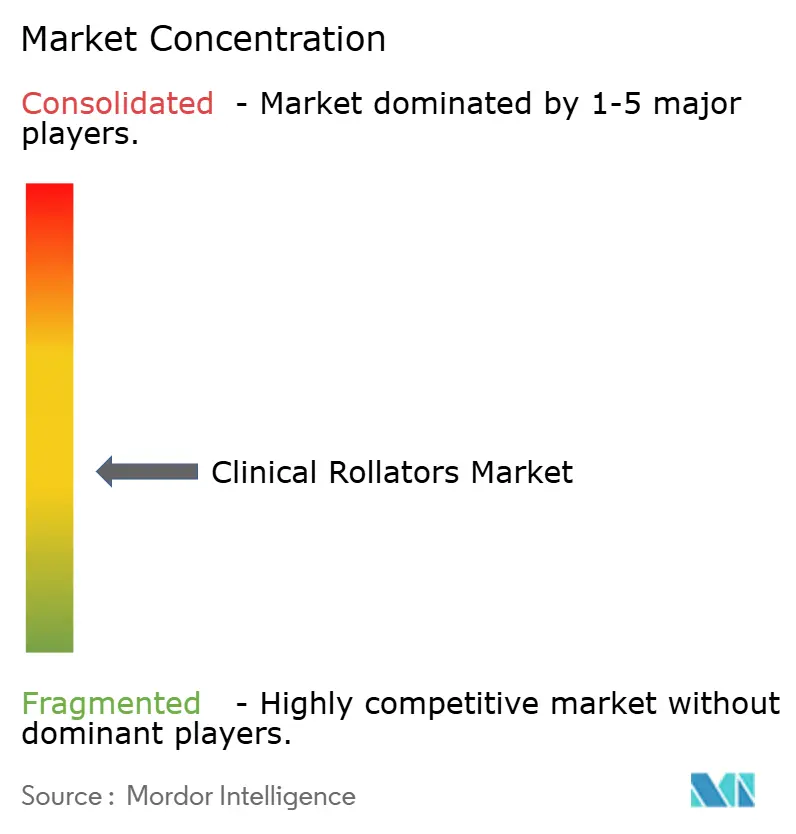
The clinical rollators market is moderately consolidated at the upper tier and fragmented below it. Drive Medical, Invacare, DHCare, Sunrise Medical, Medline Industries, and NOVA Medical Products have a broad distribution scale and institutional access. TOPRO, Trionic Sverige AB, Bischoff & Bischoff, and Meyra maintain premium positions through product differentiation and certified engineering. Kingswood Capital Management signed an agreement to acquire Drive DeVilbiss Healthcare in October 2025. Drive Medical then announced its acquisition of Compass Health Brands in January 2026. The transaction added the ProBasics, Carex, and TheraMed rollator and walker lines and expanded the company's retail pharmacy and e-commerce reach.
DHCare was formed through the January 30, 2026, merger of Invacare Europe and Asia Pacific with Direct Healthcare Group. In June 2026, DHCare signed a definitive agreement to acquire Ottobock's Human Mobility division. The transaction is expected to close in the second half of 2026. If completed, DHCare will have a presence in 16 countries and exports to more than 50 markets. The move combines post-acute mobility and care-management products with specialist mobility expertise. Sunrise Medical also acquired Ergoflix in 2025 to expand its rehabilitation portfolio with premium foldable power wheelchairs.
Smart technology remains an area where mid-sized manufacturers can differentiate without matching the distribution scale of larger suppliers. Drive Medical's June 2025 acquisition of NexStride shows a focus on neurological rehabilitation rather than frame design alone. Smart connectivity and fall detection are forecast to grow at an 11.73% CAGR through 2031, but commercial adoption remains less mature than basic rollator formats. Companies that combine ISO 13485 quality systems with sensor capabilities may be better placed for future digital monitoring requirements in institutional tenders. Smaller Scandinavian and German suppliers retain advantages in premium credibility and certification depth. Chinese original equipment manufacturers are developing export-focused designs that may challenge mid-tier European aluminum-frame suppliers outside their home regions.
Clinical Rollators Industry Leaders
-
Drive DeVilbiss Healthcare
-
Invacare Corporation
-
Sunrise Medical LLC
-
TOPRO AS
-
Medline Industries, LP
- *Disclaimer: Major Players sorted in no particular order
Clinical Rollators Market Companies Covered in this Report
- Benmor Medical
- Bischoff & Bischoff GmbH
- Briggs Healthcare
- byACRE
- Carex
- Compass Health
- Drive DeVilbiss Healthcare
- Eurovema Mobility AB
- Evolution Technologies Inc.
- GF Health Products, Inc.
- Human Care HC AB
- Invacare
- Karman Healthcare, Inc.
- Medline Industries
- Meyra
- NOVA Medical Products
- Rollz International
- Sunrise Medical
- TOPRO AS
- Trionic Sverige AB

Recent Industry Developments in Clinical Rollators Market
- June 2026: DHCare signed a definitive agreement to acquire Ottobock’s Human Mobility division. The transaction combines DHCare’s post-acute mobility and care management portfolio with Ottobock’s expertise in complex power wheelchairs and specialist mobility solutions in the DACH region. The transaction is expected to close in the second half of 2026. If completed, it will create one of Europe’s most comprehensive post-acute mobility platforms.
- January 2026: Drive Medical announced a definitive agreement to acquire Compass Health Brands. Compass Health Brands supplies branded and private-label consumer medical products, including rollators, walkers, and wheelchairs sold under the ProBasics, Carex, and TheraMed brands. The acquisition strengthens Drive Medical’s retail pharmacy and direct-to-consumer reach. It also adds private-label manufacturing capacity.


Global Clinical Rollators Market Report Scope
As per the scope of the report, clinical rollators are wheeled mobility assistance devices designed to provide support, stability, and enhanced mobility for individuals with impaired balance, reduced physical strength, neurological disorders, post-surgical recovery needs, and age-related mobility limitations. Clinical rollators are widely utilized across healthcare facilities, rehabilitation centers, long-term care settings, and home care environments to improve patient mobility, independence, and safety while reducing the risk of falls.
The clinical rollators market is segmented by product type into three-wheel rollators, four-wheel rollators, heavy-duty and bariatric rollators, lightweight rollators, specialty and pediatric rollators, and others; by material into aluminum, steel, carbon fiber and composite materials, and others; by feature into foldable design, adjustable height, seat with backrest, storage basket and tray, braking and locking system, smart connectivity and fall detection, and others; by application into indoor mobility assistance, outdoor mobility assistance, post-surgical recovery, neurological and balance rehabilitation, and others; by end user into hospitals and rehabilitation centers, clinics and physiotherapy centers, home care and aging-in-place, long-term care facilities, and others; by distribution channel into hospital pharmacies and institutional procurement, retail pharmacies, specialty medical stores, online stores and direct-to-consumer, and others; and by geography into North America, Europe, Asia-Pacific, Middle East and Africa, and South America. The market report also covers the estimated market sizes and trends for 17 countries across major regions globally. For each segment, the market size and forecast are provided in terms of value (USD).
| Three-Wheel Rollators |
| Four-Wheel Rollators |
| Heavy-Duty and Bariatric Rollators |
| Lightweight Rollators |
| Specialty and Pediatric Rollators |
| Others |
| Aluminum |
| Steel |
| Carbon Fiber and Composite Materials |
| Others |
| Foldable Design |
| Adjustable Height |
| Seat with Backrest |
| Storage Basket and Tray |
| Braking and Locking System |
| Smart Connectivity and Fall Detection |
| Others |
| Indoor Mobility Assistance |
| Outdoor Mobility Assistance |
| Post-Surgical Recovery |
| Neurological and Balance Rehabilitation |
| Others |
| Hospitals and Rehabilitation Centers |
| Clinics and Physiotherapy Centers |
| Home Care and Aging-in-Place |
| Long-Term Care Facilities |
| Others |
| Hospital Pharmacies and Institutional Procurement |
| Retail Pharmacies |
| Specialty Medical Stores |
| Online Stores and Direct-to-Consumer |
| North America | United States |
| Canada | |
| Mexico | |
| Europe | Germany |
| United Kingdom | |
| France | |
| Italy | |
| Spain | |
| Rest of Europe | |
| Asia-Pacific | China |
| Japan | |
| India | |
| Australia | |
| South Korea | |
| Rest of Asia-Pacific | |
| Middle East and Africa | GCC |
| South Africa | |
| Rest of Middle East and Africa | |
| South America | Brazil |
| Argentina | |
| Rest of South America |
| By Product Type | Three-Wheel Rollators | |
| Four-Wheel Rollators | ||
| Heavy-Duty and Bariatric Rollators | ||
| Lightweight Rollators | ||
| Specialty and Pediatric Rollators | ||
| Others | ||
| By Material | Aluminum | |
| Steel | ||
| Carbon Fiber and Composite Materials | ||
| Others | ||
| By Feature | Foldable Design | |
| Adjustable Height | ||
| Seat with Backrest | ||
| Storage Basket and Tray | ||
| Braking and Locking System | ||
| Smart Connectivity and Fall Detection | ||
| Others | ||
| By Application | Indoor Mobility Assistance | |
| Outdoor Mobility Assistance | ||
| Post-Surgical Recovery | ||
| Neurological and Balance Rehabilitation | ||
| Others | ||
| By End User | Hospitals and Rehabilitation Centers | |
| Clinics and Physiotherapy Centers | ||
| Home Care and Aging-in-Place | ||
| Long-Term Care Facilities | ||
| Others | ||
| By Distribution Channel | Hospital Pharmacies and Institutional Procurement | |
| Retail Pharmacies | ||
| Specialty Medical Stores | ||
| Online Stores and Direct-to-Consumer | ||
| By Geography | North America | United States |
| Canada | ||
| Mexico | ||
| Europe | Germany | |
| United Kingdom | ||
| France | ||
| Italy | ||
| Spain | ||
| Rest of Europe | ||
| Asia-Pacific | China | |
| Japan | ||
| India | ||
| Australia | ||
| South Korea | ||
| Rest of Asia-Pacific | ||
| Middle East and Africa | GCC | |
| South Africa | ||
| Rest of Middle East and Africa | ||
| South America | Brazil | |
| Argentina | ||
| Rest of South America | ||


Key Questions Answered in the Report
What is the projected value of the clinical rollators market by 2031?
The clinical rollators market is projected to reach USD 3.15 billion by 2031, expanding at a 6.73% CAGR from 2026.
Which product category leads clinical rollator sales?
Four-wheel rollators led with 57.32% of revenue in 2025 because they combine seating, brakes, and storage functions.
Which rollator material is growing fastest?
Carbon fiber and composite materials are forecast to grow at a 10.50% CAGR through 2031, supported by demand for lower device weight.
What is driving demand for smart rollators?
Fall detection, navigation guidance, emergency calls, and activity monitoring are supporting demand. Smart connectivity and fall detection are forecast to grow at an 11.73% CAGR through 2031.
Which region is expanding fastest for clinical rollators?
Asia-Pacific is projected to grow at a 9.34% CAGR through 2031, supported by Japan, China, and South Korea.
How does Medicare support access to rollators?
Medicare Part B covers eligible rollators as durable medical equipment under code E0143. In 2025, users paid 20.00% coinsurance after the USD 257.00 Part B deductible.
Page last updated on:





