
Clinical-grade Medical Software Market Size and Share
Market Overview
| Study Period | 2020 - 2031 |
|---|---|
| Market Size (2026) | USD 4.24 Billion |
| Market Size (2031) | USD 10.20 Billion |
| Growth Rate (2026 - 2031) | 19.18 % |
| Fastest Growing Market | Asia-Pacific |
| Largest Market | North America |
| Market Concentration | Medium |
Major Players *Disclaimer: Major Players sorted in no particular order Image © Mordor Intelligence. Reuse requires attribution under CC BY 4.0. | |
Clinical-grade Medical Software Market Analysis by Mordor Intelligence
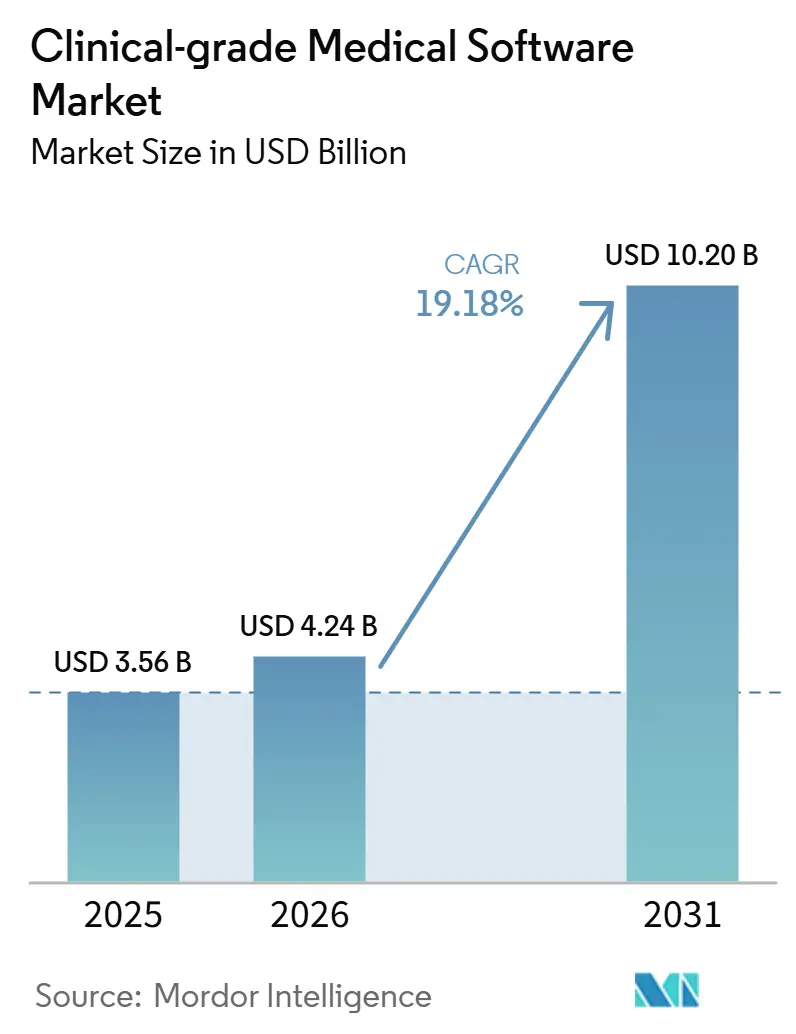
The Clinical-grade Medical Software Market size was valued at USD 3.56 billion in 2025 and is estimated to grow from USD 4.24 billion in 2026 to reach USD 10.20 billion by 2031, at a CAGR of 19.18% during the forecast period (2026-2031).
Clinical software is becoming integral to diagnostic, treatment, and care coordination workflows, moving beyond documentation. Noncommunicable diseases accounted for 74% of deaths worldwide, supporting demand for software used in screening, long-term disease management, and remote care delivery. Providers are prioritizing platforms that integrate with established clinical workflows, enable information sharing across care settings, and support imaging, clinical decision-making, and patient follow-up in a single operating environment. As a result, the clinical-grade medical software market is shaped by the balance between faster deployment and the evidence required for safe clinical use.
Key Report Takeaways
- By clinical function, diagnostic software held 33.22% of the Clinical-grade medical software market share in 2025, while therapeutic software is projected to grow at a 20.93% CAGR through 2031.
- By deployment, cloud-based software held 56.23% of the Clinical-grade medical software market share in 2025, while hybrid software is projected to grow at a 22.86% CAGR through 2031.
- By component, software held 59.34% share in 2025, while services is projected to grow at a 21.98% CAGR through 2031.
- By therapeutic area, radiology held 32.88% share in 2025, while cardiology is projected to grow at a 22.34% CAGR through 2031.
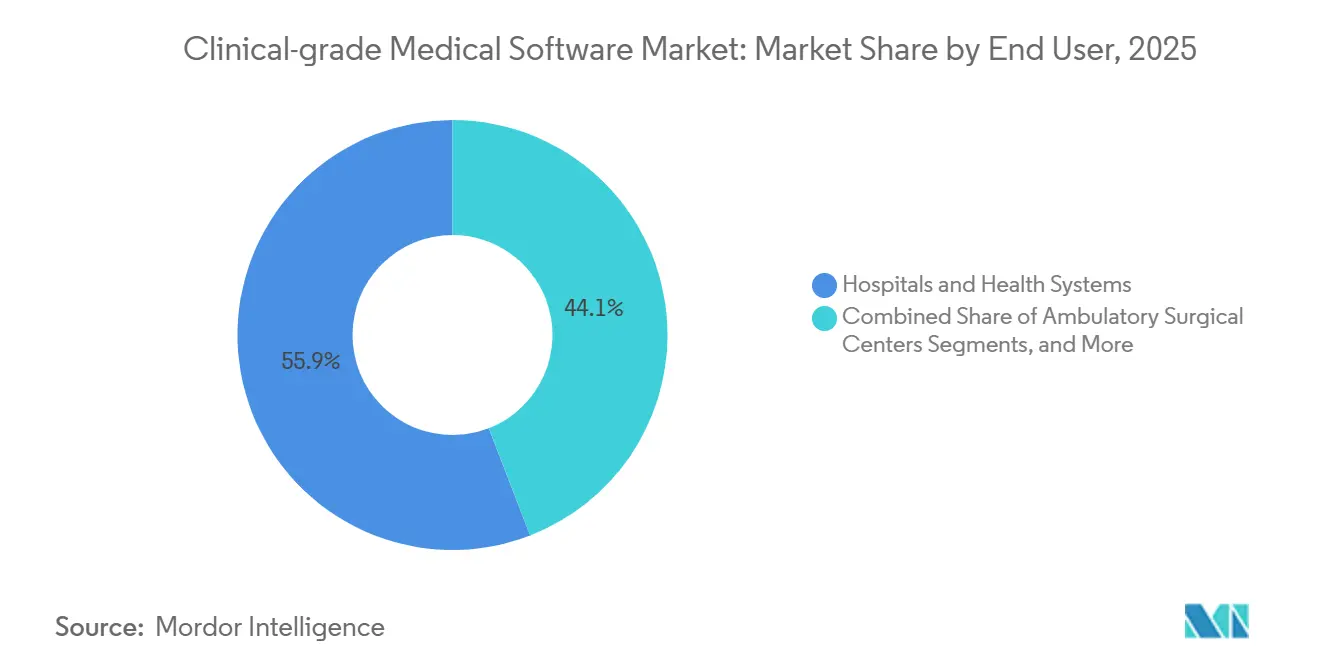
- By end user, hospitals and health systems held 55.89% share in 2025, while diagnostic and imaging centers are projected to grow at a 20.45% CAGR through 2031.
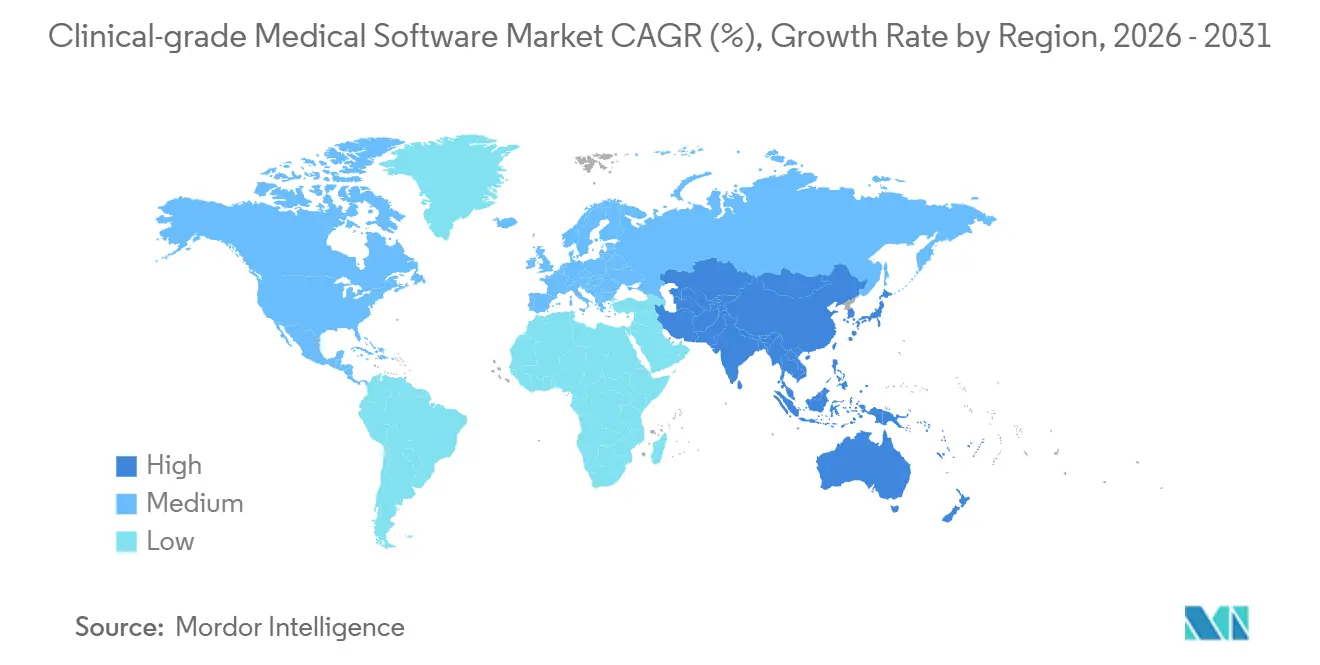
- By geography, North America held 42.76% share in 2025, while the Asia-Pacific is projected to grow at a 19.56% CAGR through 2031.
Note: Market size and forecast figures in this report are generated using Mordor Intelligence’s proprietary estimation framework, updated with the latest available data and insights as of January 2026.
Global Clinical-grade Medical Software Market Trends and Insights
Drivers Impact Analysis*
| DRIVER | (~) % IMPACT ON CAGR FORECAST | GEOGRAPHIC RELEVANCE | IMPACT TIMELINE |
|---|---|---|---|
| AI-enabled clinical workflow automation | +4.2% | Global, with peak concentration in North America and Western Europe | Short term (≤ 2 years) |
| EHR, PACS and LIS integration demand | +3.5% | Global, with spillover to Asia-Pacific and Middle East and Africa as EHR upgrades accelerate | Medium term (2-4 years) |
| Regulatory and reimbursement support for digital care | +2.8% | North America and Europe, with early gains in select GCC and Asia-Pacific markets | Medium term (2-4 years) |
| Cloud-native clinical software adoption | +3.1% | Global, concentrated in North America, Oceania, and Northern Europe | Short term (≤ 2 years) |
| Alert personalization to reduce clinician cognitive load | +1.9% | North America and Europe, with spillover to large urban hospital systems in Asia-Pacific | Medium term (2-4 years) |
| Clinical software localization for underserved specialist markets | +1.6% | Asia-Pacific, Middle East and Africa, and Latin America | Long term (≥ 4 years) |
| Source: Mordor Intelligence | |||
AI-Enabled Clinical Workflow Automation Widens Clinical Productivity Gaps
AI workflow tools are gaining visibility in clinical software purchasing decisions. Ambient documentation tools can reduce manual documentation workloads and give clinicians more time for patient care. Health systems are testing these systems to support tasks that previously depended on manual documentation and coordination. Agent-based systems may shift software value beyond the electronic health record (EHR) toward clinical task coordination, creating opportunities for specialized workflow providers and increasing pressure on established EHR suppliers. Research in a simulated setting found that agentic EHR systems approached experienced physician performance in selected diagnostic tasks, supporting continued clinical evaluation.
EHR, PACS and LIS Integration Demand Redefines Platform Value
Health systems increasingly seek software that works across EHR, PACS, LIS, and analytics systems. Fragmented imaging and laboratory systems, uneven HL7 FHIR adoption, and disconnected IoT data remain barriers to enterprise AI use. The clinical-grade medical software market benefits when vendors connect information without requiring clinicians to leave the patient record. In-context access to images within an active EHR record is becoming a practical requirement for enterprise buyers, while reliable interoperability allows suppliers to compete on operational fit rather than a single feature.
Regulatory and Reimbursement Support for Digital Care Opens Market Access
Regulatory and reimbursement policies influence whether clinical software can move from pilot use to routine care. The FDA revised its Clinical Decision Support Software Guidance on January 6, 2026, changing how certain decision-support functions are treated under the 21st Century Cures Act. The revision included enforcement discretion for certain functions that provide one clinically appropriate recommendation and no longer automatically excluded time-critical decision-support software from the non-device pathway. Bayesian Health received FDA clearance for continuous AI sepsis monitoring in May 2026, supporting the case for AI-enabled inpatient monitoring, while European MDR requirements and related compliance standards remained key procurement factors across regulated international markets.
Cloud-Native Clinical Software Adoption Moves From Strategy to Execution
Clinical software buyers are moving from cloud planning to active implementation. Cloud environments can support enterprise imaging, analytics, and applications that need flexible capacity. WellSpan Health completed the migration of more than 300 clinical applications and 7.5 petabytes of data, including its Epic EMR, in 17 weeks during July 2026. This example showed that large health systems can move core clinical workloads at scale with a structured migration plan, increasing the importance of dependable migration support, clear operational accountability, security controls, data governance, and hybrid deployment options for essential clinical functions.
Restraints Impact Analysis*
| RESTRAINT | (~) % IMPACT ON CAGR FORECAST | GEOGRAPHIC RELEVANCE | IMPACT TIMELINE |
|---|---|---|---|
| Cybersecurity, privacy and ransomware exposure | -2.1% | Global, most acute in North America and Europe where deployment density is highest | Short term (≤ 2 years) |
| Clinical validation and evidence requirements | -1.7% | Global, with stricter interpretation in North America and Europe | Medium term (2-4 years) |
| Alert fatigue from layered algorithmic prompts | -1.3% | North America and Europe, with early signals in Asia-Pacific urban centers | Medium term (2-4 years) |
| Fragmented clinical ownership of software procurement | -0.9% | Global, most pronounced in multisite health systems and emerging markets | Long term (≥ 4 years) |
| Source: Mordor Intelligence | |||
Cybersecurity Exposure Creates a Performance Risk for Clinical Software
Cybersecurity has become a clinical continuity issue, not just an IT concern. Healthcare ransomware incidents rose 58% year over year in 2025. The April 2026 ChipSoft attack showed how a vendor incident can disrupt EHR access across several institutions. Providers now prioritize security, privacy, recovery capabilities, and resilient infrastructure when evaluating clinical software, which can affect confidence in the clinical-grade medical software market, increase vendor engineering costs, and lengthen procurement cycles.
Clinical Validation Requirements Extend Deployment Timelines for AI-Driven Tools
AI-enabled clinical tools require evidence that they can operate safely in routine care, particularly in diagnosis or treatment planning. A 2025 review noted that evaluation should assess workflow integration, not only algorithmic accuracy. HeartFlow stated that more than 600 peer-reviewed publications and a dataset of 273,000 patients supported its Plaque Analysis platform before commercial coverage decisions.[1]Chen W. et al., “Interpretable Agentic AI System With Localized Reasoning for Radiology,” npj Digital Medicine, nature.com This evidence burden can favor suppliers with established clinical research capabilities.
*Our forecasts treat driver/restraint impacts as directional, not additive. The impact forecasts reflect baseline growth, mix effects, and variable interactions.
Segment Analysis
By Clinical Function: Diagnostic Software Anchors Revenue While Therapeutics Scale
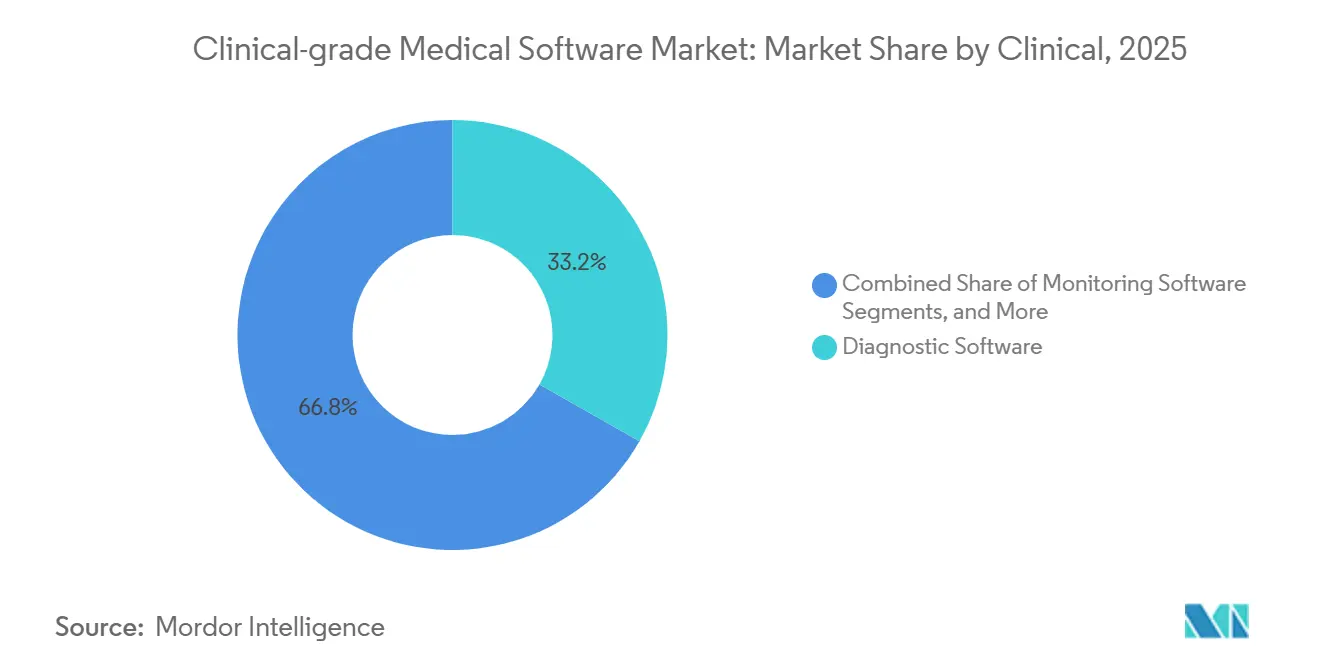
Diagnostic Software held 33.22% of the Clinical-grade Medical Software market size in 2025. Radiology and pathology workflows supported this position, as AI triage helped manage high imaging volumes and limited specialist capacity. Radiology represented 1,163 of 1,524 FDA-cleared AI algorithms by March 2026, reflecting a mature product environment for diagnostic applications. A Nature Biomedical Engineering article stated that diagnostic imaging errors caused 40,000-80,000 preventable deaths annually in the United States and more than USD 4 billion in malpractice costs.
Therapeutic Software is forecast to grow at a 20.93% CAGR through 2031. The category includes applications used in cardiovascular, respiratory, and metabolic disease management, with payer coverage for prescription digital therapeutics remaining important to expansion. Monitoring Software, Disease Management Software, Clinical Decision Support Software, Clinical Workflow and Communication Software, Telehealth and Virtual Care Software, and Medical Imaging and Visualization Software make up the remaining clinical function categories. The Clinical-grade Medical Software industry can benefit when reimbursement coverage and clinical evidence support adoption beyond pilot programs.



By Deployment: Cloud Retains Scale While Hybrid Supports Critical Workloads
Cloud-Based Software held 56.23% of the Clinical-grade Medical Software market size in 2025. Its position reflected health systems’ shift toward hosted applications, enterprise imaging, and analytics services. Cloud tools supported shared access to information across hospitals and outpatient settings and allowed providers to expand capacity without relying only on local infrastructure. Cloud deployment remained subject to security, privacy, and clinical continuity requirements.
Hybrid Software is forecast to grow at a 22.86% CAGR through 2031. Health systems use hybrid designs to retain latency-sensitive, tightly integrated, or regulation-constrained workloads on site while placing analytics, AI inference, and secondary imaging use cases in public cloud environments. A 2026 review described hybrid models that combined private hospital clouds, community clouds, and government cloud layers to support interoperability while protecting sensitive clinical records. On-Premise Software remains relevant in jurisdictions with strict data residency rules and in facilities with limited replacement budgets.
By Component: Software Leads While Services Reflect Integration Needs
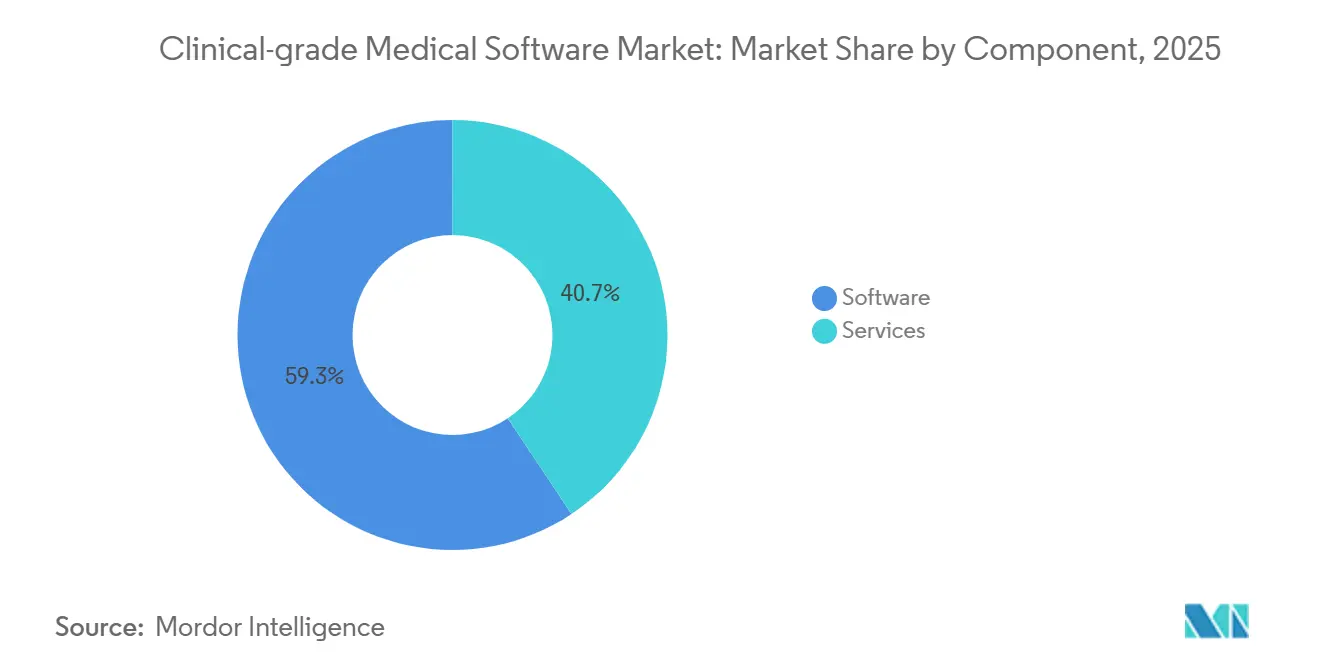
Software held a 59.34% share of the Clinical-grade Medical Software market in 2025. This category covers platform licenses for EHR, imaging, decision support, and therapeutic management applications. Health systems often prefer integrated suites that serve several clinical departments and reduce the burden of managing separate applications. This preference supports suppliers with broad product portfolios and established integration capabilities.
Services is forecast to grow at a 21.98% CAGR through 2031. Providers need implementation, workflow redesign, staff training, integration, and ongoing optimization when they deploy AI-enabled software across several systems. These tasks can continue even when an organization delays replacing its core EHR platform, making services demand less dependent on new platform purchases than software license demand. The Clinical-grade Medical Software industry will continue to require services as clinical environments become more connected and complex.
By Therapeutics Area: Radiology Leads While Cardiology Builds Momentum
Radiology held a 32.88% share of the Clinical-grade Medical Software market in 2025. The area had a dense base of AI tools for CT, MRI, and X-ray workflows. Its 1,163 FDA-cleared algorithms accounted for 76.31% of the 1,524 algorithms cited in the March 2026 source. GE HealthCare received FDA 510(k) clearance in March 2026 for View, a diagnostic viewer in its Genesis Radiology Workspace.
Cardiology is forecast to grow at a 22.34% CAGR through 2031. Growth is supported by AI tools for coronary CT angiography, echocardiography, ECG interpretation, and cardiac MRI. HeartFlow reported that its Next Gen Plaque Analysis received FDA clearance in September 2025 and had support from data on 273,000 patients. The company also reported a 21% improvement in plaque detection, while Oncology, Neurology, Respiratory, Metabolic, and Infectious Diseases applications are expanding as providers invest in precision medicine.
By End User: Hospitals Retain Demand While Imaging Centers Expand
Hospitals and Health Systems held a 55.89% share in 2025. They are the primary buyers of enterprise EHR platforms, PACS, clinical decision-support tools, and workflow automation. Large multispecialty organizations need software that can serve many departments while maintaining governance and shared clinical records. Their requirements influence the Clinical-grade Medical Software market by setting expectations for integration, support, cybersecurity, and operational reliability.
Diagnostic and Imaging Centers are forecast to grow at a 20.45% CAGR through 2031. The outpatient shift in imaging supports demand for AI triage and browser-based viewers that improve throughput without matching staff growth. Aidoc cited research showing that outpatient imaging interpretation turnaround times more than doubled between 2014 and 2023. These centers often favor subscription and per-read pricing over large capital commitments, creating openings for AI-focused suppliers with flexible commercial structures.
Geography Analysis
North America held a 42.76% share of the clinical-grade medical software market in 2025, supported by broad enterprise EHR adoption, multiple FDA-cleared AI tools, and mature payer frameworks for digital care. Providers added clinical capabilities while strengthening infrastructure against cyber risk. Mexico added demand as private hospital groups invested in digital infrastructure, while Canada remained an active buyer as providers evaluated alternatives to established platform suppliers.
Europe maintained a compliance-focused environment shaped by MDR requirements and GDPR data sovereignty rules. InterSystems announced in May 2026 that IntelliCare became the first AI-native EHR to receive EU MDR Class IIa certification. Such certifications can become important requirements in regulated tenders. Germany, the United Kingdom, and Northern Europe remained active users of clinical AI tools, while the GCC emerged for AI-native EHR adoption, with Medcare becoming the first EMEA provider to deploy InterSystems IntelliCare.
Asia-Pacific is forecast to grow at a 19.56% CAGR through 2031, supported by national digitization programs, hospital IT modernization, and local vendor development across China, India, Japan, South Korea, and Australia. China’s hospital upgrade cycles created procurement opportunities for enterprise imaging software, while India’s domestic health IT development supported accessible deployment models. South Korea’s K-Digital initiative and Australia’s My Health Record expansion also supported demand. South America, led by Brazil and Argentina, remained an emerging area as public hospital digitization created scalable procurement opportunities.

Competitive Landscape
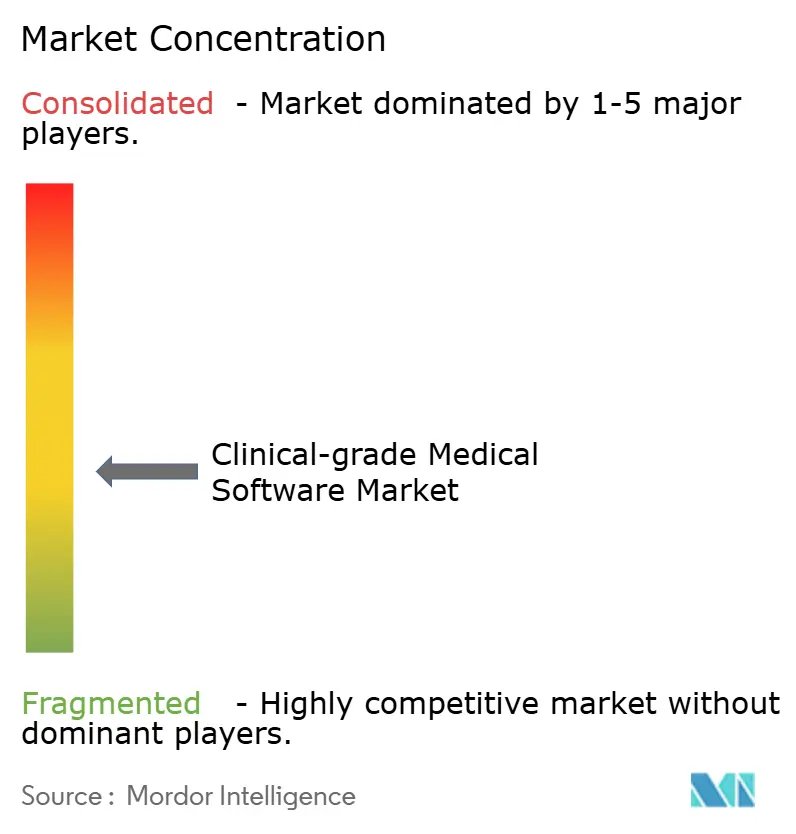
The clinical-grade medical software market is moderately fragmented, as no supplier dominates every clinical function. Epic Systems, Oracle Health, GE HealthCare, and Siemens Healthineers compete through integrated portfolios and established customer relationships. Aidoc, Lunit, and Qure.ai focus on AI applications and clinical specificity. Aidoc stated that its platform was deployed across nearly 2,000 hospitals and had analyzed 120 million patient cases. Buyers evaluate suppliers based on platform breadth, focused clinical capability, integration depth, implementation speed, clinical evidence, and workflow support.
Suppliers are expanding into adjacent workflow categories rather than offering isolated applications. IQVIA launched IQVIA.ai in March 2026 as a unified agentic AI platform built with NVIDIA Nemotron and the NeMo Agent Toolkit. GE HealthCare launched MIM Anyware in July 2026 to provide secure, web-based remote access to its MIM imaging portfolio. InterSystems used its EU MDR Class IIa certification to strengthen its position in regulated European procurement. These developments show how suppliers combine product development, compliance, and deployment flexibility to compete.
Specialist and non-English-language markets create opportunities for companies that adapt products to local care pathways. Regional suppliers compete effectively where language, implementation support, and local protocols are as important as broad product coverage. Large incumbent platforms benefit from installed bases and data integration capabilities, while AI-focused entrants gain traction by offering clear clinical value with minimal deployment disruption. The clinical-grade medical software market will continue to reward suppliers that align technical performance with evidence, local workflow requirements, and resilience.
Clinical-grade Medical Software Industry Leaders
GE HealthCare Technologies Inc.
Koninklijke Philips N.V.
Medtronic plc
Siemens Healthineers AG
Aidoc Medical Ltd.
- *Disclaimer: Major Players sorted in no particular order

Recent Industry Developments
- July 2026: Aidoc received its second FDA Breakthrough Device Designation in under one year for First Read, an AI tool for chest radiograph analysis and preliminary radiology report drafting.
- July 2026: GE HealthCare launched MIM Anyware, a secure web-based remote access platform for its MIM imaging software portfolio, along with FDA-cleared MIM Contour ProtégéAI+ 2.0.
- July 2026: WellSpan Health completed the migration of more than 300 clinical applications and 7.5 petabytes of data, including its full Epic EMR, in 17 weeks.
- July 2026: InterSystems was named a Leader in the Gartner Magic Quadrant for Enterprise EHRs, supported by IntelliCare deployments and new selections across key regions.
- May 2026: InterSystems IntelliCare became the first AI-native EHR to receive EU MDR Class IIa Medical Device Regulation certification.


Global Clinical-grade Medical Software Market Report Scope
As per the scope of the report, clinical-grade medical software is high-precision digital technology built for physician-supervised healthcare environments, meeting strict requirements for safety, validation, and evidence traceability. It typically includes systems like Software as a Medical Device (SaMD), Clinical Decision Support (CDS), and advanced Electronic Health Record (EHR) integrations.
The clinical-grade medical software market is segmented by clinical function, deployment, component, therapeutic area, end user, and geography. By clinical function, the market includes diagnostic software, monitoring software, therapeutic software, disease management software, clinical decision support software, clinical information and documentation software, clinical workflow and communication software, telehealth and virtual care software, medical imaging and visualization software, and others. By deployment, the market is segmented into cloud-based software, on-premise software, and hybrid software. By component, the market is segmented into software and services. By therapeutic area, the market is categorized into oncology, cardiology, neurology, radiology, respiratory diseases, metabolic disorders, infectious diseases, immunology, women’s health, and other therapeutic areas. By end user, the market is segmented into hospitals and health systems, ambulatory surgical centers, diagnostic and imaging centers, home healthcare providers, and others. By geography, the market is analyzed across North America, Europe, Asia-Pacific, the Middle East and Africa, and South America. The report also covers the estimated market sizes and trends for 17 countries across major regions globally. The report offers the market sizes and forecasts in terms of value (USD) for the above segments.
| Diagnostic Software |
| Monitoring Software |
| Therapeutic Software |
| Disease Management Software |
| Clinical Decision Support Software |
| Clinical Information and Documentation Software |
| Clinical Workflow and Communication Software |
| Telehealth and Virtual Care Software |
| Medical Imaging and Visualization Software |
| Others |
| Cloud-Based Software |
| On-Premise Software |
| Hybrid Software |
| Software |
| Services |
| Oncology |
| Cardiology |
| Neurology |
| Radiology |
| Respiratory Diseases |
| Metabolic Disorders |
| Infectious Diseases |
| Immunology |
| Women's Health |
| Other Therapeutic Areas |
| Hospitals and Health Systems |
| Ambulatory Surgical Centers |
| Diagnostic and Imaging Centers |
| Home Healthcare Providers |
| Others |
| North America | United States |
| Canada | |
| Mexico | |
| Europe | Germany |
| United Kingdom | |
| France | |
| Italy | |
| Spain | |
| Rest of Europe | |
| Asia-Pacific | China |
| India | |
| Japan | |
| Australia | |
| South Korea | |
| Rest of Asia-Pacific | |
| Middle East and Africa | GCC |
| South Africa | |
| Rest of Middle East and Africa | |
| South America | Brazil |
| Argentina | |
| Rest of South America |
| By Clinical Function | Diagnostic Software | |
| Monitoring Software | ||
| Therapeutic Software | ||
| Disease Management Software | ||
| Clinical Decision Support Software | ||
| Clinical Information and Documentation Software | ||
| Clinical Workflow and Communication Software | ||
| Telehealth and Virtual Care Software | ||
| Medical Imaging and Visualization Software | ||
| Others | ||
| By Deployment | Cloud-Based Software | |
| On-Premise Software | ||
| Hybrid Software | ||
| By Component | Software | |
| Services | ||
| By Therapeutics Area | Oncology | |
| Cardiology | ||
| Neurology | ||
| Radiology | ||
| Respiratory Diseases | ||
| Metabolic Disorders | ||
| Infectious Diseases | ||
| Immunology | ||
| Women's Health | ||
| Other Therapeutic Areas | ||
| By End User | Hospitals and Health Systems | |
| Ambulatory Surgical Centers | ||
| Diagnostic and Imaging Centers | ||
| Home Healthcare Providers | ||
| Others | ||
| By Geography | North America | United States |
| Canada | ||
| Mexico | ||
| Europe | Germany | |
| United Kingdom | ||
| France | ||
| Italy | ||
| Spain | ||
| Rest of Europe | ||
| Asia-Pacific | China | |
| India | ||
| Japan | ||
| Australia | ||
| South Korea | ||
| Rest of Asia-Pacific | ||
| Middle East and Africa | GCC | |
| South Africa | ||
| Rest of Middle East and Africa | ||
| South America | Brazil | |
| Argentina | ||
| Rest of South America | ||


Key Questions Answered in the Report
What is the projected value of clinical-grade medical software by 2031?
The Clinical-grade medical software market is projected to reach USD 10.20 billion by 2031, from USD 4.24 billion in 2026, at a 19.18% CAGR. The estimate reflects rising use of software in diagnostic work, treatment management, clinical documentation, enterprise imaging, and care coordination.
Which clinical function leads clinical-grade medical software adoption?
Diagnostic Software led with 33.22% share in 2025. Its position reflects established radiology and pathology workflows, where AI triage, image review, and structured clinical data can support specialists managing large volumes of studies.
Which deployment approach is growing fastest?
Hybrid Software is projected to grow at a 22.86% CAGR through 2031. In the Clinical-grade medical software market, hybrid designs allow providers to retain sensitive or time-critical workloads on site while using cloud capacity for analytics, imaging, and related applications.
Why is cardiology a fast-growing application area?
Cardiology is projected to grow at a 22.34% CAGR through 2031 as AI tools support coronary imaging, echocardiography, ECG interpretation, and cardiac MRI. The category also benefits from growing clinical evidence and reimbursement interest in cardiovascular care tools.
What is the main cybersecurity concern for clinical software buyers?
Ransomware and privacy risks can disrupt clinical access. The Clinical-grade medical software market therefore requires suppliers to demonstrate secure infrastructure, clear recovery processes, reliable access controls, and the capacity to restore essential workflows after an incident.
Which buyer group is expanding fastest?
Diagnostic and Imaging Centers are forecast to grow at a 20.45% CAGR through 2031 as outpatient imaging volumes increase. These providers often value AI triage, fast image access, flexible subscription pricing, and tools that improve throughput without equivalent staffing growth. The Clinical-grade medical software market can address these needs with focused deployment models.
Page last updated on:





