
Clinical Decision Support Software Market Size and Share
Market Overview
| Study Period | 2020 - 2031 |
|---|---|
| Market Size (2026) | USD 6.53 Billion |
| Market Size (2031) | USD 11.80 Billion |
| Growth Rate (2026 - 2031) | 12.56 % |
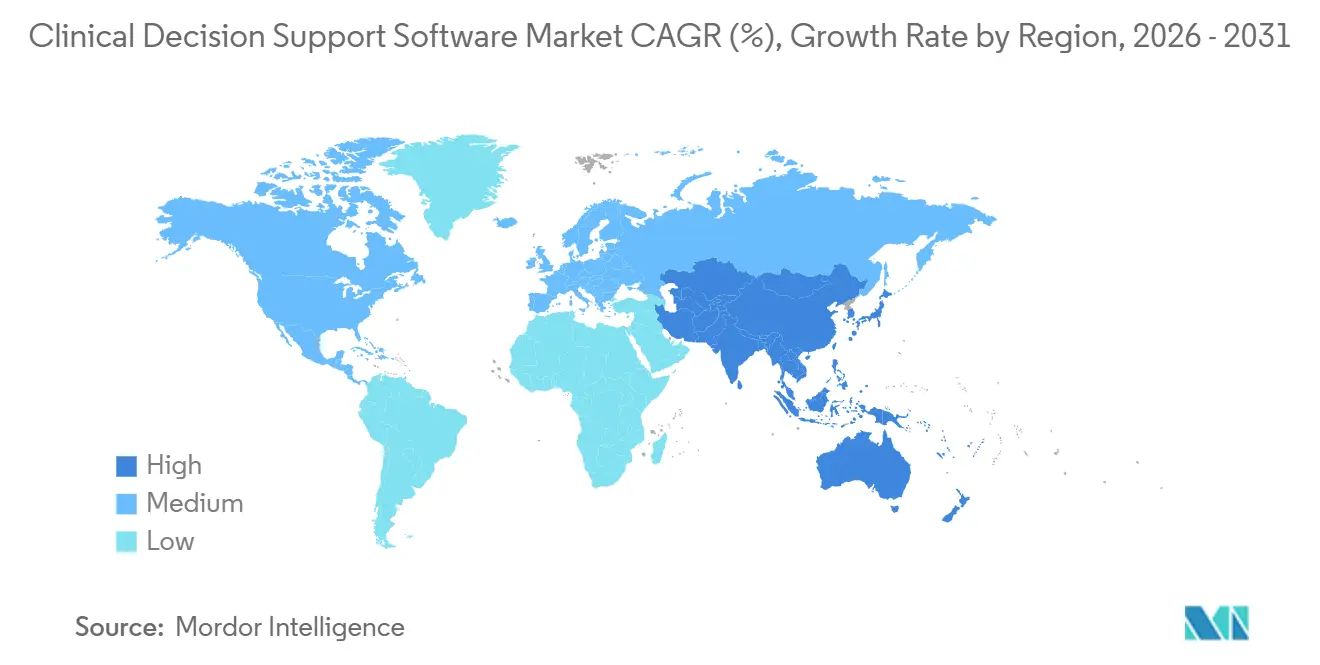
| Fastest Growing Market | Asia-Pacific |
| Largest Market | North America |
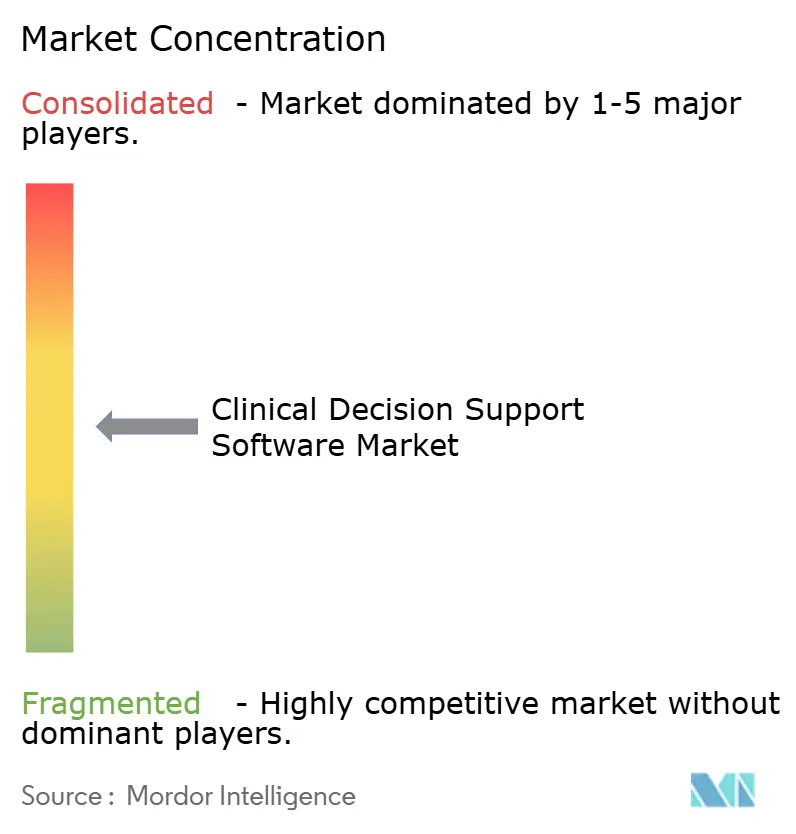
| Market Concentration | Medium |
Major Players *Disclaimer: Major Players sorted in no particular order Image © Mordor Intelligence. Reuse requires attribution under CC BY 4.0. | |
Clinical Decision Support Software Market Analysis by Mordor Intelligence
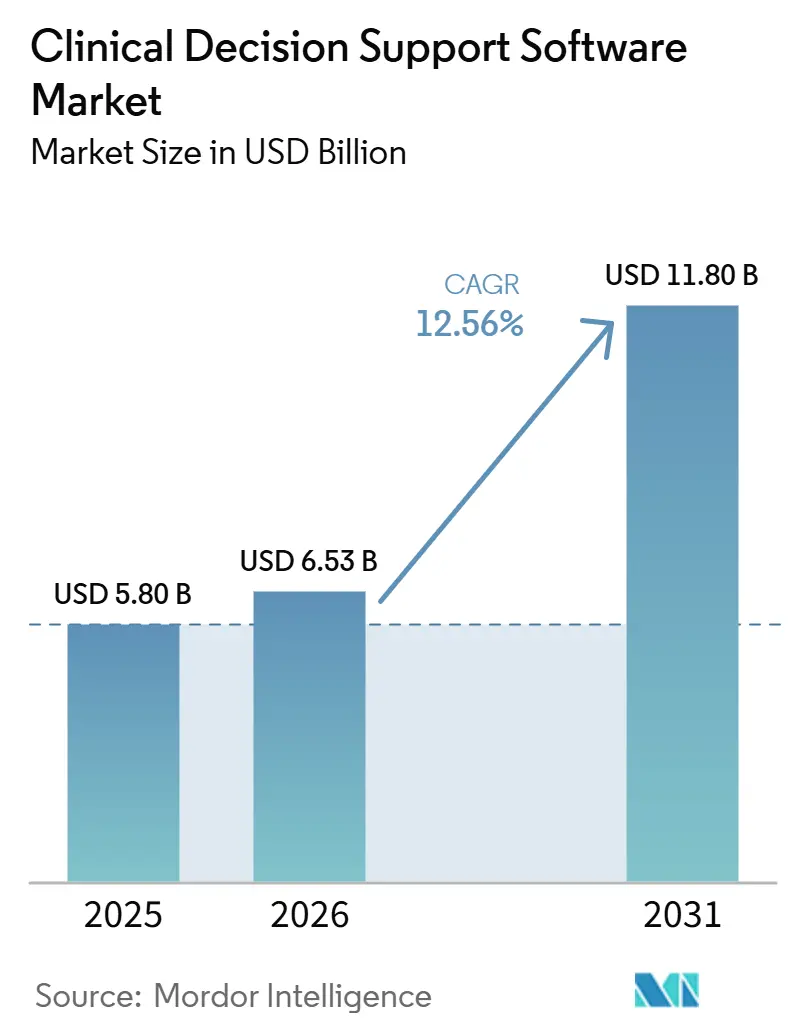
The Clinical Decision Support Software Market size is projected to expand from USD 5.80 billion in 2025 and USD 6.53 billion in 2026 to USD 11.80 billion by 2031, registering a CAGR of 12.56% between 2026 to 2031.
Growth reflects the wider use of electronic health records, tighter interoperability requirements, and a move from rule-based alerts toward patient-specific recommendations. In the United States, value-based care arrangements encourage providers to use decision support that can support quality measurement and documentation. Vendors are responding by linking evidence content, workflow tools, and AI capabilities more closely within clinical systems. The clinical decision support software market is also moving toward solutions that reduce disruption for clinicians and can show measurable safety or workflow benefits.
Key Report Takeaways
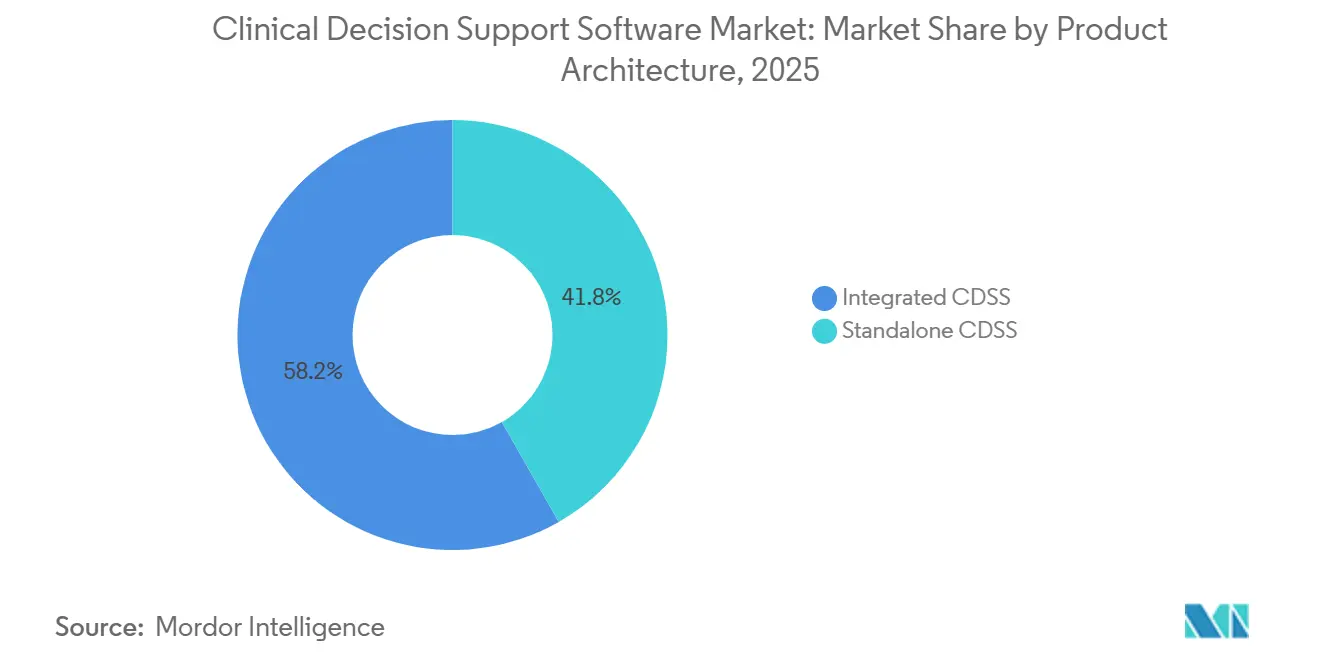
- By product architecture, integrated CDSS held 58.23% of revenue in 2025, while Standalone CDSS is projected to grow at a 15.25% CAGR through 2031.
- By component, Services held 43.64% of revenue in 2025, while software is expected to grow at a 17.67% CAGR through 2031.
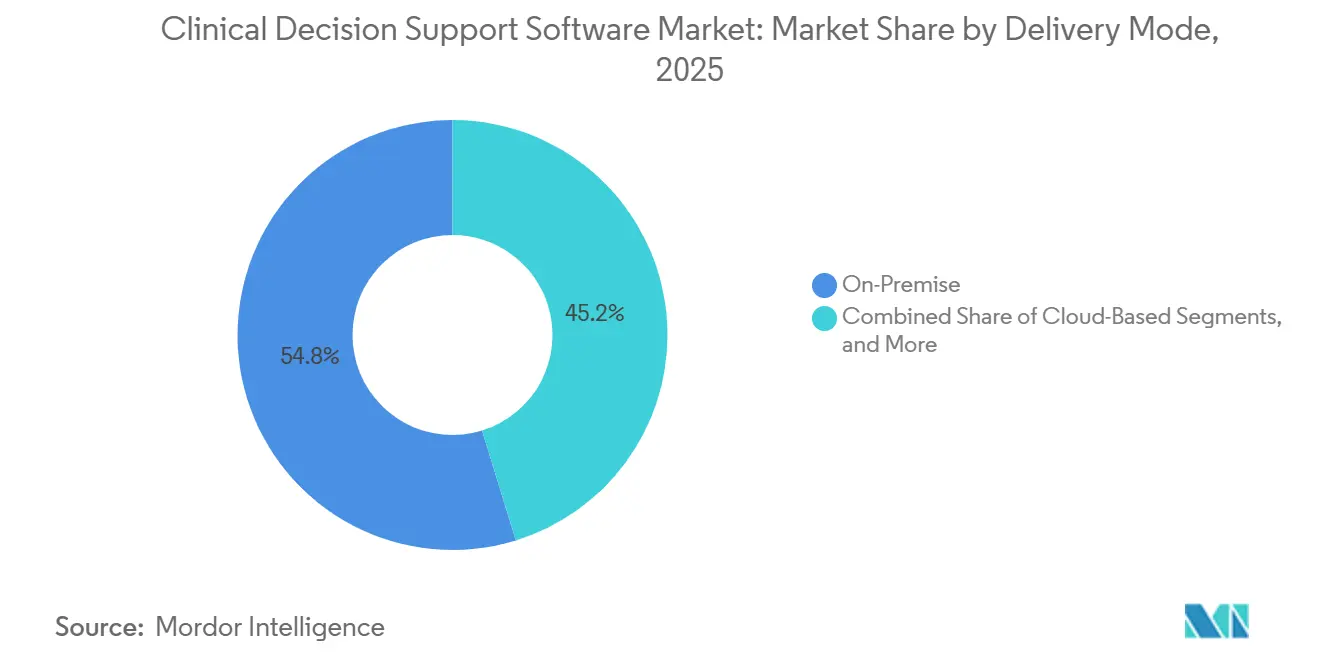
- By delivery mode, on-premise deployments held 54.77% of revenue in 2025, while cloud-based CDSS is projected to grow at a 16.35% CAGR through 2031.
- By clinical function, diagnostic decision support held 32.88% of revenue in 2025, while therapeutic decision support is projected to grow at a 15.45% CAGR through 2031.
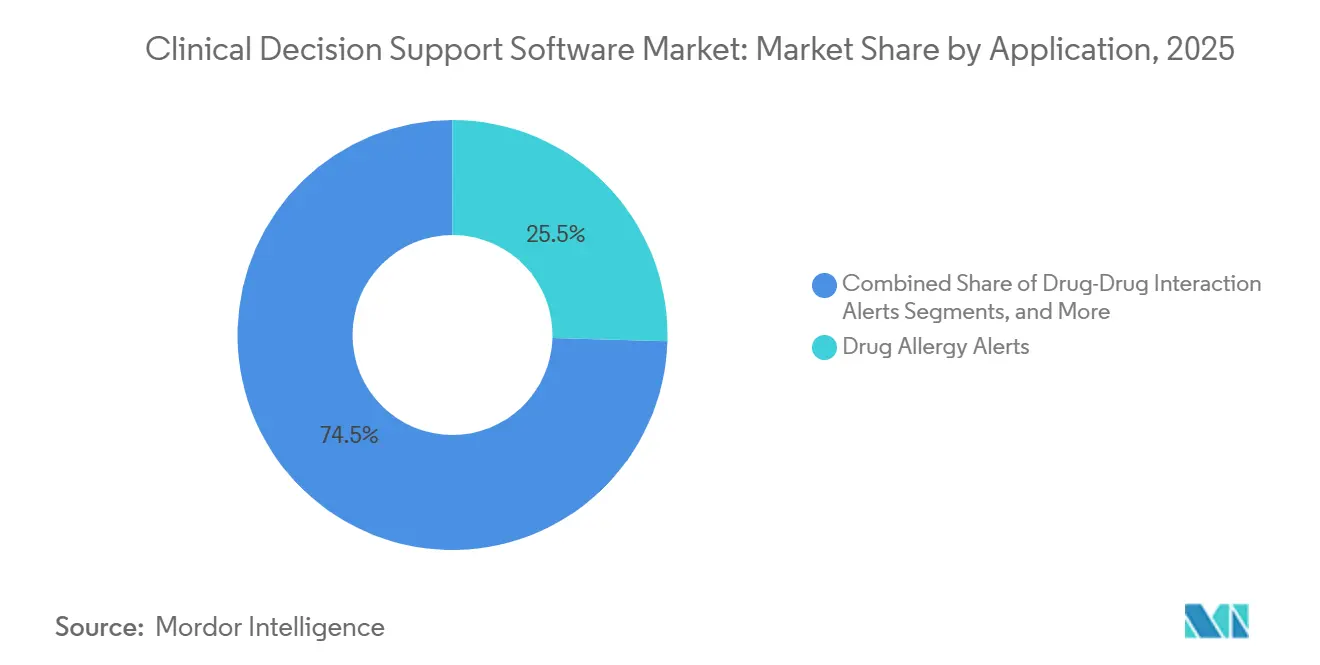
- By application, drug allergy alerts held 25.47% of revenue in 2025, while clinical guidelines and order sets is projected to grow at a 16.22% CAGR through 2031.
- By end user, hospitals and health systems held 56.77% of revenue in 2025, while ambulatory care centers are forecast to grow at a 14.55% CAGR through 2031.
- By geography, North America held 41.45% of revenue in 2025, while Asia-Pacific is projected to grow at an 20.56% CAGR through 2031.
Note: Market size and forecast figures in this report are generated using Mordor Intelligence’s proprietary estimation framework, updated with the latest available data and insights as of January 2026.
Global Clinical Decision Support Software Market Trends and Insights
Drivers Impact Analysis*
| DRIVER | (~) % IMPACT ON CAGR FORECAST | GEOGRAPHIC RELEVANCE | IMPACT TIMELINE |
|---|---|---|---|
| EHR and clinical workflow digitization | +2.8% | Global, strongest in North America and Western Europe | Short term (≤ 2 years) |
| Government certification and interoperability mandates | +1.9% | Primarily North America, with spillover to Europe and Asia-Pacific | Medium term (2-4 years) |
| Medication safety and quality reporting requirements | +1.8% | Global, with early gains in the United States, United Kingdom, Germany, and Australia | Short term (≤ 2 years) |
| Evidence-based and patient-specific care | +1.5% | North America and Europe, with spillover to Asia-Pacific | Medium term (2-4 years) |
| AI-assisted alert optimization | +2.4% | Global, concentrated in the United States, Germany, Japan, and South Korea | Long term (≥ 4 years) |
| Shareable standards-based CDS content | +1.2% | North America, Europe, and core Asia-Pacific markets | Medium term (2-4 years) |
| Source: Mordor Intelligence | |||
EHR and Clinical Workflow Digitization
Electronic health record adoption in the United States and Western Europe has created a replacement cycle for older decision support modules. Health systems are adding AI-enabled tools as earlier modules no longer meet current workflow needs. A 2025 meta-analysis found a 15% reduction in medication errors with electronic decision support, with a relative risk of 0.85 and a 95% confidence interval of 0.70-0.94. Oracle Health made its Clinical AI Agent generally available in March 2026 for U.S. inpatient and emergency department settings. Its earlier deployment at AtlantiCare reduced documentation time by 41%, and the company reported more than 200,000 cumulative hours saved for U.S. providers. The clinical decision support software market favors products that deliver measurable value within existing clinical workflows.
Government Certification and Interoperability Mandates
Regulation is shaping product design and compliance activity in the clinical decision support software market. The Office of the National Coordinator for Health Information Technology published the HTI-4 Final Rule in July 2025, adding an API-based clinical decision support criterion for standardized delivery within electronic health record workflows. The agency estimated that related efficiencies could save USD 19 billion in labor costs over 10 years. The HTI-5 Proposed Rule, published December 29, 2025, proposed AI-enabled interoperability through FHIR application programming interfaces. This direction could favor modular products over closed deployments, while certification and CMS requirements accelerate hospital procurement cycles. European Health Data Space requirements and Indian medical device rules are extending the same demand for interoperable systems.
Rising Medication Safety and Quality-Reporting Requirements
Medication safety remains a key driver for hospital investment in clinical decision support software. A 2026 review reported that computerized provider order entry systems integrated with decision support reduced serious medication errors by 55%-83% in early multisite evaluations and reduced transcription and illegibility errors by 54% in a meta-analysis of 41 studies. A 2025 systematic review of chemotherapy-focused systems found a relative risk of 0.19 for medication errors across 8 studies. Serious adverse event rates after implementation ranged from 0%-20%, compared with 0.8%-36.5% before implementation. However, 82.7% of clinically validated severe alerts at Erlangen University Hospital were not patient-relevant after local customization. Health systems in the clinical decision support software market increasingly require audit trails, override reasons, and reporting functions alongside error reduction.
AI-Assisted Alert Optimization
Alert fatigue is increasing demand for more targeted decision support. Drug-drug interaction alert override rates exceeded 90% in contemporary electronic health record settings. Adaptive systems can assess renal function, allergy history, concurrent medicines, and previous override behavior before issuing an alert. A 2025 BMJ Quality & Safety editorial stated that AI can identify unknown drug interactions, predict hazardous combinations, and prioritize prescription checks using large electronic health record datasets. The editorial also called for sociotechnical validation alongside accuracy measures. Wolters Kluwer launched UpToDate Expert AI in September 2025 and reported deployment at more than 50 major U.S. health systems by the fourth quarter of 2025.
Restraints Impact Analysis*
| RESTRAINT | (~) % IMPACT ON CAGR FORECAST | GEOGRAPHIC RELEVANCE | IMPACT TIMELINE |
|---|---|---|---|
| Alert fatigue and workflow disruption | -2.1% | Global, most acute in high electronic health record penetration markets including the United States, United Kingdom, and Netherlands | Short term (≤ 2 years) |
| High customization and maintenance cost | -1.5% | Global, particularly for mid-sized hospitals and ambulatory care networks | Medium term (2-4 years) |
| Weak patient outcome and ROI evidence | -1.0% | Global, especially where outcome reporting is not mandatory | Medium term (2-4 years) |
| Limited external validation and algorithm trust | -0.8% | Global, concentrated in markets with advanced regulatory oversight | Long term (≥ 4 years) |
| Source: Mordor Intelligence | |||
Alert Fatigue and Workflow Disruption
Alert fatigue weakens the clinical and financial case for decision support investment. A 2025 study found that only 19.6% of alerts with appropriate clinical content were patient-relevant in a locally configured medication system. A quasi-experimental study found that high-severity interruptive alerts reduced potential drug-drug interactions but did not reduce clinically relevant interactions or patient harm. Hospitals assessed alert specificity, override reasons, and post-implementation outcomes more closely, extending implementation and procurement timelines in the clinical decision support software market.
High Customization and Maintenance Cost
Total ownership costs extend beyond software licensing and include clinical informatics labor for configuration, knowledge base maintenance, and override review. Electronic health record upgrades occurred every 6-12 months, requiring fresh testing and validation for connected tools. Many vendor agreements did not cover these responsibilities, creating challenges for mid-sized hospitals and ambulatory networks with limited IT staffing. As a result, the clinical decision support software market favored embedded systems when specialist performance did not justify the added maintenance effort.
*Our forecasts treat driver/restraint impacts as directional, not additive. The impact forecasts reflect baseline growth, mix effects, and variable interactions.
Segment Analysis
By Product Architecture: Integrated Platforms Hold the Installed Base
Integrated CDSS accounted for 58.23% of the clinical decision support software market share in 2025. This position reflected electronic health record contract economics, which made standalone alternatives difficult to justify for hospitals committed to Epic or Oracle Health environments. Integration reduced context switching and kept recommendations within clinicians’ routine workflows. A 2026 systematic review found that Epic’s decision support tools managed records for more than 325 million patients globally, giving integrated products a substantial data and workflow advantage.
Standalone CDSS is forecast to grow at a 15.25% CAGR from 2026 to 2031. It is gaining traction in specialties where bundled electronic health record functions can be less capable, including oncology order management, sepsis prediction, and imaging-linked diagnostic support. Elsevier acquired Wellsheet in June 2026 to combine patient data aggregation with ClinicalKey AI evidence content. Wellsheet was deployed across 139 U.S. hospital sites, while ClinicalKey AI content was used in more than 300 hospitals globally. CDS Hooks is narrowing the line between integrated and standalone offerings by allowing external services to display recommendations inside electronic health record interfaces.



By Component: Software Gains Importance as Services Remain Essential
Services held 43.64% of revenue in 2025. Implementation, customization, and managed-content work remained necessary for large hospital deployments with complex electronic health record environments. Multi-year contracts supported this share of the clinical decision support software market. Services also helped providers tailor alerts, workflows, and content to local clinical practice, especially in systems with older infrastructure or varied departments.
Software is forecast to expand at a 17.67% CAGR from 2026 to 2031. Cloud-native designs can automate updates and reduce dependence on professional services for version management. Wolters Kluwer reported that UpToDate Expert AI reached more than 3 million clinician users after its fourth-quarter 2025 launch. Continuously updated evidence products can support subscription pricing while lowering service intensity, pressuring suppliers that rely heavily on consulting revenue to strengthen AI-enabled subscriptions.
By Delivery Mode: Cloud Adoption Expands Beyond Large Hospitals
On-premise systems accounted for 54.77% of revenue in 2025. This position largely reflected legacy hospital installations in North America and Europe. Many large academic medical centers still preferred on-premise or hybrid configurations because of data residency requirements and complex integrations. Community hospitals and ambulatory networks increasingly selected cloud-based systems to avoid server costs, creating varied deployment needs across provider types.
Cloud-based CDSS is forecast to grow at a 16.35% CAGR from 2026 to 2031. Hybrid configurations offer a middle option by retaining local clinical data management while using cloud-hosted decision logic updates. Cloud platforms can reduce maintenance work by centralizing API contract management with the vendor. The HTI-5 Proposed Rule supports FHIR-based APIs for AI-enabled interoperability, and a common integration layer could reduce customization costs for cloud deployments.
By Clinical Function: Diagnostics Holds Revenue While Therapeutics Advances
Diagnostic decision support held 32.88% of revenue in 2025. Differential diagnosis tools, imaging-linked findings, and laboratory interpretation functions had been part of hospital workflows for many years, supporting a broad installed base in the clinical decision support software market. A 2026 review of Epic tools found that externally validated real-world performance was below vendor-reported benchmarks for several models. The review reported a pooled AUROC of 0.65 for a sepsis model, compared with a vendor-reported range of 0.76-0.83.
Therapeutic decision support is forecast to grow at a 15.45% CAGR from 2026 to 2031. Oncology co-pilots, personalized antibiotic dosing, and chronic disease tools are extending decision support from order checks to treatment pathway design. GE HealthCare had a lead industrial role in the EU-funded COMPASS consortium, a EUR 50.5 million cardio-oncology initiative. The initiative combined real-world data, imaging biomarkers, and wearable data for cancer patients at cardiovascular risk, expanding the clinical decision support software market across more points of the care continuum.
By Application: Drug Allergy Alerts Remain Core, While Order Sets Expand
Drug allergy alerts captured 25.47% of the clinical decision support software market share in 2025. ONC certification requirements for drug allergy checking supported broad deployment across certified electronic health record systems. A Helsinki University Hospital study found acceptance rates of 55%-65% for drug allergy alerts and override rates of 93%-94% for interaction alerts. Drug allergy functions therefore remained more closely aligned with clinical needs than generalized interaction alerts.
Clinical guidelines and order sets are forecast to grow at a 16.22% CAGR from 2026 to 2031. FHIR-based shareable content can help health systems update evidence pathways across many sites without rebuilding each one. HL7 CDS Hooks supports delivery across Epic, Oracle Health, and athenahealth environments in the clinical decision support software market. Drug-drug interaction alerts and dosing adjustments remain important but face stronger alert-fatigue pressure. Medical diagnosis, oncology, cardiology, sepsis prediction, and population health are also developing application areas. A 2026 report stated that sepsis prediction tools reached AUC performance close to 0.94 in oncology intensive care settings.
By End User: Hospitals Lead Adoption While Ambulatory Care Broadens
Hospitals and health systems accounted for 56.77% of revenue in 2025. Their large IT budgets, extensive clinical data, and exposure to high-acuity medication risks supported continued investment. Hospitals increasingly sought explainable AI, auditable recommendation records, and local validation capabilities. These requirements reflected evidence that reported performance could differ from actual deployment results, keeping this end-user group as the central demand base for the clinical decision support software market.
Ambulatory care centers are forecast to grow at a 14.55% CAGR from 2026 to 2031. Cloud delivery is helping decision support reach physician practices, community health centers, and telehealth platforms. Premier acquired IllumiCare in June 2025 for USD 40 million. IllumiCare was deployed across more than 82,000 providers and worked with more than 50 electronic health record systems. Pharmacies, pharmacy benefit managers, specialty clinics, and long-term care providers could benefit as cloud costs fall and configured modules become more available.
Geography Analysis
North America held 39.67% of clinical decision support software market revenue in 2025. The region benefited from high electronic health record adoption, federal certification systems, and value-based care incentives. The HTI-4 Final Rule introduced an API-based clinical decision support criterion in July 2025, and ONC estimated USD 19 billion in cumulative labor savings over 10 years from related efficiencies. Canada advanced its national health data infrastructure through Canada Health Infoway, while Mexico’s IMSS-Bienestar digitalization program began supporting adoption pathways in public hospitals.
Europe followed North America, supported by digital investment in Germany, the United Kingdom, France, and the Nordic countries. The European Health Data Space increased the need for cross-border data exchange standards. Wolters Kluwer renewed UpToDate Enterprise Edition for Norway’s nationwide health system in July 2026, covering more than 50 public hospitals and 11,000 beds. These developments increased demand for interoperable products in the clinical decision support software market.
Asia-Pacific is forecast to grow at a 15.56% CAGR from 2026 to 2031. China’s healthcare digitalization and AI infrastructure investment support adoption in tier-1 and tier-2 cities. India had more than 1 billion health records linked to ABHA accounts as of May 2026. Japan, South Korea, Australia, and New Zealand are also increasing health IT capacity. Wolters Kluwer launched AI-enhanced UpToDate Enterprise Edition for Asia-Pacific in September 2025, while the Middle East, Africa, and South America remain earlier-stage opportunities.

Competitive Landscape
The clinical decision support software market has a moderately competitive structure. Enterprise electronic health record providers control many decision support workflows, with Epic Systems and Oracle Health holding strong installed bases. Specialist vendors compete on evidence depth, AI precision, FHIR interoperability, and clinical specialty coverage. More than 30 vendors compete in the specialist application tier.
Leading suppliers shifted from static content licenses to platforms offering continuously updated evidence, conversational recommendations, adaptive alerts, and predictive analytics. Elsevier’s June 2026 acquisition of Wellsheet combined clinical evidence content with electronic health record data aggregation. Wolters Kluwer partnered with Microsoft in March 2026 to bring UpToDate content into Dragon Copilot, Microsoft 365 Copilot, and Microsoft Teams. These moves extended decision support into communication and documentation workflows.
Opportunities remain in ambulatory tools for independent practices, population health surveillance, equity-aware alerting, and therapeutic support for oncology and rare diseases. These settings often require more specialized capabilities than a general electronic health record module can provide. The clinical decision support software market is moving from interruptive alerts toward context-aware assistance that supports tasks during care delivery, challenging legacy suppliers that rely on high volumes of fixed alerts.
Clinical Decision Support Software Industry Leaders
GE HealthCare Technologies Inc.
Koninklijke Philips N.V.
Siemens Healthineers AG
athenahealth, Inc.
Oracle Corporation
- *Disclaimer: Major Players sorted in no particular order

Recent Industry Developments
- May 2026: Labcorp and Epic expanded their collaboration to offer Labcorp’s full diagnostic test menu through Epic’s Aura platform, enabling test ordering and discrete results within Epic workflows.
- March 2026: Oracle Health made its Clinical AI Agent note-generation capability generally available in the United States for inpatient and emergency department settings, after an ambulatory rollout reduced documentation time by 41% at AtlantiCare.


Global Clinical Decision Support Software Market Report Scope
As per the scope of the report, Clinical Decision Support Software (CDSS) is a health information tool that matches individual patient data with a computer-ized knowledge base to help doctors and nurses make clinical decisions. Key functions include drug alerts, diagnostic suggestions, and care guidelines.
The clinical decision support software market is segmented by product architecture, component, delivery mode, clinical function, application, end user, and geography. By product architecture, the market is segmented into integrated CDSS and standalone CDSS. By component, the market is segmented into software and services. By delivery mode, the market is segmented into on-premises, cloud-based, and hybrid. By clinical function, the market is segmented into diagnostic decision support, therapeutic decision support, medication management, care pathway and guideline management, risk prediction and early warning, and clinical documentation and quality improvement. By application, the market is segmented into drug allergy alerts, drug-drug interaction alerts, dosing and renal adjustment, medical diagnosis, clinical guidelines and order sets, oncology decision support, cardiology decision support, sepsis and deterioration prediction, and population health and preventive care. By end user, the market is segmented into hospitals and health systems, ambulatory care centers, pharmacies and pharmacy benefit managers, specialty clinics, long-term care and post-acute care providers, and others. By geography, the market is analyzed across North America, Europe, Asia-Pacific, the Middle East and Africa, and South America. The report also covers the estimated market sizes and trends for 17 countries across major regions globally. The report offers the market sizes and forecasts in terms of value (USD) for the above segments.
| Integrated CDSS |
| Standalone CDSS |
| Software |
| Services |
| On-Premise |
| Cloud-Based |
| Hybrid |
| Diagnostic Decision Support |
| Therapeutic Decision Support |
| Medication Management |
| Care Pathway and Guideline Management |
| Risk Prediction and Early Warning |
| Clinical Documentation and Quality Improvement |
| Drug Allergy Alerts |
| Drug-Drug Interaction Alerts |
| Dosing and Renal Adjustment |
| Medical Diagnosis |
| Clinical Guidelines and Order Sets |
| Oncology Decision Support |
| Cardiology Decision Support |
| Sepsis and Deterioration Prediction |
| Population Health and Preventive Care |
| Hospitals and Health Systems |
| Ambulatory Care Centers |
| Pharmacies and Pharmacy Benefit Managers |
| Specialty Clinics |
| Long-Term Care and Post-Acute Care Providers |
| Others |
| North America | United States |
| Canada | |
| Mexico | |
| Europe | Germany |
| United Kingdom | |
| France | |
| Italy | |
| Spain | |
| Rest of Europe | |
| Asia-Pacific | China |
| India | |
| Japan | |
| Australia | |
| South Korea | |
| Rest of Asia-Pacific | |
| Middle East and Africa | GCC |
| South Africa | |
| Rest of Middle East and Africa | |
| South America | Brazil |
| Argentina | |
| Rest of South America |
| By Product Architecture | Integrated CDSS | |
| Standalone CDSS | ||
| By Component | Software | |
| Services | ||
| By Delivery Mode | On-Premise | |
| Cloud-Based | ||
| Hybrid | ||
| By Clinical Function | Diagnostic Decision Support | |
| Therapeutic Decision Support | ||
| Medication Management | ||
| Care Pathway and Guideline Management | ||
| Risk Prediction and Early Warning | ||
| Clinical Documentation and Quality Improvement | ||
| By Application | Drug Allergy Alerts | |
| Drug-Drug Interaction Alerts | ||
| Dosing and Renal Adjustment | ||
| Medical Diagnosis | ||
| Clinical Guidelines and Order Sets | ||
| Oncology Decision Support | ||
| Cardiology Decision Support | ||
| Sepsis and Deterioration Prediction | ||
| Population Health and Preventive Care | ||
| By End User | Hospitals and Health Systems | |
| Ambulatory Care Centers | ||
| Pharmacies and Pharmacy Benefit Managers | ||
| Specialty Clinics | ||
| Long-Term Care and Post-Acute Care Providers | ||
| Others | ||
| By Geography | North America | United States |
| Canada | ||
| Mexico | ||
| Europe | Germany | |
| United Kingdom | ||
| France | ||
| Italy | ||
| Spain | ||
| Rest of Europe | ||
| Asia-Pacific | China | |
| India | ||
| Japan | ||
| Australia | ||
| South Korea | ||
| Rest of Asia-Pacific | ||
| Middle East and Africa | GCC | |
| South Africa | ||
| Rest of Middle East and Africa | ||
| South America | Brazil | |
| Argentina | ||
| Rest of South America | ||


Key Questions Answered in the Report
What is the 2026 value of clinical decision support software?
The clinical decision support software market is valued at USD 6.53 billion in 2026 and is forecast to reach USD 11.80 billion by 2031 at a 12.56% CAGR. Growth is supported by electronic health record use, interoperability requirements, and more patient-specific decision support.
Which product architecture leads adoption?
Integrated CDSS led with 58.23% of revenue in 2025 because it is embedded in established electronic health record workflows. Standalone CDSS is growing faster at a 15.25% CAGR through 2031, particularly in specialized clinical uses.
Which component is growing fastest?
Software is forecast to expand at a 17.67% CAGR through 2031 as cloud-native platforms reduce update and maintenance work. Services remained the largest component in 2025 with 43.64% of revenue because implementation and customization are still important.
Why are clinical decision support tools important for medication safety?
Evidence cited in the report linked electronic decision support with a 15% reduction in medication errors compared with standard care. Medication safety requirements also support demand for auditable alerts, override records, and quality reporting.
Which region is growing fastest?
Asia-Pacific is forecast to grow at a 15.56% CAGR from 2026 to 2031, supported by health care digitalization and AI investment. North America led revenue in 2025 with a 39.67% share because of high electronic health record adoption and federal certification systems.
Page last updated on:





